
The ABCs of Grace

“Amazing Grace, how sweet the sound…” Thus starts one of the best-known hymns of the Christian Faith. But, do we sometimes take Grace for granted? I realized the other day that I needed a “refresher course” on Grace. Let’s go back to the ABCs…

A–AMAZING. We sing about it, but are they just words? What is so actually so amazing about Grace? Whole books have been written on the topic (including one by Philip Yancey titled “What’s so Amazing about Grace?”) To answer the question, it helps to define what Grace actually IS. Grace is undeserved or unmerited favor. You cannot “earn” Grace. You cannot buy it. You cannot trade for it. It is a gift given to the undeserving. Something wholesome and blessed that comes unexpectedly. And the amazing part of Grace, as described in the Bible, is that God– the perfect giver of all good gifts– pours out blessings on US. We are not just powerless to earn such blessings, we often scorn or even refuse them; we reject, neglect, abuse, and even destroy God’s greatest gifts. 

We waste our lives in worthless pursuits, we sabotage relationships, we mistreat nature, we laugh at God’s words of wisdom, and we deny God’s loving care– or even His very existence. Yet God still makes the sun to shine, the rain to fall; He gives us breath for our lungs and leads us to food and water and shelter. He gives us eyes to see, hands to work, minds to invent and plan, and access to friends and families where we might find love and acceptance. Instead of being amazed, we are often bitter and ungrateful as we see such gifts being misused or twisted by others like us. We want “more.” We want “different.” We want to manipulate the very gifts God offers us, and then complain when we are not satisfied with the results.

B– Boundless. God’s Grace knows no boundaries. God is gracious toward sinners. He lavishes riches on those who turn around and squander them! God gives good gifts to losers and rebels and lost causes, as well as His beloved children. God’s Grace can surprise us anywhere, any time. We can be in prison, and God’s Grace will still find us. We can be in a war-torn make-shift shelter; God’s Grace can still show up. We can be in the mountains, in the middle of the sea, or lost in the desert. We can be surrounded by noise and filth, or we can be alone in the dark, God’s Grace is there– if we are open to receive it. 

And, having received God’s Grace, we can, through Him, extend the most extraordinary Grace to others. We can forgive those who have wronged us– those who have set themselves up as our enemies, or those who have neglected our rights. NOT because Grace causes us to be wimpy or powerless to seek justice, but because Grace is STRONGER than justice. God’s Grace never comes at the EXPENSE of justice, but it comes because God holds both Justice and Grace in His hands, and He chooses to deal with Justice in His time, not ours. He does the same with Grace– choosing to bless us when we cannot expect to earn it. And we have the power to do the same– to choose blessing over cursing; to choose love and forgiveness over bitterness and revenge.

C–Complete. God’s Grace is sufficient. Period. (see Romans 3:24, 2 Corinthians 9:8, 2 Corinthians 12:9, 2 2 Peter 1:3 We cannot add anything to God’s Grace to make it better or more effective. We cannot hoard God’s Grace for a “rainy day.” We cannot try to compound God’s many blessings into a “super” blessing. And we cannot compare our blessings with those of others. God, in His wisdom, gives us what He determines is best for us. And that includes Grace. He doesn’t give “lesser” Grace to someone who needs is “less” or deserves it “less.” His Grace is always enough. It washes away petty gossip and first degree murder. It renews lives touched by gambling addictions and sexual assault. It mends sibling rivalries and ancient feuds, neighborly spats and international conflicts.

Today, I choose to look for Grace– both in the way God has poured His Grace on me, and in the way He can empower me to show Grace to others. I pray that I will not take God’s Grace for granted in my life, but cherish it, recognize it, be grateful for it, and pass it on. 

And I know I will be AMAZED! I pray you will find Amazing Grace today, as well. It’s really as simple as ABC!

Attitudes of Prayer

One day, a minister arrived later than usual for the mid-week meeting at the church where he served. He heard raised voices, and found that several of his parishioners were arguing about congregational prayer.

Stan said the congregation ought to stand.

Neil thought they should all kneel.

Ima Bower insisted that everyone should bow their heads.

Mr. Folger thought everyone should fold their hands as well.

Ray Sands declared that his hands would be raised toward Heaven during the prayer.

Iris didn’t believe in closing her eyes,

Lydia Schutter disagreed.

Selma wanted to pray scripture.

Rhys thought it would be best to recite The Lord’s Prayer at each service.

Cy Lentz just wanted everyone to pray silently in his/her seat.

Gabby Orson wanted to pray in tongues.

Andy Holder wanted everyone to hold hands when they prayed.

Wanda Singh liked the idea of praying hymn lyrics.

Mary Lee liked that idea, as long as the hymns were upbeat choruses, and not somber old hymns.

Harry and Rush both championed short prayers.

Ruth Lesley insisted that all prayers be formal, written, and submitted to the pastor for approval.

Pastor Ora Freer was dismayed by all the bickering. When the room quieted a bit, he made a suggestion.

“I think we should cancel our midweek service tonight. While I have heard about many “Attitudes” of Prayer here this evening, I don’t think we have the right “Attitude” for prayer together at this time. Perhaps next week, we can talk about which of your methods would please God the most. In the meantime, you may pray at home in any “attitude” you choose.

The next week, only five people showed up for the midweek meeting. But they had one of the most refreshing and productive prayer meetings ever held at that church.

What matters most in prayer is not the attitude of our body, the volume or nature of our words, or the nature of our expression– what matters most is the attitude of our hearts. This is especially true when we gather together. Insisting on one “right” way to pray whenever we meet with others can get in the way of our real purpose, which is to meet with GOD. God wants to hear from us–and He wants to hear us providing support and encouragement to others, even in our pursuit of prayer.

A “Lot” to Learn

I learned a “lot” studying the character of Abraham’s nephew, Lot. (Read Genesis 13, 14, and 19) Today, I want to summarize…

  • Our lives depend on choices, rather than chances…Lot experienced many opportunities and some tragedies beyond his control. But even when God gave Lot some amazing opportunities– even when He offered miraculous rescue–Lot continued to make bad decisions or no decision at all. When have I done the same? Do I wait for chance and circumstance to find me? Do I drift along without making wise choices, allowing life to carry me to my next destination? Or do I seek God–His wisdom, His Word, His provision–and choose to obey Him?
  • Not making a choice IS making a choice…Lot chose to live outside of Sodom– but he ended up in the city. Lot spent much of his time NOT making decisions or plans. He chose inactivity, chose to be vulnerable to attack, chose to live in a city so wicked it was doomed to destruction, chose to compromise and bargain with his wicked neighbors, chose to drag his feet (literally) about leaving, chose to let his daughters control his destiny and legacy. How often do I pray for God to direct my steps and guide my life, and then sit on the couch doing nothing? Lot’s story doesn’t include a single instance of Lot taking initiative. He simple reacts to, takes advantage of, or accepts whatever opportunities or misfortunes befall him. And he doesn’t see his inactivity as a sin or rebellion against God. But he never CHOOSES to follow God; to seek Him or obey him. He assumes that not choosing active rebellion and evil is enough. Have I done the same? Do I think that because I am not actively involved in wickedness that I am honoring God with my inaction and apathy?
  • You cannot live surrounded by evil and not be hurt by it. Ignoring the warning signs, tolerating evil because it becomes familiar, turning a blind eye to the ways others are being hurt–if we are not part of a solution, we are part of the problem. Lot had options– he could have moved away from Sodom; he could have stayed outside the city; he could have spoken up about the evil all around him–he did none of those things. He lived a compromised life; a life in denial. What have I done to flee evil? To speak out against injustice and oppression? To stand up for what is right? When have I winked at evil, or turned a blind eye to wickedness? How often have I sat in uncomfortable silence while someone else suffered? Because “it’s not my problem.” “One voice won’t make a difference.” “It’s just the way they are.” “I don’t want to offend anyone by getting involved. It’s none of my business, anyway.” Lot and his family suffered greatly, even as they tried to “coexist” with their wicked neighbors.

That’s a lot to consider in the life of one man. But more importantly, there are a “lot” of things to learn about the character of God in this story:

  • God sees us. God included Lot in the larger story of Abraham– He gave an orphaned boy a family, a fortune, and a future. Lot had done nothing to “earn” God’s protection or favor. He certainly did nothing to deserve being rescued– twice– and he did nothing to show gratitude for either rescue. But God didn’t make a mistake in showing Lot mercy. God wasn’t surprised by Lot’s life choices– He didn’t “fail” Lot, and He didn’t forget about Him– even after generations.
  • God is a judge. We like to concentrate on God’s mercy and blessings, but God’s goodness requires that sin, wickedness, and evil be punished. God doesn’t delight in punishment, but He will not forget the cries of the oppressed. Those who practice evil and seem to “get away with it” will face judgment. If they do not seek God’s forgiveness, they will be destroyed. The cities of Sodom and Gomorrah were destroyed by supernatural fire; Lot was destroyed by his own fears and compromises.
  • God is merciful. God destroyed Sodom and Gomorrah, but He was willing to save the cities for the sake of as few as ten “righteous” people. We know that “There is no one righteous, not even one..” (Romans 3:10), but God thoughtfully listened to Abraham, and promised to seek for anyone who could be considered worthy of saving. That He saved only Lot and his small family was for Abraham’s sake, not Lot’s– yet save them He did. God doesn’t save the “deserving”– He saves the lost!
  • God’s plans are perfect, detailed, and eternal. God saved the unworthy Lot, and even when his family repaid God’s mercy with incest, violence, and wickedness against Israel, God orchestrated the story of Ruth– a story of love, faithfulness, and redemption pulled from the ashes of this tragic story in Genesis. God has a plan for each of us– He already knows if we will participate eagerly in a story of beauty and blessing, or be dragged through a story of compromise and tragedy. But ultimately, our story will be woven into a tapestry of God’s faithfulness, righteousness, and restoration. How we respond will change our life, and potentially, the lives of generations to come. And God will give us opportunities to choose lives of obedience, wisdom, and faith. No matter if we live in Sodom, or wasted earlier chances, we can choose rescue and redemption because of God’s great love and mercy!

The Bible never records a prayer by Lot– whether he DID pray is a matter of speculation. But it seems clear that Lot did not seek God in any meaningful way– he didn’t obey God, he didn’t honor God, he didn’t walk with God as his uncle did. Abraham’s life wasn’t perfect– he lied about his wife, became impatient for God’s promised son and took matters into his own hands– but Abraham learned from his mistakes. He humbled himself, looked to God for wisdom, and trusted Him for the next step. He honored God, built altars, and called on the Name of the Lord. May we call out to the same God of Abraham for guidance and wisdom today.

Casting Shadows

Today is “Groundhog Day.” Tradition says that on this day, if a large rodent called a groundhog peeks out of its hibernation burrow to see its shadow, there will be six more weeks of winter. For more history about this observation, see https://www.yahoo.com/lifestyle/groundhog-day-five-things-didn-095407401.html?fr=sycsrp_catchall .

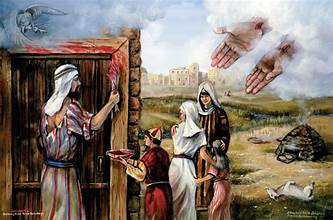
Candlemas, the celebration on which Groundhog Day is founded, is actually the day of the Baby Jesus’ presentation in the Temple (see Luke 2:22-40). Forty days after his birth, every first-born male child in Israel was to be presented at the temple, and a sacrifice was to be made for his redemption. This traces back to the Passover tradition, when the angel of death passed over the houses of the Jewish families who had painted their door frames with blood. Meanwhile, the first born sons (and animals) throughout Egypt were slaughtered. In this way, God showed His Power and His Mercy, leading Israel out of Egypt in triumph, while showing judgment on the Egyptians. (See Exodus 12).

History and tradition cast long shadows. The Jews had been slaves in Egypt for nearly 400 years. A new tradition helped them remember where they had come from and celebrate the promise that God would lead them to their own land. The Jewish people had kept this sacrificial tradition for centuries, reminding them of God’s mercy in saving their sons, and in redeeming them as a people from slavery in Egypt. Christians, realizing that this tradition “foreshadowed” the coming of Christ, adapted it into a new celebration. Christians celebrated Candlemas for centuries, remembering that Jesus was presented as OUR sacrifice, OUR redemption from Death into eternal Life Jesus came to be our Sacrifice, and also our Light. 

But somewhere along the way, pagan beliefs and rituals were woven into the story of this day, until it has become “Groundhog Day.” Instead of the Lamb of God, we celebrate a common rodent. Somewhere in Pennsylvania (Punxsutawney), a small crowd gathers as someone lifts up a frightened groundhog and pronounces a weather prediction (one that is less than 50% accurate!) And everyone is looking for a shadow, instead of celebrating the Light.

The thing about shadows is that you cannot see them when you are looking INTO the light. You have to look away, turn around, look back, to see a shadow. Shadows are cast when something gets between the source of light and a flat surface. History casts shadows. Memories cast shadows. Sin casts a huge shadow. But Jesus is pure light. The Word of Life came to be a “lamp unto (our) feet and a light unto (our) path” (Psalm 119:105 KJV). We are meant to learn from the shadows of the past, but not to walk in them. We are to walk in the light, looking forward to the fulfillment of God’s promises, even as we celebrate the faithfulness of His past actions in the lives of others.

Light casts no shadow. But it banishes the darkness where shadows live. Our choices have consequences. We can turn away from the light, or step in opposition to the light, and cast shadows that may follow for generations–cycles of abuse, isolation, hatred, anger, or regrets. Or we can choose to follow the light, and banish the shadows of the past– bringing peace, repentance, reconciliation, and hope.

Heavenly Father, today, I pray that I will be a reflection of Your light in the world; that my actions would help banish shadows of doubt and despair, and shine with Your truth and hope for others to see. Where there are shadows in my life from the past, may I learn from them and leave them behind as I follow you more closely. Where I have cast shadows in the lives of others, help me to bring light and healing in Your name. Amen.

Prayers That God Will Not Hear

We like to point out scripture that assures us that God will hear (and answer) our prayers. We like to remember God’s promises of blessing and peace and grace. And we tend to ignore or forget that there are some prayers that God has said He will not hear or answer.

God will not answer prayers that are selfish, or hypocritical. He will not answer prayers offered in pride, self-righteousness, or unbelief (see Luke 18:9-14, and Hebrews 11:6). He will not listen to prayers offered by those who oppress the poor, those who worship idols, or those who practice violence. And He will not listen to the prayers of those who reject Him, and remain in sin. https://www.gty.org/library/questions/QA160/does-god-answer-the-prayers-of-unbelievers (Please note: I don’t totally agree with the general conclusion here, but there are several great references for the individual points..)

Please note that God does not say that He will not answer prayer based on WHO a person is–God does not refuse to answer prayers based on a person’s age, nationality, gender, physical health, mental health, height, weight, social status, or any other label, including their past religious affiliation! This means that a sincere prayer of a person who is seeking God may be heard ahead of (or instead of) a prideful prayer of someone who claims to be a Christ-follower.

God is sovereign and omniscient– He knows what is in each heart, and He answers, not according to who we are, but according to who HE is. And just as He can separate our sins “as far as the east is from the west” (Psalm 103:12), and “remember (our) sins no more”(Hebrews 8:12), He can choose not to hear prayers that are offered with wrong motives or offered in defiance of His sovereignty and holiness.

None of this takes away from the fact that God DOES hear and answer prayer…God LOVES to hear from anyone and everyone who seeks His face. Nothing external can separate you from His love. Come with your anger, questions, sorrows, pains, gratitude, hope; bring your failures, your fears, and your triumphs. But God, like a wise father, doesn’t suffer fools and fakers. Even if you can fool your neighbors, friends, family, or yourself, you cannot fool God. He doesn’t want a false narrative– He wants you as you really are. He wants you to acknowledge who He REALLY is. And He will listen with an everlasting love and compassion to all such prayers!

But I’m Right!

Social media is a dangerous place these days. Everyone is an expert on something– pain, medicine, race relations, politics, religion…
I’m an expert, too. I am an expert in my own opinion! I know all I ever need to know about how I feel, what I’ve experienced, how I would solve all the world’s problems, and what everyone else should know, do, and think.

And when I pray, I am an expert in what I want, and what God should do–right?

Turns out, the Bible disagrees with me. Prayer is not about telling God what I think He should do. And one of the things He doesn’t want me to do is go about telling everyone how much I know and how right I am about everything.

I know– it flies in the face of common thought and practice. But my words are not to be about how good I am, how smart I am, how righteous I am, how “woke” I am, or how tolerant I am. My words shouldn’t be all about ME. When I do speak (or write), it should be for one of four reasons:

  • To praise– to bring honor and glory to God for who He is and all that He has done. To rehearse and proclaim His good deeds and righteous acts so that others may hear and praise Him, too.
  • To encourage, build up, edify, or heal others. Words have the power to bring hope, energy, confidence, light, and love. They also have the power to destroy, devalue, and discourage. Finally, words have the power to suck energy, waste time, and bring confusion and chaos. When I speak carelessly, selfishly, or foolishly, it does nothing to build up others. (And it probably doesn’t do me much good, either!)
  • To speak truth and stand up for righteousness–not in an arrogant way, and not to win “points”, but to honestly and firmly defend what I know to be true. I must realize that there will be others who will stand in opposition to the truth and refuse to hear what I say. Others will misconstrue and misrepresent the truth. It is NOT for me to make them believe– only to stand up and give voice to the truth when I see it under attack.
  • To express unique and creative thoughts, which is part of praising my maker. Everyone has SOMETHING to say– something that expresses their inner thoughts and unique perspectives. That should cause me to take great joy. And it should cause me to take the same joy in helping others find their voice and share their stories and ideas. Not because I’m “right” about the world, or because they are “right” in their ideas. But because God gave each of us a voice. I can listen and not agree; they can do the same. But sometimes, in the act of listening, we do more to come to understanding and agreement than we ever do by speaking. And in being allowed to speak freely, we might listen to ourselves more carefully, too.

Jesus spoke wonderful parables, deep and thoughtful prayers, piercing sermons, and tender words of encouragement and love. But He also listened–not only to the critics and enemies, but to those who hid in the shadows; those who were outcast and oppressed; those whose voices were drowned out by the crowds. He was RIGHT! More than anyone ever, He had the right to be heard…He chose to listen as well as speak. Jesus was more interested in being Himself than being “right.” More interested in showing love than showing off. More interested in understanding than overpowering. Jesus spoke–but He also laughed, and wept, and lived, and listened.

May we do the same today.

In One Accord

I heard a riddle a few years ago, that went something like this: ”What kind of car would Jesus drive? A Honda–it says in the Bible that Jesus and his disciples were all in one Accord!”

While that pun may raise some groans, it also hints at a valid principle. Those who follow Christ should be “in one accord.” Whether we are riding together in a car, or sitting together in a service, or serving together on the mission field, we should be of one mind. But what does that actually mean in a practical sense? How does it relate to a pursuit of prayer?

To be “in accord” is to be unified, in agreement, in consensus, in harmony, with all the others of a group. It is the act of blending together for a single purpose– to match up with others in a single focus–to unite in one glorious expression. Think of a harmonic musical chord– three or more single notes being played together to make a fuller, richer, more complete burst of sound. The notes must act together– they must be in harmony within the scale, and they must be played at the same time. There is even such a concept in music of “resolving” a chord– first playing a chord in a minor key, then changing one or more of the notes to form a similar chord in a major key. The human ear is drawn to chords that “resolve”– music that ends on a “positive note.”

In human relationships, we also like resolution and harmony. As Christians, we are strongly encouraged to live in harmony and unity, living for others, so that we may “glorify the God and Father of our Lord Jesus Christ with one mind and one voice.” (Romans 15:6 CSB) We are not to insist on having things “our way,” to resist those who offer Godly correction, or to be part of creating divisions. Instead, we are to refrain from selfish ambition, to remain faithful to Christ’s teachings, and to “resolve” conflict whenever possible.

Likewise in prayer. We should echo the prayers of others, as we seek God’s will to triumph over situations and circumstances. That doesn’t mean that we all have to intone the same rote words whenever we are together. But it does mean that we should support each other in prayer, just as we would in speaking to each other and about each other.

And that involves seriously evaluating how we speak and act and think about our fellow Christians. If we gossip or spread complaints about our Brothers and Sisters in Christ, we are NOT in accord, and our prayers cannot be in harmony with theirs. If we are waiting for others to see things “our way,” we should be very careful about how we pray– it may be that WE are the ones who need to reconsider, or it may be that we need to listen before we presume to judge. Being “in one accord” involves humility, kindness, gentleness, and a willingness to accept (and sometimes to give) difficult Godly correction. The goal is not for others to see things “my way,” but for all of us to see things God’s way!

And when that happens, our prayers will be like a symphony, built of gloriously harmonious chords. Just imagine how delightful it is to pray “in one accord,” knowing that our prayers not only reach heaven, but fill it with music!

For more information on this concept, check out https://www.gotquestions.org/in-one-accord.html .

Salt of the Earth

The other day, as I was doing a Bible study on the Women of the Bible (Spangler and Syswerda, Zondervan Press, 2007), I was reading about Lot’s wife. The story is found in Genesis 19. Lot and his family were living in the wicked city of Sodom, which the Lord was getting ready to destroy. Abraham, knowing his nephew and family could face destruction, had pleaded with the Lord. God had promised that if He found even 10 righteous people in the city, He would not destroy it. But the men of the city came in a mob and tried to rape the angels of God. Only Lot tried to prevent this crime, and even offered his daughters as a substitute for the angels! No other righteous people were found. The doom of Sodom was at hand.

The Angels led Lot, his wife, and his two daughters out of the city toward the small town of Zoar. In fact, they had to take them by the hands and physically drag them away from the coming disaster. They warned the entire family to flee– take nothing with them, and don’t look back! But Lot’s wife did look back, and she was turned into a pillar of salt. In one split-second of weakness, she lost her life and her future, and left her family to unravel (see later chapters in Genesis).

I remember hearing this story as a child, and one question has always nagged at me. Why a pillar of salt?

Have you ever wondered about it? What is it about the destruction of Sodom and Gomorrah that would cause anyone to become a pillar of salt? God never does anything without a reason or a lesson to learn. So what can we learn from this?

Interestingly, the authors of the Bible study spent an entire lesson on “Salt.” They told of its importance in the Ancient World, its abundance in the Middle East, and how Jesus spoke of His disciples being the “Salt of the Earth.” (see Matthew 5:13). We are commanded to have qualities similar to salt– to cleanse, purify, and season the world around us. 

And then, yesterday, we experienced some freakish winter weather. It rained. And it sleeted. And it rained some more. And the temperature hovered just at the freezing point, causing a layer of ice to form over the roads, sidewalks, trees, power lines, cars, etc. Ice was everywhere, and I was out spreading –you guessed it– salt. Salt melts the ice that covers walkways and roads, making it safer to walk or drive.

But here’s the thing about salt. It only works when it is spread around and used. It does no good to put a pillar of salt in the middle of a highway, or on the kitchen table. A pillar of salt can make an interesting decoration, but it’s real worth is in its usefulness, and in its interaction with other elements. We don’t eat salt by itself. We use it to flavor other foods– we sprinkle it, we rub it in, we dissolve it– we don’t appreciate salt unless it works WITH something else. We use it WITH ice, to melt it off of the sidewalk. We use it ON raw meat to cure it and preserve it. We use it IN water to clean or soften items.

Lot’s wife was a pillar of salt. She had worth and value; she had a family that was being preserved to be a witness of God’s Grace and Redemption. But she turned away from God’s protection and His provision. Her value was trapped by her moment of rebellion, or curiosity– whatever caused her to look back.

How are we being salt in the world today? Are we being used to season the world around us? To help spread health, and purity, and life? Are we helping to melt icy hearts and soften hard hearts we meet? Are we willing to be spilled and spread and rubbed in to situations not of our choosing? Or are we standing as pillars of useless potential?

I pray that I will learn from the story of Lot’s wife. A new lesson. A new sense of purpose today. I hope you will be encouraged, as well. Let’s go out and “shake” things up in our world today!

A Bulwark Never Failing…

“A Mighty Fortress is our God; a bulwark, never failing..”
These words are known and sung (in various translations and languages) around the world. But Martin Luther wrote this song over four hundred years ago. What relevance can these words have in an age of nuclear bombs and globalized economies and climate change? What do they mean to us today?

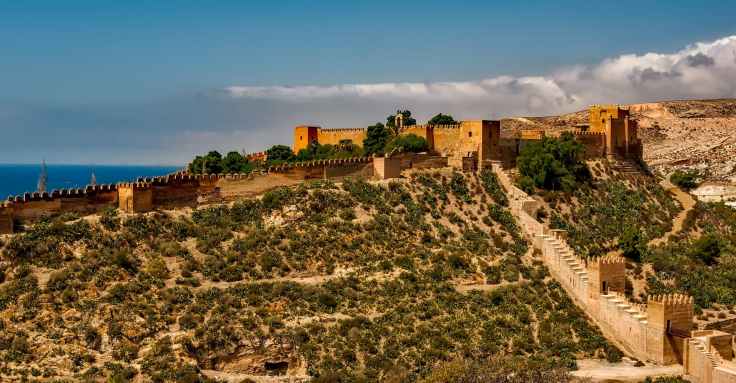
I don’t live in a nation of many castles. There are two stone “mansions” in the small town where I live. They seem tiny compared to mansions in other parts of the U.S. and the world. And we have a small armory; home to a National Guard outpost. But a mansion (or even an armory) is not the same as a castle or a fortress. Mansions are built to be impressive; armories are built to be immediately prepared for disasters or attacks; castles are built to be impregnable and permanent. Our God is not just a fortress; one outpost among many mighty gods– He is The Mighty One–uniquely sovereign, eternally victorious, and perfectly protecting all within His power.

And this protection doesn’t depend on my might or fighting ability, or my weapons or strategies. It depends on my being inside the fortress, safe and sound. The war rages all around, but it cannot defeat me, so long as I am in the fortress.

There are mighty castles, forts, towers, citadels, and walls around the world– all built by people and victims of the ravages of war, time, weather, fire, bad management, etc. Over the years, types of fortresses have given way to new weapons designed to bring them down. Wooden forts are susceptible to fire; stone castles can be brought down by catapults, battering rams, and bombs. Underground bunkers can even be ruined by earthquakes or nuclear assault. And yet, we are still amazed at the power and legacy they represent. Many have stood for hundreds or even thousands of years. But God is eternal; His might and protection will never fail. No weapon forged or imagined can triumph over His power and sovereignty.

Prayer brings us into the safe and powerful presence of God Almighty. There is nothing of our worries, our guilt, our doubts, or the accusations of the enemy that can shake the foundations of God’s fortress. And the cornerstone is none other than Jesus Christ– unshakable, victorious, and eternally one with the Father and the Spirit.

That doesn’t mean that we won’t ever find ourselves in battle, trusting in God’s armor against the arrows of the enemy. But the war is already won– His Kingdom is forever! And ever!

A Walk Around the Block

I keep a prayer journal. I’ve written about it several times on this blog. I keep track of people and places to pray about every day of the year. But I also have a tool I call “Prayer Points.” Each day of the week, I like to focus on a different aspect of life around me. One day a week, I focus on family matters. Another day, I focus on finances. Yet another day is all about cultural influences. And one day is for community. When the weather allows, I love to take walks around my neighborhood. And as I walk, I think about how I can pray for my community. I pray for the local churches (including, but not limited to my home church). I pray for the local schools, our local community college, and our local day care facilities, and their influence over our children and grandchildren. I pray for our local businesses– the grocery stores, the insurance reps, the chiropractor’s office down the street, the local bakery, the museum across the tracks (the train station, while I’m at it). I pray for houses, parks, families and pets, trees and roads, too! I am amazed at how much I notice on my walks as I am thinking of ways to pray.

It’s winter in our area right now, so I can’t physically take a walk around the block without bundling up. But I can walk the perimeter of my small shop and mentally take a walk around the neighborhood, praying as I pace back and forth. I did this the other day, and couldn’t believe how quickly the time had passed! And next week, I can take another “walk” as I pray for gas stations, fast-food restaurants (as well as the local diners and bistros), the library, the post office, the hospital….

I post this, not as a model for everyone who reads this. Some people live in remote areas– where I grew up, there were only about seven houses and four fields on “my block”! And it may not be possible, or even safe to walk around your neighborhood praying for specific buildings. But mentally, we can each consider how to pray for “our” neighborhood. It may be your neighborhood at work, or on your commute, or at school. It may be the neighborhood of your closest village or your apartment complex or cul-de-sac. You may wish to draw a map to remind you to pray for those around you. You may be able to drive around periodically. You may wish to list your closest neighbors in a journal or planner.

It’s important for our prayers to be inclusive–to reach out and carry burdens for those around us. That doesn’t mean ignoring our own needs or concerns. But it can help put those needs in perspective. We are not meant to “do life” alone. We are part of our communities, whether we acknowledge it or not; whether we participate in community life or not. And that should find reflection in our pursuit of prayer.

Have you taken a walk around the block lately? Have you noticed situations around you that call for praise or petition? What are some of the ways you see God working in your neighborhood? How would you like to see more of God’s hand at work there? In what ways might God be calling you to become more involved in community activities or one-on-one with your neighbors?

Blog at WordPress.com.

Up ↑