I am passionate about pursuing a relationship with Jesus Christ. To that end, I want to share my journey in learning more about prayer. I am a former teacher and librarian. I love to read, write, share awful puns with friends, and share the joy that comes from trusting my loving Savior.
Genesis 22:10-14 Common English Bible (CEB) 10 Then Abraham stretched out his hand and took the knife to kill his son as a sacrifice. 11 But the Lord’s messenger called out to Abraham from heaven, “Abraham? Abraham?” Abraham said, “I’m here.” 12 The messenger said, “Don’t stretch out your hand against the young man, and don’t do anything to him. I now know that you revere God and didn’t hold back your son, your only son, from me.” 13 Abraham looked up and saw a single ram caught by its horns in the dense underbrush. Abraham went over, took the ram, and offered it as an entirely burned offering instead of his son. 14 Abraham named that place “the Lord sees.” That is the reason people today say, “On this mountain the Lord is seen.”
Where to we look when we’re in trouble or need answers? I worked for many years in libraries– we “looked up” all kinds of answers for people. We looked in dictionaries, thumbed through heavy reference books, and scrolled through many websites. But even though we called it “looking up”, we spent most of our time looking down!
Many people spend hours looking down at phone screens all day, or looking ahead as they drive down the road. Very few of us spend time looking up to see the clouds, the sunset, the towering buildings or trees on the horizon. And we spend too little time “looking up” to see how God is working in, around, or through our circumstances.
Abraham set off with his son, Isaac, to make a sacrifice. He had made provisions– he brought enough food for three days’ journey (and three days back!). He brought wood, and even fire. But God had asked him to “offer” Isaac as a sacrifice, so he took no ram–but he brought a knife. God’s instructions were ambiguous–He did not tell Abraham that he must kill his son, Isaac, only that he was to take him up the mountain and “offer” him.
The writer of the book of Hebrews references this event:
Hebrews 11:17-19 New International Version (NIV) 17 By faith Abraham, when God tested him, offered Isaac as a sacrifice. He who had embraced the promises was about to sacrifice his one and only son, 18 even though God had said to him, “It is through Isaac that your offspring will be reckoned.”[a]19 Abraham reasoned that God could even raise the dead, and so in a manner of speaking he did receive Isaac back from death. Footnotes: Hebrews 11:18 Gen. 21:12
Abraham had looked up at the mountain; he had “looked up” how many provisions to take along; but at the crucial moment, when he looked up, he finally saw God’s provision. It was never God’s intention that Abraham actually kill his beloved son. It was God’s intention that Abraham (and Isaac) listen and act in faith. And so they did. The ram was already there– waiting for Abraham to look up!
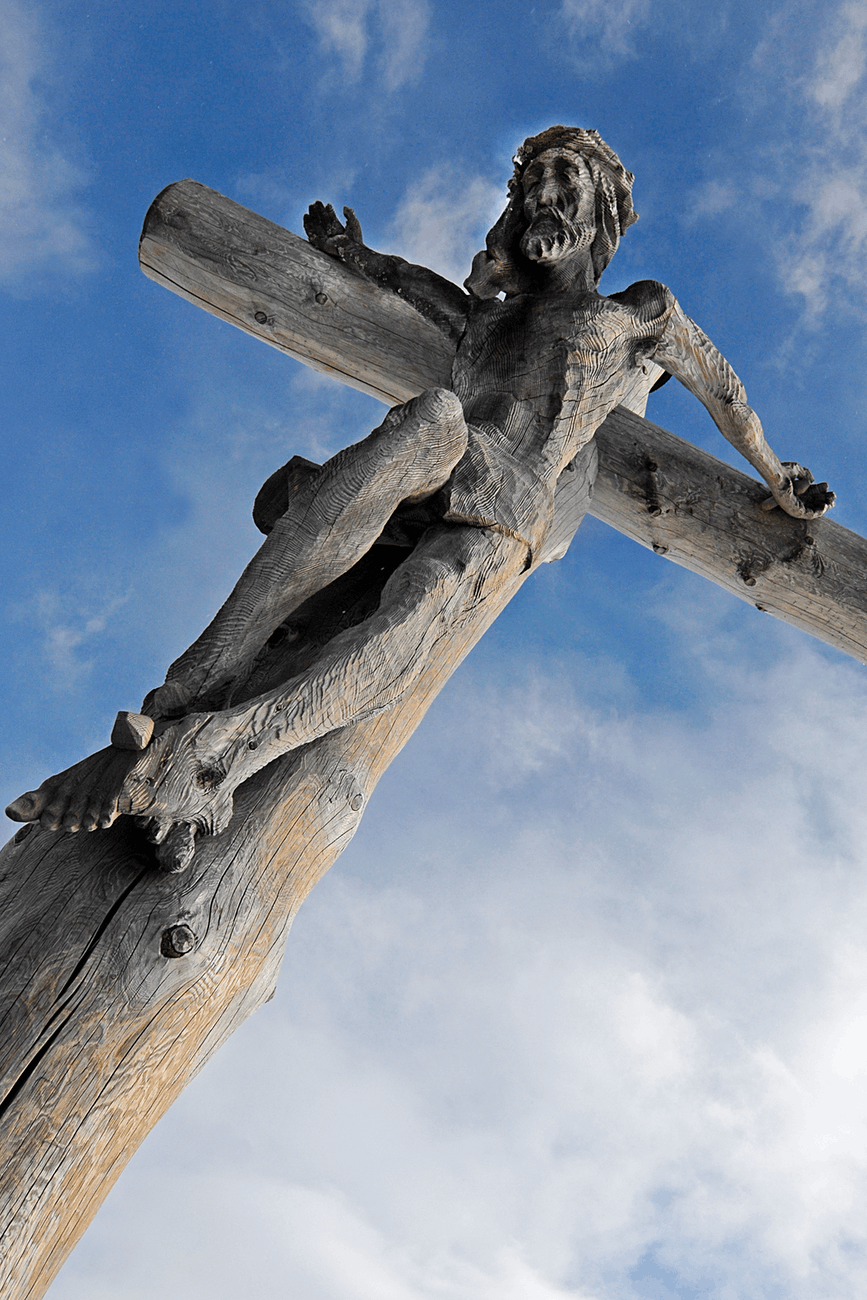
Later, when the Israelites (Abraham’s descendents!) were wandering in the wilderness, they were faced with many trials. God sent pillars of cloud and fire to lead the people as they “looked up” and followed them. When snakes came into the camp, God had Moses make a pole with a brass snake at the top. Anyone suffering from a snake bite could “look up” at the pole and be cured. Jesus referred to this story as an illustration of us own crucifixion–saying that in just the same way, he would be “lifted up.” Those who “look up” in faith to the crucified and resurrected Jesus can be cured of their sin, and given new life! https://www.christianity.com/jesus/is-jesus-god/old-testament-prophecies/jesus-is-like-the-bronze-serpent-moses-lifted-up.html
On Monday night, several strong storms moved through our area. There were also severe storms in other places, like Mexico City, and around Manila– high winds, heavy rains, hail, and flash flooding. Our town did not see much damage, but some nearby towns had many trees down and power outages, followed by near record-high heat.
Often when storms come, we question– “Where is God?” Doesn’t He see our suffering? Why does He allow it? We look for evidence of God’s goodness in spite of the storms in our life. We may even look for evidence of God’s goodness in the aftermath of a storm– “Well, it could’ve been worse..” But in the past couple days, I have seen evidence of people finding God IN the storm. At least a couple of friends were watching the storm approach and/or pass by, and they were able to capture a picture showing lightning striking through a rainbow!! Others have pictures of a glorious red sunset. Both pictures remind us of God’s faithfulness and His promises. God never promised that we would never see storms, but His rainbow reminds us that He will have mercy. A red sunset also speaks to sailors and farmers of better weather to come with a new dawn. God is not absent, waiting to speak after the storm is past. He is right there in the middle of the storm for those who are looking.
Another thing I noticed is that several people have become evidence of God’s care in, through, and in the aftermath of the storms. Several people have volunteered to help clean up downed trees, or offered to provide food and water, or even (air-conditioned) shelter for those without power. Many such people have suffered some damage themselves. But their hearts are open to help their neighbors in their time of need.
I don’t recommend that we put ourselves in grave peril to see signs in the raging storms, nor am I trying to shame those who cannot volunteer to help in times of crisis. When storms come, it is wise to take shelter and TRUST that God sees us, knows our greatest needs, and will not leave us without hope. But it is also a great time to look for ways we can both SEE God and SERVE others.
Praying can help us in both ways. We should seek to praise God at all times–even in times of storms and trials. Instead of focusing only on the problems we face, we can be reminded of all the times God has been faithful in the past and remember all the promises He has kept! Instead of focusing on our own losses or pains, we can focus on praying for the needs of others and praying for wisdom in how to be helpful and encouraging. Because God is with us. Always!
The same mighty power that brings the storm is available to withstand it. God IS present IN the storm, just as He is present before and after. Sometimes, we ignore Him during times of ease and comfort. Sometimes we miss His voice in the raging wind and pounding hail. Sometimes, like Jesus’ disciples, we forget that God controls the winds and waves, and we let fear get the better of us for awhile. We wonder if God is “asleep on the job.” (See Mark 4:35-40) But a single word is enough to calm whatever storm is raging around us.
What a powerful God! What an encouraging reminder.
Tomorrow is Flag Day in the United States– a day in which we honor our nation’s flag and all for which it stands. It is an odd holiday in a sense; most countries have a national day of celebration, but not a whole day just to celebrate their flag. We already have an day to celebrate our Independence, and days to honor the sacrifices of soldiers or the dates of famous military victories in our history. Why should we spend a day honoring our flag. Isn’t that arrogant? Isn’t it taking nationalism a bit too far?
Flags and banners are important to us. They are a visual representation of an idea or a series of ideas–“America,” perhaps, but also, “Freedom,” “Loyalty,” “Sacrifice,” “Honor,” “Bravery,” etc. We have national flags, state flags, organizational flags, family crests, even sports team flags and mascots. Flags can be used to rally troupes and inspire citizens, signify commitment to a cause or nationality, show pride or loyalty, and represent ideals held by those in a group. Colors, shapes, stripes, animals or plants, stars, shields, letters or single words– all represent something important or noble to those who see them on a flag or banner. And there is no real point to having a flag if you are never going to display it or let it fly high for all to see.
In the Song of Solomon (Song of Songs) the bride tells that her lover has brought her to a house of feasting, and that “his banner over me is love.” (Song of Solomon 2:4) The Song is an allegory that can be seen as Christ and His Church. Christ also has a banner–and it is Love–not the romantic love of the Song, but everlasting and limitless love! His Love rallies us, unites us, inspires us, and leads us. When we look for a symbol of who Christ is (and what the Church should be) we use a flag of white with a cross symbol in red on a blue (or sometimes purple) background for the corner. The white represents Christ’s purity, and the pure white robes that will be given to His saints. The blue/purple represents Christ’s majesty and authority. The red of the cross is a reminder of the blood He shed on Calvary’s cross.
Banners and flags are important. But we don’t need a flag or banner to represent Christ’s love– WE are to be His banner for the world. The world should be able to look at us and see a reflection of the limitless and unconditional Love of Christ in the way we speak and interact with others, and the way we live our lives.
Today (and tomorrow) when we happen to see a flag, let us remember that we are Christ’s ambassadors– we do more than just absorb God’s love– we are to reflect it, and be living symbols of God’s great love for the World. We should be visible testimonies that God’s love is all-important, and available to all! May that be more than just a prayer– may it be our earnest pursuit every day.
When do you pray each day? Do you have a time set aside in the morning and/or evening? Do you say grace at meal time? Do you stop during the day to pray for a certain period of time? Do you wait for “the right moment?” Do you miss precious time spent in prayer?
Most of us have a “regular” prayer time– even if it’s just a short burst of prayer in the morning or tucked into the period just after Bible study, or even a quick “Thank you” at meal times. But, for some reason, it often feels like we’re praying on “borrowed” time– time when we are planning to do other things, but a situation or feeling overwhelms us and causes us to pause for “unexpected” prayer.
Sometimes, we feel awkward, stopping to pray in the middle of some other activity; sometimes it feels forced or rushed somehow. Yet we are encouraged to “pray without ceasing” (1 Thessalonians 5:17) and to be “constant in prayer” (Romans 12:12).
We can be grateful for the privilege to coming to God in prayer– anytime, anywhere, for any reason! Imagine if we only had one opportunity every day to “catch up” with God. Imagine if we actually had to “borrow” time to be in His presence. What a wonderful gift– the omnipresence of God. What a marvelous comfort to be able to pause and know that God is always listening and always available.
In one sense, however, we are praying on “borrowed” time. Our lifetime is a gift. And our Spirit is eternal. But our physical earthly life is finite. Our ability to call on God is immediate and ever-present. But our ability to live in peace and harmony with Him depends on our acknowledgement of His Sovereignty and acceptance of His Salvation and Reconciliation. God is gracious and loving– every moment we are alive we have the opportunity to seek His face. But for those who choose to ignore or reject His invitation, there will be a moment that is “too late.” There will be no borrowing, begging, or buying another opportunity.
Today–right now!– is a perfect time to accept, claim, celebrate, and utilize the precious gift of God’s loving presence, and His desire to share all that is on our hearts and minds. Even on “borrowed” time!
8 In the sixth year, in the sixth month on the fifth day, while I was sitting in my house and the elders of Judah were sitting before me, the hand of the Sovereign Lord came on me there. 2 I looked, and I saw a figure like that of a man. From what appeared to be his waist down he was like fire, and from there up his appearance was as bright as glowing metal. 3 He stretched out what looked like a hand and took me by the hair of my head. The Spirit lifted me up between earth and heaven and in visions of God he took me to Jerusalem, to the entrance of the north gate of the inner court, where the idol that provokes to jealousy stood. 4 And there before me was the glory of the God of Israel, as in the vision I had seen in the plain. 5 Then he said to me, “Son of man, look toward the north.” So I looked, and in the entrance north of the gate of the altar I saw this idol of jealousy. 6 And he said to me, “Son of man, do you see what they are doing—the utterly detestable things the Israelites are doing here, things that will drive me far from my sanctuary? But you will see things that are even more detestable.” 7 Then he brought me to the entrance to the court. I looked, and I saw a hole in the wall. 8 He said to me, “Son of man, now dig into the wall.” So I dug into the wall and saw a doorway there.9 And he said to me, “Go in and see the wicked and detestable things they are doing here.” 10 So I went in and looked, and I saw portrayed all over the walls all kinds of crawling things and unclean animals and all the idols of Israel. 11 In front of them stood seventy elders of Israel, and Jaazaniah son of Shaphan was standing among them. Each had a censer in his hand, and a fragrant cloud of incense was rising. 12 He said to me, “Son of man, have you seen what the elders of Israel are doing in the darkness, each at the shrine of his own idol? They say, ‘The Lord does not see us; the Lord has forsaken the land.’” 13 Again, he said, “You will see them doing things that are even more detestable.” 14 Then he brought me to the entrance of the north gate of the house of the Lord, and I saw women sitting there, mourning the god Tammuz. 15 He said to me, “Do you see this, son of man? You will see things that are even more detestable than this.” 16 He then brought me into the inner court of the house of the Lord, and there at the entrance to the temple, between the portico and the altar, were about twenty-five men. With their backs toward the temple of the Lord and their faces toward the east, they were bowing down to the sun in the east. 17 He said to me, “Have you seen this, son of man? Is it a trivial matter for the people of Judah to do the detestable things they are doing here? Must they also fill the land with violence and continually arouse my anger? Look at them putting the branch to their nose! 18 Therefore I will deal with them in anger; I will not look on them with pity or spare them. Although they shout in my ears, I will not listen to them.”
Ezekiel 8 (NIV) via biblegateway.com
We make a big fuss in our culture about privacy. What I do in my own home, with my own life, in my own time, is private. And, for many of us, our privacy is sacred. We rage and fight and panic about who may be invading our privacy– listening in or watching us when we least expect it.
I must admit, I don’t like the idea of anyone spying on me or listening in on my private moments. I especially don’t like the thought of someone manipulating or using my private words, images, or ideas without my knowledge or consent.
But there is a danger in our quest for privacy– we are inclined to believe that anything we do in private CANNOT ever be discovered; that we are safe to do whatever we please, regardless of the consequences. The internet has made this idea even more dangerous–we can be private and anonymous behind the screen. We can say things we know we shouldn’t; we can view things we would be ashamed to acknowledge watching; we can explore fantasies, mask our inadequacies, pretend to be who and what we are not; all behind the “safety” of the screen.
And this is nothing new. In Ezekiel’s day, the moral, legal, political, and religious leaders of the day thought they were “safe” to indulge in idol worship behind closed doors. But more than that, they believed that God would never see as they practiced divination, witchcraft, ritual prostitution, violent orgies, even child sacrifice! They had built hidden rooms where they practiced vile rites and indulged in the very behaviors they taught others to avoid. Worse, they condemned and vilified others when they “got caught” doing the same things they practiced with impunity. And when prophets came to them with warnings–the very words of God– they had them ruined, imprisoned, tortured, and killed.
In the eighth chapter of Ezekiel, God shows his prophet a vision. He allows Ezekiel to “go behind closed doors” and see the priests and leaders at their worst–over and over again–secret rituals, detestable practices, flagrant disobedience, arrogant rebellion…And all of this was happening as the nations of Israel and Judah had collapsed, and many thousands had died from war, disease, and starvation. People had been sent into exile– defeated, starving, enslaved. Yet their leaders were keeping up an image of righteousness and proud endurance, instead of turning to God for help and hope.
God was very clear–Jerusalem WOULD be captured and destroyed. Babylon WOULD take God’s people captive and send most of them to the sword or to exile. Defiance and pride– especially relying on the great victories of the past– would not save them. Rebellion and violence would not hold back God’s judgment.
The same is true today. It is easy to write about praying and walking closely with God–I’m hidden behind a screen. I can sound righteous and Godly for a few minutes three times a week. And it is easy to point fingers and call out the bad behavior of others behind the anonymity of a computer screen. We need to speak up, speak out, and defend the cause of those who are oppressed, abused, enslaved, and silenced. But we also need to beware that we are not crying, “Shame on you!” from a locked closet, while waving banners or buying merchandise supporting the abusers.
And God sees all of it. What we may find shocking and reprehensible, God has already seen through to its conclusion! God WILL bring judgment and punishment for those who shed blood and bring violence and injustice. But God also sees what I do in the watches of the night; when I’m alone with my thoughts; when I’m not on my guard against what I view on Facebook or YouTube. God knows what celebrity gossip I crave, or what I’m “watching” on eBay. He knows if I am ignoring or justifying evil happening all around me. He watches over my shoulder when I’m reading that new novel, or I’m driving down the road (hopefully not at the same time!), or when I’m wallowing in self-pity or jealousy or anger.
When I read about Ezekiel weeping over the behavior of Israel’s leaders, I am convicted. How often do I weep and seek God’s mercy over the behavior of our leaders–all of them, and not just the ones I voted for? Or do I just fume and post about how awful “they” are (whoever “they” my be) and how “they” need to be punished? How often do I ignore my own bad behavior? I may not have a “hidden room” filled with detestable images and idols, but God is still watching how I react to challenging times. He knows if I am obeying His voice or merely pretending to follow Him while leaning on my own understanding or my own image of self-righteousness. He knows if I have made money, politics, status, safety, health, or even “religion” into idols, hoping that one or more of them will carry me through tough times. He knows if I am condemning others for their bad behavior, while hiding or justifying my own.
I want everyone to see me when I am noble and righteous–but I need to see myself as He sees me every day–His much-loved, and ever-needy, child.
Father, may I be quick to remember that You ALWAYS see me– and that You ALWAYS want me to see You as well. Help me to see You in the middle of challenging times. Help me to see You when I interact with others. Help me to obey You in the private moments when no one else is watching.
I’ve been reading in the Psalms lately, and one that has really spoken to me this week has been Psalm 3
Psalm 3English Standard Version (ESV)
Save Me, O My God
A Psalm of David, when he fled from Absalom his son.
3 O Lord, how many are my foes! Many are rising against me; 2 many are saying of my soul, “There is no salvation for him in God.” Selah[a]
3 But you, O Lord, are a shield about me, my glory, and the lifter of my head. 4 I cried aloud to the Lord, and he answered me from his holy hill. Selah
5 I lay down and slept; I woke again, for the Lord sustained me. 6 I will not be afraid of many thousands of people who have set themselves against me all around.
7 Arise, O Lord! Save me, O my God! For you strike all my enemies on the cheek; you break the teeth of the wicked.
8 Salvation belongs to the Lord; your blessing be on your people! Selah
Footnotes:
Psalm 3:2The meaning of the Hebrew word Selah, used frequently in the Psalms, is uncertain. It may be a musical or liturgical direction
Everyone has foes– no matter how hard we try to get along with everyone or do right by everyone. And if those foes are people who should be or used to be close to you, it hurts deeper and more profoundly. King David’s own son tried to take the throne and have him murdered. David, who had slain Goliath, feigned madness to escape from his own father-in-law’s murderous plots, and united a kingdom, still fled in terror from his arrogant and foolish son. Even when God rescued him from this foe, David wept and mourned for his rebellious son– to the point of discouraging the very men who had come to his aid!
But, as David did so well and so often, in the midst of his trouble, he turned first to the Lord who ruled his heart. I love the names he gives God in this Psalm—You (Thou), O Lord are a Shield about me, My Glory, and the Lifter of My Head (v. 3– emphasis mine).
David’s God is powerful, majestic, awesome– but He is not distant or unfeeling. Thou (used in the King James and other older English translations) is a term unfamiliar to many modern speakers of English, but it is the familiar form of the second person singular. Many other languages still use this form. It connotes an intimate relationship, such as a family member or beloved friend. David knew his God better than he knew his own son. He loved God whole-heartedly, devotedly, and without reservation.
Lord recognizes God’s position of authority and omnipotence. As close as David was to God, he never lost the awe and wonder of God’s holiness, His majesty, His power, and His wisdom. God raised David from shepherd boy to king. David wasn’t perfect in his obedience, but he was quick repent of his failures, and quick to give God the credit for his successes.
A Shield— God fights alongside David, protecting him, not patronizing him or removing him from the struggle. God doesn’t remove us from our battles; but neither does He leave us alone and unprotected, waiting on the sidelines for us to be slaughtered.* Yesterday, I felt clobbered by circumstances. I felt crushed and battered emotionally, and I wanted a couch, far from the noise of battle. But God knows that no one wins a battle from the couch; no one grows stronger, learns to persevere, builds character, or gains compassion from a couch. God didn’t take me out of the battle, but He was (and continues to be) a shield, protecting me from the real arrows of the enemy– despair, rage, isolation, arrogance, self-destruction–I still feel the force of the blows, and sometimes, I get wounded, but I’m still in the fight, and He’s there with me. *(One caveat– God is a shield to those who trust in Him. He does not promise that we won’t be hurt, won’t fail sometimes, or won’t face death because of our faith. However, He promises a comforter and counselor–the Holy Spirit. There are many who lead so-called “charmed” lives– lives untouched by trials or spiritual battles…Don’t be fooled into thinking that this is the same thing as being “shielded”– shields are meant for battle– charms are meant to bring luck)
My Glory— I get chills trying to wrap myself around that thought. That God, the almighty, the all-glorious light of a million galaxies worth of stars, would notice me– let alone that He would number the hairs on my head, provide for my needs, heed my call for help, and fight alongside me–would create me in His image, so that I am an exact reflection of even the teeniest part of His Glory…that He invites me to know Him in all His Glory after all my failures, and broken promises, and shortcomings, and bad moods, and thoughtless words and actions, my bad hair days and dandruff days and runny nose days, and other inglorious ugliness that I cannot hide… But the best of all, I think is the last…
The Lifter of My Head–What a picture of God’s compassion! Think of picking up a newborn baby; how carefully we lift up and support that tiny head– how longingly we cup and shield that fragile face. That’s our God! Imagine on the battlefield, a soldier, wounded, parched, having his head lifted gently by a comrade who comes to tend to his wounds and share a drink of water. Or the prodigal son, who cannot meet his father’s eyes, but finds his chin gently tilted to meet undeserved but merciful smile of his loving Dad. God lifts our head so that we can see beyond the battle; beyond the pain; beyond the grief, and gaze at the Glory only He can share.
If you don’t know this God–He is only a prayer away. If you feel distant from God– call out and ask Him to lift up your head. If you are struggling (as I have been lately), let this be a reminder to seek God by all His glorious names— He will reveal Himself to you for who He is as you call out to Him.
Ninety years ago today, my grandparents were married in a small ceremony in Elkhart, Indiana. Thirty-one years later, my parents were married in another small ceremony in Cassopolis, Michigan. My grandparents were married almost 63 years before my grandmother passed away. My parents were married over 35 years before my dad passed. My mother, when I was preparing to marry, passed on some of the advice she had received from her grandparents (who were married over 50 years themselves!) . It involved what my great-grandmother called “selective hearing.”
My great-grandmother, my grandfather, and my mother were all “fussers.” They tended to fret and stew over little things. They liked to “vent” their feelings in the moment when they felt them. Their spouses learned to listen without comment, or even walk away and let their partners “get it out of their system.” Later, they could have a calmer discussion if the situation warranted it. Similarly, if the “fretting” partner was impatient about something, the other would sometimes selectively “ignore” a summons or critical remark. It wasn’t that they were bad listeners– in fact they were excellent listeners–but they learned the wisdom of not immediately responding or reacting to things said in moments of emotion or frustration. They were listening beyond just the words that were being spoken– especially when the words were many and emotional!
God is always listening to us. He hears our every cry for help, and also all of our complaints! In His wisdom, He also practices “selective hearing.” He may sometimes seem silent or even indifferent; but often He is letting us “talk it out of our system.” He remains with us, ready to give us the help we need, but not willing to indulge our emotional tirades or snits.
One of the greatest examples of this can be found in the Psalms. David (and other psalmists) often poured out all their fears and frustrations– “where are you, God?,” “why do the wicked prosper?,” “when will you rescue me?” Amazingly, many of their complaints and questions are not answered with a specific action. Yet these same psalms end with hope and assurance–as the psalmist “talks it out,” he is reminded of God’s essential character and faithfulness through the years. God’s steady and gentle presence, though silent, communicates His commitment and Love.
I tend to be a “fretter,” and my loving husband has learned to have “selective hearing” around me. His faithful presence and willingness to let me “talk it out” without judgment and recrimination is very freeing. David very seldom “frets,” but when he does, I am learning to respond with wisdom and selectively hear what is in his heart, and not just what comes out of his mouth in a moment of frustration.
I am so thankful for the wisdom of God (and the wisdom of my husband), that doesn’t immediately jump into my occasional emotional whirlpool, but waits to pull me out and set me on calmer, solid ground! I am grateful for God’s “selective hearing!”
I was being pestered by telemarketers the other day, and it struck me that God is the exact opposite of a telemarketer. Telemarketers call, generally when it is inconvenient, to sell you a product you did not know you even wanted! They may ask polite questions, but their goal is not to help you– rather, their goal is to sell you their product. They may have your name from a list (they usually slaughter the pronunciation of mine) , but more often than not, they simply call your number at random. They’ve never met you, nor do they intend to develop a long-term relationship with you. They are not interested in your family, your background, or your most pressing needs.
God is not a telemarketer. He isn’t trying to “sell” you anything. He cares deeply and personally about who you are, and what you need. He knows you– even better than you know yourself! And He says, “Behold, I stand at the door, and knock: if any man hear my voice, and open the door, I will come in to him, and will sup with him, and he with me.” (Revelation 3:20) He doesn’t say that He will make an appointment to come to your door at His convenience. He doesn’t say that He will pound on your door and insist that you answer. He doesn’t say that He is there to make you a “limited-time offer you won’t want to miss…” The image in Revelation is that of a close friend who is always as close as your doorstep and waiting to fellowship with you.
The wonder of prayer is just that– God is ALWAYS, ALWAYS available and ready to listen, comfort, protect, encourage, forgive, advise, and just “BE” present. He invites Himself, but waits for our response to His gentle knock. He doesn’t walk away in disgust when we pretend we’re not at home. He doesn’t break in to our house, or peer through the window or blow up our voice mail box with frenzied messages.
Sometimes, WE are like the telemarketer– calling on God, insisting that He come to our rescue, or answer our doubts and questions, only to speed off without so much as a “Thank you.” And God still waits on the doorstep, waiting to come in and “sup” with us. So often, we have an agenda; we believe that God must have one, as well– that He wants a certain phrase or certain action, and then He will “go away” again, satisfied that He has “made a sale.” But God wants us to walk with Him in relationship (see Genesis 5:21-24; Genesis 6:8-9; Micah 6:8; Matthew 9:9; John 8:12; John 10:27; 1 Peter 2:21, etc.) In this sense, prayers is not an activity, but a pursuit and a way of life– an ongoing conversation between companions along their journey.
This coming Monday we will be celebrating Memorial Day in the U.S. It is a day to remember those who gave their lives in battle, defending our nation, our people, and our way of life over the course of almost 250 years. We decorate the graves of fallen soldiers with flowers and flags and plaques honoring their sacrifices. It is a strange sort of “holiday.” We don’t like to think of wars and battles– we ache for those who are terrorized by wars in the current days. We don’t celebrate war and violence– our highest goal is to achieve and preserve peace and safety. And it can seem somewhat morbid to “celebrate” the fallen soldiers of bygone days.
But we are not celebrating their deaths. We are celebrating the causes for which they fought and died. We celebrate freedom, and justice; the rights of individuals to pursue liberty and fulfill their dreams. These are causes worth fighting for, and yes, even dying for. We mourn the loss of life, and we grieve the necessity of fighting and struggling to preserve basic rights. But we are grateful for and humbled by the examples of those who have shown the courage and strength to give their all. We honor these sacrifices when we decorate the graves of fallen soldiers, or hold services and memorials at cemeteries. It is not meant to be a time of joyful celebration, but a time of solemn reflection and humble gratitude.
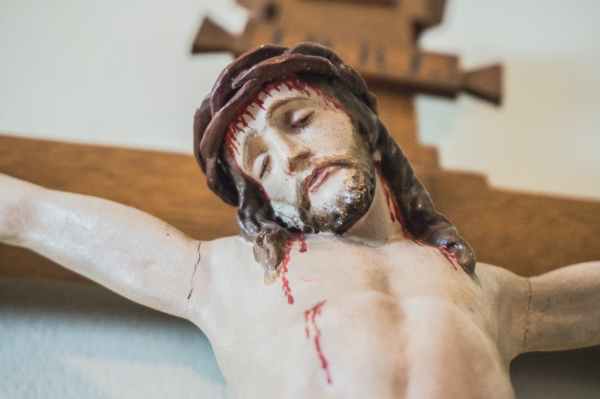
But Memorial Day can also be a time of reflecting on an empty grave– that of Jesus Christ, who gave His all for a cause even greater than liberty and justice in a particular nation or time or for a particular group of people. Jesus gave His life to reconcile an unholy human race with a Holy and Righteous God. He fought against Sin and Death, and conquered them both. And we cannot decorate a grave to honor His sacrifice, because, unlike all the soldiers we honor next week, Jesus did not just preserve a cause or a way of life– He became Life for us. His grave is empty as a symbol of Death’s defeat!
It was Jesus Himself who said, “Greater love has no one than this, that one lay down his life for his friends.” (John 15:13 NASB) Soldiers who lay down their lives often do so to save the lives of their comrades at arms– their friends and fellow warriors– as well as their countrymen and women, their neighbors, and their families. And it isn’t just soldiers who give their lives. Recent news stories tell of teachers, police officers, and other individuals who have sacrificed their lives for the sake of innocent shoppers, students, and neighbors. Such sacrifices are tragic, but they are also heroic, and deserving of our acknowledgement.
We take time to honor those who died for a cause. How much more should we honor the One who died to bring eternal freedom and life to each one of us! And how much more should we be willing to give our lives for the sake His Kingdom! There is no greater love that we can show.
23 So if you are offering your gift at the altar and there remember that your brother has something against you, 24 leave your gift there before the altar and go. First be reconciled to your brother, and then come and offer your gift.
Why do we find it so difficult to be reconciled? We crave God’s forgiveness, but we withhold our own toward our neighbors, or family members. We let anger and bitterness keep us apart. We let pride keep us from doing what we know is right in God’s eyes.
I speak from conviction. I have been estranged from a cousin of mine. Years have passed since we’ve spoken. We argued about something, and simply stopped talking. I tell myself that I have nothing for which to apologize–that’s just the way things ended. And my life is far less stressful since we’ve stopped talking. I do not “hate” my cousin, or feel bitter toward her. In fact, I tell myself that I only wish her the best– I just don’t want to be involved in her life, or have her involved in mine.
I know this is not what God wants. I know I should get in touch, and reassure her that “we’re okay”. Yet I am afraid to reach out and re-establish contact. Not because she poses any sort of physical threat, but she threatens my pride and my comfort. I find her difficult to talk to; difficult to understand. We have different ideas about boundaries and expectations–I find her “needy,” and she finds me “aloof.” I don’t think time will have made our relationship “easier.”
But God finds her precious in His sight– and worthy of my effort to reconcile our relationship. That doesn’t mean that I must allow her to manipulate me or abuse my emotions, or that I must demand that she be someone she is not to make me more comfortable. But it does mean that I may be embarrassed or inconvenienced at times. I need to be willing to listen, even when it is difficult, and so speak, even when it seems like I’ve said the same thing before. And it means that I must learn to set healthy boundaries and insist on them– not to shut her out as I have been doing, but to keep our relationship balanced and safe for both of us.
God puts a great premium on our willingness to be reconciled to one another. So much so, that Jesus told His listeners in the Sermon on the Mount, that if they were ready to bring an offering, and they remembered that someone had something against them, that they should leave their offering– unoffered– and go be reconciled first. Being at odds with others puts us at odds with their Creator and the One who loves them. Whenever possible, we should seek to reconcile. Broken relationships are sometimes a reflection of our relationship with Him. It hinders our prayer life, as well as our witness to the Power of God to redeem and reconcile the world around us.
God is aware that we are sinful people. And there are some relationships that are absolutely toxic. Reconciliation and forgiveness are NEVER about allowing another person to continue to abuse or manipulate you. Especially if this involves physical or sexual abuse. Forgiveness is not the same as accepting someone else’s manipulation or abuse. God, and only God, can redeem us and make us a new creation. Some relationships cannot be fully “reconciled” in this life. But “letting go” is not the same as “locking out” or “running away.” We must let others know that God can do what we cannot–He can restore broken relationships. He can make all things new.








































 Pursuing Prayer