I am passionate about pursuing a relationship with Jesus Christ. To that end, I want to share my journey in learning more about prayer. I am a former teacher and librarian. I love to read, write, share awful puns with friends, and share the joy that comes from trusting my loving Savior.
We have a tiny herb garden. It’s just a couple of plants each of a few different herbs– basil, rosemary, parsley, chives, etc., in small planters on our back stoop. Just enough to have fresh herbs for cooking. They smell really good when I go out to water them, or clip some to add to chicken stew or spaghetti sauce or noodles and butter.
They add flavor and color, too, but it is the smell that grabs the attention and brings immediate joy.
Our prayers are supposed to be like that, too. The Bible compares our prayers to incense with a pleasing aroma. God delights in the fragrance of our prayers.
When I water my herbs, they give off a pleasing aroma. But when I chop and crush the herbs to use them, the scent is stronger, the flavor richer, as the plants give all they have to the dish. Left in their planters, they will grow tall, but they will not be useful. They will smell good, but they won’t fulfill their greater purpose.
God wants our praise– certainly. And He is worthy of it–completely. But God also wants our chopped, crushed, bruised, torn, and painful prayers of need and brokenness. He wants us to trust Him to make even our groans and cries for help into fragrant offerings.
I have known some excellent fathers– including my own father and my husband. Fathers who do their best to provide for, pray for, protect, and prepare their families. Fathers who show patience, perseverance, wisdom, and selflessness.
But I know this isn’t the case for everyone. I have also known some wicked fathers– fathers who are physically, verbally, and mentally abusive toward their wives and children. Fathers who abandon their responsibilities, and leave behind a legacy of need, chaos, anger, and despair.
Throughout the Bible, God is portrayed as a Father. Not as a “man”– Jesus took on flesh and became a man– but the Triune God exists as Father, Son, and Spirit. God has all the characteristics of a perfect father. God also embodies all the characteristics of a good mother. But there is something about Fatherhood that God particularly wants us to learn and understand.
When God chose Abram for His special covenant, Abram’s name meant “exalted father.” But Abram was childless. God chose someone whose name had no meaning (or an ironic meaning), and changed it– not a lot–he added an “ah”, so that Abraham’s name meant “father of many” or “father of multitudes.” I don’t think it was any accident that God chose a man named “Abram,” or that He changed his name only slightly. God chose Abraham, not because he was a father, but so that he could become a father– to many! It was as a father (to Isaac, but also to Ishmael and all his other sons and descendants) that Abraham was exalted and revered.
But Abraham was not a perfect father– far from it! God gave us the story of Abraham, and drew attention to Abraham to help us learn the importance of GOD as our Father. Abraham was willing to give up his heir– the son of God’s promise– because Abraham was a “son” of God before he was a father to Isaac. https://www.biblegateway.com/passage/?search=Genesis+22&version=NIV
Even though I have known some excellent fathers, I know of only one who is perfect. And He isn’t someone else’s father, that I should be envious, or discouraged. He isn’t only “my” father, that I should be smug. He isn’t my father by birth, that I should make little of His sacrifices or His promises– they are not given out of duty or a sense of genetic obligation. He is OUR Father– He invites all of us to become His children. He lavishes love and grace, sheds tears and aches, sacrifices and pursues, rejoices and grieves– for and with every soul.
When Jesus taught His disciples to pray, He wasn’t giving them a rote prayer to memorize, but a pattern. https://www.crosswalk.com/faith/prayer/the-lords-prayer-be-encouraged-and-strengthened.html If you look through the Gospels at Jesus’ other prayers you will see it–He always begins by addressing His Father. For the group of disciples, He began with “Our Father.” Jesus, who could have claimed sole son-ship, made it clear that He (as Son with the Father and Spirit) desires this amazing relationship– more than power, more than honor, more than life! And God the Father is not a man or a mere mortal– He is Holy, Perfect, Eternally Loving and Eternally Sovereign!
There are a lot of angry people out there. They have ample reason to be angry. The world is filled with darkness, injustice, pain, sickness, violence, oppression..the list goes on. Such things should make us angry. Such things are wrong. They are destructive. They are evil.
But anger, even justified, cannot heal. It begets more anger, and yet more evil in the name of vengeance. Anger alerts us to evil, but it cannot be allowed to fester and corrode all that is good.
God created us with emotions, like anger, but He desires us to bring them under His discipline to become instruments of good. All the way back in Genesis, God cautioned Cain in his anger https://www.biblegateway.com/passage/?search=Genesis+4%3A1-16&version=NIV God did not condemn Cain for his anger, but he warned him not to be mastered by it. Cain did not listen, and in his anger, he committed the first murder. God’s wrath against Cain was swift and terrible– God cursed the ground, so it would not produce for Cain; He drove Cain to wander in the barren wilderness. Even so, God put a mark of protection on Cain, and promised His own vengeance on anyone who would try to kill him. God’s mercy overwhelmed simple retribution. God had the power (and the right) to strike Cain dead. He chose to let Cain live with the dark consequences of his anger.
God understands that we will get angry– He gets angry, too! But God sees beyond anger, beyond the immediate pain and rage that we feel when confronted with evil. God’s ways are eternal and Holy and right.
If we turn to God in our anger– if we cry out to Him and wait for His wisdom, He can turn even our anger and bitterness into something far better– resolve. We can resolve to bring good out of tragedy; we can resolve to work, and sweat, and pray, and stand firm in the midst of the storm. If anger is like fire– swift and destructive, then resolve is like a mountain–enduring and offering shelter, protection, and a fixed reference. Fire can scorch the mountain. But it cannot move it or destroy it.
We are living in uncertain and evil times. Let us acknowledge it; even be angered by it. But then, let us bring our anger, our pain, our confusion– and our hope–to God. As God warned Cain, if we do not do what is right, sin will be crouching at our door, desiring to have us; to destroy us and drive us away from God’s presence. If we deny our anger, if we push it down and pretend that it has no power to touch us, we are playing with fire. But if we bring it to God, acknowledging the struggle, crying out in our pain, God can turn our anger into resolve– steadfast through fire and storm and wind and time. Solidly committed to what is good and right and truly just.
Anger, violence, vengeance–all promise easy justice and powerful change. But once the fire of emotion and action has passed, we are left with ashes and death. But on the mountain of resolve, even the ashes become mixed with the good soil underneath to produce new life and growth. The good endures. The good resolves to endure. Goodness is eternal. Let us seek the good, and seek that God would, beyond our anger, grant us resolve.
There is a sickness in our world. Call it racism, or bigotry, or prejudice. Call it power, or oppression, or tyranny. Trace its roots to fear, to greed, to a lust for power, to pride, to hatred… Expose it as government overreach, police brutality, white supremacy, corruption, indifference to the suffering of others. Protest it with signs, looting, rioting, tear gas, lines of police officers in riot gear, shouting, and anger. Lots of anger.
There is not enough anger in the world to heal it.
Anger is a natural and even God-given emotion. God gets angry; even wrathful. It is right to be angry at injustice and hatred; division, greed, apathy, inequality, brutality, oppression, poverty, sickness, and death– they are unnatural, wrong, maddening.
But anger, even justified anger, cannot heal. It cannot build up, bind wounds, create peace. Anger feels powerful. It is active, dynamic, it tears down and threatens some of the powers that have, in their time, threatened us or those we love. It draws mobs that seem to share our anger– it looks like solidarity, even unity. It makes headlines. It creates “buzz.” It feels righteous and “right.” And it creates change. In the short term, anger “works.” Surging anger forces the oppressor to be quiet, go into hiding, make some small concessions…for now. Maybe they will pass legislation. Maybe they will give lip service to certain ideals. For now.
God understands anger– he even shares anger. Jesus even got angry. But God does not sanction letting our anger spill into vengeance, violence, and retaliation of sin for sin. Our anger does not give us the right to judge others, oppress others, steal destroy, or condemn.
The New Life 17 Now this I say and testify in the Lord, that you must no longer walk as the Gentiles do, in the futility of their minds. 18 They are darkened in their understanding, alienated from the life of God because of the ignorance that is in them, due to their hardness of heart. 19 They have become callous and have given themselves up to sensuality, greedy to practice every kind of impurity. 20 But that is not the way you learned Christ!— 21 assuming that you have heard about him and were taught in him, as the truth is in Jesus, 22 to put off your old self,[f] which belongs to your former manner of life and is corrupt through deceitful desires, 23 and to be renewed in the spirit of your minds, 24 and to put on the new self, created after the likeness of God in true righteousness and holiness. 25 Therefore, having put away falsehood, let each one of you speak the truth with his neighbor, for we are members one of another. 26 Be angry and do not sin; do not let the sun go down on your anger, 27 and give no opportunity to the devil. 28 Let the thief no longer steal, but rather let him labor, doing honest work with his own hands, so that he may have something to share with anyone in need. 29 Let no corrupting talk come out of your mouths, but only such as is good for building up, as fits the occasion, that it may give grace to those who hear. 30 And do not grieve the Holy Spirit of God, by whom you were sealed for the day of redemption. 31 Let all bitterness and wrath and anger and clamor and slander be put away from you, along with all malice. 32 Be kind to one another, tenderhearted, forgiving one another, as God in Christ forgave you.
If you have read this far, some of you will say that I am being unfair– speaking out against protesters, but not against the evil they are protesting. And if I have never spoken out against injustice, if I have never called upon people to seek peace, never lifted my hand to help my neighbors, never encouraged, never offered help, never shared in others’ grief, then I am the worst of hypocrites. Stop reading.
Anger asks us to act NOW– it asks us to abandon patience, prayer, and the promises of God, and take matters into our own hands–in our own power, in the moment, for the moment. And it tells us that we can and should act in the place of God to achieve what we believe to be His ends. Often, it asks us to act with little information, no time to reflect, and at the behest of others, who wish to use our anger to further their ends. Anger tells us that we can force evil people to surrender their power without being corrupted by it. And anger tells us that it has the only solution– the only action– that can bring peace.
Does this mean that no one should be angry? That we should do nothing active in the face of evil? ABSOLUTELY NOT! We should speak truth to our neighbors– not just the truth of our anger, but the truth of our hope for justice, our dependence on God, our love for our brothers and sisters, and our need for Mercy. We must not turn a blind eye to injustice, but we must work toward justice– not just vengeance. We must not sit silent in the face of bigotry, but we must love extravagantly– even those who seem unlovable and unwilling to love us in return. We must not silence those who are angry and hurt, but listen with respect and compassion–as we would wish to be heard.
And we MUST pray! Pray for the grieving; pray for our enemies; pray for justice; pray for peace. Pray even when we don’t have the answers– especially when we don’t have the answers. Pray–fervently, feverishly– pray on our knees and as we pace in frustration. Pray like we’ve never prayed before. Pray until we break a sweat; until we hunger and thirst for GOD’S presence on every street corner, and in every household, and at every riot, and every government office. Those who would silence our prayers and hold them in disdain are trying to silence the power of God Himself! They cannot win, but they can keep us from sharing in God’s ultimate victory by marching in a fake war, instead of defending the Kingdom. We must take our anger to God and let Him show us the path to justice, action, peace, and healing. He may ask us to step out in ways we never imagined–loving our enemy; sharing the gospel; standing in solidarity with those we used to fear; forgiving those who have hurt us; asking forgiveness from those we have hurt.
When I was a child, I was something of a picky eater. I didn’t like peas, or beets, or spinach , I wasn’t fond of lumpy mashed potatoes, and I didn’t like peanut butter sandwiches, or mustard on my hamburger. Of course, my parents were not sympathetic– I had to at least try some of my vegetables or potatoes, and, like it or not, I often found a peanut butter sandwich in my school lunch bag. I didn’t have to add mustard to a hamburger at home, but if it came on my burger at the drive-in, I either had to eat it with mustard, try to scrape it off, or go without! I didn’t have to be enthusiastic about dinner, but I was taught to be grateful for it.
Now that I am an adult, I still am not fond of peas, though I have learned to like beets and spinach. I don’t eat mashed potatoes very often, lumpy or otherwise. I eat the occasional peanut butter sandwich, and I actually love mustard on my hamburgers. I have learned to like foods that I didn’t like as a child, and learned that certain foods (even peas) are good for me, whether I like them or not.
I also learned to pray as a child–we had grace at meals, family prayer time, corporate prayer at church, and bedtime prayers. I learned that sometimes prayer is spontaneous and filled with praise; other times, prayer is dragged out of pain, or anger, pride, or shame. Prayer isn’t always “palatable.” But, like eating, it is necessary and good.
Just as I needed to learn not to be a picky eater, I have to practice prayer in all its aspects. God doesn’t just want the sweet prayers of praise that I am eager to sing out. He doesn’t just want the earnest requests I set before Him. He wants the rotten, stringy, overripe confession that I’ve been hanging on to. He wants the tormented “Why?” when things are falling apart. He wants me to chew on the unanswered requests and unfulfilled longings, and swallow the pride that insists on having its own way. He wants to savor those prayers when I can’t even find the words, but I come to Him anyway, hungry for answers, but even more thirsty for His presence.
Prayer isn’t always easy. It isn’t always “satisfying” in its daily practice. But it gives life and nourishment for the soul.
So I ask myself today: What am I praying about? What do I need to bring to God in prayer? What have I held back? What have I stopped praying for (and why)? Who has been on my heart or mind, but not in my prayers? What have I been trying to do in my own way that I haven’t shared with God in prayer? What does God know about me that I haven’t acknowledged? What praise or thanks have I withheld today? What worries have I borrowed from tomorrow?
What prayer practice do I need to try, or try again? It may take some stretching, but in the end, it’ll be better than peas!
Last time Any One Who Is Without Sin…, I looked at a few verses in the gospel of John (8: 1-11), and wrote on four insights. Today, I’d like to look at some practical implications.
If I am “part of the crowd” following Jesus, how easily do I get distracted by the “Pharisees” and critics? How often do I wander off track, looking at fine points in the scriptures that fit a particular argument? How often do I get caught up in senseless debates, allowing myself to be offended or riled up? Over the past several weeks, I have seen arguments via FB , e-mail, or other social media sites where Christians are using Bible verses, Church traditions, the U.S. Constitution, and other teachings and documents to defend such things as wearing a face mask, defying executive orders, practicing (or not practicing) social distancing, and condemning family, friends, and neighbors for taking a different view. We live in a society that reacts– often instantly and with confidence in our own morality– instead of listening and contemplating. We like building strong arguments to defend…scripture? tradition? interpretation? Jesus did none of these things when confronted by this mob. He didn’t dismantle their argument with more argument– he simply got to the heart of the matter– how to deal with Sin.
How often do I come to Jesus “knowing” the answer before I ask the question? The Pharisees in the story were not really interested in Jesus’ thoughts or wisdom concerning the situation at hand. They assumed that Jesus would have to answer in only one of two ways, and that either way, he would look bad. I may not be trying to “trap” Jesus with my prayers, but often, I AM trying to seek his confirmation, rather than his wisdom and teaching. The Apostle Paul wrote to the Corinthians, “Knowledge puffs up, but love builds up. 2 Anyone who claims to know something does not yet have the necessary knowledge; 3 but anyone who loves God is known by him.” (1 Corinthians 8:1b-3 NRSV) Many times, I am busier “loving” how much I know than learning how much God loves!
For me, one of the most amazing new insights about this passage is that once Jesus introduces the phrase, “Any one who is without sin…” everyone leaves– everyone except the one who has been caught in the act of sinning, and the One who has always been without sin. Dealing with Sin is a very personal thing– both confronting our own sinfulness, and acknowledging God’s perfect righteousness. Everyone in the original crowd came to hear Jesus teach. And they were comfortable letting someone else be humiliated and condemned for her sin. But when their own unrighteousness was introduced into the situation–secret sins, unconfessed sins, pride, prejudice, and more–they melted away. How often do I slink away, unwilling or ungrateful to see Jesus show mercy to someone I find “unworthy,” knowing that I am equally undeserving, knowing that I am not “without sin?” Yet the sinful woman in question is the only one who receives the full light of Jesus’ love and mercy. Dozens of others, eager to hear Jesus’ teaching, missed the greatest lesson of all. In the very next verse, at the very next opportunity to speak, Jesus makes one of the most amazing statements in the Gospels, “12 Again Jesus spoke to them, saying, “I am the light of the world. Whoever follows me will not walk in darkness, but will have the light of life.”(John 8:12 ESV) It’s not just showing up to hear him speak; it’s not just knowing the law–it’s following him that leads to light and life.
Finally, Jesus grants mercy. He doesn’t split hairs about the Law of Moses. He doesn’t dismiss the reality of Sin or guilt. He doesn’t give the woman a long list of do’s and don’ts for the future or a proscribed plan of atonement. He doesn’t give her a blank check to keep sinning. The Bible doesn’t give us an epilogue to the story. We don’t hear whether or not the woman gave up her life of adultery– we assume that she did. But why? Would she have given it up because she had “dodged a bullet” with the mob? Part of the reason she was brought to Jesus in the first place was that Roman law overruled Jewish law. The mob was not likely to stone this woman– especially within the city limits. ( In fact, in the book of Acts, we have the story of Stephen, who was stoned by a mob. He was dragged out of town, after facing trial by the Sanhedrin, and stoned because of his testimony against their unbelief. ) Would the woman’s life have changed because her guilty secret had been exposed, even though she had not been condemned? Or is it more likely that her life changed because she had an encounter with the “One who is without sin,” and found in Him a love greater than condemnation? She hadn’t planned to follow Jesus. She may not have taken his teaching seriously if she had been just “one of the crowd.” She wasn’t singled out because of her beauty or righteousness or knowledge or status. But Jesus poured out on her the fullness of His love and mercy. How would/does such an encounter change my life? Yours?
The Pharisees saw this woman as a pawn worthy of stoning; worthy of condemnation. They brought her, intending to throw “sticks and stones,” accusations, and painful, even fatal words. Jesus used words of healing and hope. May we do the same today– as we approach our neighbors and friends, and as we approach the Sinless one who died in our place.
I was re-reading a familiar passage in the gospel of John recently, and I was struck by a truth I had missed before. In the first part of John 8, there is a story about a woman caught in adultery https://www.biblegateway.com/passage/?search=John+8%3A1-11&version=NIV I have read this story many times, and even heard sermons preached on this passage. What struck me this time wasn’t exactly new material, or a new reading, but a new understanding of a detail that was there all along.
The story begins with Jesus teaching a crowd of people in the temple courts in Jerusalem. His teaching is interrupted by a group of Pharisees and teachers of the law. They have a woman caught in the act of adultery, and they come to Jesus asking his opinion about stoning her. They obviously know the laws of Moses, because they cite them. But they cite only a certain portion of the law, and they want Jesus to weigh in (so they can use his own words to trap him).
Jesus turns the tables, and passively bends down to write letters in the sand. He says only, “If any one of you is without sin, let him be the first to throw a stone at her.” One by one, the accusers and the crowd– everyone except Jesus–melts away. Finally, Jesus asks who is left to condemn the woman. There is no one. Jesus refuses to condemn her, and sends her on her way, telling her to “Go, and sin no more.”
There was already a crowd around Jesus before the Pharisees and teachers arrived. They did not bring this woman to Jesus to get an honest answer to a question, or to bring about justice (for that, they should have brought both her AND the man involved!); they brought her to a very public spot to humiliate her and trap Jesus. She was a pawn in a political and religious game, and she was guilty of a crime that was punishable by death. She was accused and forced to stand before a crowd to be condemned without a trial. So often, I read this passage, and my focus is on Jesus and the woman and the Pharisees– I forget that there is a crowd of ordinary people being “played” by the Pharisees for their own purposes.
Jesus never answers the question at hand. According to the laws of Moses, the woman should be stoned. That is the point the Pharisees want Jesus to address. They have set him up. If he agrees with their interpretation of the laws of Moses, he should insist that the woman be stoned. But this will be in violation of the Roman laws, and will lead to Jesus being arrested by the Romans. But if Jesus upholds the Roman law, he will be turning his back on centuries of Jewish tradition dating back to Moses. The problem is that the Pharisees have resorted to some half-truths. The laws of Moses DO speak of stoning; they speak of adultery being punishable by death– for both the man and the woman involved. However, the Priests and leaders of Israel have not followed this practice. King David committed adultery with Uriah’s wife. Neither one was stoned or condemned to death. There are no records of other adulterous couples being stoned throughout Israel’s history. So it is rather disingenuous for the Pharisees to bring this case to Jesus and ask him to speak judgment where they will not. Jesus knows this is not about actual justice; it isn’t really about the law of Moses– because they are not following it themselves! By turning the tables back on them, Jesus exposes their hypocrisy and failure in front of the very crowds they are trying to impress with their clever plans.
One by one, the woman’s accusers melt away. But it’s not just them, it’s the crowd of ordinary people– the ones who were likely riled up by the Pharisees and teachers. Think about the mob mentality–a guilty woman, caught in the act and brought before a teacher with moral authority–there is nothing like scandal to get a crowd of anonymous bystanders worked up and ready for blood. Yet, Jesus’ gentle reminder that any of us could be found “guilty” of something and condemned to shame and punishment puts out the flame of anger and resentment, and causes the mob to evaporate. No one is left to accuse, to curse, to insult, to humiliate, or condemn.
Finally, it’s down to Jesus and the sinful woman. There IS one person there who is without sin– one person who has the right to throw stones, to judge, to punish. Yet he reaches out with compassion and mercy. He is still righteous– he doesn’t shrug off the woman’s sin. He doesn’t say, “Well, that’s no big deal. Let’s just pretend that never happened.” or “I think you’ve learned a valuable lesson here today, young lady.” He simply says, “Neither do I condemn you. Go now and leave your life of sin.”
Next time, I want to address each of these details from a practical standpoint in light of modern circumstances, and what lessons I am taking from Jesus’ actions.
We are living in dark days– days of death counts, and dire predictions; of fear and grief and chaos. Masks, social distancing, angry outbursts, collapsing economies, job loss, political unrest, disease, plague–we are in the grip of a global pandemic. “Bring out your dead.” It’s a phrase from hundreds of years ago, and the horrors of other plagues and other disasters. Tombs, graveyards, skulls and visions of death abound. And yet, as Christians, we celebrate an empty tomb…
It’s been over a month since many Christians celebrated Easter (and almost a month for Orthodox Christians). How soon many of us forget the power of the resurrection. Our world is gripped with fear and anger. But we should be gripped with hope and healing. We celebrate an empty tomb– a testament to the victory of life over death, and hope over chaos!
Even when we use the symbol of the cross, it is not about Christ’s death, but his ultimate victory that we celebrate. Jesus himself even referred to the cross in these terms in John 3:
“Just as Moses lifted up the snake in the wilderness, so the Son of Man must be lifted up, that everyone who believes may have eternal life in him.”
Jesus is speaking with Nicodemus, a Pharisee and religious teacher. He is referring to an historic incident in the wilderness, when the Israelites had rebelled (once again), and the Lord sent venomous snakes among them. Nicodemus would have known about this incident, but Jesus presented it as more than just history– it was a foreshadowing of God’s perfect plan of salvation! https://www.biblegateway.com/passage/?search=Numbers+21%3A4-9&version=NIV God had Moses make a bronze snake to be lifted up on a pole. When the people looked up and saw the bronze snake, they could live. In just such a way, when Jesus was “lifted up” on the cross, he didn’t just die. He battled death to bring life to anyone who “looks up” and believes.
That ancient symbol of a snake on a pole is used by physicians to represent healing. The ancient symbol of Christ on the cross is used to represent redemption and eternal life. Combined with the reality of an empty tomb, we can celebrate life in the midst of any circumstances.
These are difficult days–even with the hope of eternal life, we still have to face the sadness and grief of death, the confusion and hardship of economic chaos, and the uncertainty of what tomorrow will look like– socially, politically, economically, and physically. But we need only “look up” and beyond our circumstances to be reminded that this is not the whole story. There is an empty tomb– ours! There is victory–ours! Won for us by the perfect plan of God, and the perfect obedience of Jesus Christ.
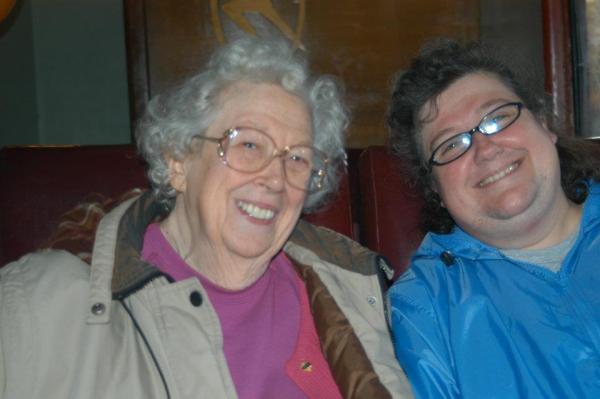
Tomorrow, my mother will celebrate her 87th birthday. Her life spans an incredible period of history. She can remember times of poverty and hardship during the Great Depression. She remembers hearing about the attack on Pearl Harbor on the radio, and worrying about her father in the Navy, and her mother working long hours in the factory. As a young wife, she sent a husband to fight in Korea, while she awaited the birth of their son. In her day, she cooked on a coal-fired stove, attended a one-room schoolhouse, wore poodle skirts and saddle shoes, and used outhouses. She has lived through the age of television and the internet– she watched a man walk on the moon (in black and white) and watched the World Trade Center towers burn and collapse (in color) on TV screens in real time. She learned to take shorthand in pencil, to type on a manual typewriter, and has done data-entry on a desktop computer.
Mom has seen a lot of changes in her life. But years ago, she developed habits that have not changed. Every day, she reads a passage of scripture, and every day, she spends time in prayer and meditation. That doesn’t mean she is perfect–some days she misses, due to illness or unexpected interruptions–and this practice, in itself, doesn’t make her a “better” person than anyone else. But daily habits do matter. When Mom lost her parents and her only sister in a matter of nine months, and then lost my Dad just three years later, her faith was tested. But it never wavered. When she had to undergo heart surgery a few years ago, her faithful habits made an impression on the hospital staff, as well as her friends and family. Throughout the recent COVID-19 lockdown, when Mom has lived alone and had to deal with cancelled doctor’s appointments, limited access to medicines, changing her routines, not being able to socialize, not being able to attend worship services, losing a close friend, etc., she has shown resilience, patience, and faith that set a marvelous example to anyone who knows her. Whether her day turns out to be momentous, boring, disastrous, or just ordinary, Mom determines to spend part of it connecting to, and worshiping, her Savior.
This seems like simple advice, but it takes practice and determination, and help from the Holy Spirit. It is tempting to look at our lives in hourly increments, trying to fill each moment and each day with meaningful activity. It is tempting to make prayer and Bible study “part of the plan,” two of the many activities in our busy schedule. And when things don’t go according to our plan, we wring our hands and lament the “waste.” Even when things go “as planned” we still consider worship and meditation one of many routine practices, like exercise, or dusting, or taking a shower. But each day is a gift– each moment is more than an opportunity to be busy “doing” and “making plans.” Each day– even the ones we think of as failures and wasted time–matters. Every day is a new opportunity to see God or to hear His voice–whether in the beauty of a sunrise, or the tears of our children; in the aftermath of a disaster, or an unexpected promotion at work; in stillness, or the noisy commute; in success and in setbacks.
Daily habits like prayer and Bible study won’t change the circumstances that come our way; they won’t necessarily help us make plans that make life easier or less frustrating. But they will teach us to place our focus where it truly belongs–on the One who is with us every day and every moment, through good times and bad–on the One who holds today (and tomorrow) in His hand. It doesn’t matter that we fill out a chart, or make a certain goal of pages read or half-hours spent on our knees– it DOES matter that we make it the cry of our heart to seek God every day that we can. Seek His wisdom, seek His mercy, seek His glory. Today.
Yesterday had 24 hours, the same as every other day. Yet it seemed to zoom past, leaving me “behind” in getting my blog ready for today. So here I am, writing “under the gun” so that I can publish today.
Blogs like this don’t have “deadlines” in the sense of print publications or broadcasts. I don’t have advertisers or managers demanding that I have content by a certain time or date. There are no editors to determine the length of any particular blog post. This one is likely to be shorter than most, in fact. And God isn’t standing by waiting to scold me for being late today. It is my own sense of expectation that gives me grief.
But God has placed all of us in time and space with a purpose. We do not have the power to “stretch” time, to reclaim it, or to bargain for more of it. Time “flies”–and what we do in the time we have flies, too. And He wants us to give our time to Him first of all.
Falling behind on a blog entry is not a life-or-death matter. Falling behind in life is another matter.
I pray that today will be a productive day, a restful day, even a challenging day– and that, as it flies by, we will fulfill God’s purpose in it. And He’ll take care of the timing!






































 Pursuing Prayer