19 1-2 Ahab reported to Jezebel everything that Elijah had done, including the massacre of the prophets. Jezebel immediately sent a messenger to Elijah with her threat: “The gods will get you for this and I’ll get even with you! By this time tomorrow you’ll be as dead as any one of those prophets.” 3-5 When Elijah saw how things were, he ran for dear life to Beersheba, far in the south of Judah. He left his young servant there and then went on into the desert another day’s journey. He came to a lone broom bush and collapsed in its shade, wanting in the worst way to be done with it all—to just die: “Enough of this, God! Take my life—I’m ready to join my ancestors in the grave!” Exhausted, he fell asleep under the lone broom bush. Suddenly an angel shook him awake and said, “Get up and eat!” 6 He looked around and, to his surprise, right by his head were a loaf of bread baked on some coals and a jug of water. He ate the meal and went back to sleep. 7 The angel of God came back, shook him awake again, and said, “Get up and eat some more—you’ve got a long journey ahead of you.” 8-9 He got up, ate and drank his fill, and set out. Nourished by that meal, he walked forty days and nights, all the way to the mountain of God, to Horeb. When he got there, he crawled into a cave and went to sleep. Then the word of God came to him: “So Elijah, what are you doing here?” 10 “I’ve been working my heart out for the God-of-the-Angel-Armies,” said Elijah. “The people of Israel have abandoned your covenant, destroyed the places of worship, and murdered your prophets. I’m the only one left, and now they’re trying to kill me.” 11-12 Then he was told, “Go, stand on the mountain at attention before God. God will pass by.” A hurricane wind ripped through the mountains and shattered the rocks before God, but God wasn’t to be found in the wind; after the wind an earthquake, but God wasn’t in the earthquake; and after the earthquake fire, but God wasn’t in the fire; and after the fire a gentle and quiet whisper.
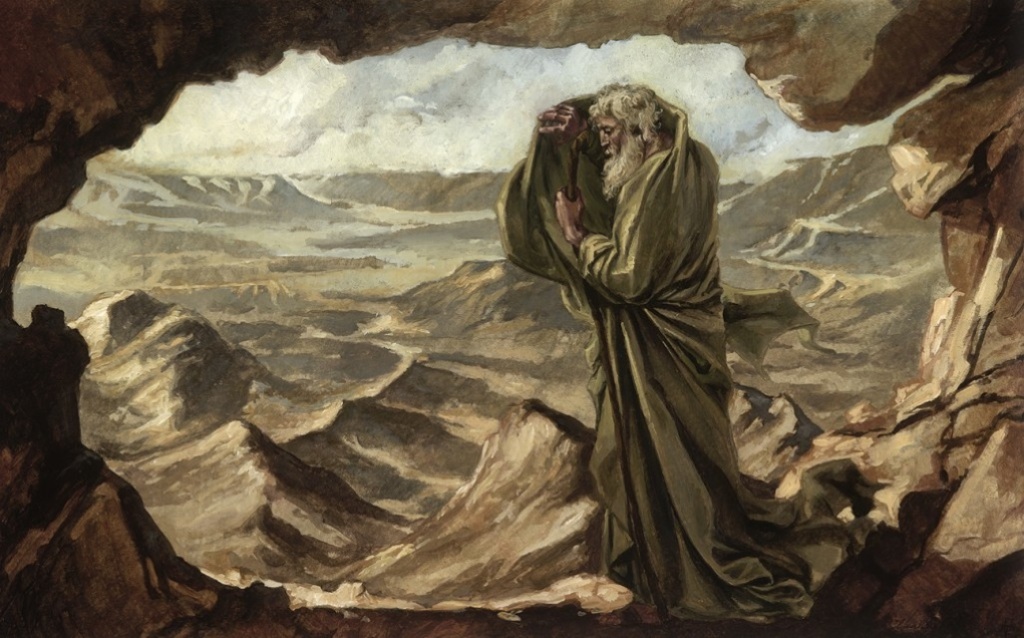
13-14 When Elijah heard the quiet voice, he muffled his face with his great cloak, went to the mouth of the cave, and stood there. A quiet voice asked, “So Elijah, now tell me, what are you doing here?” Elijah said it again, “I’ve been working my heart out for God, the God-of-the-Angel-Armies, because the people of Israel have abandoned your covenant, destroyed your places of worship, and murdered your prophets. I’m the only one left, and now they’re trying to kill me.” 15-18 God said, “Go back the way you came through the desert to Damascus. When you get there anoint Hazael; make him king over Aram. Then anoint Jehu son of Nimshi; make him king over Israel. Finally, anoint Elisha son of Shaphat from Abel Meholah to succeed you as prophet. Anyone who escapes death by Hazael will be killed by Jehu; and anyone who escapes death by Jehu will be killed by Elisha. Meanwhile, I’m preserving for myself seven thousand souls: the knees that haven’t bowed to the god Baal, the mouths that haven’t kissed his image.” 19 Elijah went straight out and found Elisha son of Shaphat in a field where there were twelve pairs of yoked oxen at work plowing; Elisha was in charge of the twelfth pair. Elijah went up to him and threw his cloak over him. 20 Elisha deserted the oxen, ran after Elijah, and said, “Please! Let me kiss my father and mother good-bye—then I’ll follow you.” “Go ahead,” said Elijah, “but, mind you, don’t forget what I’ve just done to you.” 21 So Elisha left; he took his yoke of oxen and butchered them. He made a fire with the plow and tackle and then boiled the meat—a true farewell meal for the family. Then he left and followed Elijah, becoming his right-hand man. 1 Kings 19 (The Message)
As a child, I was confused by this story from the life of Elijah the prophet. Just before this, Elijah had challenged the prophets of Baal and Asherah. He was outnumbered 850 to one, yet he stood defiantly, and asked the people of Israel to choose between their false gods and the one true God. God had produced fire on the mountain and shown His mighty power, while the false prophets were humiliated and later slain. It was a stupendous victory! And yet, Elijah, when told of Queen Jezebel’s anger, fled in terror, hid in the wilderness, and asked for death! Surely, Elijah remembered what God had just accomplished. Surely he knew that the same God who sent fire and ended the drought could protect Elijah from harm. Didn’t he? And I expected that God would react with consternation at this display by Elijah–how ungrateful to throw such a pity party after God had done such a miracle!
But God did the most curious thing. He could have sent a powerful reassurance. He could have ordered Elijah to return to the palace to deal with the wicked king and queen–finish the job and bring divine justice to Israel’s ruling family. He could have called Elijah out over his bad behavior and lack of faith. But God let Elijah whine and run away. And after Elijah threw a temper tantrum, God sent an angel to bring him food and water. Finally, God allowed Elijah to see His power in the forms of a mighty wind, an earthquake, and a fire. And it was THEN, and only then, that God spoke to Elijah in a still, small voice– a whisper– something so intimate and comforting that Elijah could not fail to recognize that it was the voice of God.
God CAN and will do mighty miracles. But so often, He prefers to work in a whisper. He is Glorious, and Powerful, and Omnipotent– yes. But He is also intimate and gentle and nurturing– especially with those who have ears to listen; those who have been broken down; those who need a quiet voice of reassurance and peace.
As I have grown older, I see so much in this passage that I couldn’t see as a child. I see how often I “lose it” just after I think I’ve won a great victory. I see how many times God has come to me in whispers and little gestures– just when I need a gentle hug and a simple reminder of His care. God is not the one who points out my temper tantrums and lack of faith. God doesn’t yell recriminations at me– even when I know I deserve them! I see how often I throw a tantrum, and expect God’s wrath, only to be met with His arms around me, calming me, lifting my head so I can look into His eyes of compassion and mercy. God is my Father– and a gentle, wise, and loving Father. And when He draws me close– He whispers of His Love.
Yes, God sent fire from the mountain. He caused justice to be done upon the false prophets. It was mighty; it was fierce; it was devastating. God IS a God of wrath– and even prophets can get wounded in the fight. There is evil in the world, and when we stand up to it, it is exhausting– even when we know God is with us. But God knows our limits. He will often give us more than we can handle– in our own power– and He will pull us through the kind of trials that test and stretch those limits. But He is also preparing a time and place of rest and His quiet whispers of encouragement and hope when we are tempted to give up.
God didn’t just whisper empty promises or nice-sounding platitudes when He finally spoke to Elijah. He brought a new message– someone else would be God’s instrument of justice for Ahab and Jezebel. Someone else would come alongside Elijah in his ministry. And someone else (7,000 someone else-s in fact!) WERE being faithful. Not only had God been with Elijah in the past, God had been preparing the future for Elijah to receive rest, and for others to rise up and carry on. He could have shouted this message from the mountaintop. But He wanted to whisper His message of hope to a faithful prophet who needed quiet reassurance after a difficult battle.
I don’t know what God wants to whisper to me (or to you) today. But I pray that we will have ears to hear, and hearts to respond. And God will whisper to us, whether we just defeated an army of enemies, or just woke up from a much needed nap! He will gently remind us that He loves us in our tantrums just as He loves us in our victories. And He will whisper, because that’s how close He really is in our every moment!
I grew up in a rambling, pre-1860s farmhouse in rural southwestern Michigan. We had a “Michigan basement”,” “– unfinished dirt floors, walls made of fieldstone and rocks, crudely cemented together, exposed floorboards and joists from the ground floor providing a ceiling. A rickety wooden stairway ended in a small cemented landing. It was a haven for dust and cobwebs, and everything in the basement had a grimy film of dust mixed with the residue of an old oil-burning furnace. It was littered with “dead” things– a rusted-out bicycle frame from the 1940s; a long-forgotten set of rattan patio furniture with mildewed pads and broken wicker bits sticking out underneath; a broken rake; and, in one corner, what looked like the skeleton of a small rodent. There was an old cabinet, formerly with two doors, now standing with one door hanging askew, and the other one missing all but half a hinge piece. Inside were old Mason jars, rimmed with lime deposits, holding nails, screws, nuts and bolts, and other odds and ends, and more Mason jars holding home-canned tomatoes from a garden of unknown vintage. There was a single 40-watt incandescent light bulb screwed into an ancient ceramic socket and mounted on one of the overhead floorboards, which did little to diminish the general sense of gloom and decay. There were four small windows–but they had long ago succumbed to grime and dirt from inside and out. It was the stuff of childhood nightmares.
Last week, we had a tornado warning, and one of my friends from church spoke of taking her children to the basement to wait out the weather. It reminded me of my own mother, gathering my sister and I– sometimes pulling us from our beds– and taking us to shelter in the basement until a storm had passed. My father often worked the night shift, and so the job was left to Mom to herd us into the southwest corner of the basement, being sure to bring a blanket and a flashlight, and make sure we were wearing slippers or shoes. She also had an old portable AM/FM radio, so we could listen to the weather bulletins amidst the gloom and dust and damp of the basement.
And yet–
My memories of going to the basement during a storm are not memories that inspire terror or disgust. I never wanted to visit the basement any other time, but during a storm, it was our “safe” place. The winds and rain and hail might rage outside, but we were warm and snug (sometimes too warm!) in our little corner. And no matter how frightened my mom may have been, she always reassured us that we would be safe together in that place. And then, she would lead us in prayer. We prayed that Dad would be safe at work. We prayed for anyone who was in the path of the storm. We prayed that God would protect our house. We prayed for those who were on the road, and for those who would have to go out after the storm to fix electric lines or rescue others. And we thanked God for our basement!
Sometimes, God uses grubby basements to be our “safe” place. What otherwise may seem like a scary situation can become a cause for praise and celebration when we remember that God is with us!
I think of the prophet Jeremiah, who was arrested and thrown into a cistern–a place far worse than our basement– but God caused him to be rescued (https://www.biblegateway.com/passage/?search=Jeremiah%2038&version=NIV). He went from the mud-filled cistern to the palace of the King! And even though Jeremiah faced many other trials and griefs, Jeremiah was able to write: “
I remember my affliction and my wandering, the bitterness and the gall. 20 I well remember them, and my soul is downcast within me. 21 Yet this I call to mind and therefore I have hope:
22 Because of the Lord’s great love we are not consumed, for his compassions never fail. 23 They are new every morning; great is your faithfulness. 24 I say to myself, “The Lord is my portion; therefore I will wait for him.” (Lamentations 3:19-24 NIV)
And I think of Paul and Silas in prison in Philippi (https://www.biblegateway.com/passage/?search=Acts%2016:16-34&version=ESV ). They sang and prayed after having been beaten and unfairly arrested. And they were trapped in the prison when an earthquake hit! But the end result was not only their vindication and freedom, but salvation for the Philippian jailor and his family!
There are seasons when we are forced to go to the basement–literally and figuratively. There are times when we must sit and wait in the dark and damp, uncertain of where the storm will hit or how long it will last. But often, in those basement moments, we find ourselves closer to God than when we climb mountains! God sits with us in the gloom. God has the power to turn our fear and uncertainty into praise and worship. And God will bring those memories of His comfort and strength back to us in other times of trouble.
Do you pray fervently? Do you pray faithfully? I confess that sometimes I go through periods of fervent prayer, but it doesn’t always last. And, while my goal is to pray faithfully, I sometimes struggle with daily prayer seeming bland.
Thankfully, God does not demand constant fervor and faithfulness (though He does provide His Spirit to help us with both!) God wants us to come before Him exactly as we are; He KNOWS exactly what we are feeling, and He wants us to experience His presence THROUGH both the peaks and valleys. Experience has taught me that faithfulness in prayer can often lead to renewed fervor. Fervor and ardency can be influenced by our emotions. I pray most fervently when I feel needy, or when I am swept up in joy, or when I am surrounded by others who are riding a particular emotion. But I pray most faithfully when I choose to step out in spite of my emotions or circumstances.
Recently, I was reading in 2 Chronicles about “Good King Asa” of Judah. If you read chronologically through the Bible, you meet King Asa in 1 Kings (briefly in chapter 15), and again in 2 Chronicles (chapters 14-16) Both times, he is classified as a “good” king in Judah, one who “did what was right in the eyes of the Lord.” He reigned for 41 years, and was a champion of reform. He was a fervent and devoted king throughout most of his reign, and was mourned upon his death. But sadly, King Asa ended his reign in rebellion against the God he had so staunchly served for most of his life.
God had blessed Asa with astonishing military victories and years of peace and prosperity. But after 36 years of faithful and fervent service, Asa seems to have turned his back on his faith. Another army threatened to invade Judah, and Asa, instead of turning to God as before, brokered a treaty with another local king for protection. He sent silver and gold from “the treasuries of the House of the Lord” to King Ben-Hadad of Aram for help in repelling the army of King Baasha of Israel (the northern kingdom of the Jews). He bribed Ben-Hadad to break his treaty with Israel, and together, they sacked the fortifications and caused Baasha to back off.
In spite of King Asa’s victory, the Lord sent a prophet to rebuke him. King Asa, who had sought the Lord throughout more than three decades of devoted service, became so angry that he had the prophet thrown in jail. He then began oppressing his own people! Three years later, Asa developed a severe disease in his feet. But instead of calling on God, he consulted only his own court physicians. He suffered for two more years before finally dying. This “Good” King, famous for his passionate pursuit of reform and devotion to God, ended his life embittered, angry, diseased, and despotic.
God still chose to use King Asa for good– Asa’s reforms were a key ingredient in keeping Judah from suffering the fate of neighboring Israel. Asa’s reign was marked by years of peace and prosperity. Many of the faithful Jews living in Israel moved to Judah, where Asa’s reforms meant that could worship freely and fully. In fact, there was such a revival that people took extreme vows to follow God whole-heartedly. What a shame that the leader who inspired such devotion would himself fall victim to greed, pride, and bitterness, and fail to truly experience the blessings he had helped bring about!
I pursue fervent prayer. I want to serve God whole-heartedly, and I want all the joy and peace of a close relationship with Him. But I also want to serve God faithfully, even when I don’t feel the passion I had last week or last month. Because I know that God is both Eternally Fervent and Eternally Faithful!
If you are going through a season where the feelings just aren’t as “strong” as they have been in the past; if you are tempted to coast on the strength of past victories; if you are wondering why your prayer life is flagging, or lacking in the zeal you once had– DON’T GIVE UP! Don’t let your story end up like Asa’s.
We are called to FINISH the race. And yes, we want to race to “win the prize” (1 Corinthians 9:24). But remember that our strength comes from God, not our own desires.
Therefore, since we are surrounded by so great a cloud of witnesses, let us also lay aside every weight, and sin which clings so closely, and let us run with endurance the race that is set before us, looking to Jesus, the founder and perfecter of our faith, who for the joy that was set before him endured the cross, despising the shame, and is seated at the right hand of the throne of God. (Hebrews 12:1-2 ESV)
We don’t have to make a choice between fervor and faithfulness, but let’s not pursue one without the other. Let’s be fervent in the sprinting, and faithful in the long stretches. Let’s finish the race well!
16 Shadrach, Meshach and Abednego replied to him, “King Nebuchadnezzar, we do not need to defend ourselves before you in this matter. 17 If we are thrown into the blazing furnace, the God we serve is able to deliver us from it, and he will deliver us[c] from Your Majesty’s hand. 18 But even if he does not, we want you to know, Your Majesty, that we will not serve your gods or worship the image of gold you have set up.”
Daniel 3:16-18 (NIV)
I hear a lot of American Christians complaining about the “dark days” in which we live. And indeed, they are dark. There is great evil in the world– wars, famines, injustices, hatred, division, greed, and immorality. But, along with complaints, I hear a note of whining. Isn’t God supposed to deliver us from just such evil? Isn’t He supposed to clear the way for us to love one another in peace and harmony? Surely, it can’t be His will for us to be laughed at, spit upon, misunderstood, and treated with contempt?!
The ancient nation of Israel was conquered and sent into exile. Israelites who had abandoned their faith, as well as those who had steadfastly served the Lord, were ripped from their homeland and marched to Babylon. Worship in the Temple of Jerusalem ceased. The Temple itself had been destroyed. There were no tabernacles, no festivals– none of the systems and structures of worship left available to God’s people. Yet some still worshipped– in homes, isolated from their fellow Jews, or in secret groups. They were not surrounded by reminders of when “their” religious beliefs were considered the cultural norm. Nor did they live in a culture that practiced religious “toleration” as we understand it today.
In the book of Daniel, the commitment of s handful of exiles is detailed as it comes in conflict with the oppressive control of the Babylonian (and later the Persian) Empire. Daniel and his three friends are challenged by the pressure to compromise and adapt to their surroundings. They are tempted and bribed by the promise of power in the court– if they can compete with other Babylonians. But they secretly hold fast to their “old” diet, and religious practices. They refuse to eat the rich food of Babylon– or bow to its gods.
In Chapter 3 of Daniel, the three friends, Shadrach, Meshach, and Abednego, refuse to bow to a golden statue of Nebudchadnezzar, the megalomaniac for whom they worked. Even though he had appointed them to high offices, he refused to “coddle” them in their worship of a foreign god. He demanded that they bow to his statue– something God had commanded them NOT to do.
It might have been easy enough to secretly meet in homes and celebrate Passover without alerting those around them. It would have been possible for them to hide scrolls containing the ancient words of their historians and prophets, to be read or studied. But they were being asked to publicly bow to a statue of their King– to acknowledge him as a “god.” And they refused. As court officials, their refusal was not just a minor snub, but a scandalous insult. Yet they stood firm.
Shocked and angered, Nebuchadnezzar, a notoriously cruel and impulsive king, gave them a generous “second chance” to save their careers and lives by obeying his orders. Amazingly, the three did not even spend a moment considering their options. They answered, boldly, courageously, and graciously, that they would not bow down to the statue. And God rescued them from the fiery furnace, so that not even their hair was singed by the flames– even though their captors were killed in the very act of pushing them into the furnace! God not only rescued them– He appeared WITH them in the midst of the flames. This so astonished Nebuchadnezzar, that he ordered them released and proclaimed that no one should say anything against the God of Shadrach, Meshach, and Abednego–an incredible act of religious toleration for that culture and time.
The story of The Fiery Furnace is well-known. I’ve used it before in my posts. But today, I’d like to focus on just one little phrase that stood out to me this week. When brought before Nebuchadnezzar the first time, the three men said, “we do not need to defend ourselves before you in this matter…” (v. 16).
How tempting it might have been to have defended their refusal– to give Nebuchadnezzar a lecture on God’s Law and His past miracles. But they refused to explain or defend their actions. They merely gave testimony of their faith that God COULD save them, and that, “even if He does not..” they were willing to die rather than dishonor Him. And Nebuchadnezzar SAW the proof of their faith in a way that their words and arguments could not have accomplished!
Most of the time, when I hear Christians talking about this story, they focus on the miraculous deliverance of the three men from the flames. The lesson is that God will be with us, no matter what. He can deliver us FROM the flames, but often, He chooses to deliver us THROUGH the flames. And that is a wonderful lesson and a true promise.
But that deliverance should not overshadow the quiet dedication of the three men. Before God joined them in the fire, they were already committed to dying in silence to obey God rather than their earthly king. They stood to lose everything– their lives, their legacy of faith, their service, their families (who might have been left destitute or even subject to punishment)– all of it was riding on their willingness to suffer injustice and torture. We know that God “showed up”– literally– in their defense. And they certainly knew that God COULD save them. But they also acknowledged that “if He does not..” they were still willing to die. And they were willing to do so, not acknowledged as martyred heroes, but as convicted criminals.
Centuries later, Jesus Christ would appear before Pontius Pilate, who asked Him to give a defense. Astonished at Jesus’ refusal to argue and plead for His life, Pilate came to the conclusion that “I find no fault in Him.” (John 19:4) Jesus willingly accepted an unjust sentence of Death, offering no argument or defense, except the Truth. No one came to His rescue. And God did NOT spare His life! The Son of God died as a criminal on a Roman cross, betrayed by Jewish leaders. Yet, Jesus’ obedience; His willingness to die brought US life, and forgiveness and peace!
There are millions of believers in Christ today who must be prepared to face a “fiery furnace” moment–maybe it involves death or torture. Perhaps it only involves being teased or despised by a neighbor or a classmate at school. And we may pray for deliverance–that is natural. But how often do we give up the chance to argue, and justify our diligence, our “right” to worship “our” way? How ready are we to be seen as foolish, or even rebellious to the culture of the day? We long for God to come to our physical rescue– to join us IN the fire– but are we willing to let Him be our defense? Are we willing to be humble in the face of obvious injustice, and let God speak up on our behalf? And what if He does not?
The Apostle Paul also faced this dilemma. Not only were there Greek and Roman officials who thought him a fool, there were Jews– his own people– who were going around defaming him, denouncing him, and spreading lies and rumors. Paul (never one to let a good argument go unargued!) spent much of his time in letters writing out his defense of the Gospel. But, in his own defense, he downplayed his position and his great knowledge of the scripture. He was not defending himself “in these matters”– he was defending the Truth of the Gospel! He also acknowledged that God could use even detractors and tormentors to spread the Gospel. And he often urged fellow believers to live in peace with their unbelieving neighbors, even those who taunted them!
It is tempting in Western Culture, where Christianity has been normalized, to think that when we defend ourselves, we are defending Christianity. But what if, like Shadrach, Meshach, and Abednego, we let God be our defense– in the flames, in the courtroom of public opinion, in our own families? What if we followed Jesus’ example and remained calm and confident, even under duress? What if we lived humble and quiet lives of integrity, ready to submit even to the flames or the cross, serving even those who would stoke the fires or pound the nails? God might just “show up” in ways we never could have imagined! Courage is often seen as boldness and speaking up in our own defense. But, sometimes, it takes greater courage to stand silent and let our actions– even when they are disparaged and misinterpreted– speak as a testimony of God’s power.
The Bible tells a story of Daniel, and when I was a child, I always focused on the dramatic part of the story. Daniel was “set up” by some of his rivals, and he ended up being thrown into a den of lions. But God shut the mouths of the lions, and Daniel was rescued. Indeed, his accusers were later given the same sentence and the lions gobbled them up in short order! (See Daniel 6 https://www.biblegateway.com/passage/?search=Daniel%206&version=NIV) Daniel’s miraculous rescue astounded even the king who had sentenced him! And it has served as a testimony of God’s faithfulness and His power to save those who love Him.
But, as in most Bible stories, there is much more going on behind the scenes. Daniel’s enemies were able to set him up because of his very public habit of praying three times a day to the God of Israel. Morning, noon, and night, Daniel fell to his knees, right in front of his open window, and prayed. We don’t know if his prayers were said aloud, shouted out for all the world to hear, but his habit was visible– it was well-known among his neighbors, friends, and enemies and it was unvarying. Daniel did not brag about his habits, or “force his beliefs” on others. But it was clear that his success and his wisdom were directly related to his devotion to God. Daniel’s enemies could find no other way to bring about his downfall, so they resorted to a trick.
Daniel’s enemies devised a clever scheme. While his habits were well-known among most people, they were not known or respected by the new king. Darius had just taken over the land, after the disastrous regency of Belshazzar (see Daniel 5). He was a wise ruler, and he had appointed 120 satraps (officials) to administer the various regions in this kingdom. Over these 120 officials, he had three special administrators, one of whom was Daniel. But Daniel had so distinguished himself, that Darius planned to put him in charge over all the others– second only to the king. Darius knew that Daniel was a brilliant administrator. But he didn’t know about Daniel’s devotion to God. And so, Daniel’s enemies capitalized on this one aspect of Daniel’s character.
Darius was approached by a group of his officials and convinced into signing an edict making it illegal (and punishable by death!) for anyone, anywhere in the kingdom to pray to any god or human being — except King Darius–for an entire month. Like so many such schemes, the object here had nothing to do with honoring King Darius, stamping out religious extremism, or any of the other so-called “reasons” they gave. And nowhere in the text does it mention that anyone else in the kingdom was “charged” under this new edict. In other words, their sole purpose was to “eliminate the threat” of Daniel being given power over them (and, possibly, their corrupt practices).
How easy it might have been for Daniel to avoid getting “caught” praying during that time. In theory, he could have shut his window. He could have taken thirty days “off,” trusting that God would know the circumstances. He could have simply prayed in a different part of his house– standing up, or walking around– and silently, surreptitiously changed his habit every so slightly. He could even have lied, saying that he was following the new law and praying to the King. But he never offered an excuse or tried to justify his disobedience of the corrupt law.
Why did someone as brilliant as Daniel not take a few simple steps to avoid the lion’s den?
The answer to this question requires a look at the context of Daniel’s life. This incident takes place near the end of Daniel’s life. He was likely in his eighties or nineties! He had been in captivity since he was a teenager. He had been ripped from his homeland, and sent to a place with a completely different language, culture, and religion. And he had served at least four different kings over several decades. He had survived other attempts to force him to compromise, blend in, and be like others around him. He had seen other schemes to corrupt worship of the One True God. He had survived other threats to his life. And through all those years, we have every reason to believe that Daniel’s habit of prayer had grown stronger, not weaker. The same teen who prayed fervently that God would allow him to return to his homeland was still on his knees– every day– praying for deliverance. Even while he faithfully served his captors, he prayed. At no time did Daniel ever experience this deliverance. For all we know of the Bible story, Daniel died in Babylon– still a captive.
But Daniel’s prayers reached Heaven. Later in the book that bears his name, Daniel tells of extraordinary visions he received about Babylon, Israel, and other nations and empires that would arise in the future. Daniel’s faithfulness and devotion serve as examples, even for our own age. But Daniel prayed all those years without seeing his hopes fulfilled in his lifetime.
Do I have the courage and conviction of Daniel? Oh, what we might experience if more of us were “guilty” of praying like Daniel prayed! If someone tried to “set me up” like Daniel’s enemies did– would there be enough evidence to convict me of being a Christian? Would someone be able to “catch” me praying at home every day? Without fear or compromise? Would I give up after a year in captivity? Would I stop praying if I were being laughed at? Arrested? Persecuted?
Do I give up when I don’t get an immediate answer to my prayers? Do I decide it’s just too difficult to keep praying for “my impossible?” For unsaved relatives, or unresolved health problems? For peace in war-torn areas, or relief for famine-ravaged regions?
I love Matthew West’s song about this issue, and I have attached a video. I hope it inspires you as it has inspired me to keep praying– knowing that God has “heard every single word you’re sayin’.”
Let’s resolve to pray like Daniel– Don’t stop! Don’t compromise! Don’t give up!
I’ve been reading in the book of Numbers this week. Numbers is not the most exciting book of the Bible. Many of the chapters are about the census, or about further rules and regulations concerning sacrificial offerings, etc.. But the chapters from 11-15 detail a series of rebellions– grumblings against Moses and efforts to return to Egypt. These rebellions happen after over two years after God had led the people out of Egypt. For two years, they have been protected, fed, sustained, and instructed by God himself. His spirit has appeared as a pillar of cloud by day and a pillar of fire by night throughout their journey. They have had manna and quail to eat, water from the rock to drink, and they have seen the vast army of Egypt drowned in a matter of minutes, while they were led through the sea on dry land!
And now, they are so close to the “finish line.” They are on the very doorstep of the land of Canaan; the land God had promised to GIVE them. All that is left is for Moses to send out some scouts to bring back a report about the land– its cities and farmland, its people and its produce. Those two years must have seemed like a lifetime, but now it would be coming to an end. God would provide a homeland; a place to build houses, raise crops, rear their children, and settle into lives of peace and prosperity.
So what happened? The scouts brought back a factual report. The land had fortified cities, and lush farmland. It was already planted with plenty of fruit trees and vineyards. And there were ancient people groups with mighty warriors. Israel had just taken a census. They also had mighty warriors, and a lot of them! Moreover, they had God’s promise that the land would be GIVEN to them as their inheritance.
They were so close! Victory, rest, and prosperity were so close they should have been able to taste them. Instead, their warriors moaned and wailed like infants. The same people who had vowed to follow the Lord at Mount Sinai, now planned to walk away from His promised prize. They decided to turn around and go back to slavery in Egypt–the same Egypt that God had decimated two years earlier by sending plagues and destroying its army.
Two years of camping and living “on the road,” lost in two hours of grumbling and fear-mongering. And the punishment? Forty years of needless wandering–time to realize what had been thrown away in petty worrying and imagining the worst. Time to regret their reaction and their failure to trust God. Time for God to show them, once again, His ability to keep them safe and sound in the desert places.
And the learning curve would be a steep one. Almost immediately, a group decided that they would “prove” to God that they were ready to conquer Canaan– on their own. But it didn’t work. Then a group decided that Moses was to blame for their misfortune. But they were “swallowed up.” In the forty extra years of wandering, group after group would challenge Moses (and God) and be destroyed from within. Moses, who had already lived forty years in the wilderness tending sheep, would have to repeat the task, shepherding the entire nation of Israel for forty long and difficult years. And even he would fall victim to his own frustrations, calling water from another rock, but doing it “his” way. Even Moses would fall in the wilderness, never getting to enter the promised land.
How many times have you noticed that the closer we get to a goal, the more likely we are to fall short. We sabotage our own efforts, or we rebel against good instruction. Sometimes we just give up a few yards short of the finish. We are just over half-way through the month of February. What goals or resolutions did you make for this year? How many of them have you stuck with?
Here are three things I take away from the lessons of Numbers 11-15:
Look Beyond. Don’t take your eyes off the prize! The scouts’ report was not all bad. Yes, the cities were walled and the warriors were big and fierce. But the walls of Jericho were eventually brought down without a single battering ram, siege ramp, or arrow! Don’t ignore the trials ahead, but don’t let them blind you to the blessings beyond them!
Look ahead, not behind. Don’t waste time living in past comforts or running from past mistakes. God has something better than whatever we’re going through now. But God isn’t waiting on the other side. He is beside us, around us, WITH us right now. He is patient with us. It may take us two years (or forty-two!) to reach a goal, but if we learn to follow God, we will never be forsaken.
Look UP! God’s spirit didn’t appear on the ground around the Israelite camp. He appeared as a pillar. God called Moses UP on Mount Sinai. We need to stop looking back at our past, or around, comparing ourselves to others, and look at God’s promises. In relation to our goals and dreams, we need to LIFT them up in prayer! Daily!
We are so close! Let’s keep going in the right direction towards God’s promises.
At least once each month, I want to give some practical tips I have learned that have improved my pursuit of prayer over the years. Today, I want to talk about praying scripture.
On its surface, praying scripture just means reading or saying Bible verses back to God. Of course, some Bible verses or passages lend themselves to this practice, while others do not. (Lists of genealogies in the Chronicles come to mind…) Sometimes, it requires that we change a pronoun or verb tense, or otherwise personalize the scripture, but we are echoing God’s “Word” back to Him in an act of worship. We may be echoing God’s literal words, or repeating words of worship spoken centuries earlier. Some examples:
“Lord, in the beginning YOU created the heavens and the earth”…(from Genesis 1:1) “Give praise to the Lord, proclaim his name; make known among the nations what he has done. Sing to him, sing praise to him; tell of all his wonderful acts. Glory in his holy name; let the hearts of those who seek the Lord rejoice. Look to the Lord and his strength; seek his face always.” 1 Chronicles 16:8-11
Create in me a pure heart, O God, and renew a steadfast spirit within me. Do not cast me from your presence or take your Holy Spirit from me. Restore to me the joy of your salvation and grant me a willing spirit, to sustain me. (Psalm 51:10-12)
“On my bed I remember you; I think of you through the watches of the night” (Psalm 63:6)
“Search me, God, and know my heart; test me and know my anxious thoughts. See if there is any offensive way in me and lead me in the way everlasting” (Psalm 139: 23-24)
Now to YOU who are able to do immeasurably more than all we ask or imagine, according to Your power that is at work within us, to You be glory in the church and in Christ Jesus throughout all generations, for ever and ever! Amen. (taken from Ephesians 3:20-21)
There are some benefits of doing this, but also some pitfalls. First the benefits:
Praying scripture can help us when we just don’t know what to say. Sometimes, we are so burdened or so exasperated, or so overwhelmed with emotion, that our words are swallowed up. But a remembered passage of scripture may allow us to speak our emotions in a way that our own words cannot. Sometimes, scripture will give us a focus that we lack, allowing us to put aside distracting thoughts, as well.
Praying scripture can help us memorize or review scripture. It can be helpful to read scripture aloud as a prayer, or even repeat key verses as prayer. Sometimes, we will be studying scripture and it speaks to us in a way that causes us to stop and pray it back.
Praying scripture can keep our prayers grounded. When we are tempted to pray selfish, momentary requests, scripture reminds us of God’s majesty, sovereignty, and timeless nature. Scripture magnified God and puts our petty worries and desires in their proper perspective.
In a group setting, praying scripture can help others focus better, or inspire them to remember another scripture passage that relates to what you have just prayed!
There are many other benefits of praying scripture, but there are also a few pitfalls:
Beware of using scripture as a substitute for your own thoughts and concerns. It is powerful to pray the Bible as it relates to your own worship and emotions, but God doesn’t want to hear only the echo of His words– He wants to hear them coming from your heart, as well as your lips. The ancient prophets warned against those who used a form of worship that lacked conviction and submission to His will.
Don’t feel bad when you say a prayer that does not contain a direct scriptural quotation– praying scripture is a tool and a guide, not a ritual or requirement. Don’t feel arrogant or superior when you DO pray scripture– it is a tool and a guide, but it does not make your prayer more effective or more Godly than an earnest prayer without a scripture reference.
Don’t “cherry-pick” scripture to pray in a way that is out of context or goes against the overall flow of scripture. Two of the most overused and misused scripture passages are Romans 8:28 and Jeremiah 29:11. They are both verses of promise and encouragement, and certainly can be used in prayer. But in context, they are meant to encourage those who are in the midst of anguish and despair, NOT promises to make life carefree or answer a selfish desire for an immediate good outcome.
If you have never (or rarely) tried praying scripture, I hope you will incorporate this tool into your pursuit of prayer. Whether you use a print Bible, scroll through a list of verses on line, or draw upon memory, you will find God’s words to be uplifting, convicting, encouraging, and wholly sufficient as you pour out your heart to your Maker. And if you already use this practice, I hope these tips will help you remember to use scripture wisely and appropriately as you pursue and practice a closer walk with God.
A couple of weeks ago, I was at a prayer meeting, and I set my phone to vibrate, so it wouldn’t ring and disturb everyone during prayer time. But I forgot to change the settings afterward. For three days, things were pretty quiet as my phone sat vibrating in my purse across the room, or plugged in to the charger overnight! I had several missed calls, and many voice mail messages waiting for me when I finally noticed what had happened. Some of the callers were trying to get in touch with me about my car’s extended warranty, but most were calls about personal or business matters that I should have responded to– if only I had heard the phone ring. This didn’t stop me from sending calls or text messages to other people; it just meant that I didn’t get their messages to me.
I think sometimes, we can do the same thing with other forms of communication, including prayer and Bible study. We send messages to God, but we live with our “ringers” off– unable to receive or respond to God’s messages to us. And, as we become aware of our neglect, we are afraid to check our “voice mail,” lest we find harsh or condemning messages from God. “Where have you been? Why aren’t you answering my calls? I’ve been trying to get in touch!”
Throughout the books of the prophets, God left such messages for His people. They “knew” His law, and His promises; yet they were deaf to His voice, and hard-hearted toward Him. Even as invaders were approaching, ready to destroy the Temple and carry the people away into exile, they ignored God’s call to return to Him and follow His ways. Instead, they prayed to worthless idols and made worthless treaties with neighboring nations– treaties they wouldn’t even keep. They listened to false prophets who only told them what they wanted to hear– that God would come to their rescue and ignore their “bad habits” and idolatry. Again and again, God sent prophets with messages of terror and destruction. And mixed into each was a message of hope and restoration–exile would come, but so would a Savior.
God still speaks through prophecies, though rarely. His greatest word was Jesus Himself, living out His Holy character, and dying to show us both the cost of Sin and the Glory of Grace! God’s “Voice Mail” message to us is Our Savior– not to save us from foreign invaders or earthly trials, but to save us from the power and slavery of Sin. His message is clear and consistent–“Follow Me!”
There are many other messages clogging our voice mail– from car warranties to frivolous memes; from distracting messages to false promises. It is important to check which messages are coming from God’s word, which messages are consistent with His Word, and which ones are contrary to His Word. God will never send a message that contradicts His Character– He will not whisper to us about “cheap grace” or set us up for failure. He WILL warn us of the consequences of Sin and offer us forgiveness whenever we repent.
Today, I need to check my “Voice Mail”. God is glad when I speak to Him, but He also wants me to listen and obey; to follow Him. There is a warning in God’s message– something far worse than a temporary exile is headed our way. But there is NO condemnation– only a plea to return to Him, and enjoy the Grace He wants to lavish on us. God’s message is far better than a car warranty– it is a message of Salvation and Eternal life; a continuing message of Hope and Restoration. If only I will listen and respond! Have you checked your voice mail lately?
I was reminded today of an old hymn; one that I heard as a child and did not understand at all. Have you ever heard a new song, and completely mis-heard the lyrics? As a young child, I often heard hymns sung that were familiar to the adults but “new” to me. This was one of them. I paid little attention to the first verse, but the chorus!?! I was convinced the congregation was singing, “Wienies (the word my grandparents sometimes used for hot dogs)! Wienies! Wienies on the everlasting arms…” It sounded like a righteous chorus of hot dog vendors at a baseball game. What could hot dogs possibly have to do with living for Christ? I giggled and snorted, and my grandmother, who was standing next to me, quietly leaned over and asked what I found so funny. When I explained it to her, she too began to giggle a little, and we shared a (quieter) giggle and smiles throughout the rest of the hymn. (Sacrilegious, I know, but it seemed very funny to a five-year-old.) Later, my grandmother lovingly explained the hymn–turning a “silly” song into a wonderful testament of God’s tender, loving care that touches me to this day.
There is another old hymn, known as “The Solid Rock” or “On Christ the Solid Rock I Stand. ” One of the lines of the hymn states, “I dare not trust the sweetest frame, but wholly lean on Jesus’ Name.” Jesus IS the solid rock, the everlasting arms, and the “frame” on which we can both stand and rest secure. He is also our anchor in any storm (see “My Anchor Holds” https://wordpress.com/post/pursuingprayer.blog/5828)
There is a curious story in the Bible about the Apostle Paul and a young man named Eutychus. https://www.gotquestions.org/Eutychus-in-the-Bible.html. The story is found in Acts 20:7-12 https://biblia.com/bible/esv/acts/20/7-12, and involves a young man listening to the Apostle Paul. As Paul talks on into the night, the young man, sitting in the third story window, falls asleep, falls out of the window, and plummets to his death. Luke, who authored the the gospel which bears his name and the book of Acts, was a doctor, and an eyewitness of this event. He clearly states that Eutychus died from his fall. But Paul runs outside and immediately brings Eutychus back to life, returning inside to finish his talk and eat with the crowd– who are amazed and relieved to find their friend alive and well. The Bible doesn’t say what they had to eat– certainly NOT hot dogs– nor does Luke spend time giving details of the aftermath of such a miracle. Paul simply picks up the limp form in his arms, lets everyone know that the young man is alive, and they all return upstairs and pick up where they left off: “breaking bread” and talking!
Luke’s story doesn’t say whether or not Eutychus was alone in the third story window, or leaning against a wide window frame or perched precariously before he fell into “a deep sleep.” I have always imagined him perched comfortably leaning against the side of a wide and open window frame, one leg drawn up and the other dangling as he listened to Paul speak. As the night wore on, he may have slouched a bit, or even turned to lean his whole back against the frame, pulling both legs up onto the wide ledge. I imagine there were others sitting close by. There may even have been others leaning against the window frames! But as they were engrossed in Paul’s message, and whatever questions were being asked and answered, Eutychus drifted into sleep and lost his balance. My mental picture may be completely wrong, but I don’t think of him hugging a narrow space and sitting tense or afraid and clinging to the window frame before sleep claimed him. I imagine that he felt safe and secure in his position, never expecting to fall to his death; never expecting to become famous for falling asleep during one of Paul’s sermons!
I don’t recommend to anyone that they trust themselves to a window frame, a third story balcony, a too-comfortable seat at the theater, or to hot dogs eaten in bleacher seats at the baseball game. God doesn’t call us to get comfortable! Even if we are listening, and trying to follow Jesus, we may still fall– literally, like Eutychus, or figuratively. We may misunderstand, or get confused or weary and lose our focus. We may put ourselves at risk by leaning on the wrong frame. I believe that the story of Eutychus has several lessons for us.
First, we should be on guard. Eutychus wasn’t doing anything especially risky or unusual at the time of his death. It would have been common for people to sit where they could see and hear a speaker– not unlike sitting in bleachers at a baseball game!–and most houses were constructed so that windows were open. We often do things that seem natural and even good, but we, too, can “fall asleep” in complacency, routine, tradition, and other things that can lead to a “fall.”
Second, we should be slow to condemn. Again, Eutychus wasn’t doing anything that “deserved” death. There was nothing overtly sinful about his situation, nor does the Biblical account suggest any reason to judge Eutychus: this was an accident that might have happened to anyone. There is something cold and un-Christlike that sometimes arises in modern Christian culture. Many of us are quick to see any misfortune as “proof” of something lacking in others. Lacking in Faith; lacking in commitment or obedience; lacking in knowledge; lacking in God’s favor. Such an attitude shows a lack of compassion and a lack of humility! Eutychus is one of US! His death would have been a tragedy– his resurrection was a source of joy. We don’t know WHY Eutychus fell– but we know that God intended for him to be saved. And isn’t that where our focus should always be?
Lastly, the story of Eutychus reminds us of Paul’s marvelous words to the Roman believers:
35 Who shall separate us from the love of Christ? Shall tribulation, or distress, or persecution, or famine, or nakedness, or danger, or sword? 36 As it is written, “For your sake we are being killed all the day long; we are regarded as sheep to be slaughtered.” 37 No, in all these things we are more than conquerors through him who loved us. 38 For I am sure that neither death nor life, nor angels nor rulers, nor things present nor things to come, nor powers, 39 nor height nor depth, nor anything else in all creation, will be able to separate us from the love of God in Christ Jesus our Lord.
Romans 8:35-39 ESV
God could have kept Eutychus from falling from that third story window, but I believe He meant for that story to come down through the ages. It is not just a miracle, and a testament to the power of God and given to the Apostle Paul. It is a great reminder that even when we are trying to listen and follow God, we can still end up trusting in the wrong things and “falling asleep”. But no matter how far we fall, or how broken or “dead” we may seem to be, God sees us, cares for us, and wants to give us new life! Nothing– not even death– can separate us from God’s loving care or His ability to give us restoration and renewed life! We can rest “safe and secure from all alarms” when we remain in (or return to) the reassuring, everlasting arms of our Savior.
Some days, I feel like Eutychus– lying broken and useless three stories below where I began. Other times, I feel like a confused hot dog vendor, calling out to God for “Wienies”, when I really need Wisdom and Grace. Still other times, I feel like one of the crowd– wondering why Eutychus fell, instead of wondering at God’s miraculous ways. But God is faithful to bring me back time after time, wrapping me in his amazing “Everlasting Arms”:
I am always drawn by the stories in the Bible. Stories of ordinary and extraordinary people used by God– sometimes in spite of themselves–to rescue others, to teach others, to serve as examples, and to show how God wants to interact (or discipline) those He loves.
One such person was a man named Saul, son of Kish. Of all the young men of Israel, God chose Saul to be their first king. This was a mixed blessing for the nation. In asking for a human king, they were saying that the did not want to be “ruled” by God or His prophets. God warned Israel through the prophet Samuel that they might come to regret having a human king. They were rejecting the pattern established by God under Moses, and asking for a system of leadership that matched the surrounding nations. This would make it easier to make treaties, do business, and interact with neighboring countries, but it would also bring some of the same problems (succession, power struggles, greed, etc.) that plagued all the other monarchies and empires around them. The choice of Saul reveals not only God’s character, but the character of Israel. God chose a man from one of the least of the families of the least of the tribes of Israel. Saul’s father, Kish, was a man of some power and wealth, but his family line was one of younger sons of younger sons. God often chooses the “least” among us to lead. He is not a respecter of rank or birth, wealth or experience. However, God also chose Saul as a man who “looked” the part. Saul was “head and shoulders” taller than others. He was good-looking and well-educated. Wasn’t this exactly was Israel wanted in a king?
On the day Samuel called a great assembly to publicly anoint the new king, lots were cast to show God’s choice. Among the 12 tribes of Israel, the tribe of Benjamin was chosen– the youngest of the sons of Jacob, and the smallest of the tribes. A lesser family among the tribe was then selected. Finally, the choice was narrowed down to Saul, son of Kish. But Saul could not be found! A search ensued, and he was eventually found– hiding among the baggage! The tallest man in the kingdom– the one who already had been confirmed as God’s choice– tried to hide from his own coronation! And it was God who revealed Saul’s hiding place and forced him to face his exaltation!
The ongoing story of Saul’s reign as king is filled with both triumph and tragedy. Time and again, Saul tries to “hide” behind excuses. He fails to obey God’s command, but blames his weakness on others. God takes away His favor, and His spirit leaves Saul, who descends into paranoia, anger, and madness.
But today, I want to look at the idea that Saul thought he could hide “among the baggage.” (1 Samuel 10:22) Other translations say he was “among the stuff” or “among the supplies.” Saul did not run away from the assembly altogether; he did not reject his role. Yet he tried to hide from the gravity and responsibility of kingship. In many ways, this shows good qualities of humility and an understanding of his own limitations. Saul’s problem wasn’t that he thought he was “born to be king.” Saul wasn’t born to be king– it was an honor thrust upon him. Saul’s problem was that he wasn’t prepared to let God rule through him. Saul would be the titular King of Israel. But who would be the King over Saul’s own life and heart? Saul, like the nation he ruled, ended up rejecting God’s rule. He tried to follow the letter of the law, and the traditions of his people, but he did not always choose to follow the God who had created them, nor did he humble himself to accept God’s correction.
We may not be chosen for a position of leadership. But what responsibilities are we hiding from today? Are we surrounding ourselves with baggage? Do we hide in the busyness of our hobbies or our job? Do we cover ourselves with “obligations” that leave us drained to no real purpose? How many hours do we spend hiding in chit-chat, or watching television, or shopping, or daydreaming? How many times are we volunteering to work with strangers in order to avoid spending time with difficult relatives or neighbors? How often do we offer up the sacrifice of generic worship instead of the sacrifice of a teachable spirit?
Saul had many gifts, which he used to strengthen his nation and expand its territory. He had the opportunity to do even more great things for God and for Israel. But he is mostly remembered for his failures– his defiance of Samuel’s orders and excuses about disobedience; his ongoing murderous pursuit of his anointed successor, David; his consultation in the dead of night with the witch of Endor; his ignoble death in battle… We too, have opportunities to do great things with God’s help and in His power. We cannot hide forever among the “stuff” of life. God will reveal our hiding places– to others, even if we don’t acknowledge them!
Today, I pray that I will come out from behind the baggage of my everyday activities, and be available for God’s good purposes!









































 Pursuing Prayer