This has been a somewhat laid-back week. I ran some errands on Monday, did some cleaning Tuesday, went to Prayer Meeting on Wednesday, and relaxed yesterday. But I wanted to share a few observations from this quiet week:
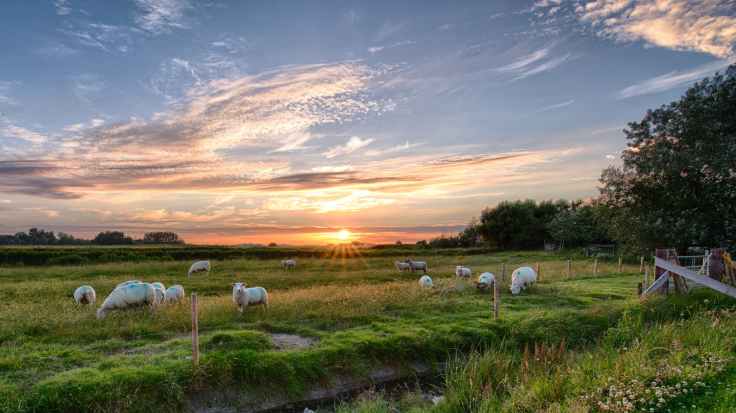
The corn is coming on fast in this area. Rain and heat mean that much of the corn was more than “knee-high by the fourth of July.” I am so thankful for farms and farmers– thankful for their hard work and planning, but also thankful for how God gives rain and sunshine in its season. It is so nice to see green fields gently swaying in the warm breezes, soaking up all the recent rains.
Other crops are blossoming, as well. It is blueberry season, and David and I hope to pick a few quarts in the next week or so. I have a small herb garden, and we are enjoying fresh basil, chives, and sage. I also have a couple of tubs of tomato plants with medium-sized green tomatoes getting ready to turn red, and some cilantro and rosemary that got a late start, but what salads we will enjoy!
While driving on my errands and to church the other day, I saw a lot of wildlife (and not-so-wild life) along the way. I saw cranes and geese, deer, a random turtle, squirrels and rabbits, sheep and cows and horses, all with their young. I saw flowers of every color and size, enjoyed the shade of trees, and enjoyed watching the clouds float through the cheery blue sky.
Everywhere, there is life! There is color and movement, singing of birds and whispers of wind. And everywhere, there is evidence of God’s goodness!
Sometimes, it is very good to push back against the busyness of errands and schedules, and just marvel at God’s creation and His provision. Nature waits on God. He supplies all the needs of the plants, the wild creatures, and the earth. And He will supply all our needs, too. Not just physical and material needs, but soul-deep needs for peace, joy, rest, purpose, and even discipline. God can lead us in “green pastures” and also through the “valley of the shadow of death.” And though the way may be challenging and even difficult sometimes, we can trust in His wisdom and guidance.
So today, I choose to use my time and space to witness God’s glory in Nature; to praise His creativity and His wisdom; and to rest in His Grace.
Tomorrow, we will celebrate Independence Day, in America. Much will be made of the freedoms we enjoy here. Many are freedoms we take for granted; others are freedoms that have been twisted or abused by our citizens, residents, and visitors.
I am very grateful for the freedoms of America. As a citizen of the U.S., I enjoy Freedom of Speech and Assembly; Freedom of Religious practice; the Right to Bear Arms; the Right to a Jury Trial with representation; the Right to Vote and participate in the democratic process; the freedom to move freely and do business across state lines, and so much more that I take for granted. But I want to be very careful to keep a proper perspective on civil and national freedoms, and citizenship in the United States. My citizenship here comes with many opportunities and freedoms, but it is not perfect. It is also not eternal– my perfect and eternal citizenship is in Heaven.
The founders of the United States, in their Declaration of Independence, listed three “unalienable” rights– “Life, Liberty, and the Pursuit of Happiness.” But they were clear about where those rights come from; not from a government, or a king, but from The Creator. Only God can give “unalienable” rights and freedoms. Governments can topple; Kings can be deposed; Laws and Constitutions can be overturned. The rights and freedoms we will celebrate this week were written on parchment, not stone. Even now, many forces are at work to “redefine” our freedoms; to alter the Constitution and the Bill of Rights– people say they are outdated, or too restrictive (or not restrictive enough!). Many want the government to have more power to define, create, and alter the rights granted in the original Constitution.
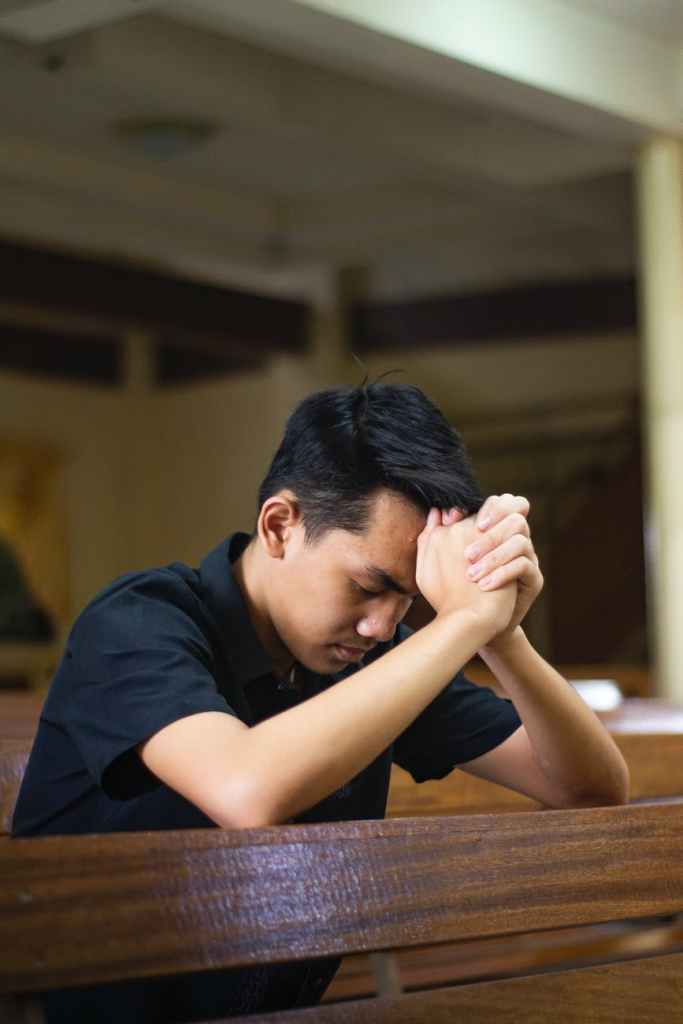
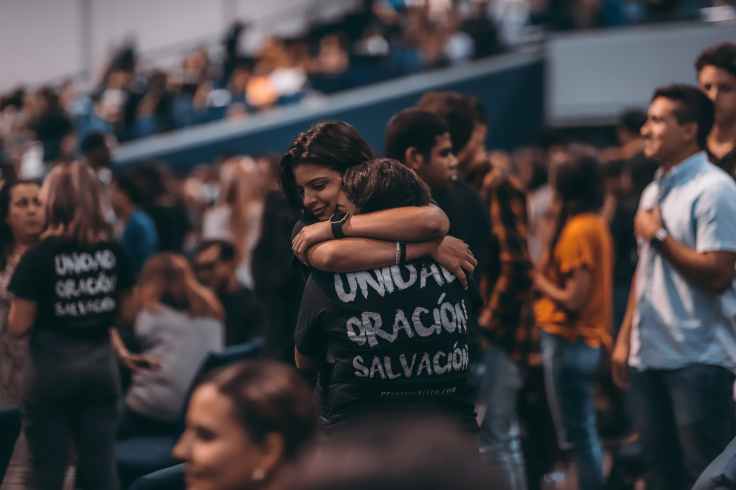
When I pray, I don’t pray to a government–even one founded on solid principles and good intentions. As much as I love my country, and support the principles of its founders, I recognize that any government can be corrupted. I may not always enjoy the freedoms I currently cherish. But even a corrupt government cannot take away my freedom in Christ to call on My Creator. I cherish the freedom I have to attend worship service, and to pray with my husband in public, or meet with other believers to share prayer requests openly. But even if those freedoms were curtailed by a corrupt government, I could still commune with God– there is no prison, or dark corner, or hospital bed, or place of exile where God cannot meet with me, hear my heart, and answer my requests.
And it is THIS freedom that I fear I take for granted most of all– that I can freely and confidently approach the very Throne of the Almighty, Sovereign God, and expect to be heard and even welcomed. I don’t have to apply for permission from a priest or the angels to pray. I don’t have to bribe someone to allow me to speak to God. I don’t have to fear that my very act of prayer will cause God to cut me off from His blessings or His presence. The Ruler of the Universe, who has the authority over not only my life and death, but my eternal existence, wants me to seek Him and talk to Him. The one who has the authority to force my obedience wants me to choose to listen to Him and follow Him.
This incredible Freedom is available to every person, regardless of their nationality. As an American, I have the freedom to speak and write, and otherwise tell about and show others about this much greater Freedom. Am I using my civil freedom to point others to eternal Freedom? Am I using this incredible Freedom to seek God’s wisdom and grace to follow Him?
21 “Not everyone who says to me, ‘Lord, Lord,’ will enter the kingdom of heaven, but the one who does the will of my Father who is in heaven. 22 On that day many will say to me, ‘Lord, Lord, did we not prophesy in your name, and cast out demons in your name, and do many mighty works in your name?’ 23 And then will I declare to them, ‘I never knew you; depart from me, you workers of lawlessness.’ –Matthew 7:21-23 (ESV)
As someone who spends her time “in pursuit” of prayer, I pay close attention when I hear others praying. People use many different phrases to address God when they pray– “Our Father in Heaven,” “Father God,” “Heavenly Father,” “Daddy,” “Papa God,” “Lord Jesus,” and many others. And there is no “right” phrase or “wrong” phrase to use. But there definitely IS a right and wrong mindset and heart attitude!
Jesus himself, shortly after teaching His disciples what is known as “The Lord’s Prayer,” talks about those who go around calling Him “Lord, Lord.” But they do not obey God, and they will not enter the Kingdom of Heaven. This suggests that that have “prayed” in some form or other, but it is merely a formality or a ritual, and not something that comes from a humble heart. Jesus goes on to tell of their insistence that they “deserve” to enter Heaven based on the incredible things they have done “in (your) name.” Most people, looking at their outward success and good works, would surely assume that they are sincere followers of Christ– after all, how else could they perform such miracles? They have called on the Name of Jesus and they have called Him, “Lord.” Yet, Jesus says of them, “I never knew you.”
What terror those words strike in the heart of those who desire to follow Christ! Is it possible that God will reject those who have called on His Name and believed on Him?
Well, Yes and No… Later in Matthew, Jesus is teaching His disciples about the final judgment, and He tells a similar story, but with more “context:” In the following parable, both the sheep and the goats claim to have done good works and both groups believe they will enter into the Kingdom of Heaven. It can be assumed that both groups have prayed at various times and believe themselves to be “known” to the Father…
31 “When the Son of Man comes in his glory, and all the angels with him, then he will sit on his glorious throne. 32 Before him will be gathered all the nations, and he will separate people one from another as a shepherd separates the sheep from the goats. 33 And he will place the sheep on his right, but the goats on the left. 34 Then the King will say to those on his right, ‘Come, you who are blessed by my Father, inherit the kingdom prepared for you from the foundation of the world. 35 For I was hungry and you gave me food, I was thirsty and you gave me drink, I was a stranger and you welcomed me, 36 I was naked and you clothed me, I was sick and you visited me, I was in prison and you came to me.’ 37 Then the righteous will answer him, saying, ‘Lord, when did we see you hungry and feed you, or thirsty and give you drink? 38 And when did we see you a stranger and welcome you, or naked and clothe you? 39 And when did we see you sick or in prison and visit you?’ 40 And the King will answer them, ‘Truly, I say to you, as you did it to one of the least of these my brothers, you did it to me.’ 41 “Then he will say to those on his left, ‘Depart from me, you cursed, into the eternal fire prepared for the devil and his angels. 42 For I was hungry and you gave me no food, I was thirsty and you gave me no drink, 43 I was a stranger and you did not welcome me, naked and you did not clothe me, sick and in prison and you did not visit me.’ 44 Then they also will answer, saying, ‘Lord, when did we see you hungry or thirsty or a stranger or naked or sick or in prison, and did not minister to you?’ 45 Then he will answer them, saying, ‘Truly, I say to you, as you did not do it to one of the least of these, you did not do it to me.’ 46 And these will go away into eternal punishment, but the righteous into eternal life.” –Matthew 25:31-46 (ESV)
We can call Christ “Lord” without actually making Him our LORD. We can pray to God without seeing Him for who He really IS. And we can follow “Christianity” without actually following CHRIST.
I think the phrase that Jesus uses in the first quote is very telling. The people call Him “Lord, Lord.” And then, they go into a litany of things “WE have (done) in your name” (emphasis added). They do NOT call Him “Father” or even “LORD” (In the Bible, the term, “LORD” is “Adonai”, which is the substitute for Yahweh– the actual NAME of God, sacred to the Hebrew authors. It is not like “lord” as we might use for any nobleman or someone in authority, but is reserved only for the One with ultimate authority and majesty. In other words, not “Lord, Lord” but “LORD– the ONLY LORD”). Instead, they call Him, “Lord, Lord”. And they boast of the spectacular and even superhuman things THEY have done. But one of the things they fail to mention is prayer. They have used His name, but they have not necessarily called on His name– except as a formality. They have not spent time in communion with Jesus. They have not asked for His will to be done. They have not come to Him in humility or praise for HIS mighty works, only in arrogance of how they have done miracles similar to His. Nowhere do they mention following in service, as Jesus taught His disciples, nor do they mention suffering in His Name! In the later parable, both groups (the “sheep” and the “goats”) were startled by the examples Jesus gave of what they HAD or HAD NOT done. These were simple acts– humble acts rendered to outcasts, rather than showy acts of power. They were acts that materialized (or didn’t!) out of humility and compassion, rather than power or favor.
True followers of Christ will take up His yoke. They will listen for His voice, and they will be eager to obey. They will serve like Him– they will stay yoked to Him in humility and in submission. If you wonder whether or not you are truly following Christ– this is a good test. Satan will always try to make us feel as though WE must carry the load, proving ourselves worthy. He may tempt us to compare ourselves with others who seem to be “winning” at Christian service by getting noticed or listing multiple achievements. But our eyes should not be on others or even on ourselves or our accomplishments. Our eyes should be focused on God– what He has done for us on the Cross; what He is doing in our lives as we obey Him; and what He chooses to do through us as we continue to follow Him–even when it seems that we are doing very little things. We may never know in this life how important our small acts of service really are. In God’s economy, they are huge. Heaven rejoices over such small things as giving a cup of water to a thirsty child, or smiling at a lonely person on the bus, or visiting someone in the hospital or in a jail cell. The world needs more humble servants and fewer TV evangelists. (Note: I am not saying that TV evangelists cannot be doing the work of God– but I am saying that I see very few humble celebrity pastors…just an observation.) And, as the Apostle Paul reminds us, God’s strength is shown best in our weakness. (see 2 Corinthians 12:9) As we come to Him in prayer, in dependence and in humility, God’s power is perfected. As we respond in obedience, our life is brought into conformity with His.
Today, as I pray, “Lord Jesus” or “Heavenly Father,” I pray that I will do it with the right spirit. I pray that I will be quick to praise, quick to obey, and eager to seek my Father’s face, instead of my own validation. After all– Jesus is LORD!
We were reviewing last week’s VBS at our church–sharing stories, “crunching” numbers, evaluating the various elements that made up each day… One of the phrases that came out of our various talks and meetings was that Bible School week had been “bathed in prayer.” What does that actually mean?
For me, it represents how prayer surrounded us– much like bath water.
It covered every part of our efforts– we prayed for the children who were registered– and those who came unexpectedly as guests. We prayed for the families of the children–those from our church, those from neighboring churches, and those who are unchurched. We prayed for all the volunteers– teens, adults, those who where there each day of VBS, and those who helped before and after with decorations, building, providing supplies and funding, advertising, etc. We prayed for each team– teaching, drama, singing, videography, sound and lights, registration, group leaders, science and crafts, snacks, sports and games, record-keeping, security, and more! We prayed weeks before VBS, and we are still praying that the seeds planted last week will grow and produce a harvest!
It flowed freely. We had organized prayer meetings, and spontaneous outbursts of prayer. We prayed in the “opportune moment” and in the planned schedule. Prayer was a consistent part of each day, but came in random bursts, as well. It came from staff, from volunteers, from children and retirees. Everyone can’t work at VBS– but everyone can pray!
It “cleansed” our efforts. It is easy to get side-tracked with the chaos and fol-de-rol of an event like Bible School. It is easy to lose focus and let stress, frustration, and even bitterness worm their way into our efforts. On the very first day, our registration and check-in system crashed– and this could have been a disaster. But we had prayed before; we prayed during our confusion, and we praised God that, system or no, HE knew who was there, where they should go, and how we should respond to THEM. We are in the middle of a construction project in our children’s wing– we had to plan around fewer classrooms available, and less indoor space. On the hottest week of the summer (so far) we had to hope that the weather would cooperate for our games. God provided cloud cover on at least two of the mornings, and overnight showers– we did not have to deal with heavy rains or the worst heat of the day on any of our days! And (at least partly) because we had prayed in advance, we were grateful instead of stressful about our circumstances, marveling at God’s provision.
Praying brings peace– like the clean and relaxed feeling you have after a good soak in the bath! And I hope that peace was reflected in the way we welcomed each child each day– in the way we listened, and in the way we spoke; in the way we encouraged, and in the way we taught; in the way we interacted with the children, and with the other volunteers.
We tend to “bathe” our “big concerns” in prayer. But what about our “little things?” What if we spent as much time praying about our next doctor appointment? Our next church service? Our next family outing?
We NEED prayer! Our efforts, without prayer, humility, and submission to the Spirit of the Lord, will be fruitless. With prayer, our lives, efforts, and plans will be clean, and bring Glory to God!
Just a thought– but if we bathed more things in prayer, we might just receive more “showers of blessing!”
I spent last week helping out at Vacation Bible School. But most of the kids didn’t see me “working.” I was behind a curtain, helping with the puppet show. My puppet was a little boy named “JJ.” He was a hand puppet. Hand puppets are pretty simple to operate– you stick your hand inside the puppet, and move its mouth as you talk. There are also “hands” you can operate with your fingers to make the puppet clap or wave, etc. During the course of the week, “JJ” also had one “costume change”– he wore a simple plastic bag poncho, but he put it on backwards. “JJ” was the comic relief of the puppetry team! But his purpose was to expand on the Biblical principles we were teaching throughout the week. “JJ” learned about sin and its effects– often by example– and about God’s forgiveness. And he helped the younger kids review their daily Bible verse.
I have worked with puppets off and on over the years, especially during my time as a youth services librarian. Puppets help tell stories in an entertaining and engaging way. But puppets are merely tools. The same stories can be told using flannel cut-outs, or videos, or illustrated comic books. In fact, everything that “JJ” did was scripted. If he nodded, it was because the script said to nod. If he sang, the song was in the script. And when the puppet show was done for the day, “JJ” rode around in a canvas bag, lifeless and unused.
We use puppets at VBS to teach about Christian principles– but pursuing a Christian life is NOT about being a puppet. Many people reject Christ, because they believe that God is asking them to become puppets. They learn about concepts like the indwelling of the Holy Spirit, and it sounds to them as though God will “possess” them, and take away their free will and their ability to live life on “their” terms. But that is not what Jesus taught. Jesus was perfect in Righteousness– yet he clearly CHOSE to follow His Father’s instructions, and he did it using His own unique personality and style. Jesus did not parrot the words of God when He taught. He told stories– parables– that brought God’s laws and commands to life, and helped people understand them better. Jesus was no puppet. And He doesn’t ask us to be puppets, either. Instead, we are witnesses– telling our own stories, living our own lives–SHOWing others how Christ lives THROUGH us. God doesn’t want “tools” or mindless puppets. He wants a relationship with us that gives our unique experiences an eternal and sacred purpose.
Yes, in Christ, we become a “new creation.” (see 2 Corinthians 5:17) We see the world through a different lens; our minds are renewed (see Romans 12:2); we follow Christ’s example and walk in obedience to God. But we do so out of our desire to be closer to God– our desire to pursue the relationship that only God can offer us. The Holy Spirit indwells us; He doesn’t coerce us or take over our mind– rather, He helps us continue in our newness and progress toward greater Godliness!
It was fun to spend a week using “JJ” to help teach the daily lessons. But we had dozens of amazing volunteers who also made VBS memorable, fun, and, hopefully a life-changing week for the kids who came. There were the actors who did a daily skit; the singers who taught the kids vibrant songs and dance moves; the Bible teachers who explained deep issues with wonderful skill; the volunteers who taught science lessons and crafts that tied in with our daily themes; the food staff, who created treats that told a story; the sports team that provided games (and plenty of water on hot days!) and the group leaders, greeters, and security staff that ensured that the kids were welcomed, introduced to others, and kept safe. Each of us lived out the message of the Gospel– God’s love for each of His children!– in our unique ways.
One of the ways we served last week was in prayer. We prayed together as a team. We prayed in our small groups and areas, and we prayed with the kids. And each person’s prayer was unique. Some people get nervous about praying aloud in a group– others are eloquent speakers. But each person’s prayer shows their heart for God and others. In our puppet skit, JJ talked about wanting to pray with his “granny” after the skit. But the puppets never prayed. And I think that is appropriate. Prayer is not about a “script.” Prayer is not about someone else putting words in your mouth. Prayer doesn’t come from a hand or a finger moving us to speak. Prayer comes from the heart. And I hope the kids (and adults) last week were moved more by our prayers than by our puppets!
This weekend, my husband, our middle grandson, and I all participated in “Field Day.” This is a 24-hour simulation and contest for amateur radio (Ham radio) operators (like David and I) to test our skills and practice our hobby. Thousands of “Hams” across the United States and Canada spend this time trying to make as many radio contacts as possible. But the object is to try to do it under “field” conditions– many groups or clubs literally set up tents in fields during this time (weather permitting!) and use solar or battery power only. There are also ways to earn “bonus” points by setting up in a public area and teaching or training young people (like our grandson) or inviting other non-licensed people to transmit under supervision. The overall goal is to have fun and share the importance of amateur radio. At the same time, we’re testing both our equipment and our skill under situations that mimic an emergency, like an extended power outage or a natural disaster, when effective and organized radio communication may help save lives.
We aren’t trying to “win” the competition, but we do try to do our best– rising to the challenge. It was a lot of fun this year to see our grandson get excited about making contact with people from Canada, and many areas of the U.S. in states he has never visited in “real life!” In previous years, we have joined up with a local club, or invited friends or neighbors to contest with us. Each year, there is the triumph or making a “difficult” contact– someone from across the continent, or someone from a remote area. And every year there is the frustration of “the ones that got away”– listening in and finding the right frequency, but being unable to both receive AND send the message necessary for a valid contact
Every year during Field Day, I am reminded of how tenuous radio communication can be. Radios are the original “wireless” communication– the forerunners of our modern cell phones. Operators must “tune” their radios to pick up on the sound waves floating through the air. There are billions of sound waves, all floating around the atmosphere. We cannot hear them with our “naked” ears– and a good thing, too! We would never be able to distinguish all the noises that pass around and above us every moment. In fact, when radios pick up on just a single frequency at a time, much of what we hear is buzzing “static.” Most modern radios and cell phones use special equipment, such as filters and “repeaters” to find specific sound waves, translate them, amplify them “above” the static, and allow us to hear messages clearly. Field Day forces us to operate without a lot of these “helpers.” Voices and Morse Code transmissions must be carefully “brought out” of the surrounding static in order to receive even simple messages. And even if I can hear someone else’s message, they must be able to hear my response, or it isn’t a true “contact.”
Field Day also reminds me of prayer– and gives me reason to rejoice! Just imagine the overwhelming volume of prayer on a typical day! With over 8 billion people on the earth, even if only a tenth of them pray on any given day, that’s still millions of prayers all rising up and floating around the universe. And God hears them all! He doesn’t just hear the “noise” of prayer– He hears our hearts! He feels our pain– and our praise! In fact, the Bible even says of our praise, that God “inhabits” the Praises of His People (Israel– see Psalm 22:3) God rides the wavelengths of our worship! And He surrounds the soundwaves of our grieving. God doesn’t have to strain to hear us, or to understand the emotion behind our prayers. Praying is not like sending a message into radio airspace. We never have to wonder if God will be able to hear us through the static! We never have to know the frustration of screaming out into the universe and being lost in the noise.
But listening through the static on Field Day also challenges me…Am I “tuning in” to God’s messages to me? Do I surround myself with extra “static” as I go through my day? Or do I spin my dial, trying to find other voices; other messages to fill the space of my life? If God inhabits praise– Am I offering Him any dwelling space? Or have I filled it up with empty praises and pursuits? And, as God’s witness and ambassador, how well am I listening to those around me? Am I busy adding my “noise” to conversations when I should be “tuning in” to someone else’s need?
Today looks like a great day for a Prayer-themed “Field Day.” Time to test my communication with God– both sending Him praise and petition, and listening for His answer above all else! And it’s a great day for spreading the great news of God’s desire to listen to us– no matter what static we live in!
I’ve been exploring the Apostle Paul’s first letter to the Corinthians; specifically chapter 13, verse 13. Paul states that there are three virtues that remain, after all else has passed away or been lost: Faith, Hope, and Love. And, while the other two are great and necessary, the greatest is Love.
So much has been written about Love– poets and prophets, songwriters and storytellers. most would agree that Love is the greatest virtue. But they wouldn’t all agree on what “Love” is. The Greeks have three different words for love– in fact most languages have more than one word– English has dozens of synonyms: Love, adore, desire, passion, enamored, infatuated, devoted…you get the idea. Except there are several ideas, so how do we know which kind of love remains? What kind of love endures beyond life and time and against every obstacle?
Human love is fallible; it is temporal (and sometimes even temporary). It doesn’t last forever– in spite of poetic promises and sacred vows. People “fall in love” and they fall out of love. Human love grows deeper; but it can also grow cold. It can be conditional, and manipulative; selfish, and shallow. Human love is often based on feelings that change with the seasons. We “love the whole world” when we are feeling good–we love mankind, but can’t stand our next door neighbor!
God’s love is eternal and unconditional. It never depends on His “mood.” It never depends on who we are or what we have done. God loves because it is His nature. He IS Love. He is the definition of enduring, everlasting, boundless, endless LOVE. This is the Love that endures. It is the Love that changes us from the inside out, and changes the world around us. It is this Love that infuses our Faith, that inspires our Hope, and allows us to approach a Holy God and share His Mercy and Grace with those we might otherwise deem “unlovable.”
We are living through chaotic times, filled with raw and dangerous emotions– anger, hatred, pride, despair, resentment, greed, grief, and fear. God’s love is more than just another emotion. I cannot love my enemy with human emotion– nor does God ask me to. God loves through us– it is His Love that we need to access and carry with us into the darkness. I want to bring Love into the world– and I want to be seen as a Loving person. But God asks me to Love even when it is rejected; even when I am seen as the enemy; even when I get hurt in the process. That doesn’t mean that I invite or tolerate abuse because I think it makes me more virtuous or because I think I somehow deserve it. But it does mean that I continue to pray, I continue to have Faith and Hope that God will turn even the smallest acts of Love into seeds that will return a harvest in His time and in His way.
When I look at the life of Jesus Christ, that is just what He did. He had the power to destroy the corrupt Temple system– He demonstrated just a particle of His passion when He drove the money changers out of the Temple courtyard (Matthew 21:12-13). He could have led a rebellion against the oppressive Roman Empire. (In fact, that is one reason He was rejected as the Messiah. He chose not to use His power for political or economic gain– even for the benefit of His own people.) He had the power to wipe out leprosy, or blindness, or demon possession– He could have been the most powerful man on Earth, and single-handedly put an end to poverty, injustice, and so much more. If solving those issues for His people in His lifetime would have been the most loving thing– He would have done it. But He spent His time listening to and helping individuals in need– those who had lost hope, those who needed healing, those who were carrying guilt and doubt and grief. He spent His time, not just talking about Love, but demonstrating Love– personal, unconditional, life-giving Love. Jesus spoke to crowds, yes, but most of His time was spent in small groups or one-on-one– teaching, eating, listening, caring–Loving.
Loving this way takes time– it takes effort, and it comes with risk. Jesus, loving in just this way, was misunderstood, rejected, hated, even killed. But His Love conquered death, and brought life and victory. I may not be asked to become a martyr– but will I seek to Love like Jesus? Will I pray for people I don’t know; or people who have opposed me, or rejected me? Will I continue to love those who have hurt me in the past, or rejected my help? Will I reach out in Love to people who are in rebellion against God? People who mock Him, cry out against Christians, persecute us–even kill us? Will I pray for and support those who are in danger because they are showing God’s Love in this way? Because whether I do or not– Love Remains. Will I be Faithful? Will I reach out in Hope? Will I risk Loving as Christ Loves?
We live with the same brokenness that Jesus faced during His ministry. People around us are hurting– we are hurting! But our Faith tells us that God hears our prayers. Our Hope tells us that God has a plan for the future. And our Love compels us to share the burdens of others as we wait for Christ’s return.
Jesus WILL someday “fix” the brokenness of this world. He WILL Reign and Rule for Eternity. But He asks us to live with the three virtues that ensure that we will overcome the darkness of our own world– that will cause us to shine a light in the darkness–Faith, Hope, and Love!
I have to start this by saying I don’t always feel particularly hopeful as I look around and hear all that is happening. There are a lot of reasons to be discouraged, even depressed. Upheaval, suffering, injustice, disasters, anger, death, and evil surround us at nearly every turn. I can say that my Faith sustains me, and it does, but I still feel beaten down and exhausted by all the chaos and hurt and anger and misunderstanding.
Faith sustains us in times of trouble, but our hearts can still feel heavy. Faith tells us that God is in control, but we can feel powerless in the midst of suffering. What keeps us motivated to look for the best on even the worst of days? What allows us to have joy even as we grieve and strain and suffer? Faith is our anchor, but what renews our strength, and keeps us looking beyond the storm?
In 1 Corinthians 13, the Apostle Paul talks about things that are temporary– possessions, knowledge, gifts, prophecies– and three things that remain: Faith, Hope, and Love. Last time, I wrote about Faith. But Hope is a more difficult and more nebulous concept. The writer of Hebrews defines Faith for us– “the substance of things hoped for; the evidence of things not seen” (Hebrews 11:1). But there is no substance or evidence for Hope. Hope is not a physical anchor; it is not a realization. Neither is it a mere wish, or dream; at best, it is an expectation. Yet Paul says it “remains,” even when other things pass away.
How is this possible– that a Christian should Hope after all else has been lost, abandoned, or destroyed? Isn’t Faith more solid, more important, than Hope? Aren’t knowledge, obedience, and perseverance more important and more tangible? Isn’t hope wispy, fleeting, and conditional? Lately, it sure seems so. I say that I hope we all get through these tough times; that we will come through all this stronger, wiser, more compassionate, more just, more prepared, etc., but what am I really hanging on to? Where is my Hope?
My Hope DOES have substance and a sure foundation–in the life, death, and resurrection of Jesus Christ, and in the sure promises of my Heavenly Father! I may have wispy dreams and half-formed wishes of what I would like to see in my life or in the world around me tomorrow, or next year. I may have dreams and visions of what Peace and Justice and Health look like– and I may never see them materialize in my lifetime. I may have to adjust my vision within the temporary world of possessions, and gifts, prophecies and human systems of government and society. But I can remember the life of Christ; in spite of His circumstances, He remained true to His purpose. In His death, He remained compassionate, humble, and loving toward those who hated Him. In His resurrection, He brought eternal Hope to all who choose to trust Him. I can Hope because He fulfilled God’s promises. He WAS Hope. He gave Hope, and He demonstrated Hope. And He pointed to the Hope of His return and our eternal destiny!
I can be inspired by the dreams and hopes of other Christians throughout the years, even if their dreams have not been realized. I can be inspired by the prophecies of others, even if they don’t match my visions. And I CAN see beyond the darkness of the moment (or the year) to see that people (even I) can change; situations can change; circumstances can change; rhetoric and tone can change for the better. Painful valleys and unexpected upheaval may not be what I would want, but sometimes, it serves to clear out the “sinking sand” where dream houses would otherwise be built.
And Hope is necessary to Prayer– Faith tells us that God hears, even when we can’t see Him or hear His answer. Hope tells us that God cares. He is not aloof in hearing our prayers. He doesn’t answer us out of some worn sense of duty or obligation. He doesn’t just give us His law or even His forgiveness– He gives us restoration and Hope and abundant life! Hope for change in our own lives; hope for progress and healing in our world; hope for victory over sin and evil. Most of all, hope for eternity. God is just and merciful, but He is also gracious and loving beyond all measure. I can cry out when all other hope is gone– His Hope Remains! His Hope is a Solid Rock. His Hope comes with an eternal guarantee.
(I will be working at our church’s Vacation Bible School all this week, so I am re-posting three entries from a couple of years ago on Faith, Hope, and Love. I will be back with new posts next week.)
If I speak in the tongues of men or of angels, but do not have love, I am only a resounding gong or a clanging cymbal. 2 If I have the gift of prophecy and can fathom all mysteries and all knowledge, and if I have a faith that can move mountains, but do not have love, I am nothing. 3 If I give all I possess to the poor and give over my body to hardship that I may boast, but do not have love, I gain nothing.4 Love is patient, love is kind. It does not envy, it does not boast, it is not proud. 5 It does not dishonor others, it is not self-seeking, it is not easily angered, it keeps no record of wrongs. 6 Love does not delight in evil but rejoices with the truth. 7 It always protects, always trusts, always hopes, always perseveres.8 Love never fails. But where there are prophecies, they will cease; where there are tongues, they will be stilled; where there is knowledge, it will pass away. 9 For we know in part and we prophesy in part, 10 but when completeness comes, what is in part disappears. 11 When I was a child, I talked like a child, I thought like a child, I reasoned like a child. When I became a man, I put the ways of childhood behind me. 12 For now we see only a reflection as in a mirror; then we shall see face to face. Now I know in part; then I shall know fully, even as I am fully known.13 And now these three remain: faith, hope and love. But the greatest of these is love.
I love reading God’s word. I spent much of my youth memorizing scripture, and much of my adulthood trying to recall what I learned then! One chapter I memorized was 1 Corinthians 13– commonly known as the “Love” chapter.
But near the end of the chapter, Paul talks about what remains, and what doesn’t–he says that prophecies and knowledge will pass away, and things that are incomplete will disappear. He lists three things that will remain. We often spend a lot of time on Love (and I will get there eventually), but I want to talk about all three, why they must remain, and why they are connected in prayer. I will begin today with Faith.
Faith, as we learn in Hebrews 11:1, is “the substance of things hoped for, the evidence of things not seen.” Faith is foundational. Faith gives us roots. Faith is an anchor. Faith keeps us grounded and strong. But Faith, as the above metaphors suggest, is deep and unseen. I can’t “show” you an anchor when it is in use. If I pull up a tree to see its roots, or tear down a building to show off its foundations, I will destroy the very thing I am trying to illustrate.
And Faith demonstrates itself best under testing. I have to admit, the last couple of years have been a difficult test of my Faith, and that of many others. Do I REALLY believe that God exists? That He cares? That He listens to prayer? That He answers? It is easy enough to say all that, but when everything around looks murky and uncertain, do my actions match my words? Do I live as though God is in control? Is His word still an anchor for me when it doesn’t seem to “work?” Do my prayers reflect confidence and praise in the midst of unrest, disease, and death? Are my prayers filled with Faith that God is who He says He is, and that He will do what He has promised? Or are my prayers timid and empty– wispy wishes, instead of honest heart-cries?
Where is my faith? Is it in myself? My words? The words of other people?My actions and deeds? In powerful groups? Governments? Money? Chance? Even Religion? Does my Faith rest in following the laws of the Bible? Does it rest in knowing the “right” picky points of theology? Or does it rest in the One who is unchanging, eternal, and all-powerful?
The world is screaming. The world is filled with fire, smoke, flashing lights and violent voices. Is God silent? Is He being drowned out or hidden by the chaos we’re walking through? Or am I listening to wrong voices, and focusing on smoke and fog?
I can’t show you the roots of my Faith in this moment. I can’t see them, and sometimes, I feel shaken. But, as Job declared, “I know my Redeemer lives” (Job 19:25a)! I will continue to declare that God DOES exist. He DOES care. He DOES listen. And He WILL answer. And I will continue to Hope and Love in light of this Faith. I will continue to seek patience, and kindness, humility, truth, justice, and perseverance as I reach out to others. And I must continue to develop Faith in the midst of difficult times. It is the anchor upon which Hope and Love rest.
Of David. 1 The Lord is my light and my salvation— whom should I fear? The Lord is the stronghold of my life— whom should I dread? 2 When evildoers came against me to devour my flesh, my foes and my enemies stumbled and fell. 3 Though an army deploys against me, my heart will not be afraid; though a war breaks out against me, I will still be confident. 4 I have asked one thing from the Lord; it is what I desire: to dwell in the house of the Lord all the days of my life, gazing on the beauty of the Lord and seeking him in his temple. 5 For he will conceal me in his shelter in the day of adversity; he will hide me under the cover of his tent; he will set me high on a rock. 6 Then my head will be high above my enemies around me; I will offer sacrifices in his tent with shouts of joy. I will sing and make music to the Lord. 7 Lord, hear my voice when I call; be gracious to me and answer me. 8 My heart says this about you: “Seek his face.” Lord, I will seek your face. 9 Do not hide your face from me; do not turn your servant away in anger. You have been my helper; do not leave me or abandon me, God of my salvation. 10 Even if my father and mother abandon me, the Lord cares for me. 11 Because of my adversaries, show me your way, Lord, and lead me on a level path. 12 Do not give me over to the will of my foes, for false witnesses rise up against me, breathing violence. 13 I am certain that I will see the Lord’s goodness in the land of the living. 14 Wait for the Lord; be strong, and let your heart be courageous. Wait for the Lord.
There are a lot of scary things in our world– war, disaster, taxes, death, violence, injustice, disease, uncertainty, evil, darkness, even supernatural and spiritual darkness–enough to keep us frightened and sleepless every night! And we spend a lot of our time fearing the unknown–worrying about the future; worrying about things that have not happened, and may never happen! We worry about things that matter– the health and well-being of our loved ones, uncertainty about our job or home, crime and civil unrest in our nation or neighborhood, difficult decisions with serious consequences. We worry about things that are less urgent–someone laughing at us, hair loss, dropping a phone call, running out of gas, losing a game or an argument…
David had some real reasons to be fearful as he wrote Psalm 27–evildoers, enemies, war and armies, false witnesses, and violence. Yet, he found safety and strength in the Lord. We can take comfort in the message of this Psalm–God is faithful. He is strong. He is eternal and unchanging. He is a stronghold we can trust.
But before we get too comfortable, let’s take a closer look. David’s trust is not based on a superficial knowledge about God. David’s trust comes as a result of seeking God’s face and following in “your way” (v. 11). David’s life was proof of God’s strength and protection, because David’s life was filled with fearsome adversaries!
Many generations after David penned this Psalm, the prophet Amos wrote to the people of Israel– people who knew this comforting psalm, but had lost their fear–people who no longer sought the Lord’s protection or His ways.
Amos 5 Christian Standard Bible (CSB)
5 Listen to this message that I am singing for you, a lament, house of Israel: 2 She has fallen; Virgin Israel will never rise again. She lies abandoned on her land with no one to raise her up. 3 For the Lord God says: The city that marches out a thousand strong will have only a hundred left, and the one that marches out a hundred strong will have only ten left in the house of Israel.
4 For the Lord says to the house of Israel: Seek me and live! 5 Do not seek Bethel or go to Gilgal or journey to Beer-sheba, for Gilgal will certainly go into exile, and Bethel will come to nothing. 6 Seek the Lord and live, or he will spread like fire throughout the house of Joseph; it will consume everything with no one at Bethel to extinguish it. 7 Those who turn justice into wormwood also throw righteousness to the ground. 8 The one who made the Pleiades and Orion, who turns darkness into dawn and darkens day into night, who summons the water of the sea and pours it out over the surface of the earth— the Lord is his name. 9 He brings destruction on the strong, and it falls on the fortress. 10 They hate the one who convicts the guilty at the city gate, and they despise the one who speaks with integrity. 11 Therefore, because you trample on the poor and exact a grain tax from him, you will never live in the houses of cut stone you have built; you will never drink the wine from the lush vineyards you have planted. 12 For I know your crimes are many and your sins innumerable. They oppress the righteous, take a bribe, and deprive the poor of justice at the city gates. 13 Therefore, those who have insight will keep silent at such a time, for the days are evil. 14 Pursue good and not evil so that you may live, and the Lord, the God of Armies, will be with you as you have claimed. 15 Hate evil and love good; establish justice in the city gate. Perhaps the Lord, the God of Armies, will be gracious to the remnant of Joseph. 16 Therefore the Lord, the God of Armies, the Lord, says: There will be wailing in all the public squares; they will cry out in anguish in all the streets. The farmer will be called on to mourn, and professional mourners to wail. 17 There will be wailing in all the vineyards, for I will pass among you. The Lord has spoken.
18 Woe to you who long for the day of the Lord! What will the day of the Lord be for you? It will be darkness and not light. 19 It will be like a man who flees from a lion only to have a bear confront him. He goes home and rests his hand against the wall only to have a snake bite him. 20 Won’t the day of the Lord be darkness rather than light, even gloom without any brightness in it? 21 I hate, I despise, your feasts! I can’t stand the stench of your solemn assemblies. 22 Even if you offer me your burnt offerings and grain offerings, I will not accept them; I will have no regard for your fellowship offerings of fattened cattle. 23 Take away from me the noise of your songs! I will not listen to the music of your harps. 24 But let justice flow like water, and righteousness, like an unfailing stream. 25 “House of Israel, was it sacrifices and grain offerings that you presented to me during the forty years in the wilderness? 26 But you have taken up Sakkuth your king and Kaiwan your star god, images you have made for yourselves. 27 So I will send you into exile beyond Damascus.” The Lord, the God of Armies, is his name. He has spoken.
The people have an outward confidence– they believe themselves to be under God’s protection and blessing. They offer sacrifices and sing worship songs and revel in their success and peace. But God’s words are frightening and urgent. Those who arrogantly call for the “Day of the Lord,” expecting God to pass judgment on their enemies will find to their shock and horror, that God’s wrath falls on them as well. Their confidence has been misplaced, because it has rested on a false picture of God, and an exaggerated sense of their own righteousness. God warns them that judgment is coming– and even as He does, He issues an invitation– “Seek me and live!” (v. 4– see also v. 6 and v. 14). God has withheld judgment, He has given His people opportunity to follow His way. Instead, they have followed the ways of the very enemies they used to fear! Their feasts and festivals have become nothing but a mockery and an affront to God–the same people who claim to worship Him are perverting justice and oppressing the poor. They cheer for evil and refuse to listen to the truth.
God is a stronghold and a light to banish fear and darkness–but a stronghold or tower cannot protect you if you are wandering alone and unprotected or worse yet, if you are leaving the tower to embrace the enemy in the dark! God doesn’t just want to be a light at the end of the tunnel– He wants to be a light to show us the road right in front of us, and a light to banish the darkness where our enemy hides! When we have a proper “fear” of the Lord– when we recognize His wisdom, strength, and sovereignty– when we seek Him in humility and awe and need, and dwell with Him, we need not fear anyone or anything else. When we make empty boasts about God’s favor and protection while ignoring His ways, and we drown out His loving warning and His call to return to safety…we should be afraid– very afraid!
Father, may I find my confidence only in You. I want to dwell in Your house and seek Your face today and every day. Thank You for being eternally strong, righteous, faithful, and merciful! Thank you for giving us warnings and providing restoration, hope, and salvation. In Jesus’ Name, Amen.








































 Pursuing Prayer