“Don’t Mess With Mister In Between”

This popular song came out in 1944, as thousands of soldiers were dying in World War 2, and millions were facing homelessness and starvation in Europe, Asia, and northern Africa. Its syncopated rhythms and upbeat lyrics helped focus minds and hearts on hope in a world torn apart by war, hatred, and despair. Further lyrics refer to biblical characters Jonah and Noah, and their experiences facing “dark” times.

The Bible gives us similar (and more specific) advice. The Apostle Paul wrote from prison to believers in hard-pressed Philippi:

Do not be anxious about anything, but in every situation, by prayer and petition, with thanksgiving, present your requests to God. And the peace of God, which transcends all understanding, will guard your hearts and your minds in Christ Jesus. Finally, brothers and sisters, whatever is true, whatever is noble, whatever is right, whatever is pure, whatever is lovely, whatever is admirable—if anything is excellent or praiseworthy—think about such things. Philippians 4:6-8 (NIV)

In other words– Accentuate the Positive and latch on to the affirmative!

To the Ephesian believers, he says:

The Old Way Has to Go (or, Eliminate the Negative):

And so I insist—and God backs me up on this—that there be no going along with the crowd, the empty-headed, mindless crowd. They’ve refused for so long to deal with God that they’ve lost touch not only with God but with reality itself. They can’t think straight anymore. Feeling no pain, they let themselves go in sexual obsession, addicted to every sort of perversion. But that’s no life for you. You learned Christ! My assumption is that you have paid careful attention to him, been well instructed in the truth precisely as we have it in Jesus. Since, then, we do not have the excuse of ignorance, everything—and I do mean everything—connected with that old way of life has to go. It’s rotten through and through. Get rid of it! And then take on an entirely new way of life—a God-fashioned life, a life renewed from the inside and working itself into your conduct as God accurately reproduces his character in you. What this adds up to, then, is this: no more lies, no more pretense. Tell your neighbor the truth. In Christ’s body we’re all connected to each other, after all. When you lie to others, you end up lying to yourself. Go ahead and be angry. You do well to be angry—but don’t use your anger as fuel for revenge. And don’t stay angry. Don’t go to bed angry. Don’t give the Devil that kind of foothold in your life. Did you use to make ends meet by stealing? Well, no more! Get an honest job so that you can help others who can’t work. Watch the way you talk. Let nothing foul or dirty come out of your mouth. Say only what helps, each word a gift. Don’t grieve God. Don’t break his heart. His Holy Spirit, moving and breathing in you, is the most intimate part of your life, making you fit for himself. Don’t take such a gift for granted. Make a clean break with all cutting, backbiting, profane talk. Be gentle with one another, sensitive. Forgive one another as quickly and thoroughly as God in Christ forgave you. Ephesians 4:17-32 (The Message)

But what does it mean when the song says, “Don’t mess with Mister In Between”? The Bible gives some advice on this as well. The Apostle James has much to say about such a man in the first chapter of his epistle. He talks about being steadfast, not doubting, not double-minded, and not swept up in temptation, blaming others, and justifying his own philosophies:

22 But be doers of the word, and not hearers only, deceiving yourselves. 23 For if anyone is a hearer of the word and not a doer, he is like a man who looks intently at his natural face in a mirror. 24 For he looks at himself and goes away and at once forgets what he was like. 25 But the one who looks into the perfect law, the law of liberty, and perseveres, being no hearer who forgets but a doer who acts, he will be blessed in his doing. James 1:22-25 (ESV)

To James, “Mister In Between” is a shadow man, a person without root or discipline, who will listen to the word of truth, but then turn back to the darkness of the world to justify inaction and/or wrong actions. Mister In Between wants to straddle the fence between sin and obedience, revenge and forgiveness, anger and patience, comfort and compassion. But that doesn’t work. Such a person lives in a false reality– one where his/her “truth” changes with each new experience or emotion, each new encounter with pleasure or grief.

Jesus Himself spoke of the dangers of living “In Between”:

Then he said to them all: “Whoever wants to be my disciple must deny themselves and take up their cross daily and follow me. 24 For whoever wants to save their life will lose it, but whoever loses their life for me will save it. 25 What good is it for someone to gain the whole world, and yet lose or forfeit their very self? 26 Whoever is ashamed of me and my words, the Son of Man will be ashamed of them when he comes in his glory and in the glory of the Father and of the holy angels… 62 Jesus replied, “No one who puts a hand to the plow and looks back is fit for service in the kingdom of God.” Luke 9:23-26;62 (NIV)

13 “You are the salt of the earth. But if the salt loses its saltiness, how can it be made salty again? It is no longer good for anything, except to be thrown out and trampled underfoot.14 “You are the light of the world. A town built on a hill cannot be hidden. 15 Neither do people light a lamp and put it under a bowl. Instead they put it on its stand, and it gives light to everyone in the house. 16 In the same way, let your light shine before others, that they may see your good deeds and glorify your Father in heaven. Matthew 5:13-16 (NIV)

We may not be in the midst of a World War (though some reading this may be experiencing war, persecution, and suffering), but we are all involved in a great Spiritual Battle. There are negative forces and philosophies warring with God’s Truth– Anger, Despair, Hatred and Vengeance, Pride, Envy, Power, Greed, and many more. We need to keep our thoughts positively turned toward “whatever is true”.. and noble and praiseworthy– we need to keep our thoughts, prayers, and actions in tune with the teachings of Jesus. We also need to “eliminate” the negativity in our lives– doubts, regrets, shame, lust, bitterness, jealousy, and empty adherence to things of this world– we need to turn our back on old ways of thinking and doing (or NOT thinking or doing) and focus on Jesus. And we need to avoid “messing” with Mister In Between– stop compromising, stop trying to straddle the fence between loving others and making them feel comfortable or superior in their sin at the cost of our own soul.

It sounds easy and jaunty to “accentuate the positive.” But it involves commitment, and the willingness to let go of the negative and the complacent that creeps into our lives. That’s my prayer for today. I hope it is yours, too.

Green Eggs and Prayer?

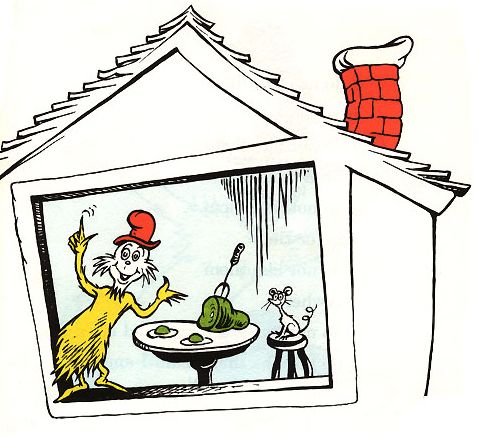
Have you ever read the Dr. Seuss classic, “Green Eggs and Ham”? In this early childhood reader, the narrator (nameless) is accosted by an enthusiastic character named Sam (Sam I Am), who wants him to try a dish called green eggs and ham. But the narrator refuses. Sam keeps offering, but the narrator continues to refuse, saying he does not like green eggs and ham, and will not try them under a variety of circumstances (in a box, with a fox, on a train, in the rain, etc..) offered by the optimistic Sam.

Finally, Sam’s persistence wears down the narrator’s resistance, and he agrees to try the dish. To his surprise, he LOVES them. In his newfound enthusiasm, he declares he WILL eat them in a box, with a fox, in a tree, in a boat, with a goat, on a train, in the rain, here or there…in fact, he WILL eat them anywhere! He ends by thanking Sam.

So what does a children’s book have to do with prayer?

Well, I believe that the pursuit of prayer as an integral part of living a Christ-like lifestyle is kind of like green eggs and ham. Most people who dismiss the power of prayer have never really pursued it. They have seen it, heard about it– maybe even gotten a whiff of it. They may have “sampled” prayer many years ago as a child or in a single moment of desperation. And the result was disappointment or confusion. Prayer didn’t solve all their problems in an instant. They didn’t get the miracle they hoped for. They didn’t get the bike for Christmas. Their neighbor’s leukemia wasn’t cured. Their situation at work got even worse. Their wife still left and filed for divorce. “Prayer” left a bad taste in their mouth. And they have heard others dismiss prayer and faith as obsolete, ignorant practices, designed for backward and unenlightened people. Like the slightly nauseating color of green eggs and ham, prayer has been deemed unappetizing and best avoided.

And now, when someone mentions a lifestyle of prayer– when someone talks about praying as a daily habit, or a natural part of their worship–the reaction is scorn and suspicion. Prayer doesn’t look powerful. It doesn’t look appetizing. How can something so simple and tame have any effect? Why is the world still suffering so much injustice and evil if there are people out there praying every day? And why do Christians (and others with a prayer tradition) cling to prayer as though it will solve life’s problems?

But prayer, like eggs, can have a bad reputation. For years, we were told that eggs were awful for you– high in protein, yes, but also high in cholesterol, and likely to contribute to diabetes and colon cancer. Recent studies contradict each other, but many now say that eggs are actually good for you. Similarly, during times of crises or disasters, prayer is often derided as inactive and ineffective, and we get mixed messages about people who offer to pray for victims and their families.

Recently, I was challenged about my pursuit of prayer. What good does my prayer do in the face of injustice and disease, death and suffering that people experience? Why do I pray to a God that allows bad things to happen? I have been challenged before, and my answer remains the same. I pray because I have known the peace that comes from trusting God’s wisdom, HIS timing, and His Love for each of us. I don’t have answers for all the “what-ifs” or the “whys.” But I continue to trust that God DOES! And daily prayer is not about “me,” or my questions or what I wish for. It’s about communing with the God who has been faithful all my life and continues to be faithful in every season. The God I love, and the God who knows the end from the beginning.

So what if more of us prayed daily– not just as a reaction to disasters– but pro-actively? What if we prayed, not in anger or bitterness, not transactionally, expecting a particular outcome, but with gratitude for who God is, what He has already done, and what He will choose to do in His loving sovereignty? What if we prayed with open minds and hearts, trusting that we are talking to a God who loves us and knows what is best, not just in the temporary, but in the eternal scope of our lives? We would still see evil in this fallen world, but what if our prayers DO make a difference– we just don’t see the whole scope of what God has provided, or the evil He has NOT allowed to touch us?

I speak as one who has pursued prayer for more than half a century. I’m not perfect. Sometimes, I get frustrated when my desires don’t align with God’s answers. But that’s not the fault of Prayer. Prayer DOES change things– maybe not instantly, and maybe not in the ways I imagine in the short term– but I have seen and experienced the power of prayer. I have felt it in my own life, and I have seen in in studying history and talking to people whose lives were radically transformed by their prayers and the prayers of others.

Philippians 4: 6 says: “Do not be anxious about anything, but in every situation, by prayer and petition, with thanksgiving, present your requests to God.” After this, Paul promises in verses 7 and 8 “And the peace of God, which surpasses all understanding, will guard your hearts and minds through Christ Jesus. Finally, brethren, whatever things are true, whatever things are noble, whatever things are just, whatever things are pure, whatever things are lovely, whatever things are of good report, if there is any virtue and if there is anything praiseworthy—meditate on these things.” (taken from the King James Bible online).

In every situation, we can pray. So, to paraphrase Sam I Am, I WILL pray here and there! I will pray most anywhere (except I won’t close my eyes if I am driving!) So to end:

“I’ll be praying in a boat,
I could be praying with a goat.
I may be praying in the rain.
Or in the dark. Or on a train.

And in a car (eyes open of course). And in a tree.
Because Prayer, it is so good, you see!


So I would still pray in a box.
And I would still pray with a fox.
I will pray inside my house.
And I will pray beside a mouse.

And I will write “Pursuing Prayer”
Because I serve a Lord who Cares!

What if we all had the same enthusiasm for prayer as Sam had about Green Eggs and Ham? What if we keep praying “without ceasing” (1 Thessalonians 5:17) and with confidence (1 John 5:14-15) each day?

“Try it! Try it!”

You’ll be so glad you did.

The Prince of Peace

They have healed the wound of my people lightly, saying, ‘Peace, peace,’ when there is no peace. Jeremiah 8:11(ESV)

While people are saying, “There is peace and security,” then sudden destruction will come upon them as labor pains come upon a pregnant woman, and they will not escape. 1 Thessalonians 5:3 (ESV)

Peace I leave with you; my peace I give to you. Not as the world gives do I give to you. Let not your hearts be troubled, neither let them be afraid. John 14:27 (ESV)

I have said these things to you, that in me you may have peace. In the world you will have tribulation. But take heart; I have overcome the world.” John 16:33 (ESV)

Jesus answered: “Watch out that no one deceives you. For many will come in my name, claiming, ‘I am the Messiah,’ and will deceive many. You will hear of wars and rumors of wars, but see to it that you are not alarmed. Such things must happen, but the end is still to come. Nation will rise against nation, and kingdom against kingdom. There will be famines and earthquakes in various places. All these are the beginning of birth pains…21 For then there will be great distress, unequaled from the beginning of the world until now—and never to be equaled again. Matthew 24:4-8; 21 (NIV)

One of the prophetic names given to Jesus in the book of Isaiah is “Prince of Peace” (Isaiah 9:6). And yet, Jesus did not bring an end to the Roman occupation of Judea while He walked the earth. He did not end slavery or war or oppression. He did not bring the kind of “peace” that most of us look for even today. We live in a world of war, dissention, upheaval, and chaos. There is hatred, injustice, slavery, abuse, and oppression, and none of the efforts to bring peace in our world have succeeded in wiping out any of these evils. In the nearly 2000 years since His crucifixion and the rise of the Christian Church, these evils have remained. Great strides have been made over the years– slavery is officially outlawed in many areas of the world; human rights have been codified. Humanitarian efforts have greatly decreased the number of people who die of starvation and disease, homelessness and exposure to the elements. But there are thousands, and indeed hundreds of thousands of people around the world who are refugees from their home countries, who are denied human rights, who live in fear of bombing raids and terrorist attacks.

Where is the Peace?

Jesus spoke freely of the tribulations His followers through the generations would face. He never promised us a world without any trouble. He promised that, in this life, we WILL have trouble. And it will increase over time. People will grow suspicious, hateful, and cold. Nations will rise up against other nations; families will be divided in such a way that one’s greatest enemies will be their closest relatives! Wars and natural disasters will intensify. And ONLY Christ’s return will stop any of it. Human efforts may make a difference for a short while, or make a small difference for a long while, but nothing we can do, single-handedly or as a human race, will deliver us from the evil that lives in the human heart. In fact, we often delude ourselves into thinking that we can change the world on our own; we seek to force our plans on others “for their own good,” little knowing that we may be sowing the seeds of bitterness, backlash, and revenge.

Jesus Christ is the Prince of Peace. He will administer perfect peace and justice when He returns. And in the meantime, He offers us an inner peace that passes all understanding. We can experience peace as bullets whip around us; as we are being misunderstood, mistreated, and abused; as we face injustice and oppression. We can do this because Jesus gave us the example. He did not fight back or even complain as He was arrested, falsely accused, sentenced, and executed. He did not seek to force everyone to accept His rightful claims. He did not even protest the unjust treatment of His people by the Romans.

What He did instead was to focus on God’s mission– He interacted with those who were suffering; He healed the sick; He brought comfort to those who were grieving. He brought sinners to repentance and sought to make peace between individuals and God. Jesus is the Prince of real and lasting Peace– not just peace in “our time” or peace for a generation, but eternal and everlastingly joyous Peace. This is the kind of peace that sees trouble and tribulation for what it is– temporary and transformational. Suffering can make us bitter or better, and Jesus shows us how to experience the latter. When we protest instead of pray, we forfeit that peace. When we pray, we gain wisdom in how to stand firm against injustice without losing our own peace and perspective.

These are not peaceful times, but we can still experience peace, hope, trust, endurance, joy, and light in the days ahead, thanks to our Prince of Peace.

The Price of Discontent

If anyone teaches a different doctrine and does not agree with the sound words of our Lord Jesus Christ and the teaching that accords with godliness, he is puffed up with conceit and understands nothing. He has an unhealthy craving for controversy and for quarrels about words, which produce envy, dissension, slander, evil suspicions, and constant friction among people who are depraved in mind and deprived of the truth, imagining that godliness is a means of gain. But godliness with contentment is great gain, for we brought nothing into the world, and we cannot take anything out of the world. But if we have food and clothing, with these we will be content. But those who desire to be rich fall into temptation, into a snare, into many senseless and harmful desires that plunge people into ruin and destruction. 10 For the love of money is a root of all kinds of evils. It is through this craving that some have wandered away from the faith and pierced themselves with many pangs.
1 Timothy 6: 3-10 (ESV)

This past week, I have really been struggling with discontent. There are things I want that I can’t afford; things I want to accomplish, but I have other obligations that eat away at my time and energy. I want to lose weight and exercise more– the spirit is willing– but my body and will-power are weak. And I spiraled down into anger, frustration, depression, and comparison. It’s been an ugly week. Instead of thanking God that we have enough money to pay the bills and buy groceries, I complain about the price of the groceries and bills, and the lack of money left over for entertainment or new clothes I don’t need.

“Godliness with contentment is great gain” (v.6). It’s a verse I learned as a girl, and yet I’m still struggling with the concept. Part of that, I think may be that our culture’s teachings clash with the Bible. There are people in our culture– even pastors and Bible teachers– who twist the Gospel so that, as Paul says they (imagine) that godliness is a MEANS of gain. (v. 5). And I have listened to, and bought into, that concept– that God rewards (financially, socially, physically) those who practice “godliness”. But what kind of godliness bargains with God for reward? What kind of godliness leads to discontent and anger?

No. Godliness is not a game or a role to play at. It is, much like prayer, a pursuit and a lifestyle. It is discipleship– following the example of Christ’s life and teachings– changing the way I think and the way I live. And no amount of “following the principles” on my own will lead to that kind of change, because my motive will always be “gain.” Whether gaining money, or status, or achievements and accolades, this type of sham godliness will leave me discontented. And the price of that discontent will be my life.

 The thief comes only to steal and kill and destroy. I came that they may have life and have it abundantly.
John 10:10 (ESV).

Jesus did not come to earth to gain fame or fortune. He was despised by many and crucified by the religious authorities of his day. He was misunderstood, and he was, in worldly terms, a failure. He was homeless, childless; there were no monuments to His achievements, no medals or honors bestowed on Him by the rulers of the day. BUT He came to make it possible for us to break the chains of Sin, guilt, worry, jealousy, and discontent. Jesus saw suffering around Him. He saw people with beautiful houses, high social status, productive farms or businesses, and great political power. But He was not drawn to them. He was content to do the Father’s will; content to travel from town to town, talking with lepers and prostitutes, with tax collectors and beggars. And His life changed the world! It is because of His life, death, and resurrection that I can have eternal life and abundant life now and forevermore (John 3:16).

That doesn’t mean that I have everything I want, or that I don’t have to struggle in the present. And it doesn’t mean that I am comfortable and complacent with what I do have. Sometimes, life is difficult and doesn’t seem very “abundant” in the moment. I still have bills. I still have diabetes. And I still have ambitions and unrealized goals. I just need to remember what the Gospel is really all about. It isn’t about becoming rich or well-respected, or productive in the eyes of the world. My life may be quietly abundant in the things that really matter– peace with God, time with family and friends, opportunities to reach out with hope and encouragement to those who need it, seeing beyond the moments of life to the value of life itself.

“Godliness with contentment” isn’t about wealth or achievement. It’s about the journey– and taking this journey WITH God–walking at His pace, walking where He tells me to walk, walking toward a greater goal. Discontent takes me along a different path– one that will never result in a life that is truly abundant and worth living. I waste my days wishing for this or regretting that or envying someone else’s victories instead of being able to join with them in celebration. It teaches me to be frantic, restless, and angry with myself and others. It leaves me exhausted and unfulfilled.

Money, fame, achievement– none of these is the “root of all evil.” Rather, it is the love of ANYTHING that displaces my “first” love for God that is the root of all kinds of hurt, grief, disappointment, and waste.

The Lost Art of Saying Grace

“God is great, God is Good…”
“Come, Lord Jesus, be our guest…”
“For what we are about to receive…”
“Bless us, O Lord, and these, Thy gifts…”

Saying grace at the family dinner table used to be a tradition.  So much so, that it has been made fun of several times in the movies and on television.  Some families recited a favorite prayer; others selected a family member to do the honors.  Some families held hands; some closed their eyes; some stood.  But NOBODY touched their plate until the Amen.

Grace has fallen out of favor in recent years.  Some families still practice it for the holidays or special occasions, but many of us have lost the art of saying grace.  In fact, many of us no longer have a family dinner table.  Some of us eat, sleep, and live alone; others share a house, but rarely a meal, and never a grace.  I would like to think that many of us WOULD say grace more often if  we made time and effort for it, but many others actually hold grace in contempt, calling it old-fashioned; a senseless ritual, or a meaningless tradition.

I want to look a little more closely at grace– how and why we say it, and what it means (or should mean) as part of our daily walk with God.  Calling grace a meaningless tradition may sound harsh, but it may also be a valid criticism.  If “Come, Lord Jesus…” could be replaced with “Gentlemen, start your engines…”, then it might be time to rethink the entire practice.  Similarly, if we dust off grace, only to say it for company, or to show that we still acknowledge tradition and have “good manners”, we’re missing the point.  Grace should be more than just a moment to bow our heads, say a few familiar words, and dig in…grace has become laughable and spoof-able precisely because it has become senseless, formulaic, awkward, and grudging.

I am a big fan of Jimmy Stewart. And this short clip from the beginning of the movie Shenandoah is a prayer said sarcastically by a bitter man who lost his wife and promised her that he would continue to raise their children in a “Christian” home, in spite of his own anger against God. (He later has a change of heart in the movie.) There are many other film and TV scenes that make fun of saying grace without any remorse, repentance, but with a heavy dose of disdain.

I read a tragic statement by someone who claimed that saying grace is actually “graceless”– tactless and inane.  The writer suggested that when we thank God for food, we are really thanking him for feeding us, and choosing to bless us, as he allows others to starve– that saying grace makes us feel more special/less guilty in light of social and economic inequities, which he blithely allows.  In other words, saying grace, in this person’s opinion, makes us arrogant and apathetic to the condition of others, while giving an unjust God undeserved thanks.

I would posit that it should be just the opposite.  I suppose there are many who pray with the arrogant mindset suggested above, but their mindsets and their hearts are not mine to judge.  True grace is not about the recipient of the grace, or the other potential recipients of grace, but about the giver–God– and his worthiness to receive our sincere thanks.  If I believe that God is indeed unjust, then it makes little sense to feel “blessed” or “special” at all– an unjust God is also capricious and unreasonable is not likely to be impressed or swayed by my smug “thank you,” anyway.  So not praying doesn’t make me any less arrogant or apathetic toward others, nor does it move me to be more grateful or more generous than one who prays.  It merely passes the blame for all injustice to God, leaving me off the hook, and making me feel more just than God.

tablegrace

However, if God is loving and gracious, promising perfect justice in his time, and forgiveness to those who seek him; a God who promises to be close to the poor in spirit, those who hunger and thirst for righteousness, and who are broken and contrite; I am not thanking him for who I am, for what I have, or for what I think he should do.  I am thanking him for who he is and for what he has chosen to give.  Some days, I may NOT have a lot to eat, or pleasant surroundings. I may be the victim of injustice done by evil people. But I can still thank God for what I DO have and for who HE is. And on those other days, in thanking him for the very things I would take for granted, I am reminded that blessings are not given for me to boast about or hoard, but to share with others.  That’s what saying grace SHOULD do–cause us to reflect on God’s goodness, our true neediness, and our call to share God’s blessings with a needy world.

Grace is also an invitation– asking God to be part of every moment of our day.  According to his Word, he’s always present, anyway.  But grace is a way of acknowledging and welcoming that presence.  And that invitation isn’t limited to Thanksgiving or Sunday dinner with the whole gang.  That invitation can be made anywhere, by anyone, at any meal (or snack, or midnight raid on the fridge!)

Is God welcome at our dinner table?  Does he share in our drive-thru breakfast, or our trip to the deli?  Do we allow him to join us at the restaurant, where others might overhear and find us quaint and old-fashioned?  Does he sit with us in front of the TV or computer as we absent-mindedly munch on a sandwich?  Grace isn’t about our goodness, our riches, or worthiness to enjoy God’s blessings.  Grace is about a gracious God who has poured out blessings on a graceless and fallen world; a God who loves us all equally and offers to give us something more precious than food– freedom, forgiveness, and family–forevermore.

gracelady

“God IS great; God IS good; Now we thank him for our food.”
“Come, Lord Jesus, be our Guest; let this food to us be BLESSED”
“For what we are about to receive, may the Lord make us TRULY grateful.”
“Bless us, O Lord, and these, THY gifts, which we are about to receive from THY bounty. Through Christ, our Lord. Amen.”
“Dear Heavenly Father, thank you for this day and this food. Bless it to our good and to your glory. May all we say and do bring honor to Your Name. Amen.”


Piece of Mind v. Peace of Mind

We live in an angry world, filled with outrage, entitlement, bitterness, hurt, and arrogance. Everywhere we look, someone is giving someone else (sometimes everyone else) a “piece of their mind.” And those who do are often lauded and celebrated. Pundits, critics, “talking heads,” columnists, “expert” opinion-makers (recognized or self-appointed)– all make careers out of sharing their opinions, their theories, expertise, or knowledge. They may be clever, intelligent, even entertaining; they may be popular, intimidating, or impressive in their range of knowledge. I may agree with their opinions, and share their conclusions or beliefs. But I should be careful not to become “puffed up” with knowledge.

Knowledge puffs up but love builds up. The man who thinks he knows something does not yet know as he ought to know. But the man who loves God is known by God. 1 Corinthians 8:1-3

1 Corinthians 8:1-3

https://dailydevotionscripture.blogspot.com/2012/11/knowledge-puffs-up-love-builds-up.html#:~:text=Knowledge%20puffs%20up%20but%20love%20builds

It is very tempting– VERY tempting– to join in this practice of verbal tongue-lashing. To show off our superior knowledge or our righteous opinions. To win arguments and create “mic-drop” moments.

Meeting anger with anger, sarcasm with sarcasm, and pride with pride is natural. But it is not God’s way. God calls for us to have peace of mind– to have a mind that can see and hear the reality of our fallen world but respond in an unnaturally loving and gracious manner given to us by the Holy Spirit. We are to speak words of peace, to walk in humility, and to love our neighbors as ourselves.

Our words can be powerful– for good or evil. We can speak peace and goodwill, harmony, and love into a world that is drowning in hateful comparisons, disdain, selfishness, malicious gossip, idle chatter, and careless opinions. Words can uplift, encourage, heal, and strengthen. Words–even quiet words– can stem the tide of malice and bring light and hope.

And it is not just what we pass on to others with our words– we become what we speak! When we speak arrogance and self-righteousness, we become (and remain) self-righteous and arrogant. When we speak love and joy, peace and patience, trust and truth, we become more peaceful, joyful, patient and trustworthy.

Jesus– the Word of God– often used a quiet sentence to bring hope, reassurance, and blessing to people in need. Jesus felt anger– and He had every right to speak HIS opinion and HIS omniscience when He was tested and unfairly questioned. But He chose to be patient. His answers were not laced with malice and sarcasm, but they silenced His critics, and served as lessons for others who were listening. What a great example for us!

What might happen if we spent less time giving a “piece of our mind” and more time spreading “peace of mind” in our world?

What If?

As I am writing this, people in my country are voting or preparing to vote in a Presidential election.  Many of them are voting in fear, confusion, or anger, and asking, “What if my candidate/cause/political party doesn’t ‘win’ today?”  “What if I voted for the ‘wrong’ policies or people?”  “What does the future hold?”

These are not uncommon or unrealistic questions, but they are questions that can waste our time and sap our energy in hypothetical posturing.  The writer of Ecclesiastes says:

alone beach calm dawn

Ecclesiastes 11:1-6 King James Version (KJV)

11 Cast thy bread upon the waters: for thou shalt find it after many days. Give a portion to seven, and also to eight; for thou knowest not what evil shall be upon the earth. If the clouds be full of rain, they empty themselves upon the earth: and if the tree fall toward the south, or toward the north, in the place where the tree falleth, there it shall be. He that observeth the wind shall not sow; and he that regardeth the clouds shall not reap. As thou knowest not what is the way of the spirit, nor how the bones do grow in the womb of her that is with child: even so thou knowest not the works of God who maketh all. In the morning sow thy seed, and in the evening withhold not thine hand: for thou knowest not whether shall prosper, either this or that, or whether they both shall be alike good. 

woman wearing grey long sleeved top photography

It is not wrong to wonder about the future, but we cannot be sure that our actions will always produce the results we long for– especially when we have little control over other people’s actions and consequences.  The first two verses of this passage warn us not to “put all of our eggs in one basket”.  As free citizens in a democratic republic, we shouldn’t put our trust in any one political party, platform, or politician.  Nor should we live in a social or political “echo chamber”, listening only to the views and ideas with which we feel most comfortable, or least challenged.  However, we should look at the long-term consequences of proposals and the reasons behind them before we promote change just for the sake of it.

The third verse reminds us that some changes and events are beyond our knowledge or control.  It’s not that our vote “doesn’t make a difference” or that we’re on “the wrong side of history”– it may mean that history has taken a detour surrounding a certain issue.  It may mean that God is allowing for something we have not imagined (as He did in the days of Habakkuk). Get some great “Insight” into the Book of Habakkuk here.

aerial photo of buildings and roads

But there is more wisdom to come in verses 4-6.  Waiting for certainty of outcome, or being distracted by our circumstances or every “wind of change” can lead us to miss the very real opportunities for present action.  God has given us everything we need (see 2 Peter 1:3-5) for godly living and godly decision-making.  That doesn’t mean that our decisions will always reflect popular “wisdom”; it doesn’t even mean that our decisions will be the same as all other fellow believers and followers of Christ.  It DOES mean that we can make our decisions without fear.  God knows us– He understands your heart and mind better than anyone; He knows why people who agree on spiritual matters may not agree on politics.  But more than that, God KNOWS the future!  He knows all the things that we merely guess at.  So we should act in the present with the best information we have, and leave the rest to the God who knows best.

girl wearing blue denim dress shirt

Modern politics relies heavily on conjecture– polls, predictions, pledges, projections, plans, and campaign promises.  But God is still sovereign over all nations, governments, and peoples.  Instead of asking, “What if..” we should be asking of God, “What now?!”   And we need to be ready to listen and obey!  Let’s pray today for the wisdom to listen more, act with confidence, and trust our future to the one who has already seen it!

Arguing With the Almighty

Our country has recently weathered (pun intended!) two major hurricanes which caused devastation and chaos. It seems like an unlikely connection, but I was thinking the other day about the movie, “Forrest Gump.” In it, a bitter, beaten, and angry character begins arguing with God– in the midst of a hurricane!

“Lieutenant Dan” was an able soldier, fighting in Vietnam and in charge of a small unit, which included the simple-minded Forrest Gump. When their unit was ambushed, Dan was badly injured and lost the use of his legs. Meanwhile, Forrest Gump received only a small flesh wound, and managed to save several of his fellow soldiers, receiving a medal for bravery. One of the soldiers rescued by Forrest, Dan resented his situation– disabled and ignored– while Forrest went on to become successful and celebrated.

Worse, in the years after the war, Forrest found Dan, homeless and dejected, and offered him a job and a home– on his shrimping boat. Forrest knew next to nothing about shrimping, and Dan, torn between bitterness and gratitude, gave Forrest a hard time. Dan’s life had gone nowhere, and Forrest seemed to dodge every bullet (literally), finding success in spite of his naivete and seemingly stupid choices.

It is a very relatable situation. We all know someone who seems to sail through life, while others seem to have nothing but bad luck and hardship. The class clown who ends up “making it big”– they spend money like it’s going out of style, and yet it keeps flooding in, seemingly without any effort. The neighbor who loses his job, and then his house catches on fire. And that person whose entire life seems to be lived under a cloud of misery and bitterness.

Gary Sinise as “Lieutenant Dan” in the movie Forrest Gump.

When the two men find themselves in the middle of a hurricane, Dan can take it no longer. He lashes out– not at Forrest this time, but at God. How could a loving God allow Dan to go through trial after trial– the loss of his legs and so many of the men under his command, the loss of his dignity and productivity, the loss of his independence, and now, another deadly situation beyond his control. He yells at God–“Come and get me!” He challenges God to just kill him; just finish him off–or leave him alone.

But God is silent– and soon, so is the hurricane. Forrest and Dan have survived. In fact, Forrest’s decision to be out of the harbor means their boat is the only one to survive–suddenly, they can’t catch the shrimp fast enough! Forrest becomes a millionaire and hires a fleet of fishing boats. But what about Dan?

Somewhere in the middle of the storm, Dan’s heart is pierced by a simple and life-changing thought. God has not been the one “ruining” Dan’s life– He is the one who has been preserving it! God brought him through war, disability, injustice, loneliness, frustration, and the raging sea. God was not a cosmic bully. God was not singling out Dan for punishment– after all, thousands of others had been wounded and killed in the war; millions of people knew what it was like to be hungry, homeless, and lonely; and hundreds had been devastated by the hurricane– even while they were safely evacuated or hunkered down on land. Forrest had not dodged every “bullet.” He had lost his best friend in battle; he had been rejected (time after time) by the woman he loved; he had been teased, bullied, and cheated dozens of times, and he had been tossed about by the same waves and winds Dan had survived. Dan ends up leaving Forrest, and setting off on his own, having found a peace that transcends his pain and bitterness. He swims off with a smile, leaving behind the opportunity to remain with Forrest and make millions.

Arguing with the Almighty is very tempting when we face difficult circumstances– and when we focus on our own lot, and not on the bigger picture. God is bigger than any of the troubles we face. And He is not unaware or unconcerned about whatever we are going through. Just as Lieutenant Dan challenged God, the biblical character of Job challenged God to vindicate him as he went through trials and pain. God finally answered, and Job realized that God was far bigger than anything Job had ever known or experienced. And in the end, God restored Job– giving him a new family, and even more material wealth than he had before!

Sometimes, God allows us to go through periods of pain and struggle– not because He is punishing us or because He is a tyrant, but because He is more interested in our ultimate salvation than He is in our immediate comfort. We moan and complain that God “doesn’t want us to be happy,” as if our momentary happiness is more important than our character development, than the happiness of those around us, or than God’s design for the world.

Near the end of the movie, Lieutenant Dan visits Forrest. He is transformed. No longer angry and bitter, he is quiet, self-assured, and standing! He has “new legs” made of titanium, and he has found joy, love, and success of his own.

Of course, many of us, regardless of our situations, have tried arguing with God at certain times of our lives. The loss of a loved one; the breakup of a marriage; a diagnosis of cancer; a miscarriage of justice and the loss of a reputation– it is natural to be angry, hurt, and confused. And God is more than big enough to “take it” when we ask “WHY?!!” But we will never “win” such arguments– not because God is a tyrant who won’t let us have what we want– but because God is GOD, and we are not. He alone knows how our story ends, and what trials– and blessings– await us. He alone knows what is “right” in the scope of eternity– not just for us, but for our loved ones, our neighbors, our nation, and our times. God can see that we get, not just “new legs,” but a new heart, and a new mind!

Hurricanes happen– so do hurts and hurdles. We can choose to see God’s hand–and believe that it is raised in anger, or reaching out to hold us. That choice is yours. That choice is mine. Every day.

Choices

I like having choices. When I go to a restaurant, I get a menu, with several choices– appetizers, entrees, beverages, desserts. I have choices at the grocery store– brand X cereal or brand Y, different sizes of laundry detergent, which cucumber to put in a produce bag– sometimes even a choice between paper and plastic and reusable bags! I have a choice to buy or rent a house or apartment/condo. I have a choice about the car I drive or the choice not to drive, but to walk or take public transportation. I choose which church to attend, or not to attend at all. I choose when I get up in the morning and when I go to sleep. I choose what to wear each day. I choose to obey the law, including speed limits on the highway and slowing down in school zones, paying whatever taxes are due, and registering for the census, voting, and other civic duties.

Many of these choices seem benign. It doesn’t really matter to anyone else which brand of cereal I buy or when I eat it, or even if I decide not to eat it, but end up throwing it out. It doesn’t matter to most people where I live, or go to church, or what I am wearing. It doesn’t hurt anyone else if I drive a couple of miles faster than the speed limit on a back road somewhere.

But some choices DO matter– they matter a lot. If I choose to drive at high speed through a school zone, I might end up accidentally killing a student or school worker. If I live in a house or apartment I cannot afford, or if I refuse to maintain my house or apartment, I may end up evicted or homeless. If I choose to use drugs– even prescription drugs– in an unwise manner, I may end up in the hospital or in the cemetery! And I may hurt others around me in the process.

I live in a nation that prizes “freedom” and “freedom to choose.” But in the past century, more and more voices are being raised in an effort to make all choices “equal.” And they are not. Many of our “choices” are in direct contradiction to the Word of God, to traditional values, and even to common sense! Our choices have consequences– some benign, and some catastrophic. Voices are shouting about their “right to choose” even as they are also raised in righteous indignation about others’ rights and choices.

I could speak to this for days on end, defending my own choices, and pointing out which “choices” break my heart or offend me. But I feel compelled to point out just three things to consider about individual choices:

  1. How does this choice honor God? I think it is easy to focus on “big” choices when we think of this, but I have been challenged lately to see how even my “easy” and “little” choices honor Him. Does it really matter which brand of cereal I eat in the morning? Probably not. But what about brands and manufacturers that support causes that do not honor God? Most of the time, I am unaware of such considerations. But the money I spend on my favorite sugary breakfast treat may help sponsor evil. And if I am aware of which manufacturers are giving large donations to causes I despise, but I am still buying their products every week, I am helping to sponsor that evil.
  2. How does this choice impact others? We DO have the freedom to choose our actions, but we do NOT have freedom from the consequences of those actions. “My Body, My Choice” looks good on posters and banners, but things like abortion or gender reassignment have an impact beyond a single person. Abortion always ends with the death of a second “body”– one without any choice in the matter. Gender reassignment impacts more than just one person– it impacts their present and future relationships, as well as impacting their future physical health and reproductive system. It is also important to establish whether my choices are made to try to please or influence others. It’s easy to blame others after the fact, citing “peer pressure” or claiming “I didn’t have another choice,” but is that really true, or was one choice just a lot easier or more popular than another? That same group that pressured you make certain choices– will they be there for you afterward? No matter the consequences? Will they still be your friends if you make a different choice?
  3. Does this choice help me grow into a better person? Many of our choices come from wanting to be a happier, wealthier, or more popular person– NOT a healthier, more mature, or wiser person. And most of our choices focus on immediate gratification, rather than long-term growth. Doing something because you have the “right to choose” is not the same as “doing the right thing.” Doing the right thing often involves sacrifice and even a season of suffering. Our present choices–even the small ones– will impact our future circumstances, and our development as an individual. Eating a donut today may be tasty, but eating donuts every day may lead to obesity, diabetes or heart disease, and even a lessening of enjoyment for donuts– they’re no longer a tasty treat, but a habitual threat to my health!
  4. Am I angry and defensive about my “choice?” Years ago, I was stopped for speeding on my way to work. Of course, I had been running a little late, and being stopped made me even later. I had to explain my tardiness to my boss, who dismissed the whole incident with a sly “next time, don’t get caught..” But one of my co-workers self-righteously handed me a two-page pamphlet on the evils of driving over the speed limit. At that time, I was indignant and offended. (I still would be a bit miffed– I don’t agree with either of the reactions I got that day, but that’s another post…) As I have grown older, however, I have come to value the three questions above– and it changes my perspective. I KNOW it’s “wrong” to drive over the speed limit. I know many people do it anyway and get away with it. But the bottom line is this–speeding does not honor God. It does not help anyone else, and could potentially harm someone. And it does not grow my character. I don’t automatically become a “good” person if I DON’T speed– let me be clear about that. But I do grow in character when my choices are made out of a heart that prioritizes God and others over my own selfishness (and procrastination!) When I find myself getting angry and defensive, I need to consider whether or not it is really guilt. If I wasn’t speeding that day, I wouldn’t have had any reason to be angry with my co-worker or ashamed of being “caught.” If someone is angry and defensive about his or her behavior, it is often brought about by guilt, shame, and a rebellious spirit, tired of defending what everyone else (and sometimes their own conscience) tells them is “wrong.”

We make choices every day– some benign, some “good,” some “bad.” Let’s pray for wisdom to make the best choices, confess the “wrong” choices, and offer encouragement and truth, rather than judgment, to those around us.

Today, I’m praying about the “choice” of abortion and its impact on my nation (as well as worldwide). In the 50+ years since Roe v. Wade attempted to make abortion “legal” in all 50 of the United States, over 60 million abortions have been reported in the U.S. during those years.* This figure does not include other nations, unreported (back alley or non-clinical) abortions, or natural miscarriages. Not only does this represent the “choice” to end the lives of over 60 million precious individuals, it represents millions of women (along with men and other family members) who have been impacted by the deceptive offer of “freedom” and the increasing pressure to make this “choice” seem both normal and healthy. For my friends, family, and others who have made this choice– my heart aches for what you have been through, and I rejoice with those of you who have found Grace and renewed hope through Jesus. God loves you– YOU, not your past choices– and welcomes you to choose Him today and every day. For those who have not been in a position to be tempted by this “choice”– I pray that we live with compassion, and that we stand up for and speak up for TRUTH and LIFE– not self-righteousness and fear.
* A more conservative estimate still places the number at well over 40 million
https://www.pewresearch.org/short-reads/2024/03/25/what-the-data-says-about-abortion-in-the-us/
https://www.statista.com/statistics/185274/number-of-legal-abortions-in-the-us-since-2000/

The Offer of Life or Death

11 Now what I am commanding you today is not too difficult for you or beyond your reach. 12 It is not up in heaven, so that you have to ask, “Who will ascend into heaven to get it and proclaim it to us so we may obey it?” 13 Nor is it beyond the sea, so that you have to ask, “Who will cross the sea to get it and proclaim it to us so we may obey it?” 14 No, the word is very near you; it is in your mouth and in your heart so you may obey it. 15 See, I set before you today life and prosperity, death and destruction. 16 For I command you today to love the Lord your God, to walk in obedience to him, and to keep his commands, decrees and laws; then you will live and increase, and the Lord your God will bless you in the land you are entering to possess. 17 But if your heart turns away and you are not obedient, and if you are drawn away to bow down to other gods and worship them, 18 I declare to you this day that you will certainly be destroyed. You will not live long in the land you are crossing the Jordan to enter and possess. 19 This day I call the heavens and the earth as witnesses against you that I have set before you life and death, blessings and curses. Now choose life, so that you and your children may live 20 and that you may love the Lord your God, listen to his voice, and hold fast to him. For the Lord is your life, and he will give you many years in the land he swore to give to your fathers, Abraham, Isaac and Jacob.
Deuteronomy 30: 11-20 (NIV)

At dawn he appeared again in the temple courts, where all the people gathered around him, and he sat down to teach them. The teachers of the law and the Pharisees brought in a woman caught in adultery. They made her stand before the group and said to Jesus, “Teacher, this woman was caught in the act of adultery. In the Law Moses commanded us to stone such women. Now what do you say?” They were using this question as a trap, in order to have a basis for accusing him.
But Jesus bent down and started to write on the ground with his finger. When they kept on questioning him, he straightened up and said to them, “Let any one of you who is without sin be the first to throw a stone at her.” Again he stooped down and wrote on the ground.
At this, those who heard began to go away one at a time, the older ones first, until only Jesus was left, with the woman still standing there. 10 Jesus straightened up and asked her, “Woman, where are they? Has no one condemned you?”|
11 “No one, sir,” she said.
“Then neither do I condemn you,” Jesus declared. “Go now and leave your life of sin.”
St. John 8:2-11

Lament

Where are the heroes of old?
Where are the role models?
Where are the men and women of integrity?
Where is Honor?

I look at images of sneering mobs, of angry masses.
They protest in bright colors.
They shout and wave their signs.

Where are those who mourn?
Where are those who warn of danger, crying out a warning;
Crying out for mercy?

Where are Isaiah and Jeremiah?
Where is Ezekiel? Hosea?
Where are the Apostles?
Where are the evangelists?

Everyone is shouting– who is lamenting?
Everyone is angry– who is repentant?
Everyone is righteous in their own eyes.
Yet no one is righteous– no, not one.

We have a generation worshipping comic book “gods”,
And mocking the God of Creation.
People who obsess over someone else’s right to eat an egg,
While screaming for the right to kill their own child without guilt.
Millions praying to their government for more food and better shelter
While ignoring their hungry and homeless neighbors.
While trying to bury Your Words and Your Peace.

And YOUR people, Lord…
People who bear the name of Christ
Are bragging about their blessings from You,
While criticizing others and ignoring the lost.
Those who honor You with their lips
Refuse to cry out in surrender to You;
Refuse to reach out help their neighbors.

Where are the servants?
Where is the remnant of the Faithful?
Where are the prophets? The truth-tellers?
Where are those who mourn?
Where is the Lament?

Blog at WordPress.com.

Up ↑