Daniel–Prayer Under Pressure (Part 1)

In Chapter 2 of the Book of Daniel, there is an interesting story. Most often, students of the Bible focus on the prophetic meaning of Nebuchadnezzar’s dream. But I want to look at the context, and see what this story tells us of Daniel, his friends, his boss, and his God. (see text here: https://www.biblegateway.com/passage/?search=Daniel+2&version=NIV )

First, let’s look at the extraordinary presumption of Nebuchadnezzar. (God will deal with him severely a few chapters later!) The ruler of the vast Babylonian empire, Nebuchadnezzar’s word is absolute. His whims and moods control the destinies of all his courtiers, as well as all the people under his domain. Princes, satraps, governors, advisers, military leaders, and common citizens all live in fear of his absolute power, even as they try to curry favor and rise among the ranks.

Nebuchadnezzar is not (at this point) crazy; he is not a foolish man. He has led campaigns to destroy several strong enemies, and has wisely appointed a number of officials to administer his sprawling empire. Daniel (and his friends, Shadrach, Meshach, and Abednego) are among several captured youth who are being assimilated into this administration. But this story shows the beginning of Nebuchadnezzar’s descent into madness and humiliation. He has had a dream (some translations suggest it was a recurring nightmare) that disturbs him greatly. It has him agitated. It causes him to act in an irrational manner. He calls in all the magicians, enchanters, astrologers and sorcerers of the kingdom. He is desperate for answers.

We don’t know how many various men (or even women) were called in, but they represent all the best minds of the entire Babylonian empire. And Nebuchadnezzar wants the impossible–not only are they to correctly interpret his strange dream; they are to do it without any clue about what happened in it! As they try to reason with their king, he accuses them of wanting to mislead him, and threatens them with death and the destruction of their homes and families! This is a very real threat– the king’s word is absolute, and his wrath inescapable. Nebuchadnezzar’s bizarre actions and irrational fear are signs of much worse to come. As powerful as he is, the king is plagued by insecurities throughout his reign. Pleasing, or even appeasing such a man must be like constantly walking a tightrope.

The story seems to suggest that Daniel and his friends were not included in the first summons before Nebuchadnezzar. Perhaps they were still too young to be included; perhaps they were still in training. But it is clear that they will be included in the execution orders if they cannot please this tyrant. This marks the second trial faced by Daniel in his captivity, but it is the first time he comes to the forefront of Nebuchadnezzar’s notice. While the king raves and threatens his other counselors, he listens to Daniel’s plea for more time. In the end, he is awed by Daniel’s interpretation, by Daniel’s courage– and by the God Daniel serves.

It is not only Daniel’s wisdom and courage that are highlighted in this story. Daniel has a confidence and peace that Nebuchadnezzar lacks. Daniel calmly asks for more time. He asks for help from his friends before he proceeds. And when he recognizes the importance (and the danger) of the dream, he doesn’t respond with panic or theatrics. He very calmy presents God’s answer to the king and gives God the credit for everything. It wasn’t just Daniel’s amazing gift of prophecy and interpretation that saved the lives of all the other wise men, magicians, and counselors. It was his absolute trust that God was in control of the situation– both the current situation with Nebuchadnezzar, and the ongoing situation of Daniel’s captivity.

No matter what irrational situation we may face today, no matter what impossible task we are given; no matter who threatens us or makes ridiculous demands– God is more powerful. He causes kingdoms to rise and fall. He knows the future, and nothing is outside his control. Even the direst circumstances and most impossible situations can lead to opportunities …opportunities that showcase God’s omnipotence and sovereignty.

Green Eggs and Prayer?

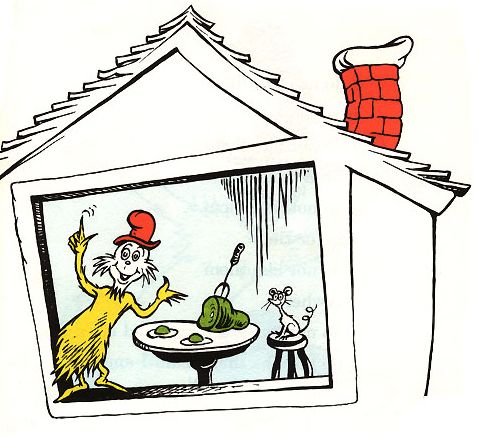
Have you ever read the Dr. Seuss classic, “Green Eggs and Ham”? In this early childhood reader, the narrator (nameless) is accosted by an enthusiastic character named Sam (Sam I Am), who wants him to try a dish called green eggs and ham. But the narrator refuses. Sam keeps offering, but the narrator continues to refuse, saying he does not like green eggs and ham, and will not try them under a variety of circumstances (in a box, with a fox, on a train, in the rain, etc..) offered by the optimistic Sam.

Finally, Sam’s persistence wears down the narrator’s resistance, and he agrees to try the dish. To his surprise, he LOVES them. In his newfound enthusiasm, he declares he WILL eat them in a box, with a fox, in a tree, in a boat, with a goat, on a train, in the rain, here or there…in fact, he WILL eat them anywhere! He ends by thanking Sam.

So what does a children’s book have to do with prayer?

Well, I believe that the pursuit of prayer as an integral part of living a Christ-like lifestyle is kind of like green eggs and ham. Most people who dismiss the power of prayer have never really pursued it. They have seen it, heard about it– maybe even gotten a whiff of it. They may have “sampled” prayer many years ago as a child or in a single moment of desperation. And the result was disappointment or confusion. Prayer didn’t solve all their problems in an instant. They didn’t get the miracle they hoped for. They didn’t get the bike for Christmas. Their neighbor’s leukemia wasn’t cured. Their situation at work got even worse. Their wife still left and filed for divorce. “Prayer” left a bad taste in their mouth. And they have heard others dismiss prayer and faith as obsolete, ignorant practices, designed for backward and unenlightened people. Like the slightly nauseating color of green eggs and ham, prayer has been deemed unappetizing and best avoided.

And now, when someone mentions a lifestyle of prayer– when someone talks about praying as a daily habit, or a natural part of their worship–the reaction is scorn and suspicion. Prayer doesn’t look powerful. It doesn’t look appetizing. How can something so simple and tame have any effect? Why is the world still suffering so much injustice and evil if there are people out there praying every day? And why do Christians (and others with a prayer tradition) cling to prayer as though it will solve life’s problems?

But prayer, like eggs, can have a bad reputation. For years, we were told that eggs were awful for you– high in protein, yes, but also high in cholesterol, and likely to contribute to diabetes and colon cancer. Recent studies contradict each other, but many now say that eggs are actually good for you. Similarly, during times of crises or disasters, prayer is often derided as inactive and ineffective, and we get mixed messages about people who offer to pray for victims and their families.

Recently, I was challenged about my pursuit of prayer. What good does my prayer do in the face of injustice and disease, death and suffering that people experience? Why do I pray to a God that allows bad things to happen? I have been challenged before, and my answer remains the same. I pray because I have known the peace that comes from trusting God’s wisdom, HIS timing, and His Love for each of us. I don’t have answers for all the “what-ifs” or the “whys.” But I continue to trust that God DOES! And daily prayer is not about “me,” or my questions or what I wish for. It’s about communing with the God who has been faithful all my life and continues to be faithful in every season. The God I love, and the God who knows the end from the beginning.

So what if more of us prayed daily– not just as a reaction to disasters– but pro-actively? What if we prayed, not in anger or bitterness, not transactionally, expecting a particular outcome, but with gratitude for who God is, what He has already done, and what He will choose to do in His loving sovereignty? What if we prayed with open minds and hearts, trusting that we are talking to a God who loves us and knows what is best, not just in the temporary, but in the eternal scope of our lives? We would still see evil in this fallen world, but what if our prayers DO make a difference– we just don’t see the whole scope of what God has provided, or the evil He has NOT allowed to touch us?

I speak as one who has pursued prayer for more than half a century. I’m not perfect. Sometimes, I get frustrated when my desires don’t align with God’s answers. But that’s not the fault of Prayer. Prayer DOES change things– maybe not instantly, and maybe not in the ways I imagine in the short term– but I have seen and experienced the power of prayer. I have felt it in my own life, and I have seen in in studying history and talking to people whose lives were radically transformed by their prayers and the prayers of others.

Philippians 4: 6 says: “Do not be anxious about anything, but in every situation, by prayer and petition, with thanksgiving, present your requests to God.” After this, Paul promises in verses 7 and 8 “And the peace of God, which surpasses all understanding, will guard your hearts and minds through Christ Jesus. Finally, brethren, whatever things are true, whatever things are noble, whatever things are just, whatever things are pure, whatever things are lovely, whatever things are of good report, if there is any virtue and if there is anything praiseworthy—meditate on these things.” (taken from the King James Bible online).

In every situation, we can pray. So, to paraphrase Sam I Am, I WILL pray here and there! I will pray most anywhere (except I won’t close my eyes if I am driving!) So to end:

“I’ll be praying in a boat,
I could be praying with a goat.
I may be praying in the rain.
Or in the dark. Or on a train.

And in a car (eyes open of course). And in a tree.
Because Prayer, it is so good, you see!


So I would still pray in a box.
And I would still pray with a fox.
I will pray inside my house.
And I will pray beside a mouse.

And I will write “Pursuing Prayer”
Because I serve a Lord who Cares!

What if we all had the same enthusiasm for prayer as Sam had about Green Eggs and Ham? What if we keep praying “without ceasing” (1 Thessalonians 5:17) and with confidence (1 John 5:14-15) each day?

“Try it! Try it!”

You’ll be so glad you did.

April Fools

Yes, I know I’m early– April begins tomorrow, and the first of April is known as “April Fool’s Day.” It’s a day for pulling practical jokes and trying to “fool” people with fake news stories (actually, that can happen any day of the year, but it’s usually more obvious on April first). And when people tomorrow sit on a whoopee cushion, or bite into a frosted bagel, thinking it’s a donut, or they pass on a “breaking” news story about alien invasions, they will be laughed at and labeled “fools.”

But the Bible has a different outlook. We laugh at people who are deluded by headlines and gags; God warns us not to be deluded by our own thoughts and feelings.

The fool says in his heart, ‘There is no God.’ They are corrupt, their deeds are vile; there is no one who does good. The Lord looks down from heaven on all mankind to see if there are any who understand, any who seek God. All have turned away, all have become corrupt; there is no one who does good, not even one. Do all these evildoers know nothing?” Psalm 14:1-4 (NIV)

This doesn’t mean that corrupt people are corrupt merely because they are stupid, ignorant, or gullible, or that those who claim “there is no God” just don’t know any better. In fact, many atheists and agnostics know more about Biblical scholarship that most people who claim to be Christians! And many who claim to be Christians behave as though they don’t believe in or have any reverence for God!

What it IS saying is that even intelligent and well-read people can “fool” themselves into believing that God is irrelevant to the way they live their lives. Because they have not seen God act in dramatic fashion to bring justice– either punishment for their own corruption, or punishment for someone else’s injustice against them, they have concluded that God does not see, does not care, does not answer, or does not exist. They may be intelligent; they may even have a personal moral code of a sort. They may even base their “personal” morality on principles from the Bible. But they deny that God has any power or authority over their life. And this is just as true in the lives of people who carry the name of Christ as it is among atheists!

So why does the Psalmist call such people “fools?” Because God DOES see, He DOES bring Justice, He DOES answer– in His way and His timing. And when we forget that, or refuse to come to terms with that, we begin thinking that WE are in God’s place– that WE have the power and authority to do whatever we think is right or just and we can ignore God’s word, His warnings, and His sovereignty–or whatever parts of those we find inconvenient.

And many “fools” live their lives believing they are smarter, cleverer, and wiser than those who revere God. After all, their life circumstances are not so different from those who practice reverence and obedience– often they are wealthier, healthier, and more successful than their neighbors! What is the “reward” of being humble, obedient, and following a lot of “outdated and irrelevant” Biblical principles? In fact, on the face of it, it looks as though Christ followers are the real “fools!” We cannot “prove” God’s power in our lives if we are acting in our own power or measuring our life only through our current circumstances.

The Apostle Paul addresses this in 1 Corinthians, where many new believers were doubting the truth of the Resurrection. This is a central teaching of the Christian church, and yet it is a difficult reality to explain and teach to those who do not believe in life after death. A person who adopts a set of moral principles– even those taught by Jesus Christ– but doesn’t believe in the Resurrection of Christ can’t truly be called a “Christ-follower” or a “Christian.” But without the Resurrection, there is no life-changing power in a mere set of man-made rules, or the teachings of a dead folk hero.

We have preached that Christ has been raised from the dead. So how can some of you say that no one rises from the dead?  If no one rises from the dead, then not even Christ has been raised.  And if Christ has not been raised, what we preach doesn’t mean anything. Your faith doesn’t mean anything either.  More than that, we would be lying about God. We are witnesses that God raised Christ from the dead. But he did not raise him if the dead are not raised.  If the dead are not raised, then Christ has not been raised either.  And if Christ has not been raised, your faith doesn’t mean anything. Your sins have not been forgiven. Those who have died believing in Christ are also lost. Do we have hope in Christ only for this life? Then people should pity us more than anyone else. But Christ really has been raised from the dead. He is the first of all those who will rise from the dead. 1 Corinthians 15: 12-20

How does this relate to the pursuit of Prayer? If we pray to someone who “might” exist or who “may” hear us when we call, if we pray to someone who “probably” has the power to heal the sick or break the power of addiction, we really aren’t praying– we are foolishly practicing wishful thinking–we are gambling with our faith. AND, if we are praying, but then acting as though God won’t answer, we will not wait for His wisdom or wait to see His power at work in our lives. Instead, we will act on our own convictions, with our own limited understanding of the consequences (intended AND unintended) of our actions.

We can pray with confidence because God is Real; He really is Good; and because Christ really did rise from the dead in Power and Glory. Otherwise, we are praying in the mushy desire that God will rubber-stamp our requests, or that our daily circumstances are greater than God’s eternal promises. Let’s not fall into “foolish” thinking tomorrow– especially as it applies to the power of Prayer!

Jephthah or Jabez?

There are many great examples of prayer throughout the Bible, but there are two that are often used out of context and applied wrongly.  One is found in the book of the Judges; the other in the Chronicles.

Jephthah was a mighty warrior– the son of a mighty warrior and a prostitute.  He had several half-brothers, but they wanted nothing to do with him.  He was an outcast for much of his life, but when things got tough, the people of the region changed their tune and begged him to be their leader and help deliver them from the oppressive Ammonites.   Before going into battle, Jephthah prayed, and made a tragic vow.  In fact, his vow has become a model of what NOT to do in approaching God.

pexels-photo-415380.jpeg
Judges 11:30-31 New American Standard Bible (NASB)
30 Jephthah made a vow to the Lord and said, “If You will indeed give the sons of Ammon into my hand, 31 then it shall be that whatever comes out of the doors of my house to meet me when I return in peace from the sons of Ammon, it shall be the Lord’s, and I will offer it up as a burnt offering.”

Upon returning from his success in battle, who should come out of the door of his house, but his only daughter, singing and dancing in celebration of her father’s victory!  Having made such a rash vow, Jephthah now has to fulfill it, and sacrifices his only child on the altar.

Many people read this passage of scripture and are shocked– how could God be so cruel?  Why didn’t he stop Jephthah from making such a rash vow?  How could he hold Jephthah to such a vow?  Doesn’t this prove that God is either clueless or deliberately cruel?  Either God knew that the tragedy would happen, and failed to prevent it, or he had no idea  of the outcome.

But I think this is a misreading of events and a misrepresentation of God.  Just before Jephthah makes his vow, the text states that “the Spirit of the Lord came upon Jephthah.  He crossed Gilead and Manasseh, passed through Mizpah of Gilead, and from there he advanced upon the Ammonites.”  People make note of the first part of verse 29, that the Spirit of the Lord came upon Jephthah prior to his making the rash vow.  But we should note that God’s Spirit did not require Jephthah to make ANY vow.   Jephthah’s vow was rash and ill-considered– these are not attributes of God or of His Spirit.  And God’s Spirit came upon Jephthah before he crossed his own native territory– territory he had fled early in life.  In crossing back through lands that now welcomed him after making him feel unwanted and ashamed, Jephthah gets cocky.  His vow is not about saving his nation from harm and oppression, or about bringing God glory.  It is about himself.  He mentions himself five times; his enemies, God, and his sacrifice, each twice; Israel never. 

Jephthah had an incredible opportunity, not only to save his nation, but to redeem his reputation and become a leader of might and integrity.  Instead, he is remembered for his rash vow.  I believe that God could have stopped Jephthah from making such a vow; and God could have kept his daughter from coming out of the house that day of her father’s return.  But I don’t believe it was cruelty that prevented him from acting.  I believe God is both omnipotent and good.  Jephthah learned the hard way that his rash self-promotion had disastrous consequences.  His daughter, who was innocent, could have berated her father, or cursed God– instead, she honored them both in a way that reflected her culture and teaching.  We are given a shocking reminder not to play games with our unknown future.  God does not keep us from our own folly, nor from its consequences, when we fail to seek His wisdom above our own pride.

In contrast, we see another prayer in 1 Chronicles:

1 Chronicles 4:9-10 New American Standard Bible (NASB)
Jabez was more honorable than his brothers, and his mother named him Jabez saying, “Because I bore him with pain.” 10 Now Jabez called on the God of Israel, saying, “Oh that You would bless me indeed and enlarge my border, and that Your hand might be with me, and that You would keep me from harm that it may not pain me!” And God granted him what he requested.

Once again, this prayer is sometimes taken out of context and misused to suggest that God is like a genie in a bottle, and that a pain-free life and expanded riches are ours just for the asking.  If we pray the prayer of Jabez, and we don’t see an immediate change in our circumstances, we sometimes question God’s goodness and His provision– doesn’t He care about our needs?  Doesn’t he hear our prayer?

Jabez, unlike Jephthah above, is described as honorable.  His prayer is more balanced and conscious of God’s sovereignty.  Jabez mentions himself five times, just like Jephthah; but he mentions God three times in supplication– asking God to be with him, help him, and bless him, rather than vowing what he can do for God if God grants him victory.    Notice also the context of the preceding verse.  His prayer is partly asking God to remove the sting and curse of his name, which meant “pain.”  He is not asking for enormous wealth or power, so much as asking for God’s presence and blessing.  There is a subtle, but important difference here.  Jephthah is playing at making a deal with God– If you grant me a victory, I will make it up to you by offering whatever comes out of my house.  Jephthah is asking for God’s help, but he is also vowing to give God “whatever comes out of the doors of MY house” (emphasis added). If a rat had come scurrying out, would Jabez have offered that? If it was a chicken or a lizard, or a lame sheep? And “whatever” came out of Jephthah’s house already belonged to God, and came from the hand of God, didn’t it?

pexels-photo-156151.jpeg

Jabez comes with nothing and asks God to be his portion and protection.  He makes no bargain with God contingent on God’s answer.  There is nothing in this prayer that assumes God’s riches will be his or that God owes him anything; only the faith that God is able to bless him, and that God, in his goodness can keep him from harm.

Jephthah, or Jabez?  Two examples…two very different outcomes.  May we have the wisdom not to confuse the two, or lose the lessons they teach.

Sowing the Wind

“They sow the wind, and reap the whirlwind…”  Hosea 8:7

Hosea was a prophet who foretold the destruction (and eventual restoration) of his people.  God was pouring out his judgment against an unfaithful nation, and he used the tragic family life of Hosea as a living example of his dealings with Israel.  Hosea married a prostitute; an unfaithful and unloving spouse who chased after men with ready money and cheap gifts.  But when her activities resulted in slavery, shame, and despair, Hosea redeemed her and restored her as his wife.  In the same way, God had made a promise to the people of Israel, but they had broken their covenant and followed their own rules, chasing after the surrounding cultures, with their foreign gods and their hedonistic rituals, including human sacrifice, temple prostitutes, and divination.  There are many metaphors used throughout this book, but one that often stands out is the short phrase found in chapter eight.  In it, God is talking about the unfaithful priests and leaders of Israel, who have not only betrayed God in their rebellion and idolatry, but have led others astray.  God says of them that they have sown the wind, and are reaping/will reap the whirlwind.

How does this relate to us today in our pursuit of prayer?

I believe that many of us are sowing the wind– we do it in our careless words, gossip, rumor-mongering, complaining, babbling, prattling, and yes, in our half-hearted obedience, and our tepid prayers.  We often come to God, not eager to commune with him, or to hear his voice, not in humble adoration and open confession, but to complain, wheedle, and boast.  We pay lip service to his Holiness, while refusing to give up that bad habit that “isn’t really all that bad.”  We thank him for his Grace, but harbor resentment against a neighbor or family member who slighted us.  We ask for him to bring us success in our plans and ventures without really making sure if they line up with his will.  We excuse our lack of attendance at church, and our failure to spend time in God’s word.  We make rash promises to do “better” if God just gets us through this week.  We ask for his blessing, and thank him for the riches he has bestowed on us, but we turn our noses at those in our backyard who are in need.  We are bold about posting “Christian” sayings on Facebook, X, Pinterest, and Instagram–almost as bold as posting about our favorite new Brew Pub or Spa trip or “almost inappropriate” joke, or latest political rant.  Except that our “Christian” posts are less entertaining and more critical of others.  (They’re usually really pretty, though– pictures of flowers or mountain streams or desert sunsets–it’s really easy to “like” and “share” a sunset!.)  We cheapen the Gospel, we cheapen the Christian walk, we cheapen prayer, when we pursue it as a hobby or a social habit. Bur prayer is not something we do only because (or only when)  it makes us feel “good” or “better”– it is something we pursue because it brings us life and peace for eternity, and it brings glory and joy to the King of Kings.

“They sow the wind, and reap the whirlwind…”  There is a price for this shallow, careless pursuit of something that looks and feels vaguely like Godliness.  It is the whirlwind…being tossed about by “every wind of doctrine” as Paul warns against in Ephesians 4.  It is being caught up in doubts and half-truths, compromises, hypocrisy, division, scandal, and shame.  It is having to face the onslaught of detractors and persecution that come as a result of so many of us abusing and misrepresenting the very Gospel of the one whose name we carry.   “Oh, what peace we often forfeit; Oh, what needless pain we bear; All because we do not carry everything to God in prayer.”  The words of that old hymn are no less true today– when we trifle with prayer, carrying only our selfish needs, our petty complaints, and our flimsy agendas to God in prayer, we pay a huge price.

There is another metaphor, this one in the Gospel of John, that I think helps us combat this tendency to “sow the wind”–  Jesus says of himself in John 15 that he is the vine, and we are the branches.  If we are faithful, we remain in him– we draw our life and strength from him– and we are fruitful.  Remaining in him, we are grounded– he provides the roots that keep us from blowing every which way.  And he provides the nourishment, and strength to grow and produce more fruit.

I say “we” because I too am guilty of having sown the wind.  The great news, in Hosea and in the Gospel of John, is that God is eager to restore us– to graft us in–to welcome us home after our storm-tossed wanderings.  Let’s get serious about abiding in God, instead of scattering the latest “feel-good” religious spam.  God, forgive me for the times I have cheapened your precious gift of prayer.  Help me to abide in you, and refrain from careless words to you, about you, and about others.

Prayer Bullies

When I first felt the urge to blog about prayer and prayer life, I held off a bit.  I think prayer is many things– important, impactful, practical, personal, holy, and humbling.  I finally decided to start writing, not because I am an expert on prayer, or that I have mastered the practice, but because I feel passionate about growing in my prayer and praying with more knowledge, focus, and impact. Seven years and over 900 posts later, I still feel the same. I’m sharing in the hope that you will be encouraged, challenged, and equipped to do the same.  I want to explore the many aspects of prayer and learn all that it can be. But one thing prayer should never be is a bludgeon.

I find it embarrassing to be in the company of certain fellow Christians when I hear them try to stop a discussion or argument with the phrase, “I’ll pray for you.”  There are many times and ways one can say this phrase in love and mean it as a sincere gesture, but sometimes it is as condescending and insincere as a Southern, “well, bless your little pea-pickin’ heart.” They want a type of “mic-drop” moment; an argument-ending, argument-winning phrase, and this is what comes out.

“I’ll pray for you”, in this context, suggests that you (and only you) have a problem.  I don’t need to listen to, reconsider, or even try to understand your argument, because I have already determined that you have no valid point, and I have no obligation to hear you out. I know I’m right and you are not. 

But more than that, it suggests two horrible things about prayer that are untrue and misleading.  First, it suggests that my only interest in praying for you is to “fix” you.  In other words, I can’t convince you to see things my way, so I will reluctantly spend some of my precious time praying that you see things my way.  I won’t listen to you, try to understand you, or give you any of my respect, but I will do my best to bring your bad behavior and/or faulty beliefs to God’s attention (in contrast to my.own).  Prayer should never be a threat, or a weapon to be used against another person. Nor should it be a boast about one’s self-righteousness or moral superiority.

Secondly, this way of saying, “I’ll pray for you” suggests that prayer is leverage; that I have God on some kind of leash.  I pray when things aren’t going my way, and God “fixes” them–including people who don’t share my theology or doctrine or worship preference.  Anyone who prays with this mindset is not really praying, and God will not be impressed or coerced into doing anything that goes against His will– no matter how “righteous” I may believe it to be.

One of the dangers of writing and talking about prayer in a public forum is the risk of seeming to or actually to impose personal preferences, practices, and beliefs on others.  I hope to suggest many prayer thoughts and practices that I find true, helpful, challenging, or even dangerous, but I don’t want to insist that there is only one way to think about prayer or to practice it.  Prayer is our way of communicating with our creator.  He didn’t make us all the same; we don’t all like the same things, we don’t all interact the same way; we don’t have the same talents, passions, or responses to the world around us.  The one constant in prayer is God.  What I believe about God will determine how I pray, why I pray, maybe even when or how often I pray.  But it won’t determine God’s character or his actions toward another person.  I cannot make God make you do anything.  I cannot use God as some kind of enforcer or hypnotist or brain-washer– nor should I wish to.  Because that’s not how God works, either.  He desires that everyone come to Him willingly.  He invites us into relationship with Him, not abject humiliation and mindless submission.

I do pray for people who dislike or despise me, who dishonor or deny God.  I pray for their health, their safety, and their redemption.  I pray for family and close friends and complete strangers.  But I should do so knowing that God cherishes each person–gave his life for each one.  God is not a bully, even though he has been characterized as such by some.  God wants us to pray for everyone–not with pride or bitterness or an agenda, but with his compassion, grace, and love.

Piece of Mind v. Peace of Mind

We live in an angry world, filled with outrage, entitlement, bitterness, hurt, and arrogance. Everywhere we look, someone is giving someone else (sometimes everyone else) a “piece of their mind.” And those who do are often lauded and celebrated. Pundits, critics, “talking heads,” columnists, “expert” opinion-makers (recognized or self-appointed)– all make careers out of sharing their opinions, their theories, expertise, or knowledge. They may be clever, intelligent, even entertaining; they may be popular, intimidating, or impressive in their range of knowledge. I may agree with their opinions, and share their conclusions or beliefs. But I should be careful not to become “puffed up” with knowledge.

Knowledge puffs up but love builds up. The man who thinks he knows something does not yet know as he ought to know. But the man who loves God is known by God. 1 Corinthians 8:1-3

1 Corinthians 8:1-3

https://dailydevotionscripture.blogspot.com/2012/11/knowledge-puffs-up-love-builds-up.html#:~:text=Knowledge%20puffs%20up%20but%20love%20builds

It is very tempting– VERY tempting– to join in this practice of verbal tongue-lashing. To show off our superior knowledge or our righteous opinions. To win arguments and create “mic-drop” moments.

Meeting anger with anger, sarcasm with sarcasm, and pride with pride is natural. But it is not God’s way. God calls for us to have peace of mind– to have a mind that can see and hear the reality of our fallen world but respond in an unnaturally loving and gracious manner given to us by the Holy Spirit. We are to speak words of peace, to walk in humility, and to love our neighbors as ourselves.

Our words can be powerful– for good or evil. We can speak peace and goodwill, harmony, and love into a world that is drowning in hateful comparisons, disdain, selfishness, malicious gossip, idle chatter, and careless opinions. Words can uplift, encourage, heal, and strengthen. Words–even quiet words– can stem the tide of malice and bring light and hope.

And it is not just what we pass on to others with our words– we become what we speak! When we speak arrogance and self-righteousness, we become (and remain) self-righteous and arrogant. When we speak love and joy, peace and patience, trust and truth, we become more peaceful, joyful, patient and trustworthy.

Jesus– the Word of God– often used a quiet sentence to bring hope, reassurance, and blessing to people in need. Jesus felt anger– and He had every right to speak HIS opinion and HIS omniscience when He was tested and unfairly questioned. But He chose to be patient. His answers were not laced with malice and sarcasm, but they silenced His critics, and served as lessons for others who were listening. What a great example for us!

What might happen if we spent less time giving a “piece of our mind” and more time spreading “peace of mind” in our world?

Pharisee Prayers

He also told this parable to some who trusted in themselves that they were righteous, and treated others with contempt: 10 “Two men went up into the temple to pray, one a Pharisee and the other a tax collector. 11 The Pharisee, standing by himself, prayed[a] thus: ‘God, I thank you that I am not like other men, extortioners, unjust, adulterers, or even like this tax collector. 12 I fast twice a week; I give tithes of all that I get.’ 13 But the tax collector, standing far off, would not even lift up his eyes to heaven, but beat his breast, saying, ‘God, be merciful to me, a sinner!’ 14 I tell you, this man went down to his house justified, rather than the other. For everyone who exalts himself will be humbled, but the one who humbles himself will be exalted.” Luke 19:9-14 (ESV)

I study prayer. I write about prayer. But I am not an “expert” on prayer. That is not to say that one cannot become proficient in prayer or learn to pray “better.” But prayer is ultimately the pursuit of a relationship. I can pray eloquently in public. I can pray earnestly at home. I can pray fervently every day. And I will still pursue prayer– “more” “deeper” “better” prayer.

But it can be easy to fall into the trap of thinking that my relationship with God is based on my own efforts. That the “more” or “better” I pray, the more God will listen; the more God will accept me. That is a lie. God doesn’t want my “best.” He wants my all. He wants me to come to Him “just as I am”– not in an idealized version of myself.

Jesus spoke of this kind of prayer in the parable of the Pharisee and the Sinner. The Pharisee knows how to pray eloquently about himself. He is confident in his own righteousness. He does not need to ask God for anything. He really doesn’t need to thank God for anything. He has secured his own righteousness in his own eyes, and he wants to thank God for noticing (and surely rewarding?) his goodness.

We are sinners saved by grace. Yet we often act like sinners saved by our own cleverness in accepting God’s gracious gifts. Sure, Jesus paid a price for our sin on Calvary– but that was nearly 2,000 years ago. We are saved! We are justified! We “get it.” And our prayers are offered up in pride and self-confidence. God will hear us. God loves us. God will be impressed by our discipline and our fervor. When we do this, we are like the arrogant Pharisee in the parable. Such prayers do not honor God. They do not honor the work of the Cross. They do not reflect a right relationship with our LORD and Savior.

However, we are not exactly like the Sinner in this parable, either. If we have confessed our sins, and believe on Jesus Christ, our sins HAVE BEEN forgiven, and we have been justified. We do not need to offer sacrifices or beg for mercy over and over again for our past offenses. Our guilt has been washed away. We come humbly, but we come as sons and daughters of the King– co-heirs with Jesus.

God does not want wimpy, doubtful prayers. He does not want us to waver or hide from Him. He wants us to come boldly to the throne of Grace (See Hebrews 4;14-16). But we do so knowing that it is Jesus’ righteousness that gives us the right and His love that gives us the desire to come. It is the finished work of the Resurrection that makes us confident. We should pray honestly and humbly–whether in thanksgiving or confession of new sins– but with confidence and joy in our restored relationship with God through Jesus Christ.

Let us never forget that we pray to an all-powerful, Holy God, who is also gracious and merciful. We can come with TRUE thanksgiving for what God has done; for who He is; and for who we are IN Him.

“Lord, I thank you that YOU are not like other men and women. I thank you that You have made a way for me to be cleansed. I thank you that no matter what I have done, or what I do, Your love for me never changes. And I thank you that You listen to, and answer my prayers! You are Holy, Faithful, and True.”

When God Is In the Shadows

(SPOILER ALERT)– this post is about The Lord of the Rings and contains many references to plot devices. If you have not read the books or seen the movies, you will be confused and the narrative will be spoiled..

It’s no secret that I am a big fan of the Lord of the Rings by J.R.R.Tolkein. I’ve read through the trilogy several times, and I love to watch the movie version, as well. Even though it is a fantasy story, many of the situations and lessons are “true.” We may not face orcs or dragons or undead ring-wraiths, but we do face difficult challenges, such as war, grief, confusion, and oppression. We WILL face difficulties in life; we need to face them with resolve, courage, wisdom, and action. We may not have to destroy the Ring of Power, but we may have to battle addictions, habits, and relationships that threaten to destroy us.

One of the elements of the Lord of the Rings that captured my imagination from the very first readings was the “fall” of the wizards, Gandalf and Saruman. Saruman, who is introduced as one of the council of “good” wizards, and a mentor/friend of Gandalf, seems like someone who will be able to help the Fellowship in their quest to destroy the Ring of Power. But Saruman has “fallen” under the thrall of the evil Sauron. Using one of the “seeing stones,” Saruman has seen into the Dark Lord’s plans, and has decided that his own wisdom and power are enough to equal those of Sauron. His “fall” is one of self-delusion and arrogance. And his fall is described in terms of color. Where once he was called Saruman the White (the color of light when all the colors come together), Saruman becomes a prism, reflecting all the colors, but broken up, diffused, and no longer giving a true light.

Gandalf’s “fall” in the chasm as he battles the demonic Balrog is both dramatic and unexpected. Coming on the heels of Saruman’s betrayal, it sends shockwaves through all of Middle Earth. It left me devastated. After all, Gandalf is wise, good, and powerful. Having read The Hobbit, it was comforting to have a familiar guiding force to lead this new “adventure.” It is his knowledge and encouragement that has provided leadership and stability for the Fellowship of the Ring. His sudden and tragic absence leaves a gaping hole and many questions. His is a literal “fall.” He falls into blackness– fire and shadow and utter silence.

It strikes me that the wizards of The Lord of the Rings are not unlike the gods and heroes we make for ourselves. We imagine God (and often human heroes, including pastors and other religious figures) as being benign old men, walking among us, offering just enough wisdom, power, and “magic” to entertain, enlighten, and encourage us. We listen for good advice (whether or not we actually take it!), and we take comfort in the fact that they seem to know all that is going to happen. Of course, the wizards in the books are not REALLY gods–they know many things, but they cannot see all ends; they have great power, but they cannot defeat Sauron on their own (nor successfully challenge him, as Saruman learns); they are not always where they say they will be when they said they would be there.

“You’re late, Gandalf!”
“A wizards is never late, Frodo Baggins. Nor is he early. He arrives precisely when he means to.”
(From the Fellowship of the Ring)

Not only is Gandalf “late” for Bilbo’s special party (according to Frodo), but he completely misses his meeting with Frodo and the other hobbits in Bree, due to circumstances beyond his control. And, when the company seems to need him most, he falls into the great chasm and they must flee to the Elves at Imladris. Galadriel offers some encouragement, but it is tinged with dire warnings. Saruman’s “fall” highlights his shortcomings– he can only “see” victory through compromise, deception, and the machinery of war. Everything about him becomes twisted and sullied. In the books, he ends up being a two-bit tyrant, defeated in his attempt to take over the Shire. In the movies, he “falls” from his tower of Orthanc and sinks into the stinking pools festering around his ruined ambitions.

What about our visions and expectations of God? Sometimes, it seems as though He is “late” or “absent” in the midst of our difficulties. We want Him to come in and save the day– tell us exactly what to do next, or make an obstacle disappear, or bring a host of warriors to fight our battles. Other times, it seems as though our vision of God is seen through a prism…if God is really good, how could He let _______ happen? If God is really just, why is there still so much injustice around us? And what about others who follow a different “God.” Which one is real? Which one is “Right?” How can we know? In fact, those who follow Christ are following a God who faced betrayal and death– and He seemed to be defeated. And sometimes, it seems as though He has left us to the mercy of the evil that surrounds us.

God sometimes seems to be “fallen into shadow.” He seems to be absent. Or at least distant and silent. Just as in The Lord of the Rings, we can be left like the Fellowship– shocked, dismayed, left feeling lost and hopeless. Where is God in those moments?

But when I re-read the books, or when I sit down to binge-watch the movies –again– I find myself seeing things from a different perspective. Gandalf and Saruman both “fall” before even the middle of the story. Saruman’s betrayal seems not just tragic, but nearly insurmountable. Gandalf’s absence leads (indirectly) to the breaking up of the Fellowship into smaller, leaderless factions. But here’s what I see clearly in reflection– the Shadows that seem to swirl around the wizards are just that. They are shadows. There is darkness in the Land of Mordor. But Frodo and the rest of the Fellowship carry their own light. (Frodo, in fact, carries a literal light in his gift from Galadriel). They stay true to one another and true to their quest. As Sam points out at Osgiliath, they have had many chances of turning back and giving up, but they hold on to the hope that Good will win over Darkness, and Truth will defeat oppression and deceit, and yes, even the Ring of Power. Gandalf’s absence, while shocking and discouraging, is not permanent, nor is it devastating. It only seems so in the shadow of uncertainty and the chaos of war and suffering. The other members of the Fellowship actually develop their character, their strengths, and their gifts when Gandalf isn’t there to make things easier. He has already given them the wisdom they need– even if they don’t realize it. Gimli and Legolas become a team as their unlikely friendship develops. Merry and Pippin mature into warriors and diplomats. Aragorn becomes the King he was always destined to be. Frodo and Sam–unaware of Gandalf’s victory until the very end, still face all their dangers, including betrayal by Gollum, and save all of Middle Earth!

And so it is with our difficulties. We are looking around for help, wondering how we will continue if God is in the shadows; if God remains silent. We want to see His hand moving the chess pieces, or hear His voice calling out our next step. When we don’t hear it, we can make bad choices– we can give up hope, compromise with the enemy, or trust in our own power to see us through–or we can stay true to His Word and keep running the good race (see 2 Timothy 4:7-8) God does not abandon us– unlike the wizards, He is omniscient and omnipresent– but sometimes He stays in the shadows, knowing that it is for our development and maturity. I don’t have certainty about my choices and my actions, but I have the Bible and I have the Holy Spirit.. I have prayer. And I have the people God sends into my life to give advice and encouragement. I may not know if I can trust even the advice of religious leaders, but I can compare their advice with what I read in God’s Word and what I see in their actions. When I read the Bible, I read about promises God made to the nation of Israel– promises He kept. I read in Ezekiel, and Daniel, and again in Matthew and Revelation about His promises for the end of the ages.

It may look dark for the characters in The Lord of the Rings as they battle their way through Middle Earth. But I DO know how the story ends! I know that Gandalf does not stay in the shadows– he comes back more powerful than ever! And Saruman’s army of orcs is defeated; Saruman’s poisonous plot to usurp the mind and will of King Theoden is discovered and the king restored to health. And the Fellowship (excepting Boromir) is reunited after Frodo and Sam are successful in destroying the Ring. And I may not know the next step in my own story, but I know how my story will end! God may seem to be AWOL or “in the shadows” during my current circumstances– in my grieving, struggling, and pain. I may not see justice and peace in my near future– I may not see them in my lifetime– but I can KNOW that God is never late. He is never too early. He will arrive precisely when He means to. No shadow will be able to hide Him; no darkness will be able to comprehend Him. He will come in the blazing light of His Glory– and He will come to make all things new!

“Lord, Lord…”

21 “Not everyone who says to me, ‘Lord, Lord,’ will enter the kingdom of heaven, but the one who does the will of my Father who is in heaven. 22 On that day many will say to me, ‘Lord, Lord, did we not prophesy in your name, and cast out demons in your name, and do many mighty works in your name?’ 23 And then will I declare to them, ‘I never knew you; depart from me, you workers of lawlessness.’
–Matthew 7:21-23 (ESV)

As someone who spends her time “in pursuit” of prayer, I pay close attention when I hear others praying. People use many different phrases to address God when they pray– “Our Father in Heaven,” “Father God,” “Heavenly Father,” “Daddy,” “Papa God,” “Lord Jesus,” and many others. And there is no “right” phrase or “wrong” phrase to use. But there definitely IS a right and wrong mindset and heart attitude!

Jesus himself, shortly after teaching His disciples what is known as “The Lord’s Prayer,” talks about those who go around calling Him “Lord, Lord.” But they do not obey God, and they will not enter the Kingdom of Heaven. This suggests that that have “prayed” in some form or other, but it is merely a formality or a ritual, and not something that comes from a humble heart. Jesus goes on to tell of their insistence that they “deserve” to enter Heaven based on the incredible things they have done “in (your) name.” Most people, looking at their outward success and good works, would surely assume that they are sincere followers of Christ– after all, how else could they perform such miracles? They have called on the Name of Jesus and they have called Him, “Lord.” Yet, Jesus says of them, “I never knew you.”

What terror those words strike in the heart of those who desire to follow Christ! Is it possible that God will reject those who have called on His Name and believed on Him?

Well, Yes and No… Later in Matthew, Jesus is teaching His disciples about the final judgment, and He tells a similar story, but with more “context:” In the following parable, both the sheep and the goats claim to have done good works and both groups believe they will enter into the Kingdom of Heaven. It can be assumed that both groups have prayed at various times and believe themselves to be “known” to the Father…

31 “When the Son of Man comes in his glory, and all the angels with him, then he will sit on his glorious throne. 32 Before him will be gathered all the nations, and he will separate people one from another as a shepherd separates the sheep from the goats. 33 And he will place the sheep on his right, but the goats on the left. 34 Then the King will say to those on his right, ‘Come, you who are blessed by my Father, inherit the kingdom prepared for you from the foundation of the world. 35 For I was hungry and you gave me food, I was thirsty and you gave me drink, I was a stranger and you welcomed me, 36 I was naked and you clothed me, I was sick and you visited me, I was in prison and you came to me.’ 37 Then the righteous will answer him, saying, ‘Lord, when did we see you hungry and feed you, or thirsty and give you drink? 38 And when did we see you a stranger and welcome you, or naked and clothe you? 39 And when did we see you sick or in prison and visit you?’ 40 And the King will answer them, ‘Truly, I say to you, as you did it to one of the least of these my brothers, you did it to me.’ 41 “Then he will say to those on his left, ‘Depart from me, you cursed, into the eternal fire prepared for the devil and his angels. 42 For I was hungry and you gave me no food, I was thirsty and you gave me no drink, 43 I was a stranger and you did not welcome me, naked and you did not clothe me, sick and in prison and you did not visit me.’ 44 Then they also will answer, saying, ‘Lord, when did we see you hungry or thirsty or a stranger or naked or sick or in prison, and did not minister to you?’ 45 Then he will answer them, saying, ‘Truly, I say to you, as you did not do it to one of the least of these, you did not do it to me.’ 46 And these will go away into eternal punishment, but the righteous into eternal life.”
–Matthew 25:31-46 (ESV)

We can call Christ “Lord” without actually making Him our LORD. We can pray to God without seeing Him for who He really IS. And we can follow “Christianity” without actually following CHRIST.

I think the phrase that Jesus uses in the first quote is very telling. The people call Him “Lord, Lord.” And then, they go into a litany of things “WE have (done) in your name” (emphasis added). They do NOT call Him “Father” or even “LORD” (In the Bible, the term, “LORD” is “Adonai”, which is the substitute for Yahweh– the actual NAME of God, sacred to the Hebrew authors. It is not like “lord” as we might use for any nobleman or someone in authority, but is reserved only for the One with ultimate authority and majesty. In other words, not “Lord, Lord” but “LORD– the ONLY LORD”). Instead, they call Him, “Lord, Lord”. And they boast of the spectacular and even superhuman things THEY have done. But one of the things they fail to mention is prayer. They have used His name, but they have not necessarily called on His name– except as a formality. They have not spent time in communion with Jesus. They have not asked for His will to be done. They have not come to Him in humility or praise for HIS mighty works, only in arrogance of how they have done miracles similar to His. Nowhere do they mention following in service, as Jesus taught His disciples, nor do they mention suffering in His Name! In the later parable, both groups (the “sheep” and the “goats”) were startled by the examples Jesus gave of what they HAD or HAD NOT done. These were simple acts– humble acts rendered to outcasts, rather than showy acts of power. They were acts that materialized (or didn’t!) out of humility and compassion, rather than power or favor.

True followers of Christ will take up His yoke. They will listen for His voice, and they will be eager to obey. They will serve like Him– they will stay yoked to Him in humility and in submission. If you wonder whether or not you are truly following Christ– this is a good test. Satan will always try to make us feel as though WE must carry the load, proving ourselves worthy. He may tempt us to compare ourselves with others who seem to be “winning” at Christian service by getting noticed or listing multiple achievements. But our eyes should not be on others or even on ourselves or our accomplishments. Our eyes should be focused on God– what He has done for us on the Cross; what He is doing in our lives as we obey Him; and what He chooses to do through us as we continue to follow Him–even when it seems that we are doing very little things. We may never know in this life how important our small acts of service really are. In God’s economy, they are huge. Heaven rejoices over such small things as giving a cup of water to a thirsty child, or smiling at a lonely person on the bus, or visiting someone in the hospital or in a jail cell. The world needs more humble servants and fewer TV evangelists. (Note: I am not saying that TV evangelists cannot be doing the work of God– but I am saying that I see very few humble celebrity pastors…just an observation.) And, as the Apostle Paul reminds us, God’s strength is shown best in our weakness. (see 2 Corinthians 12:9) As we come to Him in prayer, in dependence and in humility, God’s power is perfected. As we respond in obedience, our life is brought into conformity with His.

Today, as I pray, “Lord Jesus” or “Heavenly Father,” I pray that I will do it with the right spirit. I pray that I will be quick to praise, quick to obey, and eager to seek my Father’s face, instead of my own validation. After all– Jesus is LORD!

Blog at WordPress.com.

Up ↑