Laughing With the Sinners

There is a line in a song by Billy Joel (Only the Good Die Young) which reads, “I’d rather laugh with the sinners than cry with the saints. The sinners are much more fun.”

There is a myth about sin– that sin is fun and obedience is drudgery. Sinners laugh and live carefree, happy lives, while “saints” lead gloomy lives filled with tears, worry, and anguish. Heaven will be filled with sour-faced do-gooders playing harps, while Hell will be an eternal party.

Photo by Julia Larson on Pexels.com

Nothing could be further from reality. While sin gives momentary pleasure and temporary laughter, it also leads to devastating pain and haunting regret. Broken families, lost relationships, stress, and guilt are just some of the consequences of sin. The idea that “I’m not hurting anybody– I’m just doing what makes me happy” is a false comfort.

Photo by Victoria Borodinova on Pexels.com

Similarly, while obedience may require us to make sacrifices or suffer momentarily, it also leads to great reward–discipline, wisdom, integrity, and a legacy of hope and help. The idea that “I’m missing out on the fun” is also a false one. “Saints” may cry, but often their tears are for the misfortunes of others!

Unfortunately, the common stereotype of sinners laughing while saints cry or, more often, sit in judgment, is based on observation. I have known some very sour Christians. They may not be crying, but they frequently make others around them cry! They nag, scold, wag their fingers, consign their neighbors and family members to Hell, and act as though they are too good for everyone else. When challenged about their negative attitude, sometimes they suggest that they are just “waiting for Heaven.” Others plead a genuine concern for others, and they worry that the laughter they hear now will turn to mourning in the future.

Photo by Paul Theodor Oja on Pexels.com

But I have also known joyful Christians– laughing, singing, encouraging others, whistling while they work, even laughing in the face of suffering and persecution! They, too, are “waiting for Heaven.” But in the meantime, they are celebrating their new and abundant life in Christ. Their attitude and actions attract others, and reflect the love, joy, peace, and hope that transcends the mere “happiness” of a moment’s sinful pleasure.

Photo by Akshar Dave on Pexels.com

The Bible says much about the value of both laughter and tears; of joyous celebration and sober reflection. In the end, ALL of us are “sinners”–no one is righteous on her/his own. Jesus, when He walked the earth and interacted with people, wept and celebrated with them. The Pharisees reprimanded Jesus and His disciples for their “feasting” and spending time with prostitutes and tax collectors. And yet, Jesus had harsh words about sin and Hell, and often spent time alone and in anguish of heart.

Photo by Andrea Piacquadio on Pexels.com

The crying of saints is not, in itself, of any more value than the laughter of sinners. But laughter and happiness in the moment cannot save us from the sting of death or the yawning emptiness of an eternity without God. And that is no laughing matter! Unfortunately, the song is based on an empty myth. Death comes to all of us, young or old, “good” or “bad,” gloomy or exuberant in life. What makes the difference is not our laughter or tears, or even our efforts to obey or live “good” lives– what makes a difference is GRACE and FAITH. And I’d rather live with the redeemed than die with the defiant!

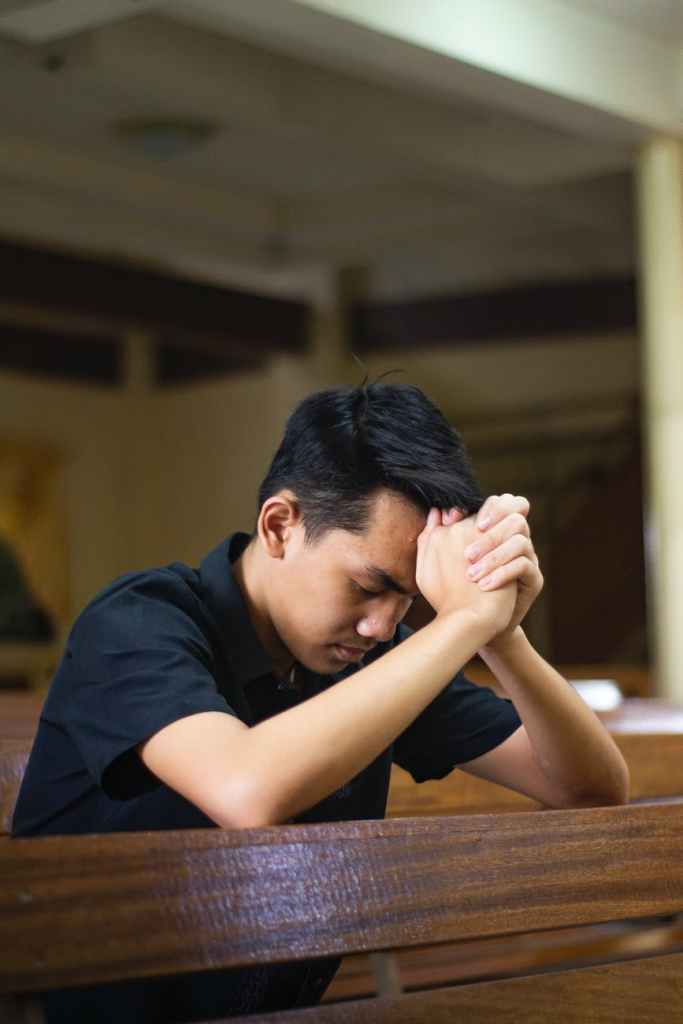
Presumptuous Prayers

The Pharisee and the Tax Collector

He also told this parable to some who trusted in themselves that they were righteous, and treated others with contempt: 10 “Two men went up into the temple to pray, one a Pharisee and the other a tax collector. 11 The Pharisee, standing by himself, prayed thus: ‘God, I thank you that I am not like other men, extortioners, unjust, adulterers, or even like this tax collector. 12 I fast twice a week; I give tithes of all that I get.’ 13 But the tax collector, standing far off, would not even lift up his eyes to heaven, but beat his breast, saying, ‘God, be merciful to me, a sinner!’ 14 I tell you, this man went down to his house justified, rather than the other. For everyone who exalts himself will be humbled, but the one who humbles himself will be exalted.”

Luke 18:9-14 ESV (via biblegateway.com)
Photo by sobhan joodi on Pexels.com

“Father, help my neighbor see her sin. Change her heart, Lord Jesus.”

“Heavenly Father, I know it is not your will that I face this diagnosis of cancer. Help the doctors to see their mistake.”

“God, this job opening is a perfect opportunity– I claim this job in Your Name.”

Photo by Luis Quintero on Pexels.com

I’m not saying that the above examples are all about presumption, especially taken out of context, but I think it is easy to fall into a dangerous habit of thinking that our will must also be God’s will, and not the other way around. What if God is waiting for me to reach out in Love to my “sinful” neighbor? What if it is MY heart that needs to be changed? What if God’s plan for my life includes cancer– or a miraculous healing from it? What if my response to cancer is an opportunity to show God’s peace? What if God has a better job, or better timing for that job?

I actually had that experience. When I was first out of college, I applied for many teaching positions– nothing was open the first year, and I ended up working at a public relations firm as a proofreader. I was laid off nine months later– just in time to apply for teaching positions again. The “perfect” job came up at my old high school, where they needed an English teacher. I interviewed well, and thought I had the job. But they went with a teacher who had more experience. So I signed up to do substitute work– not what I wanted, but it paid for my room and board, and not much else. It was late January when I got the call. The other teacher had been chronically ill, and they needed me to “substitute” for the rest of the year, with a possibility of a contract the next year. When I arrived, the classes were in chaos. The students were unruly and way behind in their studies. It wasn’t the “perfect” job– it was difficult. But I prayed– agonizing, humbling, needy prayers. I stayed at that position another seven years. Any I prayed through every day. But what if I had gotten the job at the first try? Would my prayers have been as pure, or would they have been laced with presumption?

Photo by Katerina Holmes on Pexels.com

I pray every day. I read God’s word every day. But I am in need– every day– of God’s mercy, His wisdom, and His Holy Spirit to guide my thoughts. Too often, I presume when I pray– that God will do what I want, that He will see things from my perspective, that He will not ask me to go through hardship or disappointment, or pain.

Our prayers don’t need to be as arrogant as that of the Pharisee in this parable to hold certain prideful presumptions.

Photo by Ian Panelo on Pexels.com

“Lord, be merciful to me, a sinner! Give me strength to face the day ahead, grace to share Your Love with those around me, and eyes to see Your hands at work. Thank you for Your salvation, for Your promises, and for Your faithfulness. Amen.”

My Cup Runneth Over

“Are you the type of person who sees the glass half-full, or half-empty?” Amateur psychologists like to ask questions like this, to determine if others are optimists or pessimists. But what happens when you realize your cup or glass is really full to overflowing?!

Photo by Bran Sodre on Pexels.com

Often, we look at our lives and circumstances with a pessimistic attitude. “I’m stuck at home during the pandemic– I can’t be with my friends, I can’t visit the gym, I can’t go to work..” We think of our “full” lives just weeks ago, and we miss all the things we took for granted– even the things we were complaining about before! And we worry and panic about tomorrow, or next week, or later today! But this is not God’s view. All that we are “missing” right now, God knows. He knows what we need, what we want, and what is best for us to have (or not have) during these days. Even if we are suffering from COVID-19, or waiting and praying for a loved one who is isolated and struggling, God knows. He listens for every breath– even the labored ones; He knows all that has come before this moment, and all that will happen in the next. If our glass is truly half-empty, we need only ask, and God will give us wisdom, patience, strength, and whatever He knows we need for the next breath; the next step.

Photo by Bia Sousa on Pexels.com

Sometimes, we carry an overly optimistic mindset–taking pride in our half-full glass, and not allowing God to finish filling it. We sit safe in our houses, confident that we will survive any threat and defeat any enemy, especially a tiny virus. We don’t need God’s help; His abundance of wisdom and grace. We’ve got everything covered with our half-full arrogance. But this is also not God’s view. God doesn’t want to fill our cup so that we can be smug and self-satisfied. God wants to fill us to overflowing, so that we can bless others, and see the incredible riches of His mercy and love! Some people look like they are “half-empty” from the outside– they are poor, or tired, or weak– but they are overflowing with God’s love; gushing with grace, lavish with love, exuding excitement, and overflowing with joy. Meanwhile, the optimist who is smug and self-serving, may seal up her “half-full” glass, refusing to share her hope and joy with others who need it.

Photo by Andrea Piacquadio on Pexels.com

God is never stingy with His riches. Paul reminds us that God’s Grace is sufficient https://www.biblegateway.com/passage/?search=2+Corinthians+12%3A6-10&version=NIV, that God can meet all our needs out of His abundance https://www.biblegateway.com/passage/?search=Philippians+4%3A19&version=NIV, and that God is able to do more than we can possibly imagine https://www.biblegateway.com/passage/?search=Ephesians+3%3A20-21&version=KJV; the Apostle James writes that every good and perfect gift is from above https://www.biblegateway.com/passage/?search=James+1%3A17&version=ESV . However, we must be open to accept them, and open to share them with those around us! This is especially true when God’s riches may be hidden by clouds of doubt, worry, and fear.

Photo by Alin Luna on Pexels.com

So today, I need to see, not whether my cup is half-full or half-empty of energy, or money, or health– I need to see where my cup is overflowing with God’s Grace, His Peace, and His Love!

Prayer in the “Off-Season”

World Cup fever is at a high this week.  England was stunned by Croatia in the semi-finals–Croatia will face France in the finals on Sunday.  Teams have played hard all season to make it to the World Cup– most of them will go home disappointed (at least a little).  Fans will have to wait until next season to see their favorite team make another attempt at winning it all.

action activity adult athlete
Photo by Pixabay on Pexels.com

In the meantime, the players will be in the “off-season.”  Some will take well-earned vacations, and spend more time with their families.  Some will spend time with doctors and physical therapists to work on injuries sustained during the regular season.  Some will be working with coaches and trainers to develop in areas where they feel they need extra help.  Others will cut back on their training schedule.  Still others will spend time with agents trying to get traded to another team (or avoid being traded to another team).

man jumping above gray concrete surface under blue sky at daytime
Photo by antas singh on Pexels.com

People who study sports often say that what happens in the “off-season” can be as important to players and teams as what happens during the intense training of the regular season.  Habits form, attitudes develop, team chemistry alters– any or all of these factors can change for better or for worse.

corner field football field game
Photo by Lorenzo Cafaro on Pexels.com

The same is true in our prayer lives.  When we are facing struggles or heartaches, we pray with intensity and passion.  But when things are going smoothly, sometimes we let our prayer lives “take a break.”  We pray with less frequency, less intensity, and less focus.  I’m guilty of this; even though I know it can happen, bad habits creep in, and suddenly, my prayer life is haphazard and lackluster.  Using a journal helps, in that I have a focus for each day already written in, and a place to write in new requests, and even answers.

However, a major part of staying on course is to commit to the discipline of prayer.  “Discipline” sounds boring and constrained–something I do out of obligation and not out of love.  But that’s not true of all discipline.  Athletes are disciplined– because they love their sport, and they want to develop and play at the best of their ability.  Musicians are disciplined– because they love music, and they want to develop their art.  Professional athletes and musicians often have a contractual commitment to stay in practice and develop their talents.  When athletes are part of a team, or musicians are part of a band, orchestra, or chamber group, they have an additional reason to be disciplined– to play more effectively with others.

adult art band blur
Photo by Pixabay on Pexels.com

In my personal life, there are disciplines– hygiene, sleep habits, diet, and exercise, that I practice, not because I love saying, “NO” to that piece of chocolate cake or walking that extra mile, but because I want to stay healthy, clean, and active.  Prayer is no different– except that it is for my spiritual health– and it is part of my relationship with God.

Instead of slacking off during the “off-season”, many athletes and musicians will use this time to step back and look at what they have learned, what they would like to do better, and how they can develop their skills.  I think this offers a great opportunity in prayer, as well.  After a season of grief, struggle, doubt, or testing, it is good to take some time to make some assessments.  Sometimes we don’t know all the reasons for the times of testing or trial we have just faced.  But that doesn’t mean that we can’t look back and see whether we have grown, or if we need to make some adjustments, or if we have developed new habits or skills (good or bad).  It is a good time to “count our blessings”, “pray without ceasing”, “ask, seek, and knock”, and look at the ways God has been faithful (and hopefully ways that we have been faithful!) over the years.

activity business calculation chart
Photo by rawpixel.com on Pexels.com

Some of us are in the struggle of a busy, harsh, or painful season.  Let’s not let that struggle go to waste.  Some of us will be facing trials next week, or next month–spending time training in the “off-season” will make us stronger for the fight!  And the best news– we already know the outcome!  Let’s pray harder– pray stronger–and go for the win!

action activity adult athletes
Photo by Pixabay on Pexels.com

Why There Are No Do-Attitudes…

In Jesus’ Sermon On the Mount (Matthew 5-7), Jesus listed what have become known as “The Beatitudes”.  Each phrase begins with “Blessed are..” or “Happy are…” (depending on the translation).  The blessings are specific, but they are also reserved for those who do not appear to be due for blessings– the poor in spirit, those who mourn, the meek, the persecuted, those who hunger and thirst for righteousness.  Each group seems pitiable, not suited for accolades and celebration.  They’ve done nothing to deserve blessing.  Yet Jesus calls them “Happy” and assigns them amazing gifts and blessings– not for their hard work or achievements, but because of their emptiness; their need and their ability to receive the blessings of God.

city man person people
Photo by Pixabay on Pexels.com

There are wonderful sermons and analyses and studies on the Beatitudes, but in relation to prayer, I want to look at this aspect.  There are no blessings in the list for the doers– the movers and shakers, the revolutionaries and the organizers and life-changers.  Throughout the Sermon, Jesus spends more time on attitude than on action–Murder is an action– forbidden by the Ten Commandments– but it is based on attitudes like hatred, disdain, envy, and rage.  Clearly, Jesus does not want us to be unproductive or isolated from the needs of others, but our busyness, our stress, our huffing and puffing and scurrying about, does not impress Him, nor does it bring us the kind of happiness only God can offer.

He gives the same emphasis when he discusses prayer– prayer is not about public eloquence or long strings of words or excessive emotional outbursts.  In fact, effective prayer has little to do with who is praying, what words or word order or language they use, where they pray, or when they pray.  It IS about how and why and TO WHOM they are praying.  And the only active verb not assigned to “Our Father” is found in the phrase, “…as we forgive…”

man hugging a woman wearing black tank top
Photo by Pixabay on Pexels.com

God does not command us to pray seven times a day, or to have a prayer list a mile long, or to pray only when we are in great need.  He wants us to “pray without ceasing”, not as a recurring action, but as a constant state of being aware of and responsive to His presence.

I have a niece who has spent several years in dance.  When she was a beginner, it was both comical and sad to watch as she and many others agonized and counted the steps out as they performed– often getting all the right steps, but a slight beat ahead of or behind the music and/or the other dancers.  But what a delight to see the development of young students into graceful dancers– seeing the transition from just doing the right steps at the (approximate) right time to internalizing and coordinating the music and movement into art.

adult art ballerina ballet
Photo by Pixabay on Pexels.com

I have friends who are runners, and while I don’t run, I have watched those who do…there is a difference in the stride, the posture, and the face of someone who is “a runner” and someone who is just “running.”  It’s not the action, but the attitude that makes the difference.

woman wearing black sports bra and jogger shorts smiling
Photo by nappy on Pexels.com

Prayer is a gift; a privilege; a sacred meditative conversation with our Creator, Our Father, and our King.  I don’t want to just pray– I want to BE in Prayer!

Blog at WordPress.com.

Up ↑