Perfect Peace

I know several people (myself included) who are facing stressful situations on a daily basis– some are fighting cancer, some are caring for aging parents, some have rebellious teens, some have lost jobs or are in danger of losing their home, some are fighting depression or addiction, others have lost close family members–some are facing multiple stressors every day.

Stress is a killer and a thief.  It robs us of energy, time, and focus.  And it isolates us– as we focus on our stressful surroundings, they begin to close in on us, hemming us in and keeping others out.  We long to be stress-free–sitting on a beach or lying in a hammock  or on a chaise without a care in the world– no worries, just peace.  And we pray for it.

borderline-depression-psycholgie-personalities.jpg

But peace isn’t the absence of stressful circumstances.  I once met a man who was, in fact, lying on a chaise by a poolside, a sandy beach less than 100 feet away– palm trees and gentle breezes relieving the searing heat, icy drinks available at a whim.   He had nothing to do but soak in the heat and sea air, relax, and enjoy his day.  He had all the time and money he needed to find perfect peace– but he didn’t have it.  He was bored, and restless, and dissatisfied with life.  He couldn’t lie still, and he found no wonder in all the beauty and peace all around him.

Peace doesn’t come by denying stressful circumstances, or running away from them, either.  Ask the next three people you meet how they are doing, and they will likely answer, “I’m fine.”  We know they’re not really “fine”– they know that we know they’re not “fine,” yet neither of us tells or demands to know the truth.  Stress isn’t contagious, but we avoid sharing it.  I don’t want to hear about your stress, in case it reminds me of my own; you don’t want to share your stress in case I judge you as being weak or whiny.  We learn from others around us that “success sells.”  “Fake it until you make it,” as some would say.

pexels-photo-313690.jpeg

We can’t get peace by any means in our own power– we can’t manufacture it, legislate it, demand it, buy it, trade for it, or wish it into being.  In fact, the more we try to chase after it, the more elusive it becomes.  Peace is a by-product of faith and trust– the result of a relationship in which circumstances are not borne or understood only by us but shared with someone all-wise and all-powerful.  Our circumstances don’t need to disappear, but we must believe that they are not insurmountable or permanent, and that we are not forgotten in the midst of them.

You will keep in perfect peace
    those whose minds are steadfast,
    because they trust in you. (Isaiah 26:3 NIV)

Peace comes from knowing and sharing with the Prince of Peace.  He doesn’t take away our circumstances (though he can, and sometimes will remove some of our stressors–even against our will).  Most of the time, Jesus will take away our blinders, instead.  He will turn our focus away from our own pain, loss, frustration, or confusion, and allow us to see Him working around us, in us, through us, in ways that put things back in perspective.

sosua

The peaceful scene I described above– the beach, the pool, the gentle breezes– I was in the same location and enjoying every minute of it.  This in spite of numerous bug bites, an almost certain case of sunburn, and a very short time before I had to return to the snowy Midwest, and the normal stresses of my ordinary life.  But, while I knew they were waiting for me, I wasn’t concentrating on them.  And even while I enjoyed the beauty of the beach, I wasn’t focused on the sun or the sand, or my tan/burn progress.  I was enjoying the memory of working with rescued children, of meeting amazing foster parents and missionaries, and of seeing what God was doing to heal and bring peace to lives that had been ravaged.  I was seeing in the beauty of my short stay at the resort the promise of what God has in store for me throughout eternity.  THAT will be perfect peace– not shortened by time, not diminished by restlessness or dissatisfaction, or denial.

Sinking Sand

24 “Everyone then who hears these words of mine and does them will be like a wise man who built his house on the rock. 25 And the rain fell, and the floods came, and the winds blew and beat on that house, but it did not fall, because it had been founded on the rock. 26 And everyone who hears these words of mine and does not do them will be like a foolish man who built his house on the sand. 27 And the rain fell, and the floods came, and the winds blew and beat against that house, and it fell, and great was the fall of it.”

Matthew 7:24-27 ESV via biblegateway.com

I’ve been thinking on old hymns lately, and one that has gotten stuck in my head is the one often called “The Solid Rock”, or “My Hope is Built on Nothing Less.” While slight variations of the lyrics exist, the words follow here:

1My hope is built on nothing less
Than Jesus Christ, my righteousness;
I dare not trust the sweetest frame,
But wholly lean on Jesus’ name.
 On Christ, the solid Rock, I stand;
All other ground is sinking sand,
  All other ground is sinking sand.
2When darkness veils His lovely face,
I rest on His unchanging grace;
In every high and stormy gale,
My anchor holds within the veil.
3His oath, His covenant, His blood,
Support me in the whelming flood;
When all around my soul gives way,
He then is all my hope and stay.
4When He shall come with trumpet sound,
Oh, may I then in Him be found;
In Him, my righteousness, alone,
Faultless to stand before the throne.

For more on the history behind this hymn, see this link:https://www.umcdiscipleship.org/resources/history-of-hymns-my-hope-is-built

While the song speaks of anchors, frames, and trumpet sounds, its inspiration comes from Jesus’ parable of the houses built on rock and sand, found in Matthew 7. We understand the wisdom of building our house upon the rock, on a solid foundation; we may even agree that Christ is the only solid foundation, and our only hope of salvation. We confess that Jesus is Lord; we say all the right things, and do many good works, believing that we are building on the rock.

But there are days when I build a temporary summer house on the beach–days when I plant my bare feet in the sandy shoreline, while the gentle waves tickle my toes and slowly cover my feet with glinting sand. My “main” house is safely sitting on the rock, but I am living at the beach. If the storm comes, I might run back inside, but I am lulled into thinking that the storm will never come, and I will only need the shelter and the solid ground in times of distress and obvious danger.

Slowly, the tide and sinking sand can pull me in– I slide into the sinking sand, until the water covers my ankles, and knees. I am still standing, but I am farther from the solid ground, and more vulnerable to the next big wave. It doesn’t take a storm to make me fall over and start thrashing in the surf. I don’t have to rush toward danger, or ignore clear warning signs. I just have to stand in the sinking sand, idly enjoying the scenery, and trusting in my own ability to run to safety at the last minute.

“All other ground is sinking sand.” There is nothing wrong with enjoying some time at the beach (although I wouldn’t recommend the beaches in my area in November, when the waves are treacherous and the wind slices through several layers of clothing!). There is nothing wrong with enjoying the blessings God has given us in this life. But we cannot plant ourselves in comfort and complacency and hope to build a solid foundation. I cannot trust in my circumstances when they are pleasant and only look to God when I am half-drowned and far from shore. Not because He can’t or won’t rescue me– He is still my hope and my firm foundation– but because I will forget how to stand and where to turn to regain solid footing. My house will be on solid ground, but empty and useless to me on the shifting, sinking sand where I am actually spending my life.

But when I live on solid ground, the storms of life cannot pull me away from safety. “When all around my soul gives way, He then is all my Hope and Stay.”

Photo by Pok Rie on Pexels.com

Recently, this old hymn has been updated and revised. The message still remains– My Hope is Built on Nothing Less: Christ alone is my Cornerstone and sure foundation. I dare not trust in my circumstances, my own wisdom or feelings, my family, my finances, my health, or any dreams or hopes apart from Christ. That doesn’t mean I don’t enjoy any of these things. I do, and I thank God for all He has given me. But I pray that I never drift away from the solid and eternal foundation that only He can bring and be in my life.

The Rocks Cry Out

A couple of days ago, while the weather was still cold, but clear, my husband and I visited one of the many beaches along the eastern coast of Lake Michigan.  The beaches are popular throughout the summer months, especially those with lots of dunes and smooth sand for sunbathing and picnics and beach volleyball.  We’re the sort of odd ducks who like to visit in the off-season, bundled in parkas and combing the rocky shores looking for unique stones and beach glass.

I was reminded of Jesus’ parable of the two men– one who built his house upon the rock, and the other who built his on sand.  https://www.biblegateway.com/passage/?search=Matthew+7%3A24-27&version=ESV.   Sandy beaches are wonderful to visit in the summer, when the weather is perfect, the sun is shining, and the lake is calm.  But over the winter months, people avoid sandy beaches (as we did) because the wind and waves can erode great patches of sand, moving it about and changing the shoreline considerably.  On the bigger public beaches, crews put up fences to keep the winter gales from blowing sand away from the shore and into the parking lots and streets.  The fences also trap the sand and snow on the shore.  Snow banks that form on the beach can melt and carry the sand back into the lake, forming new sand bars that can cause damage to small boats.  Even in the summer, large waves can produce undertows and dangerous currents for the unwary. 

Photo by Miro Alt on Pexels.com

In many ways, sand is like sin.  Sand is attractive– smooth and glistening in the sun.  It is warm and seems to yield to the touch.  But sand shifts; it blows and drifts easily, but it sticks in place where we least want it, tiny grains getting into hair and clothes, shoes, and beach towels.  It slips away, slides from under our feet, fails to hold its shape, unless we wet it down and pack it, and then it crumbles under the action of the waves.

Photo by Pixabay on Pexels.com

Rock, on the other hand, is secure.  It takes centuries to erode; it doesn’t shift or fall away.  A rocky coast may not seem as inviting for pleasure, but it makes a far better foundation for a home or a lighthouse.  Even the smaller stones along the beach do not blow around in a strong wind, nor do they melt away with the snow.

Photo by Pixabay on Pexels.com

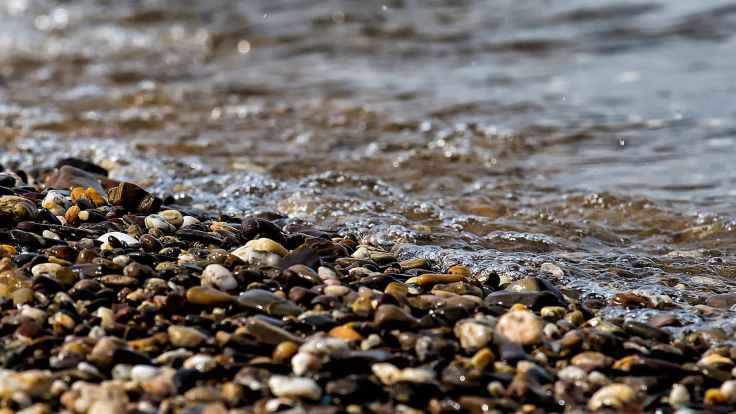
Beach stones can offer further illustrate how God works in our lives.  Stones on the beach start out with sharp edges.  They are cold and hard and uneven.  But over time, the rocks are slowly churned by the waves and the movement of smaller rocks and sand, and they are smoothed and polished by their environment.  Among the sharp rocks are beautiful agates and quartz, their varied colors seeming to absorb sunlight and heat.  Just so, we are transformed from hard and cold isolated individuals as we absorb the Son’s character.  And, as we are churned up against others, and the hard edges get smoothed away, His beautiful character is revealed in us, and we shine.  With further polishing, the stones reveal the kind of strength and beauty that make them worthy of being displayed or set in jewelry.  Not every rock along the beach will go through this transformation..some will remain hard and sharp; others will be ground into sand.  But some will cry out in their beauty and strength as testimonies of  God’s eternal process of redemption.

Blog at WordPress.com.

Up ↑