Pray For Me, Not About Me

Gossip and judgment are nasty habits– what happens when they creep into our prayer life?

I’ve sometimes struggled with the idea of praying for those who have hurt me or mistreated those I love.  We are commanded to do it, but often, I am tempted to pray about my enemies instead of praying for them.  As if God didn’t know what they had done; as if he needed me to alert him to their bad behavior, and remind him of how I was slighted, misunderstood, or powerless to bring justice to my friend or family member who was wronged.  I want to tell God how to treat them– how to punish them, or abase them, or bring them to feel remorse.  I want to hang on to the indignation and sense of victimhood–after all, God is going to make it right in the end, vindicating me and humiliating them, right?  Except that’s not how it works in God’s economy…My vindication does not come at their expense, but through the blood of the truly innocent Lamb of God.  Let that sink in.  God is not in the business of torturing others to make himself feel more righteous.  If I want to follow Christ, my actions, and my prayers, should be full of his Grace, not my bitterness.

I am not alone in this– and I’m sure I have been “prayed about” often enough.  Even saints and matriarchs of old have done it.  And King David was guilty of it as well–several of the Psalms include angry, even vicious rants against David’s enemies.  It’s understandable; it’s only natural for us to feel indignant, angry, and hurt in the face of injustice, unkindness, hatred, and abuse.  And it’s not inappropriate for us to cry out for justice, or pour out our hurt and frustration. But it is wrong to stand in judgment and unforgiveness when we come before the throne of Heaven.

gossip

I believe that these are the difficult prayers that teach us to know God better– as well as ourselves.  To pray for those who have hurt us means that we must move beyond what they have done– not to deny it, or to excuse or forget about it, but to give it over to God –and deal with who they are.  They are lost exactly as we are lost, but for the grace of God.  They are redeemable, not because they can undo or atone for what has happened, but because God says that whosoever trusts in Him can be saved.  They are precious in God’s sight.  When we stop focusing on who hurt us, and how, we can instead focus on who heals us, and how he wants to heal others.

These prayers also serve to remind us that our true “enemies” are not the people who say or do unkind or even wicked things.  Our true enemies are not the ones who can hurt our feelings, or even our minds or bodies.  Our true enemies are the ones who would steal our souls– who tempt us to hold on to rage and despair, to hopelessness and doubt, to bitterness and shame.

It is so easy to write these words, and to “know” the right thing to do.  But it is a painful, heartbreaking, humbling, stumbling uphill climb to DO the right thing.  I still catch myself so often praying about certain people, instead of praying for them.  God knows my heart–he knows if my prayer is sincere.  And, as I struggle, I am reminded that the change I would wish to see in someone else mirrors the change I should wish to see in me  The same Grace that God sends to heal and comfort me is the same Grace he offers to everyone who will take it–even when they choose not to accept it.

So I hope I am learning to pray for those who sneer at me; those who lash out in their own pain, anger, or thoughtlessness.  To pray for their health and safety, their well-being, and their wholeness. For their sake–for the sake of the One who loves them eternally.  And in the hope that healing and restoration will triumph over what lies in the past.

Green Eggs and Prayer?

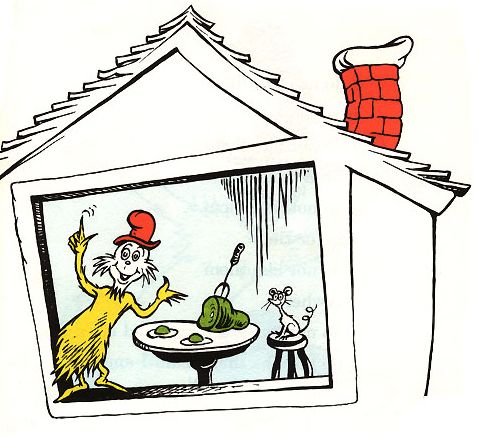
Have you ever read the Dr. Seuss classic, “Green Eggs and Ham”? In this early childhood reader, the narrator (nameless) is accosted by an enthusiastic character named Sam (Sam I Am), who wants him to try a dish called green eggs and ham. But the narrator refuses. Sam keeps offering, but the narrator continues to refuse, saying he does not like green eggs and ham, and will not try them under a variety of circumstances (in a box, with a fox, on a train, in the rain, etc..) offered by the optimistic Sam.

Finally, Sam’s persistence wears down the narrator’s resistance, and he agrees to try the dish. To his surprise, he LOVES them. In his newfound enthusiasm, he declares he WILL eat them in a box, with a fox, in a tree, in a boat, with a goat, on a train, in the rain, here or there…in fact, he WILL eat them anywhere! He ends by thanking Sam.

So what does a children’s book have to do with prayer?

Well, I believe that the pursuit of prayer as an integral part of living a Christ-like lifestyle is kind of like green eggs and ham. Most people who dismiss the power of prayer have never really pursued it. They have seen it, heard about it– maybe even gotten a whiff of it. They may have “sampled” prayer many years ago as a child or in a single moment of desperation. And the result was disappointment or confusion. Prayer didn’t solve all their problems in an instant. They didn’t get the miracle they hoped for. They didn’t get the bike for Christmas. Their neighbor’s leukemia wasn’t cured. Their situation at work got even worse. Their wife still left and filed for divorce. “Prayer” left a bad taste in their mouth. And they have heard others dismiss prayer and faith as obsolete, ignorant practices, designed for backward and unenlightened people. Like the slightly nauseating color of green eggs and ham, prayer has been deemed unappetizing and best avoided.

And now, when someone mentions a lifestyle of prayer– when someone talks about praying as a daily habit, or a natural part of their worship–the reaction is scorn and suspicion. Prayer doesn’t look powerful. It doesn’t look appetizing. How can something so simple and tame have any effect? Why is the world still suffering so much injustice and evil if there are people out there praying every day? And why do Christians (and others with a prayer tradition) cling to prayer as though it will solve life’s problems?

But prayer, like eggs, can have a bad reputation. For years, we were told that eggs were awful for you– high in protein, yes, but also high in cholesterol, and likely to contribute to diabetes and colon cancer. Recent studies contradict each other, but many now say that eggs are actually good for you. Similarly, during times of crises or disasters, prayer is often derided as inactive and ineffective, and we get mixed messages about people who offer to pray for victims and their families.

Recently, I was challenged about my pursuit of prayer. What good does my prayer do in the face of injustice and disease, death and suffering that people experience? Why do I pray to a God that allows bad things to happen? I have been challenged before, and my answer remains the same. I pray because I have known the peace that comes from trusting God’s wisdom, HIS timing, and His Love for each of us. I don’t have answers for all the “what-ifs” or the “whys.” But I continue to trust that God DOES! And daily prayer is not about “me,” or my questions or what I wish for. It’s about communing with the God who has been faithful all my life and continues to be faithful in every season. The God I love, and the God who knows the end from the beginning.

So what if more of us prayed daily– not just as a reaction to disasters– but pro-actively? What if we prayed, not in anger or bitterness, not transactionally, expecting a particular outcome, but with gratitude for who God is, what He has already done, and what He will choose to do in His loving sovereignty? What if we prayed with open minds and hearts, trusting that we are talking to a God who loves us and knows what is best, not just in the temporary, but in the eternal scope of our lives? We would still see evil in this fallen world, but what if our prayers DO make a difference– we just don’t see the whole scope of what God has provided, or the evil He has NOT allowed to touch us?

I speak as one who has pursued prayer for more than half a century. I’m not perfect. Sometimes, I get frustrated when my desires don’t align with God’s answers. But that’s not the fault of Prayer. Prayer DOES change things– maybe not instantly, and maybe not in the ways I imagine in the short term– but I have seen and experienced the power of prayer. I have felt it in my own life, and I have seen in in studying history and talking to people whose lives were radically transformed by their prayers and the prayers of others.

Philippians 4: 6 says: “Do not be anxious about anything, but in every situation, by prayer and petition, with thanksgiving, present your requests to God.” After this, Paul promises in verses 7 and 8 “And the peace of God, which surpasses all understanding, will guard your hearts and minds through Christ Jesus. Finally, brethren, whatever things are true, whatever things are noble, whatever things are just, whatever things are pure, whatever things are lovely, whatever things are of good report, if there is any virtue and if there is anything praiseworthy—meditate on these things.” (taken from the King James Bible online).

In every situation, we can pray. So, to paraphrase Sam I Am, I WILL pray here and there! I will pray most anywhere (except I won’t close my eyes if I am driving!) So to end:

“I’ll be praying in a boat,
I could be praying with a goat.
I may be praying in the rain.
Or in the dark. Or on a train.

And in a car (eyes open of course). And in a tree.
Because Prayer, it is so good, you see!


So I would still pray in a box.
And I would still pray with a fox.
I will pray inside my house.
And I will pray beside a mouse.

And I will write “Pursuing Prayer”
Because I serve a Lord who Cares!

What if we all had the same enthusiasm for prayer as Sam had about Green Eggs and Ham? What if we keep praying “without ceasing” (1 Thessalonians 5:17) and with confidence (1 John 5:14-15) each day?

“Try it! Try it!”

You’ll be so glad you did.

Praying for the Enemy

pexels-photo-984953.jpeg

Everybody has enemies.  And when I use the term “enemies”, I’m mosl referring to two types of people.  There are the people who are your enemies– they hate you.  They are scheming to hurt or destroy you; people who defame or slander you; people who betray you; people who cheat and lie to and steal from and abuse you or those closest to you.  Then there are the people for whom you are an enemy– you don’t like them, you don’t trust them, you don’t respect them; you probably defame or gossip about them, and you hurt them, even if it is unintentional.  Some enemies fall into both categories, but not all.

And then there are existential “enemies”– not personal enemies, but those who live in opposition to our way of life, or our beliefs, or our nation. There are enemies within and enemies without– those who argue in the street, and enemies who plan catastrophic destruction to entire groups of people. And sometimes, those enemies can include “us.” “Us” v. “Them.”

I would love to say that I have no enemies–of any type.  But, alas, they exist.   God calls on us to love our enemies, to pray for them, to show them kindness, and to bless them!  In our own power, we can’t do this.  We can make the attempt to forgive the unforgivable, to love the unlovable, and reconcile the impossible, but we fall short in our attempts:  the betrayal is too deep; the hurt is too overwhelming; the damage is irreversible, and the impossible is just…well…impossible.

pexels-photo-1058068.jpeg


 Loving our enemies is one of the proofs of God’s existence, his goodness, his power, his own boundless love at work through our imperfect words and efforts.  Praying for our enemies, showing kindness and grace in the face of hatred and betrayal–these are miracles that defy explanation.  That is one good reason to keep praying for the enemies in our lives– God can work through us to effect reconciliation, healing, and peace. And this includes those enemies who want to do is immeasurable harm. We don’t have to pray for their triumph at our expense– but we should be praying for their salvation; for their safety; for their good! Yes, even “those” enemies. God can change even the most horrific situation.

pexels-photo-984926.jpeg

Another good reason is that prayer changes US.  Praying for our enemies is difficult.  It is humbling.  It breaks our pride and forces us to let go of the bitterness and recognize God’s rightful place as judge, avenger, and healer.  It reminds us that God’s love, being boundless and eternal, stretches to those people who don’t deserve it, whether that is the hurtful person you don’t want to forgive, or the hurtful YOU who needs to be forgiven. God even loves those who seek our destruction. God loves those who hate HIM! God prayed for those who crucified Him– while He was dying. Can we say that we follow Him and do any less?


But praying for our enemies isn’t just about bringing peace and harmony or transforming us into better versions of ourselves.  No amount of willpower, or good intention, or logic, or internal fortitude, or peaceful meditation, or persuasive rhetoric, or even powerful prayer will be enough to eliminate our enemies or make us perfect in love. Our prayers may stop neighborhood chaos or family feuds. They may even cause wars to cease. But they may NOT. Jesus is the Prince of Peace– not me. My job is to recognize that I cannot bring peace, but I can live in the Peace that passes all understanding– even in the midst of chaos and turmoil. And I can show love, even as I stand up for truth and hold fast to God’s Word. Love doesn’t mean that I will compromise. But I will respond with compassion– even in conflict.


pexels-photo-669032.jpeg

We pray FOR our enemies, but not all of our enemies.  There are two enemies we need to pray AGAINST– Sin and Satan.  They are the true enemies, trying to destroy both sinner and sinned-against.  They are not just our enemies, but enemies of God.  Both are defeated.  Their power is illusory, and their damage, while intensely painful, is temporary.  And when we refuse to pray for our human “enemies” we serve their destructive purposes. When we follow our own fears, hurts, and feelings of outrage, instead of God’s wisdom in showing love to our enemies, they gain a temporary victory. And we end up on the losing end!


The Prince of Peace

They have healed the wound of my people lightly, saying, ‘Peace, peace,’ when there is no peace. Jeremiah 8:11(ESV)

While people are saying, “There is peace and security,” then sudden destruction will come upon them as labor pains come upon a pregnant woman, and they will not escape. 1 Thessalonians 5:3 (ESV)

Peace I leave with you; my peace I give to you. Not as the world gives do I give to you. Let not your hearts be troubled, neither let them be afraid. John 14:27 (ESV)

I have said these things to you, that in me you may have peace. In the world you will have tribulation. But take heart; I have overcome the world.” John 16:33 (ESV)

Jesus answered: “Watch out that no one deceives you. For many will come in my name, claiming, ‘I am the Messiah,’ and will deceive many. You will hear of wars and rumors of wars, but see to it that you are not alarmed. Such things must happen, but the end is still to come. Nation will rise against nation, and kingdom against kingdom. There will be famines and earthquakes in various places. All these are the beginning of birth pains…21 For then there will be great distress, unequaled from the beginning of the world until now—and never to be equaled again. Matthew 24:4-8; 21 (NIV)

One of the prophetic names given to Jesus in the book of Isaiah is “Prince of Peace” (Isaiah 9:6). And yet, Jesus did not bring an end to the Roman occupation of Judea while He walked the earth. He did not end slavery or war or oppression. He did not bring the kind of “peace” that most of us look for even today. We live in a world of war, dissention, upheaval, and chaos. There is hatred, injustice, slavery, abuse, and oppression, and none of the efforts to bring peace in our world have succeeded in wiping out any of these evils. In the nearly 2000 years since His crucifixion and the rise of the Christian Church, these evils have remained. Great strides have been made over the years– slavery is officially outlawed in many areas of the world; human rights have been codified. Humanitarian efforts have greatly decreased the number of people who die of starvation and disease, homelessness and exposure to the elements. But there are thousands, and indeed hundreds of thousands of people around the world who are refugees from their home countries, who are denied human rights, who live in fear of bombing raids and terrorist attacks.

Where is the Peace?

Jesus spoke freely of the tribulations His followers through the generations would face. He never promised us a world without any trouble. He promised that, in this life, we WILL have trouble. And it will increase over time. People will grow suspicious, hateful, and cold. Nations will rise up against other nations; families will be divided in such a way that one’s greatest enemies will be their closest relatives! Wars and natural disasters will intensify. And ONLY Christ’s return will stop any of it. Human efforts may make a difference for a short while, or make a small difference for a long while, but nothing we can do, single-handedly or as a human race, will deliver us from the evil that lives in the human heart. In fact, we often delude ourselves into thinking that we can change the world on our own; we seek to force our plans on others “for their own good,” little knowing that we may be sowing the seeds of bitterness, backlash, and revenge.

Jesus Christ is the Prince of Peace. He will administer perfect peace and justice when He returns. And in the meantime, He offers us an inner peace that passes all understanding. We can experience peace as bullets whip around us; as we are being misunderstood, mistreated, and abused; as we face injustice and oppression. We can do this because Jesus gave us the example. He did not fight back or even complain as He was arrested, falsely accused, sentenced, and executed. He did not seek to force everyone to accept His rightful claims. He did not even protest the unjust treatment of His people by the Romans.

What He did instead was to focus on God’s mission– He interacted with those who were suffering; He healed the sick; He brought comfort to those who were grieving. He brought sinners to repentance and sought to make peace between individuals and God. Jesus is the Prince of real and lasting Peace– not just peace in “our time” or peace for a generation, but eternal and everlastingly joyous Peace. This is the kind of peace that sees trouble and tribulation for what it is– temporary and transformational. Suffering can make us bitter or better, and Jesus shows us how to experience the latter. When we protest instead of pray, we forfeit that peace. When we pray, we gain wisdom in how to stand firm against injustice without losing our own peace and perspective.

These are not peaceful times, but we can still experience peace, hope, trust, endurance, joy, and light in the days ahead, thanks to our Prince of Peace.

The Lost Art of Saying Grace

“God is great, God is Good…”
“Come, Lord Jesus, be our guest…”
“For what we are about to receive…”
“Bless us, O Lord, and these, Thy gifts…”

Saying grace at the family dinner table used to be a tradition.  So much so, that it has been made fun of several times in the movies and on television.  Some families recited a favorite prayer; others selected a family member to do the honors.  Some families held hands; some closed their eyes; some stood.  But NOBODY touched their plate until the Amen.

Grace has fallen out of favor in recent years.  Some families still practice it for the holidays or special occasions, but many of us have lost the art of saying grace.  In fact, many of us no longer have a family dinner table.  Some of us eat, sleep, and live alone; others share a house, but rarely a meal, and never a grace.  I would like to think that many of us WOULD say grace more often if  we made time and effort for it, but many others actually hold grace in contempt, calling it old-fashioned; a senseless ritual, or a meaningless tradition.

I want to look a little more closely at grace– how and why we say it, and what it means (or should mean) as part of our daily walk with God.  Calling grace a meaningless tradition may sound harsh, but it may also be a valid criticism.  If “Come, Lord Jesus…” could be replaced with “Gentlemen, start your engines…”, then it might be time to rethink the entire practice.  Similarly, if we dust off grace, only to say it for company, or to show that we still acknowledge tradition and have “good manners”, we’re missing the point.  Grace should be more than just a moment to bow our heads, say a few familiar words, and dig in…grace has become laughable and spoof-able precisely because it has become senseless, formulaic, awkward, and grudging.

I am a big fan of Jimmy Stewart. And this short clip from the beginning of the movie Shenandoah is a prayer said sarcastically by a bitter man who lost his wife and promised her that he would continue to raise their children in a “Christian” home, in spite of his own anger against God. (He later has a change of heart in the movie.) There are many other film and TV scenes that make fun of saying grace without any remorse, repentance, but with a heavy dose of disdain.

I read a tragic statement by someone who claimed that saying grace is actually “graceless”– tactless and inane.  The writer suggested that when we thank God for food, we are really thanking him for feeding us, and choosing to bless us, as he allows others to starve– that saying grace makes us feel more special/less guilty in light of social and economic inequities, which he blithely allows.  In other words, saying grace, in this person’s opinion, makes us arrogant and apathetic to the condition of others, while giving an unjust God undeserved thanks.

I would posit that it should be just the opposite.  I suppose there are many who pray with the arrogant mindset suggested above, but their mindsets and their hearts are not mine to judge.  True grace is not about the recipient of the grace, or the other potential recipients of grace, but about the giver–God– and his worthiness to receive our sincere thanks.  If I believe that God is indeed unjust, then it makes little sense to feel “blessed” or “special” at all– an unjust God is also capricious and unreasonable is not likely to be impressed or swayed by my smug “thank you,” anyway.  So not praying doesn’t make me any less arrogant or apathetic toward others, nor does it move me to be more grateful or more generous than one who prays.  It merely passes the blame for all injustice to God, leaving me off the hook, and making me feel more just than God.

tablegrace

However, if God is loving and gracious, promising perfect justice in his time, and forgiveness to those who seek him; a God who promises to be close to the poor in spirit, those who hunger and thirst for righteousness, and who are broken and contrite; I am not thanking him for who I am, for what I have, or for what I think he should do.  I am thanking him for who he is and for what he has chosen to give.  Some days, I may NOT have a lot to eat, or pleasant surroundings. I may be the victim of injustice done by evil people. But I can still thank God for what I DO have and for who HE is. And on those other days, in thanking him for the very things I would take for granted, I am reminded that blessings are not given for me to boast about or hoard, but to share with others.  That’s what saying grace SHOULD do–cause us to reflect on God’s goodness, our true neediness, and our call to share God’s blessings with a needy world.

Grace is also an invitation– asking God to be part of every moment of our day.  According to his Word, he’s always present, anyway.  But grace is a way of acknowledging and welcoming that presence.  And that invitation isn’t limited to Thanksgiving or Sunday dinner with the whole gang.  That invitation can be made anywhere, by anyone, at any meal (or snack, or midnight raid on the fridge!)

Is God welcome at our dinner table?  Does he share in our drive-thru breakfast, or our trip to the deli?  Do we allow him to join us at the restaurant, where others might overhear and find us quaint and old-fashioned?  Does he sit with us in front of the TV or computer as we absent-mindedly munch on a sandwich?  Grace isn’t about our goodness, our riches, or worthiness to enjoy God’s blessings.  Grace is about a gracious God who has poured out blessings on a graceless and fallen world; a God who loves us all equally and offers to give us something more precious than food– freedom, forgiveness, and family–forevermore.

gracelady

“God IS great; God IS good; Now we thank him for our food.”
“Come, Lord Jesus, be our Guest; let this food to us be BLESSED”
“For what we are about to receive, may the Lord make us TRULY grateful.”
“Bless us, O Lord, and these, THY gifts, which we are about to receive from THY bounty. Through Christ, our Lord. Amen.”
“Dear Heavenly Father, thank you for this day and this food. Bless it to our good and to your glory. May all we say and do bring honor to Your Name. Amen.”


Piece of Mind v. Peace of Mind

We live in an angry world, filled with outrage, entitlement, bitterness, hurt, and arrogance. Everywhere we look, someone is giving someone else (sometimes everyone else) a “piece of their mind.” And those who do are often lauded and celebrated. Pundits, critics, “talking heads,” columnists, “expert” opinion-makers (recognized or self-appointed)– all make careers out of sharing their opinions, their theories, expertise, or knowledge. They may be clever, intelligent, even entertaining; they may be popular, intimidating, or impressive in their range of knowledge. I may agree with their opinions, and share their conclusions or beliefs. But I should be careful not to become “puffed up” with knowledge.

Knowledge puffs up but love builds up. The man who thinks he knows something does not yet know as he ought to know. But the man who loves God is known by God. 1 Corinthians 8:1-3

1 Corinthians 8:1-3

https://dailydevotionscripture.blogspot.com/2012/11/knowledge-puffs-up-love-builds-up.html#:~:text=Knowledge%20puffs%20up%20but%20love%20builds

It is very tempting– VERY tempting– to join in this practice of verbal tongue-lashing. To show off our superior knowledge or our righteous opinions. To win arguments and create “mic-drop” moments.

Meeting anger with anger, sarcasm with sarcasm, and pride with pride is natural. But it is not God’s way. God calls for us to have peace of mind– to have a mind that can see and hear the reality of our fallen world but respond in an unnaturally loving and gracious manner given to us by the Holy Spirit. We are to speak words of peace, to walk in humility, and to love our neighbors as ourselves.

Our words can be powerful– for good or evil. We can speak peace and goodwill, harmony, and love into a world that is drowning in hateful comparisons, disdain, selfishness, malicious gossip, idle chatter, and careless opinions. Words can uplift, encourage, heal, and strengthen. Words–even quiet words– can stem the tide of malice and bring light and hope.

And it is not just what we pass on to others with our words– we become what we speak! When we speak arrogance and self-righteousness, we become (and remain) self-righteous and arrogant. When we speak love and joy, peace and patience, trust and truth, we become more peaceful, joyful, patient and trustworthy.

Jesus– the Word of God– often used a quiet sentence to bring hope, reassurance, and blessing to people in need. Jesus felt anger– and He had every right to speak HIS opinion and HIS omniscience when He was tested and unfairly questioned. But He chose to be patient. His answers were not laced with malice and sarcasm, but they silenced His critics, and served as lessons for others who were listening. What a great example for us!

What might happen if we spent less time giving a “piece of our mind” and more time spreading “peace of mind” in our world?

How Long?

We are preparing for Advent season. We celebrate the coming of our Savior, and His humble birth in Bethlehem over 2000 years ago. We count down the days with advent calendars, candles, and other traditions. And it can be difficult to wait for Christmas Eve and Christmas Day to come.

But imagine those people who lived BEFORE the Advent…those who held the promise, but had not seen it fulfilled. Imagine waiting an entire lifetime without ever hearing the Good News– He is Here! The Messiah has come!

There are promises and hints and prophecies throughout the Bible in what we call the “Old Testament.” And the New Testament is filled with the story of Jesus’ life, death, resurrection, and rule, as well as the outcome of His mission to bring Salvation and Hope to a darkened world. But in between the two testaments there stretches a period of nearly 400 years when God was silent.

I get frustrated when I have to wait 45 minutes at the doctor’s office! Imagine listening to stories from grandparents and elders about promises made a thousand years before, knowing that there was no word, no glimmer of fulfillment for over a dozen generations or more!

And yet, we celebrate the glory of the fulfillment. And on the strength of that glory, and Jesus’ teachings, we are waiting for His triumphant return. A return that hasn’t come in nearly 2000 years.

The difference for us is that we live in the aftermath of the Advent. He HAS already come. He HAS Risen! He has assured us of His return– with His own mouth, in His own words. How long will we have to wait? Will He return within our lifetime? Christians have been asking this question for almost 100 generations now, but we ask with wonder and hope.

The mystery of Advent has become the mystery of the Revelation. We don’t just celebrate the promise given to Abraham or Moses– we celebrate the ongoing promise of Eternity– past and present and future.

I’m reminded of the classic tale by Charles DIckens– A Christmas Carol– where Ebenezer Scrooge is visited by three spirits. He is transported to his own past, sees the present through a different lens, and gets a terrifying glimpse into the future he can expect if he does not repent of his ways. So much of the tale is dark and foreboding, but the ending is rapturous– almost literally. Scrooge’s life has been a narrow life, filled with bitterness, greed, and fear. He spends much of his Christmas Eve adventure wondering about time– how long has Marley been dead? Why appear to Scrooge now? How long before the next spirit will appear? How long will Tiny Tim live? How long has he been haunted– has he missed Christmas Day? Does he still have time to change?

How Long? Ebenezer Scrooge never gets a clear answer about his own future– how long does he have to live? How long will Tiny Tim survive? At first, he is not even sure he HAS survived the night. But he DOES get a clear picture of the glory of hope; the value of time; the joy of promises made and kept; and the true riches of redemption.

We have just under four weeks before we celebrate Christmas Day. In this season of Advent, may we use our time to reflect and rejoice in the promise that was fulfilled so long ago, and in the promise that awaits us for all eternity!

Arguing With the Almighty

Our country has recently weathered (pun intended!) two major hurricanes which caused devastation and chaos. It seems like an unlikely connection, but I was thinking the other day about the movie, “Forrest Gump.” In it, a bitter, beaten, and angry character begins arguing with God– in the midst of a hurricane!

“Lieutenant Dan” was an able soldier, fighting in Vietnam and in charge of a small unit, which included the simple-minded Forrest Gump. When their unit was ambushed, Dan was badly injured and lost the use of his legs. Meanwhile, Forrest Gump received only a small flesh wound, and managed to save several of his fellow soldiers, receiving a medal for bravery. One of the soldiers rescued by Forrest, Dan resented his situation– disabled and ignored– while Forrest went on to become successful and celebrated.

Worse, in the years after the war, Forrest found Dan, homeless and dejected, and offered him a job and a home– on his shrimping boat. Forrest knew next to nothing about shrimping, and Dan, torn between bitterness and gratitude, gave Forrest a hard time. Dan’s life had gone nowhere, and Forrest seemed to dodge every bullet (literally), finding success in spite of his naivete and seemingly stupid choices.

It is a very relatable situation. We all know someone who seems to sail through life, while others seem to have nothing but bad luck and hardship. The class clown who ends up “making it big”– they spend money like it’s going out of style, and yet it keeps flooding in, seemingly without any effort. The neighbor who loses his job, and then his house catches on fire. And that person whose entire life seems to be lived under a cloud of misery and bitterness.

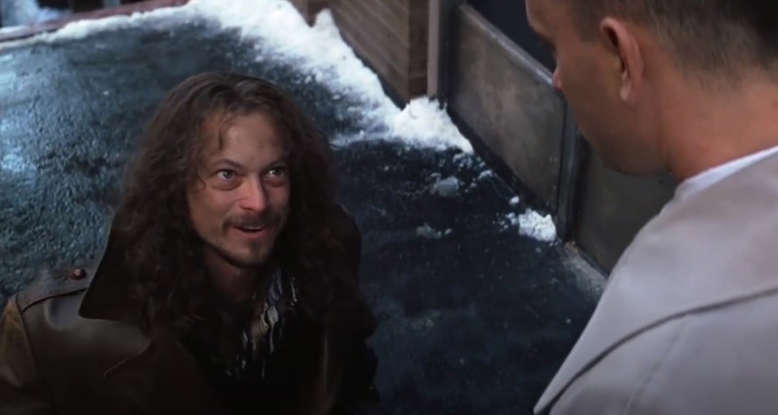
Gary Sinise as “Lieutenant Dan” in the movie Forrest Gump.

When the two men find themselves in the middle of a hurricane, Dan can take it no longer. He lashes out– not at Forrest this time, but at God. How could a loving God allow Dan to go through trial after trial– the loss of his legs and so many of the men under his command, the loss of his dignity and productivity, the loss of his independence, and now, another deadly situation beyond his control. He yells at God–“Come and get me!” He challenges God to just kill him; just finish him off–or leave him alone.

But God is silent– and soon, so is the hurricane. Forrest and Dan have survived. In fact, Forrest’s decision to be out of the harbor means their boat is the only one to survive–suddenly, they can’t catch the shrimp fast enough! Forrest becomes a millionaire and hires a fleet of fishing boats. But what about Dan?

Somewhere in the middle of the storm, Dan’s heart is pierced by a simple and life-changing thought. God has not been the one “ruining” Dan’s life– He is the one who has been preserving it! God brought him through war, disability, injustice, loneliness, frustration, and the raging sea. God was not a cosmic bully. God was not singling out Dan for punishment– after all, thousands of others had been wounded and killed in the war; millions of people knew what it was like to be hungry, homeless, and lonely; and hundreds had been devastated by the hurricane– even while they were safely evacuated or hunkered down on land. Forrest had not dodged every “bullet.” He had lost his best friend in battle; he had been rejected (time after time) by the woman he loved; he had been teased, bullied, and cheated dozens of times, and he had been tossed about by the same waves and winds Dan had survived. Dan ends up leaving Forrest, and setting off on his own, having found a peace that transcends his pain and bitterness. He swims off with a smile, leaving behind the opportunity to remain with Forrest and make millions.

Arguing with the Almighty is very tempting when we face difficult circumstances– and when we focus on our own lot, and not on the bigger picture. God is bigger than any of the troubles we face. And He is not unaware or unconcerned about whatever we are going through. Just as Lieutenant Dan challenged God, the biblical character of Job challenged God to vindicate him as he went through trials and pain. God finally answered, and Job realized that God was far bigger than anything Job had ever known or experienced. And in the end, God restored Job– giving him a new family, and even more material wealth than he had before!

Sometimes, God allows us to go through periods of pain and struggle– not because He is punishing us or because He is a tyrant, but because He is more interested in our ultimate salvation than He is in our immediate comfort. We moan and complain that God “doesn’t want us to be happy,” as if our momentary happiness is more important than our character development, than the happiness of those around us, or than God’s design for the world.

Near the end of the movie, Lieutenant Dan visits Forrest. He is transformed. No longer angry and bitter, he is quiet, self-assured, and standing! He has “new legs” made of titanium, and he has found joy, love, and success of his own.

Of course, many of us, regardless of our situations, have tried arguing with God at certain times of our lives. The loss of a loved one; the breakup of a marriage; a diagnosis of cancer; a miscarriage of justice and the loss of a reputation– it is natural to be angry, hurt, and confused. And God is more than big enough to “take it” when we ask “WHY?!!” But we will never “win” such arguments– not because God is a tyrant who won’t let us have what we want– but because God is GOD, and we are not. He alone knows how our story ends, and what trials– and blessings– await us. He alone knows what is “right” in the scope of eternity– not just for us, but for our loved ones, our neighbors, our nation, and our times. God can see that we get, not just “new legs,” but a new heart, and a new mind!

Hurricanes happen– so do hurts and hurdles. We can choose to see God’s hand–and believe that it is raised in anger, or reaching out to hold us. That choice is yours. That choice is mine. Every day.

Out of the Same Mouth

Likewise, the tongue is a small part of the body, but it makes great boasts. Consider what a great forest is set on fire by a small spark. The tongue also is a fire, a world of evil among the parts of the body. It corrupts the whole body, sets the whole course of one’s life on fire, and is itself set on fire by hell.All kinds of animals, birds, reptiles and sea creatures are being tamed and have been tamed by mankind, but no human being can tame the tongue. It is a restless evil, full of deadly poison. With the tongue we praise our Lord and Father, and with it we curse human beings, who have been made in God’s likeness. 10 Out of the same mouth come praise and cursing. My brothers and sisters, this should not be. 11 Can both fresh water and salt water flow from the same spring? 

James 3:5-10 NIV via biblegateway.com (emphasis added)

‘We have two ears and one mouth so that we can listen twice as much as we speak.’

Epictetus (Greek philosopher)

Have you ever made a tape of you speaking, and played it back to listen to yourself? Or have you had someone remind you of what you said earlier in the day or week? Have you been astonished to hear what came out of your mouth (or how someone else interpreted your words)? James, the brother of Jesus, had much to say about the dangerous power of an untamed tongue. “Fire”, “poison”, “corrupt”, “restless”, “evil”, and “deadly” are harsh words, but we should heed James’ warning.

Out of the same mouth come praise and cursing…
Out of the same mouth come worship and complaining…
Out of the same mouth come encouragement and gossip…
Out of the same mouth come blessings and bitterness…
Out of the same mouth come hymns of heaven and threats of hell…

And it’s not just our mouths, anymore. I see (and have seen it in my own feeds) posts on social media that make me wonder if the person posting is aware of what they posted just minutes or hours before–rants and boasts, complaints and smug condemnation sprinkled with Bible verses about Peace and Love, and pictures of puppies. We copy and paste, write and speak “in the moment” out of the emotions and thoughts that we allow to govern us. And while we may forget our momentary outbursts and random sarcastic comments, others do not. God does not ignore them, either. He can and will forgive them, but He isn’t “fooled” by our gracious cover-ups and flowery quote boxes.

Especially in this election season, it is tempting to let emotions and “righteous” indignation cause us to speak or post in ways that show disrespect, disdain, and even hatred toward neighbors, co-workers, and (yes, possibly) relatives who may vote differently or for different reasons than we do. We hurry to post or “share” clever put-downs or preachy thoughts about what others should “know” or how they should think and act. But would we say such things in person? Do we really mean to hurt others in our quest to be “right” or clever or morally virtuous in the eyes of a few people we barely know?

When I pray today, I need to “listen” to what I’ve been saying lately. Do I need to deal with hidden anger or resentment? Do I need to confess (both to God and to someone else) about gossip? Do I need to reconsider the way I speak about my relationships and my achievements (and failures!)? Do I need to stop following or sharing certain sites or content? Do I need to spend less time talking and posting than listening and praying?

The same mouth that praises God should be speaking life, peace, healing, and hope to those around me. The same mouth that promises to follow Christ, should promise to reach out to those for whom He died. The same mouth that gives thanks for Salvation should be eager to share the Good News.

The tongue is powerful–whether as a weapon or a tool; whether controlled or out of control. God wants to teach us to use it as a tool for good. Not just when we pray, or worship, but every time we use it!

“I Hate Waiting…”

One of my favorite characters from “The Princess Bride” is Inigo Montoya. He has a few redeeming qualities– he is a loyal friend; he is intensely (obsessively) loyal to his father’s memory; he is basically honest; and he has a soft spot for lost causes, including a tender-hearted giant and a (mostly) dead pirate/rival/would-be hero.

But Inigo has many failings, as well. He is a drunkard, he lacks the skills to plan great achievements, and he has an over-developed sense of revenge that gets him in a lot of trouble. Also, he hates waiting. And he has done a lot of it– he’s waited over 20 years to track down his father’s killer and challenge him to a duel (the above-mentioned revenge).

When he first meets Westley (the above-mentioned pirate/rival/would-be hero), Westley is climbing a treacherous cliff. Inigo waits at the top as Westley struggles up the rocky crag, trying not to fall to his death. Inigo, ever concerned, calls down to ask how it’s going. He wants to know if Westley can “a-speed things up.” He REALLY hates waiting. Later, as he seeks to rescue Westley, he is told that he must wait at least 15 minutes for the magic potion to work and for Westley to regain consciousness. Inigo is delighted when Westley can talk and move his head a little, but he cannot wait for Westley to regain the use of his arms or legs before “storming the castle!”

Not many of us enjoy waiting. Some of us are better at it than others. And it is a character quality that God asks us to develop. Several times in the Bible, God asks us to “wait” or “wait on the LORD.”

When we pray, it is tempting to expect or even demand an immediate, clear answer. If we don’t get it, we fall into two temptations. The first is to despair and/or lose faith. If God doesn’t “show up” right away, we are tempted to believe that He just isn’t listening or doesn’t care about our situation. As time goes by, we may become bitter, angry, sullen, and depressed. We stop calling out to God; we turn away and seek answers (or escape) elsewhere.

The second temptation, the one I believe Inigo falls into, is to stop depending on God and carry the burden of our pain, our grief, or our situation all by ourselves. Inigo’s father was killed when he was eleven years old–his entire adult life has been wasted on a quest to avenge his father’s death. He hasn’t developed a life of his own– he has no career (he does odd jobs for crooks like Vizzini), no family, no plans for a sustained future– only his anger and bitterness over a twenty-year-old tragedy. And only when, in desperation, Inigo pauses for a moment and prays, does he find any real help in achieving his goals. In fact, at the end of the story, when Inigo finally achieves his revenge on Count Rugen, he is left with a dilemma. He admits to Westley that he has no idea what to do with the rest of his life! He has allowed the past to consume both his present and his future.

Another story that illustrates this temptation is the story of King Saul. In 1 Samuel 13, Saul has begun to attack the enemies surrounding Israel. He and his troops are hiding in caves and waiting for the prophet Samuel to offer a sacrifice and seek God’s counsel. The enemy is camped nearby with thousands of troops and chariots, and Saul’s men are beginning to panic and desert him. When Samuel doesn’t come at the appointed time, Saul disobeys God’s law by offering the sacrifices himself, even though he is not of the priestly line. Instead of standing firm, and encouraging his men, Saul gives in to the general panic and takes matters into his own hands. He takes a visible action — offering the sacrifice– without taking the right attitude of seeking God’s counsel.

Waiting can be difficult– especially when we are faced with fear, anxiety, danger, and lack of plan or purpose. But learning to wait for God’s ways and timing will teach us how to grow in Faith and confidence. Today, instead of asking God to “a-speed things up,” may we thank Him for all the times He has been faithful in the past, and trust that He will “arrive” at just the right time!

Blog at WordPress.com.

Up ↑