Out of the Blue

There is an English phrase for something that happens completely unexpectedly; we say that “it came out of the blue.” I thought I understood that phrase, but I got a deeper understanding this past Friday. My husband and I were in Elkhart, Indiana, just across the border from our home county in Michigan. We often drive the 20 miles or so to Elkhart for shopping, banking, eating out, and more. The weather was surprisingly warm and humid for March, with a light breeze and blue skies dotted with light gray clouds. David and I had eschewed both coats and jackets for the day– nearly unheard of for this time of year in our area.
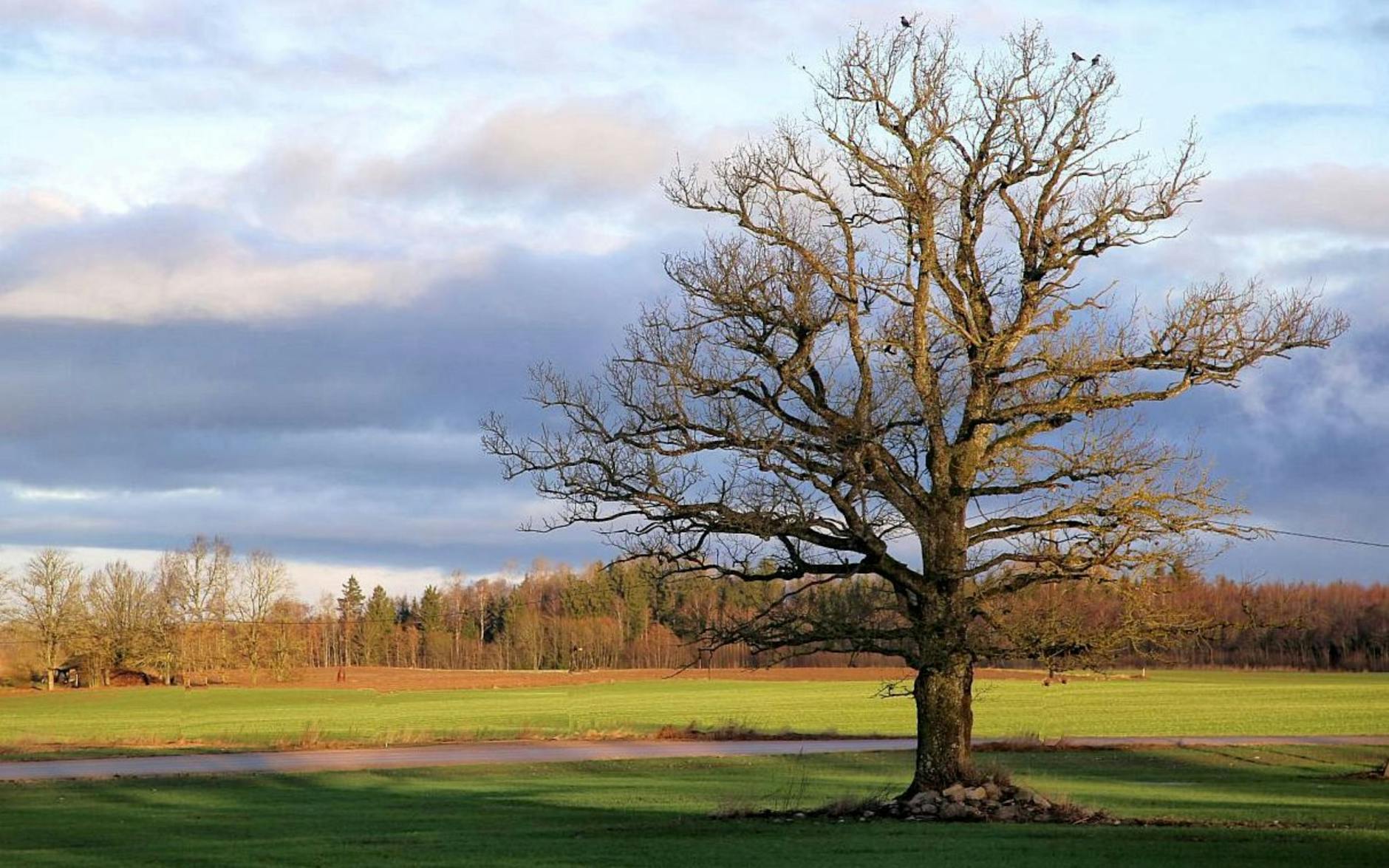
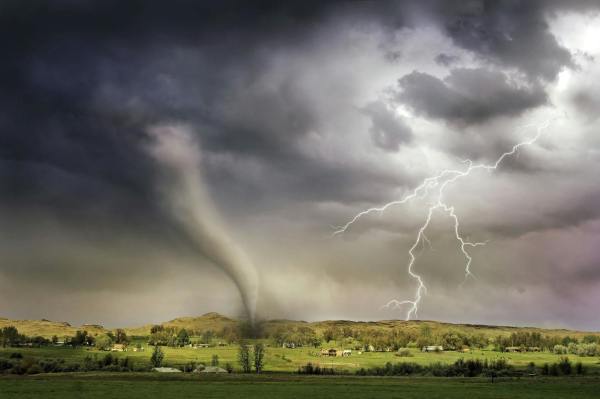
But as we prepared to return home, we noticed that the gray clouds to the north of us had grown darker and heavier. And lower. Still, there was blue sky above us and to the south. It wasn’t raining and there was only a light breeze. We were listening to a radio talk show, which was suddenly interrupted by a high-pitched alarm. The announcer said that there was a tornado warning for our county– the one we were driving through!– and that we should be looking for rain and hail, strong winds, and possible tornadic activity.

We searched the skies– the same clouds we had seen in the north looked darker than normal, but we experienced no strong winds and no rain. About a mile later, we saw evidence that it had rained recently, but otherwise, it was calm. The sky above us was blue. Birds were singing. The air seemed fresh and calm. Still, the weather alert kept giving details. A tornado warning was in effect for the next 35 minutes for our county and the one directly east of us. But we kept driving. A couple of miles later, we saw a small patch of damage– a few twigs and dead leaves had blown across the road in one spot. The evidence of rain became clearer– there were large puddles. We drove through some of the area that had been mentioned in the alert– we skirted Edwardsburg, Diamond Lake, and Cassopolis. We saw small spots of rain and wind damage, and we came into some rain that was still falling, but it was gentle. Behind us to the south and west, the skies were blue.
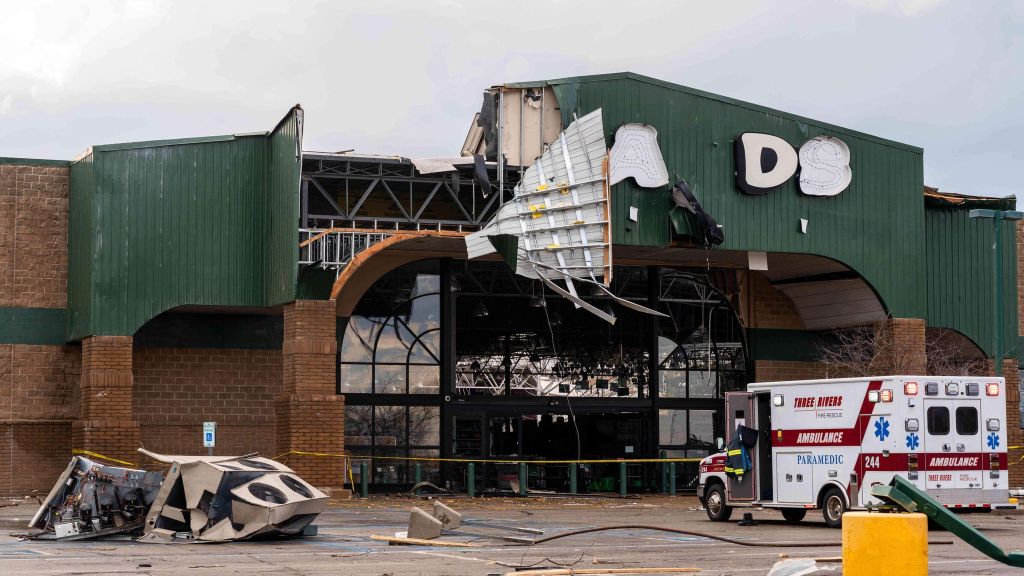
When we arrived home, we looked at the recent news posts. We were shocked to see that several houses on either side of our path had been touched by hail and tornadoes just before came home, and that tornadoes were still doing damage to the east– in the town where our son lives! We watched as video footage showed the grocery store where I had shopped just days ago losing parts of its roof, while the DIY store across the street lost its entire roof and some of the west wall! Power lines were down, cars and small buildings were being lifted, twisted, and thrown back down on the ground. This was only a mile from our son’s house! And now, our cell phones weren’t working, so we couldn’t call him to see if he was ok. And our skies were blue–someone close by even posted pictures of rainbows!

It turned out our son and his home were fine– they were out of power for a few hours, but no damage to the roof or house or vehicles. Some of my cousins, who also live in that city reported on-line that they were also safe. Whew!

Long story– scary afternoon and evening– but it got me thinking. We were right at the edge of a dangerous storm path, and without the radio warning, we would have concluded that there had been no more than a rain shower around us. Had we been traveling just a few minutes earlier, we might have been taken unawares. This storm came with very little warning, and did a lot of damage, yet people were going about their daily lives– unprepared and unaware of the danger.
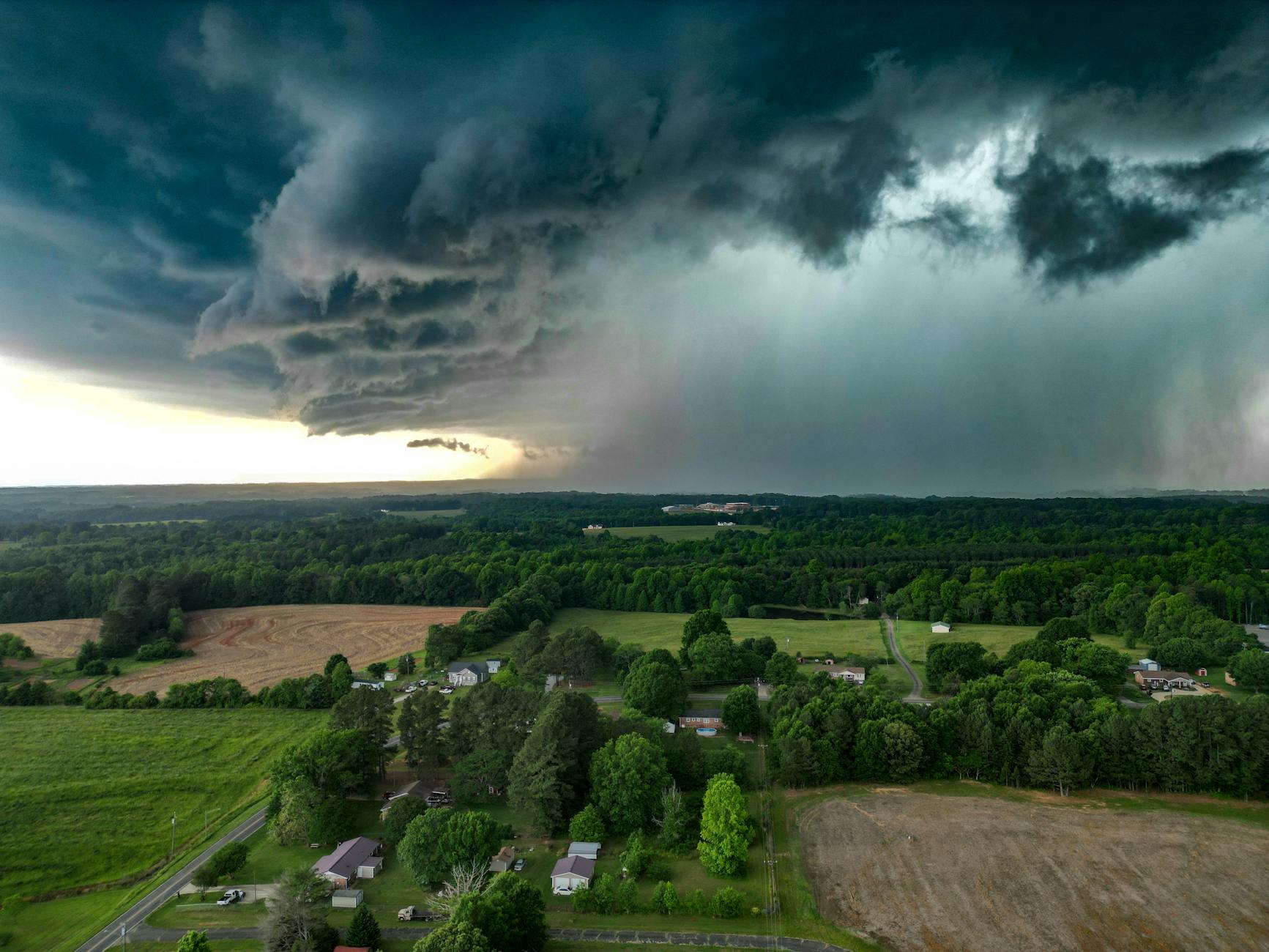
Tornadoes are scary because they often come like that– with little warning, and little way of predicting how strong or fast or dangerous they will be. But how many other things in life hit us “out of the blue?” A heart attack, an auto accident, a house fire–suddenly our life spins out of control. How will we react?

After the first shock, we can become lost in the immediate chaos– everything we depend on can vanish in an instant. “Out of the blue” we can lose our health, our job, our home, our relationships, our bank account, and anything else where we find our security. OR, we can rediscover our strength, our hope, and our trust in a God who is more powerful than a tornado; more solid and eternal than any building, and constantly aware of our circumstances– whether we are enjoying blue skies or looking at threatening clouds from the ruins of our family home.

I am praying for the families who were impacted by the recent storms– especially those families who lost homes or loved ones. I can’t offer the comfort of knowing why this happened, or what exactly will come next. But I can offer the hope of knowing the One who knows all things, and whose love is greater than anything else we could ever trust.

Sometimes, bad things come “out of the blue.” Bad things happen to people– not just “bad” people, or “good” people–for reasons that make no earthly sense. But such things, like tornadoes, pass away, die out, leave their mark, or move on. And if we look again, we will be able to see the “blue” sky– the good things that remain, and the hope of renewal.
Where Does My Help Come From?

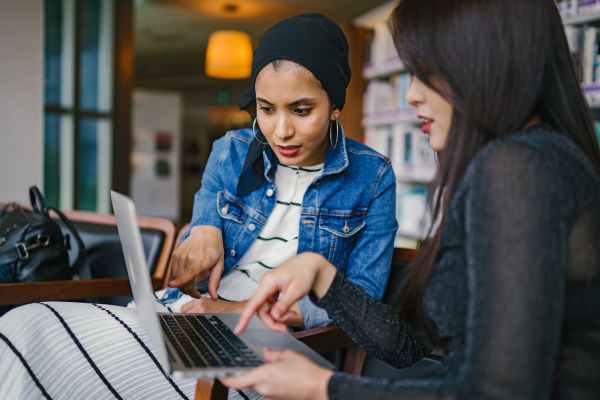
I read an on-line article the other day https://www.verywellhealth.com/perils-of-using-the-internet-to-self-diagnose-4117449 about people using the internet to find medical information, rather than seeing a doctor. The article focuses on self-diagnosis, and the dangers of using only on-line sources to diagnose and treat a chronic medical condition. But I was astonished to note that over two-thirds of American adults (according to various studies) are using the internet to get at least some of their medical advice, and many of them prefer to get their medical information in this way. Why is this?

I think there are several factors, many of which are not discussed in the article:

  • Convenience–The internet is easy, quick, and convenient. I can look up medical terms, symptoms, treatment options, find testimonials and comparisons of various medications and procedures all at the touch of a few buttons, all from the privacy of my own home. I can stay in my pajamas!
  • Cost (in both time and money)– I can save hours of sitting in waiting rooms and thousands of dollars by seeking help from the internet. I don’t need to “waste” time or money on multiple appointments in multiple locations with multiple specialists. I don’t need to spend more on medication if the internet offers alternative treatments.
  • “Confirmation Bias”– the article does discuss the idea that using the internet often helps us achieve a sense that we “know” ourselves better than our health care provider– that the information on the internet can be customized to confirm our already-held beliefs about what is wrong and how to treat it. And we can find on-line groups and sites that will confirm and support whatever we already believe about our health or treatment options, or steer us toward a course of treatment that more closely aligns with our established preferences and habits.
  • Community–One of the positive points about using the internet is that we can connect with a community of others who also suffer from similar chronic conditions. We can receive support and advice from people near and far, and connect with resources that would otherwise be unknown to us, given by those who seem to understand and sympathize.
  • Credibility–The article does NOT go into much detail about this, but many Americans (and I suspect others) no longer have a blind trust in the medical profession. Even once respected institutions, such as the National Institutes of Health, the Center for Disease Control, and the World Health Organization have lost much of their status and credibility due to their handling of COVID and other recent medical crises. We no longer trust the “experts” to give us the best medical advice. We are looking for someone (anyone) who seems to have a better answer–one that doesn’t require us to trust where we have felt disappointed or hurt.

Of course, this poses danger and risk to anyone who is trying to “go it alone” in their medical journey. We risk getting it wrong and causing more harm– even risking our lives. We may end up spending more time, energy, and money “fixing” the damage we cause by trusting the wrong people, and end up confused, frustrated, and angry at ourselves and everyone else we trusted to help us. Even “support” groups have been known to give false encouragement and even prey on people or families who are struggling with chronic illness.

But this article also reminded me that we can risk our spiritual health in the same way– going it alone instead of getting connected to a local church, or substituting on-line articles and blogs (even this one!) for daily personal prayer and Bible study. How does this happen, and WHY?

  • Do we find it more convenient to pick and choose our counsel from the abundance of resources available on-line? Do we only want to read or listen to those who tell us what we want to hear? (See 2 Timothy 4:3-5)
  • Are we trying to “cut corners” in the cost of being a Christian? Do we find it too much to spend time in church, wrestle with questions, accept correction from others, or ask for help?
  • Are we worried about “fitting in” or are we trying to create a “holy huddle” of like-minded people, regardless of our call to be part of the “Body of Christ?” (see 1 Corinthians 12:12-30)
  • Have we lost faith in the Church because of past encounters with others, or the attacks of unbelievers? Do we find it easier to “customize” our spiritual life, closing ourselves off from the kind of challenges that cause us to grow, and falling into a comfortable compromise?

The internet can be a wonderful tool, allowing us to share encouragement, testimonies, warnings, and valuable information globally with a few keystrokes! But it is not without risks. Ultimately, we need to trust, not the makers of websites, or the self-proclaimed “experts” of the world, but in the Sovereign God– the Maker of Heaven and Earth, the one who holds the future of our health (both physical and spiritual) in His Almighty Hands!

Trust in the LORD with all your heart and lean not on your own understanding;
In all your ways submit to Him, and He will make your paths straight.

Proverbs 3:5-6 (NIV)

I lift my eyes toward the mountains.
Where will my help from from?
My help comes from the LORD,
The Maker of heaven and earth.

Psalm 121:1-2

My prayer today is that we would look beyond the mountains of information we find on the internet, and fix our sight and our trust in God for our daily bread, our health, and our future. May we rely on His wisdom to help us seek the right counsel, and to learn, even from our sufferings, that His Presence and His Promises are eternal, sufficient, and sure!

Souvenirs or Baggage?

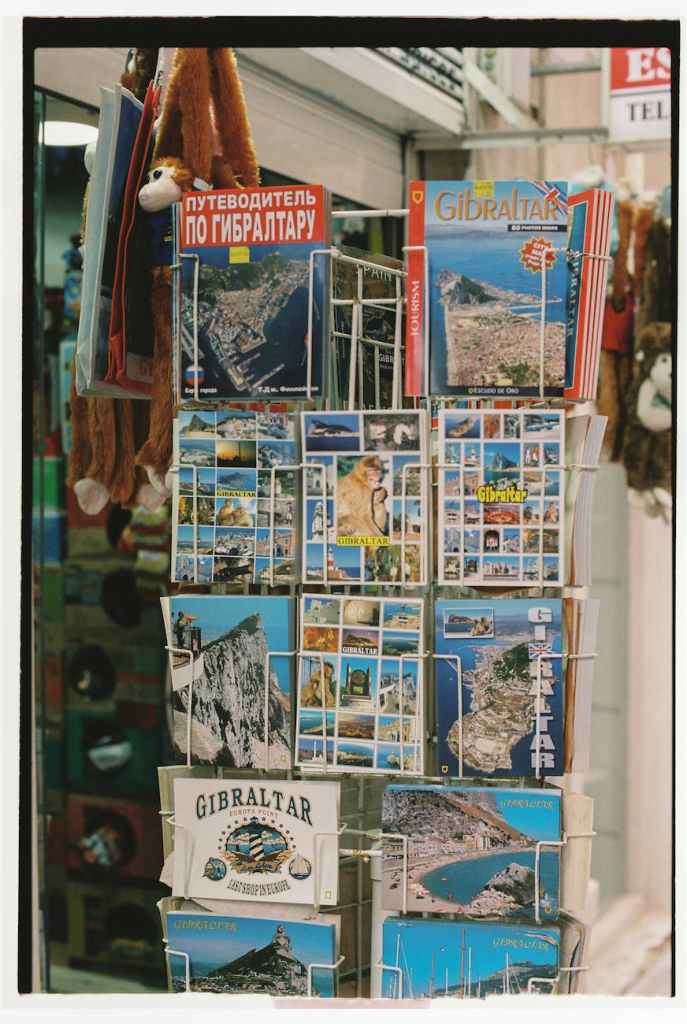
My Mom died recently, and my brother and sister and I are cleaning out her estate. This is by no means a small task, as my Mother saved EVERYTHING! All of our elementary school report cards, 4-H Awards programs, class play programs, thousands of photos (mostly unidentified), post cards from all of our vacations (including places we re-visited!), ticket stubs from movies and football games and banquets, our old baby shoes, broken toys, recipes clipped from magazines and old boxes, letters we sent from college, and letters sent to her when she was in high school. She even saved such things that her own mother and grandmother had saved! Souvenirs and memories, all tucked away or piled up throughout her house.

Photo by Tina Nord on Pexels.com

My mom was what is known as a “hoarder.” She was pathological in her collecting bits and pieces of everything that went on all around her. She had clothing she had never worn. She had Christmas gifts she had opened and put back in their wrapping, but never enjoyed. She had books she had never read, DVDs she had never watched, and pots and pans she had never used. She had stacks and bags and boxes of memories she always meant to sort through– someday.

Photo by Ricky Esquivel on Pexels.com

As she grew older, she sometimes would lament that we, as her children, would be burdened with the job of sorting through all her “stuff.” Even so, she wouldn’t let us touch any of it until the last months of her life, when it was obvious that she would never be able to do it herself. And we weren’t to throw anything out– only make an attempt to organize it all!

Photo by Ketut Subiyanto on Pexels.com

Of course, now we are throwing out the majority of what she kept. Much of it was damaged by being stacked and stored in the haphazard way it was. Some was damaged by a leaky roof, or mice. Many of the things that are damaged were once useful, and might have been useful yet if they had not been hoarded and held back. Blankets and towels that might have been passed on were left to be chewed up or rotted. Books and photos are warped or stained.

Photo by Wendelin Jacober on Pexels.com

I loved Mom, and she was a great woman of God– a prayer warrior and evangelist. But she was human. In this part of her life, she missed some great opportunities to bless others with the resources she had. She even missed the opportunity to enjoy many of the things she obsessively stored for “someday.” Moreover, she saved many things that weren’t useful. Old boxes and jars of spoiled food, old bills and advertisements, expired credit cards and driver’s licenses.

I have been reminded of many things as I’ve helped go through Mom’s “things.” There are many wonderful memories that still can be found in all of her souvenirs. I found an old storybook– one of my favorites–about a Mama Bear and her naughty, curious little cub. “Why do you love me?,” the cub asks after getting into trouble yet again. “Because you’re my little bear,” she answers as she cleans the wounds and lovingly carries her cub home. Love transcends mischief. It transcends things like lost opportunities and hoarding tendencies, and the frustrations of life.

But sometimes we hang on to things, not out of love, but out of pain or desperation. Mom was a child of the Great Depression. Her family had to move a lot when she was younger. She was forced to give away toys and clothes she wanted to keep; forced to leave old friends and make new ones; forced to make things “last” when new things couldn’t be had. She spent many years having to be frugal and careful to make small memories last a lifetime. She became obsessed with collecting “souvenirs” of even the smallest events, even tragic ones, and holding on to what was “good enough,” even if something better was offered.

Photo by Carlo Ju00fcnemann on Pexels.com

Many of Mom’s “souvenirs” have become baggage for those of us who follow. And many of our “souvenirs” will be baggage for those who follow us. Some of our scars will be passed down to our children. Some of our hopes and dreams will be unrealized–unopened and unused gifts that “might have been.” Others objects and experiences will be pleasant reminders of the love that lasts beyond our own lives and limitations. But objects, in themselves, cannot take the place of the actual experiences of joy, love, and peace they are meant to represent.

Photo by Inna Lesyk on Pexels.com

God wants us to hold fast to certain things. Truth. Hope. Love. Faith. But He calls us to let go of other things. Bitterness, resentment, anger, self-pity. I know that in my final days, I will probably find that I am still carrying some baggage. But I hope that I will find more souvenirs– good memories of a life enjoyed, goals accomplished, and relationships that have stood the test of time. Mom had those in abundance. But some were hidden among the baggage–treasured memories of those who loved her, and those whom she loved, surrounded by the baggage of heartache and longing. I pray that those who follow me won’t have to search among the ruins to find my souvenirs, or hunt through piles of souvenirs to find my treasures.

Blog at WordPress.com.

Up ↑