One of my favorite old hymns is the ancient Irish tune, “Be Thou My Vision.” I have heard it jokingly referred to as “the optometrist’s hymn.” But there’s a lot more to unpack in the title than just a plug for good eye care.
God’s word is full of references to sight, seeing, blindness, light, lamps, darkness, night, day, visions and dreams, foresight and prophecy, images and reflections, and much more. God is both the source of our sight, and of our insight. God sheds light on our deepest secrets of the past, and provides a lamp allowing us to see the obstacles ahead more clearly. Jesus came to be the Light of the World, and bring sight to the blind, both physically blind and spiritually blind.
Many times, we pray for answers– we want a quick solution to our circumstances, or a definitive direction for our next step. But God sometimes wants to show us a bigger picture. Sometimes, he wants to show us more intricate details. Instead of asking for what we want God to give us, we need to ask for God to give us the vision HE has for our future. He may not reveal every detail– or he may only reveal the next detailed step. But God’s vision is clearer and bigger, and more glorious than we will ever know if we aren’t willing to look with His eyes to see.
We also need to ask God to BE our vision– that we would see him more clearly for Who He Is! Whatever is in our focus will appear bigger and clearer than things in the periphery. When we allow Him to be our vision, we start to see things from His perspective, which makes all the difference. What we see on our own is often an optical illusion– problems look bigger than they really are, hurts and grievances grow larger, and people become distorted by the lenses or mirrors we use to view them. And we lose sight of God’s glory, wisdom, majesty, power, and everlasting love. But God restores our focus and our perspective, so that we see problems in the light of His power to overcome; we see people who are made in His likeness and image– people who are loved by God, even if they are in rebellion against Him. We see the glory of God’s creation as it was meant to be, even as we see the wreckage of pollution, corruption, disease and disaster. We see God’s mercy as lives are transformed and families are mended and justice is finally achieved. And we see the rays of hope in God’s promises fulfilled and those yet to be fulfilled.
We live in dark times. War, hatred, terrorism, oppression, destruction, and despair– they are all around us. And yet, we pray. We do not succumb to the darkness, but we seek out the light. Many Christians pray in literal darkness, as they have no electricity, or they are in dark prisons, or they worship in secret locations and inner rooms. But many of us pray in figurative darkness– our minds and eyes clouded with overstimulation and muddied theology. And we may pray “in the dark” about the situations faced by our brothers and sisters in other parts of the world– even in other parts of our local communities!
Praying in the dark, much like walking in the dark, involves a lot of caution, and a lot of trust. We pray strategically, knowing there are unseen obstacles and dangers around us, but confident that, with God’s wisdom and presence, we can avoid them and reach our goals.
What are some specific features that prayer should have when we find ourselves in the dark places of life?
Fervency–There is a quality of urgent and whole-hearted commitment to seeing God’s face, God’s wisdom, God’s will, God’s timing, and God’s guidance as we pray. “Not my will, but THINE, be done!” Christ, as He prayed in Gethsemane (see Matthew 26:36-46) We may not sweat drops of blood, but we should pray with a fervent desire to offer our bodies as living sacrifices (Romans 12:1)
Focus– Sometimes, we can “see” more clearly in the dark. This is because we have fewer (visual) distractions. When we are overwhelmed with darkness, we let go of lesser things and concerns, and we pray for those things we really need, rather than those things we desire. We also have a greater sense of God’s provision and power, so we grow more grateful and joyful for what we DO have. ” For the sake of Christ, then, I am content with weaknesses, insults, hardships, persecutions, and calamities. For when I am weak, then I am strong.” 2 Corinthians 12:10 (ESV)
Frequency–I pray almost constantly when I am burdened or facing obstacles that seem impossible to overcome. Dark times can remind us that God alone can be trusted to lead us through. HE is God, and I am NOT! And like the men and women of the Bible who faced incredible odds, I can trust Him to hear and act. He sees me, He hears me, He Loves me, and He has a plan for my life that includes being with Him for Eternity! “Whom have I in heaven but you? And earth has nothing I desire besides you. My flesh and my heart may fail, but God is the strength of my heart and my portion forever.” Psalm 73:25-26 (NIV)
Fellowship– This one may seem counter-intuitive. Many times, I feel more alone in the dark. But I have learned that I can actually feel just as lonely in a crowd and in the light. Dark times may make our “circle” smaller, but we may find that our few relationships grow stronger, and we open ourselves up to suffering in others that we would ignore in our carefree days. I think of those who end up on refugee camps or cancer treatment centers– the friendships made there are sometimes stronger than family! “Every time you cross my mind, I break out in exclamations of thanks to God. Each exclamation is a trigger to prayer. I find myself praying for you with a glad heart. I am so pleased that you have continued on in this with us, believing and proclaiming God’s Message, from the day you heard it right up to the present. There has never been the slightest doubt in my mind that the God who started this great work in you would keep at it and bring it to a flourishing finish on the very day Christ Jesus appears.” Philippians 1:3-6 (The Message)
Darkness and trials can drive us away from help and hope. But when we learn to Pray in the dark– to seek God with a whole and undivided heart– He will be our light in the darkness and our hope in the midst of desperate circumstances. And we can take comfort, even in the midst of pain and danger, in knowing that we are NEVER alone when we pray– even in the dark! We may not know the perfect words or have the perfect circumstances; we may not be able to see our next step– but we serve a perfect God, who will never let us go. There is no darkness– no circumstance– that can separate us from God’s love or His salvation, or keep our prayers from reaching Him.
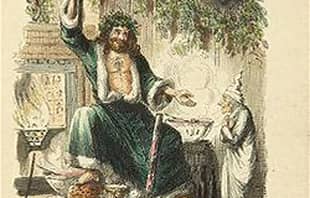
If you missed my last blog post, I’m looking at the story of A Christmas Carol, by Charles Dickens. It may not seem like a “jolly” Christmas story, or even a “religious” story, but it is “spiritual.” Ebenezer Scrooge is literally haunted by three spirits over the course of Christmas Eve. Last time, I spoke of the Ghost of Christmas Past. Today, I’d like to look at the Ghost of Christmas Present.
I know, Christmas was a few days ago– we’re currently at the cusp of New Year’s Eve, but these few days between Christmas and New Year’s Day can often feel jumbled up and run together. And, traditionally, the Christmas season is not just one day, but twelve days, stretching from December 25 to January 6. So today is still technically part of “Christmas.”
In “A Christmas Carol”, Scrooge is actually visited by four spirits. The first is the ghost of his old friend, Jacob Marley, who offers Scrooge both a dire warning, and a chance of redemption. Scrooge has already been visited by Marley, and by the ghost of Christmas past– a look at the moments and people who have shaped Scrooge’s life up to the present. Scrooge has seen both happiness and tragedy in his life, but the “light of truth” carried by the first ghost has shown how Scrooge has rejected happiness, instead embracing a life of fear, loneliness, and greed.
The next spirit, the Ghost of Christmas Present, focuses less of Scrooge himself, and more on the people he has ignored or rejected. This spirit shows Scrooge what he is missing by hoarding his wealth and isolating himself from the rest of the world. It is a picture that many of us would do well to study!
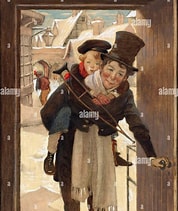
One of the first stops is the home of Bob Cratchit, Scrooge’s underpaid, put-upon clerk. Scrooge makes use of Bob’s time and skills, without ever showing any interest in him as a person. Scrooge is oblivious to Bob’s existence outside of the counting house. He assumes that Bob has a family, but he has no idea who makes up that family. The Ghost of Christmas Present forces Scrooge to see that Bob and his wife have several children, including a sickly and crippled son named Tiny Tim. Though they have very little money (thanks in part to Bob’s meager wages!), they have plenty of love and happiness. Scrooge fears many things that may happen, while his clerk faces very real fears that “haunt” him every day. Yet Bob does not complain, does not exhibit bitterness, and does not hide away from the world.
Next, the ghost takes Scrooge to see his nephew. Scrooge keeps his nephew at a distance because of his bitterness and fear. But in doing so, he is missing out on his nephew’s kindness, wit, and warm circle of friends. Scrooge has treated his nephew with disdain, fearing that the younger man is jealous of all his riches. But the ghost shows Scrooge that his nephew actually feels sorry for his uncle. Again, Scrooge has great wealth, but his nephew is content, and even very happy with his lower station in life. He loves his wife and enjoys friendships that make him wealthier in many ways than his uncle!
Finally, the ghost of Christmas Present shows Scrooge a sight he would never willingly see– the suffering and neediness of the poor, whom Scrooge has sneeringly consigned to death. Rather than seeing humanity, Scrooge sees only people who might drain him of his wealth– the undeserving poor who “cost more than they are worth.” The ghost reminds Scrooge of an earlier off-handed remark about helping those who would rather die than go to workhouses: “If they’d rather die, then let them do it–and decrease the surplus population!” The ghost warns Scrooge that he should be very careful in declaring who is among the ‘surplus population’. In heaven’s eyes, Ebenezer Scrooge himself might have less worth than ‘the least of these.’
And the King will answer them, ‘Truly, I say to you, as you did it to one of the least of these my brothers, and sisters you did it to me.’“Then he will say to those on his left, ‘Depart from me, you cursed, into the eternal fire prepared for the devil and his angels. For I was hungry and you gave me no food, I was thirsty and you gave me no drink, I was a stranger, and you did not welcome me, naked and you did not clothe me, sick and in prison and you did not visit me.’ Then they also will answer, saying, ‘Lord, when did we see you hungry or thirsty or a stranger or naked or sick or in prison, and did not minister to you?’Then he will answer them, saying, ‘Truly, I say to you, as you did not do it to one of the least of these, you did not do it to me.’ (Matthew 25:40-45 ESV)
Scrooge’s feelings and senses are overwhelmed by what he experiences. The present surrounds him– the sights, the smells, the laughter, the cold of a dark winter’s night, and the heat from a roaring fireplace; the stench of the docks and homeless camps, and the aromas of Christmas dinner; the colors and lights of decorations, toys, and costumes; the ringing of bells, and the singing of Christmas Carols. Once again, Scrooge can hear music and laughter, he can sense the love and compassion, but he can only participate on the periphery. The music haunts him, but it comes from others, not from his own frozen heart.
So, what happens to us in this Christmas present? Do we feel connected to the joy and gratitude, the love and hope of the season? Or are we isolated by worry, frozen in fear, enslaved by anger or greed? Christmas is often a time of great sadness and loneliness. And sometimes, the laughter and the lights seem hollow and fake. Especially in the days just after Christmas, we can feel let down, abandoned by the promise of merriment and fulfillment brought by parties and gifts and feasting and entertainment. Outside, the winter is still cold, the bills keep coming in the mail, and fears and worries cloud our days. Some of our fears are very real– disease, grief, loss, sudden changes in circumstances and relationships–Christmas lights and music alone cannot cut through the fog.
My prayer for today, and for the New Year at our doorstep, is that we would open our ears and eyes and hearts to what is around us– acknowledge that we live in a fallen and often worrisome world, but recognize that there are opportunities all around us, as well. We don’t have to isolate. We don’t have to live in constant fear. Christmas isn’t just a day; it isn’t just a season– Christmas is about Christ coming to dwell with us!
Open your ears! Listen to the music of the season– “Peace on Earth! Good Will to Mankind!” “JOY to the World! The LORD has come!” “Let Heaven and Nature Sing!” “Glory to the Newborn King!” Keep listening to the promises of God’s Word– “Never will I leave you nor forsake you!” “Lo, I am with you always!”
Open your eyes– see the wonderful opportunities to share both joy and sadness with others. Seek out the great opportunities to give and receive help and love and fellowship! See the good things that the LORD has done– the friendships and family in your life; the beauty of nature, the ‘wonder of His Love!’.
Open your heart– Receive the greatest Gift! Redemption; new birth; eternal and abundant Life! Choose life and gratitude and humility. Practice childlike faith, hope, and JOY!
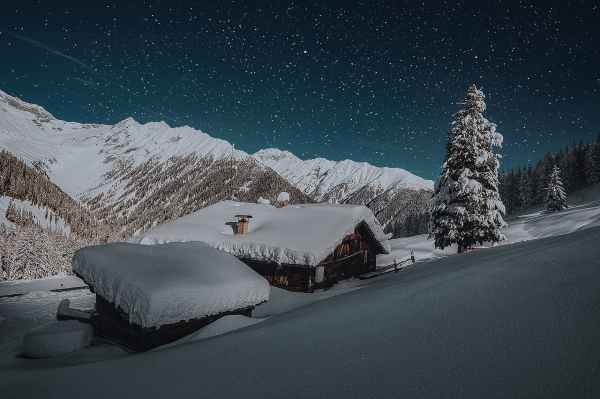
One of the great classic Christmas carols, “The First Noel,” describes the night of Christ’s birth as a “cold winter’s night, that was so deep.”
It is dreamy and dramatic to think of Jesus coming into a cold, dark, dreary (and even snowy) world, bringing angels, glorious stars, kings bearing expensive gifts, and joyous songs.
We tend to look at Advent as a time of darkness and silence, in anticipation of the coming light and the Gospel. The idea that the world before the Birth of the Savior was cold continues the pattern of absence. Darkness does not exist independently. Neither does silence or cold. Each is the absence of something else– Light, sound, warmth–and it can only be known by the degree to which its opposite is reduced, distant, or absent. In contrast, the light, sound, or warmth is made more evident in contrast with its opposite–we may not notice a slight difference in lighting on a sunny day, or a slight difference in temperature; but a candle in a dark room, or a whisper in a silent auditorium has a dramatic effect.
We don’t actually know the exact date of Jesus’ birth, and while December falls during winter, that doesn’t always mean a cold night in every part of the world. If shepherds were watching their flocks in fields just outside of Bethlehem, it is not likely that the temperatures were below freezing, or that there was snow and ice all around. The Middle East is not known for icy winters, after all. Nighttime generally brings colder temperatures, and it may be close to freezing by the middle of the night if you have no fire or protection from the wind, but a “cold winter’s night” is more likely to be found in Minnesota or Finland, not in Bethlehem, and usually in the middle of winter– January– rather than the beginning of the season.
However, just like the darkness and silence, the cold of that first Christmas was spiritual in nature. (https://www.biblegateway.com/passage/?search=John+1%3A9-12&version=ESV). Jesus entered a frigid world– a world of closed-off people, suspicious, oppressed, angry, sick, and world-weary. Hatred can be cold, but colder still is apathy and disdain and hopelessness. The world of Advent is a world desperate for the light and heat and sound of God’s love– not because God is absent, but because people have moved so far away from Him. The light becomes dimmer, the songs become a series of indistinct noises, and the cold and damp of night creep into our souls. Today, even with the hope and light of the Gospel story, we take our focus off of the true light of the world, and the true source of warmth and love, and too often focus on the lesser warmth of a new jacket, or the glittering lights of a shopping center, or the strident sounds of greed and envy.
Jesus may not have come in the cold of midwinter. But He came into a world of cold hearts as a helpless baby in a strange and unwelcoming land. And he was wrapped in rags and placed in a feeding trough– the warmest place that could be found. But even in this tiny, shivering baby, there was the warmth of Pure Love. And it was felt by all who came in contact with Him– shepherds rejoiced, Mary pondered, Wise Men knelt in adoration.
I love seeing candles and firesides at Christmas time– I love coming into a warm house, full of laughter and love, or singing carols on a cold night, and being invited inside to share the warmth. I love fellowship at church, and sharing a hug and a smile with those I meet. Imagine the warmth of God with us–All of the warmth and life of being wrapped in the arms of Grace, and held by the nail-scarred hands, never to be cold or alone ever again. Can you feel it? Can you anticipate it? Imagine passing that on to someone who has never known such warmth…on a cold winter’s night…
(This post is an updated version of one that first appeared three years ago, during the COVID pandemic. I have updated a few of the references to reflect the change. There is still a lot of darkness and confusion in the world, but some of the sources have changed a bit.)
The past few days have been a dark place for me. I don’t mean that something horrible has happened, or that my life has been upended. But things seem dim and indistinct. Some things I took for granted turn out to be less than sure. Events have been chaotic and tinged with evil and sadness. The present economy seems far from certain, and rumors swirl around the upcoming elections. Many places around the world are at war, and there is violence, unrest, crime, and uncertainty nearly everywhere. Even traditionally “safe” institutions like the family and the Church are under constant attack. It is difficult to know who or what to trust– everything seems shadowed and indistinct.
I read a novel a while ago, set in the early days of World War II in London. Because of the threat of air raids from Germany, the people were required to “black out” their windows at night, and drive with no headlights. People who had driven or walked around the streets of London with confidence just weeks before were being injured or even killed because they could no longer trust the once familiar streets. Craters and rubble from bombing raids, or hastily built ditches and barricades; hidden dangers filled neighborhoods. And people could not count on streetlights, headlights, or lights in windows to guide them safely home. At the same time, thousands of people, fearing that the Germans would use deadly gas, were carrying around gas masks (just in case!), and leaving them on buses or at pubs or train stations, because they were unused to the extra responsibility. Suddenly, the gas mask they were depending on was lost, and all the extra preparation turned out to be useless, anyway.
It reminds me how often I would see people just a couple of years ago, getting ready to enter a store, only to return to their car for their required mask. Many people wore them “the wrong way:” others wore them for months longer than necessary. Still others wore the same mask for several days but failed to wash their hands. Some people stayed in their homes for weeks, even when they could have spent some time getting fresh air at a park or one their porch or stoop. Others took great risks going to stores where other customers were sick. And many workers had no choice but to report to work, knowing they would be exposed to COVID. Many people refused to get the vaccines once they became available, while others were demanding that everyone had to get the vaccine or be charged with a crime. No one was sure if they were “safe”– even with masks, vaccines, and other protocols. It was a very dark time.
Hard times and difficult situations can cause us to shift our focus and have to learn new routines–even new vocabulary! At certain times, life almost seems “normal.” At others, we seem to be tossed by every new wave that comes along. It can be easy to lose one’s way in the fog and darkness of chaos and changing times.
The Psalmist and King, David, had words of wisdom for times like these: “Thy word is a lamp unto my feet, and a light unto my path.” (Psalm 119: 105 KJV)
Even when things seem dark and it feels like I’ve lost my way, God is right beside me. If I have no other “light” to see by, God’s word will be enough to guide me on. When I pray– even in the dark–God sees me clearly, and knows the way ahead.
Of David. 1 The Lord is my light and my salvation— whom should I fear? The Lord is the stronghold of my life— whom should I dread? 2 When evildoers came against me to devour my flesh, my foes and my enemies stumbled and fell. 3 Though an army deploys against me, my heart will not be afraid; though a war breaks out against me, I will still be confident. 4 I have asked one thing from the Lord; it is what I desire: to dwell in the house of the Lord all the days of my life, gazing on the beauty of the Lord and seeking him in his temple. 5 For he will conceal me in his shelter in the day of adversity; he will hide me under the cover of his tent; he will set me high on a rock. 6 Then my head will be high above my enemies around me; I will offer sacrifices in his tent with shouts of joy. I will sing and make music to the Lord. 7 Lord, hear my voice when I call; be gracious to me and answer me. 8 My heart says this about you: “Seek his face.” Lord, I will seek your face. 9 Do not hide your face from me; do not turn your servant away in anger. You have been my helper; do not leave me or abandon me, God of my salvation. 10 Even if my father and mother abandon me, the Lord cares for me. 11 Because of my adversaries, show me your way, Lord, and lead me on a level path. 12 Do not give me over to the will of my foes, for false witnesses rise up against me, breathing violence. 13 I am certain that I will see the Lord’s goodness in the land of the living. 14 Wait for the Lord; be strong, and let your heart be courageous. Wait for the Lord.
There are a lot of scary things in our world– war, disaster, taxes, death, violence, injustice, disease, uncertainty, evil, darkness, even supernatural and spiritual darkness–enough to keep us frightened and sleepless every night! And we spend a lot of our time fearing the unknown–worrying about the future; worrying about things that have not happened, and may never happen! We worry about things that matter– the health and well-being of our loved ones, uncertainty about our job or home, crime and civil unrest in our nation or neighborhood, difficult decisions with serious consequences. We worry about things that are less urgent–someone laughing at us, hair loss, dropping a phone call, running out of gas, losing a game or an argument…
David had some real reasons to be fearful as he wrote Psalm 27–evildoers, enemies, war and armies, false witnesses, and violence. Yet, he found safety and strength in the Lord. We can take comfort in the message of this Psalm–God is faithful. He is strong. He is eternal and unchanging. He is a stronghold we can trust.
But before we get too comfortable, let’s take a closer look. David’s trust is not based on a superficial knowledge about God. David’s trust comes as a result of seeking God’s face and following in “your way” (v. 11). David’s life was proof of God’s strength and protection, because David’s life was filled with fearsome adversaries!
Many generations after David penned this Psalm, the prophet Amos wrote to the people of Israel– people who knew this comforting psalm, but had lost their fear–people who no longer sought the Lord’s protection or His ways.
Amos 5 Christian Standard Bible (CSB)
5 Listen to this message that I am singing for you, a lament, house of Israel: 2 She has fallen; Virgin Israel will never rise again. She lies abandoned on her land with no one to raise her up. 3 For the Lord God says: The city that marches out a thousand strong will have only a hundred left, and the one that marches out a hundred strong will have only ten left in the house of Israel.
4 For the Lord says to the house of Israel: Seek me and live! 5 Do not seek Bethel or go to Gilgal or journey to Beer-sheba, for Gilgal will certainly go into exile, and Bethel will come to nothing. 6 Seek the Lord and live, or he will spread like fire throughout the house of Joseph; it will consume everything with no one at Bethel to extinguish it. 7 Those who turn justice into wormwood also throw righteousness to the ground. 8 The one who made the Pleiades and Orion, who turns darkness into dawn and darkens day into night, who summons the water of the sea and pours it out over the surface of the earth— the Lord is his name. 9 He brings destruction on the strong, and it falls on the fortress. 10 They hate the one who convicts the guilty at the city gate, and they despise the one who speaks with integrity. 11 Therefore, because you trample on the poor and exact a grain tax from him, you will never live in the houses of cut stone you have built; you will never drink the wine from the lush vineyards you have planted. 12 For I know your crimes are many and your sins innumerable. They oppress the righteous, take a bribe, and deprive the poor of justice at the city gates. 13 Therefore, those who have insight will keep silent at such a time, for the days are evil. 14 Pursue good and not evil so that you may live, and the Lord, the God of Armies, will be with you as you have claimed. 15 Hate evil and love good; establish justice in the city gate. Perhaps the Lord, the God of Armies, will be gracious to the remnant of Joseph. 16 Therefore the Lord, the God of Armies, the Lord, says: There will be wailing in all the public squares; they will cry out in anguish in all the streets. The farmer will be called on to mourn, and professional mourners to wail. 17 There will be wailing in all the vineyards, for I will pass among you. The Lord has spoken.
18 Woe to you who long for the day of the Lord! What will the day of the Lord be for you? It will be darkness and not light. 19 It will be like a man who flees from a lion only to have a bear confront him. He goes home and rests his hand against the wall only to have a snake bite him. 20 Won’t the day of the Lord be darkness rather than light, even gloom without any brightness in it? 21 I hate, I despise, your feasts! I can’t stand the stench of your solemn assemblies. 22 Even if you offer me your burnt offerings and grain offerings, I will not accept them; I will have no regard for your fellowship offerings of fattened cattle. 23 Take away from me the noise of your songs! I will not listen to the music of your harps. 24 But let justice flow like water, and righteousness, like an unfailing stream. 25 “House of Israel, was it sacrifices and grain offerings that you presented to me during the forty years in the wilderness? 26 But you have taken up Sakkuth your king and Kaiwan your star god, images you have made for yourselves. 27 So I will send you into exile beyond Damascus.” The Lord, the God of Armies, is his name. He has spoken.
The people have an outward confidence– they believe themselves to be under God’s protection and blessing. They offer sacrifices and sing worship songs and revel in their success and peace. But God’s words are frightening and urgent. Those who arrogantly call for the “Day of the Lord,” expecting God to pass judgment on their enemies will find to their shock and horror, that God’s wrath falls on them as well. Their confidence has been misplaced, because it has rested on a false picture of God, and an exaggerated sense of their own righteousness. God warns them that judgment is coming– and even as He does, He issues an invitation– “Seek me and live!” (v. 4– see also v. 6 and v. 14). God has withheld judgment, He has given His people opportunity to follow His way. Instead, they have followed the ways of the very enemies they used to fear! Their feasts and festivals have become nothing but a mockery and an affront to God–the same people who claim to worship Him are perverting justice and oppressing the poor. They cheer for evil and refuse to listen to the truth.
God is a stronghold and a light to banish fear and darkness–but a stronghold or tower cannot protect you if you are wandering alone and unprotected or worse yet, if you are leaving the tower to embrace the enemy in the dark! God doesn’t just want to be a light at the end of the tunnel– He wants to be a light to show us the road right in front of us, and a light to banish the darkness where our enemy hides! When we have a proper “fear” of the Lord– when we recognize His wisdom, strength, and sovereignty– when we seek Him in humility and awe and need, and dwell with Him, we need not fear anyone or anything else. When we make empty boasts about God’s favor and protection while ignoring His ways, and we drown out His loving warning and His call to return to safety…we should be afraid– very afraid!
Father, may I find my confidence only in You. I want to dwell in Your house and seek Your face today and every day. Thank You for being eternally strong, righteous, faithful, and merciful! Thank you for giving us warnings and providing restoration, hope, and salvation. In Jesus’ Name, Amen.
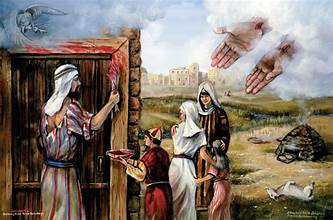
Candlemas, the celebration on which Groundhog Day is founded, is actually the day of the Baby Jesus’ presentation in the Temple (see Luke 2:22-40). Forty days after his birth, every first-born male child in Israel was to be presented at the temple, and a sacrifice was to be made for his redemption. This traces back to the Passover tradition, when the angel of death passed over the houses of the Jewish families who had painted their door frames with blood. Meanwhile, the first born sons (and animals) throughout Egypt were slaughtered. In this way, God showed His Power and His Mercy, leading Israel out of Egypt in triumph, while showing judgment on the Egyptians. (See Exodus 12).
History and tradition cast long shadows. The Jews had been slaves in Egypt for nearly 400 years. A new tradition helped them remember where they had come from and celebrate the promise that God would lead them to their own land. The Jewish people had kept this sacrificial tradition for centuries, reminding them of God’s mercy in saving their sons, and in redeeming them as a people from slavery in Egypt. Christians, realizing that this tradition “foreshadowed” the coming of Christ, adapted it into a new celebration. Christians celebrated Candlemas for centuries, remembering that Jesus was presented as OUR sacrifice, OUR redemption from Death into eternal Life Jesus came to be our Sacrifice, and also our Light.
But somewhere along the way, pagan beliefs and rituals were woven into the story of this day, until it has become “Groundhog Day.” Instead of the Lamb of God, we celebrate a common rodent. Somewhere in Pennsylvania (Punxsutawney), a small crowd gathers as someone lifts up a frightened groundhog and pronounces a weather prediction (one that is less than 50% accurate!) And everyone is looking for a shadow, instead of celebrating the Light.
The thing about shadows is that you cannot see them when you are looking INTO the light. You have to look away, turn around, look back, to see a shadow. Shadows are cast when something gets between the source of light and a flat surface. History casts shadows. Memories cast shadows. Sin casts a huge shadow. But Jesus is pure light. The Word of Life came to be a “lamp unto (our) feet and a light unto (our) path” (Psalm 119:105 KJV). We are meant to learn from the shadows of the past, but not to walk in them. We are to walk in the light, looking forward to the fulfillment of God’s promises, even as we celebrate the faithfulness of His past actions in the lives of others.
Light casts no shadow. But it banishes the darkness where shadows live. Our choices have consequences. We can turn away from the light, or step in opposition to the light, and cast shadows that may follow for generations–cycles of abuse, isolation, hatred, anger, or regrets. Or we can choose to follow the light, and banish the shadows of the past– bringing peace, repentance, reconciliation, and hope.
Heavenly Father, today, I pray that I will be a reflection of Your light in the world; that my actions would help banish shadows of doubt and despair, and shine with Your truth and hope for others to see. Where there are shadows in my life from the past, may I learn from them and leave them behind as I follow you more closely. Where I have cast shadows in the lives of others, help me to bring light and healing in Your name. Amen.
When I was a late teen, and into my early twenties, I loved English pop music, including the duo, Wham! Their music was bubbly, upbeat (mostly), and easy to sing along to. I listened along, sang along, watched their videos, and danced along. When the duo broke up, I was eager to follow the rise of singer/songwriter George Michael, whose first two solo albums I bought and listened to, as well. But the tone of his solo music was different. There were danceable, singable tunes, but they were darker and more cynical. And many of the songs were less about enjoying life and more about social commentary, confusion, and even despair. The songs were well-crafted, but they were haunting, rather than enjoyable or uplifting. They spoke of sadness, depression, and world-weariness.
One of the songs that has haunted me for years was from his second album, “Listen Without Prejudice.” In it, he talks about greed, poverty, apathy, and a loss of innocence. It’s called “Praying for Time,” but the tone of the song suggests that time has all but run out.
And yet…
One of the ideas that still shines through the words of the song is that prayer–specifically praying for time–may be the only hope that we can still cling to. And in a time of darkness and hopelessness, prayer can reach beyond “wounded skies” to a God whose Grace extends even to His children who have “slipped out the back door.”
There is something about the idea of time as a gift from God that stays in the soul, long after most hope is gone. I think it is why we are so driven by the concept of time and time “running out” as we hustle through our busy lives. I think it is why we spend time avoiding “down time” and “alone time” and the quiet time we should take to reflect, meditate, and yes, even time to pray. And I think, too, that it is why we recognize that wasted time is a sin– that there is a purpose in our time on Earth that transcends having “fun” or living for our own selfish aims. George Michael often used “spiritual” words and phrases for his songs– often with a cynical twist, pointing out some of the hypocrisy he saw around him (and occasionally, within himself).
These are the days of the open hand They will not be the last Look around now These are the days of the beggars and the choosers
This is the year of the hungry man Whose place is in the past Hand in hand with ignorance And legitimate excuses
The rich declare themselves poor And most of us are not sure If we have too much But we’ll take our chances ‘Cause God’s stopped keeping score
I guess somewhere along the way He must have let us all out to play Turned his back and all God’s children Crept out the back door
And it’s hard to love, there’s so much to hate Hanging on to hope When there is no hope to speak of And the wounded skies above say it’s much, much too late Well, maybe we should all be praying for time
These are the days of the empty hand Oh, you hold on to what you can And charity is a coat you wear twice a year
This is the year of the guilty man Your television takes a stand And you find that what was over there is over here
So you scream from behind your door Say, “What’s mine is mine and not yours” I may have too much but I’ll take my chances ‘Cause God’s stopped keeping score
And you cling to the things they sold you Did you cover your eyes when they told you That he can’t come back ‘Cause he has no children to come back for
It’s hard to love, there’s so much to hate Hanging on to hope when there is no hope to speak of And the wounded skies above say it’s much too late So maybe we should all be praying for time
“Praying for Time” George Michael, Listen Without Prejudice, 1990 (lyrics taken from Lyrics.com)
In an interview, George Michael analyzes his own lyrics:
While he mentions “He” and “God,” it is clearly humanity he blames for the apathy and selfishness, greed and scandal, the “empty hand” and “wounded skies” mentioned in the song. And his repetition of “all God’s Children” and its counterpart, “no children to come back for,” is aimed at US– people who “slipped out the back door,” moving away from God and embracing our own wickedness. WE have entered this time of hopelessness and despair. WE have crafted it in our own ignorance, and then in our own pride and stubbornness. But we can still pray for time– time to repent, time to return, time to reach out to others with compassion and hope. What the song just barely misses is that prayer can open so much more than just time. Prayer can bring renewal, justice, redemption, and eternal hope! God hasn’t stopped “keeping score,” by any means. But He is holding back the wrath and judgment we all deserve, giving us time to seek Him! Most of all, we can pray, not with desperation, but with confidence– even in times of confusion and distress, because we have an Advocate, Jesus Christ, who hears all our prayers– desperate, confused, ashamed, angry, hopeful, offered with no more than a mustard seed’s faith.
George Michael, like all of us, lived in a fallen world. He was looking at the world, and seeing injustice, greed, apathy, corruption, violence, and the ravages of Sin. His own life was plagued with sorrow, tragedy, pain, injustice, drug addiction, betrayal, and the effects of Sin– both his own and others’. I don’t know if he ever found peace and hope in this life. I hope so. His gifted life ended early and tragically. But his song lives on with a warning, and a hint of promise, too.
We SHOULD all be praying for time– time to change. Time to repent, and seek God’s wisdom. Time to reach out to a darkened world with more than despair and dark analysis. To reach out with the Hope of Christ, who brings Redemption, Justice, and MERCY! We should be praying for time to meditate on the Goodness of God, as well as time to see the needs of others. We should be praying for wisdom to share our resources, and to multiply the good we can do– things that only God’s power can really accomplish. We should be praying for connection– restored relationships, and renewed fellowship with the Father. We should be praying for time to pray! Not just a desperate kind of prayer that this song suggests, but a lifelong pursuit of prayer that connects us to the Source of Hope, Joy, Peace, Power, and Love.
This year, while I don’t often listen to George Michael’s music anymore, I will be “praying for time.” And I will be investing more time in prayer! I hope you will join me in the time God has gifted us with this year!
For more analysis of the song and its relation to prayer see the following:
Christmas is a time of joy and light. But the time of Advent is often a time of somber reflection. We remember a time we have never known– a time before the coming of Christ the Messiah– a time before the mysteries of Heaven were revealed and before the victory of Salvation was accomplished. Advent reminds us of the spiritual darkness that existed before God, in human form, in humble obedience, and in sacrificial love, became the Light of the World, and the Hope of All Nations.
Before the bells rang, and the angels sang; before the kings brought gold and the shepherds ran to tell the news; before there were Christmas Carols, Christmas decorations, or Christmas pageants– there was solemn silence, fear, dread, and waiting. God had been silent. The prophets had been silent. The world had grown hard and cold.
Jesus stepped out of the unfathomable glory of the Highest Heaven– surrounded by armies of angels all worshiping Him and ready to do His bidding. In an instant, He became a helpless fetus inside a helpless young woman, a subject of the Roman Empire, and at the mercy of her culture. Her fiance could have repudiated her; her parents could have disowned her; her community could have had her stoned to death, along with her unborn child. No one, even those who were anticipating the arrival of a Christ, was expecting this tiny baby growing inside the womb to change the course of history.
He was born in obscurity, in ignominious squalor. He was the Lord of All Creation, wrapped in rags and laid in a feeding trough in an overcrowded city at tax time. There were no bells or carolers, no glittering trees or festivals of lights, no sounds of joy and celebration– not in that manger in Bethlehem. Instead, there were strangers pushing and shoving, shouting, and snoring in the inns and houses and streets, being watched by soldiers and pickpockets alike, as they made their way through narrow, unfamiliar streets and tried to lock out the worry and danger and dread. There may have been silence in the fields and valleys outside of town, but not near the stable where Jesus was born. No. The “silence” we sing about during Advent is the silence inside our own hearts– a call to “be still,” and know that this baby we celebrate is God Incarnate. He is the One to whom every knee will one day bow, and every tongue confess that He is LORD.
In the stillness and silence of Advent, in the darkness lit only by candles and faint hope, we being to understand the contrast. We re-imagine what came before the joy and hope and eternal clouds of witnesses shouting, “Holy, Holy, Holy!” We remember the days and years before the angels sang, and the star danced across the night sky– before the shocking crucifixion and the glorious resurrection of this still unborn Savior.
Let us spend these days of Advent preparing our hearts for the true wonder of Christmas. It doesn’t come in the wrapped packages under a festive tree, or in the feasting with friends or family. It doesn’t come with sirens and parades, or speakers at the mall blaring out favorite tunes. It doesn’t come in the majesty of a Cathedral ringing with the voices of a choir and organ. It comes when the silence and darkness of our sin and dread are pierced with the overwhelming glory of God With Us– Emmanuel is coming! But for now, for these moments, Let All Mortal Flesh Keep Silence.
“O come, all ye faithful, joyful and triumphant, O come ye, O come ye to Bethlehem!”
“Come to Bethlehem and see Him whose birth the angels sing; come, adore on bended knee Christ the Lord, the new-born King.”
“O little town of Bethlehem, how still we see thee lie! Above thy deep and dreamless sleep the silent stars go by. Yet in thy dark streets shineth the everlasting light; the hopes and fears of all the years are met in thee tonight.”
“Come!” It echoes in our Christmas Carols; it echoes throughout Jesus’ ministry. It thrums and courses through the prophets and into the Revelations, “Amen, Come Lord Jesus!”(Revelation 22:20)
Christmas is all about coming– the coming of the Christ Child; the coming of the angels to shepherds; the coming of the shepherds to see the newborn King; the coming of the Wise Men. And we are bidden to “come” to Bethlehem and share in the joy and wonder of God coming to be our Emmanuel– God With Us.
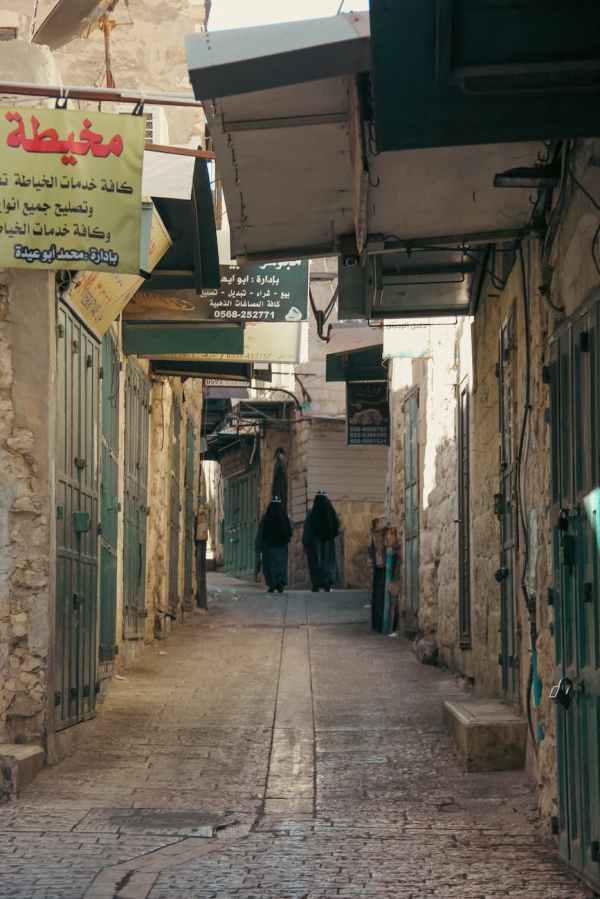
But the journey to Bethlehem is not as easy or a joyful as one might imagine. Bethlehem is crowded. It is dark and dreary. It is not “silent” as the hymns make out. It is noisy, dirty, and filled with people who “aren’t from around here.” There is no room here. There is no joyous welcome. There is not enough to eat, what with all the out-of-town travelers; shelves are bare, while garbage is piling up in the streets. Tempers are high, and patience is low.
“Come to Bethlehem.” At this moment, Bethlehem is caught in the chaos and struggle of war. Hospitals are in danger. People live in fear and violence. There is no peace and quiet– no silent streets or glorious angels in the sky– only the light and noise of rockets. We may not be able to physically travel to Bethlehem at the moment, but we can focus our prayers on the Middle East– to the hurting people in Israel and in Gaza– to earnestly pray for truth and peace there. We may not be able to travel back in time to Bethlehem, but we can travel across town to help our neighbors who need encouragement; we can step out of our safe and comfortable lives to share light in the dark regions of today’s world. And we can “Come” to prayer– to lift up those who are hurting, to ask for strength and courage to help, to own our own limitations and emptiness.
“Come to Bethlehem.” At this season, we are tempted to stay where it is cozy and familiar; or to travel somewhere warm and welcoming. We want the joy and peace of the Christmas Season to come to us! But we are bidden to come to Bethlehem, with its crowded streets and suspicious strangers; its unfamiliar alleys and rude Roman officials. We are bidden to come and share this message of peace where there IS no peace. We are asked to come where there is need and darkness and fear– to spread the Good News, not to sit on it.
“Come to Bethlehem.” Are we avoiding our own “Bethlehem?” Are there places we could visit to spread light; places we’re being called to, or places where we should go to “be counted,” but we refuse to come? Are there people we can encourage? Ways we can share hope and help– if we are willing to come away from our own comfort and (manufactured) joy?
Perhaps we long to hear the angels shouting “Glory to God in the Highest!” (Luke 2:14) But if we won’t “come” to Bethlehem, we may miss their song. We may miss seeing the message of Christmas if we insist that it comes to our pleasant palace, instead of seeking the Babe in the Manger of the Little Town of Bethlehem.
“Come to Bethlehem and See.” “Come, Let us Adore Him!” “Come!”


































 Pursuing Prayer