19 1-2 Ahab reported to Jezebel everything that Elijah had done, including the massacre of the prophets. Jezebel immediately sent a messenger to Elijah with her threat: “The gods will get you for this and I’ll get even with you! By this time tomorrow you’ll be as dead as any one of those prophets.” 3-5 When Elijah saw how things were, he ran for dear life to Beersheba, far in the south of Judah. He left his young servant there and then went on into the desert another day’s journey. He came to a lone broom bush and collapsed in its shade, wanting in the worst way to be done with it all—to just die: “Enough of this, God! Take my life—I’m ready to join my ancestors in the grave!” Exhausted, he fell asleep under the lone broom bush. Suddenly an angel shook him awake and said, “Get up and eat!” 6 He looked around and, to his surprise, right by his head were a loaf of bread baked on some coals and a jug of water. He ate the meal and went back to sleep. 7 The angel of God came back, shook him awake again, and said, “Get up and eat some more—you’ve got a long journey ahead of you.” 8-9 He got up, ate and drank his fill, and set out. Nourished by that meal, he walked forty days and nights, all the way to the mountain of God, to Horeb. When he got there, he crawled into a cave and went to sleep. Then the word of God came to him: “So Elijah, what are you doing here?” 10 “I’ve been working my heart out for the God-of-the-Angel-Armies,” said Elijah. “The people of Israel have abandoned your covenant, destroyed the places of worship, and murdered your prophets. I’m the only one left, and now they’re trying to kill me.” 11-12 Then he was told, “Go, stand on the mountain at attention before God. God will pass by.” A hurricane wind ripped through the mountains and shattered the rocks before God, but God wasn’t to be found in the wind; after the wind an earthquake, but God wasn’t in the earthquake; and after the earthquake fire, but God wasn’t in the fire; and after the fire a gentle and quiet whisper.
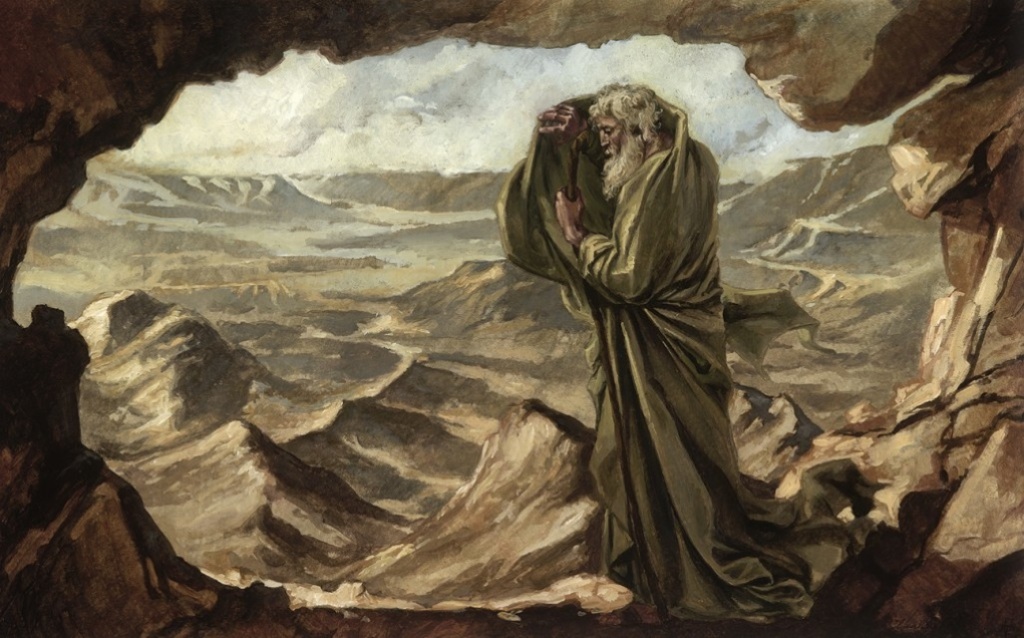
13-14 When Elijah heard the quiet voice, he muffled his face with his great cloak, went to the mouth of the cave, and stood there. A quiet voice asked, “So Elijah, now tell me, what are you doing here?” Elijah said it again, “I’ve been working my heart out for God, the God-of-the-Angel-Armies, because the people of Israel have abandoned your covenant, destroyed your places of worship, and murdered your prophets. I’m the only one left, and now they’re trying to kill me.” 15-18 God said, “Go back the way you came through the desert to Damascus. When you get there anoint Hazael; make him king over Aram. Then anoint Jehu son of Nimshi; make him king over Israel. Finally, anoint Elisha son of Shaphat from Abel Meholah to succeed you as prophet. Anyone who escapes death by Hazael will be killed by Jehu; and anyone who escapes death by Jehu will be killed by Elisha. Meanwhile, I’m preserving for myself seven thousand souls: the knees that haven’t bowed to the god Baal, the mouths that haven’t kissed his image.” 19 Elijah went straight out and found Elisha son of Shaphat in a field where there were twelve pairs of yoked oxen at work plowing; Elisha was in charge of the twelfth pair. Elijah went up to him and threw his cloak over him. 20 Elisha deserted the oxen, ran after Elijah, and said, “Please! Let me kiss my father and mother good-bye—then I’ll follow you.” “Go ahead,” said Elijah, “but, mind you, don’t forget what I’ve just done to you.” 21 So Elisha left; he took his yoke of oxen and butchered them. He made a fire with the plow and tackle and then boiled the meat—a true farewell meal for the family. Then he left and followed Elijah, becoming his right-hand man. 1 Kings 19 (The Message)
As a child, I was confused by this story from the life of Elijah the prophet. Just before this, Elijah had challenged the prophets of Baal and Asherah. He was outnumbered 850 to one, yet he stood defiantly, and asked the people of Israel to choose between their false gods and the one true God. God had produced fire on the mountain and shown His mighty power, while the false prophets were humiliated and later slain. It was a stupendous victory! And yet, Elijah, when told of Queen Jezebel’s anger, fled in terror, hid in the wilderness, and asked for death! Surely, Elijah remembered what God had just accomplished. Surely he knew that the same God who sent fire and ended the drought could protect Elijah from harm. Didn’t he? And I expected that God would react with consternation at this display by Elijah–how ungrateful to throw such a pity party after God had done such a miracle!
But God did the most curious thing. He could have sent a powerful reassurance. He could have ordered Elijah to return to the palace to deal with the wicked king and queen–finish the job and bring divine justice to Israel’s ruling family. He could have called Elijah out over his bad behavior and lack of faith. But God let Elijah whine and run away. And after Elijah threw a temper tantrum, God sent an angel to bring him food and water. Finally, God allowed Elijah to see His power in the forms of a mighty wind, an earthquake, and a fire. And it was THEN, and only then, that God spoke to Elijah in a still, small voice– a whisper– something so intimate and comforting that Elijah could not fail to recognize that it was the voice of God.
God CAN and will do mighty miracles. But so often, He prefers to work in a whisper. He is Glorious, and Powerful, and Omnipotent– yes. But He is also intimate and gentle and nurturing– especially with those who have ears to listen; those who have been broken down; those who need a quiet voice of reassurance and peace.
As I have grown older, I see so much in this passage that I couldn’t see as a child. I see how often I “lose it” just after I think I’ve won a great victory. I see how many times God has come to me in whispers and little gestures– just when I need a gentle hug and a simple reminder of His care. God is not the one who points out my temper tantrums and lack of faith. God doesn’t yell recriminations at me– even when I know I deserve them! I see how often I throw a tantrum, and expect God’s wrath, only to be met with His arms around me, calming me, lifting my head so I can look into His eyes of compassion and mercy. God is my Father– and a gentle, wise, and loving Father. And when He draws me close– He whispers of His Love.
Yes, God sent fire from the mountain. He caused justice to be done upon the false prophets. It was mighty; it was fierce; it was devastating. God IS a God of wrath– and even prophets can get wounded in the fight. There is evil in the world, and when we stand up to it, it is exhausting– even when we know God is with us. But God knows our limits. He will often give us more than we can handle– in our own power– and He will pull us through the kind of trials that test and stretch those limits. But He is also preparing a time and place of rest and His quiet whispers of encouragement and hope when we are tempted to give up.
God didn’t just whisper empty promises or nice-sounding platitudes when He finally spoke to Elijah. He brought a new message– someone else would be God’s instrument of justice for Ahab and Jezebel. Someone else would come alongside Elijah in his ministry. And someone else (7,000 someone else-s in fact!) WERE being faithful. Not only had God been with Elijah in the past, God had been preparing the future for Elijah to receive rest, and for others to rise up and carry on. He could have shouted this message from the mountaintop. But He wanted to whisper His message of hope to a faithful prophet who needed quiet reassurance after a difficult battle.
I don’t know what God wants to whisper to me (or to you) today. But I pray that we will have ears to hear, and hearts to respond. And God will whisper to us, whether we just defeated an army of enemies, or just woke up from a much needed nap! He will gently remind us that He loves us in our tantrums just as He loves us in our victories. And He will whisper, because that’s how close He really is in our every moment!
“Times are tough!” I hear many people complaining about the economy lately. And they have good reason– gas prices, food prices, housing prices, taxes– everything is getting more expensive, and wages or other sources of income just aren’t keeping up.
While we may worry about the current economic conditions, we need to step back and look at a different economy– God’s economy.
This weekend, I wrote out checks and paid bills. I even put some money in the offering at church. But God doesn’t look at the amount of money I paid or gave away, how much I spent or saved, earned or invested. He’s aware, of course, of such things, but God looks at a different “bottom line.” God cares how I spend or save money, whether it’s pennies or thousands of dollars. But He also cares how I spend my time and energy. And my life is “richer” than just the money in my bank account or the things in my house.
God doesn’t give us everything we want– He loves us too much for that. Life isn’t about having the most “toys;” it isn’t about having the easiest or most entertaining experiences. It isn’t about “winning” and having “more.”
I have noticed that the happiest people are often those who have had to struggle the hardest. In God’s economy, it is His pleasure to give more than we can ask or imagine– but often in ways we would never expect. (see Ephesians 3:20-21) In God’s economy, I am rich. Not because of anything that I have done, or earned, or because I was born to a wealthy family or because I won the lottery. I am rich because of what God has done. And if I am tempted to doubt that, I can begin listing all the blessings of God– and I will run out of space and time!
God has given me life. I didn’t choose to be born. I did not have the power to create myself. But God made me unique among all the people who have ever lived. He gave me a body, a mind, a soul, and a spirit. He gave me thoughts and dreams and opportunities to grow and enjoy life.
God gives me hope and purpose and a reason to live. Life can be difficult. It can be painful. It can be tempting to see only the darkness, the grief, the regrets. But it can be beautiful. It can be almost painfully beautiful, sometimes. What a gift. And what a gift God offers in each new day. A new chance to hope. A new chance to strive. A new chance to make a difference.
God has given me family and friends. And sometimes, that can be a struggle! We aren’t perfect, and we don’t always see eye to eye. We step on the toes or we step on the feelings of others. But we also make each other laugh. We make each other stronger. We help each other grow. We enrich the lives of others, and others enrich our lives in return.
God has given me His word– His promises; His love-letter; His wisdom; His counsel; His power to shape my story. And yours! The Bible is not just a collection of stories or words. It is Truth. It is Grace. It is how we can KNOW the riches God has for each of us.
God has given me His Salvation. No matter what today brings; no matter what has happened in my past– whether things I have done, or things that have been done to me–God sees me as His child. And if I believe in Him; if I trust Him to be who He says He is– my Father, my Savior, my Lord–He will throw my past and my guilt “as far as the east is from the west”(see Psalm 103:12). I am debt-free! And I will inherit all that God will share with His children throughout eternity!
And God has given my His Presence. I am never alone. I am never forsaken or forgotten. NEVER. (Hebrews 13:5) If I am sitting in despair on an ash heap, seeing no hope and no future, God is sitting there with me, waiting for me to see Him, and accept that He is more than “enough” to get me through.
And with such riches, I can follow God’s lead and be generous in return. I don’t have the power to give life, but I can celebrate it, advocate for it, protect it, and remind others of its beauty and promise.
I can encourage others– with acts of service, with a smile, by faithfully lifting them up in prayer. What if we thought about hugs as endowments? What if, in God’s economy, every hug you give is worth $2,000? What if every prayer is like investing in a bank account? What if your smile is worth a fortune to someone today? I can be a friend to someone who feels unseen or unheard. I can share a conversation with someone who feels lonely. I can share a burden for someone who just needs a helping hand.
I can share God’s promises. I can share His wisdom. I can share His compassion. I can share His Mercy and Grace with those who least expect or “deserve” it. I can share my hope and my joy. I can help someone look up and look beyond a bad day. And where there is suffering and pain– I can share that, too, knowing it is part of God’s good economy. And maybe, as I offer my presence, I can help someone else see the presence of God sitting there with us both!
You may not feel very rich today. And in this world’s economy, you may be in great need. God may not shower you with cash or assets in the present moment. But God has promised to give you everything you truly need for life and Godliness (2 Peter 1:3-4)
When I was a late teen, and into my early twenties, I loved English pop music, including the duo, Wham! Their music was bubbly, upbeat (mostly), and easy to sing along to. I listened along, sang along, watched their videos, and danced along. When the duo broke up, I was eager to follow the rise of singer/songwriter George Michael, whose first two solo albums I bought and listened to, as well. But the tone of his solo music was different. There were danceable, singable tunes, but they were darker and more cynical. And many of the songs were less about enjoying life and more about social commentary, confusion, and even despair. The songs were well-crafted, but they were haunting, rather than enjoyable or uplifting. They spoke of sadness, depression, and world-weariness.
One of the songs that has haunted me for years was from his second album, “Listen Without Prejudice.” In it, he talks about greed, poverty, apathy, and a loss of innocence. It’s called “Praying for Time,” but the tone of the song suggests that time has all but run out.
And yet…
One of the ideas that still shines through the words of the song is that prayer–specifically praying for time–may be the only hope that we can still cling to. And in a time of darkness and hopelessness, prayer can reach beyond “wounded skies” to a God whose Grace extends even to His children who have “slipped out the back door.”
There is something about the idea of time as a gift from God that stays in the soul, long after most hope is gone. I think it is why we are so driven by the concept of time and time “running out” as we hustle through our busy lives. I think it is why we spend time avoiding “down time” and “alone time” and the quiet time we should take to reflect, meditate, and yes, even time to pray. And I think, too, that it is why we recognize that wasted time is a sin– that there is a purpose in our time on Earth that transcends having “fun” or living for our own selfish aims. George Michael often used “spiritual” words and phrases for his songs– often with a cynical twist, pointing out some of the hypocrisy he saw around him (and occasionally, within himself).
These are the days of the open hand They will not be the last Look around now These are the days of the beggars and the choosers
This is the year of the hungry man Whose place is in the past Hand in hand with ignorance And legitimate excuses
The rich declare themselves poor And most of us are not sure If we have too much But we’ll take our chances ‘Cause God’s stopped keeping score
I guess somewhere along the way He must have let us all out to play Turned his back and all God’s children Crept out the back door
And it’s hard to love, there’s so much to hate Hanging on to hope When there is no hope to speak of And the wounded skies above say it’s much, much too late Well, maybe we should all be praying for time
These are the days of the empty hand Oh, you hold on to what you can And charity is a coat you wear twice a year
This is the year of the guilty man Your television takes a stand And you find that what was over there is over here
So you scream from behind your door Say, “What’s mine is mine and not yours” I may have too much but I’ll take my chances ‘Cause God’s stopped keeping score
And you cling to the things they sold you Did you cover your eyes when they told you That he can’t come back ‘Cause he has no children to come back for
It’s hard to love, there’s so much to hate Hanging on to hope when there is no hope to speak of And the wounded skies above say it’s much too late So maybe we should all be praying for time
“Praying for Time” George Michael, Listen Without Prejudice, 1990 (lyrics taken from Lyrics.com)
In an interview, George Michael analyzes his own lyrics:
While he mentions “He” and “God,” it is clearly humanity he blames for the apathy and selfishness, greed and scandal, the “empty hand” and “wounded skies” mentioned in the song. And his repetition of “all God’s Children” and its counterpart, “no children to come back for,” is aimed at US– people who “slipped out the back door,” moving away from God and embracing our own wickedness. WE have entered this time of hopelessness and despair. WE have crafted it in our own ignorance, and then in our own pride and stubbornness. But we can still pray for time– time to repent, time to return, time to reach out to others with compassion and hope. What the song just barely misses is that prayer can open so much more than just time. Prayer can bring renewal, justice, redemption, and eternal hope! God hasn’t stopped “keeping score,” by any means. But He is holding back the wrath and judgment we all deserve, giving us time to seek Him! Most of all, we can pray, not with desperation, but with confidence– even in times of confusion and distress, because we have an Advocate, Jesus Christ, who hears all our prayers– desperate, confused, ashamed, angry, hopeful, offered with no more than a mustard seed’s faith.
George Michael, like all of us, lived in a fallen world. He was looking at the world, and seeing injustice, greed, apathy, corruption, violence, and the ravages of Sin. His own life was plagued with sorrow, tragedy, pain, injustice, drug addiction, betrayal, and the effects of Sin– both his own and others’. I don’t know if he ever found peace and hope in this life. I hope so. His gifted life ended early and tragically. But his song lives on with a warning, and a hint of promise, too.
We SHOULD all be praying for time– time to change. Time to repent, and seek God’s wisdom. Time to reach out to a darkened world with more than despair and dark analysis. To reach out with the Hope of Christ, who brings Redemption, Justice, and MERCY! We should be praying for time to meditate on the Goodness of God, as well as time to see the needs of others. We should be praying for wisdom to share our resources, and to multiply the good we can do– things that only God’s power can really accomplish. We should be praying for connection– restored relationships, and renewed fellowship with the Father. We should be praying for time to pray! Not just a desperate kind of prayer that this song suggests, but a lifelong pursuit of prayer that connects us to the Source of Hope, Joy, Peace, Power, and Love.
This year, while I don’t often listen to George Michael’s music anymore, I will be “praying for time.” And I will be investing more time in prayer! I hope you will join me in the time God has gifted us with this year!
For more analysis of the song and its relation to prayer see the following:
It was almost 160 years ago, during the darkest days of America’s Civil War, that Henry Wadsworth Longfellow wrote a poem “Christmas Bells” that would become the Christmas Hymn, “I Heard the Bells on Christmas Day.” His son had been badly wounded in battle; his wife had died just a few years earlier, and the nation was in ruins and chaos. No one knew how much longer the war would continue or what the final outcome would be; Longfellow did not know if his son would live, or if he would be paralyzed for life. As he listened to the bells of Christmas ringing from church towers, he poured out all his doubts and fears in verse. Yet he concluded, “The Wrong shall fail, the Right prevail, with peace on earth, good-will to men.”
Christmas is not just a celebration of “comfort and joy” that comes from tinsel and lights, cozy fires, or gifts under brightly lit trees. Christmas is about Hope in times of darkness. It is about promises kept; prophesies fulfilled, victory assured, even when it looks as though the Enemy has the upper hand.
It is horribly tempting in troubled times to wonder and question God’s ways– does He hear? Does He see? Is He asleep? Does He exist? How can a “good” God allow such suffering and pain? And like Longfellow, we listen to our circumstances, and they seem to drown out the message of Christmas– “For Hate is strong, and mocks the song of peace on earth, good-will to men.” The cannons of yesteryear may have been replaced with 24-hour news cycles or Facebook news feeds, with protests and terrorist attacks; war and political corruption; social tensions and economic turmoil, but the noise is still the same. There is hatred, deceit, destruction, and doubt in our world–it was present during the Civil War; it was present during the Roman occupation at the time of Christ’s birth. But that birth brought a singular hope– one that has become so familiar, and so casual as to be almost forgotten amidst the immediate urgent noises of the day.
The trappings of Christmas sometimes hide the very Glory of Christ’s Advent. God CAME. He LIVED AMONG US. He was humble. He felt the cold and heat of long days and nights; his feet got dirty from walking. He laughed and cried. And, He DIED. He felt agony and shame and fear as he gasped for breath, naked and bloody and facing sneers and anger from the crowd. But God IS NOT DEAD–He conquered death; He rose again victorious. And He did it so that our suffering is not in vain– our suffering is not the end of our story.
GOD IS NOT DEAD. Hope is not in vain. Nor does He sleep–even in the silence of our lonely nights, even in the noisy chaos of life in 2023–God has not stepped off His throne; He has not turned His back on mankind. “The Wrong shall fail–” though it may seem strong and strut arrogantly through the streets, shouting and threatening–God is the final authority. Nothing is hidden from Him. He sees every injustice, every secret sin; He hears every lie, every twisted truth, every deceit. And He has no favorites– there is no excuse, no “religious” exemption– ALL have sinned, and all will be held to account.
EXCEPT– because of that one birth and death and resurrection–the debt is already paid. “The Right (shall) prevail with peace on earth, good-will to men.” For those who listen beyond the noise of battle, the bells of Christmas ring “more loud and deep” with the hope and joy and strength that overcome our pain and struggle. Longfellow found that truth– and I’m so glad he shared it. I hope his words will continue to remind us to listen through this season for the true message of Christmas.
One of my favorite Christmas movies has always been “It’s a Wonderful Life.” The movie tells the story of a man who finds himself desperate, sad, frustrated, angry, and suicidal on Christmas Eve –sounds like a real winner, huh? But before he gets to that point, Heaven is preparing an angel to come to his rescue. Through the eyes of the angel, the viewer “gets to know” George Bailey– his family, his friends, his struggles and his joys–and gets to see his life in perspective. The angel, Clarence, decides to give George an unusual gift– the chance to see what the world would be like, not just if he were to commit suicide, but what it would be like if he, George Bailey, had never existed. George is astounded and horrified to see the effects of his absence, and he learns to value his life, his family, and his friends as never before.
The dramatic effect of one person’s life cannot be overstated, but this is especially true of the life of Christ! Can we dare to imagine what life would be like today if Jesus had never been born?
Of course, the most obvious and tragic consequence is that there would be no Salvation by Grace. For a more complete discussion on this, there are several other essays and even books, including “What if Jesus Had Never Been Born” by D. James Kennedy and Jerry Newcombe. (Full disclosure: I have not read this book– I just found out about it as I was writing this, but I trust it is a good resource.) And all speculation on this subject is just that– the Bible is clear that it was always God’s plan for Jesus to come, to live, to die, and to defeat death, just as He did, just when He did. Any alternative vision is not from God, but from our own imaginations. But what other “ripples” do we take for granted in our world, that would not have happened (or would have happened very differently) if Jesus had never been born, or had not completed the work of His life, death, and resurrection?
There would be no Christmas. Not just the Christian celebration of Christmas, but much of what we call “secular” Christmas. While some cultures might have a local festival for winter solstice, there would be no worldwide celebration such as we know.
There would be no “Santa Claus,” no “St. Nick,” no “Father Christmas,” no “Papa Noel”, etc. The model for our modern Santa Claus, St. Nicholas, wouldn’t have been a Christian Bishop in Asia Minor, because there would have been no Christians there, or anywhere else.
No Christmas Cartoons– no story about Rudoph the Red-Nosed Reindeer; no singing elves and jolly Mrs. Santa Claus; no Heat Miser and Snow Miser (if you know some of the other Rankin-Bass productions..) Hours of childhood memories erased.
No other Christmas stories and movies– no Scrooge and Marley; no MIracle on 34th Street; no “Yes, Virginia, There is a Santa Claus”; no “Santa Clause” (and its successors) no “Christmas Story” or “Christmas Vacation”; not even Hans Gruber falling from the Nakatomi Tower. Millions of DVDs, books, VHS tapes, local theater productions– never existed.
We can kiss Frosty the Snowman goodbye, as well. Without the magical snowfall of Christmas, the story never takes shape– literally.
No Christmas Carols or Christmas music. I know of at least three local radio stations that are playing Christmas music exclusively right now. They started the day after Thanksgiving, and they will continue through the end of the month. Thousands of Christmas songs– from favorites like “O, Come All Ye Faithful,” and “O, Holy Night,” to annual disasters, like “Last Christmas,” and “Santa, Baby”– all wiped out.
No Christmas cards. Millions of cards are sent out each year, connecting family and friends around the world. Except there wouldn’t be any if Christ had never been born.
No Christmas Lights.
No Christmas shopping. (And while that may seem like a good thing for my personal budget, have you ever looked at what the Christmas season means for most Western economies?) No Christmas wrapping; no Christmas ornaments; no Christmas sweaters or socks; no Christmas candy or cookies…
No Salvation Army bell ringers at the stores– no Salvation Army; no reason to ring bells…
No Christian charities– not just the Salvation Army, but every other charity that was founded on Christian principles, or for Christian outreach…no downtown rescue missions, no soup kitchens, no international Christian efforts to rescue hurting children or provide relief for families. I by no means want to suggest that ONLY Christians are charitable, or that NO charities would exist without Christ. Charities are a mainstay of most religions, and always have been. The distinction I would make is that more Christian charities have been developed and have thrived in the last 2,000 years, than charities started by other religious and secular organizations, and there is evidence that they do more efficient and more broad-based work than their counterparts. https://www.christianpost.com/news/christian-charities-more-reliable-than-others-according-to-forbes.html
No Christian colleges or universities– Are you a fan of Notre Dame Football? Sorry. Notre Dame doesn’t exist. Neither do Harvard, Yale, Princeton, Cambridge, Oxford, Saint Andrews, Georgetown, and several other colleges and universities throughout Europe, North America, and elsewhere. Even universities that are completely secular today were once founded on the idea that education was a Christian virtue. This doesn’t mean that there would be no places of higher learning– there would just be far fewer than we know today.
No “Christian” books– and this includes books that introduce Christian concepts, allegories, and allusions. No “Pilgrim’s Progress,” no “Jane Eyre.” no “Lord of the Rings…”
No Churches– no cathedrals, no picturesque country chapels, no strip mall fellowships, no megachurches…
None of the Christian Memes; Promises; favorite verses… no Beatitudes; no Fruit of the Spirit; no “Golden Rule,” no Romans 8:28 or John 3:16 or Philippians 4:13…
No Twenty-First Century! Our calendar is literally based in part on the assumed birth of Christ. And while there are other calendars– Chinese, Aztec, Hebrew, etc., that are numbered differently, most of the world uses the Roman/Julian/Gregorian Calendar, which splits time into B. C. or B.C.E. — literally “Before Christ” or “Before the Christian Era”, and A.D. (Anno Domini– year of our Lord!) or C.E. “Christian Era.”
It paints a pretty bleak picture. Our world, as we know it, would be vastly different if Christ had never been born. That is not to say that the innovations, inventions, or achievements of the past centuries might NOT have happened at all– but they would have happened without the same purpose and effect. Many of the events of the past two millennia were inspired by, undertaken by, and driven by the message of the Christ– His birth, death, resurrection, and promised return! We hear about some of the negative things of the Church– wars and excesses, scandals and failures. But what about the successes– the transformation of violent cultures and conflicts into peaceful resolution, the drive to end slavery, cure illnesses, eradicate hunger–so many of the blessings we enjoy here on earth are the result of work done by those who long to love their neighbors as themselves and to see God’s will done “on earth as it is in Heaven!” The Joy and Generosity of the Christmas season cannot be separated from its central cause. The Wonder, the sense of the Miraculous and Holy, the sense that there is something “More” beyond a crisp winter morning or a day off work or a genial meal with friends–it all MEANS something. It doesn’t just come from nowhere, or a human desire to be kinder this one day each year. The character of George Bailey exemplifies an ordinary life that has meaning and purpose. His sense of purpose has gotten lost in the crush of bills, obligations, disappointments, and injustices. His prayer is one of quiet desperation; he is completely unaware that it is part of a vast chorus of prayers. But God hears it– and God sends Clarence!
There is a reason that George is visited by an Angel on Christmas Eve. Clarence may not be suave and sophisticated; he may not have intellectual arguments that can help George comprehend all of life’s wonder and purpose. But just like the angels at the first Christmas, Clarence comes from Heaven. He is God’s chosen messenger. He brings Heaven’s perspective and truth into a dark world, showing George what IS and HAS BEEN and what CAN BE– all because George was born– because CHRIST was born! It IS a WONDERFUL Life– not because of our circumstances, but because God’s Greatest Gift redefines our circumstances and transforms our perspective!
4-7 But when the time arrived that was set by God the Father, God sent his Son, born among us of a woman, born under the conditions of the law so that he might redeem those of us who have been kidnapped by the law. Thus we have been set free to experience our rightful heritage. You can tell for sure that you are now fully adopted as his own children because God sent the Spirit of his Son into our lives crying out, “Papa! Father!” Doesn’t that privilege of intimate conversation with God make it plain that you are not a slave, but a child? And if you are a child, you’re also an heir, with complete access to the inheritance.
Galatians 4:4-7 (The Message)
George emerges from his nightmare experience to find he is, in fact, “the richest man in town.” Oh, that we would wake up this Christmas morning fully aware of the rich heritage that is ours– because WE were born. Because HE was born! Because we can be BORN AGAIN!
We’re getting some rain outside as I write this. Not pouring rain; nor torrential rain; just a steady drizzle. But it looks as though we will get rain for another two days at least. Without stop. Cloudy, wet, chilly, dreary weather.
The news has been dreary, too. War, political upheaval, economic disaster looming, and general unrest. And it isn’t just localized. There is trouble everywhere, and, seemingly, all the time. And yet…events march along as though things are normal– as though the future will be bright tomorrow. There are festivals being planned (some with rain dates, others may be cancelled or lightly attended if the rain continues or worsens); people seem to be in the same hurrying, scurrying rhythm as yesterday. Some complain, or seem a bit oppressed, but most don’t even comment on the catastrophic events unfolding around us. They buy and sell, eat and drink, and rush to and fro like always.
There seems to be a universal weariness– people are tired of bad news, anger, protests, and arguing, but no one seems to want to DO anything positive, unless it is to live in denial of what is actually happening. “Oh, they are just exaggerating.” “That might happen elsewhere, but it will never happen HERE!” “Things will work out– we just need to wait it out.”
It reminds me of the warning of Jesus in Matthew 24:
For as in those days before the flood they were eating and drinking, marrying and giving in marriage, until the day when Noah entered the ark, 39 and they were unaware until the flood came and swept them all away, so will be the coming of the Son of Man.
Matthew 24:38-39 ESV
While I can listen to or watch bad news unfolding, it hasn’t impacted me directly. I don’t have to worry about bombs coming into my neighborhood (at least, I’m not expecting any today); I haven’t lost my home or a loved one in the past week. I watch the clouds and rain from the safety of a warm, dry apartment. It is easy to become apathetic. And, if I think about any of it, it is easy enough to say a quick prayer for “others” “over there.”
But I’m not building an ark. Jesus’s warning was not to “toss off a quick prayer” as we see signs of danger and await His return. Prayer is important, but it isn’t something to be done lightly. Living for Christ is more than wearing the name “Christ Follower” and a t-shirt or cross necklace. When was the last time I spent an hour in earnest prayer? When was the last time I fasted? When was the last time I felt compelled to act for the cause of Christ?
I’m not surprised that most people walk around angry, or apathetic about the state of the world. But as Christians, we should be working to make a visible difference. And that means our prayers must also be different than the comfortable “good wish” prayers that many of us (and I must include myself) often practice.
In the days of Noah, people were going about their daily lives without any clue of the horrors to come. And yet, there were signs, even then. There was evil everywhere– corruption, fighting, cheating, lies, danger, disease, famine, and oppression. But only Noah was building an Ark. He wasn’t caught up in watching CNN or trolling the internet, but he also wasn’t leading an “ordinary” life. His life stood out, because he listened to God. He was focused on what really mattered– saving those who would enter the Ark and survive the judgment to come. The Ark had room for more people– but they refused the invitation. Maybe they had a dentist appointment scheduled for that day; maybe they didn’t want to miss their “girls day out.” Perhaps they were planning a fishing trip or they were buying a house.
But he said to him, “A man once gave a great banquet and invited many. 17 And at the time for the banquet he sent his servant to say to those who had been invited, ‘Come, for everything is now ready.’ 18 But they all alike began to make excuses. The first said to him, ‘I have bought a field, and I must go out and see it. Please have me excused.’ 19 And another said, ‘I have bought five yoke of oxen, and I go to examine them. Please have me excused.’ 20 And another said, ‘I have married a wife, and therefore I cannot come.’ 21 So the servant came and reported these things to his master. Then the master of the house became angry and said to his servant, ‘Go out quickly to the streets and lanes of the city, and bring in the poor and crippled and blind and lame.’ 22 And the servant said, ‘Sir, what you commanded has been done, and still there is room.’ 23 And the master said to the servant, ‘Go out to the highways and hedges and compel people to come in, that my house may be filled. 24 For I tell you, none of those men who were invited shall taste my banquet.’”
Luke 14:16-35 ESV
Again, Jesus warns that we are to be prepared to drop the “business” of daily living; to be prepared for the Return of Christ. There is a cost involved in being a “Christian” or a “Christ Follower.” We are not to be like those who are walking around with our heads in the clouds, or worse, with our heads filled with apathy or gloom. We are to be salt and light in this dark world. We should be praying for boldness and wisdom to seek out opportunities to serve, to encourage, and to share the Gospel.
“Lord, take over my days and my prayers, that I would not settle for comfort, but seek you with a fervent heart, and seek not to just observe, but to serve!”
At least once a month this year, I hope to include a post on helpful tips to improve our pursuit of prayer. These are tips I’ve gathered over the years, and it helps me to remember as I write about them.
Today, I want to talk about starting and finishing well.
Beginning prayer with a Hallelujah helps focus my attention where it should be– on God! Too many times, I start praying with a “need” mindset. I’m focused on a need or a situation in my life or the lives around me. But the greatest “need” I have is to lift my eyes and focus on the ONE who is higher and greater and more powerful than any situation; the ONE who can satisfy every “need” and bring justice, restoration, and hope to any situation.
I have learned two different acronyms for prayer over the years– ACTS and PRAY. ACTS stands for Adoration, Confession, Thanksgiving, and Supplication. PRAY stands for Praise, Repent, Ask, and YES! (action). In both, the first step is to bring praise and adoration to the One who is worthy of it.
Sometimes, this is easy to do. Sometimes, it is painful. When I am stressed, worried, grieving, or convicted, my focus is inward and downward– and I can spiral into depression, isolation, and fear. The last thing I want to do is turn my focus away. God’s glory and righteousness can be blinding in the face of dark depression and despair. And yet–
Start small. Begin with one aspect of God’s character that you have experienced– His Grace, His Faithfulness, His Love. Meditate on it. Express it. Expand on it. Recall some of the specific ways in which God has been gracious, faithful, or loving. Think about some of God’s other attributes– His wisdom, power, omnipresence; His eternal nature, His creation. Soon, it becomes easier to speak, and even sing, His Praise!
Often, this will lead naturally into confession and repentance. When we begin by focusing on God’s greatness, His Holiness, and His majesty, our worries show themselves for lack of faith; our needs, while still real, reveal opportunities for God to “show up!” and for us to learn new depths of His character IF we are humble, obedient, and willing to learn.
Praise and Adoration are important first steps in prayer. But it is equally important to end our prayers well. Sometimes, our “Amen” is muted as our focus returns to our requests. And sometimes, it can be difficult and even painful to say “Amen!” I KNOW God is all-gracious, all-knowing, and all-powerful. But I also know that I don’t have enough money to pay the latest bill, or that I have been diagnosed with an incurable disease, or that my son or daughter is still lost. And I know that God may be asking me to walk through the valley of the shadow of death. He will be beside me, but He’s not going to remove the shadow or the valley to make it easier.
Over the years, I have found that it is better to wrestle IN prayer than to end with a half-hearted Amen. I must go back to Adoration; find my Thanksgiving, reclaim my Yes, Lord! before I say, “AMEN!” Otherwise, I am like the double-minded person in the book of James: being tossed like a wave in the ocean and filled with petty doubts in spite of my knowledge of God’s goodness.
End your prayer on a high note today. Remember to sandwich requests and concerns between hymns of praise and odes of thanksgiving. “Amen” should always echo our “Hallelujah!”
Today is the Summer Solstice. In the Northern Hemisphere, it marks the “longest day” of the year. However, today will have exactly the same number of minutes and hours as any other day. The difference is the amount of sunlight/daylight hours, as opposed to hours of night/darkness. And even this varies by where we live in relation to the equator. Those who live close to the equator will see little difference today– those near the North Pole will not see the sun dip below the horizon at all.
In some ways, today is NOT the longest day of my year. One of the longest days for me so far this year was the day my mother died. Even though it was February, when the days are “short,” that day was filled with questions, emotions, and obligations. Time seemed to stand still for a while, as we took in the reality that she had left us to go Home, and then time seemed to expend for all the aftermath of death. Who needed to be called and contacted? What would we need to do in the coming days and weeks to plan a funeral, notify authorities, pay bills and close accounts, etc.? How would we notify family and friends without “missing” someone? Each tick of the clock seemed to bring new thoughts and emotions.
I was thinking about time recently. We are still busy cleaning up Mom’s house and settling her estate. Days seem to pass quickly now, as we have deadlines, and much work to keep us busy. I’m glad for the extended daylight hours, but I’m also tired! Most days– even longer days!– I feel like I’m falling behind. And I find many hours are “wasted” on unimportant things; inconsequential things. Will I spend my time today any differently or more efficiently than any of the “shorter” days to come?
The Bible says a lot about time. (https://www.openbible.info/topics/time) We are creatures bound by time. We have a beginning and an end; we have a limited life span. And we do not know those limits. We cannot break the bonds of time to live longer lives, or to live our lives in the distant past or future. That is the “stuff” of science fiction and daydreams. We cannot bargain for more time, whether we are thirty and diagnosed with cancer or ALS or another terminal illness, or we are ninety-two and long to reach our centennial birthday. Even our individual days are dictated by the march of time. We cannot live our days backward. We cannot stop the clock or stretch out a certain hour over any other. Instead, we must make the most of every minute; every day that we are given.
But we were not created just for one short lifespan. Our bodies will wear out and die, but our spirits were created for eternity. There will be no “longest” or “shortest” days in Heaven or Hell. There will be no sunsets, no endings or “do-overs”, no deadlines. For the Christian, this is a great comfort. My Mom has said her last “Goodbye.” She never has to worry about deadlines, unfinished tasks, or “putting off until tomorrow..” My grieving is over a temporary loss; a brief “au revoir”, rather than a gaping chasm of eternal separation.
But there will be a very different “longest day” for those who do not choose Christ in this life. And that day will be one of endless darkness, endless despair. There will be no sunrise, no rest, no refreshment or renewal, no “tomorrow.” Today, I pray that we would “number our days” in this life (Psalm 90:12), and put them to good use. I pray that I would reflect God’s love to those who are living in the shadow of that endless darkness. I pray that the Holy Spirit might shine a light (through me and through others) that would draw people to Him.
There will be many hours of light today, but the days will grow shorter. The seasons remind us that time on Earth is fickle and fleeting. May we live wisely in this “longest” day of the year!
Several years ago, there was a popular song lamenting that, “all we are is dust in the wind.” The song evokes a feeling of hopelessness– we are weak, small, and helpless as dust in the wind. It speaks of impermanence, brevity, sadness, and despair in the face of forces greater than ourselves, and offers a warning not to “hang on” to earthly vanities.
The Bible speaks to this –God told Adam in the Garden of Eden that he would die and return to the dust from which he was formed (Genesis 2:7 and 3:19). Abraham was told that his seed would be “like the dust of the earth;” spread out across the earth and unable to be counted. The book of Job is filled with images of dust and ashes, as Job, homeless and afflicted, sits covered in them, talking of his life and death, and the emptiness of loss.
But there are surprisingly few references to dust in the New Testament. Jesus tells his disciples to visit cities, and where the people will not listen, the disciples are to leave and “shake the dust from (their) feet” as a testimony against them (Matthew 10:14; Mark 6:11; Luke 9:5)
There are two aspects of dust I want to look at today. First, as the song suggests, dust is carried along by the wind. It has no permanence, no weight, no importance, no resistance, and is swept away by a chance wind, or by design with a broom or dust cloth. Dust is not cherished, but discarded. But dust is not destroyed by the wind– it is carried, lifted, moved, and dispersed, but not destroyed. The dust of today will be somewhere else many generations from now, and the dust that settles on our floors, tables, and under the bed may have been blown there from thousands of miles and centuries away! In just such a way, our lives– fragile and brief, leave traces of words spoken, kindnesses shared, and sacrifices made, that live long after our bodies return to ashes and dust. There is an amazing glory in a mote of dust carried by the stillness into a beam of sunlight. It sparkles and dances and drifts in a graceful spiral, suspended in light and air. And there is glory in a life lived in the light, seeking stillness and grace, being carried by the slightest whisper of God’s eternal love.
Secondly, dust that is not in motion, not in the light, IS discarded, unwanted, corrosive, and dead. There is no glory in layers of accumulated dust covering the beauty of an antique dresser or building up in the corner of a room. Dust that is NOT carried on the wind sits, worthless and destructive. It gets absorbed into an unsightly pile of sad, dead matter, and it sits– going nowhere, doing nothing. We shake it off, brush it off, wash it off, sweep it away, and get rid of it.
Dust comes from death– dead skin cells, dead plant and animal matter–and I think there is a very real reason it is mentioned so often in connection with sin, sickness, unbelief, judgment, and death (though not in all cases). God does not want to leave us unmoved and dead– He wants to bring us to glory and give us new life in Him. We are dust in the wind– but that is not all we are. Instead, it is what we are for a brief moment in time– being carried to a new destination, or sinking and settling into despair.
I pray that we will be lifted up in prayer and faith today, to dance in the light of God’s glorious grace, and carry our mote of glory and grace to wherever God my send us.
What happens when your prayers don’t seem to make any difference? People around you complain that you are passive, even apathetic about critical needs. “People are dying!” “People are suffering, and you want to stop and pray?!”
YES! Buy why do I continue to advocate for prayer in the face of overwhelming injustice and evil? Shouldn’t I be talking about action? Shouldn’t I be posting plans to end injustice or poverty or war? Shouldn’t I be willing to say that sometimes, prayer just isn’t enough?
Well, firstly, I believe that Prayer is far more powerful than most people know. Prayer IS enough, because GOD IS ENOUGH! I can’t stop gun violence, or human trafficking, or an epidemic. I can’t– not with all the resources in the world; not with all the action I can muster; not with any effort or plan or army of willing human helpers. And neither can anyone else. I can march in protest, I can write and call and badger legislators to change laws or enforce the laws we already have. Such actions might make me feel better– they might even have some immediate effect. But they won’t “fix” the continuing and underlying problem of Sin. Only God can do that, and He WILL do it. He may choose to work through human agency to right some wrongs or change the immediate future, but our world is broken, and God’s ultimate plan is bigger than just a convenient patch for Sin’s consequences.
However, I will concede that sometimes prayer, by itself, is not nearly “enough.” Prayer must be paired with Faith. I know many people who say that prayer “doesn’t work,” not because they didn’t pray, or weren’t sincere in their desire or their wish for God to act on their behalf, but because they believe in their desire– their wish or their plan– more than they believe in God’s goodness or His ability to bring good out of whatever struggle we are facing.
This is not a simple concept– that God is eternally good even in the midst of evil and horror– it can be painful beyond words. God may choose to allow the sin of drunk driving to take the life of an innocent person in our family, or leave us permanently paralyzed. Or He may allow war to strip us of all that we own– our home and our freedom. How can we possibly view such circumstances as “good?” Why does God allow for violence and injustice? Why does He allow it to continue– seemingly unabated and unchecked? How can God call Himself “Good” while letting evil touch our lives and the lives of millions innocent people? Praying — and continuing to pray– in such circumstances seems like a mockery of our pain and grief. It seems like God is deaf to our cries– indifferent, or even watching smugly from a distance. Why pray to such a God?
But IS this what God is really like? And why do we believe the worst about Him, rather than trust that His wisdom and Love are actually greater than what we can comprehend or experience in the present? Why do we blame God for the evil we see in others? Why do we ignore our own actions or inaction that often contribute to our situation? Why do we believe that God “owes” us a life without sorrow and pain– even as we see others suffering the consequences of sin– sometimes because of our failures? Why do we insist that God always act in accordance with OUR desires, when we often will not act in accordance with His? Why do we “test” God with prayers in our times of trouble, when we will not trouble Him with our prayers in times of peace and plenty? If anyone should have led a life without sorrow or pain, it should have been Jesus. Jesus prayed all the time– He even taught others how to pray (Matthew 6:9-15). He was completely obedient to His Father. Yet God’s own Son faced heartbreak, betrayal, and a painful, unjust death on the Cross. He wept over the death of a close friend– a death He Himself could have prevented (and later reversed)! (John 11) He was in such deep distress in the Garden of Gethsemane that He sweat blood! (Luke 22:44) God’s plan is not for us to live a life free of trouble, but a life of victory OVER despair and doubt!
Seeking “more” than prayer is often seeking “more” than God–as if we can do better on our own. As though we can out-love, out-give, out-do, and over-power the God of creation;the God of the Cross, and the God of the Resurrection and the Life. Deriding prayer is deriding the God to whom we pray– we minimize His power and His compassion while inflating our own. If God doesn’t exist, one might argue that it doesn’t matter– but then, why waste time deriding what doesn’t exist?! Prayer matters because God DOES exist, and because God matters Trusting God means being willing to wait and accept His will; even if we don’t get the answer we want. God’s ways are not our ways, but that doesn’t mean they are inferior or ineffective. God will not “undo” our circumstances, but He will help us through our circumstances. He won’t take away our grief. But He will shape it into something with purpose– if we let Him.
Finally, there are times when prayer must be paired with action. It IS enough to pray for God to act. But when God prompts US to act, and we do not, our prayers are empty words. Faith may lead us to wait, but it won’t lead us to sit idly by when we have the opportunity to help. Faith may lead me to keep taking the next step– even when I can’t see the way forward. Faith may lead me to let go of a dream I thought would be “enough.” It may lead me into the valley of the shadow of death– in my own life, or on behalf of someone else. I can’t take away someone’s grief at the loss of a child– but I can share in it. I can listen and offer friendship, rather than a quick platitude and a few empty words. I can continue to be there when others fade away. I can’t undo the horrors of war– but I can help care for refugees, and I can work to build peace in my neighborhood, even as I pray. I can take the next step in making someone else’s burden just a little lighter, and making the world a little brighter wherever God gives me the chance. And prayer is one way I can focus on the source of strength, wisdom, and compassion to allow me to do my part better.
The next time you hear someone saying that prayer is “not enough,” remember that no human effort will ever be “enough” to do what only God can do! But prayer taps into the power and grace that is “sufficient” for all our greatest needs.















































 Pursuing Prayer