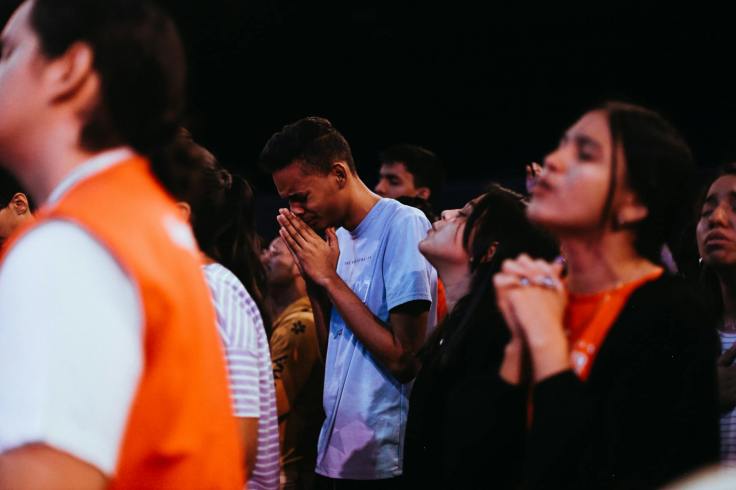
I saw you at the store today. I saw your stressed-out look And your nervous glances. I nodded and said, “Hello.” I didn’t ask about your family– Your husband’s job search, Your child’s illness… I felt so bad for you.
But did I Pray?
She came into my shop yesterday. She was slurring her words a little As she tried to focus. She didn’t meet my eyes. I was polite to her. I felt guilty because I was a bit Relieved when she left. I wondered if she would be ok.
But did I Pray?
I worked into the night making pies For the church bake sale. Peach, cherry, pecan– Perfect crusts for each one. I gave my best effort.
But did I Pray?
I got up and wrote my blog for the day. I spoke of prayer and the need to cry out, To share my heart in prayer. I quoted scripture, shared personal anecdotes And offered suggestions about how to Start and end the day–
But did I Pray?
Lord, forgive me for the times I’ve failed to come to You– In my pride, or in my need, In my confusion or awkwardness. In my sorrow, or in my joy. Help me to seek You FIRST So I don’t have to think back and ask
I love to cook. I’ve been cooking for most of my life, and sometimes, I don’t use a recipe. Often, it’s a dish I’ve made so many times, I make it from memory. Other times, I’m adapting for ingredients I have, or substituting one cooking technique for another.
But I don’t recommend creating a new dish without a recipe or guideline. Cooking is a lot like chemistry– too much of one ingredient, or leaving out another one entirely, can result in disaster! You can’t just throw together a little of this and a little of that, cook it for who knows how long, and expect good results.
The same can be said for pursuing prayer as a lifestyle. I use a “recipe” for prayer. And yes, there are times when I vary from it. But a good, healthy prayer LIFE should contain the following four ingredients:
Praise/Worship/Adoration: After all, we are not praying to an unknown being with unknown qualities. We are praying to the One True God, whose marvelous attributes are worthy of unending praise. If I am praying regularly, and NOT praising God, what is the purpose of my prayer? It can devolve into a laundry list of my complaints, worries, wishes, and whims, instead of being a conversation between a child and her Beloved and Faithful Father.
Confession/Repentance/Review: This ingredient is a stumbling block for many people. If we have been forgiven, why do we need to confess or repent? God already knows our deeds, and Jesus’ death and resurrection have already removed our sins as far as the East is from the West, right? Right. But Confession is not about beating ourselves up over wrongs we cannot undo. Rather, it is simply agreeing with God about our condition and actions. Yes, Jesus has forgiven me. But I need to acknowledge who I am before Him. I am forgiven, not by being better than someone else, or even better than I was before, but because God has extended His Grace and Mercy. And if I don’t remind myself of this fundamental truth, I may forget, and begin to believe that I no longer “need” God’s mercy in my life.
Asking/Requests/Supplication: Supplication is an old word that means asking or pleading. Once again, this can be a stumbling block in a couple of different ways. As with confession, God already knows what we are going to ask. He already knows our needs. Saying them isn’t about making God aware; it’s about giving us a chance to seek HIS mercy, HIS will, and HIS answer. And it’s about acknowledging HIS sovereignty in all aspects of our life. I can’t count the number of times I have asked God for something, and realized that I was not really asking, but rather trying to dictate to God what I wanted to have happen. If I’ve started with the first two ingredients above, I quickly realize that, while God knows what is in my heart, He also knows what is best– and often that is much larger or better than I can imagine!
Thanksgiving/Responding/Yielding: The last ingredient in a healthy prayer life is a heart bursting with Thanksgiving and willing response to God’s Love and Care in my life. Prayer is, at heart, a conversation we have with God. And part of any good relationship is affirming that bond. If I talk with my friend, and even ask a favor, or share some of my burdens, I don’t just walk away without acknowledging how much their friendship and love mean to me– regardless of whether they respond immediately to my request. And I don’t listen to their loving advice and support and walk away as though they never spoke. Prayer should include a time of saying, “YES!” to our relationship with Jesus. YES, I trust you. YES, I gladly accept Your will and all the blessings You have provided in my life. YES, I will obey you and follow you!
Of course, every prayer and every pray-er is unique. Some prayers will have more asking than confessing; others will be “heavy” on Thanksgiving (especially those coming up later this month!). But it is good to stop and consider how the “ingredients” of prayer are producing a harvest in the way we live and the way we pursue a Godly lifestyle. For more about this topic, see https://www.dailyeffectiveprayer.org/prayer-acronym/ and also https://proverbs31mentor.com/acts-prayer/.
How do I respond when someone asks me to pray for them? That may seem like a silly question. It seems obvious that if someone asks for prayer, my response would be to pray. But is that what I am really doing?
I caught myself a few years ago on Facebook saying one thing and doing another. Someone would post a prayer request. I would reply in the comment section that I would pray, that I was “sending prayers”, or that I was praying for them– but then I wouldn’t. I would forget; or I would sort of send up a quick, “God help so-and-so” and move on. It doesn’t mean that I never prayed at all about their situation. But I felt that my comments were more about being “seen” as a prayer warrior than actually being faithful in prayer.
There are many people who have said they are praying for me at certain times in my life. And maybe all of them have. But there are some people who stop whatever they’re doing and pray NOW. They don’t just pray FOR me, they pray WITH me. And they enter into my situation. They pray specifics. They pray for God’s will to be done– even if it isn’t pretty or easy. They pray for my growth and not just for my immediate relief.
I don’t always pray that way for others. I can’t always drop what I’m doing to enter into someone else’s situation. But I’ve stopped being so glib on Facebook. If I have the time to comment, I have the time to stop and say more than a quick prayer. I may not know specifics and details, but when I do, I can lift those up to God. And I can always spend time lovingly asking God to work His Perfect Will in the lives of those who are seeking prayer support. After all, God knows ALL the details, and far better than I do!
Keeping a prayer journal really helps. Especially when I keep it close at hand. I can easily jot down the name or request of the person who has asked for prayer. And having it in my journal means that I will see it again; I will revisit the request, pray about it again, or write in how it was answered (if I know).
So what?
None of this makes me a better person or a better prayer warrior than my neighbor. That’s not the point. The point is it makes me a better prayer warrior than I was before. It helps me see how interconnected we all are– we ALL need prayer, and we ALL need to seek help sometimes. It helps me to be more consistent and disciplined in my prayer life. It keeps me grateful– grateful that I can do something to help others; grateful for the gifts and blessings I have; grateful that God listens and answers prayer; grateful that God has given me so many friends and family to love. And it helps me to be more transparent about my own needs and struggles.
On that note, I am asking for prayer today, as David and I have some decisions to make as we get older. Some decisions are about finances; others relate to our health and lifestyle changes we may need to make. We want to honor God with our “golden” years, whether that involves continuing to live upstairs above our store, or moving and selling the store.
Yesterday, I voted in a primary election. In a few months, I will vote in a general election for President. I live in a nation of choices. I can choose to vote for any of the listed candidates, or I can write in a name. I can choose not to vote at all. I can choose how to spend my money– I can invest, purchase, pay my bills (or not), gamble it away, or give the money to charity. I choose what to do with my time– I can sleep all day, go to work on time or arrive late, I can spend all my time on-line, or I can binge-watch movies or TV shows. I can keep a consistent schedule, or I can take each day’s time as it comes. I can choose where to go– I can stay indoors in my apartment, I can walk all over town, or I can get in my car and drive to another city. I can choose my attitude and outlook; I can choose my political and social stands, and I can choose my beliefs. Others may apply pressure and coercion, but they can’t take away my right to choose.,. For better or for worse!
However, my choices have consequences. If I choose to act against the law of the land, it is very likely that I will be caught and punished. I may be fined, or jailed. I may face a trial. In many countries, I may be executed for doing things that would be allowed in my home country. If I choose not to pay my bills or not to go to work, I may face economic hardship as a result– late fees, loss of a job, and a difficult time finding future employment. If I choose to eat only junk food, or no food at all, I will experience health issues. The choices I made today in the voting booth, and the choices I will make in November will have consequences– most of which I cannot predict with any accuracy. I think I know what will happen– and others may predict dire consequences if I don’t vote “their” way– and my one small vote may not seem consequential, but it counts! Even my small actions have a ripple effect on the rest of my life, and the way in which I conduct it. I will either “show up” or I will “stand back.” I will either accept responsibility in the small things and large, or I will try to blame others. I will practice self-control and discipline, or I will drift through life at the whim of emotions, influences, peer pressure, and deceptions.
When it comes to prayer, I also have choices. There are times when I feel “compelled” to pray– circumstances beyond my understanding or control will cause me to want to cry out for divine help. Hearing about others’ needs make me want to ask God to work in their circumstances. Sometimes, I feel waves of gratitude and worship that cause me to sing and praise God for His character, His faithfulness, and the blessings He has poured out in my life. But I am not required to pray. I choose to pray. Sometimes, my choice to pray is simple, natural, and automatic. At other times, it is a sacrifice to pray. Prayer is more than just “an option” in my life. It really is a pursuit. I choose to keep a prayer journal. I choose to focus on prayer every day– both in practice and in testimony (as in this blog entry).
So today, I will join with others this morning in corporate prayer. I will pray alone at home. I will pray throughout the day for my community, and for individuals as they come to mind or show up in my prayer journal. And some of the prayers will come naturally; others will require me to dig deep, to confess my own failures, and admit my need for God’s Grace, His Wisdom, and His Strength.
And the consequences? Well, I can’t predict how my prayers may impact my own life or the lives of others. I don’t know how God will choose to answer my prayers. I don’t pray because God always does what I want– I trust Him to do what is BEST; and I have learned that His timing and His ways ARE the best!–but I pray because I know it is the best and first action I should take in any situation. I’m not perfect in prayer. I don’t always pray first. I don’t always listen for God’s answer when I DO pray. And I also know the consequences of NOT praying– worry, confusion, anger, restlessness, disappointment, and more. Oh, I may not experience all of these things instantly. But eventually, my choices and their consequences lead to frustration when they are not coupled with prayer, trust, and obedience.
I hope you are praying, trusting, and following God today. I hope that is your choice every day. God will not force you to come to Him. But He is ALWAYS right there when you do! Your choice to pray may not change the world instantly, but it WILL have consequences!
When I voted yesterday, I got a sticker, proclaiming to everyone that I had made the choice to vote. What might happen if Christians (myself included) were bold enough to proclaim our choice to pray every day and in all circumstances!?
We don’t like to talk about (or write about!) prayers of confession and repentance. And yet, the Bible is full of such prayers. In fact, even the Lord’s Prayer contains the phrase “forgive us..” Even if we pray eloquent prayers of praise and petition, our prayers will be lacking without first evaluating our relationship with Christ and seeking His forgiveness and continued cleansing.
I know there are those who will challenge this statement– after all, once we have “accepted Christ,” aren’t we considered to have His righteousness? Haven’t we BEEN forgiven? If we must keep asking for forgiveness, does that mean that Christ’s death and resurrection are not sufficient to “save” us?
I do not mean to suggest anything of the sort. We ARE forgiven– past, present, and future– our names entered in the Lamb’s Book of Life. God isn’t holding on to a grudge over every future fib, flub, or fall. And nor should we. Confession in the prayer of a Christian shouldn’t be wallowing in guilt and shame, or confessing the same sins over and over, doubting that Christ’s finished work isn’t actually finished. But just as in all close friendships, we sometimes ask, “Are we ok?”, to clear the air and maintain closeness, it is appropriate to “fess up” with God– to clear the air– precisely so that shame and guilt DO NOT build up or slowly seep into our relationship.
God will not withhold His promised salvation from us if we are trusting in Him. We are justified, and our advocate, Jesus Christ, mediates for us constantly, just as the Holy Spirit indwells us to be able to overcome temptation and do what we cannot do on our own. But WE are still living in our fallen world and fallen bodies. We will find it difficult to trust; we will find it tempting to judge others; we will doubt our own decisions– did we really do “right”? And while God is eternally faithful– we are not; nor have we reached perfection in all our daily actions and thoughts. We are “okay” with God– but confession reminds us of that!
In the story of the prodigal son (Luke 15:11-32), the son rehearses a speech of confession. And even as he begins saying his rehearsed words, His father interrupts with complete reassurance of his love. How much more does God delight in reassuring us of His eternal, unfailing love!?
Two thoughts I’d like to add here:
One– It can be very easy for us to fall into confession as a works-based ritual. Confession adds nothing to Christ’s finished work on the Cross. We are saved by God’s Grace– period. Ten thousand prayers of confession will not make us “more” saved.
Two– It can be just as easy to avoid self-evaluation and discipline as we grow “comfortable” with our Christian Walk. Confession is not about “right” and “wrong” as much as it is about humility. The Apostle Paul says, “And I am sure that God who began the good work within you will keep right on helping you grow in his grace until his task within you is finally finished on that day when Jesus Christ returns.” (Philippians 1:6 The Living Bible)
We don’t need to be hampered by guilt, fear, or shame– but we should want to keep our relationship with God pure above all other relationships. And that means being willing to submit to God’s will and God’s discipline on a daily basis. Confession is not an admission of God’s failure to save us; nor of our commitment to follow Him. Rather, it is an admission of how important that relationship is, and how much we need to keep our commitment fresh, pure, and vibrant. God HAS forgiven us; He will continue to forgive– freely, and fully!– as we follow Him.
My husband and I recently sat in the comfort of our apartment, and watched the movie trilogy of The Lord of the Rings. I’ve read the books several times, and enjoyed the movie several times, as well. The story is a classic tale of good v. evil, where it looks almost impossible for good to triumph. But, through the courageous acts of a few unlikely heroes (with the help of many others), evil is destroyed at last, and peace–eventually– returns to Middle Earth. It is one of my favorite stories, but it is not always “comfortable.”
The books and movies can be almost torture to watch, sometimes. There are battles, and betrayals, tragedies, and frustrations galore. From the midges that attack the party near the beginning of their journey, to the Ring Wraiths who relentlessly haunt Frodo as he carries the ring of power to its final end; from the unnatural armies of the Uruk-Hai, created by the betrayer Saruman, to the betrayal of Boromir from within their own fellowship; from the fall of Gandalf in the mines of Moria to the madness of Denethor in Gondor–there are plenty of times that the reader/viewer is tempted to turn away from such agony and despair. How could there be a “happy” ending? How could Frodo and Sam possibly survive long enough to finish the task, let alone return from it?
And yet, Sam himself provides an answer:
Yes, that’s so,’ said Sam. ‘And we shouldn’t be here at all, if we’d known more about it before we started. But I suppose it’s often that way. The brave things in the oldtales and songs, Mr. Frodo: adventures, as I used to call them. I used to think that they were things the wonderful folk of the stories went out and looked for, because they wanted them, because they were exciting and life was a bit dull, a kind of a sport, as you might say. But that’s not the way of it with the tales that really mattered, or the ones that stay in the mind. Folk seem to have been just landed in them, usually – their paths were laid that way, as you put it. But I expect they had lots of chances, like us, of turning back, only they didn’t. And if they had, we shouldn’t know, because they’d have been forgotten. We hear about those as just went on – and not all to a good end, mind you; at least not to what folk inside a story and not outside it call a good end. You know, coming home, and finding things all right, though not quite the same – like old Mr Bilbo. But those aren’t always the best tales to hear, though they may be the best tales to get landed in! I wonder what sort of a tale we’ve fallen into?’ ‘I wonder,’ said Frodo. ‘But I don’t know. And that’s the way of a real tale. Take any one that you’re fond of. You may know, or guess, what kind of a tale it is, happy-ending or sad-ending, but the people in it don’t know. And you don’t want them to.’ https://thetolkien.forum/wiki/Sams-Speech
Movie version:
Often, when I am facing “an adventure,” I am praying for God to take away the circumstances; to change the world around me, so I can be comfortable. I love to read stories, but I don’t want to live through what it might take to make a great one! And yet, God calls us to “be strong and courageous” (Joshua 1:9). Jesus calls us to be courageous as well, “In the world you have tribulation, but take courage; I have overcome the world” (John 16:33b). And Paul reminds his protege, Timothy, that “God has not given us a spirit of timidity, but of power and love and discipline.” (2 Timothy 1:7)
In the movie version of Lord of the Rings, the four courageous hobbits return to the Shire after all the fighting to find things almost exactly as they had left them– hobbits comfortably going about their business, oblivious to the grand and terrible adventures of their neighbors and the rest of the world. Hobbits, we are told early on, do not concern themselves with the “adventures” of the wider world. They like comfort. And the Shire, in some ways, represents a haven from the evils of the world of men and orcs and other creatures. In the books, however, evil spills over into the Shire, and the hobbits must face battles even when they expect to return to comfort.
Comfort is a wonderful feeling– ease and peace, no reason to worry or fret. Everything is familiar and good, expected, and desired. But comfort doesn’t build character. Courage does. Frodo and Sam, Merry and Pippin, all return to the Shire changed by their adventures. They are no longer “comfortable” living in ignorance of the wider world, no longer afraid of what might happen if they step beyond the borders of the Shire.
The same is true for us as Christ followers. Jesus commands us to Go into all the world. He does not promise comfort, in fact, He promises that we WILL have trouble. But He also promises that we will not face danger alone; and that we will see victory– His final victory. We DO know the end of the story! We do not know what tomorrow may bring, but we DO know that it won’t end in futility. Even our disasters will be redeemed! Even if tomorrow brings tragedy, grief, pain, or torture, we know it is not the way our story ends. But we must face tomorrow with courage. We must continue on THROUGH the story, even when it looks like we can’t go on. Courage, not comfort, will lead us to the victory.
Today, I pray that God will forgive me for the times I have asked for comfort and not for courage. For the times I have stayed in the Shire, instead of going forth to face the battles beyond. For the times I have been too afraid, or just too lazy, to obey His call to GO and be a light in this dark world.
It is Morel season in my home state of Michigan. Morels are mushrooms that only grow in mid-Spring. They are usually found in or near wooded areas, and they are delicious! Thousands of eager hunters search woods, roadsides, forests, orchards, and glades looking for the elusive spores each year. While morels can be “grown,” they are not easy to cultivate. Finding them is like a treasure hunt in all the freshness of spring’s new growth!
Morel mushroom
But there are several look-alike mushrooms– some of which are dangerous and even poisonous– growing now, too. It takes a good eye and some knowledge to tell the difference. False morels may have a similar shape, but they usually are slightly different in color and texture. Some false morels will appear brown, reddish, or even slightly purple, while true morels range from yellow, yellow-gray, or gray-black. False morels may be “puffier” or “spongier” than true morels. And while true morel “caps” attach to their stems, false ones may be detached or flared. It is important to know the difference and to be cautious when collecting the elusive morel.
false morel–gyromitra esculenta
The same is true of morals–there are plenty of people masquerading as men and women of integrity. They are polite, clean, charming; many are even respected members of the community. They may volunteer, give to charities, attend a local church, run for public office, hold a job requiring responsibility and trust. They look and act like honest, kind people. But they may be dangerous– even poisonous. They may even rise to positions in the church, destroying faith and trust among members of their flock, or spreading distrust and confusion among neighbors and even families.
So how do we “spot” the difference? Just as importantly, how do know which type we are!?
There are a few principles in the Bible that we can use to identify “false prophets” and those with “look-alike morals.”
First, we need to study what a true “Christ-follower” should look like. It is vital that we take the time to study for ourselves what the Bible says. Asking “what would Jesus do?” does us no good if we don’t know what He actually did and said! Putting all our trust in a role model or a dynamic leader is like choosing a mushroom because it “looks tasty–it could be a morel…”
Second, we need to look for people who try to “color” or “shade” the truth to look “tastier.” All the way back in the Garden of Eden, Satan used this trick with Eve– twisting God’s words, adding supposedly “hidden” knowledge, and dismissing the severity of God’s warning:
The woman said to the serpent, “We may eat fruit from the trees in the garden, but God did say, ‘You must not eat fruit from the tree that is in the middle of the garden, and you must not touch it, or you will die.’”“You will not certainly die,” the serpent said to the woman. “For God knows that when you eat from it your eyes will be opened, and you will be like God, knowing good and evil.”
Genesis 3:2-5 (NIV)
Closely related to this, we need to look for people who use words to spread division or discontent–including constant critics and complainers. It is tempting to get caught up in arguments about certain traditions, worship styles, external standards, new practices, personal revelation, etc.. But we must avoid such poison, and avoid spreading it! One poisonous mushroom can poison the whole “batch!”
Beware of those who arrogantly claim to have “new knowledge” or “new interpretations”– God does NOT change; nor does His Word. New insights and deeper or personal understanding should stand up under testing. Someone who is not willing to be questioned or asked to explain themselves may have a bad reason for their unwillingness. Just because something is traditional, or “old” doesn’t mean it must change.
Also beware those who are dismissive toward others in the church, whether they are critical of the teaching, the music, certain ministry programs, or individuals who serve. We are commanded to build one another up, not pass judgment based on personal prefrerences.
Look (and listen) closely to make sure we are still “attached” to our stem– the Living Word of God. Many Christians will quote “moral” sayings that are found nowhere in the Bible:
“God helps those who help themselves.”
“The devil made me do it.”
“There are many paths to God.”
“All you need is love.”
“God just wants us to be happy.”
“God will never give you more than you can handle..”
Finally, we need to look at the person’s “fruit.” Someone can have an impressive outward show of morals, yet miss out on “bearing fruit.” Such people may display all the trappings of earthly success, yet they seen to have no peace, or their lives seem joyless or filled with discontent or intemperence. In my own life, am I demonstrating Love, Joy, Peace, Patience, Kindness, Goodness, Faithfulness, Gentleness, and Self-Control? (see Galatians 5:22-23) Am I humble? Or am I impatient, unkind, judgmental, fickle, reckless, complaining, bitter, envious, angry, dissatisfied, greedy, worried, and prone to mock others– especially those in the church?
Beware of false prophets, who come to you in sheep’s clothing but inwardly are ravenous wolves. You will recognize them by their fruits. Are grapes gathered from thorn bushes, or figs from thistles? So, every healthy tree bears good fruit, but the diseased tree bears bad fruit. A healthy tree cannot bear bad fruit, nor can a diseased tree bear good fruit. Every tree that does not bear good fruit is cut down and thrown into the fire. Thus you will recognize them by their fruits.
Matthew 7:15-20 (ESV)
When we find true followers of Christ, we should be able to recognize the treasure of a life redeemed and transformed. While none of us is perfect while we remain in our present bodies, we should be producing a harvest of good fruit that sets us apart from “look-alikes” who are merely outwardly moral.
My church is offering several fitness challenges this month. I’m working on two of them, walking, and “water.” Walking seems self-explanatory–the challenge is to walk more, with more focus, etc.. We get daily updates with great tips on walking safely, facts on the benefits of walking (as opposed to running or strength-training), and additional challenges for focus, finding a walking partner, and more. My job is largely sedentary, so even though I try to walk around somewhat at work, I enjoy the challenge of finding ways to get more steps/more time spent walking each day.
The “water” challenge seems a bit harder to explain. In fact, when I signed up, I got a message saying something like, “Congratulations! You signed up for the one fitness challenge that doesn’t involve fitness!” But I am finding the water challenge to be both physically and spiritually enriching. The challenge is to drink “enough” water. Seems easy, right? But it turns out that I haven’t been drinking enough water each day. And the effects are subtle, but dangerous– everything from dry skin to constipation; damage to the kidney and liver (who knew?), sluggishness and fatigue, weight gain, “brain fog,” irritability, muscle cramps, and more, https://steptohealth.com/consequences-drinking-little-water/#google_vignette Of course, all of these symptoms can be caused by other factors, but drinking more water can help alleviate many of them without medications or more extreme treatments. It IS possible to drink too MUCH water during the day, but most of us have the opposite problem. Why are we depriving ourselves of something so crucial to our health?
In my case, one of the leading reasons I wasn’t drinking enough water is that I simply wasn’t thirsty. I work indoors in a temperature-controlled environment. I don’t do heavy manual labor. I don’t work up a sweat. And it simply didn’t occur to me to drink at regular intervals. I would drink water or sugary drinks with meals, or when I “felt” thirsty, and when I developed diabetes, I cut out the sugary drinks– without replacing them with the same amount of water!
I have been challenged this month to drink eight ounces of water each hour for eight hours of my day– a total of 64 ounces, or a half-gallon! I make sure at least some of the water contains electrolytes, which help keep me from deficiencies in key minerals like potassium and magnesium (see more info here: https://microsoftstart.msn.com/en-us/health/ask-professionals/in-expert-answers-on-Electrolytes/in-Electrolytes?questionid=9toqf9mo&type=condition&source=bing_expertqna_ac ) It may sound easy, but I have to remind myself to drink, even if I don’t feel thirsty; even if I’m “busy” with something else. At first, there were “uncomfortable” side effects– I had to use the restroom more often, for starters. And I didn’t feel the positive side effects right away. But over two weeks in, I’m seeing some real benefits. I still use the bathroom more frequently during the day, but less frequently at night! I wasn’t expecting that! And I’m developing a rhythm in my water intake that keeps me from feeling “empty” in the mid-afternoons, when I am tempted to snack, which has helped me lose a little weight–by drinking more! Combined with the walking challenge, I am finding myself with more energy and a brighter outlook, especially in the mornings.
So what does all this have to do with Pursuing Prayer?
Well, the Bible talks a lot about water– a LOT– and about thirst. Not just a thirst for water, but a spiritual “thirst.”
Blessed are those who hunger and thirst for righteousness, for they will be filled. (Matthew 5:6)
Behold, the days are coming, declares the Lord GOD, when I will send a famine on the land— not a famine of bread or a thirst for water, but a famine of hearing the words of the LORD. (Amos 8:11)
Just as we can fall into the bad habit of ignoring our body’s need for water, we can ignore our soul’s need for communion with God. We can neglect reading Scripture, or spending time in prayer and meditation, and it can lead to serious side effects.
I don’t always “feel” like praying. I don’t always have a natural “thirst” for reading the Bible (I fell asleep this morning reading in 1 Chronicles…) But when I DON’T take time to read or pray, I have even less “thirst” for it– even though my need is still as great or greater!
We can’t spend all our lives on our knees and ignoring our daily tasks. We can’t always carve out hours or days to spend in meditation and Bible study. There are seasons of life where we will remain “thirsty” for a while. But let’s be vigilant to create habits that help us stay both physically and spiritually healthy.
One of the ways we were challenged in the first week of the month was simply add one glass of water to our routine each day. Even if we weren’t drinking a lot of water, just one glass more would help. Let me offer a similar challenge to pray “one more prayer” each day. If you normally pray in the morning or evening, add a “prayer break” to your afternoon. Treat it just like a coffee break (or water break?!) Add a prayer of thanks as you pull in the drive after the work day or after a trip to the grocery store. Write out a prayer request and tape it to the bathroom mirror to remind you to lift up one extra prayer today.
Let’s get thirsty! After all, Jesus Himself is the “Living Water.” He will satisfy!
3 His divine power has given us everything we need for a godly life through our knowledge of him who called us by his own glory and goodness.4 Through these he has given us his very great and precious promises, so that through them you may participate in the divine nature, having escaped the corruption in the world caused by evil desires. 5 For this very reason, make every effort to add to your faith goodness; and to goodness, knowledge;6 and to knowledge, self-control; and to self-control, perseverance; and to perseverance, godliness;7 and to godliness, mutual affection; and to mutual affection, love.8 For if you possess these qualities in increasing measure, they will keep you from being ineffective and unproductive in your knowledge of our Lord Jesus Christ.
If you ask most people what they need, you will not hear the items listed in this passage of scripture. Most people view needs in very personal and concrete terms– food, water, shelter, safety, air…we need these to exist during our life on earth. God cares about our physical and most basic needs. But most people have other “needs” that they try to meet with what the Apostle Peter refers to here as “evil desires”. We “need” to feel loved– but we end up in unhealthy relationships, or fleeting relationships that don’t meet our need. We “need” to feel secure and worthwhile– but we end up feeling fearful and ashamed. We “need” to achieve; to find fulfillment and worth in our actions, words, relationships, and legacy–but, too often, our efforts lead us to compromise the very dreams and ambitions we started with, leading us to mediocrity or even disaster.
Jesus, through His divine power, has given us everything we need–everything! His death and resurrection provided the way for us to find true forgiveness and new life. We won’t find it in any of the things we think we “need”– a new job, or a new relationship; a new car or a new cause.
Over the years, I have returned to this passage many times. There is a lot to unpack in just a few verses. One of the things that always “gets” me about this passage is that I want to just leap from Faith to Love without the steps in-between. The world needs love– I need love– and I want to spread love, reflect love, and be known for loving others. God is Love, and showed His love through Christ– I believe in God and trust Christ. Voila!– He has given me everything I need, so I should be loving. But Peter writes what he knows very well. Following Jesus, learning from Him, growing to be more like Him–it begins with Faith, but it grows through discipleship. I “loved” people before I had Faith in Christ. I may “feel” love for others, but if my thoughts and actions are not being transformed by His Spirit; or if I continue to act out of habit or selfish impulse, my “love” will be corrupted and compromised by the world. It will be “my” love and not God’s love working through me. For that to happen, I need to add goodness, knowledge, self-control, perseverance and all the rest.
And adding these virtues requires that I humble myself to admit that I am not “good”, that I don’t already “know” everything…that I “need” to depend on God for any goodness, wisdom, discipline, strength to persevere, etc.
God is Good– He has already made provision for me to have everything I really need. He will guide me every step of the way; giving me all that I need when and how I need it most. I don’t “need” to worry or run myself ragged trying to earn God’s approval or favor. But I do “need” to trust that God will continue to work in me and through me for His Glory. And I need to come daily before His throne to listen and learn from Him, and reach out daily to go through the steps of turning Faith into Love in action.
As I write this, I’m having an “off” day. I don’t feel well. I don’t particularly feel like worshipping or saying joyful prayers. I don’t even feel particularly like saying a prayer. But I will pray– even if it’s just a mumble or a groan.
God meets us where we are. He is not just the God of the joyful and productive; the “shiny, happy people,” or the ones who feel like overcomers. God is the God of the hurting; the God of the lonely; the God of those who are sad, tired, and feeling “off.” Of course, God doesn’t want me to go through life this way. I will have better days– days of accomplishments and celebration. But God does not leave me alone when I am grumpy, upset, or “blue.” He is right beside me, surrounding me with His presence. So I can mumble today, even if I sang yesterday or cry out in anguish tomorrow.
Prayer is a pursuit for every day– not just when we “feel like it” or when we are desperate for answers. It is a discipline. If I choose not to pray today, I may more easily choose not to pray tomorrow, or the next day. And God will still be waiting there, patiently, whether I mumble or give Him the “silent treatment.” Because prayer is more than just a pursuit and a discipline. It is part of a relationship. God already knows me intimately, but He wants ME to know HIM as well. And He wants me to know and experience His Love– even when I don’t feel it; even when I know I’m not very loveable. And that knowledge–that enduring relationship–will carry me through days like today. I can mumble, or whisper all the lies and sadness I feel on a particular day, but God’s presence will break through and wrap me in the cloak of Truth–the everlasting Truth of His Love and Faithfulness. Feelings will pass, but Faithfulness endures. And I pray to the God who is Eternally Faithful–even when I am temporarily feeling faithless and far away.
God is an expert at turning mumbles into melodies!