Cautious or Courageous?

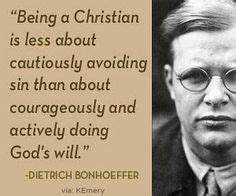
Being a Christian is less about cautiously avoiding sin than about courageously and actively doing God’s will.

Dietrich Bonhoeffer

Dietrich Bonhoeffer was a German pastor and writer who ended up sacrificing his life as he protested the Nazi regime in his homeland. Many of the things he wrote are uncomfortable for modern Christians to read. Sometimes, we want to coast along, joyfully celebrating our own Salvation, and ignoring the evil around us. After all, the ultimate victory is already won in Christ, isn’t it?

I write a lot about the power of prayer. And I stand behind what I write. But a life of prayer and Bible Study that doesn’t result in actively living out and spreading the Gospel is a life of lukewarm and selective obedience. This is not to say that we should skitter around trying to earn our Salvation with random acts and self-righteous crusades. But we must have the courage to “come out of the closet” as Christians in a dark and unfriendly world.

Photo by Pavel Danilyuk on Pexels.com

What does this look like? Does it mean wearing a badge or getting in people’s faces with “the Truth.” Perhaps. But mostly, it means every day living out the kind of love and truth that Jesus demonstrated. Jesus didn’t march in protests, hand out pamphlets with convicting messages, or start arguments to humiliate atheists in front of crowds. But He didn’t back down in the face of arguments and tough questions asked by His opponents. He ate with sinners– but He didn’t wink at their sin, or send them away reassured that they were “good enough” to please God. He went where God sent, spoke God’s Truth, and DID God’s work.

Jesus wasn’t a writer; He wasn’t a professor of Theology, or an elected official. The Pharisees were constantly frustrated with His lack of “credentials.” But their frustration came because Jesus spoke with the kind of authority they could never achieve– Jesus was authentic. He spoke, not from cold and lofty intelligence, but from wisdom and love. And Jesus didn’t just speak. He served. He listened. He lived out all that He spoke. He “courageously and actively” DID the will of the Father.

Jesus prayed and studied scripture. Jesus spent time alone communing with the Father. He spent time in rest. He spent time being social with His family and friends. But in every activity, He wove in the Truth of God’s word. And crowds followed Him. They wanted to listen, even as He spoke uncomfortable truths. And some of them came to love Him. Others came to hate Him, and even kill him.

We can’t be true followers of Christ and not risk being mocked, and hated. We WILL be misunderstood, laughed at, persecuted, ignored, and inconvenienced. We should not invite this with obnoxious or arrogant behavior. But we must not shrink away from it when it comes at us, or try to avoid it by being silent in the face of evil and injustice.

One of the recent charges leveled against Christians is that we meet evil with “thoughts and prayers” but little action. We must be wise and careful with such charges. Often, the taunt is thrown at us in an effort to get us to take a specific, ungodly “action” INSTEAD of praying. But we must honestly examine ourselves and ask what Godly actions SHOULD I be taking to make a difference? What actions should I be denouncing as ungodly, even if they are popular and seem to be “right?” And what must I do to defend the power of prayer in the face of ridicule?

Photo by Mikhail Nilov on Pexels.com

One of the other charges leveled against Christians is that we are “intolerant.” Again, we need to be wise and careful in answering this charge. Are we quick to judge others, while giving ourselves a “pat on the back” for merely avoiding a particular sin or sinful lifestyle? What is if about our life and work that makes others see us as “intolerant?” Are we exclusive and prejudiced in our interactions? Or are we humble in presenting the truth of God’s word? Do we speak from a need to defend our own actions or from a desire to help others? Are others offended by our words and actions, or by the truth of God as it convicts them?

Photo by Ketut Subiyanto on Pexels.com

I pray today that I would be courageous and active in LIVING the Christian life, and not merely writing about it.

Unwelcome or Uncomfortable?

I really enjoy going to church. I love our church family. I love the sanctuary. I love singing and worship. I love the teaching from the Bible each week. I always feel welcome and comfortable and inspired. Well…almost always.

Have you ever visited a new or unfamiliar group? It need not be a church– any group that is already established, where you are visiting for the first time? It can be a very uncomfortable experience, even if the other members make an effort to be welcoming. There may be group dynamics with which you are unfamiliar; maybe there are rituals or responses that are new to you, as well. Where should you sit? Are you taking “someone else’s” spot? Are you expected to participate? At what level? Should you introduce yourself, or will you be asked to do so at some point? Will others introduce themselves?

Photo by cottonbro on Pexels.com

I was thinking about all this in relation to church because of Easter service last week. As we entered, several people greeted us with “He is Risen!”, to which we responded, “He is Risen, Indeed!” But not everyone responded– some were confused. As the service started, a husband and wife introduced this phrase as a tradition, explaining the call and the expected response. They welcomed any newcomers, then they invited us to say it as a congregation. This helped make it a more comfortable experience for any visitors.

Photo by Luis Quintero on Pexels.com

I have visited many churches over the years, and some congregations work hard to make everyone feel welcome, and even comfortable. But there is a difference between welcome and comfort. I have visited some churches where I feel welcome, but not very comfortable. The people are nice, the music is upbeat, but there is a restlessness– sometimes inside my own conscience–that makes me squirm. This can be a good thing– a movement of the Holy Spirit. But it can also be a warning that something is “off” in the worship– the focus is not on God, or the message is not true to Scripture, or there is a tension between members of the group that needs to be resolved.

I have also visited churches where I felt comfortable enough, but I did not feel welcome. I knew all the right phrases to say or the words to all the songs and hymns; the seating was soft, and the room was neither too hot nor too chilly. But I felt closed out by the other worshippers. They did not notice that I was there, and they (probably) never noticed that I did not return. No one introduced themselves or made an effort to reach out, nor did they respond when I tried to reach out to them.

How does any of this relate to prayer? Prayer can sometimes be uncomfortable– confession, supplication, confusion, and even doubt. God is not in the business of making us comfortable at the expense of our own good. Sometimes we need to be made uncomfortable in order to take needed steps to change or move ahead. Sometimes, we need to recognize our discomfort as a warning to look around and reevaluate. And sometimes, we need to be patient in our discomfort, as it is only temporary, and stretches our Faith.

But we should never feel unwelcome in the presence of God. God longs to meet with us, even in our discomfort– even at our worst! Jesus modeled this attitude throughout His ministry. He made many people uncomfortable (particularly the Pharisees!), but all were welcome to come, to listen, and to speak to Him. He took time to talk to people that were often seen as outcasts, but He was just as likely to talk to people who thought of themselves as very important. Jesus SAW people. He acknowledged them, and He valued them. As followers of Jesus, we can feel welcome, AND comforted when we come into His presence.

Photo by Kampus Production on Pexels.com

But even more, we should follow the example of Christ when reaching out to others. We are Christ’s ambassadors, and if we make people feel unwelcome and unwanted, they may never understand how wide and deep and immense God’s love for them really is. At the same time, we need to be reminded that others may still feel uncomfortable for their own reasons. We should make every effort to be welcoming, but we should allow for the Holy Spirit’s work as well. We should not push people away, but we should be prepared that some will choose to walk away from uncomfortable truth.

Blog at WordPress.com.

Up ↑