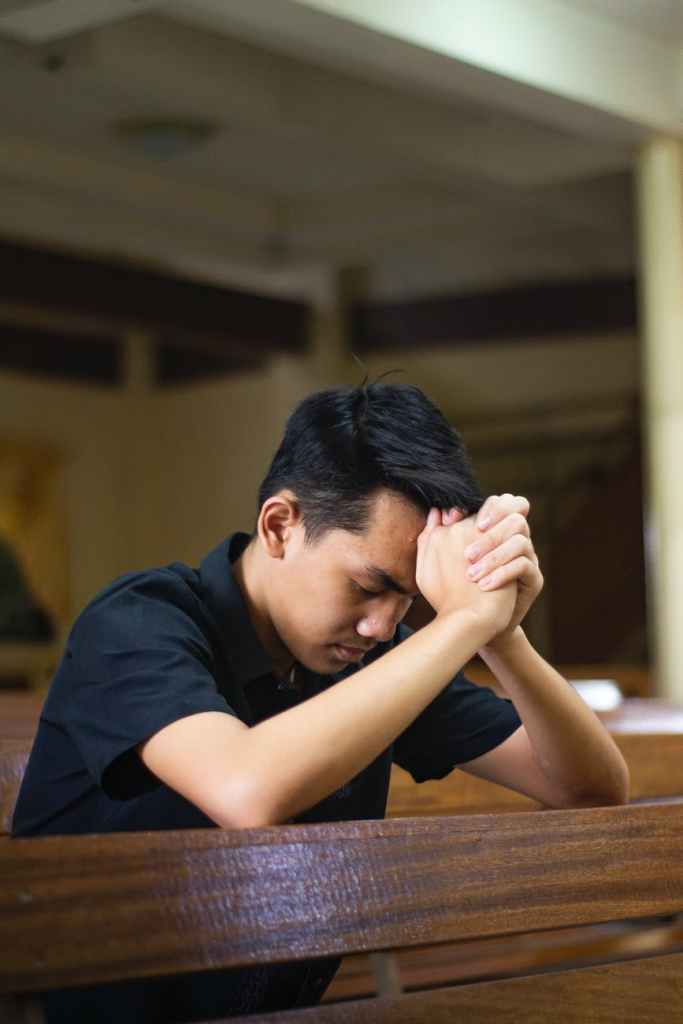
I really need to go on that diet. I really should call my Aunt Kay. I need an hour of peace and quiet. And time to sit and pray.
But I’m scrolling through Facebook. I’m following the news. I just need another look; This meme has so many views..
I should greet that new couple at church. I should make them feel at home. But I need a cup of coffee first. And my hair should be re-combed.
My Bible waits by my chair– Unread these past four days. Later, I know it will still be there– Ready to catch my gaze
Tomorrow, or the next day. God will understand. I want to follow His Way, But this wasn’t what I planned.
I got caught up in a magazine I stopped to shoot the breeze– My house is needing to be cleaned Before I get on my knees.
I “had to,” “should have,” “had a mind” To spend time with God, and yet My day’s flown past, and now I find I’ve only time to fret.
“Not yet” was my sad refrain “Not yet” kept me on the go. “Not yet” robbed me once again Of time spent with One who loves me so.
And so my day was filled and rife With wasted time and small regrets. I missed the more abundant life Of trust grown from obedience.
The internet will still be there Tomorrow and the next day; But the trust built up in an hour of prayer Can never be taken away.
Today may be busy with “urgent” needs and countless distractions. But there will only be one “today” to meet with God– in prayer, Bible study, meditation, and worship. What is my priority today? Even if I can’t “find” an entire hour in my busy schedule, have I made a plan and a priority to meet with God? Am I searching for opportunities to serve Him and encourage others, or am I too busy searching for my own entertainment and fulfillment? What are the empty things in my life that I should be telling, “Not yet?”
As I look out my window today, the sun is shining on hundreds of bare branches. The sky is blue-gray, and the branches are brown and mostly lifeless. Occasionally, a breeze will stir the thin upper branches, or the very last of the dead-looking leaves. When the snows come, the branches and twigs will glisten and stand out against the white-covered ground and slate-gray skies above.
But elsewhere in town, and in the forests and woods just outside of town, there are evergreens! Their green needles and sturdy, squat shapes may go unnoticed in spring and fall, when the other trees show off their glorious changing colors and elegant branches. Soon it will be their time to stand out. Their low branches help break the snow drifts, and increase visibility. Their greenery reminds us that life endures and continues.
I hesitated to write about Christmas Trees. There are no Christmas Trees in the Bible story of the Nativity. Decorated trees have a connection with pagan rituals from long ago. It wasn’t until the first half of the 19th century that Christmas Trees really became a tradition throughout most of Europe and spread to America. What connection do they really have with pursuing a Christian Walk? Only the ones we choose to apply…
Evergreen trees are a symbol of eternal faithfulness. They stay green year-round. They do not lose “leaves” like other trees (though they drop needles and cones). This can be a reminder to us of God’s faithfulness and His unchanging nature.
Evergreen trees are generally the “newest” trees. After a fire, for instance, pine and fir trees will be the first trees to spring up. Hardwoods take longer to recover and regenerate after a disaster. Just as the birth of Jesus represented the coming of new life and hope, an evergreen tree can symbolize new, fresh growth.
While there is no “Christmas” Tree in the birth of Christ, there is a tree in His death on a wooden cross. Hidden in the greenery and lushness of a Christmas Tree is the solid trunk that symbolizes the Cross that Jesus bore, and the Cross that bore Him. Even the needles on the tree call to mind the crown of thorns– sharp, painful, prickly. Jesus came to serve; He came to bear the shame and humiliation, the pain and suffering that WE deserve.
Christmas Trees “point” upwards. Unlike many other trees, they get narrower as you look up, and are broad near the bottom. This is a reminder that here on earth, we are to spread out–spread the Gospel, spread the Love of Christ to as many as we can. And our focus should be drawn up to God in Heaven. That is why we traditionally “crown” our trees with stars or angels– to remind us that Heaven should be our “top” focus.

This year, if you are putting up a Christmas Tree, I pray that your focus would not be on the tree itself. It may be real or artificial; green or white or some other metallic color. It may be decorated with glass bulbs, funky home-made crafts, expensive, individualized ornaments, chains of cranberries or popcorn, bright ribbons or twinkle-lights, paper chains, or even photos of loved ones. But all that can be distracting from the true meaning of a Christmas Tree and WHO it represents. And I pray that your focus would not be on the gifts placed in or around the tree, but that those gifts would truly remind us of the greatest Gift of all– Jesus! I pray that the tree would be another wonderful reminder of the one who created trees, knowing He would one day die on one! I pray that you would be encouraged to share new and enduring life and growth to others. I pray that you would be encouraged that God’s plans are eternal, and His Promises faithful and sure.
I love to cook. I love looking at new recipes, and finding new ways to use fresh ingredient, use up that last bit of leftovers, or stretch staple foods like beans, flour, or rice. And I love to pray. I love being able to lift up praises, requests, and even questions. I love knowing that I can confess even my most shameful thoughts or deeds to a God who already knows, loves me more than I can imagine, and stands eager to forgive me and strengthen me to make wiser choices.
Cooking can be exciting, challenging, and creative. But it doesn’t have to be. I don’t have to cook at all in our culture. I can (at some expense) dine out every day, and let someone else do all the work. Or, I can buy pre-made meals, “processed” foods and “instant” mixes– “just add water,” “cooks in 6 minutes,” “ready to eat.” I can pray “processed” prayers, too. I can recite prayers of others, mumble graces by rote, and even read off a list of requests with little or no effort or emotion.
But processed prayer isn’t healthy– no more than processed food. Oh, it won’t seem much different– at first. And it isn’t “bad”–every once in a while. But a steady diet of praying someone else’s words and thoughts doesn’t build a personal relationship. We miss out on the “process” of praying, and the end result is not as fresh and healthful.
When I cook from scratch, I have to follow a process:
I need to make sure I have the proper ingredients.
Some ingredients need to be seeded, skinned, peeled, chopped, or otherwise readied before they can be used.
Ingredients need to be added in the proper order.
Measurements are important. 1 teaspoon of salt is not the same as 1/2 cup of salt!
I need to use the proper methods– simmer, boil, chill, bake, etc.
Timing is crucial, too. Cookies may take 10 minutes to bake– a roast may take 3 hours.
I want to include all the “ingredients” of a deep prayer– Adoration and Praise; Acknowledging God’s Sovereignty and Power; Confession and Repentance; Thankfulness; Presenting my requests; Lifting up the needs of others; and Committing to Listen and Obey God.
Timing is important–I need to make time to visit with God in Prayer. It shouldn’t be an afterthought or another activity to squeeze in IF I have a chance!
That doesn’t mean that we can’t (or shouldn’t) pray “in the moment” or recite The Lord’s Prayer, or the Prayer of St. Francis, or another written prayer. It doesn’t mean that we should make all our prayers from a “recipe” or a formula. But if our prayer “diet” is becoming dependent on “processed” prayers, we may need to go back to the kitchen!
I love visiting old churches and cathedrals, with their vaulted ceilings and solid stone walls infused with centuries of incense and the echoed prayers. And I love being outdoors surrounded by the glorious beauty of creation. These spaces seem infused with a special sense of the sacred. It is easy to feel close to God is such spaces.
But God is omnipresent. A crowded bus is no farther from God’s presence than a majestic mesa. The hush of a hospital ward is just as close to His heart as the swelling choir in a cathedral. In fact, when Jesus lived among us on earth, He spent much of His time walking dusty roads, talking and working miracles among the noisy “rabble” of ordinary people. He did not seek out “sacred spaces;” instead, He took the “sacred” into the dark and dirty streets where it was often ignored or dismissed.
Sometimes, Jesus would go off by Himself into the wilderness or into the hills to pray, as well. It is important to make a time or space to do this. But there is nothing especially sacred about particular spaces– even ones designed to be places of worship. It may not be easy to find a physical space for prayer and worship, but we can make a mental “space”– close off distractions, move or turn away from others for a few precious minutes–focus on God’s presence. Remember, His presence is always with us; we just need to acknowledge it!
Prayer connects us to God– wherever and whenever we pray. That doesn’t mean that we should not seek out special times and places to be alone with God. But we needn’t wait for a certain moment or location or position in which to meet with God. He is eternally, immediately available to listen. Are we?
12 Therefore, since we are surrounded by so great a cloud of witnesses [who by faith have testified to the truth of God’s absolute faithfulness], stripping off every unnecessary weight and the sin which so easily and cleverly entangles us, let us run with endurance and active persistence the race that is set before us, 2 [looking away from all that will distract us and] focusing our eyes on Jesus, who is the Author and Perfecter of faith [the first incentive for our belief and the One who brings our faith to maturity], who for the joy [of accomplishing the goal] set before Him endured the cross, disregarding the shame, and sat down at the right hand of the throne of God [revealing His deity, His authority, and the completion of His work].
Hebrews 12:1-2 (The Amplified Bible, via biblegateway.com)
My first job out of college was in an advertising/public relations firm. I was not a copywriter or an executive. I was a proofreader. It was not my job to write ad copy, or even edit it. But it was my job to see that the end product was perfect– no spelling or typographical errors, no missing punctuation or wrong spacing, no missing or “covered” text near the graphics.
Most publishers don’t use proofreaders anymore. In this age of spellcheck and computer grammar programs, they no longer feel the need to hire a person to do such a mundane job. And it wasn’t a thrilling job. It was boring and repetitive to look over the same copy several times to make corrections or to sign off on corrected copy. Sometimes, I would look at the same few lines of text five or six times–a misspelling here, a missed comma there, or a client wanted to change the word order or the font, so I had to check if the typography matched the written specifications, and if the font change made any difference in the spacing and word divisions at the ends of lines.
One day, a mistake got by me, and made it into the final product. It was a “small job,” one that I had looked at near the end of a busy day. I looked at the changed copy, but not the entire text. I was distracted, and I signed off on it without giving it a complete study. The client caught the new mistake, and brought it to my boss’s attention. Suddenly, my obscure little corner of the office was a hot spot. The initial mistake wasn’t mine, but because I had not caught it, the print run would have to be destroyed and a new print run ordered at the company’s expense– a $14,000 mistake! I was not fired, but I was given a chewing-out, and I lost my chance at a raise and a promotion. Just one little mistake, but it ruined the message our client wanted to create!
In Hebrews 12:2, we are told to “fix our eyes on Jesus, the author and perfecter of our faith.” (emphasis added) Instead of fixing our eyes on imperfect text, or being distracted by what we see going on around us, we are to study the life and words of Jesus– to be “proofreaders” of His perfect words. As we listen to, and read, and live out His words and follow His example, we will see– and become– “proof” of His wisdom and righteousness. As we study His perfection, we will also see how many of the world’s “answers” fall short.
Jesus is the author of our faith– not us. We cannot write our own story of obedience and faithfulness without falling short. We cannot live a perfect life; nor can we “perfect” the life we have already lived. We cannot undo our own mistakes; nor can we undo the wrongs that have been done to us. Finally, we do not have the authority or the power to create life, or establish the principles needed to have abundant or eternal life. We cannot create purpose or arrange circumstances to give our life meaning and perfection. Jesus writes the story; Jesus, by His blood and power, edits our story.
Jesus is also the perfecter of our faith– He gives us wisdom, and helps us build self-control, perseverance, goodness, patience, and love for others. He brings us through trials and sufferings, and allows us to see His faithfulness in the midst of even our worst pain. He redeems us, transforms us, and gives us the power to grow more like Him in Holiness. He sanctifies us, and readies us for our future life with Him in Glory. We can’t do any of this in our own power or strength of will. We still have a role to play in living out our own story, and our own faith–but the power and the results come from God’s work through our lives.
God doesn’t make mistakes. God never needs an editor. He doesn’t “need” a proofreader. But WE need to see the “proof” of God’s promises, His provisions, and His perfection. God sent His WORD to live among us– that is what we celebrate throughout this Advent season– God’s WORD is sufficient; it is perfect; it is true. And it is for ALL who believe!
St. Francis was allowed to visit a 21st century university, which housed a chapel bearing his name. He was both honored and confused by the opportunity. Walking about the campus, he was amazed at the number and variety of students rushing to and fro; they were not looking at the grounds or the sidewalks or at each other– they were focused on their devices. It was a noisy campus, full of the sounds of buses and other traffic, music and podcasts playing, people arguing… Finally, St. Francis arrived at “his” chapel. It was a beautiful building, quiet and simple in its design. It was empty, except for a single student, saying her prayers. At the entrance, there was a plaque with a well-known prayer:
Lord, make me an instrument of Your peace; Where there is hatred, let me sow love; Where there is injury, pardon; Where there is doubt, faith; Where there is despair, hope; Where there is darkness, light; And where there is sadness, joy.
O Divine Master, Grant that I may not so much seek To be consoled as to console; To be understood, as to understand; To be loved, as to love; For it is in giving that we receive, It is in pardoning that we are pardoned, And it is in dying that we are born to Eternal Life. Amen.
Francis took a seat, absorbing the peaceful stillness, yet wondering at his assignment. Why had he been sent here? Why this moment in time? Taking his cue from the student, he also spent some time in prayer. Then he walked back outside.
He was struck again by the students– they were everywhere, but they were isolated. No one noticed him or stopped to speak. He tried to talk to someone–anyone–but they were all busy and not inclined to pause or interact. He noticed a coffee house across the street. Carefully avoiding speeding buses and weaving bikes, he crossed and entered the shop. It was a little quieter than the commons, but most of the customers were sipping their drinks and staring at screens–personal devices or the huge screen above the counter, streaming the latest news. War, scandal, protests, mud-slinging politicians, all made their appearance, only to be replaced by a commercial break and the next headline. No one stopped in horror at the litany of injustice, death, greed, or duplicity. They simply sipped their lattes and went back to scrolling through their Instagram accounts.
The door opened to admit the student he had seen earlier in the chapel. She glanced up at the big screen, shook her head, and ordered a coffee. She found a table, and sat down. The coffee house was busy; it was the last empty table. She smiled as another student came in. She invited the other student to sit with her. She started a conversation. At first, the other student was jumpy and disinclined to talk. But soon, the two students were chatting. The sound of it attracted attention. Some customers were bothered by the new noise; others were intrigued by the sound of real conversation– even laughter! Two other students brought their chairs and drinks over and joined the conversation. They spoke of missing their families, of struggling with certain classes, and enjoying others. They spoke of future plans, and the obstacles that stood in the way. They spoke of fears for the future, as well. Francis noticed that one student listened from a distance, but did not join the others. He seemed weary and despondent. Francis walked over and asked if he could just sit at his table for awhile. The young man was startled, but said, “Suit yourself.”
Francis sat in silence, his head bowed. Finally, the young man spoke quietly. “I saw you watching that girl. Just a word of warning– she’s a nut job. She comes in here about once a week, talking nonsense. She’s not even a student here.”
“And yet, I saw you were also watching her. She intrigues you.”
“I don’t know how she does it. She comes in here, talking about love and joy and faith, and people listen to her. They eat that stuff up. Don’t they know it’s all garbage? Look at the news! But she comes in, all smiling and happy– she’s crazy.”
“But she still intrigues you. Could it be that she is at peace, and you are not?”
“Peace?! Peace is nothing but an illusion. Power is what counts. Action. Look at her– she’s not doing anything to make the world better, and yet she acts like she’s got all the answers. It’s sickening!”
“Why do you keep watching her?”
“I don’t even know. She’s so stupid. She’s all wrong, and she acts like everything is fine.”
“Have you spoken to her? How do you know what she thinks and feels?”
“I’ve told you. She’s crazy. I don’t want to talk to someone like that.”
“Are you afraid?”
“Afraid of what?”
“That she’s not as crazy as you think. That she might laugh at your thoughts, the way you laugh at hers. That she won’t talk to you, like she talks to the others… Maybe you’re afraid of what you would say.”
“What do you mean?”
“What would you say to her if she spoke to you? Would you listen, or would you argue? Would you wipe the smile off her face and take away her joy and faith? Would you make the world a better place by winning your argument with her?”
The young man was at a loss for words. He suddenly noticed that other conversation had stopped. People were looking at him– even the young woman he had been talking about. His face turned red, and he jumped out of his seat and dashed out of the coffee house. The group dispersed, and Francis was left alone with the young woman.
“He may be right, you know,” she said with a wry smile. I don’t think I do enough to make the world a better place. I just sit and talk with people, and listen, and pray. It’s not much. Not enough to make a real difference.”
Francis put a hand on her shoulder and shook his head. “It is enough in God’s economy to be available. To be humble and willing and faithful. Keep up the good work. And may God bless you.”
I sat down to pray this morning. My phone rang. Somewhere a dog barked. I suddenly remembered I had to swap out the laundry. I got distracted by the breakfast dishes…
My call was from someone I love– someone I was going to pray for anyway. The dog probably belonged to my neighbor– someone else to lift up in prayer. Which reminds me of the woman at church who just lost her beloved pet… I hung up my new sweater; a gift from my husband. How blessed I am! Our dryer is old, but it still works– another blessing. And the dishes–well, we had food to eat this morning. But they can wait until I finish spending time on my knees.
Prayers, like life, get interrupted. But we can see those interruptions as excuses or opportunities.
Wynken, Blynken, and Nod one night
Sailed off in a wooden shoe,—
Sailed on a river of crystal light
Into a sea of dew.
“Where are you going, and what do you wish?”
The old moon asked the three.
“We have come to fish for the herring-fish
That live in this beautiful sea;
Nets of silver and gold have we,"
Said Wynken,
Blynken,
And Nod.
The old moon laughed and sang a song,
As they rocked in the wooden shoe;
And the wind that sped them all night long
Ruffled the waves of dew;
The little stars were the herring-fish
That lived in the beautiful sea.
“Now cast your nets wherever you wish,—
Never afraid are we!”
So cried the stars to the fishermen three,
Wynken,
Blynken,
And Nod.
All night long their nets they threw
To the stars in the twinkling foam,—
Then down from the skies came the wooden shoe,
Bringing the fishermen home:
‘Twas all so pretty a sail, it seemed
As if it could not be;
And some folk thought ‘twas a dream they’d dreamed
Of sailing that beautiful sea;
But I shall name you the fishermen three:
Wynken,
Blynken,
And Nod.
Wynken and Blynken are two little eyes,
And Nod is a little head,
And the wooden shoe that sailed the skies
Is a wee one’s trundle-bed;
So shut your eyes while Mother sings
Of wonderful sights that be,
And you shall see the beautiful things
As you rock in the misty sea
Where the old shoe rocked the fishermen three:—
Wynken,
Blynken,
And Nod.
What does a child’s poem have to do with the Bible and prayer?
I’m not sure there is an exact answer to that..I was wistfully thinking of something to write about, and as I looked for a Bible verse for inspiration, I came upon an odd Proverb (which I’ll get to in a minute) about winking. This set me to thinking about the old child’s poem and song– one of my favorites. I wondered– if the Bible has something to say about winking, does it also address blinking and nodding? And, if so, can we draw a connection between the three and then from all three to prayer?
I think we can… bear with me. Since the poem has to do with sleeping as well, I want to start, (and come back in the end) with this passage from Mark, where Jesus is praying, and the disciples are nodding off.
Mark 14:32-42English Standard Version (ESV)
Jesus Prays in Gethsemane
32 And they went to a place called Gethsemane. And he said to his disciples, “Sit here while I pray.”33 And he took with him Peter and James and John, and began to be greatly distressed and troubled.34 And he said to them, “My soul is very sorrowful, even to death. Remain here and watch.”35 And going a little farther, he fell on the ground and prayed that, if it were possible, the hour might pass from him.36 And he said, “Abba, Father, all things are possible for you. Remove this cup from me. Yet not what I will, but what you will.”37 And he came and found them sleeping, and he said to Peter, “Simon, are you asleep? Could you not watch one hour?38 Watch and pray that you may not enter into temptation. The spirit indeed is willing, but the flesh is weak.”39 And again he went away and prayed, saying the same words.40 And again he came and found them sleeping, for their eyes were very heavy, and they did not know what to answer him.41 And he came the third time and said to them, “Are you still sleeping and taking your rest? It is enough; the hour has come. The Son of Man is betrayed into the hands of sinners.42 Rise, let us be going; see, my betrayer is at hand.”
How often have you prayed early in the morning or late in the evening, only to find yourself nodding off? I’ve certainly done it– more embarrassingly, I’ve seen (or rather heard) it happening in a group setting! It’s not a laughing matter at any time, but in this setting, Jesus is in anguish so powerful he was sweating out blood– he even describes it as being “sorrowful even to death”–yet his disciples failed to stay awake, keep watch, or help him pray.
Hold onto that image for a minute.
When I was first thinking about what to write, I didn’t start with nodding. I found a verse about winking in Proverbs 10:10: “He who winks maliciously causes grief, and a chattering fool comes to ruin.” (NIV) There are other verses throughout scripture that talk about the danger of winking.
Photo by Chandrashekar Hosakere Matt on Pexels.com
Winking isn’t exactly the same as nodding or sleeping, but it involves closing ones eyes (or eye) to evil– giving it a momentary pass. Winking “maliciously” is not only turning a blind eye, but actually colluding with evil– giving it a figurative “nod” of approval. We don’t often think of winking as a sin. Winking is winsome, flirtatious perhaps, but it is passive. How can it hurt to wink? We don’t wink at war, or genocide, or injustice…do we? How often do we excuse what is clearly bad behavior because we don’t want to offend someone else, or come across as “judgmental”? How often do we fall into the false justification that “the ends justify the means”–that a small lie or bad habit can be ignored or overlooked in light of “the greater good” we expect will result from our overall actions?
God calls us to integrity– being honest with ourselves as well as with others. When we wink at so-called small sins, we begin to close our eyes (or at least one eye) to the truth. Sin disguises itself as winsome and flirtatious, but it is not passive– it eats away at truth, life, peace, and joy–it is corrosive, poisonous, and deadly.
1 Corinthians 15:52New English Translation (NET Bible)
52 in a moment, in the blinking of an eye, at the last trumpet. For the trumpet will sound, and the dead will be raised imperishable, and we will be changed.
2 Peter 3:8New English Translation (NET Bible)
8 Now, dear friends, do not let this one thing escape your notice, that a single day is like a thousand years with the Lord and a thousand years are like a single day.
Winking at evil is especially dangerous if we lose sight of the urgency of these last days. There is a tension in the Christian view of the future–on the one hand, we expect the “soon” return of Christ. He will come in the “blink of an eye”; like a “thief in the night” with no warning, and with judgment. On the other hand, he is patient, not wanting any to perish. God is beyond and above Time– he is slow to anger, and slow to judgment–but he is also eternally aware and omnipresent.
We don’t choose to blink– and we do it often throughout the day. In fact, it is good and necessary that we do so. But, because blinking is an automatic function, we don’t think about it–even when we are tired and blinking turns into “nodding off.” If we continue to look about, or try to read, or worse, drive in this condition, we will miss important information, and we risk making mistakes and getting into accidents.
The same can be true as we walk through our days waiting for the return of Christ. Sometimes, instead of resting in Grace and looking to God for help, we get focused on all the distractions around us. In our restlessness we put much of our focus on what will happen in the “blink of an eye” and less focus on the single day or even the thousand years that God has given us to bring in a harvest.
And this leads me to the nodding…Jesus had something to say about this very tension of waiting and anticipating his return. He gave several parables, but I want to focus on just one– the parable of the virgins in Matthew 25.
Jesus pointed out that even if we are invited to have a role in the wedding feast, we need to be prepared. The virgins in the story were not punished for having fallen asleep (as all of them might have been), but the five foolish virgins had no oil when the bridegroom finally came. They didn’t just “nod off” waiting for the groom, they were winking at their own lack of preparation, blinking back their false expectation that what they had in their own lamps would be enough, and nodding off with no concern that they might be left out of the festivities.
In the same way, we can be guilty of winking at our own lack of obedience and commitment, blinking in the flashy distractions of the world around us, and nodding off unprepared for the very event we claim to hope for most. If we were with Jesus in the garden, would we be any more faithful or watchful than the disciples? Are we sending up vague and half-hearted prayers as we get sucked into the distractions around us? Are we so busy pointing fingers at others or excusing our own lack of diligence that we have nothing left to bring to God in earnest prayer? Have we given up on prayer in favor of social media or social action to “let our light shine”? Are we winkin’, blinkin’, and nodding off in our Christian walk?
Instead, Jesus asks us to “watch and pray” during these dark and dangerous times.