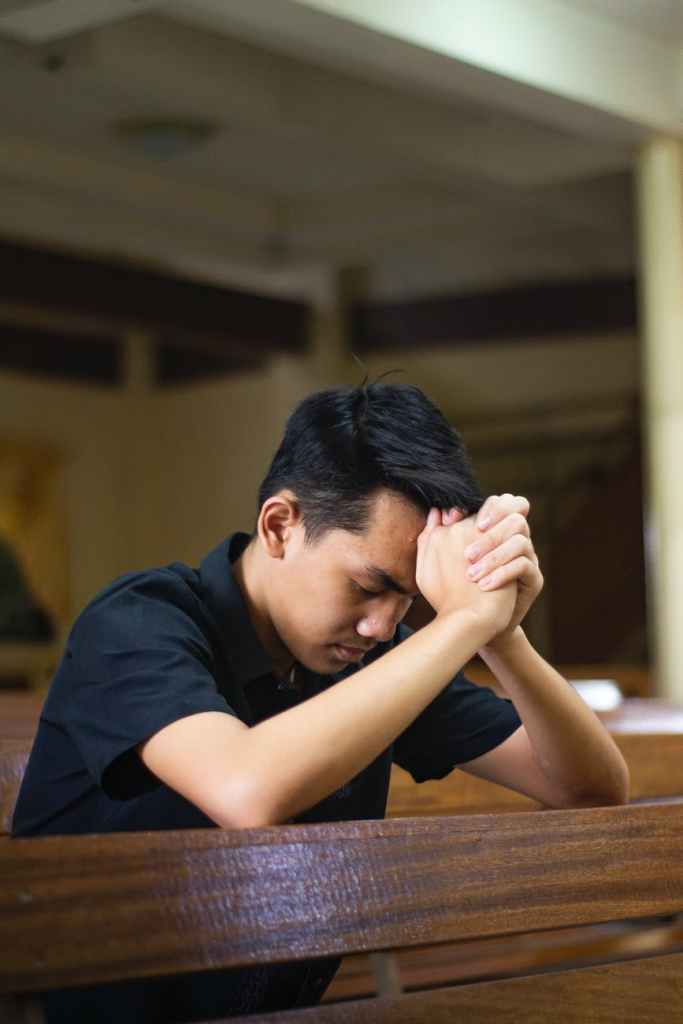
Praying in the Dark

(This post is an updated version of one that first appeared three years ago, during the COVID pandemic. I have updated a few of the references to reflect the change. There is still a lot of darkness and confusion in the world, but some of the sources have changed a bit.)

The past few days have been a dark place for me. I don’t mean that something horrible has happened, or that my life has been upended. But things seem dim and indistinct. Some things I took for granted turn out to be less than sure. Events have been chaotic and tinged with evil and sadness. The present economy seems far from certain, and rumors swirl around the upcoming elections. Many places around the world are at war, and there is violence, unrest, crime, and uncertainty nearly everywhere. Even traditionally “safe” institutions like the family and the Church are under constant attack. It is difficult to know who or what to trust– everything seems shadowed and indistinct.
I read a novel a while ago, set in the early days of World War II in London. Because of the threat of air raids from Germany, the people were required to “black out” their windows at night, and drive with no headlights. People who had driven or walked around the streets of London with confidence just weeks before were being injured or even killed because they could no longer trust the once familiar streets. Craters and rubble from bombing raids, or hastily built ditches and barricades; hidden dangers filled neighborhoods. And people could not count on streetlights, headlights, or lights in windows to guide them safely home. At the same time, thousands of people, fearing that the Germans would use deadly gas, were carrying around gas masks (just in case!), and leaving them on buses or at pubs or train stations, because they were unused to the extra responsibility. Suddenly, the gas mask they were depending on was lost, and all the extra preparation turned out to be useless, anyway.

It reminds me how often I would see people just a couple of years ago, getting ready to enter a store, only to return to their car for their required mask. Many people wore them “the wrong way:” others wore them for months longer than necessary. Still others wore the same mask for several days but failed to wash their hands. Some people stayed in their homes for weeks, even when they could have spent some time getting fresh air at a park or one their porch or stoop. Others took great risks going to stores where other customers were sick. And many workers had no choice but to report to work, knowing they would be exposed to COVID. Many people refused to get the vaccines once they became available, while others were demanding that everyone had to get the vaccine or be charged with a crime. No one was sure if they were “safe”– even with masks, vaccines, and other protocols. It was a very dark time.

Hard times and difficult situations can cause us to shift our focus and have to learn new routines–even new vocabulary! At certain times, life almost seems “normal.” At others, we seem to be tossed by every new wave that comes along. It can be easy to lose one’s way in the fog and darkness of chaos and changing times.

The Psalmist and King, David, had words of wisdom for times like these: “Thy word is a lamp unto my feet, and a light unto my path.” (Psalm 119: 105 KJV)

Even when things seem dark and it feels like I’ve lost my way, God is right beside me. If I have no other “light” to see by, God’s word will be enough to guide me on. When I pray– even in the dark–God sees me clearly, and knows the way ahead.

Photo by Pat Whelen on Pexels.com

And I needed to be reminded of that again this week.

What Is It Worth?

My husband and I own a small shop. It’s actually a two-part shop, with used items, antiques and collectibles in the front, and amateur radio gear in the back. We have a few “new” radios, books, and other items, but most of our items are second-hand. This sometimes creates a problem in pricing.

Photo by Skitterphoto on Pexels.com

New items usually come with a manufacturer’s recommended price, based on what the item costs from the factory or warehouse. Sometimes, price is based on what we pay at a wholesaler. But used items aren’t coming from a wholesaler or a factory warehouse. Often, we pick up pieces from an estate sale or another shop like ours. Sometimes, we are selling items that were salvaged or even donated.

Photo by Leticia Ribeiro on Pexels.com

So how do we determine a price on a used item? For that matter, how are prices determined for some of the new items that we sell? Of course there are a few guidelines:

  • Basic costs– what did it cost to produce the item (or procure the item)? How much for the materials? Labor? Shipping? Packaging? Also, what are the basic costs of running the store– will the sales of these items be enough to cover expenses like the light bill and rent and miscellaneous supplies as well as covering the cost to replace them?
  • Supply and Demand– how rare is this item? How easily can someone find a similar item at a similar price? How easily can we find more of this item (or something similar)? Do we have “too many” of the same item? Which items are selling “too fast” at a lower price?
  • Quality– some items involve more craftsmanship. Some contain sturdier or more expensive materials–real copper wiring, metal gears instead of plastic, silver v. silver-plate, hand-carved instead of mass-produced, etc.
  • “Aesthetics”–Antiques are often valued for their condition. But it varies from one piece or type of piece to another. Glass and ceramics are more valuable if they are unchipped. Old magazine ads carefully cut out and attractively framed can be more valuable than the entire magazine from which they came. Certain colors of glass are worth more than others. Wooden items that have been repainted, repaired, or refinished can actually lose value over those left in their original condition. Some items sell better with a “patina,” while others do better if they are polished and clean.
  • Ultimately, however, the items in our store are “worth” only what we decide, and what our customers are willing to pay for them. If we are “wrong” about the worth of an item, it may sit on the shelf collecting dust– either because we have priced it too high, or because the price is so low that a customer mistrusts our judgement about the quality of the product.
Photo by cottonbro on Pexels.com

Why am I writing about this on a blog about prayer?

We have a tendency to place values on people and situations, as well as items. Sometimes, we think it “isn’t worth it” to pray about a minor problem that we face, or someone we don’t know very well, or don’t think of very highly. Perhaps we think that our requests are too ordinary, or too small, or too chronic to bring before God. Lost keys; that lingering pain in the elbow; the barking dog that keeps us up at night; the sibling that hasn’t spoken to us in 15 years–we wonder if they are worth making the effort (or continuing to make the effort).

Photo by Meruyert Gonullu on Pexels.com

But, in God’s economy, every person–and each moment in each person’s day–is of enormous value! God uses the small things of life to make a big impact. Every prayer that is lifted to God from a sincere heart and with even the tiniest grain of faith can have unbelievable consequences. There are hundreds of examples throughout the Bible, and hundreds of thousands of other testimonies to illustrate this truth The same is true for “big” prayers– the impossible situations– that plague us. War, famine, disease, corruption and injustice are NOT too big for God to handle. Just because they are too big for us to solve (or even understand) does not make them too big for us to pray about, or our prayers too little to make a difference.

Photo by Tima Miroshnichenko on Pexels.com

I was reading in 2 Samuel 16 the other day. King David faced betrayal– from his son, Absolem, and also from one of his counselors, Ahitophel. David prayed– almost as an afterthought– that Ahitophel would give Absolem bad advice. And he did! But God also prompted David to send another counselor, Hushai, as a secret agent. At first, Absolem followed the advice of Ahitophel without question, and it seemed to work in his favor. But at a crucial moment, Absolem hesitated and asked for a second opinion. Ahitophel’s advice, according to the writer of 2 Samuel, was actually the better advice. But Absolem chose to follow the clever but ineffective advice of Hushai instead! David’s prayer was answered, and even when it seemed that David’s prayer “wasn’t enough,” God protected David, frustrated Ahitophel, and brought judgment and punishment to Absolem, ending in his death. There is no record of either Absolem or Ahitophel praying at all during the rebellion.

Photo by Ian Panelo on Pexels.com

God won’t judge the quantity or quality of what we pray for, or who we pray for, or how we pray– He values it all. Prayer is truly “priceless!”

Blog at WordPress.com.

Up ↑