The Weary World Rejoices…

We live in a weary world– weary of war, weary of chaos, weary of worry, and weary of sin and its consequences. From the time the alarm rings to the time we finally lay down our weary heads, we are bombarded by stress, misunderstandings, distractions, disappointments, questions, harsh words, harsh images, demands, doubts– I’m tired just listing them…

Even so, we are surrounded by promises (mostly false) of peace and rest, satisfaction and success. “Buy this!” “Try that!” “New!” “Improved!” The voices call out, offering temporary bliss, or temporary escape from the weariness all around. “Jingle Bells!” “Happy Holidays!” “Tidings of Comfort and Joy!” It is tempting to let Christmas become just like all the other worldly distractions–shiny, loud, stressful and fleeting, full of promise, but leaving us empty and cold in the end.

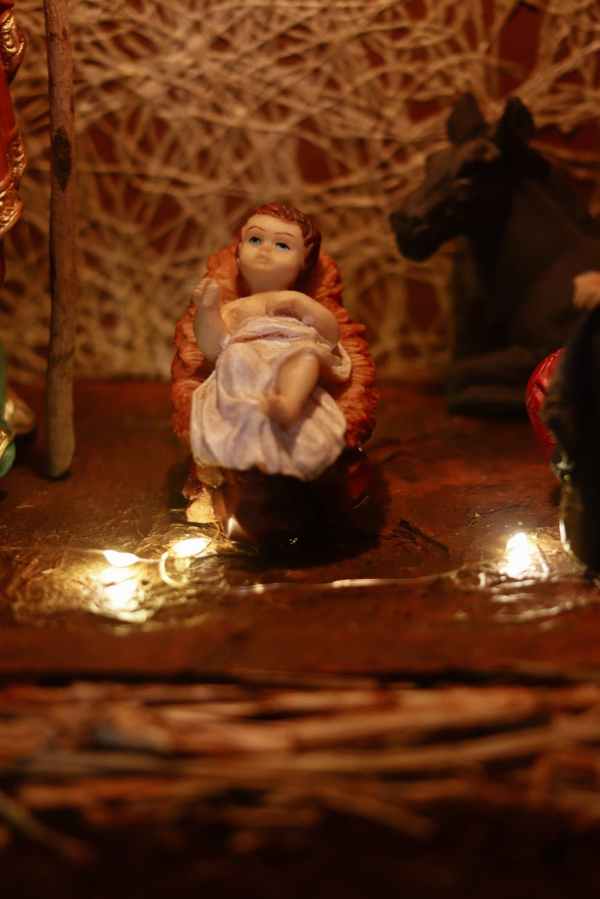
But Christmas IS different, because it doesn’t celebrate what the world has to offer. The celebration includes lights and bells, songs and gifts, food and friends and family– but at its heart, Christmas celebrates something “out of this world!” Jesus came to a weary world long ago, and no matter how weary the world was, or is, or will be, Jesus brought all the hope and healing of Heaven in the small package of a tiny infant child in a crowded town in a conquered land.

On that Holy Night, God crashed the party– He did more than watch from a distance, more than speak from the skies above or send angel messengers–He arrived, actively participating in the struggle, the bone-weariness, the hunger and thirst and chill and stress of living among His fallen and fractured creation.

And the weary world rejoices–can you hear it? Above the bustling noise of people shouting, and car horns blaring, and advertising slogans, and piped-in Christmas songs…Can you feel it–beyond the comfort of a warm blanket and hot cocoa, beyond the hugs of friends or the smiles of strangers or gifts from loved ones? Can you see it–beyond the glare of city lights, undimmed by the darkness of hatred and greed?

The lights and songs will fade away, but the Love, Joy, and Peace of God that came to the world that first Christmas is for all time!

“Fall on your knees!
Oh, hear the angel voices,
‘O Night Divine. O Night, when Christ was born.
O Holy Night!'”

O Come, O Come, Emmanuel!

It is Advent season. We celebrate in four weeks an event that was anticipated for four hundred years! For four centuries, the people of Israel waited for the coming Messiah without ever hearing a word from God. Oh, there were prophecies– some stretching back centuries– that promised he would arrive. But when?!

Imagine praying earnestly for an event that would not happen for another three or four hundred years? Imagine praying into silence for an entire lifetime for an event that even your great-grandchildren would never witness?

We live in a fast world. Fast food, high-speed internet, overnight delivery of packages, instant communication, bullet trains– we have lost the skill of waiting. Yet Advent celebrates the waiting, the anticipation of a birth so amazing and so consequential, that we look back over 2,000 years in wonder!

The birth of Emmanuel was worth the wait. “God With Us” came into the world “at just the right time.” (Galatians 4:4). He was not a moment too early or too late to fulfill all the prophecies and bring Salvation to mankind. Those who prayed faithfully over the centuries may not have lived to see the fulfillment, but they put their hope and trust in the prophets and in the God they served.

We are in another Advent season– we await the return of Christ! We have no way of knowing the exact hour or day (or year or even century) of His return. But with the same wonder and hope of those faithful men and women of old, we should pray for His coming again! We should share the glorious story of His first coming. We should celebrate and worship the Faithfulness of God. He keeps all His promises “at just the right time.”

And as we wait, we must not give up hope or lose our passion for the Mission that Christ left with us. “Go, and make disciples of all nations” (Matthew 28:19-20). As wonderful as Christ’s birth was, it pales in comparison to His triumphant return to judge and rule the earth. May we look back in wonder and forward in joy as we celebrate this season.

Epiphany!

I’m late writing this post today. The new year is unfolding faster than I had planned, and I come to this day unprepared.

But that’s kind of the idea behind Epiphany. We focus so much on preparation during the Advent and Christmas season that the season which follows can be lost in the shuffle of “getting back to normal.” Even at the historical birth of Christ, there was a real focus on everyone “getting back to normal” after the hustle and bustle of the census and the travel-weariness it generated. Very few people were focused on “Christmas” because Jesus was still considered one small child in a land of thousands of others. There were no Christmas traditions, no trees to un-decorate, no gift wrapping to put away for next year, no leftover cookies to finish eating. And then, twelve days after the glorious events of Christmas Eve and Christmas Day we celebrate Epiphany.

Also known as Kings’ Day, or Twelfth Night, this is the date we celebrate the arrival of the Magi (Kings or Wise Men) who traveled to Bethlehem to see the newborn King of the Jews. They did not arrive at the same time as the shepherds, and the account in Matthew has them visiting Mary, Joseph, and the Baby in a house. We must assume that Joseph found better accommodations for his family as the rush of census-taking waned, and yet he wanted somewhere safe to stay while the baby was still so small. The Magi came unannounced, unexpected, and “late” in the story.

The word “Epiphany” means a revelation or manifestation of something supernatural. The shepherds had gone through an epiphany when the angels appeared to them in the fields and told them to go to the manger on Christmas Eve. But the Magi, who had been following the star for months, finally had their Epiphany upon seeing the young child several days or even weeks after His birth. We don’t know that it was actually on the twelfth day after Jesus’ birth, but at some point, the Magi arrived at their destination and saw God in the Flesh! And their lives would never “get back to normal!” And their visit was a revelation to Mary and Joseph as well. The Kings brought expensive gifts of Gold, Frankincense, and Myrrh. They also brought the revelation they had received about the threat of Herod and the need to leave Bethlehem. If Mary and Joseph thought the worst was over, they were shocked into action by the warning of the Magi.

And yet, we celebrate this moment in time, this further revelation that a tiny baby was going to change everything. This knowledge that the Wise Men of Old held, and we can hold today– an encounter with Jesus is a revelation of the supernatural–this baby is GOD in the FLESH, GOD with US, GOD living AMONG us, GOD dying FOR us, GOD who will RETURN to REIGN over us. Nothing will ever be “normal” after such an encounter!

And I hope that can be said for all who read this– that we have encountered the Messiah; the Holy Son of God and Son of Man–and we have been forever changed! There is no end to the season of wonder and delight; there is no need for bright lights and tinsel-topped greenery, and no need to put away the joyful trappings of what His arrival really means.

Epiphany should “sneak up” on us– any day, anywhere–it should amaze us and surprise us with Holy wonder as we encounter the reality of “Emmanuel–God with Us!” And it should cause us to respond with prayers. Not only joyful prayers and prayers of thanksgiving, but prayers in our weariness, prayers in our anticipation of days to come and trials to face. Just like the Wise Men, we may have a long and even difficult journey in 2025. But at the end of it we will encounter God– not as a sweet baby in the manger but as our Lord, as well as our constant companion, our champion, and our heart’s desire!

Boxing Day Prayers

Yesterday was Boxing Day– a day for boxing up the Christmas decorations and finding places for all the gifts we received on Christmas Day. Traditionally, this includes donating things that we do not need or sharing some of our gifts with those who did not receive gifts on Christmas. Not everyone does this on December 26. Some people will exchange gifts on January 6. Some have already donated gifts to others to receive on or before Christmas. Many families leave their decorations up past the New Year; but most people are ready to put away all the trappings of Christmas and move on to other things– last minute cleaning, New Year’s resolutions, looking ahead to changes.

There is a sadness about putting away the lights and tinsel, candles and manger scenes. There is a melancholy that comes with taking down the lights, putting away all the ribbons and greeting cards, the candles and such. We have waited so long for now the wait has ended. And there is something about wrapping up Baby Jesus and putting Him in a box to sit on a shelf for most of the year that seems to mock the very celebration of Christmas. Jesus CAME! Not just for a day; not just as a newborn. Jesus didn’t come to sit on a shelf in the attic, carefully wrapped in paper waiting for His next birthday. He LIVED. He GREW. He LOVED. Jesus, and the message of His life, death, and resurrection cannot be contained in a box. It cannot be relegated to a shelf. Jesus is not just the baby of Christmas. He is the Lord of Life, the Light of the World, the teller of Parables, the Lamb of God, and the Risen Messiah!

But in another way, Boxing Day is completely appropriate for the season. Jesus came to be “regifted” and “passed on” to those in need! Jesus did not stay in the manger; the angels did not camp out with the shepherds; the wise men returned to their homes after giving their gifts. Life goes on! And it IS appropriate to put away the baby Jesus and focus on what comes next– Jesus living out His life and His mission; Jesus preparing for His Ministry, as well as preparing for the Cross and His Resurrection. Jesus returning to Heaven, where He is “hidden” until His coming again.

Today, my prayer is that we will not hide Jesus on a shelf or in a box, but “hide” Him in our hearts as we prepare for the coming year. And, just as we celebrated the Miracle of His first coming, that we would continue in a spirit of Advent as we await His Return! Let us prepare for OUR mission– to share the Gospel and spread Joy and Peace to others, whether with gifts, encouraging words, or just making connections and listening. May we anticipate with wonder and excitement the work He is doing even now among His Disciples and Followers, and the coming Fulfillment of His promises to make all things new!

As we put away the lights, and take down the ornaments, may we save the warm glow of remembering– He Has Come! He is Here WITH Us! Emmanuel! May we let Him shine Through us in the days to come, spreading Hope and Joy and Peace. And may we look forward to the day when we won’t need to unwrap Jesus from a box on the shelf– He will be our very present Source of Light, our King and Ruler, Forever, AMEN!

O Come, O Come, Emmanuel

During this season of Advent, we often sing this ancient hymn.  It dates back nearly 900 years, and continues to be sung and/chanted in Latin.  https://hymnary.org/text/o_come_o_come_emmanuel_and_ransom

The hymn is a contrast of weary longing and hopeful prophecy.  The promised Messiah has not yet arrived, but his coming is sure, and cause for great rejoicing.

The hymn is also a prayer– pleading for the coming of Messiah, even as it comforts with the reminder that he WILL come.  And it reminds us of the power of prayer– not just the power of approaching Almighty God, but the power of acknowledging our longings, our needs, and our dependence on God.  Even in our darkest hours, even in captivity and oppression, we can have hope in God’s timing and wisdom.  He DOES see our struggle; he DOES care, and he WILL send hope and rescue.

But the song also points out a pitfall–in the first verse, the prayer is for Emmanuel to rescue Israel from Roman Occupation; to end its immediate plight of being politically and economically oppressed.  There were many people who saw Messiah, heard him speak, even felt his touch, who rejected him because he did not do what they were expecting.  There are many today who cannot believe in Jesus Christ because he doesn’t take away their current circumstances of pain and suffering.

In their narrow focus, people miss the greater miracle of what Messiah is all about.  Jesus did not come to free us from temporary troubles and trials; to make us comfortably apathetic or arrogantly victorious over personal poverty or sickness.  He came to free us to be able to endure and/or overcome our circumstances; to offer hope where there seems to be no hope.  He came to show us that our circumstances don’t define us or cut us off from God’s love; that our past is not more powerful than His forgiveness and power to heal; that even suffering and oppression can be endured with joy, even as we work together to overcome them.

This year, as I ponder this hymn, I am both discouraged, and emboldened. I am discouraged, because I hear voices calling out for many things, but few of them are calling for a Messiah. We live in a world that desperately wants what Christ offers– peace, unity, forgiveness, eternal life– but without a Savior. We want to save ourselves, and we want to do it casually, heroically, and without acknowledging our helplessness. We read books, seek out gurus and life coaches, haunt the internet, all searching for answers that only God can provide. We long to see an end to injustice and oppression– or whatever seem unfair or difficult to us or those we champion– but we don’t want to submit to the example of a humble Christ who serves others.
But I am emboldened to pray that more of us would desire more than the “quick fix” or the “feel good” solutions of the world. I pray that we would earnestly desire that this Advent Season would be a time of yearning for MORE of Christ; more of His Joy; more of His Love for others; more of His Hope to spread around us. I want us to Rejoice– not in the bright lights and decorations, or even the beautiful melodies of Christmas carols– but in the real gift of Christmas! Emmanuel!

This season, as we sing this hymn, I pray that we would see the continuation of its message.  Emmanuel HAS come– Jesus not only came and won the victory over sin and death on Calvary; he has commissioned US to be the bearers of the Good News.  There are dark places in the world praying for hope and rescue to COME.  Will we share the love of Christ in our own neighborhoods?  When we bear the name of Christ, we should be on mission to rescue those who are captives, not of Rome, but of Sin and the tyranny of Death.  So that we all can  know the reason to Rejoice! Rejoice!

Jesus Wept

It is the shortest verse in the entire Bible– St. John 11:35:  “Jesus wept.”  Only two words.  They are easily memorized; they are also easily overlooked or misrepresented.  Jesus wept over the death of his good friend Lazarus.

Read the story of Lazarus here.

Jesus wept–Emmanuel felt deep emotion and showed it.  God shed tears over the pain and sadness of a death; Messiah cried for the loss of his good friend.  Jesus was no stranger to sadness and loss– God understands the sharp sting of death.  God is compassionate, not heartless or cruel.  If we are in emotional turmoil, it is not because God doesn’t know our pain or doesn’t care.  He hurts WITH us in our times of deepest need.

girl in pink jacket on wooden bridge in the forest

Jesus wept–People often ask the rhetorical question, “What would Jesus do?” when faced with a situation.  Here is an example of what Jesus did– he wept.  Sometimes, the “thing to do” is to acknowledge the reality of our situation–death hurts.  It brings out feelings of anger and even fear.  Death is scary.  It’s ugly, and it fills us with a sense of injustice, and a desire to wake up and find that death is just a very bad dream.  Aching loss, wracking sobs, feeling punched in the gut by circumstances– these are valid feelings and reactions.  To pretend otherwise or to deny ourselves or others the right to express those feelings does great harm, just as wallowing in sadness and remaining isolated in our grief can drag us into hopeless depression.

Jesus wept– period.  He didn’t punch a wall or point fingers at Mary and Martha for “letting” their brother die.  He didn’t try to justify his extra-long stay that kept him from arriving before his friend died.  Neither did he justify returning to a region where he was not “safe” from the authorities in order to comfort the sisters (and ultimately raise Lazarus back to life).  People often criticize Christians for “not doing enough” to erase hunger, cure diseases, or end poverty in the world.  Some even point out that Jesus, being God incarnate, had the power to do all of this during his earthly ministry.  But he didn’t.  As he was dying, he said, “It is finished.”  He wasn’t referring to some social revolution or economic program, or political movement that would abolish the oppression of the Roman Empire, or the corruption of the Pharisees, or end the slave trade.  That doesn’t mean that God approves of evil, corruption, and injustice.

But it means that Jesus’s mission was accomplished through what he did in life and through his sacrificial death.  He loved freely, healed those who were willing, and taught about the true character of his Heavenly Father.  He ate, and laughed, and slept; he burped and sweat, and cried.  He prayed and worshiped and worked and gave.  Jesus didn’t weep because he had no power to keep Lazarus from dying.  He proved that just minutes later.

person holding hand

Jesus wept because he was showing us the very heart of God.  God’s heart is not to flex his sovereign muscles and demand our instant and abject obedience– though he has the perfect authority and right to do so.  His heart is to walk intimately with us, even when that walk goes through the very valley of the shadow of death!  God’s love isn’t flinty and cold.  It isn’t pushy and arrogant and selfish.  It is extravagant and gracious beyond all imagination.  It is raw agony and pure joy. It doesn’t immediately “fix” our hurts or answer all our questions, but it wraps around us even IN our pain, and it give us hope to endure and carry on.

man hugging a woman wearing black tank top

What in your life causes you to weep?  What burdens and aches and frustrations and questions drive you to tears?  Jesus may not take away what hurts us, but he will never turn us away because we are scarred or scared or broken.  He will share our burdens, wipe our eyes, and hold us as we pour out our tears.

…And the Word Was With God…

We get excited about Christmas coming–we put up trees and decorations, and often a manger scene or Creche, with Mary and Joseph and the baby Jesus in the manger. But Jesus didn’t start as a baby. Long before He ever came to Bethlehem, Jesus was one with the Father. He ruled from the heights of Heaven. He saw the first dawn of the first day on Earth. He walked in the Garden with Adam and Eve. He was a witness to all the events leading up to His own birth.

Photo by Pixabay on Pexels.com

We like to picture Jesus as a baby. We like to picture Him as a man. We like to think of Him as a good teacher. And these are all correct. But we miss the full picture if we never imagine Jesus with God before He ascended to Heaven. The Ascension was Jesus returning to His rightful place, after the work of Salvation was accomplished in chronological, Earthly time. Jesus walked with His disciples. He ate with them, He laughed and talked with them. But He spent His earthly life talking and walking and relating with His Father, too. Nothing separated them, until that moment when Jesus became Sin for us so that we could be restored to a relationship with the Father.

Photo by RFA on Pexels.com
Photo by Ivan Samkov on Pexels.com

On the Cross, Jesus cried out, “My God, My God, why have you forsaken ME?”(Matthew 27:46 or Mark 15:34). God was not just “sending” His son as an emissary or a benign sacrifice to demonstrate how much He could love us. Jesus came, fully intending to be a living sacrifice. He endured the “imposed” separation of a human body, bound by time and place, separated physically from the glories of Heaven. But this separation– this knowledge of being forsaken, banished to Hell and Death–was what Jesus came to take upon Himself. The one who had eternally existed in loving harmony with the Father and the Spirit, had to be ripped away from Himself, forsaken by the Father and Spirit as one condemned. The one who had lived a perfect life of obedience had to be shunned as one who was unclean and unworthy of life, so that WE could have the right to be adopted as sons and daughters of God. We can be “with God” because He chose to endure the inconceivable pain of the rejection that we deserved. But there is another miracle of the Birth of Jesus that we overlook.

At the moment of Jesus’ birth, He was Emmanuel– God with US. Just by entering into a human existence, God already fulfilled His promise to bring us to Himself. When Jesus ate with His disciples, God was eating with them. When He laughed with them and walked side by side with them, the fullness of God was there. By His death, He continued “with us” to the grave and beyond. There is not a single moment of life –or death– that God, through Jesus, has not experienced and shared with us. In His resurrection, Jesus broke the power of Sin and death to separate us from God. Even the power of God’s justice cannot condemn those who put their trust in the finished work of Jesus, because Jesus has paid the debt in full. There is NOTHING that can ever separate us from God’s love and His loving presence. The Word was with God– and that same Word was with us. That same Word lives with, and in, and through us throughout our days on earth. And, if we have put our faith in this same Emmanuel, we will be “with God” throughout eternity.

Photo by Marcelo Moreira on Pexels.com

I need to meditate on this truth today. Even in the Holiday season, I can feel very separated from God–surrounded by stress and worries; focused on my own struggles and goals; chasing after a temporary joy in the busyness of preparations. Jesus has not forsaken me to return to Heaven– He is no less “with me” for being once again “with God.” No, He doesn’t physically walk beside me and eat with me, or talk audibly to me. But His presence is constant, steady, and promised.

Photo by Alena Shekhovtcova on Pexels.com

The Word– the same Word that spoke galaxies into being; the same Word that conquered Death and Sin–is “with us!” Today. Every moment! We will never have to cry out, “My God, my God, why have You forsaken me?” And we know this because Jesus CAME! He didn’t just “say” it. He gave us “His Word.”

Hallelujah!

Christmas Eve–people around the world will be celebrating the birth of Jesus Christ. Some will meet for evening and midnight candlelight services tonight. Others will begin celebrating tomorrow morning. Some will celebrate with great solemnity; others with great festivity; some, like the monks chorus above, with laughter and frivolity. Even amid continuing pandemic travel and gathering restrictions, families and individuals will celebrate with music, gift-giving, phone calls, small gatherings, reading Bible passages about Jesus’ birth, feasting, sharing memories, and praying.
There are only a few occasions throughout the year that can be said to be nearly universal, but Christmas comes close. Even where it is not celebrated as a cultural phenomenon, complete with tinsel and trees, lights and decorations, it is celebrated by the faithful who thrill with joy at the reminder that God Himself chose to come live with people He created– that He came to share in their day-to-day triumphs and struggles; so much so that He chose to share in our fate: Death. GOD cried out in hunger. GOD shivered with cold, and felt exhaustion. GOD suffered shame and misunderstanding and abandonment. GOD felt agony and struggled to breathe as blood and sweat ran down His brow and into His eyes. And by His coming, and suffering, and dying, HE brought us life and hope, eternal joy and peace! It is the very greatest reason to celebrate– bigger than national holidays or seasonal festivals; bigger than cultural differences and vast distances; bigger than mere tradition or historical remembrance.

Hallelujah!

Photo by Bich Tran on Pexels.com

For many, this Christmas will be bittersweet– we have suffered greatly; some of us are still reeling from loss and grief. Others are living with fear and confusion about the future. In many ways, our situation is not so different from that first Christmas in Bethlehem. We feel “taxed” by events and circumstances. The world seems dark and dreary and cold. More than ever, we need to listen for the song of the Angels– for “good news of great joy, which shall be to all people.”

And, maybe more than ever in our lifetime, we need to be like the shepherds–eager to seek out the gift of the newborn Savior; Eager to embrace the wonder of Emmanuel; eager to share the hope we find at the manger. Hallelujah! Unto US a child is given; unto US a son is born! (Isaiah 9:6)

Photo by MART PRODUCTION on Pexels.com

I’ve been writing a lot about Advent and Christmas lately, rather than focusing on Pursuing Prayer. But they are part of the same whole. I pursue a life of prayer precisely because Jesus came in the flesh and lived and died and rose again. I believe in the power of prayer because Jesus modeled how to pray– even as He faced betrayal and death. I believe in the gift of prayer because Jesus prayed for me long before I was ever born (see John 17). I pursue prayer with confidence because Jesus keeps His promises.

Hallelujah!

The Hopes and Fears of All the Years..

My paternal grandmother was born in Shanghai. But not the Shanghai most people think of. Not a great Eastern city of importance, but a tiny settlement called Shanghai (or Shanghai Corners) in southwestern Michigan. It doesn’t have a post office; it’s not even listed on most maps. And it wasn’t named directly after the great Chinese city– it was named after a breed of chicken (most likely the breed now known as Cochin)!

Jesus wasn’t born in Jerusalem. He wasn’t born in Rome or Athens, or New York City or London or Johannesburg or Tokyo. Jesus was born in Bethlehem. It wasn’t as small as Shanghai Corners, Michigan, but it wasn’t a city of great importance, wealth, or industry. And yet, it was the place where history would be reshaped. Our modern calendar divides into what happened before that night in Bethlehem and what came after. More than two thousand years later, no event has been able to displace it as the pivotal event of recorded history.

Photo by Burkay Canatar on Pexels.com

And this division wasn’t caused by a revolution, or a series of wars. It wasn’t shaped by disaster or plague, victory or catastrophe. It came silently with the birth of a single baby, wrapped in strips of cloth and placed into a makeshift bed. But all the years revolve around that single birth. All the great triumphs of history– the moon landing, the invention of the printing press, the conquests of Alexander the Great, the building of the Sphinx–all are placed in the context of the arrival of God in human form. God stepped into the limits of human history, and the timeline was permanently altered. Before His appearance, prophets and seers looked forward. After His arrival, history looks back. But His birth is the focal point; the period. The end of the Beginning and the beginning of the End.

Photo by Pixabay on Pexels.com

The hopes of all the ancients–shrouded in mists and wonder– were given flesh and bones. The fears– dark and amorphous– were blinded by the light of His Presence.

What hopes and fears are we carrying today? Our hopes have a name– Jesus; Emmanuel! Our fears have nowhere to hide from His power. And this wondrous gift, while it first arrived in the little town of Bethlehem, reaches around the entire Earth– to Shanghai, and Shanghai Corners; New Delhi, and St. Petersburg; Dallas and Buenos Aires; Cairo and Caraballo; Los Angeles and Lagos; and thousands of small towns in between.

Photo by Nishant Aneja on Pexels.com

“Oh Holy Child of Bethlehem,
Descend to us, we pray;
Cast out our sin, and enter in:
Be born in us today.”

God and Sinners, Reconciled!

Every year, we celebrate the birth of Emmanuel– God With Us. It is amazing to consider the Love of God that brought Him from His Heavenly throne to a lowly manger stall, the King of Glory contained in the tiny body of a sleepy infant.

Photo by nappy on Pexels.com

But we should be careful not to miss the rest of the story. As wonderful as it is to think that God would love His creation enough to visit among us, to “taste” life as a human, the story gets gloriously magnified as Jesus leaves the manger to enter a ministry. Jesus didn’t just live among us, He healed, taught, laughed, formed friendships, and served among people– many of whom scoffed, scorned, and rejected Him and His message.

And His message was this: God wants– in fact He passionately yearns– to restore the relationship WE have broken. Jesus didn’t come to “taste” human life– He came to GIVE His life as a sacrifice for those who didn’t deserve it, to extend forgiveness to those who had no right to ask for it. The Holy and Perfect God became the guilt and shame of Sin, so that we could be reconciled to Him. He accepted the penalty of Death, so that we could be given eternal life.

Photo by Edu Carvalho on Pexels.com

This miracle of reconciliation can be difficult to understand. I sometimes get “stuck” in the weight of my past–I know that Christ offers forgiveness, but I sometimes act as though the penalty hasn’t been removed; only suspended. But that’s not what Jesus taught. Like a leper cured of leprosy, I am clean–no scars, no stains, no relapse–all traces of my disease removed. In this world, I will still feel the sting of the consequences of Sin– betrayal, sickness, injustice, even death. But death is no longer my destiny; it is a temporary rest stop on my way HOME.

Photo by Anna Shvets on Pexels.com

Jesus didn’t come to “taste” human life; He came to “taste” death– and He came to destroy its power, so that we could know true Life, and live it to the fullest!

Joy! Peace! Reconciliation! Eternity! Emmanuel!

Blog at WordPress.com.

Up ↑