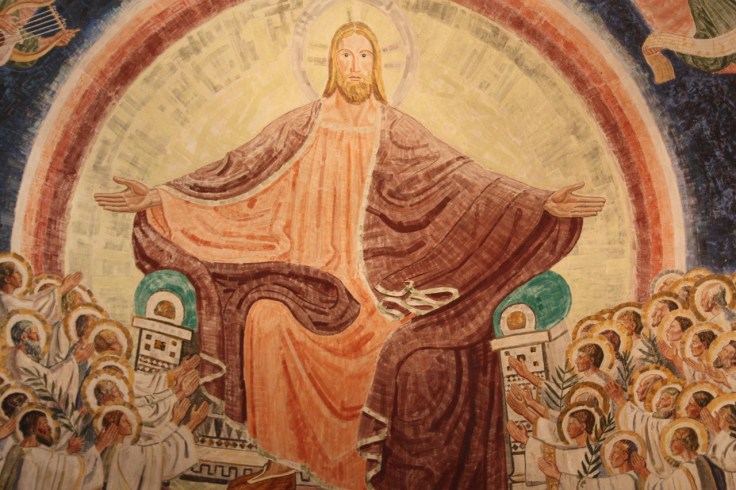

Almighty!

I’ve been looking at the Names of God lately. In my last post, I meditated on “Adonai”– The LORD. God has the ultimate authority over all things. He is the Master; the King; the Ruler; the One LORD of All.

Today, I want to explore a related Name– Almighty. It is often used in conjunction with LORD. God is the LORD ALMIGHTY. Whereas LORD refers to God’s ultimate authority, Almighty refers to His Absolute Ability. He is all-powerful, all-wise– able to do exceedingly, abundantly, above all that we could ever ask or imagine (see Ephesians 3:20). There is literally nothing that God cannot do. There are many things He WILL not do– He will never leave or forsake those who are His; He will never be untrue to His own Word or break His promises; He will never change His nature or be untrue to it– but He CAN do whatever He wants.

And this is where we sometimes fail to grasp the fullness of His name, Almighty. We know that He is Mighty; that He is mightier than we are, at least. But He is the source of Everything! He is mightier than Nature–He spoke all of it into being! He is mightier than Time– He is unbound by time or age or deterioration. He is mightier than Sin and Death– He proved that through the death and resurrection of Jesus Christ! He is mightier than the dark emptiness of space– He holds the entire Universe in His Hands!

And that brings me to the subconscious wonder of the name, Almighty. God is not JUST all-powerful and eternally capable. His Almighty nature is GOOD! All of His power is regulated and matched by Mercy and Grace! He has the authority (as LORD) and the power (as the Almighty) to be a terrible enemy. In fact, Job speaks of this repeatedly when he feels that God is punishing him unfairly (see Job 27). I can’t argue against God and win; I can’t grapple with God and defeat Him (Jacob tried that in Genesis 32). I am powerless against God– physically, mentally, spiritually–I cannot “win” against God by fighting, arguing, cajoling, bargaining, or using any weapon. There is no army, no spirit, no power that can budge God from His plans.

But God is NOT my enemy or my rival! Only Sin and my own rebellion and pride can make me an enemy of God. In fact, He wants a relationship with me; He wants me to live in peace and harmony with Him! He has moved Heaven and Earth to reconcile me to Himself through the death and resurrection of Jesus Christ! He is like a mama bear or a lioness with their cubs, jealously guarding me from Sin and Death. He is my Father, my protector, my provider, and my Shepherd– the ALMIGHTY! And yet He cares about the smallest details of my life– He numbers the hairs on my head and keeps track of any injustice that has ever been done to me (or by me!) to be settled and made perfect on the Day of Judgment.

What a humbling thought! What a joyous reality! The Almighty LOVES ME! He LOVES YOU! And His Love is all-powerful and eternal. The ALMIGHTY IS LOVE! How can I not praise Him! How can I not see Him in every moment!

Onward!

Today is Memorial Day in the U.S.– a day when we honor those who have fallen in battle and given their lives for our country. It is also a day on which we often decorate the gravestones of ancestors and relatives who have passed on. There may seem to be little connection between soldiers of war and civilian great-grannies or uncles, but Memorial Day can stretch to both– especially to Christians. Here’s how I see it:

  • Soldiers who gave their lives never lived to see the fruits of their sacrifice. They died, never knowing if their sacrifice was in vain. Our ancestors, similarly, poured their efforts into rearing children and living lives of integrity, little knowing how their efforts would be carried on by the next generation. There is a risk in battle– whether a war-time conflict, or just daily survival–a risk that all our hard work and all the perils we face will end in failure. We memorialize those whose efforts did NOT fail. We honor those whose sacrifices made a difference in our lives and in the lives of others. They lived (and died) for a purpose– and we honor that purpose, as well as the individual lives.
  • All of us are fighting a battle– a spiritual battle– in which our very lives are on the line. Some of us will lose our lives, literally, through imprisonment, persecution, torture, or disastrous choices we make to surrender to the enemy. Others will lose our lives figuratively, giving up our time and our own dreams to a greater cause. We honor those who went before us in this fight. We honor the good examples and the fallen heroes.
  • Soldiers go where they are sent. They often die and are buried far from their homes, on the battlefield. They may or may not have graves with the rest of their families. Many in our family were immigrants and pioneers, moving far from “home” to start a new life. Some of them moved as the result of war coming to their ancestral home and pushing them to relocate.

Memorials– whether gravestones, statues, monuments, or stories passed down to the next generation– serve as reminders of our priorities– freedom, family, and Faith. God’s people throughout the years have raised memorials to commemorate God’s faithfulness, as well as the high cost of fighting against Sin and its effects.

Dr. Martin Luther King, Jr. Memorial

I pray that on this Memorial Day, we will take time to remember, and give thanks for those who have fought the “good fight” in the name of freedom, and in the name of Faith. But more than that, I pray that we will be inspired to carry on the fight– knowing the risks and weighing the costs–to preserve those things that are most important. Let’s pause to remember– and then let’s move Onward!

Why Should I Pray for My Enemy?

But I say to you, Love your enemies and pray for those who persecute you,

Matthew 5:44 (ESV)

The obvious answer to the question in the title is that Jesus commands it. But what practical and spiritual reasons are there for such a counter-intuitive action? Jesus himself continues:

43-47 “You’re familiar with the old written law, ‘Love your friend,’ and its unwritten companion, ‘Hate your enemy.’ I’m challenging that. I’m telling you to love your enemies. Let them bring out the best in you, not the worst. When someone gives you a hard time, respond with the supple moves of prayer, for then you are working out of your true selves, your God-created selves. This is what God does. He gives his best—the sun to warm and the rain to nourish—to everyone, regardless: the good and bad, the nice and nasty. If all you do is love the lovable, do you expect a bonus? Anybody can do that. If you simply say hello to those who greet you, do you expect a medal? Any run-of-the-mill sinner does that.

Matthew 5:43-47 (The Message)
Photo by Keira Burton on Pexels.com

If we are following Christ and asking His Spirit to help us grow in Godliness, we should be acting– and reacting– like God. God makes the sun shine and the rain to fall on everyone. He is Mercy and Grace personified. That takes away nothing from His ability to exact justice. But His true desire is to show mercy– and that includes mercy THROUGH us!

But there are other good (and related) reasons to pray for our enemies.

  • Such prayers put things in perspective. If I focus on the injustices that my enemies have done (or continue to do), they become larger than God’s power to restore and redeem. If I focus on God’s power, the injustices, while still real, take their proper place. God is bigger; God is greater; God is wiser; God is Sovereign.
  • Such prayers remind me that I am not immune from causing pain and distress to others. It is natural for us to see our enemies as completely different from ourselves. “They” are evil, callous, and deserving of punishment. But, if we are honest– we are also deserving of punishment. We, too, have been callous, careless, selfish, angry, or bitter with someone, somewhere, at some time. God has dealt with us mercifully. How can we be grateful for His mercy and fail to pray for others who need it?
Photo by Ketut Subiyanto on Pexels.com
  • Praying for our enemies may not change them, but it will change US. Praying for my enemies forces me to release my anger and bitterness, so that I don’t become trapped in a cycle of letting my enemy become my obsession or even my role model. I say this from negative experience; NOT praying for someone I considered my enemy led to me say and do things that were unkind and vicious– because I thought she “deserved” the same treatment she had given me and others. One day I woke up and realized that I was slowly becoming like her– letting her behavior determine who I was in return: suspicious, hard-hearted, critical, and vindictive.
Photo by Matt Jerome Connor on Pexels.com
  • Praying for others reminds us that our true enemies are not other people. Once again, it is easy and natural to create a monster out of the person who is our “enemy.” They have often caused very real and very intense pain and suffering– personal, physical, psychological, emotional, financial, and sometimes chronic and catastrophic–sometimes, they show no remorse; sometimes, they refuse to accept responsibility for their actions. God knows all this. He sees all this. He aches for our pain– and for their rebellion. But the root cause is not a person– no matter how involved they are in delivering the pain. The real cause is Sin and Brokenness. That’s why WE can’t fix it. That’s why WE don’t have the power or authority to administer righteous judgment over it. And that also means–
  • Such prayers can free us of the burden of guilt, shame, bitterness, and hurt of the past. That doesn’t mean that we must deny the very real hurt we have felt. But we no longer have to be bound and shackled by it. When we can lift up our enemies and our past, and give them to God– really let go and give them to Him–He will carry that load, and let us run the race before us.
Photo by Pixabay on Pexels.com

One caveat here. Loving your enemy; praying for them– these are not the same as believing their lies or consenting to their abuse. There may be people in your life that you must pray for– from a distance! You can love someone, and still set clear boundaries to protect yourself and others. God will never abandon us. But He doesn’t call us to enable others in their evil actions. This is especially true in cases of domestic violence. Love your enemy, but get help and healing. And continue to pray!

Blessed Are the Merciful

“Blessed are the merciful, for they will be shown mercy” (Matthew 5:7).

Am I merciful when I pray? That’s not a question I normally ask, but I’m looking at the Beatitudes, and how they relate to my pursuit of prayer. I pray for justice; I pray for healing; I pray to be more Christlike, but do I specifically pray about mercy? Certainly, I thank God for HIS mercy toward me, and I hope I show mercy to others, but does it enter my prayer life?

Photo by Michelle Leman on Pexels.com

It’s easy to pray for mercy for ourselves, when we know we deserve justice (and punishment). It’s easy to ask for mercy for our loved ones. But do I pray to become more merciful? Do I pray for a greater love of Mercy? In Micah 6:8, we are told that God requires three things– to do justice, to love mercy, and to walk humbly with Him. Often, it is easier to love justice, do mercy (when it suits us) and walk in our own way, asking God to follow US as we go through the day– bless me, bless my work, bless my travels, etc..

Mercy requires a knowledge of justice and a humble acceptance of God’s sovereignty. Justice is NOT whatever we think is “fair” or “equitable” in a certain set of circumstances. Justice is defined by God, and the only way to “do justice” is to obey His will. We will not “love mercy” until we experience it at God’s hands.

That’s really what this Holy Week is all about–God’s justice, God’s Mercy, and His Victory and Lordship. As we go through this week, in preparation for Easter, it is vital to meditate on what Jesus DID for justice to be satisfied, the depth of His Love that caused Him to suffer and die to provide, not just mercy, but Unspeakable Grace, and the humility He demonstrated in His time on earth– serving, sacrificing, even dying the painful and humiliating death on a cross–all for me; all for you.

Photo by RFA on Pexels.com

And we must be careful about making Mercy all about us and all about the here and now. We live in a culture of “instant gratification.” We want God’s mercy to “fix” the immediate problems we see around us. Those who are merciful WILL be shown mercy– but we may not see instant ease and comfort in a situation where others hold a grudge, or where the natural consequences of our sin still exist. We have been justified before God– He will not count those sins against us–but we still live in the fallen world where sin leads to death and destruction. God will redeem all things in His time, and we can trust that His mercy will triumph over even the worst of circumstances, but we may still have to endure suffering for a season.

Photo by Inzmam Khan on Pexels.com

When we come to God in prayer, we have no right to withhold mercy– either from those who may have offended us, or from ourselves for things we did in the past. Mercy is a gift– one we cannot give without having received it, and one we cannot hold on to without sharing it freely. When we pray for our enemies, we must pray with a heart of mercy– not because they deserve it, but because God’s sovereignty demands it.

Photo by Daniel Maforte on Pexels.com

In My Distress…

This has been a week full of distress.. My husband and I got our second COVID vaccine (even though we recovered from the virus earlier this year), and spent a day bedridden with fever, chills, and body aches. But we recovered. I got word that my great-nephew broke his arm. Someone I know had to take her daughter to the emergency room–Again–with a serious infection. Another couple delivered a stillborn son. Yet another delivered a tiny, premature little girl. Another woman is back in the hospital, and another friend is off work with a lingering illness that remains undiagnosed. And that is just a list of health issues!

Photo by Pixabay on Pexels.com

It has been said that when we are in distress– especially with bedridden illness– we are forced to look up. And this gives us the impetus to call out to God. Not everyone will do so. And some will call out in anger or bitterness. But the Psalmist David used his distress to call out to God for help. In Psalm 18:6 he says: “In my distress I called upon the LORD; to my God I cried for help. From his temple he heard my voice, and my cry to him reached his ears.”(ESV via bibleref.com) David’s distress was not from illness, but from being hemmed in by King Saul, who had closed in and had David trapped and seemingly helpless–first in a walled city, then twice in the wilderness. (1 Samuel 23) Three times, David’s situation seemed hopeless, and three times, he was rescued from capture and death.

Photo by Pixabay on Pexels.com

It is tempting to look out at our circumstances, and lose hope. Even when we know that God hears us and loves us, sometimes his answers are not what we expect. David called out to God, yet he had to face his enemy three times before Saul abandoned his hunt (temporarily!) My husband and I recovered quickly from our reaction earlier this week, but we faced the pain and symptoms three times– during the actual illness, and, less severely with each dose of the vaccine. My nephew will have to be in a cast most of the summer. The tiny baby will be in the neonatal ICU for several weeks, if she survives. Her family will be waiting and worrying and praying. Yet, God DID deliver David in a miraculous way; He brought my husband through a severe case of COVID that involved a stay in the hospital and a related case of pneumonia; He gave life to this precious little baby; He is bringing peace to the family that lost their precious little boy. His timing may not be ours; His ways are not our ways. But God’s ears are always open, and His ways are always good, and His wisdom is perfect.

Photo by Mohan Reddy Atalu on Pexels.com

Distress can make us impatient and cause us to doubt Our Father’s care. But when we remember God’s faithfulness in the past– both toward us and those we love–we can find the strength to wait and even praise God in the struggle.

Photo by Mary Taylor on Pexels.com

Thy Rod and Thy Staff, They Comfort Me

I don’t know about anyone else, but this phrase always made me feel uncomfortable. Growing up, I thought of rods and staffs (staves?) the same way I thought of the teacher’s wooden paddle at school– something to be avoided at all costs. They didn’t comfort me one bit; instead, they inspired fear and loathing. “Spare the rod and spoil the child (Proverbs 13:24)*,” meant that someone was due for a spanking. Spanking was in fashion when I was young, though my parents used it extremely rarely, and the dreaded teacher’s paddle never touched my tiny terrified tush. A rod, staff, switch, paddle, or hand– all were threats of punishment– sometimes inspiring fear and even resentment.

Photo by Ian Panelo on Pexels.com

And yet, in all my youth, I never stood in fear of my parents. They never beat me, or spanked me without cause, or withheld loving forgiveness and reconciliation. Their discipline, which rested almost exclusively with other methods, was for my benefit– teaching me to respect just authority, recognize the limits of my will, and develop patience, compassion, and responsible behavior.

Photo by Agung Pandit Wiguna on Pexels.com

God does not hold the rod and staff as instruments of terror. God’s love and wisdom are infinitely greater than the love and wisdom of human parents. And God’s sovereignty and authority are infinitely greater than that of any ruler or earthly power we know. God’s rod and staff are not weapons to be used against us. Instead, they are the symbols of authority and tools of our Good Shepherd. His staff is like the scepter of the King of Kings, or the staff of a warrior. He will gently use the rod to direct our steps or keep us from going off the path. And he will use the staff to protect us from the advances of the enemy. He has the authority to use these tools, and the grace and wisdom to use them for our good.

Photo by Ekrulila on Pexels.com

During times of trial and confusion, the Shepherd’s authority should bring us enormous comfort. When disease and fear are closing in, when we travel down the valley of the shadow of death, when evil seems to be prowling, stalking, and ready to pounce– we have a Shepherd who has every resource to keep them from devouring us. Circumstances like the current pandemic are not sent by God to terrorize us. In fact, God holds the rod and staff in hand– He has set the limits of COVID-19; He has provided (and will provide) opportunities for us to learn many good lessons and see many astonishing developments– treatments, protocols, cooperative efforts– that will be for our ongoing benefit; for those who do get ill, suffer loss, or even die from COVID-19, He gives grace and peace to those who seek Him. He comforts us in ways that go beyond our natural understanding.

One of my favorite stories is The Lord of the Rings, by J.R.R. Tolkein. In this saga, the wizard, Gandalf, always carries a staff. It looks harmless enough– a walking stick in the hands of an old man. But when faced with an enemy, or when members of the Fellowship are threatened, Gandalf uses his staff effectively to chase away shadows, defend his friends, and battle the most fearsome of monsters. Gandalf is no threat to the frightened Hobbits, or even to the mad king Theoden. But to the traitorous Saruman and wicked steward, Denethor, he stands in fearless opposition. That doesn’t mean that the Hobbits never face danger or that Gandalf fights all their battles for them. And, because Gandalf is not all-powerful and omniscient, he cannot guarantee their ultimate victory. But his presence is enough to instill hope and comfort wherever he goes.

God will let us see uncertain days– days when things look grim and we don’t see how anything good can come of our circumstances. But one thing is certain–our God is ever-present, and more than able to bring us hope, peace beyond understanding, joy, and comfort along the way– no matter, where; no matter what!

  • Note–If we see the “rod” and “staff” only as instruments of punishment, we are missing the point of this proverb. If we “spare” the rod of authority– never providing discipline and correction or teaching respect and responsibility– that is when we spoil the child. And whatever one’s views about corporal punishment, it should never be used to promote terror or abuse.

Blog at WordPress.com.

Up ↑