
I’m really not sure at all how this post relates to prayer, but it is a subject that’s been stewing in my brain for awhile, so I thought I would “write out” my thoughts.

I have long been disgusted with a certain argument used by those who discount Creation (by a supreme God with intelligent design and purpose as put forth in Scripture). Their claim of a universe that is the result of a series of random accidents is compared to a chimpanzee with a typewriter. Supposedly, given enough time, there is a possibility that the chimp could “randomly” type a masterpiece– a Shakespearean play or the text of the New Testament.. It is a very tiny probability, but, the argument goes, enough of a probability to suggest that the universe came about in a similarly unexpectedly random way. The proponents of this argument always seem to leave their chimp typing away, convinced that their argument is unassailable– that they can drop the mic, walk off stage to the thunderous applause of their peers, and sit smugly back while creationists pick up their jaw from the floor and stammer in defeat. (To further explore how this analogy works, see https://www.npr.org/sections/13.7/2013/12/10/249726951/the-infinite-monkey-theorem-comes-to-life)
I’m flabbergasted that this argument still gets any credence. It is laughable in its illogical assumptions and disregard for the complexity and wonder of Creation. AND it refutes its own basic assumption– that of randomness. Let me break it down:

- First their example is NOT random at all. And, once true randomness is introduced, the idiocy of the argument is obvious. What if we replace the chimpanzee with any other random animal? A hedgehog. A butterfly. A hippopotamus. A fish. What is the probability of any of THEM typing a masterpiece? None. The theory hangs on the mathematical principle of probability theory, but probability rests, not on random unknowns, but on specific factors and specified outcomes, i.e. an agent (such as a chimpanzee) with the ability to use a specific type of tool (such as a keyboard) to produce a certain outcome (such as a specific phrase or work of literature).
- The same thing applies if we replace the typewriter. Oh, modern arguments have replaced the typewriter with a computer keyboard– in fact computer models have even been tasked with trying to figure up the most likely probability percentage of this “random” event. But what if we take away the keyboard filled with letters, and give the chimp a crayon of a ball point pen. What chance then of the simian “creating” a work of fiction or a sacred book? As soon as it becomes apparent that the “probability” of such random factors producing a specific outcome is not just tiny, but non-existent, the analogy becomes ludicrous.
- Finally, we don’t have random literature. Generally, we have “Hamlet.” But barring that, we have “random” works by Shakespeare, or Milton, or the King James Bible. The chimpanzee doesn’t have an Arabic keyboard. It never seems to type out classic works in Chinese literature (though it “could” in theory, I suppose). What we have is a very specific example of a single creative act that “might” statistically be “produced” (see the discussion on this below) given an infinite amount of time. And it is a visual image that our brains are tricked into thinking of as a “possible” outcome of random chance.

- But it is not just the absence of true randomness, but the absence of reality that distresses me. The proponents of this argument not only want us to assume that the chimpanzee CAN type out a masterpiece, but that it WILL type out a masterpiece. On what theoretical plane is it logical to assume that the average (or even above-average) chimpanzee will spend any length of time pounding away at a keyboard to produce literature? To what purpose? Why should it? Or that the typewriter will never “jam” or run out of ribbon; or that a word processor will never experience a “glitch” or lose power, or have enough memory to store all the “failed” attempts. Will “auto correct” kick in? At what point does reality suggest that this “random” event is not only not probable, but not logical? As one wit suggested, “A million chimps at a million typewriters will never write Hamlet, but they will break the typewriters and fling their poop.”(I found this on the internet– I have no attribution for the “quote” as it was simply included with an image of a chimp at the typewriter.)
- And how long will this take? You can’t realistically have a single, immortal chimpanzee in this scenario. You need infinite generations of chimps (supplied with typewriters) with nothing better to do than prove an illogical “random” theory. How many humans will it take to “witness” this process? How do they determine that the outcome has been reached successfully? And they all–chimps, machinery, witnesses– have to work toward this single goal; NOT of their own free will (and not “randomly”), but enslaved to a very human need to suggest what can only be theorized.
- This brings me to another failing of the argument. One of the reasons we still use the word “theory” when speaking of Evolution or the “Big Bang” is that they can be theorized, but never demonstrated. No one can demonstrate how a universe can be formed out of nothing, because the universe and all its materials are already here. The most one could ever do is “re-create” or “simulate” what happened “In the beginning.” Similarly, the theoretical chimpanzee (or aardvark, or whatever) will never “create” Hamlet or the book of Matthew, or Paradise Lost. At most, it might create a reproduction–by “accident” rather than earnest intent–of an already existing masterpiece. This is not Creation. It is not even imitation, in the way that “West Side Story” re-creates “Romeo and Juliet” or a new translation of St. Matthew “modernizes” the King James Version of the same gospel. If a chimpanzee successfully photocopies a page of Shakespeare, we would never suggest that it was a literary “creation.”
- And this brings me to my last baffling observation– that the Creation of the Universe would be compared to the creation of a single artistic product, and that Art and Literature would be dismissed as mere random “occurrences,” the likes of which any monkey could produce.
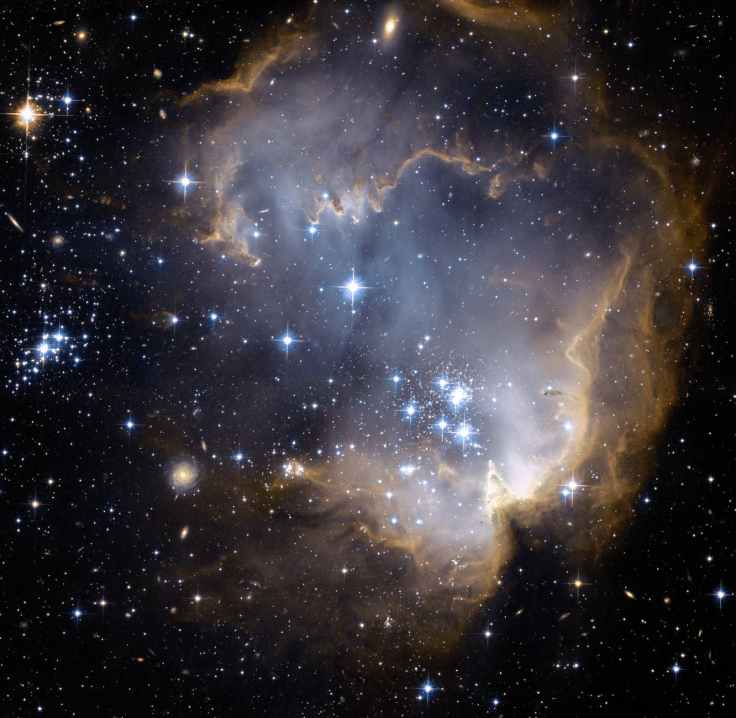
The Apostle Paul warned of this kind of futile thinking in his letter to the Romans:
18 The wrath of God is being revealed from heaven against all the godlessness and wickedness of people, who suppress the truth by their wickedness, 19 since what may be known about God is plain to them, because God has made it plain to them. 20 For since the creation of the world God’s invisible qualities—his eternal power and divine nature—have been clearly seen, being understood from what has been made, so that people are without excuse.21 For although they knew God, they neither glorified him as God nor gave thanks to him, but their thinking became futile and their foolish hearts were darkened. 22 Although they claimed to be wise, they became fools 23 and exchanged the glory of the immortal God for images made to look like a mortal human being and birds and animals and reptiles.24 Therefore God gave them over in the sinful desires of their hearts to sexual impurity for the degrading of their bodies with one another. 25 They exchanged the truth about God for a lie, and worshiped and served created things rather than the Creator—who is forever praised. Amen.
Romans 1:18-25 (NIV)
The world is filled with awesome and majestic reminders of God’s Power, His Character, His Faithfulness, His Wonder, and His Glory. God created the chimpanzee– and the kangaroo, the pineapple, the ostrich, the Milky Way, and YOU! And He created individuals with the creative capacity to invent typewriters, write sonnets, paint murals, and compose sonatas. He is a God of infinite variety, and amazing consistency. Many of those who study the origins of life on Earth– really study it, rather than trying to “figure it out,” have concluded that the factors necessary to “create” and sustain life– and more amazingly, to sustain the life we see around us in its beauty, power, and complexity–require such exquisite precision and timing that the “probability” of life on Earth (and the probability of “Earth” itself) without a supreme and purposeful Creator is beyond human calculation– and even beyond computer calculation!

So I guess this does bring me back to prayer– We don’t pray to a theoretical “god,” but the God of Creation, and Wonder, and Majesty! Let’s remember to Praise Him today!





 Pursuing Prayer