Summer and Winter, and Springtime and Harvest

Great is Thy faithfulness, O God, my Father;
There is no shadow of turning with Thee.
Thou changest not; thy compassions, they fail not–
As Thou hast been, Thou forever wilt be.

Summer and winter, and springtime and harvest,
Sun, moon, and stars in their courses above:
Join with all nature in manifold witness
To Thy great faithfulness, mercy, and love.

Great is Thy faithfulness. Great is Thy faithfulness;
Morning by morning, new mercies I see.
All I have needed, Thy hand hath provided:
Great is Thy faithfulness, LORD unto me.

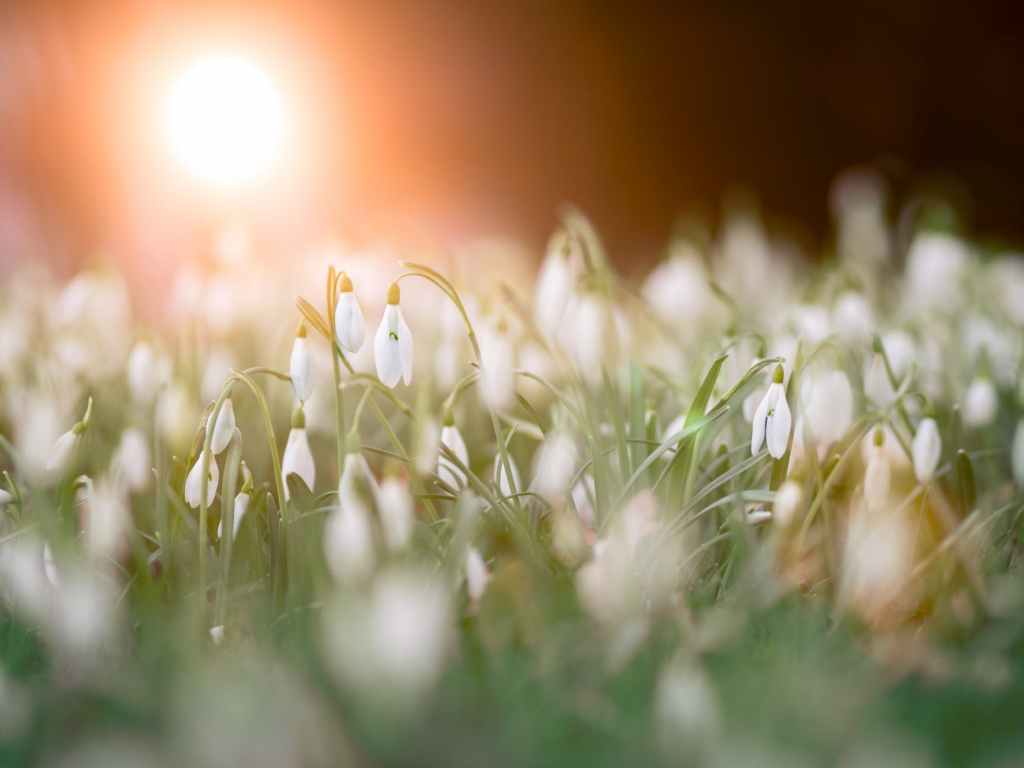
According to the calendar, it is spring in Michigan right now. But we’ve experienced nearly all four seasons in the past two weeks! Some days were mild and sunny, others were rainy, windy, chilly, and a couple of days were even blustery with snow and sleet! Flowers have started popping up, birds have been chirping, even as the snow flies! My hall tree is covered in jackets, winter coats, hats, scarves, and caps. A few days, I’ve been in short shirt sleeves and sunglasses; the next days, I’ve needed a coat, hat, and gloves!

But even in days of chaotic weather, God is faithful! Even when I can’t decide what to wear, God is with me. If it should suddenly snow in June (and that HAS happened in Michigan before), God will not abandon me. Just as each day brings its own weather, each day brings God’s blessings.

Some days those blessings may include sunshine and bird song. Other days may include a much-needed hug from a friend, or a shoulder to cry on. Some days will bring both joy and sorrow, with God in the center of each. Each raindrop, each chattering squirrel, each beam of sunlight– all testify to God’s enduring presence. Each bud on the tree, each new tadpole, each wildflower in the forest, remind me that God is faithful to bring new life out of even the dead of winter.

Spring is a wonderful time to reflect on the goodness of God, and His wisdom in creating seasons– wet, dry, cold, hot, restful, chaotic– God is master of all the seasons, and all the days of our lives. And that is a bright thought, no matter what the weather brings today!


May Day Mishaps

Today is the first of May– May Day. May Day has a long history, with pagan origins tied to the celebration of late spring or early summer. In many European nations, there would be dancing around a May Pole, or May bush, floral garlands, and floral bouquets offered at various shrines, including to the Virgin Mary. In some communities, girls vied to be crowned the “May Queen,” while stories were told of fairies. May Day was popular in the United States for many years around the turn of the 20th century– with parades, flower baskets, and more. It is less popular in modern times, and many of the floral parades and festive outings take place around Memorial Day, instead.

When I was a child in elementary school, we made paper “flowers” and a small paper coronet with a loop handle for May Day. I remember making daffodils, hyacinths, and tulips out of construction paper and other craft materials, and making the coronet “baskets” out of decorated paper cones. We glued or stapled the pieces together to take home. Then, we were encouraged to loop the handle over the door knob at the front door of our house when we got home, knock, and run and hide around the corner. Presumably, our mothers or babysitters would see the gift of flowers and wonder who could have left them there. It was a fun game to play, and a way to celebrate the season of wonderful spring flowers.

Unfortunately, when we did this in kindergarten, my flowers got trampled on the bus. It was a rainy day, and my flowers fell in the aisle, where a boy stepped on them with muddy sneakers. They were ruined. I cried and cried, and another boy on the bus gave me the flowers he had made. It was a thoughtful gesture– one I’ve never forgotten– but I remained desolate. I told my mother the whole sordid story, and she told me that, in her day, they had picked wildflowers, such as violets and even clovers, and tied them with a string to leave on someone’s porch. Then she took me outside, and we made a small bunch of violets with a couple of “Dutchman’s Breeches.” I didn’t get to surprise her, but we had such fun looking for wildflowers together.

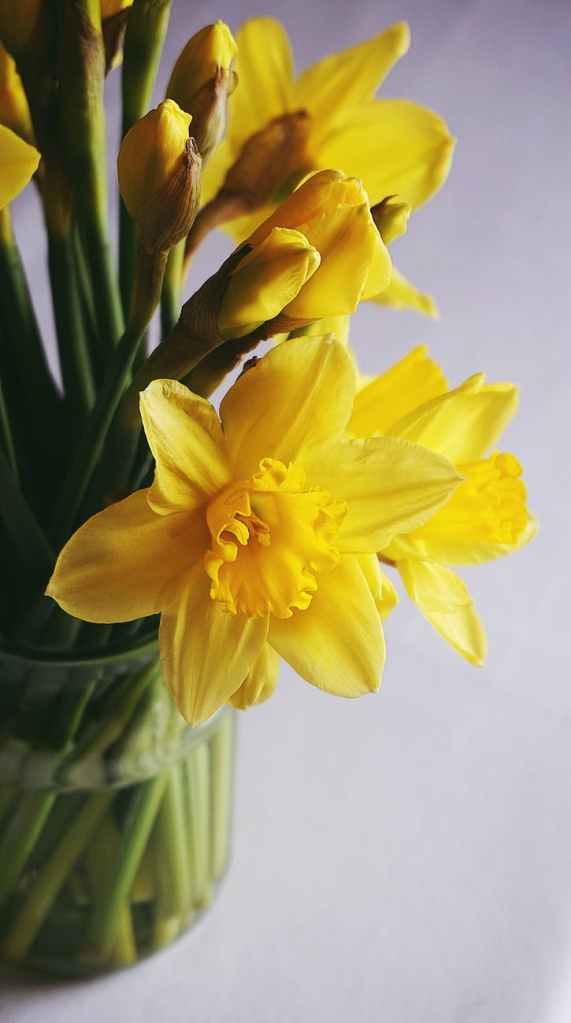
I loved this game so much, I decided to go a step further the next year. We made paper “bouquets” at school, just like the previous year. Mine stayed clean and dry, and I hung it on the doorknob and mom pretended to be surprised. But later, I took one of our juice glasses from the cupboard, and picked a nice bunch of my mom’s live daffodils and hyacinths, a couple of her irises, and a tulip. I tried to arrange them in the juice glass, but it was too short and small to hold all the flowers I had picked. I left it on the porch, near the door, and knocked and hid, waiting to see my mom’s delight at her “surprise” bouquet. But instead of delight, I heard her wail– “Oh, no! My flowers!” The glass had tipped over, the flowers lay limply all over the porch, and the glass had rolled onto the ground. I thought I had made a wonderful surprise. Instead, I had made a mess. I had picked almost all of Mom’s best daffodils, and all of her pink hyacinths. I had trampled some of her other irises to get to the one I wanted. She only had a few tulips, and I had picked the only red one.

My intentions were good, but my execution was poor. And the result was disappointing and hurtful to us both. Mom didn’t realize I was right around the corner hearing her dismay, and I didn’t realize my “gift” would fall so flat.

It’s been over 50 years since my “May Day Mishap,” but there are some lessons I have never forgotten:

  • Picked flowers die! Mom wasn’t angry with me for wanting to pick flowers, but she knew that picked flowers would wilt and die. In later years, Mom loved receiving hanging flower baskets, and planters with live flowers. And we had many memories of planting live annuals in the front yard or at graves near Memorial Day– flowers that might take root and spread joy throughout the summer months. In the same way, there are so many “showy” projects that vie for our attention– projects that may seem urgent or offer quick rewards like status or money. We are tempted to “pick” projects that will make us look good or feel good in the moment. But the really important projects are those that have lasting impact, even if they don’t “show” as well. We are wise to invest in “little” things that have lasting impact over “big” but fleeting activities and investments.
  • When giving gifts, it really is the thought that counts! My mom was just as delighted by the “second-hand” flowers I got from my classmate as she was by the the ones I made the next year. Not because his were “better” than mine, but because they demonstrated that I had a good friend at school with a kind heart. My “mishap” gift came, in part, because I wanted to give a “better” gift, not because I wanted to delight my mom, but I wanted to impress her. My mom was a saver– she saved all my old school papers, old valentines, birthday cards, and more. And she saved letters from her friends and family– over eighty years of them! Not because the cards and letters themselves were so wonderful, but because each one came with good wishes. She had an entire farmhouse of good wishes and thoughtful memories when she passed away in 2023.
  • Relationships are more important and more valuable than resources. I loved looking for wildflowers with my Mom that year of kindergarten. It’s one of my favorite memories of May Day. And I still remember the kindness of my friend, Ken, whose heart has since led him to the mission field on more than one occasion. No May Day flowers will last over fifty years, but friendships and relationships can and do!
  • Forgiveness is sweeter than flowers. I was so astonished to think that my error in judgment had caused my mother pain– and yet, when she found me, she hugged me tight and gently offered both forgiveness and correction. She demonstrated exactly the way our Father loves us. So often, I want to come to God with a bouquet of praise, or a basket of good works, leave it before His Throne and run away and hide. But God isn’t impressed by my flowers or my grand gestures. He wants to spend time with ME. Every year, he sends fields of wild flowers; in every season of life He sends friends, helpers, and other blessings. And, more than anything, He wants to share all of it with me. Not because I deserve it, but because He is so full of love and forgiveness. He wants to remind me to “come home” to His gracious arms. He is not waiting to scold me, punish me, or make me feel small. He wants to hug me, and with patience and gentleness, He will offer His Love, and correction. No matter what “May Day Mishaps” I may have.

This May Day, I am encouraged by God’s faithfulness, His forgiveness, and the power of His love. I hope you are, too!

No Greater Love…

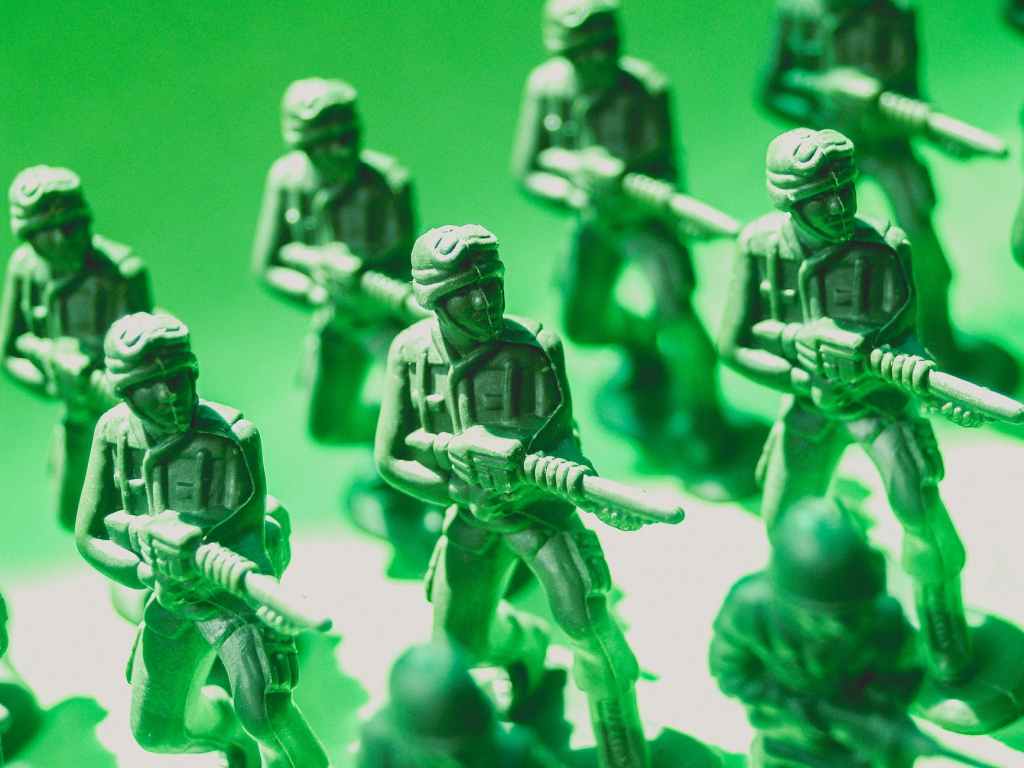
This coming Monday we will be celebrating Memorial Day in the U.S. It is a day to remember those who gave their lives in battle, defending our nation, our people, and our way of life over the course of almost 250 years. We decorate the graves of fallen soldiers with flowers and flags and plaques honoring their sacrifices. It is a strange sort of “holiday.” We don’t like to think of wars and battles– we ache for those who are terrorized by wars in the current days. We don’t celebrate war and violence– our highest goal is to achieve and preserve peace and safety. And it can seem somewhat morbid to “celebrate” the fallen soldiers of bygone days.

Photo by RODNAE Productions on Pexels.com

But we are not celebrating their deaths. We are celebrating the causes for which they fought and died. We celebrate freedom, and justice; the rights of individuals to pursue liberty and fulfill their dreams. These are causes worth fighting for, and yes, even dying for. We mourn the loss of life, and we grieve the necessity of fighting and struggling to preserve basic rights. But we are grateful for and humbled by the examples of those who have shown the courage and strength to give their all. We honor these sacrifices when we decorate the graves of fallen soldiers, or hold services and memorials at cemeteries. It is not meant to be a time of joyful celebration, but a time of solemn reflection and humble gratitude.

Photo by Pixabay on Pexels.com

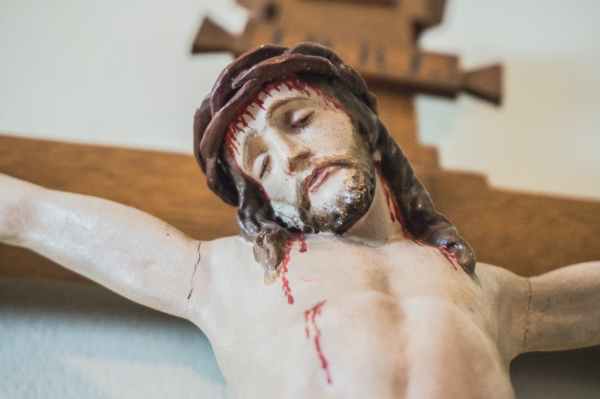
But Memorial Day can also be a time of reflecting on an empty grave– that of Jesus Christ, who gave His all for a cause even greater than liberty and justice in a particular nation or time or for a particular group of people. Jesus gave His life to reconcile an unholy human race with a Holy and Righteous God. He fought against Sin and Death, and conquered them both. And we cannot decorate a grave to honor His sacrifice, because, unlike all the soldiers we honor next week, Jesus did not just preserve a cause or a way of life– He became Life for us. His grave is empty as a symbol of Death’s defeat!

It was Jesus Himself who said, “Greater love has no one than this, that one lay down his life for his friends.” (John 15:13 NASB) Soldiers who lay down their lives often do so to save the lives of their comrades at arms– their friends and fellow warriors– as well as their countrymen and women, their neighbors, and their families. And it isn’t just soldiers who give their lives. Recent news stories tell of teachers, police officers, and other individuals who have sacrificed their lives for the sake of innocent shoppers, students, and neighbors. Such sacrifices are tragic, but they are also heroic, and deserving of our acknowledgement.

We take time to honor those who died for a cause. How much more should we honor the One who died to bring eternal freedom and life to each one of us! And how much more should we be willing to give our lives for the sake His Kingdom! There is no greater love that we can show.

Photo by RODNAE Productions on Pexels.com

Mayday!

Today is the first of May. This is also known as May Day or Mayday. In many countries, there are traditional celebrations, including dancing around a May Pole, or leaving a small bouquet of fresh spring flowers on someone’s doorstep. It is meant to be a happy occasion, signaling the arrival of spring flowers after a month of showers and growth– the promise of more growth and greenery after a long winter and cool, wet, spring.

Photo by Suzy Hazelwood on Pexels.com

This year, many people have been looking forward to May 1 as a potential “end” to the lockdown/shelter-in-place orders. They are eager for a chance to return to “life as normal,” including spending time in parks and gardens, and celebrating with friends. They long to chat, mingle, and dance with their friends and loved ones in the sunnier, greener weather. Others are just tired of being “cooped up,” and want to get out into the busy marketplaces and public squares. But many leaders (mayors, governors, ministers, presidents, etc.,) are extending the orders to continue social distancing during this pandemic season.

There is another meaning for the phrase “Mayday!” It is an urgent call for help. It comes from the French phrase m’aidez– help me–and is used mostly in radio transmissions from ships in danger. Many people around the world today are, figuratively or metaphorically, calling out “M’aidez!” They are calling on their political leaders, financial institutions, hospitals, emergency workers, and others for help– healing, testing, equipment, food, answers to impossible questions, guidance, and comfort. For many, it feels like drowning in a sea of uncertainty and danger.

Photo by stein egil liland on Pexels.com

Even in times of uncertainty and danger, we have a Faithful and Loving God. When we cry out, “Mayday! Help!”, He is ready and able to answer our call:

I cried unto the Lord with my voice, and he heard me out of his holy hill. Selah.

I laid me down and slept; I awaked; for the Lord sustained me.

6 I will not be afraid of ten thousands of people, that have set themselves against me round about.

Many times in his life, David had called on the Lord, and found him faithful– to protect him, rescue him, bless him, and forgive him. David danced and celebrated God’s provision for Israel, and he also cried out in anguish and bitterness of soul. And in every situation, God heard David’s “Mayday! M’aidez!”

Photo by icon0.com on Pexels.com
  • King David’s descendant, King Hezekiah, also cried out to the Lord. He led the entire nation of Israel in celebrating a magnificent Passover feast and a Festival of Unleavened Bread. He also built up and fortified walls that had been allowed to crumble. He strengthened a weakened nation. In spite of his measures, however, the nation was threatened with invasion and destruction by a powerful Assyrian army. https://www.biblegateway.com/passage/?search=2+Chronicles+32&version=ESV But Hezekiah, along with the prophet Isaiah, sent up a “M’aidez!” to God, and He answered in a mighty way: 20 Then Hezekiah the king and Isaiah the prophet, the son of Amoz, prayed because of this and cried to heaven. 21 And the Lord sent an angel, who cut off all the mighty warriors and commanders and officers in the camp of the king of Assyria. So he returned with shame of face to his own land. And when he came into the house of his god, some of his own sons struck him down there with the sword. 22 So the Lord saved Hezekiah and the inhabitants of Jerusalem from the hand of Sennacherib king of Assyria and from the hand of all his enemies, and he provided for them on every side. 23 And many brought gifts to the Lord to Jerusalem and precious things to Hezekiah king of Judah, so that he was exalted in the sight of all nations from that time onward.
  • The Apostle Peter called out as he was sinking into the waves. https://www.biblegateway.com/passage/?search=matthew+14%3A22-32&version=NIV His faith, which made him to want to walk out to Jesus on the water, faltered. Peter knew the danger of open water, he faced such dangers in his fishing boat nearly every day. Without a miracle, he would sink below the wind-churned waves and be unable to make it back to the boat or swim all the way to shore. He cried out, “Lord, save me!” “M’aidez!” And Jesus was there to hold his hand and bring him to safety. Later in life, Peter went forth boldly preaching the Resurrection of Jesus, and spreading the Good News that Jesus Saves! Peter knew from first-hand experience that Jesus not only brought physical salvation from storms, but He offered spiritual salvation, renewal, and hope. In fact, it is in one of Peter’s epistles that we find this verse of hope: “..casting all your care upon Him, for He cares for you.” (1 Peter 5:7)
Photo by Guy Kawasaki on Pexels.com

This May Day, we may call out to God in desperation, or in celebration, or both. But let’s take every opportunity to call on His Holy Name.

Photo by 3Motional Studio on Pexels.com

Consider the Lilies..

We just celebrated a most unusual Easter– traditions, like gathering at church for sunrise services or grand cantatas, big family meals, Easter Egg hunts, and parades had to be re-imagined, or cancelled. And one Easter tradition that didn’t get a lot of press attention was the damage done to the Easter flower market. Lilies, hyacinths, daffodils, and other spring flowers–some grown locally, others imported from around the world–were unable to be shipped or sold as people are in quarantine. Churches and restaurants, two of the largest consumers of Easter Lilies, had to cancel their orders for this year. People who normally buy lilies from garden centers or florists were unable to do so, and those who grow them were unable to ship them out or sell them. Literally millions of flowers had to be burned, composted, and destroyed during this season of “new life.” Flowers for funerals, weddings, and birthdays were also lost, and millions more will be lost as we approach Mother’s Day next month. What a waste of beauty and life!

Photo by Alena Koval on Pexels.com

And yet..

Some will say that it is a waste of time to mourn the loss of flowers when we should be mourning the loss of human life to COVID-19. I don’t think it is an “either/or” kind of mourning. There is a lot to mourn during these days, and we should not be ashamed to mourn–loss of connection, loss of beauty in the form of flowers, loss of jobs and prosperity, loss of opportunities– many of which we take for granted.

Photo by Italo Melo on Pexels.com

But Easter is not about our loss– in fact, it is not about loss at all. It is about victory and hope and ETERNAL life– not the life of a lily or even a human body– eternal, joyful, victorious life given to us as a gift for all who will receive it! If we are missing a beautiful symbol of that victory this year, we can never be deprived of the reality the Lilies represent!

Photo by Pixabay on Pexels.com

I am reminded that Jesus (and others in the Bible) had a lot to say about Lilies..and grass, and other plants, and their relation to human life. https://www.biblegateway.com/passage/?search=Matthew+6%3A25-34%2CLuke+12%3A22-32&version=ASV https://www.biblegateway.com/passage/?search=Psalm+103%3A15-17&version=ESV
https://www.biblegateway.com/passage/?search=1+peter+1%3A22-25&version=ESV

Photo by Simon Matzinger on Pexels.com

In this season, many of us are feeling very much like the “lilies of the field.” Our lives seem uncertain, our days unproductive, even futile as we wait for this crisis to pass. We miss these symbols of beauty and new life, but we must not place our hope in the symbols. We must not place our hope in what we know or what we do or what we own. Jesus reminds us that we are– our souls, our lives, our hopes, our thoughts, and our longings– worth far more than lilies or sparrows– God knows what we need, and His love for us doesn’t depend on our being “essential”, or healthy, or having all the answers.

Photo by Porapak Apichodilok on Pexels.com

This season reminds us that our lives here are precious, and temporary as the grass. But our existence is both precious and eternal–and thanks to the very God who clothes the lilies of the field, we need not worry or fear what lies ahead. All who turn to Him will be saved. We are not destined to be burned or composted or forgotten. We may face uncertain days ahead, but God has a purpose and a plan for us to bloom– not just for a season, and not just to adorn a building or a home, but to bloom for eternity in His very presence!

Bloom Where You Are Planted

I love living in Southwest Lower Michigan– especially in the spring.  We have blossoms everywhere– apple blossoms, cherry blossoms, dogwood, red buds, tulips and irises, hyacinth and daffodils.  The rich earthy smell of freshly plowed gardens and fields permeates the air, and rides on the breezes coming off Lake Michigan.  Birds, newly returned from their winter wanderings are busily building nests, chirping away, while the sun’s rays chase away the last of the winter chill each morning.  There is color and new life everywhere you turn.

pexels-photo-165542.jpeg

We have a lot of spring festivals in the area, most of them centered on the blooms and blossoms that fill the countryside.  Gardens, orchards and fields are not just for show around here– they are also important parts of our economy and eco-system.  Without a good spring full of blossoms, buds, and blooms, we may have a disastrous harvest in the fall, and run-off of the soil; bees will die off, wild and domestic animals will have less grass and fewer berries to eat.  A late spring can shorten the growing season and shrink the harvest; an early spring can bring buds out too soon, only to have them lost to a late season frost or to have them mature too early and be burned in a mid-summer drought.

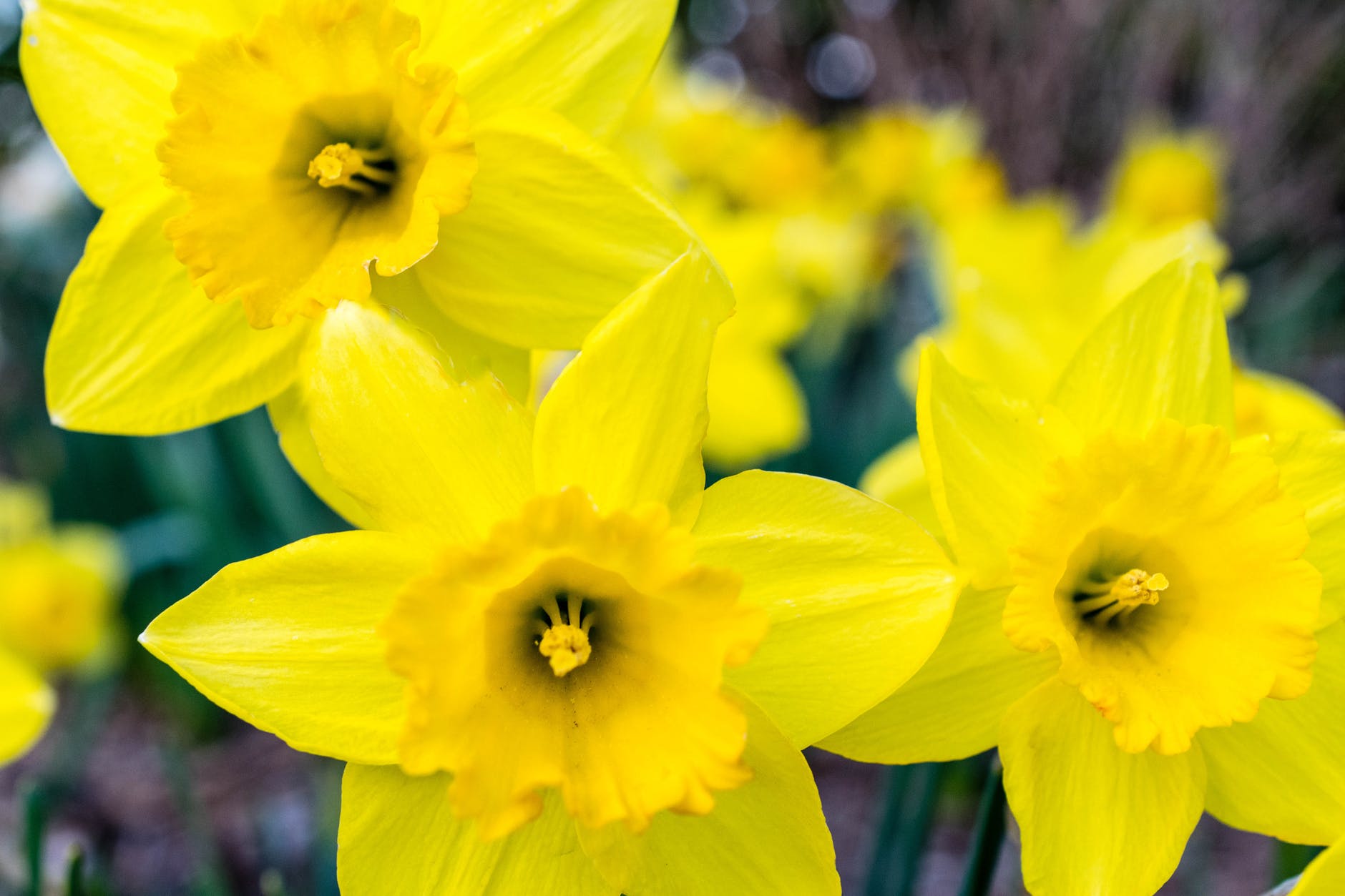
And yet, I have seen crocuses burst through two inches of snow; buds that defy harsh weather and cruel winds.  I have seen daffodils blooming where there once was a house and a yard, but now there are only brambles and foundation stones.  I have seen trees twisted and split by long-ago storms– one side dead and rotting, but with buds and new branches on the other side.

crocus-flower-spring-purple-60120.jpegpexels-photo-1031413.jpeg

It is easy to bloom when you are in a lovely flower bed, with tilled earth, fertilizer, gentle rains, just the right amount of sun, and protection from the winds and pests and birds.  But it is more spectacular to bloom in the desert; to defy the odds and stand in stark contrast to brambles, a broken-up sidewalk, or a litter-filled back alley; to bloom in the snow and sleet or weather a flood or a tornado.

pexels-photo-1035739.jpeg


Not always so with prayer.  Sometimes, it is easier to pray when we feel our own needs and shortcomings; when we are driven by our circumstances to call out for help.  When all is well, we may be grateful, but we may also begin to slack off.  We stop asking for wisdom and guidance, coasting in the beauty and ease of a good life, and forgetting that the beauty and the ease– indeed the life itself– is not our right, but a gift.  Amid so many other beautiful prayers, ours seem drab and ordinary, almost unworthy of God’s notice.

But God DOES notice– he has placed each of us where he wants us to bloom and grow– to pray, to fellowship, to walk with other believers and give off the fragrance of His grace as we live our lives in obedience to Him.  Have you been planted in an apartment complex?  Have you been planted as a suddenly single parent of three kids?  Have you been planted on a campus?  In a group of friends that all have Harleys?  Or one block from a rescue mission or homeless shelter?  A classroom full of high-energy first-graders?  A community that has had a lot of crime and blight?

pexels-photo-991681.jpeg

God has not placed you in circumstances to reward or punish you, but to grow you in the soil that can produce the best harvest.  Is your prayer list filled with needy people who live in turmoil and rebellion?  Bloom where you are planted– you may be the only person praying for your cantankerous neighbor– the only raindrop or fertile soil s/he will ever encounter.  Has God placed you in a family of people who taunt you for your faith?  Bloom where you are planted– pray for strength to stand firm in the beauty of meekness and compassion in the face of their taunts and disdain.  Are you in a greenhouse full of self-righteous orchids making you feel dowdy and wilted by comparison?  Bloom where you are planted– pray for God’s eyes to see the beauty in yourself, as well as those around you, and stop trying to be an orchid where God needs a lily.

Has God planted you in trying circumstances?  Bloom where you are planted– pray for God’s Peace as you face each day:

Matthew 6:25-34 English Standard Version (ESV)

Do Not Be Anxious

25 “Therefore I tell you, do not be anxious about your life, what you will eat or what you will drink, nor about your body, what you will put on. Is not life more than food, and the body more than clothing? 26 Look at the birds of the air: they neither sow nor reap nor gather into barns, and yet your heavenly Father feeds them. Are you not of more value than they?27 And which of you by being anxious can add a single hour to his span of life?[a] 28 And why are you anxious about clothing? Consider the lilies of the field, how they grow: they neither toil nor spin, 29 yet I tell you, even Solomon in all his glory was not arrayed like one of these. * 30 But if God so clothes the grass of the field, which today is alive and tomorrow is thrown into the oven, will he not much more clothe you, O you of little faith? 31 Therefore do not be anxious, saying, ‘What shall we eat?’ or ‘What shall we drink?’ or ‘What shall we wear?’ 32 For the Gentiles seek after all these things, and your heavenly Father knows that you need them all. 33 But seek first the kingdom of God and his righteousness, and all these things will be added to you.*

34 “Therefore do not be anxious about tomorrow, for tomorrow will be anxious for itself. Sufficient for the day is its own trouble.

*Emphasis added

Blog at WordPress.com.

Up ↑