There is a distance– A yawning, gaping separation Between me and my loved ones, Between families and friends, Between us and each other, Between us and YOU.
And yet, You are here, Waiting, whispering… Words of hope and comfort, Words of healing and peace, Words of love and unity.
You are life. You are truth– Brighter than fear, More powerful than death, Closer than our next precious breath.
Banish the distance, Lord. Banish the fear and loneliness; Banish the chaos and darkness; Bring us –all of US–together– In peace In health In hope, In Your eternal Love.
GOD–Almighty, Bountiful, Compassionate, Deliverer, Eternal, Faithful, Glorious, Holy, Incomprehensible, Just, Kind, Loving, Merciful, Noble, Omnipresent, Perfect, Quick to listen, Redeemer, Sovereign, Trustworthy, Unchanging, Victorious, Wise, EXcellent, Yahweh, Zealous. Father, let me fix my eyes, my mind, my soul, on YOU. Let me see you; let me stay close by you and be true to you. Let me reflect you and share your glory today.
LOVES–Adores, Blesses, Cares, Delights, Encourages, Favors, Gives, Holds, Intercedes, Justifies, Knows, Listens, Ministers, Nears, Ordains, Protects, Quiets, Reveals, Sanctifies, Treasures, Understands, Values, Watches, EXhorts, Yearns, Zeroes in… Jesus, your love for me is beyond anything I can imagine. I don’t understand it, I don’t deserve it, and I can’t be separated from it. It hems me in and holds me close– even when I don’t see it. I thank you and praise you for BEING love; for showing love; for sending your Son; for showering me with your mercy; for showing me how to share your love with others.
YOU. No long alphabet list– just let that sink in. God LOVES you. He adores and pursues YOU. He wants to spend an eternity with YOU– helping you become the YOU you were always created to be! Lord, let whoever may read this to know and experience the power of Your love, today. May they be wrapped in Your mercy and grace. May they be strengthened and encouraged in the warmth of Your invitation to COME to You.
On this Good Friday, it may seem redundant and unnecessary to point this out, but Jesus died. As the world around us faces a global pandemic, we are forced to face our own mortality. People are dying from COVID-19– people we know; people we know about; people we have never met. Their deaths are more than just statistics. They represent personal loss to all their friends, family, and people in their communities. Jesus’ death was more than just another execution– more than just another dead body to be disposed of before the start of the Sabbath.
Jesus. Died. Emmanuel– God with us– died. Ceased to live. Bled out and stopped breathing. His body was cold and lifeless, wrapped in burial cloths and laid in a tomb. This was not just like sleeping, or missing a heartbeat. He was gone. This is not normally cause for celebration– this was not a “Good” Friday.
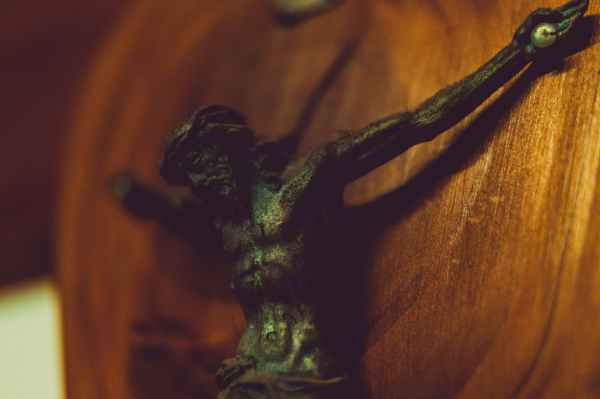
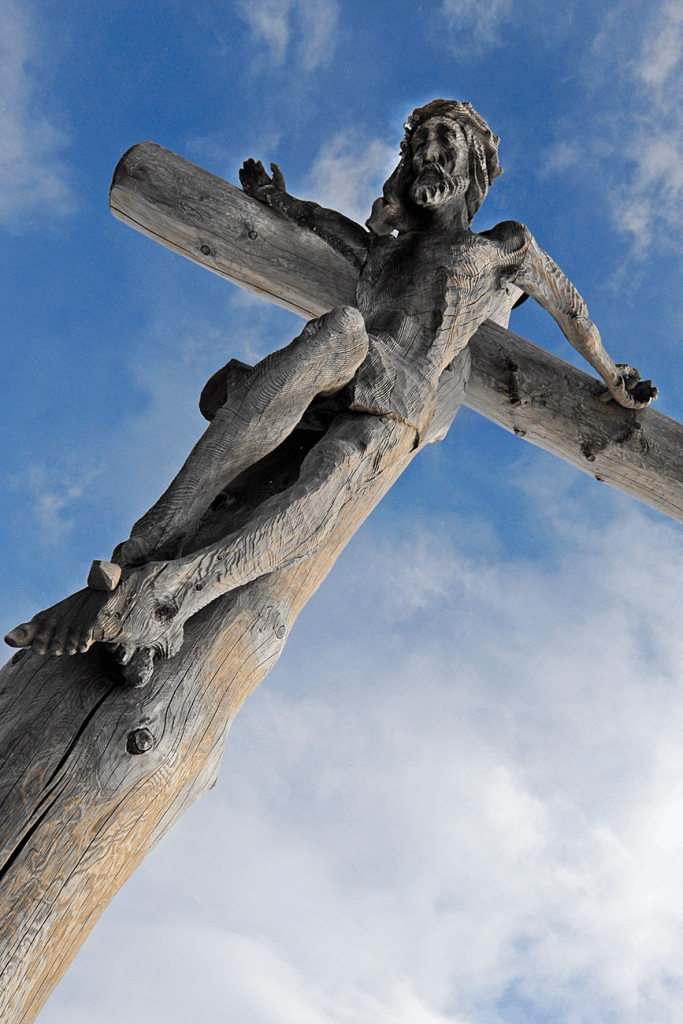
Jesus was not the only religious leader to die at the hands of enemies or rivals. The fact that his followers would commemorate or memorialize his death is not unusual or incomprehensible. But Jesus wasn’t just assassinated. He was condemned to die as a criminal. His death wasn’t just shocking or violent– it was humiliating, vile, excruciatingly painful, and involved public ridicule and anguish. There is nothing glamorous or brave or victorious about a cross. Christians who wear cross necklaces or t-shirts with blood-covered spikes might just as well wear handcuffs or ankle bracelets, or a picture of Jesus in an electric chair to show their devotion to a man who died as a criminal. Even though Pilate declared that he could find nothing wrong, he still allowed the conviction and death sentence to stand. Jesus didn’t win against his enemies– he lost, and he lost everything.
In our rush to celebrate Easter, and the “rest of the story,” sometimes we lose sight of the cross. Jesus– creator of the universe, perfect in the eyes of the law, beloved by God the Father–died a cruel, humiliating, senseless death. Those who are dying today of COVID-19 are struggling for their next breath, exactly as Jesus did so long ago. Jesus did not just “give up,” he didn’t just go into a coma as a gesture, knowing he would wake up in three days anyway, so why struggle for that next breath, or push through that cramp in his arm or leg, or let the sweat and blood from his forehead run into his eyes, unable to wipe them away or keep the flies from landing around his nose or ears… Jesus died– He heaved and strove and agonized until his heart and lungs and muscles could do no more.
We talk about Jesus as the “Lamb of God, who takes away the sin of the world” (John 1:29). Earlier in Israel’s history, God rescued the entire nation of Israel from their slavery to the Egyptians. He caused the angel of death to visit all of Egypt and kill all the first-born throughout the land. (https://www.biblegateway.com/passage/?search=Exodus+12&version=ESV)
All of Passover is a foreshadowing and visual representation of what was to happen at the crucifixion. Jesus became the sacrificial lamb, whose life would be given, and his blood be used, to save us from death and destruction, and allow us to be free. His body was broken, just like the bread of the Passover, to give us life.
Just as the lamb’s blood was placed on the sides of the door posts, Jesus’ blood stained the two ends of the cross where his hands were nailed. It stained the top and bottom of the cross where his head and feet bled, just as the lamb’s blood was placed on the top of the door frame and dripped to the ground beneath.
Jesus became a metaphysical “doorway”, painted with blood, through which we can enter into a place of safety, forgiveness, and promise. But only by going through the door– only by trusting fully in the work of Jesus’ death (and resurrection)– that we can be saved.
It wasn’t merely the act of painting the lamb’s blood on a door that saved anyone– it involved going into the house, and obeying the word of the Lord. It was wrapped up in preparing for a journey in which they would leave behind their slavery and old way of life, and walk through uncharted territory, led by God’s spirit, to a land of promise they had never seen. No Egyptian, by merely smearing blood on the doorposts or wrestling with the angel of death, or wearing a mask or staying behind locked doors, could defeat the plague. No Israelite could ignore God’s instructions, and roam the streets, trusting the the blood on the doorposts would cover him three blocks away. Death–and life– came on God’s terms. Wearing a cross necklace and “looking the part” won’t substitute for true faith that results in repentance, obedience, and discipleship.
Jesus died. And he rose again! But he didn’t do it so we could sail through life on our own terms. He came to show us that God can take our slavery, our sin, our failure, our sickness and sorrow, even our death– even senseless, humiliating, forsaken death– and give victory, life, and peace to those who follow Him.
“Do This in Remembrance of ME” Remember My Creation. Remember My Life. Remember My Humble service. Remember My Death and Resurrection. Remember My Victory. Remember I am Coming Soon!
I worked for many years at a public library doing pre-school story time programs. One of the favorite songs among the children was “Head and Shoulders, Knees and Toes.” Children love rhymes, music, and movement, and this song involved all three. Children stood, ready to stretch and bend, point, and sing: “Head and shoulders, knees and toes, knees and toes.” Their hands flew from one body part to another as we sang, faster and faster. “Eyes and ears and mouth and nose; head and shoulders, knees and toes, knees and toes.” Faster and faster, louder and louder, the excitement growing, until the song ended in a breathless shout, “Knees and toes”!
Another favorite was the “Hokey Pokey”, in which we formed a circle and took turns “putting in” and “putting out” various limbs and body parts, “turning (ourselves) about” and clapping. We “put in” our right arms, our left legs, our heads, and “our whole selves.” From the earliest of ages, we become aware of the various parts of our bodies, their names and functions, and how they work together.
As God’s people, we are to be the “Body of Christ” (1 Corinthians 12:12-14) and our bodies are to be His temple(1 Corinthians 6:19). It is important that we recognize how every part of our body needs to be consecrated and ready to serve, to worship, and to reflect God’s Glory.
This is not a new concept. In fact, much of the book of Leviticus is given over to consecrating every aspect of the worship of God by His children. There are detailed instructions for the priests– how and when to enter the Tabernacle; what to wear, what kind of offerings to bring and how to prepare for service. One set of details involves the installation ceremony for the priests. They were to wash from head to toe, before putting on the sacred garments. They were to offer a blood sacrifice, and some of the blood was to be placed or smeared in three places– the lobe of the right ear, the thumb of the right hand, and the big toe of the right foot (Leviticus 14:28).
Scholars through the years have given us many reasons for these detailed instructions (see this link for a terrific overview) https://www.myjewishlearning.com/article/ears-thumbs-and-toes/, and most of them bring out the idea that God wants us to worship and be consecrated “from head to toe.” God has authority over how we choose to use our ears, hands, and feet– He wants purity in our words and deeds. He wants us to listen to Him, obey Him, and follow Him.
The smearing of blood in these three areas also demonstrates a need for atonement– only blood can cover or atone for our lack of attentiveness, our lack of obedience, and our open rebellion against God’s authority. The blood of the ritual sacrifices in Leviticus are a foreshadowing of the ultimate atonement we receive from the sacrifice of the Only True Lamb, Jesus Christ. Christ takes away our sin, and consecrates us to His service and worship– from head to toe!
And, unlike the Hokey Pokey, THAT’S what it’s all about! God gives us His life and purity, His Grace and forgiveness, His divine purpose and eternal Glory when we “put our whole selves” in His hands, and He “turns us all about,” to become more than conquerors (Romans 8:37), a royal priesthood (1 Peter 2:9), and the sheep of His pasture. (Psalm 100:3)
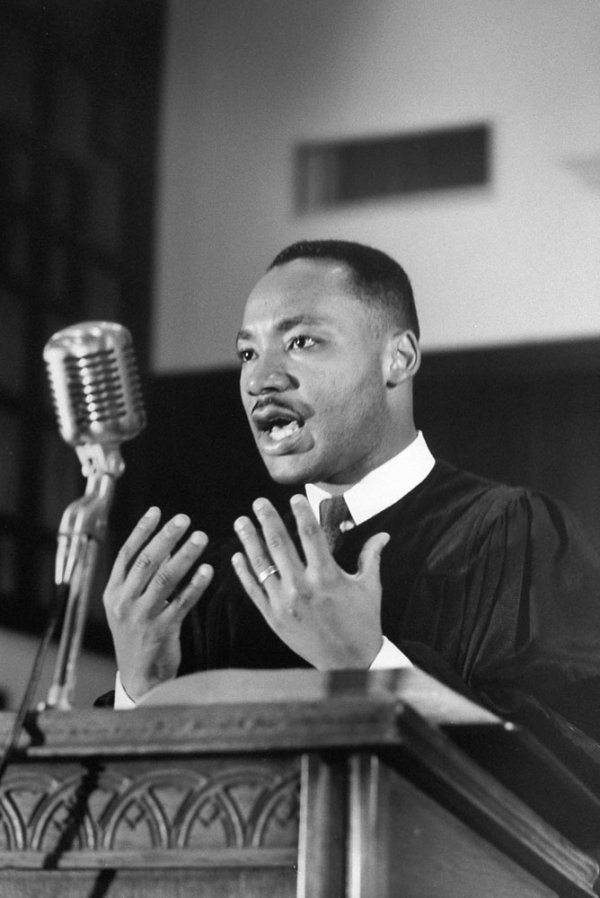
Last week in America, we marked two important dates. We celebrated the birth of a great hero, patriot, and statesman, Martin Luther King, Jr. And we marked the 47th anniversary of the Supreme Court decision, Roe v. Wade, which effectively legalized abortion across the land.
The life of Dr. King was marked by hardship, oppression, violence, and assassination at the age of 39. Dr. King was a brilliant student and gifted speaker. He led peaceful protests and civil rights marches calling for justice and equality under the law for all people. More than 50 years after his death, there are still issues of racial discrimination and racial tensions in this country. The disproportionate loss of life and liberty among blacks in urban areas has led to a new round of protests, some of which go under the name of “Black Lives Matter.” There is a feeling that, especially with the police and government officials, black lives don’t matter– that black lives are devalued and dismissed as less deserving of respect and protection.
In light of this, there has been “push back” from those who argue that “ALL Lives Matter”, or that “Blue Lives Matter” (blue for police who have become victims of mob violence and angry crowds who feel that the police are responsible for racism and corruption). The argument is that groups like “Black Lives Matter” are not so much about bringing awareness or promoting justice, but are meant to divide us as a nation and exact revenge for past offenses, slights, and perceived slights.
There is speculation about what might have happened if Dr. King had not died when he did. Would he have continued leading non-violent protests? Would the Civil Rights movement of the sixties gained more momentum under Dr. King’s leadership? Would our nation have achieved a new dawn of equality, freedom, and unity, greater and stronger than what we have seen in the last five decades? Would Dr. King be pleased with the progress we have made, or ashamed? Did his life make a difference? Yes. But was it “enough” of a difference? Does it matter to a young person of color growing up in Baltimore or Chicago that Dr. King spoke out, marched, and died for a dream that seems frozen in time and unfulfilled?
Just two days after our nation wrestled with that uncomfortable memory, we marked one even more controversial. In 1973, our Supreme Court ruled that no state could prohibit abortion. The decision also limited the ability of states to restrict abortion. Since that decision, an estimated 60 million Americans http://www.numberofabortions.com/ (not to mention infants around the world) have been denied the right by legal practice to be born. This is roughly equal to the number of people killed in World War II, though estimates of both numbers vary by source (https://www.nationalww2museum.org/students-teachers/student-resources/research-starters/research-starters-worldwide-deaths-world-war)
In looking at abortion, we see millions of lives who were determined NOT to matter. They didn’t deserve respect, protection, liberty, education, dreams, food, shelter…not even breath and a heartbeat!
Oh God– let us see life as YOU see it. Every life matters infinitely to You. You have created all life–unique, precious, priceless, glorious, fragile, and yet eternal. You walked among people, healed the sick and broken, reached out to the outcast and isolated, welcomed children, and brought the dead back to life. In Christ, you took on human life– breathed the air, knew joy and pain, weariness, hunger, and strife.
One life– every life– matters. It matters, not because we are important to the world, but because we are precious in the eyes of our creator. We celebrate the life of Dr. King, because we was considered important in the history of our nation. But God celebrated Dr. King’s life from the moment of his conception. God knit him together in his mother’s womb, just as He does for each of us. God knew the moment of Dr. King’s birth. He saw every tear, heard every laugh, felt every bruise that Dr. King experienced. And God knew the moment of Dr. King’s assassination. He knew the shock and horror it would be for his family. He knew that years later, we would quote Dr. King’s words and even argue about his relevance and impact. But Dr. King’s life mattered to God even if it had been a life of obscurity or failure.
Similarly, and incredibly, every one of those 60 million lives that have been lost to abortion “mattered” to God. He knew and loved them from the moment of conception. And He knew– He KNEW– that they would be aborted; thrown away and discarded by those who should have loved and protected them. And He LOVES those who killed them– their lives “matter” to God as well. Dr. King’s dream was that his children would be judged by the content of their character. God will judge us one day on that basis; but He offers to judge us by the content of HIS character, if we will trust Him to forgive us for the past, and transform us as we live for Him.
Your life matters to God. It has worth and meaning. You are infinitely precious– so much so that God sent His only son to live and to die for your sake. What an incredible love He has for you! What an incredible love He has for every person you will encounter today!
As we approach the arrival of a new year, there is a lot of talk about vision–20/20 vision, that is. For the past few years, I’ve heard of companies, community groups, even churches using the year 2020 as a target date for planning, and using the phrase “2020 Vision” in their mission statements, fund-raising drives, and talking points.
The phrase comes from 20/20 vision, considered clear or “good” vision. Someone with 20/20 vision has no need of corrective lenses or surgery to improve their reading, or correct their sight. Figuratively, 20/20 vision suggests good planning or foresight. So it is desirable to plan with clear “vision” and forethought, rather than jumping into a project, or from one unmet goal to another.
But, while it’s clever to borrow the idea of 20/20 vision and tie it to the coming year, it doesn’t guarantee that our future plans will be wise or successful just because the calendar says 2020. In the same way, just because we have 20/20 vision, it doesn’t mean that we can see everything around us perfectly. We will see clearly those things on which we focus– those things that are right in front of us and not obstructed. Even with “good” vision, we cannot see things that are hidden from sight or things that are outside our scope of vision.
Even the old phrase, “Hindsight is 20/20 vision,” doesn’t mean that we will always gain clarity with time. Sometimes we understand past experiences in a different light after time has passed. But sometimes, we are still left wondering and asking about events from our past; no wiser or less damaged by setbacks or failures, and no better prepared for future trials and pains.
If vision, even good vision and planning, is no guarantee of future success, perhaps it would be better to trust to “blind faith.” After all, doesn’t the Bible say, “walk by faith, not by sight?” Except the Bible doesn’t exactly say that. Instead it says:
6 So we are always confident, knowing that while we are at home in the body we are absent from the Lord. 7 For we walk by faith, not by sight. 8 We are confident, yes, well pleased rather to be absent from the body and to be present with the Lord.
This verse often gets taken out of context and twisted to suggest that “faith” is opposed to “sight,” and therefore faith must be “blind” to reason, experience, or reality. Many good articles and sermons have been written to clarify the concept (see one example here: https://www.biblestudytools.com/blogs/theologically-driven/walk-by-faith-a-misused-verse.html). Faith is not blind–or should not be blind. Rather, it utilizes the ability and practice of seeing what is hidden or indistinct in the present. If our faith is based on empty myth, rumor, conjecture, or cloud dreams, it is not faith at all–it is nothing more than a mirage. Faith is seeing beyond the obvious, the blatantly visible, and trusting more than just what we can immediately see. We don’t walk through life ignoring reality, or dancing across a superhighway full of speeding cars. But we see our circumstances as having hidden elements; our lives have unseen depths, and are lived on both physical and metaphysical spheres. There is more to life than meets the eye– and while faith may not always show us a clear picture of what lies beyond our sight, it causes us to know that something beyond our “20/20 vision” exists and matters.
The great old hymn, “It Is Well With My Soul,” speaks to this as well. No matter what our circumstances look like, we can have confidence that “It is well, it is well, with my soul!” “And Lord, haste the day when my faith shall be sight..” We look forward, even as we look around, and look back to the finished work of Jesus our Savior. We see the present, but we walk in the knowledge that there is more than what our eyes behold.
Faith doesn’t negate the need to use our senses and common sense to navigate life. And using planning and vision for the future doesn’t negate the need for faith. Rather, they work together. And they work together best in prayer.
When we pray, we are exercising our faith– speaking to the One we do not see, though we know Him and trust Him. And we bring to Him our plans and visions and hopes and dreams. We lay them in His Hands, trusting that where our vision is “good,” He will empower and bless us; where our own vision is lacking, His Spirit will help us to refocus and see enough of what lies beyond to keep walking forward.
God’s ways are not our ways. God often turns our expectations on their heads– choosing Abraham and Sarah to become parents at an advanced age; choosing Moses, reluctant, disgraced, and hot-tempered, to shepherd close to a million refugees across the wilderness; choosing David, young and poorly armed to defeat the mighty giant, Goliath; choosing to send His Messiah as an infant, the son of a teenage girl stranded miles from home in a cattle shed…
Not only that, but God chooses to include cryptic and seemingly random details in many of the stories we read in the Bible. When Abraham and Sarah received news that they would become parents, Sarah laughed. Such a small detail, but God called attention to it, even giving the name Isaac (Laughter) to this promised son. When God called Moses, He didn’t just include the details of the burning bush and the miraculous signs, He chose to include Moses’s excuses and objections, and a curious command to Moses to remove his shoes.
Recently, I found a short discussion about the “five smooth stones” David used to defeat Goliath. https://www.biblegateway.com/passage/?search=1+Samuel+17%3A26-50&version=MSG Some teachers spend time talking about the number of stones– why five? Did David doubt God’s power and provision? Can we attach significance or apply principles to each stone? But someone commented (I’m sorry, I lost the reference, or I would attach a link) on the fact that the stones were smooth–I’d never really noticed that detail before. David chose five smooth stones from the brook, not five heavy rocks, not sharp-edged stones of flint, not round balls made of iron– five smooth stones. The smooth stones in the brook may seem like a strange choice to us if we are not used to using a sling, but to David, such stones meant greater accuracy and speed. Five such stones would have been about a handful– easy to carry, load, and fire in rapid succession, if necessary.
I would like to suggest that there are some principles here that apply to both prayer and Christian living, especially involving how we can pray for and interact with the “giants” and “enemies” in our lives:
First, understand the reality of the “Giant”—Goliath was huge; bigger than any single warrior in Israel. But he wasn’t bigger than God. Goliath was also hampered by his heavy armor, his size, and his arrogance. David was offered armor and weapons similar to Goliath’s, but David’s greatest weapon was his understanding that Goliath was no match for the God of Angel Armies! We often make the mistake of magnifying our enemies. We see their size, their shining armor, and heavy weaponry. We forget that God is the maker of smooth stones!
Second, actions really do speak louder than words. Goliath inspired fear; he taunted the army of Israel. Yet he never landed a blow against David. Goliath scoffed, bullied, and talked a good game, but David paired his words with action. Goliath demanded that David (or any other warrior) “Come down to me..” He had a javelin and a spear, but he never used either one. I find it interesting that many “enemies” of the Church behave the same way. They want to challenge the followers of Christ in debates; they publish books and articles filled with arrogant words, accusations, and complex arguments. It is tempting to respond in kind– to get into a war of words; to match their arrogance with our self-righteous assertions. What if we fought their words with action, instead of spending so much of our time answering and defending ourselves against empty arguments and accusations. We will not “win” any culture wars; we will not “win” the hearts and minds of the next generation; we will not “defend” morality by using bigger, better, or more persuasive words, or by having better armor and sharper weapons than our enemies. We need smooth stones from the brook–small acts of kindness and humility and grace that defy all the logic and brute force of those who trust in their own understanding.
Third, accuracy is better than power. Goliath had one spear–and it was impressive–” His spear shaft was like a weaver’s rod, and its iron point weighed six hundred shekels.” (verse 7). Still, Goliath had a javelin, a sword, and several pounds of armor. David had no armor, one shepherd’s staff, and his sling and five smooth stones. But he only used one stone! It was accurate and true; it was sufficient, and it won the battle! Sin likes to flaunt it’s power–shiny armor, impressive weapons.. But if we are “true”–if we hold fast to the truth and follow the words and example of Jesus Christ–if we are faithful in our everyday walk with Christ, it is sufficient. There is an amazing climax in the movie, Star Wars (episode 4, A New Hope), where the young Luke Skywalker is sent with a group of fighters on a seemingly impossible task– destroy the “indestructible” Death Star! There is only one weakness–one small target. Luke’s small fighter plane is old and outdated; he and his fellow soldiers are under attack, and the pressure is on. But Luke’s accurate shot leads to victory. It is a modern retelling of the story of David and Goliath (with several space-age gadgets and extra plot twists). How many of our interactions with others get “sidetracked” by anger, envy, bitterness, and pride, to the point that we no longer reflect Christ accurately? How often do we consistently pray to stay “true” to God’s word, rather than praying for more powerful opportunities or platforms?
Fourth, know your strengths and weaknesses (and those of your enemy). David knew that his strength was, first and foremost, in God. And David’s passion for God’s honor gave him focus and commitment beyond all that was found among the skilled soldiers of either side. He knew that fancy weapons and armor could not improve his skill with the sling, and that his skill had been tested in battle before. But David also knew better than to aim the stone at Goliaths’s breastplate, shield, or greaves. Goliath’s weakness was in his head! His first weakness was in thinking that his power was enough to defy the God of Israel’s army. But he also left his head unprotected from attack. Some scholars have even suggested that Goliath may have had very poor eyesight– that he was a fierce warrior in hand-to-hand combat, but literally could not see the stone coming at his forehead. Perhaps all his blustering and taunting was, in part, to distract from his very real vulnerability. I am reminded that this is also true of many of the “giants” we face. Their weakness is in their head and in their vision–they trust in their own understanding and in human arguments, or in their “vision” of who God is, or “isn’t”, or “should be”. They rely on what they can comprehend and control. They wave their swords and rattle their shields; they have gleaming armor and they “talk a good game”. They have locked away their hearts and bodies, often hiding painful scars and deep hurts. Goliath was a giant–but he wasn’t a god. He was once a little boy (or maybe never a “little” boy, but a young boy..). David was a young man (probably in his mid-to-late teens), who was a simple shepherd. How do we see ourselves? How do we see others around us? Do we know our weaknesses? Do we see the vulnerability in those who would threaten us?
Last, God’s “weapons” are not like those of the world. Five smooth stones do not look like weapons. In fact, five smooth stones from the brook may have looked charming and harmless and even comforting in David’s hand. Four of those stones may have gone back into the brook, to be polished some more by the current, or carried out to the sea. Christ’s followers have armor and weapons, but they are spiritual in nature. We are to put on the “whole armor of God” (https://www.biblegateway.com/passage/?search=Ephesians+6%3A11-18&version=ESV, including the “sword of the Spirit”, which is the word of God. Truth, Righteousness, Peace, Good News, Faith, Salvation– This is how we prepare for battle! And we are to pray at all times! Imagine dropping the weapons of sarcasm and self-righteous posturing, and picking up a smooth stone of grace! God calls us to use unconventional “weapons”– not to kill or destroy those around us, but to demolish lies, tear down walls of hatred, and defend the helpless. Has God placed you in a situation where you need to pick up “five smooth stones” today?
It is fascinating to study the life of Jacob. His story is rich with contradiction and confrontation. But it is also a magnificent story of God’s grace, protection, and redemption.
We’ve spent a lot of time discussing Jacob’s relationship with Laban, his uncle/father-in-law, and a man who made Jacob’s lies and duplicity look like child’s play. (See https://pursuingprayer.blog/2019/07/01/jacob-meets-his-match-part-one/ and https://pursuingprayer.blog/2019/07/03/jacob-meets-his-match-part-two/ ). While Jacob learned a lot from this stormy relationship, God was not finished putting Jacob to the test. As Jacob moved his family away from Laban, bringing them to their new home in Canaan, he encountered his estranged brother, Esau. (See https://pursuingprayer.blog/2019/06/28/jacob-the-brother-of-esau/). But, just before the encounter, Jacob encountered someone else. https://www.biblegateway.com/passage/?search=Genesis+32%3A22-32&version=ESV He wrestled all night with “a man”, and he refused to let go until he received a blessing. “The man” touched his hip joint, so it was wrenched out of its socket, and gave him a new name, Israel. When Jacob asked the man’s name, he returned with a strange question: “Why do you ask my name?” He never answered Jacob’s question, but he didn’t need to. Jacob acknowledges that he wrestled with God– he met him, spoke to him, and grappled with him face-to-face– and his life was not only spared, but blessed!
I love this story of Jacob, and it gives me a great deal of hope for many reasons:
Jacob got a new name. This is significant throughout the entire Bible. Whenever someone gets a new name, it indicates that he/she has a new nature, a new future, a new relationship with God. Jacob was named for all the worst of his character attributes– he literally came out of the womb grabbing his brother’s heel, and his name means “heel-grabber” and “cheat”. But his new name, Israel, turns all of that on its head–Jacob “grabbed” hold of God and would not let go! He “struggled” with God, and God promised to be with him in all his struggles; to protect him, to bless him, to be on his side. When we come to Christ in faith, we may not get a new name, but we get a new nature, and a new relationship with God. Christ promises to be our advocate– he will struggle with us, uphold us, strengthen us, and bless us–all we need to do is grab hold of the grace that is offered!
God met with Jacob where he was– literally and figuratively. Sometimes, we meet someone who “struggles”– with every thing and everyone. Jacob had contentious relationships with nearly everyone in his life. He was accused, abused, cheated, hated, passed over, fought over, lied to, and aggravated. God didn’t come to him in glory and splendor– he came and wrestled with Jacob–down and dirty, gritty and unannounced. And when Jacob hung on and kept fighting, God let him. He even “cheated” by putting his hip socket out of joint to end the match. God could have showed up and overwhelmed Jacob with his glorious presence. He could have visited him as he did Abraham–stopping by for a meal and a visit. He could even have appeared in another dream. But he knew Jacob from the inside-out– he knew Jacob’s character and temperament; he knew Jacob’s fears and deepest needs. He grappled with a grappler, twisting and turning in sweaty combat. And when it was over, Jacob KNEW his God. He knew that God would not let go– would not send him away, would not let him sneak away in the middle of the night, would not destroy him. Instead, this God would hold him, struggle WITH him, and bless him afterward. I think we often forget that God is not just Holy and Awesome; he is not just a God who loves in a vague and universal way. God is very personal and intimate. He will engage with our doubts, our fears, our high-spirited, strong-willed natures, and he will embrace us with all the fierceness of death–even death on a cross.
God’s timing doesn’t always make sense, but it is always perfect. Jacob was leaving horrible situation, on the eve of a difficult confrontation with his brother, and, ultimately, on a difficult journey to reconciliation with his father. God didn’t need to give Jacob a pep talk, or a list of do’s and don’t’s. He gave him a new name and a new blessing to replace the past hurts and inspire Jacob to build a new life. Jacob was able to face his brother and father with renewed confidence that God would see him through.
Finally, it is in this story that God literally becomes “the God of Jacob” in a personal and profound sense. God still longs to be the God of __________”– fill in the blank with your own name! If you have been wrestling with God or against God, or just avoiding God, let this be the day that you receive the blessing of God’s grace. It’s yours for the asking. And likely, it will be less painful than Jacob’s encounter!
Throughout the Bible there are stories of people –sometimes rather ordinary and even deeply flawed people–who end up in extraordinary and miraculous situations. I spent some time exploring Hannah, and her journey through barrenness and into motherhood. I’d like to go back several generations to look at the intriguing character of Jacob.
Jacob often appears as an adjunct character– son of Isaac, and grandson of the patriarch Abraham, he seems to be something of a mis-step in God’s promise to build a nation and bless the world. Jacob seems to bumble through life– the second son, living in the shadow of a heroic older brother; a cheap con-artist, whose deception rips his family in two; a sly cheat who finally meets his match in a dishonest and conniving father-in-law; a beleaguered husband and father, juggling two feuding sisters, their two servants, a dozen warring sons, a tragic daughter… It would be easy to confuse this Bible story with a modern TV sitcom or reality show about dysfunctional family life.
Yet… Jacob, like his grandfather, Abraham, saw God face to face, even wrestling with him on one occasion. God gave Jacob the vision of a stairway leading to Heaven; God gave Jacob his blessing, independent of the one from Isaac; he chose Jacob over Esau to carry on the line of patriarchs; God gave Jacob a new name– Israel– which became fixed as the name of God’s people. Generations later, King David prayed to and worshiped “the God of Jacob” as a refuge. Jesus even referred to His Father as the “God of Abraham, Isaac, and Jacob.”
What makes Jacob stand out? Why does nearly half of the book of Genesis cover the years of Jacob’s life? I want to spend some time in the coming days to look a bit closer at this flawed man, how God revealed aspects of His own character in his dealings with Jacob, and how knowing Jacob better can help us as we pray to “his” God (and ours).































 Pursuing Prayer