The Sweetest Frame…

I have several friends who are really great at photography– some have made it their profession. One of the hallmarks of a great photograph is “framing.” I’m not talking about choosing a frame for a printed photograph, but choosing natural elements that draw the eye to a focal point. It include perspective, focus, lighting, and even composition– which elements make it into the picture, and which ones are excluded. After all, photos, by their very nature, only show part of the whole reality. Even a panoramic picture cannot show everything at once, and the photographer chooses where s/he wants to place the focus and framing.

We have a tendency to “frame” our lives in a similar way. We focus on only part of the whole reality of life. We choose to “frame” our present situations, our past memories, and our future hopes– even when they are out of focus! We can do this in both positive and negative ways. At one point in my life, I felt I had found “the perfect job” as a youth services librarian at a local public library. It was pleasant work that made use of my skills, talents, and interests. It included a mixture of social interaction and self-directed projects. I loved the job, my co-workers, our patrons, the work environment–it was a pleasure and an honor to work there.
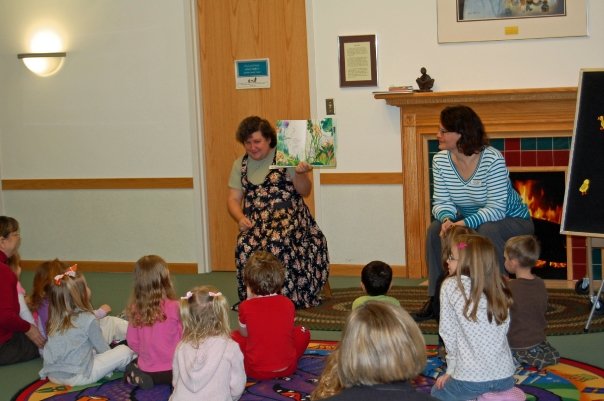
Library Story Time

But I was viewing my job (and myself in that job) through a frame. There was more happening in the wider picture of my life and development. After more than a dozen years there, things had changed. I still loved the work, and while some co-workers retired or moved, and the staff changed a bit, the work environment was still mostly peaceful and friendly. I still found the job challenging and rewarding, and I had gotten to know people in the community over the years who truly felt like family. But, as my role changed, so did some of the relationships. As new leadership came, so did new directions and new priorities. And I had become “comfortable”– and somewhat complacent as well.

In time, it became clear that my “perfect” job was not only not perfect, but becoming a source of frustration, stress, and unhappiness. And there were other things happening that demanded my focus. I was preparing to become a wife and move to a new community. My mother’s health was deteriorating, demanding more of my time and energy. My future husband wanted to open a shop– someone would have to work there, and we couldn’t afford to hire anyone, even part-time. That meant working a second job at the shop while trying to maintain my efforts at the library.

As the “frame” of my life shifted, I felt confused, even angry, with God. Why would He allow something so good to turn sour? Why did I feel like I was losing myself? Didn’t He want me to be happy and fulfilled? Didn’t He want me to use my talents to help others?

Now, after a few years’ perspective, I can see some of the “rest” of the picture. I had begun to see myself through the lens of my job, and I was depending on that vision, rather than focusing on what God was doing in, around, and through my life. There was nothing “wrong” with my job, per se, but God needed me to be willing to let go and move in new directions. Now I am preparing for another change, as we have decided to close our shop, and I will look for the next step– a new job, new opportunities, new challenges.

My nation just went through a contentious election. Many people are upset at the outcome, while others are relieved. But just as it happened with my job, I need to be careful NOT to depend on politics and governments to be “saviors.” No political party or platform or policy can “fix” sin and brokenness. The “system” isn’t the root of the problem. As individuals, we need to submit ourselves to the authority of those in government, but only AFTER we submit to the authority of God. HE is the King of Kings, the Lord of Lords, and His power exceeds that of Presidents, Cabinets, Congresses. Our nation must prepare for new challenges, as well as new opportunities.

I write all this, knowing that there are people going through much more traumatic “shifts” in their lives– the changing of a government administration, with its unknown power and potential can be worrying; the loss of a job, and a change of career is a disappointment. But it is not the same as the loss of a spouse or child, the sudden loss of a home to fire, or an unexpected diagnosis of cancer or other health issue. But the principle is not so different. God’s ways are eternal. Sometimes, we see the uncertainty and trauma in front of us, or surrounding us, and it becomes a frame for all of our thinking and emotions. But the “picture” is much bigger than just our immediate situation. God calls us to trust Him in all circumstances, knowing that His love for us is not just for this life, but for all eternity. Whatever we (or our loved ones) go through here is but a snapshot– one of millions that God will put together in a Glorious and Perfect collage.

Moreover, God gives us the privilege of listening to us when we call out to Him. We need not be afraid to ask, “Why this?” or “Why now?” or even “Why me?” But when we ask, we need to be willing to shift our focus, and remember where our Hope is Built– On Christ the Solid Rock. Even the sweetest “frame”– our career, our relationships, our identity, our politics, our happiness in this life– cannot compare with His faithfulness and eternal Sovereignty.
What If?

As I am writing this, people in my country are voting or preparing to vote in a Presidential election.  Many of them are voting in fear, confusion, or anger, and asking, “What if my candidate/cause/political party doesn’t ‘win’ today?”  “What if I voted for the ‘wrong’ policies or people?”  “What does the future hold?”

These are not uncommon or unrealistic questions, but they are questions that can waste our time and sap our energy in hypothetical posturing.  The writer of Ecclesiastes says:

alone beach calm dawn

Ecclesiastes 11:1-6 King James Version (KJV)

11 Cast thy bread upon the waters: for thou shalt find it after many days. Give a portion to seven, and also to eight; for thou knowest not what evil shall be upon the earth. If the clouds be full of rain, they empty themselves upon the earth: and if the tree fall toward the south, or toward the north, in the place where the tree falleth, there it shall be. He that observeth the wind shall not sow; and he that regardeth the clouds shall not reap. As thou knowest not what is the way of the spirit, nor how the bones do grow in the womb of her that is with child: even so thou knowest not the works of God who maketh all. In the morning sow thy seed, and in the evening withhold not thine hand: for thou knowest not whether shall prosper, either this or that, or whether they both shall be alike good. 

woman wearing grey long sleeved top photography

It is not wrong to wonder about the future, but we cannot be sure that our actions will always produce the results we long for– especially when we have little control over other people’s actions and consequences.  The first two verses of this passage warn us not to “put all of our eggs in one basket”.  As free citizens in a democratic republic, we shouldn’t put our trust in any one political party, platform, or politician.  Nor should we live in a social or political “echo chamber”, listening only to the views and ideas with which we feel most comfortable, or least challenged.  However, we should look at the long-term consequences of proposals and the reasons behind them before we promote change just for the sake of it.

The third verse reminds us that some changes and events are beyond our knowledge or control.  It’s not that our vote “doesn’t make a difference” or that we’re on “the wrong side of history”– it may mean that history has taken a detour surrounding a certain issue.  It may mean that God is allowing for something we have not imagined (as He did in the days of Habakkuk). Get some great “Insight” into the Book of Habakkuk here.

aerial photo of buildings and roads

But there is more wisdom to come in verses 4-6.  Waiting for certainty of outcome, or being distracted by our circumstances or every “wind of change” can lead us to miss the very real opportunities for present action.  God has given us everything we need (see 2 Peter 1:3-5) for godly living and godly decision-making.  That doesn’t mean that our decisions will always reflect popular “wisdom”; it doesn’t even mean that our decisions will be the same as all other fellow believers and followers of Christ.  It DOES mean that we can make our decisions without fear.  God knows us– He understands your heart and mind better than anyone; He knows why people who agree on spiritual matters may not agree on politics.  But more than that, God KNOWS the future!  He knows all the things that we merely guess at.  So we should act in the present with the best information we have, and leave the rest to the God who knows best.

girl wearing blue denim dress shirt

Modern politics relies heavily on conjecture– polls, predictions, pledges, projections, plans, and campaign promises.  But God is still sovereign over all nations, governments, and peoples.  Instead of asking, “What if..” we should be asking of God, “What now?!”   And we need to be ready to listen and obey!  Let’s pray today for the wisdom to listen more, act with confidence, and trust our future to the one who has already seen it!

Prayer and Freedom

Tomorrow, we will celebrate Independence Day, in America. Much will be made of the freedoms we enjoy here. Many are freedoms we take for granted; others are freedoms that have been twisted or abused by our citizens, residents, and visitors.

I am very grateful for the freedoms of America. As a citizen of the U.S., I enjoy Freedom of Speech and Assembly; Freedom of Religious practice; the Right to Bear Arms; the Right to a Jury Trial with representation; the Right to Vote and participate in the democratic process; the freedom to move freely and do business across state lines, and so much more that I take for granted. But I want to be very careful to keep a proper perspective on civil and national freedoms, and citizenship in the United States. My citizenship here comes with many opportunities and freedoms, but it is not perfect. It is also not eternal– my perfect and eternal citizenship is in Heaven.

The founders of the United States, in their Declaration of Independence, listed three “unalienable” rights– “Life, Liberty, and the Pursuit of Happiness.” But they were clear about where those rights come from; not from a government, or a king, but from The Creator. Only God can give “unalienable” rights and freedoms. Governments can topple; Kings can be deposed; Laws and Constitutions can be overturned. The rights and freedoms we will celebrate this week were written on parchment, not stone. Even now, many forces are at work to “redefine” our freedoms; to alter the Constitution and the Bill of Rights– people say they are outdated, or too restrictive (or not restrictive enough!). Many want the government to have more power to define, create, and alter the rights granted in the original Constitution.

When I pray, I don’t pray to a government–even one founded on solid principles and good intentions. As much as I love my country, and support the principles of its founders, I recognize that any government can be corrupted. I may not always enjoy the freedoms I currently cherish. But even a corrupt government cannot take away my freedom in Christ to call on My Creator. I cherish the freedom I have to attend worship service, and to pray with my husband in public, or meet with other believers to share prayer requests openly. But even if those freedoms were curtailed by a corrupt government, I could still commune with God– there is no prison, or dark corner, or hospital bed, or place of exile where God cannot meet with me, hear my heart, and answer my requests.

And it is THIS freedom that I fear I take for granted most of all– that I can freely and confidently approach the very Throne of the Almighty, Sovereign God, and expect to be heard and even welcomed. I don’t have to apply for permission from a priest or the angels to pray. I don’t have to bribe someone to allow me to speak to God. I don’t have to fear that my very act of prayer will cause God to cut me off from His blessings or His presence. The Ruler of the Universe, who has the authority over not only my life and death, but my eternal existence, wants me to seek Him and talk to Him. The one who has the authority to force my obedience wants me to choose to listen to Him and follow Him.

This incredible Freedom is available to every person, regardless of their nationality. As an American, I have the freedom to speak and write, and otherwise tell about and show others about this much greater Freedom. Am I using my civil freedom to point others to eternal Freedom? Am I using this incredible Freedom to seek God’s wisdom and grace to follow Him?

We the People

Yesterday and today mark two important milestones in North America. September 16 is Mexican Independence Day, and September 17 is Constitution Day in the United States. On these days, people in our two countries celebrate some of the great things that can be accomplished by “we the people.” The founders of our nations were not perfect, but they fought and worked and came together to make “a more perfect union,” and a brighter future for their citizens.

All around the world, governments are instituted to protect the rights and lives of people– to protect them from danger, to allow them to interact in peace and safety, and to provide for “the general welfare” of all. But governments– even the best–are run by fallible people.

Photo by Hugo Entrepreneur on Pexels.com

The Bible tells a long and complex story of the ancient nation of Israel. Tracing its origins to a single patriarch (Abraham), the family grew to be a powerful nation, ruled first by priests and judges, and then by a series of kings. The nation split into two distinct countries, before being scattered and sent into exile. The story of the nation is chronicled (literally) in the books of 1 and 2 Samuel, 1 and 2 Kings, and 1 and 2 Chronicles. In the books of the prophets, the same message comes from God again and again–Israel and Judah have both fallen into the same idolatry and corruption that doomed the nations they had conquered in former times. Instead of seeking justice for all the people, and providing order and protection, the leaders had become drunkards, liars, thieves, and murderers. They betrayed their allies, made foolish treaties, oppressed the poor and helpless, and celebrated their own cleverness. “We the People” had devolved into “us versus them.” Worship of God had been replaced by worship of a pantheon of foreign gods–worship that involved ritual prostitution and human sacrifice. Family members and fellow citizens were sold into slavery, robbed and beaten, used and abused, and slaughtered–without remorse or fear of retribution. God’s warnings were followed by His justice and punishment, and the demise of both nations, as well as punishment for their neighbors.

Photo by u0404u0432u0433u0435u043du0456u0439 u0421u0438u043cu043eu043du0435u043du043au043e on Pexels.com

Israel’s story, while very detailed, isn’t unique in history. Instead, it is a case study of what can happen when the people abandon unity and the rule of law for division and corruption. It is what happens when “who we are” becomes more important than “whose” we are; when “we” are more important than anyone else–even God. Israel and Judah continued to be religious right up to the point where they were dragged off to exile. They brought offerings and sacrifices, sang songs, prayed, and memorized scripture. Their leaders assured them that God would protect them and continue to let them prosper as their enemies marched up to the gates of Jerusalem. They had not abandoned the worship of God– they had just added idolatry to it. They worshipped their own prosperity, they worshipped gods and goddesses of the harvest, of war, of wealth, and wisdom. They still thought God was great– but not necessarily Sovereign.

Who or what are we worshipping today? What “new” and additional principles have we added to our own Constitution? To the laws of the land? To our way of being good citizens in our respective countries? To the eternal Word of God? When we hear the phrase, “We the People,” does it bring to mind people who look and live differently than us? Does it bring thoughts of justice and unity? Does it humble us?

Photo by Life Matters on Pexels.com

King David, the second, and one of the greatest of Israel’s kings wrote: “Know that the Lord, He is God; It is He who has made us, and not we ourselves; We are His people and the sheep of His pasture.” (Psalm 100:3 NKJV) “We the People,” by ourselves, will scatter and fall into destruction, like sheep without a shepherd.

Blog at WordPress.com.

Up ↑