Am I a “Picky” Pray-er?

When I was a child, I was something of a picky eater. I didn’t like peas, or beets, or spinach , I wasn’t fond of lumpy mashed potatoes, and I didn’t like peanut butter sandwiches, or mustard on my hamburger. Of course, my parents were not sympathetic– I had to at least try some of my vegetables or potatoes, and, like it or not, I often found a peanut butter sandwich in my school lunch bag. I didn’t have to add mustard to a hamburger at home, but if it came on my burger at the drive-in, I either had to eat it with mustard, try to scrape it off, or go without! I didn’t have to be enthusiastic about dinner, but I was taught to be grateful for it.

Now that I am an adult, I still am not fond of peas, though I have learned to like beets and spinach. I don’t eat mashed potatoes very often, lumpy or otherwise. I eat the occasional peanut butter sandwich, and I actually love mustard on my hamburgers. I have learned to like foods that I didn’t like as a child, and learned that certain foods (even peas) are good for me, whether I like them or not.

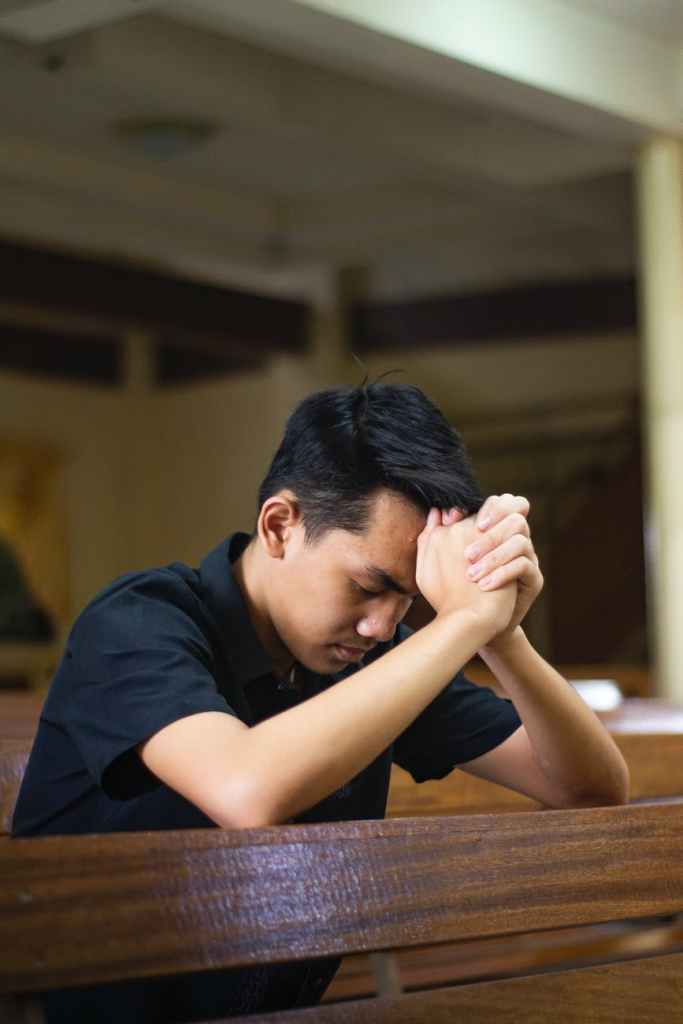
Photo by Shohei Ohara on Pexels.com

I also learned to pray as a child–we had grace at meals, family prayer time, corporate prayer at church, and bedtime prayers. I learned that sometimes prayer is spontaneous and filled with praise; other times, prayer is dragged out of pain, or anger, pride, or shame. Prayer isn’t always “palatable.” But, like eating, it is necessary and good.

Just as I needed to learn not to be a picky eater, I have to practice prayer in all its aspects. God doesn’t just want the sweet prayers of praise that I am eager to sing out. He doesn’t just want the earnest requests I set before Him. He wants the rotten, stringy, overripe confession that I’ve been hanging on to. He wants the tormented “Why?” when things are falling apart. He wants me to chew on the unanswered requests and unfulfilled longings, and swallow the pride that insists on having its own way. He wants to savor those prayers when I can’t even find the words, but I come to Him anyway, hungry for answers, but even more thirsty for His presence.

Photo by sergio omassi on Pexels.com

Prayer isn’t always easy. It isn’t always “satisfying” in its daily practice. But it gives life and nourishment for the soul.

So I ask myself today: What am I praying about? What do I need to bring to God in prayer? What have I held back? What have I stopped praying for (and why)? Who has been on my heart or mind, but not in my prayers? What have I been trying to do in my own way that I haven’t shared with God in prayer? What does God know about me that I haven’t acknowledged? What praise or thanks have I withheld today? What worries have I borrowed from tomorrow?

What prayer practice do I need to try, or try again? It may take some stretching, but in the end, it’ll be better than peas!

Planting Seeds

I live in Michigan, and our state is in the news, because our Governor has issued a new set of restrictions in light of the ongoing COVID-19 outbreak. There is a “Stay Home; Stay Safe” measure restricting travel and “non-essential” business until the end of April. But parts of her new executive order have drawn criticism–especially her restriction of gardening and landscaping activities. Larger stores are not allowed to sell plants and seeds and gardening implements, as they are considered “non-essential” (as opposed to food and medicine purchases). It is still unclear whether or not gardening centers or roadside businesses can still sell plants or seeds if that is their primary business.

Photo by Engin Akyurt on Pexels.com

Thousands of residents are upset about these restrictions, and the slippery logic behind allowing liquor sales, sales of lottery tickets, and recreational marijuana, and allowing access to abortion clinics, while seeming to single out gardening, landscaping, home improvement (we can’t buy paint), and other reasonably “safe” activities, and prohibiting families from being with their loved ones– especially those who are dying of non-COVID-19 related causes.

I am not faulting those who are upset, and I won’t use this space to either fault or defend our governor. These are challenging times, and tempers flare, patience grows thin, and people are not always going to think or act at their best.

Photo by Paul Theodor Oja on Pexels.com

My point is that we– all of us– are sowing seeds during this time. Maybe not vegetable seeds or herbs or flowers, but seeds of discontent, seeds of anger, seeds of bitterness, and seeds of pride. We don’t need soil or seed packets or starter plants to sow a crop of good or bad spiritual produce. We don’t need to visit a store or garden center to bloom where we are planted.

So today, my prayer is that I would plant the following seeds:

Photo by Maggie Zhao on Pexels.com
  • Kindness–Words and deeds that show honor, respect, and love for those around me. Not just my friends, but also those who count themselves my enemies, and those with whom I disagree. Kindness multiplies and brings a fruitful harvest.
  • Joy–Not phony happiness, but true joy– the kind that doesn’t deny hardship, but gives strength in tough times. The kind that grieves with those who grieve, but offers hope and compassion. It is a sweet balm that brings healing and a lingering fragrance.
  • Patience–Waiting is not easy. It is not comfortable. But it is quiet strength that doesn’t give way to panic and anger. Patience is a “hardy” plant for any season.
  • Forgiveness– Forgiveness must be carefully tended in times of distress and uncertainty. We must prune away pride and hurt feelings and the desire for vengeance. Forgiveness is a rare and precious plant.
  • Gratitude/Contentment–I woke up today. That was a blessing. I opened my eyes and saw a roof over my head. I was warm and wrapped in blankets in a bed in a bedroom in my own apartment. I turned on a light, pulled clothes out of my closet, took a shower, and looked in the refrigerator where I had a choice of food to eat. I can breathe without a respirator, I can walk and use my arms and hands. I can speak and listen. Even in the midst of these times– even if I had no home or food, no running water, and I tested positive for COVID-19, or cancer, or MS–God is with me; God loves me; God knows everything about me; God sent His own Son to die for me when I was still a sinner! Gratitude is like a morning glory, declaring beauty, not because of its surroundings, but because that is its nature and its purpose. We can do the same!
  • Faith–I saw a meme the other day that said , “If a tiny virus can do this much damage, imagine what mustard-seed-sized faith can do! There is so much confusion, so much doubt, so much despair right now. But Faith, like a mustard seed, can spread and grow, even under (sometimes especially under) adverse circumstances. And Faith is another strong plant that can withstand the strong hot winds of adversity and weather great storms.
  • Love–Love is like a tomato plant– it just keeps growing and giving and producing. But, like a tomato plant, we need to watch out for blight and worms. True love drives out fear, overcomes, endures…you’ve probably heard all the cliches. But love also involves risk, rejection, and even pain. Make sure you plant your love in good soil and give it the supporting frame of faith in the one who IS Love.
Photo by Kaboompics .com on Pexels.com
  • and finally, Prayer– Prayer is a root vegetable; it grows in good soil and where is can’t always be seen. Prayer can thrive in times of quarantine. It is (or should be) untroubled by what is happening “above ground.” It needs the “living water” of God’s Holy Spirit, and the good soil of faith. Its roots are deep, and it provides nourishment for the soul.

Praying it Forward

Have you ever been the recipient of a small act of kindness, and “paid it forward” by doing something nice for others? It doesn’t have to be an extravagant gesture–someone holds a door open for you, so you do the same for someone else when your hands are free; you give someone a compliment, and as you walk on, you hear them complimenting the next person they see. It doesn’t even have to be the same action–you may see someone pick up trash along the sidewalk, and later you make a small donation to a local charity that collects gently used items for needy residents…

Photo by Pixabay on Pexels.com

The idea is that when we see good things happening, we can be inspired to join in and “spread the good.” In a world full of things that are not so “good”– bitterness, greed, hatred, pushing and shoving, name-calling, apathy, sadness, shame, and evil–good deeds stand out. Even the smallest kind word, smile, or simple act can have an exponential impact when it gets passed on.

Photo by mentatdgt on Pexels.com

Have you ever considered “Praying it forward?” Not as a substitute for “paying it forward”, but as a supplement? When you see someone doing a kindness, or when you are the recipient of that kindness, you can pray:

  • Thank–of course, if you have the opportunity, thank the other person first, but then thank God for HIS goodness and kindness; thank Him for the person you’ve seen or interacted with; thank Him for giving you eyes to see (or ears to hear, etc.) the goodness around you; thank him for others who have blessed you in the past
  • Bless–if you have the opportunity, bless the other person with a smile, or a reciprocal act of kindness, but then ask God to bless the other person–and/or someone else who is on your mind.
  • Ask– ask God for opportunities to “pay it forward”, or just to spread more kindness! Ask how you can show kindness, mercy, and love to others throughout the day. Even more, ask God to intervene (or help you intervene) in places and lives that need more than a small act of kindness.
  • Confess/Repent–sometimes a small act or word of kindness will convict us, reminding us of a time when we have withheld mercy, or have been the means of causing harm or destruction. Use this time to confess and seek to make amends (if possible), or seek forgiveness.
Photo by Vlad Chețan on Pexels.com

May today offer you opportunities to “pay it forward”, and then to “Pray if forward!”

God Created…


For the Beauty of the Earth
The United Methodist Hymnal Number 092
Text: Folliot S. Pierpoint 
Music: Conrad Kocher; Arr. by W.H. Monk 
Tune: DIX, Meter: 77.77.77

1. For the beauty of the earth, 
for the glory of the skies, 
for the love which from our birth 
over and around us lies; 
Lord of all, to thee we raise 
this our hymn of grateful praise. 

Photo by Studio 7042 on Pexels.com


2. For the beauty of each hour 
of the day and of the night, 
hill and vale, and tree and flower, 
sun and moon, and stars of light; 
Lord of all, to thee we raise 
this our hymn of grateful praise. 


3. For the joy of ear and eye, 
for the heart and mind’s delight, 
for the mystic harmony, 
linking sense to sound and sight; 
Lord of all, to thee we raise 
this our hymn of grateful praise. 

\Photo by Pixabay on Pexels.com


4. For the joy of human love, 
brother, sister, parent, child, 
friends on earth and friends above, 
for all gentle thoughts and mild; 
Lord of all, to thee we raise 
this our hymn of grateful praise. 

Photo by Edward Eyer on Pexels.com


5. For thy church, that evermore 
lifteth holy hands above, 
offering up on every shore 
her pure sacrifice of love; 
Lord of all, to thee we raise 
this our hymn of grateful praise. 

Photo by Pixabay on Pexels.com


6. For thyself, best Gift Divine, 
to the world so freely given, 
for that great, great love of thine, 
peace on earth, and joy in heaven: 
Lord of all, to thee we raise 
this our hymn of grateful praise. 

Photo by David Dibert on Pexels.com

This week, may we raise hymns of grateful praise to the creator of all the beauty of the earth.

For by him all things were created: things in heaven and on earth, visible and invisible, whether thrones or powers or rulers or authorities; all tings were created by him and for him. 

Colossians 1:16


In the beginning was the Word, and the Word was with God, and the Word was God. He was in the beginning with God. All things were made through him, and without him was not any thing made that was made. In him was life, and the life was the light of men. The light shines in the darkness, and the darkness has not overcome it.

St. John 1:1-5 (ESV)

Praying for the Pulpit

October is Pastor Appreciation Month.  I have mixed feelings about such designations.  I’m glad to appreciate my pastors, past and present; to honor their service, their wisdom, their heart for God and their flocks, and their selfless devotion to both.  And I believe that pastors are some of the most under-appreciated, over-worked, overlooked people in our world today.  One way we can show appreciation is to pray for our pastors, their families, and our churches.  And not just during a single month of the year.  But for the remainder of this month,  let’s make a point of praying faithfully for pastors.  Here are a few reasons why, beyond just showing appreciation:

The raw data…

Reasons many pastors are leaving the ministry..

Pastors under personal attack (Christianity Today)

architecture building chapel church
Photo by Pixabay on Pexels.com

How can we pray for pastors?

  • Remember their basic daily needs (health, family, finances, emotions, wisdom, etc.) as well as spiritual needs
  • Remember they are sinners saved by grace, just like the rest of us– pray for grace and wisdom to show encouragement and acceptance
  • Ask them how you can pray for them!  It is surprising how many in the congregation are willing to share their needs but NEVER ask how they can lift up their pastors.
  • Ask God to show you ways to appreciate, encourage, and (genuinely) help your pastor(s).

light sign typography lighting
Photo by Gratisography on Pexels.com

  • Be grateful–Thank God for your pastor–Thank Him for your pastor’s strengths, and for the ways your pastor has shown growth and humility.  Thank God for your pastor’s family and for those who come alongside to help him/her in ministry.  Thank God if you live in an area where pastors can preach freely, openly, and honestly from God’s Word.
  • Be honest–(see above)  Being grateful for our pastor doesn’t mean that s/he is flawless, or that we don’t care about differences of opinion, or even questionable practices.  Giving grace doesn’t mean ignoring sin; but it also means looking honestly and prayerfully at a situation.  Often the “fault” we see lies in ourselves; we don’t like the sermons because they hit too close to home, or because are expecting great oratory and have no patience for simple homilies.  But occasionally, the fault is something that requires talking with or even confronting the pastor.  Pray for wisdom and humility, grace and strength.

belief bible book business
Photo by Pixabay on Pexels.com

  • Be wise.  Satan likes nothing better than to get us thinking about, discussing, and even bringing to God every little fault about our pastor (and our neighbor, our spouse, our in-laws, and even ourselves!)  Satan also thrives on half-truths, rumors, misinformation and assumption.  Pray that God will keep your pastor safe from ugly rumors, lies, and false accusations; pray also that God will keep your pastor accountable and your congregation open to following Biblical principles for confrontation, punishment, repentance, and restoration for all.

Faithful, God-fearing, loving, wise pastors are priceless gifts from our Heavenly Father.  Let’s be sure to pray for them, pray WITH them, and speak words of encouragement and gratitude.

And it wouldn’t hurt if you sent them a card or gift, or offered to take them out for coffee or dinner– just a thought…

chocolate cupcake with white and red toppings
Photo by Jess Watters on Pexels.com

The Birds of the Air Have Fled…

The air is different.
Cooler
Scented with readiness…
Waiting

The birds are restless of wing;
Apples hang heavy
As people and days
Move a little faster.

Anticipating the season;
Bringing in the harvest
Preparing to face
The cold gray of winter.

This short burst of color–
This cacophony of bird chatter
And swinging scythes–
Will give way to moaning winds
And skeletal branches reaching out
To empty skies.

asphalt autumn beauty colorful
Photo by Pixabay on Pexels.com

Autumn is coming– you can feel it in the air and start to see it on the trees here.  It’s coming on to “sweater” weather.  Football, the smell of vineyards heavy with grapes and orchards filled with apples and pears.  Gardeners and farmers are tripping over pumpkins and squash, and preparing to bring in the corn, wheat, and beans.  Squirrels are starting to zip about and look for nuts  and seeds to store.

selective focus photography of squirrel
Photo by Edwin Andrews on Pexels.com

There is a sense of urgency about this time of year– the harvest is ready to bring in; it will not wait for a more convenient moment.  Preparations for the coming winter must be completed while the good weather holds.

blue tractor next to white farm vehicle at daytime
Photo by Pixabay on Pexels.com

There is also a sense of completion and evaluation.  We look back at the summer with longing–did we make the most of sunny days and delayed sunsets?  Did we bring in a bumper crop?  And we look forward with a little anxiety– are we ready to weather the biting winds and bleak days ahead?

adult beverage breakfast celebration
Photo by Pixabay on Pexels.com

God has given us seasons– where I live, there are dramatic changes from summer to autumn– in other regions, there are changes from rainy season to dry season.  Each change gives us time to pause and notice where we have been and where we are headed.

white trash bin under red leaves tree
Photo by Dianne on Pexels.com

The same is true in our personal lives– we go through seasons of change.  Children grow to adulthood; young parents become empty-nesters (eventually); hectic days at the office give way to days at the doctor’s office; bank accounts and circles of friends grow or shrink.

adult affection baby child
Photo by Pixabay on Pexels.com

In every season, we should give thanks– for health, youth, and wisdom, as well as trials that refine us, and discipline that shapes us.

abundance agriculture autumn decoration banana
Photo by Pixabay on Pexels.com

The Power of a Praying Mother

Mother’s Day is coming, and I wanted to say a few words about the mothers in my life and their legacy of prayer.  My Mom is a prayer warrior.  I blog about prayer, and I pursue a better prayer life, but my Mom is a seasoned soldier,  and the daughter of another mighty woman of prayer.  Most of what I know about prayer, I learned through the examples of my Mom and Gram, but I have also been blessed by the godly examples of my mother-in-law, sister and sisters-in-law, aunts, cousins, and many more.

030

From my Mother, I learned to pray from the depths of my heart.  I have seen and heard her pray through pain, grief, and despair– not just her own, but more often that of someone else.  I have caught her holding back sobs over relatives and neighbors who don’t know or aren’t following Christ.  I’ve seen her pause in silent prayer over the plight of a person who is facing a lost job, or chemotherapy, or a migraine.  She very seldom offers to pray  aloud,”in the moment”, but she prays fervently, nonetheless.


Gramgrad

From my Grandmother, I learned to be patient and consistent in prayer.  Gram was quiet and unassuming, but she had an unshakable faith.  She prayed for years over situations that looked hopeless; often for people who or situations which never changed.  I asked her once how she kept from getting angry and frustrated.  She looked me straight in the eye and said, “We can’t change somebody else, and we can’t make them do what’s right.  That’s not our job.  Our job is to love each other, pray for each another, and let God deal with the rest.”  She died never seeing answers to some of what she prayed for, but that didn’t stop others from taking up the banner, and it never stopped her from earnestly and joyfully “taking it to the Lord in Prayer.”  She never gave up, never lost hope, and never stopped showing compassion.


There have been many other prayer warriors in my life– women (and men) of great faith who sought the Lord, and whose lives and words have had an unimaginable impact.  My family, members of my church family, classmates and friends from school or college, neighbors through the years…some of them have held my hand and prayed with me face-to-face; others have prayed on their knees in private; some have prayed for special needs and circumstances; others have prayed at the Holy Spirit’s prompting, never knowing why, but bowing in obedience.

prayermotherdaughter

Praying mothers are a treasure.  If you have one, or had one, don’t underestimate the value of her example.  And don’t just say, “Thank you”…Pay it forward.  Pray for family, neighbors and friends.  Pray early, pray often, pray without ceasing.  We all need more praying mothers, fathers, cousins, neighbors, co-workers, etc.  If you did not have a praying mother, you have a golden opportunity to become that good example to someone else.  You also have the opportunity to adopt a prayer partner– a surrogate praying mother–to pray with you and for you.

Great Expectations

Earlier this week, the Duke and Duchess of Cambridge (otherwise known as Prince William  and Kate Middleton), welcomed their third child.  As with most royal births, there was a lot of fanfare and speculation well in advance of the actual delivery.  Early tabloid reports hinted at twins; bookmakers were figuring odds for delivery dates, names– even what the Duchess would be wearing as she brought the newborn outside for his first “sighting”.  As of the writing of this blog, the name has yet to be announced, which is cause for more speculation and anticipation.

pexels-photo-50632.jpeg

Preparing for a newborn is exciting, and filled with certain expectations.   We imagine what the baby will look like, what kind of personality s/he will have, all the wonderful discoveries to be made. But we need to be careful not to let our expectations become idols.  There’s nothing wrong with hoping for good outcomes, but it can be dangerous to get locked into a particular expected outcome.  Children surprise us (in good ways and other ways) be being themselves, and not who or what we expect them to be.

pexels-photo-185934.jpeg

When we pray, we sometimes come with certain expectations–that God will answer in a certain way or on a certain timeline.  This is not the same as having faith.  Faith says that God will hear our prayer; that he knows best, and that he will act in accordance with his own love and mercy.  It doesn’t mean that he will give us what we want when we want it, or that he will give us what makes us comfortable and happy.  His answers may seem difficult or even painful to accept– certainly not what we were expecting.  When he chooses to answer in ways that don’t meet our expectations, we wonder why.  When he chooses to say “wait,” or even, “no,” we may feel cheated and even resentful, instead of thankful that our prayers are heard by a loving God.  Often, we have built up such expectations of what “the best” should look like that we miss the real miracle God is giving us instead.

pexels-photo-236287.jpeg

Worse, there are times when our expectations reveal a lack of faith or a lack of understanding of God’s ways.  We pray for peace, but what we really want is ease and comfort.  Peace– real peace– is often revealed in times of stress, hardship and loss!  We don’t want stress; we don’t pray for stress, but stress and hardship are going to come into our lives at some point.  Praying for peace won’t bring stress, any more than not praying will keep it away!  We expect the peace to come without the battle; we expect the growth to come without the growth pains; we expect to win the race without having to run!

Sometimes we won’t even pray for what we really want or need because we expect that God will “test” us or give us difficult circumstances if we ask for certain things (like patience or peace).  We see God as some sort of cosmic con artist, who teases us with the promise of good things, only to laugh as we suffer.  But this is a wrong view of God.  God doesn’t play games or “trick” us by giving us hardship when we ask for healing, though it may feel like it at the time. Suffering and hardship are not the gifts of God– his amazing gift is the ability to redeem even the worst of circumstances and bring joy and rest and peace that passes any expectation, any dread, or any understanding we have.  Often, our very desire for extra patience, peace, and joy are opportunities for us to learn more about God’s grace–and more about ourselves.

Life seldom meets our expectations–God is waiting to exceed even our wildest dreams!  Don’t just pray expecting something good might happen.  Pray expecting God to SHOW UP!


Surprise!

The world is full of surprises– some good, some bad.  Open your mailbox on any given day, or walk down the street…you are bound to see something unexpected.  You may get a bill you forgot about, or run into an old friend.  There are surprises in the weather patterns, in traffic patterns, in relationships, in jobs, all around our houses and neighborhoods, in world events.  Some are shocking, some delightful, and any of them can change our days or even our lives.

We like pleasant surprises; we fear the unpleasant ones.  But most of us don’t pray for them.  We pray for miracles–healing and rescue and transformation–pleasant outcomes that we hope for or imagine.  We pray for ease and comfort, or wisdom and strength to face the bad times.  But we don’t ask God to surprise us.

Why don’t I ask God to awe me?  Dazzle me?  Surprise me?  Sometimes I fear that he might surprise me with what my past actions deserve.  More often, I simply want to stay in the comfort and simplicity of what I already know.  I don’t want to be delighted; I just want to be entertained.

pexels-photo-96405.jpeg

One thing I know, but I need to be reminded:  God does not give bad surprises.  He does not send ANYTHING into my life that can’t be used for my good and his glory.  The world will send tragedy and I will have to face the consequences of Sin– mine and others’.  I may be unfairly treated at work; I may be struck by a drunk driver and paralyzed.  I may face difficult losses, and inexplicable circumstances.  And the mistake is to see these as “surprises” from God.  God never promised a pain-free, problem-free life in this world, but he surprises us with the kind of gifts that overcome and even confound our tragic circumstances– the power to forgive, to be joyful, to have peace, and share love.

John 16:33 English Standard Version (ESV)

33 I have said these things to you, that in me you may have peace. In the world you will have tribulation. But take heart; I have overcome the world.”

Matthew 7:9-11 New International Version (NIV)

“Which of you, if your son asks for bread, will give him a stone? 10 Or if he asks for a fish, will give him a snake? 11 If you, then, though you are evil, know how to give good gifts to your children, how much more will your Father in heaven give good gifts to those who ask him!

The road ahead is full of surprises–that’s a great reason to pray.  God loves to surprise us with good things– that’s another great reason to pray for them!

gift-jeans-fashion-pack-157879.jpeg


The Empty Cross

The most common symbol of the Christian religion is the cross.  And, while many statues and necklaces and artistic renderings include a dying Christ figure , the kind you most often see is the empty cross.  On this day between the crucifixion and the resurrection, I want to consider the significance of the empty cross.

  • First, the empty cross reminds us that Christ lived.  In spite of those who continue to challenge the historical evidence, there was a man named Jesus of Nazareth.  He lived in a particular time and place, and he was tried and sentenced to death by crucifixion.  His existence caused the modern Western Calendar to be split into two distinctive parts based on the estimated year of his birth, and his life, death, and resurrection gave rise to a movement that has never been stamped out, equaled, or eclipsed.

pexels-photo-51524.jpeg

  • Second, it reminds us that Christ died.  He was fully human in his capacity to feel pain, rejection, betrayal, hunger, thirst, and grief.  Yet he also experienced joy, companionship, hope, love, compassion, laughter, and growth.  He didn’t just grow old or fade into obscurity.  He didn’t leave his life’s work unfinished, he didn’t compromise or change his message; he didn’t give up or start over with a different “crew.”  Though he never staged a coup, or built up an arsenal, or rose to a seat of power or influence, this homeless, itinerant, soft-spoken rabbi was seen as enough of a threat to the leaders of his time that he was framed, tried and convicted, and sentenced to death.
  • The empty cross also reminds us how he died.  Modern crosses often look imposing and even triumphant, as they tower over a mega church parking lot, or hang on a chain of elegant silver, or stand in rows of chiseled rock in a military cemetery.  “O death, where is your sting?  O grave, where is your victory?”  (I Cor. 15:55)  But the torture before and during the crucifixion were brutal– bones were not broken, but they were pulled out of joint and then forced to bear the full weight of a bloody, swollen and bruised body of ripped muscles and exposed flesh.  Heat caused the salty sweat mixed with blood to drip into his eyes, his open wounds, and around his nose and mouth, but he was unable to wipe any of it away.  Flies gathered; he couldn’t keep them from buzzing or biting.  Each breath was a torturous push and pull of the arms and body upon the nails holding him at an unnatural angle against a wooden bar that rubbed against his already raw back.  And all of this was public; entertainment for the masses of hecklers, and those who were rejoicing in his humiliation and failure.  There was nothing pretty or majestic about the cross on that day.

jesus-cross-summit-cross-37737.png

  • The empty cross reminds us that Jesus was buried and put under Roman guard.  His emaciated, bloody, barely recognizable remains were wrapped up and prepared with spices.  Guards, whose lives depended on this body remaining in the tomb and undisturbed, were posted, and a huge boulder rolled into place to block entry to and exit from the tomb.  Jesus didn’t spontaneously climb down off the cross, or waltz out of an air-conditioned cave.
  • Finally, the empty cross reminds us that Jesus was the Christ–death could not stop him; the grave could not hold him.  His victory was complete.  He didn’t claw his way out of that tomb; he didn’t sneak out in the dead of night; he didn’t hobble into hiding for several weeks because he was only “mostly dead” of his torturous injuries.  He arose, victorious, recognizable to those who knew him best; healed and full of power.

pexels-photo-635699.jpeg

There are hundreds of reasons why we “cherish the Old Rugged Cross.”  And, though the cross stands empty, our reasons are not.  Hallelujah!  Tomorrow, hundreds of millions of Christians will be celebrating the empty tomb.  But for today, I want to celebrate the empty cross.

Blog at WordPress.com.

Up ↑