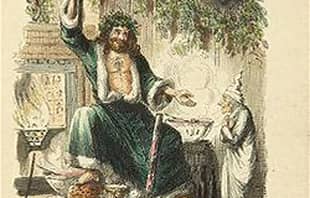
The Ghost of Christmas Present

If you missed my last blog post, I’m looking at the story of A Christmas Carol, by Charles Dickens. It may not seem like a “jolly” Christmas story, or even a “religious” story, but it is “spiritual.” Ebenezer Scrooge is literally haunted by three spirits over the course of Christmas Eve. Last time, I spoke of the Ghost of Christmas Past. Today, I’d like to look at the Ghost of Christmas Present.

I know, Christmas was a few days ago– we’re currently at the cusp of New Year’s Eve, but these few days between Christmas and New Year’s Day can often feel jumbled up and run together. And, traditionally, the Christmas season is not just one day, but twelve days, stretching from December 25 to January 6. So today is still technically part of “Christmas.”

In “A Christmas Carol”, Scrooge is actually visited by four spirits. The first is the ghost of his old friend, Jacob Marley, who offers Scrooge both a dire warning, and a chance of redemption. Scrooge has already been visited by Marley, and by the ghost of Christmas past– a look at the moments and people who have shaped Scrooge’s life up to the present. Scrooge has seen both happiness and tragedy in his life, but the “light of truth” carried by the first ghost has shown how Scrooge has rejected happiness, instead embracing a life of fear, loneliness, and greed.

The next spirit, the Ghost of Christmas Present, focuses less of Scrooge himself, and more on the people he has ignored or rejected. This spirit shows Scrooge what he is missing by hoarding his wealth and isolating himself from the rest of the world. It is a picture that many of us would do well to study!
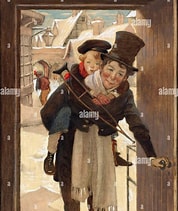
One of the first stops is the home of Bob Cratchit, Scrooge’s underpaid, put-upon clerk. Scrooge makes use of Bob’s time and skills, without ever showing any interest in him as a person. Scrooge is oblivious to Bob’s existence outside of the counting house. He assumes that Bob has a family, but he has no idea who makes up that family. The Ghost of Christmas Present forces Scrooge to see that Bob and his wife have several children, including a sickly and crippled son named Tiny Tim. Though they have very little money (thanks in part to Bob’s meager wages!), they have plenty of love and happiness. Scrooge fears many things that may happen, while his clerk faces very real fears that “haunt” him every day. Yet Bob does not complain, does not exhibit bitterness, and does not hide away from the world.

Next, the ghost takes Scrooge to see his nephew. Scrooge keeps his nephew at a distance because of his bitterness and fear. But in doing so, he is missing out on his nephew’s kindness, wit, and warm circle of friends. Scrooge has treated his nephew with disdain, fearing that the younger man is jealous of all his riches. But the ghost shows Scrooge that his nephew actually feels sorry for his uncle. Again, Scrooge has great wealth, but his nephew is content, and even very happy with his lower station in life. He loves his wife and enjoys friendships that make him wealthier in many ways than his uncle!

Finally, the ghost of Christmas Present shows Scrooge a sight he would never willingly see– the suffering and neediness of the poor, whom Scrooge has sneeringly consigned to death. Rather than seeing humanity, Scrooge sees only people who might drain him of his wealth– the undeserving poor who “cost more than they are worth.” The ghost reminds Scrooge of an earlier off-handed remark about helping those who would rather die than go to workhouses: “If they’d rather die, then let them do it–and decrease the surplus population!” The ghost warns Scrooge that he should be very careful in declaring who is among the ‘surplus population’. In heaven’s eyes, Ebenezer Scrooge himself might have less worth than ‘the least of these.’

 And the King will answer them, ‘Truly, I say to you, as you did it to one of the least of these my brothers, and sisters you did it to me.’ “Then he will say to those on his left, ‘Depart from me, you cursed, into the eternal fire prepared for the devil and his angels. For I was hungry and you gave me no food, I was thirsty and you gave me no drink, I was a stranger, and you did not welcome me, naked and you did not clothe me, sick and in prison and you did not visit me.’ Then they also will answer, saying, ‘Lord, when did we see you hungry or thirsty or a stranger or naked or sick or in prison, and did not minister to you?’ Then he will answer them, saying, ‘Truly, I say to you, as you did not do it to one of the least of these, you did not do it to me.’ (Matthew 25:40-45 ESV)

Scrooge’s feelings and senses are overwhelmed by what he experiences. The present surrounds him– the sights, the smells, the laughter, the cold of a dark winter’s night, and the heat from a roaring fireplace; the stench of the docks and homeless camps, and the aromas of Christmas dinner; the colors and lights of decorations, toys, and costumes; the ringing of bells, and the singing of Christmas Carols. Once again, Scrooge can hear music and laughter, he can sense the love and compassion, but he can only participate on the periphery. The music haunts him, but it comes from others, not from his own frozen heart.

So, what happens to us in this Christmas present? Do we feel connected to the joy and gratitude, the love and hope of the season? Or are we isolated by worry, frozen in fear, enslaved by anger or greed? Christmas is often a time of great sadness and loneliness. And sometimes, the laughter and the lights seem hollow and fake. Especially in the days just after Christmas, we can feel let down, abandoned by the promise of merriment and fulfillment brought by parties and gifts and feasting and entertainment. Outside, the winter is still cold, the bills keep coming in the mail, and fears and worries cloud our days. Some of our fears are very real– disease, grief, loss, sudden changes in circumstances and relationships–Christmas lights and music alone cannot cut through the fog.

My prayer for today, and for the New Year at our doorstep, is that we would open our ears and eyes and hearts to what is around us– acknowledge that we live in a fallen and often worrisome world, but recognize that there are opportunities all around us, as well. We don’t have to isolate. We don’t have to live in constant fear. Christmas isn’t just a day; it isn’t just a season– Christmas is about Christ coming to dwell with us!

Open your ears! Listen to the music of the season– “Peace on Earth! Good Will to Mankind!” “JOY to the World! The LORD has come!” “Let Heaven and Nature Sing!” “Glory to the Newborn King!” Keep listening to the promises of God’s Word– “Never will I leave you nor forsake you!” “Lo, I am with you always!”

Open your eyes– see the wonderful opportunities to share both joy and sadness with others. Seek out the great opportunities to give and receive help and love and fellowship! See the good things that the LORD has done– the friendships and family in your life; the beauty of nature, the ‘wonder of His Love!’.

Open your heart– Receive the greatest Gift! Redemption; new birth; eternal and abundant Life! Choose life and gratitude and humility. Practice childlike faith, hope, and JOY!


The Ghost of Christmas Past

Charles Dickens wrote “A Christmas Carol”– a (literally) haunting tale of greed, bitterness, and, in the end, redemption. Set in Victorian England, the story involves a miser named Scrooge, his business partner, Marley, who has been dead for seven years, and three mysterious spirits: The Ghost of Christmas Past, the Ghost of Christmas Present, and the Ghost of Christmas Yet to Come…

Scrooge and Marley

Scrooge doesn’t really hate Christmas. He considers it a Humbug– an annoying and worthless distraction from the “reality” of making money. What bothers Scrooge– what eats at him and rules his actions– is the fear of poverty and powerlessness. He avoids relationships so that he cannot be hurt or abandoned. He avoids spending money– even for common comforts like coal to heat his office–for fear that he will fall into poverty. He does not like people because he will not trust anyone enough to risk getting hurt or used.

Scrooge’s only “friend,” his former partner Marley, lived by similar principles during his lifetime. He “visits” Scrooge on Christmas Eve to warn him of the fate that awaits those who fail to realize that there is more to life than making and keeping money. “Mankind was my business. The common welfare was my business; charity, mercy, forbearance, benevolence, were all my business. The dealings of my trade were but a drop of water in the comprehensive ocean of my business!” Marley has managed to arrange for Scrooge to be haunted by memories of the past, visions of the present, and shadows of what may be in the future.

The first of these “spirits” reminds Scrooge of Christmases from his childhood and early adulthood. Some of the memories are sad– Scrooge is left to spend the holiday alone at school, as his cold and distant father refuses to show him love, mercy, or guidance. Later, Scrooge is reminded of how his decision to pursue wealth alienated the woman he could have married. But there are happier memories, too. His first boss, Mr. Fezziwig, brought happiness and a sense of camaraderie and purpose to Scrooge’s early employment. He celebrated both hard work and the joy of fellowship with his employees. Scrooge sees visions of his beloved sister and is reminded that he has a family (his sister’s son) with whom he could make and share happy memories– if only he would choose to do so.

I will write about the other visitations later, but I want to camp out here for a little bit.

What memories would the Ghost of Christmas Past bring to me? To you? Are there sad or painful memories of Christmases without loved ones? Christmases that included anger or rejection? Christmases spent with poverty, uncertainty, or sickness? Would you feel bitterness? Fear? Guilt? Regret? Or would there be nostalgia for days gone by? Longing for family members who have passed? Questions about what might have been?

It is tempting sometimes to shove our memories of Christmas past in a closet or an old trunk and try to forget them. In Dickens’ story, Scrooge ends up desperately trying to snuff out the light of Truth that the spirit is holding. He doesn’t want to remember; doesn’t want to know or deal with the pain and loss of his past.

But before we can truly live in the present, we must confront the past. We do not have to live there. Our memories– good and bad– are but shadows of the things that have been. But they can cast long and devastating shadows if we let them. Denying past pain or trauma can give us a false sense of control. Burying ourselves in work or pleasure or entertainment may feel like a solution. Being cautious and angry and cynical may seem like wisdom. We can blame others, blame ourselves, even blame God for our feelings of hurt and fear of being hurt again and again. OR we can, with the light of truth, revisit our past. We can discover the healing power of redemption and forgiveness. We can– we must– still acknowledge the pain, the injustice, the grief that lies on our past. But we also must see that the shadows of the past only fall behind us. However the past may have shaped us, damaged us, challenged us, or forged us, the present and the future can be turned in a new direction.

And that is possible because of Christmas– because of Christ!

When Scrooge first visits his past with the Ghost of Christmas Past, the first image he experiences is of his classmates from school riding in sleighs and wagons singing Christmas carols. Singing! He could not join in. As an adult he has chosen not to join others as they sing of the wonder of Christ’s birth. But the carols echo– their message endures! Christ is Born! Glory to the Newborn King!

My prayer today is that Christmas past holds some happy memories for you. But the very Good News of Christmas is that it isn’t just about the past. And our past Christmases don’t have to haunt us. Because the Light of Truth– The True Light of the World (John 1:9) –that came on that first Christmas so long ago leads the way forward!

The Weary World Rejoices…

We live in a weary world– weary of war, weary of chaos, weary of worry, and weary of sin and its consequences. From the time the alarm rings to the time we finally lay down our weary heads, we are bombarded by stress, misunderstandings, distractions, disappointments, questions, harsh words, harsh images, demands, doubts– I’m tired just listing them…

Even so, we are surrounded by promises (mostly false) of peace and rest, satisfaction and success. “Buy this!” “Try that!” “New!” “Improved!” The voices call out, offering temporary bliss, or temporary escape from the weariness all around. “Jingle Bells!” “Happy Holidays!” “Tidings of Comfort and Joy!” It is tempting to let Christmas become just like all the other worldly distractions–shiny, loud, stressful and fleeting, full of promise, but leaving us empty and cold in the end.

But Christmas IS different, because it doesn’t celebrate what the world has to offer. The celebration includes lights and bells, songs and gifts, food and friends and family– but at its heart, Christmas celebrates something “out of this world!” Jesus came to a weary world long ago, and no matter how weary the world was, or is, or will be, Jesus brought all the hope and healing of Heaven in the small package of a tiny infant child in a crowded town in a conquered land.

On that Holy Night, God crashed the party– He did more than watch from a distance, more than speak from the skies above or send angel messengers–He arrived, actively participating in the struggle, the bone-weariness, the hunger and thirst and chill and stress of living among His fallen and fractured creation.

And the weary world rejoices–can you hear it? Above the bustling noise of people shouting, and car horns blaring, and advertising slogans, and piped-in Christmas songs…Can you feel it–beyond the comfort of a warm blanket and hot cocoa, beyond the hugs of friends or the smiles of strangers or gifts from loved ones? Can you see it–beyond the glare of city lights, undimmed by the darkness of hatred and greed?

The lights and songs will fade away, but the Love, Joy, and Peace of God that came to the world that first Christmas is for all time!

“Fall on your knees!
Oh, hear the angel voices,
‘O Night Divine. O Night, when Christ was born.
O Holy Night!'”

“Don’t Mess With Mister In Between”

This popular song came out in 1944, as thousands of soldiers were dying in World War 2, and millions were facing homelessness and starvation in Europe, Asia, and northern Africa. Its syncopated rhythms and upbeat lyrics helped focus minds and hearts on hope in a world torn apart by war, hatred, and despair. Further lyrics refer to biblical characters Jonah and Noah, and their experiences facing “dark” times.

The Bible gives us similar (and more specific) advice. The Apostle Paul wrote from prison to believers in hard-pressed Philippi:

Do not be anxious about anything, but in every situation, by prayer and petition, with thanksgiving, present your requests to God. And the peace of God, which transcends all understanding, will guard your hearts and your minds in Christ Jesus. Finally, brothers and sisters, whatever is true, whatever is noble, whatever is right, whatever is pure, whatever is lovely, whatever is admirable—if anything is excellent or praiseworthy—think about such things. Philippians 4:6-8 (NIV)

In other words– Accentuate the Positive and latch on to the affirmative!

To the Ephesian believers, he says:

The Old Way Has to Go (or, Eliminate the Negative):

And so I insist—and God backs me up on this—that there be no going along with the crowd, the empty-headed, mindless crowd. They’ve refused for so long to deal with God that they’ve lost touch not only with God but with reality itself. They can’t think straight anymore. Feeling no pain, they let themselves go in sexual obsession, addicted to every sort of perversion. But that’s no life for you. You learned Christ! My assumption is that you have paid careful attention to him, been well instructed in the truth precisely as we have it in Jesus. Since, then, we do not have the excuse of ignorance, everything—and I do mean everything—connected with that old way of life has to go. It’s rotten through and through. Get rid of it! And then take on an entirely new way of life—a God-fashioned life, a life renewed from the inside and working itself into your conduct as God accurately reproduces his character in you. What this adds up to, then, is this: no more lies, no more pretense. Tell your neighbor the truth. In Christ’s body we’re all connected to each other, after all. When you lie to others, you end up lying to yourself. Go ahead and be angry. You do well to be angry—but don’t use your anger as fuel for revenge. And don’t stay angry. Don’t go to bed angry. Don’t give the Devil that kind of foothold in your life. Did you use to make ends meet by stealing? Well, no more! Get an honest job so that you can help others who can’t work. Watch the way you talk. Let nothing foul or dirty come out of your mouth. Say only what helps, each word a gift. Don’t grieve God. Don’t break his heart. His Holy Spirit, moving and breathing in you, is the most intimate part of your life, making you fit for himself. Don’t take such a gift for granted. Make a clean break with all cutting, backbiting, profane talk. Be gentle with one another, sensitive. Forgive one another as quickly and thoroughly as God in Christ forgave you. Ephesians 4:17-32 (The Message)

But what does it mean when the song says, “Don’t mess with Mister In Between”? The Bible gives some advice on this as well. The Apostle James has much to say about such a man in the first chapter of his epistle. He talks about being steadfast, not doubting, not double-minded, and not swept up in temptation, blaming others, and justifying his own philosophies:

22 But be doers of the word, and not hearers only, deceiving yourselves. 23 For if anyone is a hearer of the word and not a doer, he is like a man who looks intently at his natural face in a mirror. 24 For he looks at himself and goes away and at once forgets what he was like. 25 But the one who looks into the perfect law, the law of liberty, and perseveres, being no hearer who forgets but a doer who acts, he will be blessed in his doing. James 1:22-25 (ESV)

To James, “Mister In Between” is a shadow man, a person without root or discipline, who will listen to the word of truth, but then turn back to the darkness of the world to justify inaction and/or wrong actions. Mister In Between wants to straddle the fence between sin and obedience, revenge and forgiveness, anger and patience, comfort and compassion. But that doesn’t work. Such a person lives in a false reality– one where his/her “truth” changes with each new experience or emotion, each new encounter with pleasure or grief.

Jesus Himself spoke of the dangers of living “In Between”:

Then he said to them all: “Whoever wants to be my disciple must deny themselves and take up their cross daily and follow me. 24 For whoever wants to save their life will lose it, but whoever loses their life for me will save it. 25 What good is it for someone to gain the whole world, and yet lose or forfeit their very self? 26 Whoever is ashamed of me and my words, the Son of Man will be ashamed of them when he comes in his glory and in the glory of the Father and of the holy angels… 62 Jesus replied, “No one who puts a hand to the plow and looks back is fit for service in the kingdom of God.” Luke 9:23-26;62 (NIV)

13 “You are the salt of the earth. But if the salt loses its saltiness, how can it be made salty again? It is no longer good for anything, except to be thrown out and trampled underfoot.14 “You are the light of the world. A town built on a hill cannot be hidden. 15 Neither do people light a lamp and put it under a bowl. Instead they put it on its stand, and it gives light to everyone in the house. 16 In the same way, let your light shine before others, that they may see your good deeds and glorify your Father in heaven. Matthew 5:13-16 (NIV)

We may not be in the midst of a World War (though some reading this may be experiencing war, persecution, and suffering), but we are all involved in a great Spiritual Battle. There are negative forces and philosophies warring with God’s Truth– Anger, Despair, Hatred and Vengeance, Pride, Envy, Power, Greed, and many more. We need to keep our thoughts positively turned toward “whatever is true”.. and noble and praiseworthy– we need to keep our thoughts, prayers, and actions in tune with the teachings of Jesus. We also need to “eliminate” the negativity in our lives– doubts, regrets, shame, lust, bitterness, jealousy, and empty adherence to things of this world– we need to turn our back on old ways of thinking and doing (or NOT thinking or doing) and focus on Jesus. And we need to avoid “messing” with Mister In Between– stop compromising, stop trying to straddle the fence between loving others and making them feel comfortable or superior in their sin at the cost of our own soul.

It sounds easy and jaunty to “accentuate the positive.” But it involves commitment, and the willingness to let go of the negative and the complacent that creeps into our lives. That’s my prayer for today. I hope it is yours, too.

All I Want for Christmas…

Children are busily writing letters to Santa and making lists for their parents– “I want…” We’re listening to “Christmas Classics” on the radio– “All I Want for Christmas is My Two Front Teeth.” “All I Want for Christmas is You,” “I’ll be home for Christmas…Please have snow and mistletoe and presents on the tree…” “Christmas, Christmas time is here; time for toys and time for cheer. We’ve been good but we can’t last– Hurry, Christmas. Hurry fast!”

Advent is a time of expectation and hope. But it can also be a time of selfishness and greed. “I want…” “I’m dreaming…” Even if the things we want and wish for are not ‘bad’ things, we can get so caught up in the wanting and wishing, that we forget the deeper meaning and purpose– not just of Christmas, but of life! Life isn’t about getting things– even good or nice things. And Christmas, while it is a season of gifts, is primarily a season of giving.

Turning the radio to a Christian station, I can hear old familiar carols reminding me of the real reason for this season. “O Come, O Come, Emanuel!” “Joy to the World!” “Hark, the Herald Angels Sing–Glory to the Newborn King!” “What Can I Give Him, Poor As I Am?” “Yet In Thy Dark Streets Shineth the Everlasting Light…” “This, this is Christ the King; whom shepherds guard and angels sing.”

Even so, it is tempting to spend time this Advent season thinking and praying about all the things we want– noble things like Peace on Earth, Good Will to Men, and good things like health and happiness for our loved ones, and even selfish things, like a new toaster or a new pair of gloves. But what about what GOD wants this Christmas?

Photo by Wolf Art on Pexels.com

God wants us to enjoy the blessings He sends our way. But He also wants us to be grateful for the blessings we already have; the ones we have enjoyed (and even taken for granted) all year long. He wants us to take time in this busy season to reach out, not just with gifts and cookies and lights and greeting cards, but with compassion, warmth of heart, a willingness to listen, an invitation to share tears as well as joys, and efforts to heal old wounds and make peace right in our own families and neighborhoods. Christmas isn’t just about the baby in the manger– it’s about the Christ of the Cross, and the Return of Christ the Triumphant. And this is Our Advent season– awaiting and preparing for His Return!

There are many good things to “want” this Christmas. But all I really want is to be ready for His Coming– ready to receive His Grace, His Hope, His Joy, and to point others to “Thy Glorious Light!”

How Long?

We are preparing for Advent season. We celebrate the coming of our Savior, and His humble birth in Bethlehem over 2000 years ago. We count down the days with advent calendars, candles, and other traditions. And it can be difficult to wait for Christmas Eve and Christmas Day to come.

But imagine those people who lived BEFORE the Advent…those who held the promise, but had not seen it fulfilled. Imagine waiting an entire lifetime without ever hearing the Good News– He is Here! The Messiah has come!

There are promises and hints and prophecies throughout the Bible in what we call the “Old Testament.” And the New Testament is filled with the story of Jesus’ life, death, resurrection, and rule, as well as the outcome of His mission to bring Salvation and Hope to a darkened world. But in between the two testaments there stretches a period of nearly 400 years when God was silent.

I get frustrated when I have to wait 45 minutes at the doctor’s office! Imagine listening to stories from grandparents and elders about promises made a thousand years before, knowing that there was no word, no glimmer of fulfillment for over a dozen generations or more!

And yet, we celebrate the glory of the fulfillment. And on the strength of that glory, and Jesus’ teachings, we are waiting for His triumphant return. A return that hasn’t come in nearly 2000 years.

The difference for us is that we live in the aftermath of the Advent. He HAS already come. He HAS Risen! He has assured us of His return– with His own mouth, in His own words. How long will we have to wait? Will He return within our lifetime? Christians have been asking this question for almost 100 generations now, but we ask with wonder and hope.

The mystery of Advent has become the mystery of the Revelation. We don’t just celebrate the promise given to Abraham or Moses– we celebrate the ongoing promise of Eternity– past and present and future.

I’m reminded of the classic tale by Charles DIckens– A Christmas Carol– where Ebenezer Scrooge is visited by three spirits. He is transported to his own past, sees the present through a different lens, and gets a terrifying glimpse into the future he can expect if he does not repent of his ways. So much of the tale is dark and foreboding, but the ending is rapturous– almost literally. Scrooge’s life has been a narrow life, filled with bitterness, greed, and fear. He spends much of his Christmas Eve adventure wondering about time– how long has Marley been dead? Why appear to Scrooge now? How long before the next spirit will appear? How long will Tiny Tim live? How long has he been haunted– has he missed Christmas Day? Does he still have time to change?

How Long? Ebenezer Scrooge never gets a clear answer about his own future– how long does he have to live? How long will Tiny Tim survive? At first, he is not even sure he HAS survived the night. But he DOES get a clear picture of the glory of hope; the value of time; the joy of promises made and kept; and the true riches of redemption.

We have just under four weeks before we celebrate Christmas Day. In this season of Advent, may we use our time to reflect and rejoice in the promise that was fulfilled so long ago, and in the promise that awaits us for all eternity!

Lament

Where are the heroes of old?
Where are the role models?
Where are the men and women of integrity?
Where is Honor?

I look at images of sneering mobs, of angry masses.
They protest in bright colors.
They shout and wave their signs.

Where are those who mourn?
Where are those who warn of danger, crying out a warning;
Crying out for mercy?

Where are Isaiah and Jeremiah?
Where is Ezekiel? Hosea?
Where are the Apostles?
Where are the evangelists?

Everyone is shouting– who is lamenting?
Everyone is angry– who is repentant?
Everyone is righteous in their own eyes.
Yet no one is righteous– no, not one.

We have a generation worshipping comic book “gods”,
And mocking the God of Creation.
People who obsess over someone else’s right to eat an egg,
While screaming for the right to kill their own child without guilt.
Millions praying to their government for more food and better shelter
While ignoring their hungry and homeless neighbors.
While trying to bury Your Words and Your Peace.

And YOUR people, Lord…
People who bear the name of Christ
Are bragging about their blessings from You,
While criticizing others and ignoring the lost.
Those who honor You with their lips
Refuse to cry out in surrender to You;
Refuse to reach out help their neighbors.

Where are the servants?
Where is the remnant of the Faithful?
Where are the prophets? The truth-tellers?
Where are those who mourn?
Where is the Lament?

Fervor and Faithfulness

Do you pray fervently? Do you pray faithfully? I confess that sometimes I go through periods of fervent prayer, but it doesn’t always last. And, while my goal is to pray faithfully, I sometimes struggle with daily prayer seeming bland.

Thankfully, God does not demand constant fervor and faithfulness (though He does provide His Spirit to help us with both!) God wants us to come before Him exactly as we are; He KNOWS exactly what we are feeling, and He wants us to experience His presence THROUGH both the peaks and valleys. Experience has taught me that faithfulness in prayer can often lead to renewed fervor. Fervor and ardency can be influenced by our emotions. I pray most fervently when I feel needy, or when I am swept up in joy, or when I am surrounded by others who are riding a particular emotion. But I pray most faithfully when I choose to step out in spite of my emotions or circumstances.

Recently, I was reading in 2 Chronicles about “Good King Asa” of Judah. If you read chronologically through the Bible, you meet King Asa in 1 Kings (briefly in chapter 15), and again in 2 Chronicles (chapters 14-16) Both times, he is classified as a “good” king in Judah, one who “did what was right in the eyes of the Lord.” He reigned for 41 years, and was a champion of reform. He was a fervent and devoted king throughout most of his reign, and was mourned upon his death. But sadly, King Asa ended his reign in rebellion against the God he had so staunchly served for most of his life.

God had blessed Asa with astonishing military victories and years of peace and prosperity. But after 36 years of faithful and fervent service, Asa seems to have turned his back on his faith. Another army threatened to invade Judah, and Asa, instead of turning to God as before, brokered a treaty with another local king for protection. He sent silver and gold from “the treasuries of the House of the Lord” to King Ben-Hadad of Aram for help in repelling the army of King Baasha of Israel (the northern kingdom of the Jews). He bribed Ben-Hadad to break his treaty with Israel, and together, they sacked the fortifications and caused Baasha to back off.

In spite of King Asa’s victory, the Lord sent a prophet to rebuke him. King Asa, who had sought the Lord throughout more than three decades of devoted service, became so angry that he had the prophet thrown in jail. He then began oppressing his own people! Three years later, Asa developed a severe disease in his feet. But instead of calling on God, he consulted only his own court physicians. He suffered for two more years before finally dying. This “Good” King, famous for his passionate pursuit of reform and devotion to God, ended his life embittered, angry, diseased, and despotic.

God still chose to use King Asa for good– Asa’s reforms were a key ingredient in keeping Judah from suffering the fate of neighboring Israel. Asa’s reign was marked by years of peace and prosperity. Many of the faithful Jews living in Israel moved to Judah, where Asa’s reforms meant that could worship freely and fully. In fact, there was such a revival that people took extreme vows to follow God whole-heartedly. What a shame that the leader who inspired such devotion would himself fall victim to greed, pride, and bitterness, and fail to truly experience the blessings he had helped bring about!

I pursue fervent prayer. I want to serve God whole-heartedly, and I want all the joy and peace of a close relationship with Him. But I also want to serve God faithfully, even when I don’t feel the passion I had last week or last month. Because I know that God is both Eternally Fervent and Eternally Faithful!

If you are going through a season where the feelings just aren’t as “strong” as they have been in the past; if you are tempted to coast on the strength of past victories; if you are wondering why your prayer life is flagging, or lacking in the zeal you once had– DON’T GIVE UP! Don’t let your story end up like Asa’s.

We are called to FINISH the race. And yes, we want to race to “win the prize” (1 Corinthians 9:24). But remember that our strength comes from God, not our own desires.

Therefore, since we are surrounded by so great a cloud of witnesses, let us also lay aside every weight, and sin which clings so closely, and let us run with endurance the race that is set before us, looking to Jesus, the founder and perfecter of our faith, who for the joy that was set before him endured the cross, despising the shame, and is seated at the right hand of the throne of God. (Hebrews 12:1-2 ESV)

We don’t have to make a choice between fervor and faithfulness, but let’s not pursue one without the other. Let’s be fervent in the sprinting, and faithful in the long stretches. Let’s finish the race well!

Praying for Time

When I was a late teen, and into my early twenties, I loved English pop music, including the duo, Wham! Their music was bubbly, upbeat (mostly), and easy to sing along to. I listened along, sang along, watched their videos, and danced along. When the duo broke up, I was eager to follow the rise of singer/songwriter George Michael, whose first two solo albums I bought and listened to, as well. But the tone of his solo music was different. There were danceable, singable tunes, but they were darker and more cynical. And many of the songs were less about enjoying life and more about social commentary, confusion, and even despair. The songs were well-crafted, but they were haunting, rather than enjoyable or uplifting. They spoke of sadness, depression, and world-weariness.

One of the songs that has haunted me for years was from his second album, “Listen Without Prejudice.” In it, he talks about greed, poverty, apathy, and a loss of innocence. It’s called “Praying for Time,” but the tone of the song suggests that time has all but run out.

And yet…

One of the ideas that still shines through the words of the song is that prayer–specifically praying for time–may be the only hope that we can still cling to. And in a time of darkness and hopelessness, prayer can reach beyond “wounded skies” to a God whose Grace extends even to His children who have “slipped out the back door.”

There is something about the idea of time as a gift from God that stays in the soul, long after most hope is gone. I think it is why we are so driven by the concept of time and time “running out” as we hustle through our busy lives. I think it is why we spend time avoiding “down time” and “alone time” and the quiet time we should take to reflect, meditate, and yes, even time to pray. And I think, too, that it is why we recognize that wasted time is a sin– that there is a purpose in our time on Earth that transcends having “fun” or living for our own selfish aims. George Michael often used “spiritual” words and phrases for his songs– often with a cynical twist, pointing out some of the hypocrisy he saw around him (and occasionally, within himself).

These are the days of the open hand
They will not be the last
Look around now
These are the days of the beggars and the choosers

This is the year of the hungry man
Whose place is in the past
Hand in hand with ignorance
And legitimate excuses

The rich declare themselves poor
And most of us are not sure
If we have too much
But we’ll take our chances
‘Cause God’s stopped keeping score

I guess somewhere along the way
He must have let us all out to play
Turned his back and all God’s children
Crept out the back door

And it’s hard to love, there’s so much to hate
Hanging on to hope
When there is no hope to speak of
And the wounded skies above say it’s much, much too late
Well, maybe we should all be praying for time

These are the days of the empty hand
Oh, you hold on to what you can
And charity is a coat you wear twice a year

This is the year of the guilty man
Your television takes a stand
And you find that what was over there is over here

So you scream from behind your door
Say, “What’s mine is mine and not yours”
I may have too much but I’ll take my chances
‘Cause God’s stopped keeping score

And you cling to the things they sold you
Did you cover your eyes when they told you
That he can’t come back
‘Cause he has no children to come back for

It’s hard to love, there’s so much to hate
Hanging on to hope when there is no hope to speak of
And the wounded skies above say it’s much too late
So maybe we should all be praying for time

“Praying for Time” George Michael, Listen Without Prejudice, 1990 (lyrics taken from Lyrics.com)

In an interview, George Michael analyzes his own lyrics:

While he mentions “He” and “God,” it is clearly humanity he blames for the apathy and selfishness, greed and scandal, the “empty hand” and “wounded skies” mentioned in the song. And his repetition of “all God’s Children” and its counterpart, “no children to come back for,” is aimed at US– people who “slipped out the back door,” moving away from God and embracing our own wickedness. WE have entered this time of hopelessness and despair. WE have crafted it in our own ignorance, and then in our own pride and stubbornness. But we can still pray for time– time to repent, time to return, time to reach out to others with compassion and hope. What the song just barely misses is that prayer can open so much more than just time. Prayer can bring renewal, justice, redemption, and eternal hope! God hasn’t stopped “keeping score,” by any means. But He is holding back the wrath and judgment we all deserve, giving us time to seek Him! Most of all, we can pray, not with desperation, but with confidence– even in times of confusion and distress, because we have an Advocate, Jesus Christ, who hears all our prayers– desperate, confused, ashamed, angry, hopeful, offered with no more than a mustard seed’s faith.

George Michael, like all of us, lived in a fallen world. He was looking at the world, and seeing injustice, greed, apathy, corruption, violence, and the ravages of Sin. His own life was plagued with sorrow, tragedy, pain, injustice, drug addiction, betrayal, and the effects of Sin– both his own and others’. I don’t know if he ever found peace and hope in this life. I hope so. His gifted life ended early and tragically. But his song lives on with a warning, and a hint of promise, too.

We SHOULD all be praying for time– time to change. Time to repent, and seek God’s wisdom. Time to reach out to a darkened world with more than despair and dark analysis. To reach out with the Hope of Christ, who brings Redemption, Justice, and MERCY! We should be praying for time to meditate on the Goodness of God, as well as time to see the needs of others. We should be praying for wisdom to share our resources, and to multiply the good we can do– things that only God’s power can really accomplish. We should be praying for connection– restored relationships, and renewed fellowship with the Father. We should be praying for time to pray! Not just a desperate kind of prayer that this song suggests, but a lifelong pursuit of prayer that connects us to the Source of Hope, Joy, Peace, Power, and Love.


This year, while I don’t often listen to George Michael’s music anymore, I will be “praying for time.” And I will be investing more time in prayer! I hope you will join me in the time God has gifted us with this year!

For more analysis of the song and its relation to prayer see the following:

Who Are We Feeding?

“An old Cherokee man told his grandson, ‘..My boy, there is a great battle between two wolves that live inside us all. One is evil–it is anger, jealousy, greed, lies, resentment, regret, and arrogance. The other is good– it is joy, love, peace, hope, kindness, humility, empathy, and truth.’ The boy thought for awhile, and then he asked, ‘ Grandfather, which wolf wins the great battle?’ The wise old man replied quietly, ‘The one you feed.'”

The Story of the Two Wolves– a Cherokee legend

 “Don’t store up treasures here on earth, where moths eat them and rust destroys them, and where thieves break in and steal. 20 Store your treasures in heaven, where moths and rust cannot destroy, and thieves do not break in and steal. 21 Wherever your treasure is, there the desires of your heart will also be. 22 “Your eye is like a lamp that provides light for your body. When your eye is healthy, your whole body is filled with light. 23 But when your eye is unhealthy, your whole body is filled with darkness. And if the light you think you have is actually darkness, how deep that darkness is! 24 “No one can serve two masters. For you will hate one and love the other; you will be devoted to one and despise the other. You cannot serve God and be enslaved to money. 25 “That is why I tell you not to worry about everyday life—whether you have enough food and drink, or enough clothes to wear. Isn’t life more than food, and your body more than clothing? 26 Look at the birds. They don’t plant or harvest or store food in barns, for your heavenly Father feeds them. And aren’t you far more valuable to him than they are? 27 Can all your worries add a single moment to your life?28 “And why worry about your clothing? Look at the lilies of the field and how they grow. They don’t work or make their clothing, 29 yet Solomon in all his glory was not dressed as beautifully as they are. 30 And if God cares so wonderfully for wildflowers that are here today and thrown into the fire tomorrow, he will certainly care for you. Why do you have so little faith? 31 “So don’t worry about these things, saying, ‘What will we eat? What will we drink? What will we wear?’ 32 These things dominate the thoughts of unbelievers, but your heavenly Father already knows all your needs. 33 Seek the Kingdom of God above all else, and live righteously, and he will give you everything you need.

Matthew 6:19-33 NLT

Just a short while ago, I published a blog entry called, “You Are Not What You Eat.” But sometimes, you DO become what you consume. I’m not talking literally about food, but figuratively you become what you read, and listen to, and spend time and money on– what you consume can end up consuming You!

“Watch your thoughts, they become your words; watch your words, they become your actions; watch your actions, they become your habits; watch your habits, they become your character; watch your character, it becomes your destiny.”

― Lao Tzu

Just like the two wolves in the Cherokee legend, there are two forces at work inside us. The Bible calls them “flesh” and “spirit.” The Apostle Paul also writes about this great battle:

15 For I do not understand my own actions. For I do not do what I want, but I do the very thing I hate. 16 Now if I do what I do not want, I agree with the law, that it is good. 17 So now it is no longer I who do it, but sin that dwells within me. 18 For I know that nothing good dwells in me, that is, in my flesh. For I have the desire to do what is right, but not the ability to carry it out. 19 For I do not do the good I want, but the evil I do not want is what I keep on doing. 20 Now if I do what I do not want, it is no longer I who do it, but sin that dwells within me.

Romans 7:15-20 ESV

We all start with “good intentions.” We want to be known as a “good person.” We want to have healthy relationships. We want the trust and respect of others. But Sin works in us against our own good intentions. We get hurt, so we lash out in anger. We see others achieving success or enjoying benefits we think we should have, and we become envious or resentful. We allow fear, greed, or bitterness to overpower us. We lie, or we isolate ourselves from others. We give up in despair, or reject the help and advice of those who want what’s best for us. We rely on our own resources and “will power” to achieve success, even to lose weight– but we always seem to fall short! We compare ourselves to others– sometimes ending in arrogance and apathy, sometimes ending in shame and humiliation.

But the battleground is not always so obvious as arrogance or despair, hurting others or being victimized. Who are we feeding in those moments of relaxation and ease? Are we scrolling through websites that waste our valuable time or encourage us to devalue others around us? Are we listening to music that encourages us to anger and pleasing ourselves at any expense? Are we reading books or watching movies that honor God? Are we spending money in ways that please Him? Are we spending our “down” time on our knees? Who are we feeding when times are tough? Are we spending time worrying or scurrying around trying to “make things happen” a certain way? Are we grateful, or fearful? Are we terrified or trusting? Our small choices in things that don’t seem to matter can start to change the way we think, and speak, act, and live.

There IS a great battle. But there are also tiny battles in the little moments of our day: opportunities to inch closer to God or to lose ground to the distractions and temptations of the world. And on our own, we will lose the battle, for the “flesh” will conspire to steal even the “good” food we think we are feeding ourselves. Thankfully, Christ came to feed the “good wolf.” In following Christ; in developing a relationship with Him, we allow His Spirit to nourish us. He is the “bread of life.” He is the “living water.” He alone provides the power to win the battle. Paul follows up in Romans by saying:

Likewise the Spirit helps us in our weakness. For we do not know what to pray for as we ought, but the Spirit himself intercedes for us with groanings too deep for words. 27 And he who searches hearts knows what is the mind of the Spirit, because the Spirit intercedes for the saints according to the will of God. 28 And we know that for those who love God all things work together for good, for those who are called according to his purpose. 29 For those whom he foreknew he also predestined to be conformed to the image of his Son, in order that he might be the firstborn among many brothers. 30 And those whom he predestined he also called, and those whom he called he also justified, and those whom he justified he also glorified.

Romans 8 26-30 ESV

So who are we feeding today? Or rather, who is feeding us? What are we consuming, and is it consuming us in turn? I hope we are feeding on God’s Word today, and walking with Him in each moment– whether in quiet reflection or in desperate need. May we be nourished and satisfied as we walk forward with Him!

Blog at WordPress.com.

Up ↑