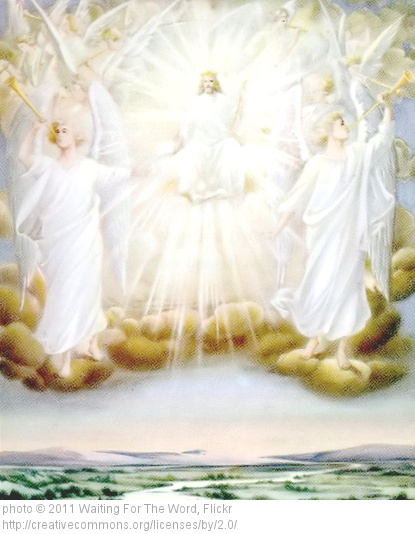
Holy!

Not so much a name of God as a description of His Character, the word Holy means “sacred, separate or set apart, morally blameless; complete; whole; lacking nothing; worthy of worship.” God is Holy. There is no force, no person, no entity who can rival God or be a peer of God. Satan is not God’s equal. Sin, death, evil, none of these can successfully oppose God, or cause Him to stumble or challenge Him. God is Supreme– Alone in His Power and Glory and Sovereignty.

I pray to a Holy God. I pray with the guidance of His Holy Spirit. I follow Christ, who demonstrated Holiness in human form during His time on earth. Sinless perfection, He walked among sinful men and women, healing, teaching, and showing perfect Love and Mercy.

We live in a world that constantly questions this aspect of God. How can a Holy God allow people to suffer injustice, doubts and struggles, and even death? Surely, this is a mistake! God must have failed at some point, or we would live in a perfect world.

God doesn’t make mistakes! And sometimes, that is a concept that can be difficult to fully comprehend. Yes, we know God is “good.” And we know He is powerful. But He is so much more than that. He is without guilt, without doubt, without confusion, without failure. When I see and experience injustice or disease, disappointment, misunderstanding, exhaustion, grief–these are not from God. They come from a fallen world in rebellion against our perfect maker.

Except we once did! Adam and Eve lived in the Garden of Eden, and God provided for their every need. They didn’t need clothing– it never got cold, and the insects, animals, and plants posed no threats. They didn’t need the Law, because they walked with God and knew only good. They didn’t need jobs or houses, money or banks, governments, medicine, dictionaries, alarm clocks or Wikipedia. God didn’t sin– they did. And God didn’t get caught by surprise by the Fall– He already had planned for mankind’s redemption. God didn’t fail. He was, is, and will always be Holy.

This also means He is always “wholly” sufficient for our every need. Even the needs to be understood and to be rescued from our own failures. God, who is Holy, sent His Holy Son to live IN our fallen world– to taste OUR failure, and to set things right. Whatever we suffer now is not God’s “fault,” and it has already been made right in His perfect plan. He understands our temporary pain and suffering differently than we do, because He sees the finished product– our renewal, redemption, and “perfection” in Him!

So I am very thankful today for the Holiness of God. It is something I cannot fully understand until I experience it first-hand, but I can trust in it, put my hope in it, and LIVE in the promise of it, even when I stumble, fail, and struggle.

For more on the Holiness of God, see https://www.whatchristianswanttoknow.com/what-is-the-biblical-definition-of-holy/#:~:text=If%20you%20think%20God%20is%20concerned https://www.biblestudytools.com/bible-study/topical-studies/what-does-it-mean-to-be-holy.html


Lamb of God

Abraham put the wood on Isaac’s shoulder, but he carried the hot coals and the knife. As the two of them walked along, Isaac said, “Father, we have the coals and the wood, but where is the lamb for the sacrifice?”
“My son,” Abraham answered, “God will provide the lamb.”

(Genesis 22:6-8 Contemporary English Version)

The next day John saw Jesus coming toward him and said, “Look, the Lamb of God, who takes away the sin of the world!  (John 1:29 NIV)

After this I looked, and there before me was a great multitude that no one could count, from every nation, tribe, people and language, standing before the throne and before the Lamb. They were wearing white robes and were holding palm branches in their hands. 10 And they cried out in a loud voice:
“Salvation belongs to our God,
who sits on the throne,
and to the Lamb.”
(Revelation 7:9-10 NIV)

In my last post, I spoke of Jesus being “The Good Shepherd.” But He is also the Lamb– the Lamb of God, who takes away the sin of the world! This image may seem to contrast with the previous Names of God– names full of authority, power, might, wisdom, and strength. A lamb is powerless and has no authority. So, what can this name possibly tell us about God?

From the beginning, God used a lamb to represent innocence and sacrifice. Cain and Abel brought sacrifices to God– Cain brought crops he had grown; Abel brought a lamb. God was pleased with Abel’s sacrifice, more than Cain’s. The Bible doesn’t spell out exactly why, but I think the context of the rest of the Bible gives us a clue. When God gave His laws and regulations to the nation of Israel, He specified that the sacrifice for sin, for guilt, for peace, and for worship were to be animals–pure and innocent– their blood the factor that would bring atonement and peace. The innocent lambs would be killed, their blood poured out on the ground, their meat sacrificed on the altar, and the rest of their bodies (skin, bones, offal, etc.,) taken outside of the camp and destroyed. Vegetables, bread, herbs, wine– these could all be offered as free-will offerings, but they were not to be used for sacrifice. And the lambs (or other animals) had to be spotless and free of disease or disfigurement– perfect.

Sin is death– it doesn’t just bring disruption– it is fatal. Because God is HOLY, He cannot dismiss Sin with a shrug and say, “humans will be humans…”, or “it’s ok this once…” or “at least you learned your lesson.” But because the world is infected with Sin, even lambs and goats are not good enough to fully remove the stain and sentence of Sin. Only Holiness could do that.

Jesus is the Lamb of God. Just as Abel offered a lamb for a sacrifice; just as Abraham was ready and willing to offer his beloved son of the promise, God offered His only begotten Son as the only possible perfect sacrifice for Sin. Jesus came as a helpless, powerless babe. He lived a humble and obedient life of service and sacrifice. And He became the ultimate Sacrifice on the Cross.

Jesus is also the victorious Lamb of Revelation, worthy of all praise and adoration! God’s Might and Power are equaled only by His Grace and Lovingkindness. He is both Shepherd and warrior– fiercely protective of His people– and the sacrificial Servant Lamb who humbly serves both God and mankind. He is NOT a lamb without power or authority. But He willingly lays aside all the trappings of authority in order to teach us how to obey and follow Him.

He is God ALMIGHTY, and Ruler of All– but He is also gentle and humble. I do not pray to a God who is far off, aloof, distant, or unfeeling. I pray to the Lamb of God who was wounded for me, who willingly offered to become the sacrifice for my sins, and who died the death I deserved. And I pray to the Lamb who rose victorious, making what should have been the darkest day of history Good Friday!

Too Clever for God?

I love puzzles, puns, mysteries– I love clever plot twists in novels. Most of the time. But there is a type and degree of “cleverness” that is offensive to me. And that is the kind of clever that is meant to sting, hurt, or humiliate.

I love the old movie with Jimmy Stewart called “Harvey.” It is a silly comedy about a man who claims to see, and talk to, a six-foot tall invisible rabbit named Harvey. Jimmy Stewart’s character, Elwood Dowd, is a mostly harmless and genial man, but he is an embarrassment to his socialite sister, and a puzzlement to his neighbors and the staff at the mental institution where his sister wants him committed. The doctors are especially intrigued by Elwood, because he appears to be intelligent, rational, and agreeable– “nice”– except for the rabbit! Meanwhile, the other characters in the film are mostly uptight, stressed, angry, and unpleasant. But Elwood has an explanation. He claims that his mother always told him there were two ways to “go through life.” You could be “oh, so clever,” or you could be “nice.” Elwood has chosen “nice.” And his life– even with its crazy invisible rabbit, is more serene, more fulfilling, than the lives of those who are “smarter” and more powerful.

Such a simple line in a silly film, but that thought resonates with me, and it matches Biblical teaching, too! The Bible has much to say about people who think that they are clever. Those who are proud of their intelligence and acumen; those who are wise in their own eyes. This is not the same as being intelligent, while acknowledging that you don’t know everything. Such “clever” people tend to be cynical, snide, and sarcastic. The Bible calls them “mockers”– people who make fun of and belittle others; those who use their intelligence and quick thinking as a weapon to bludgeon and bully their way through life.

We see and hear it often on television, in government, on talk radio, or comedy routines. We hear it in conversations among groups of peers in the workplace or in social situations. There’s always at least one person who entertains others with jokes or stories that are “wicked” funny– jokes that might make you a bit uncomfortable in certain situations, because you know they are unkind, unjust, or downright offensive–even if they are funny. Jokes that get a laugh at someone else’s expense. Remarks that “burn” people with differing beliefs, opinions, or lifestyles. We sometimes even hear it in the church, with harsh remarks for those who think or worship differently from us.

Just like Elwood Dowd’s mother, God has given us a blueprint for life– we can go through life being “oh, so clever” or “nice.” We can be arrogant; overly certain that we know everything, heaping contempt on those who are struggling or who don’t see things “our way.” Or we can be humble and kind; listening to others, offering loving encouragement and counsel, rather than snide “I told you so’s”, embarrassing comparisons, or pithy quips.

The Apostle Paul, in Galatians 6, outlines how we should not only “bear our own burdens” by taking responsibility for our own strengths, weaknesses, faults, and duties, but also “bear one another’s burdens” by showing compassion and reaching out in love. In the middle of this advice, Paul warns us against deceiving ourselves, and reminds us that “God is not mocked” (v. 7)– We cannot dismiss God’s Holiness in our own life, nor can we dismiss God’s command to love our neighbor. Anyone who does mock God (and those made in His likeness!) are deceived in thinking they are clever and beyond judgment.

Recent world events have reminded me of this truth. The opening ceremony at the Paris Olympics was marred by a “clever” but offensive display. Those who organized it and put it on, “explained away” the offense, claiming it was something entirely different; that their actions were not offensive, and those who were offended were misinterpreting their intentions. Many of them are sneering at Christians, even as they “mythsplain” their mockery. But their actions weren’t just mocking Christians around the world, they were mocking Christ. And many of us Christians responded with our own angry and mocking comments, memes, and posts, calling them names, or worse. But God– and God alone– is Holy and Just. Those actions will be punished, but they will be justly punished by God Himself. In fact, if any of those who participated in that display (and any who have responded hatefully) will repent and turn from their mockery and sin, Christ Himself has already paid the price for their actions!

People can be mocked. Even Christians can be mocked. Christ can be laughed at, spit upon, and even crucified in this fallen world. But God is eternally Holy and Just. He will have “the last laugh.” No one is too clever for God. The same people who laugh at Christ will someday bow before Him in worship, acknowledging that He is the King of Kings. That same King offers His Grace to each of us.

Christ isn’t about being “clever” or smug. Even though He has the perfect right to boast. He chooses to be “nice.” He chooses Grace. He chooses Love. And THAT makes all the difference!

Afraid to Pray?

Are you ever afraid to pray? Afraid that God will not hear, or worse yet, that God will hear but reject your prayers?

The Bible has much to say about fear and our worship of God and in our conduct before God. We are supposed to have a healthy “fear of the Lord.” After all, God is Sovereign. He holds absolute power over life and death, both in this life and throughout eternity! We should have the kind of awe and respect we have for one whose power is so great. We fear forces of nature, such as fire, floods, earthquakes and tornados. We should be afraid of God’s power in relation to our own. But what does this mean in relation to prayer? Does fear have any place in our pursuit of prayer?

So we have come to know and to believe the love that God has for us. God is love, and whoever abides in love abides in God, and God abides in him. By this is love perfected with us, so that we may have confidence for the day of judgment, because as he is so also are we in this world. There is no fear in love, but perfect love casts out fear. For fear has to do with punishment, and whoever fears has not been perfected in love. We love because he first loved us.

1 John 4:16-19 (ESV)

The “fear of the Lord” has to do with God’s power and authority to punish sin. We live in a fallen, sinful world, and we are fallen, sinful people. Our natural response is that of Adam and Eve in the Garden of Eden– to hide from God, and try to avoid His righteous judgment against us. Those whose consciences have been seared will lose this healthy and natural fear– they will be proud in their defiance against God. They will say that God is not sovereign or Holy; that He does not have the power to judge them; that they can “bargain” with God about their eternal destiny– they will even deny His very existence. Others will claim that God is Holy, but not “Good.” They claim that He is disposed to judge harshly; that He is vindictive and without mercy; that He demands too much of us. On the other end of the spectrum, Christians and others can become so disposed to seeing God as their friend and advocate that they forget His awesome Holiness and Power. Christians have no reason to be afraid of God, but we have every reason to stand in AWE of Him!

The Truth of God, as revealed in Jesus Christ is that God is LOVE– perfect and everlasting Love! While He has the power and the authority to judge, it is His desire to lavish mercy on us! Such love should compel us to run TO God, rather than run away from Him! We fall on our knees in worship and adoration, not in abject terror.

So what could still cause us to be afraid to pray?

Perhaps we are still in sin, or we have strayed back into sin. Christ has already paid the penalty for Sin– it has no real power over the believer who “abides in God.” But it still has the power to draw us away from God and damage our relationship so long as we hide it, refuse to confess it, or repent of it. Even as we know that Christ has paid the price for our Sin, we also know that we need to abide in His Love to grow into a more perfect relationship with Him.

Perhaps we are holding on to old patterns of thinking and old guilt. Satan is an accuser. Even after we have confessed our sin and received God’s forgiveness, Satan will try to keep us enslaved to our guilt and shame. He will try to bring it to mind, or have others treat us with condemnation or condescension, so that we feel unforgiven or unlovable. We need to follow the advice of the Apostle Paul:

So here’s what I want you to do, God helping you: Take your everyday, ordinary life—your sleeping, eating, going-to-work, and walking-around life—and place it before God as an offering. Embracing what God does for you is the best thing you can do for him. Don’t become so well-adjusted to your culture that you fit into it without even thinking. Instead, fix your attention on God. You’ll be changed from the inside out. Readily recognize what he wants from you, and quickly respond to it. Unlike the culture around you, always dragging you down to its level of immaturity, God brings the best out of you, develops well-formed maturity in you.

Romans 12:1-2 (The Message)
Photo by Rubenstein Rebello on Pexels.com

God’s love is PERFECT. But our love is not. Sometimes we are praying, not out of love, but out of duty or even selfish motives. We pray for God to give a green light to our wants and desires and plans, rather than listening for His wisdom and grace in our situation. We pray for God to “change” that person who annoys us or persecutes us, rather than praying for God’s blessing on them, and listening to the ways He may want to “change” us! Sometimes we cannot see the wisdom of an outcome we don’t like, and we are afraid of the unknown path we must take– even with God’s continued presence by our side.

We don’t have to be afraid to pray. But when we feel apprehensive, it may be a sign that we NEED to pray–honestly telling God what He already knows and asking for the grace and wisdom to listen to what He so lovingly wants to tell us.

Therefore, since we have a great high priest who has passed through the heavens—Jesus the Son of God—let us hold fast to our confession.  For we do not have a high priest who is unable to sympathize with our weaknesses, but one who has been tempted in every way as we are, yet without sin. Therefore, let us approach the throne of grace with boldness, so that we may receive mercy and find grace to help us in time of need.

Hebrews 4:14-16 (CSB)

Why Confess?

One of the prayer models I like to use often is based on the acronym ACTS. ACTS stands for Adoration, Confession, Thanksgiving, and Supplication. I like this model because it is well-rounded. It works like this:


ADORATION–I love to begin prayer by remembering and acknowledging God’s worth, His supremacy, His Holiness, and His majesty. It sharpens my focus on the WHO of prayer, rather than the WHAT of my worries or doubts. And it puts everything in the proper perspective. Sometimes, I come to God by praying a Hymn, or praying a Psalm, or remembering the many names of God.

CONFESSION–Confession is important in prayer, and since I want to concentrate on it, I’ll come back to this element below.

THANKSGIVING– Thanksgiving returns me to remembering what God has already done– for me, for others, throughout history, and just yesterday in my life. Instead of prayer being all about my needs, wants, or concerns, prayer should be an honest conversation with God. And that must include gratitude, because God is truly GOOD! If you ever doubt that, think about the first five minutes of your morning. If you awoke, you are alive (thank you, God!). If you heard your alarm, opened your eyes and saw anything, if you were lying on a bed, in a shelter with a roof, if you were able to sleep through the night without the terrors of war, slavery, starvation, torture, or chronic agonizing pain, you have much for which to be grateful. If you were able to get out of bed on your own, able to eat breakfast, get dressed, and you have a job to go to or a purpose to fulfill in this day, you are among the blessed. To withhold praise and thanksgiving is to miss one of the privileges of life.

Photo by Tima Miroshnichenko on Pexels.com

SUPPLICATION–Yes, we bring requests to God. And He already knows what we need, what we desire, and what He has planned for us. So supplication is not about making God aware of our needs. But it is another act of acknowledging that God hears and responds to us. Because that’s the kind of God He IS! And because we have spent time Adoring, Confessing (to), and Thanking God, we know that we can present our requests without fear or doubt.

Most of us are fine with Adoring, Thanking, and Saying our requests, but Confession can be tricky– especially in our culture. What are the elements of Confession that trip us up? Mostly, I think, it’s a misunderstanding of what confession is (within the element of prayer) and what it is NOT.

Confession is defined as admitting to guilt, or to a crime or sin or wrongful act. But, even more basically, confession is an admission that we are not the ultimate authority over our lives or the lives of others. As such, we must confess before we can accept God’s atonement for our Sin. If we do not confess our need for God, we cannot accept, understand, or appreciate the depth and nature of His sacrificial Love for us. So when we pray, we must confess, not only God’s Glory in the heavens and the Earth, but His Sovereignty in our lives; His authority over our emotions, our thoughts, and our actions. King David gave us many great examples of confession in his Psalms– and they can be terrific models to use in our own prayers. (See Psalm 6, Psalm 32, Psalm 38, Psalm 51, and others.)

Confession in prayer is not primarily a list of our petty missteps– though we should be willing and able to name them, rather than denying what we’ve said and done–but a daily admission of God’s right to determine how we conduct our thoughts, our habits, our priorities, and our relationships, and acknowledging that God is Merciful, Gracious and Loving– beyond all our failures, mistakes, and even past rebellion. Confession shouldn’t focus so much on what we’ve done, as on how God is able to free us from guilt and shame, and how we intend to move on away from the past. We confess that our ways are not Holy, and in doing so, we underscore that God’s ways ARE Holy, perfect, wise, and good. God already knows our thoughts and actions, but WE need to be reminded of our goal– to run the good race (see Hebrews 12:1, and 1 Timothy 6:12) to follow Christ; to become more like God each day!

Confession is primary to the Christian Life– we confess that ONLY by the work of Jesus (the cross and resurrection) can we be reconciled to God. We cannot pray openly to God if we don’t believe–and confess– that this is true. God is not fooled by sweet talk or glib arguments. We cannot believe that Jesus’ atoning death and resurrection saved us if we don’t believe that it was necessary and good for Him to do so. And besides, confession is good for the soul!

“If we confess our sins, he is faithful and just to forgive us our sins and to cleanse us from all unrighteousness.”

1 John 1:9 (KJV)

Confession has a negative reputation in many Christian circles, and it is misunderstood in others. Just listing our sins or admitting we did something wrong doesn’t have any value without the positive confession that Jesus is “the way, the truth, and the life.” (see John 14:6) In fact, a better definition of Christian confession is this– agreeing with God about who I am (a sinner/imperfect/unable to attain Holiness on my own), and who HE is (perfect/Holy/Sovereign/the One who Loves me absolutely)

When we pray today, I hope we will confess– positively, profoundly, willingly, and whole-heartedly. I hope we will humbly and honestly confess any actions or habits that are interfering with our Christian walk. And I hope we will joyfully confess that Jesus is LORD; that we are trusting in Him to guide us, intercede for us, and give us the power to live more abundantly in this life, and throughout eternity. What a great way to pray!

Lord of All

Lord of the Universe
Lord of the Laundry
Lord of my Future
Lord of my Pocket Change

Photo by Miguel u00c1. Padriu00f1u00e1n on Pexels.com

Father
Almighty
Sovereign
King

You are bigger, greater, wiser, more powerful and Holier than any
Person
Thing
Spirit
Force
Within or without.

Photo by Yunus Tuu011f on Pexels.com

You are Light
And Life.
Wisdom and
Healing.

You are Trustworthy
True
Righteous
Glorious and
Worthy of Praise.

Nothing escapes Your notice.
Nothing surprises You.
Nothing frustrates or puzzles You
Nothing is too difficult or too messy or too broken
For You to LOVE
To Change
To Cherish

Photo by Gustavo Gutierrez on Pexels.com

You Redeem
Renew
Save and
Reconcile
Make all things New

You ARE!

Photo by Efigie lima Marcos on Pexels.com

And that is More than Enough for anything that can happen today!

Holy, Majestic, Awesome God!

5-9 So don’t lose a minute in building on what you’ve been given, complementing your basic faith with good character, spiritual understanding, alert discipline, passionate patience, reverent wonder, warm friendliness, and generous love, each dimension fitting into and developing the others. With these qualities active and growing in your lives, no grass will grow under your feet, no day will pass without its reward as you mature in your experience of our Master Jesus. Without these qualities you can’t see what’s right before you, oblivious that your old sinful life has been wiped off the books.

2 Peter 1:5-9 (The Message) (emphasis added)
Photo by cottonbro on Pexels.com

I think one of the hallmarks of a Christian is not knowledge about God, but personal experience of God. And one of the signs of such experience is a reverent wonder– an overwhelming AWE– of God. Of who He is and how He works, what He has done, and what He has promised to do. As we grow in faith, good character, understanding, discipline, and patience, we are ready to absorb the absolute WONDER of this majestic, mighty, amazing God we serve. We revel in our own personal experience of Salvation, but we also begin to see the magnitude of God’s Grace, His Power, His Wisdom and His Holiness.

Photo by Min An on Pexels.com

Many of the ancient prophets tried to describe their encounters with God’s presence. Daniel and the Apostle John were paralyzed and prostrate when visited by angels. Paul was blinded by the light. Moses’ face had to be covered after being in God’s presence. because his face was so radiant. Isaiah was struck dumb. The list goes on… We may not experience the presence of angels or receive prophecies like they did, but we can experience a sense of ecstasy in contemplating our marvelous Lord and Savior.

One prophet who had such an experience was Habakkuk. Habakkuk lived in perilous and evil times. His nation was in rebellion toward God’s law, and its citizens, from the leaders and priests to the farmers and townspeople, were paying lip-service to God while prostrating themselves to foreign gods and foreign countries. The leaders lived in splendor, while many of their own people starved, or were sold into slavery. Habakkuk, in frustration, prayed to God, pleading for relief from evil, and judgment for the righteous. He had faith, was of good character, understood the law, had developed discipline, and had a passionate patience– but his patience was mixed with frustration. “How long must I wait to see justice and reform?” “How long will my people keep seeking help from wicked foreigners?” “When will we be free of oppression?”

Photo by Wallace Chuck on Pexels.com

Habakkuk was not just whining. He had a heart for his own people, and wanted to see what God would do. God’s answer was not what Habakkuk was expecting. God promised justice and redemption– but only after invasion, more oppression, and exile! God was sending a vast and merciless army to crush not only His own people, but all the wicked nations in whom they had placed their trust. God was going to “pull the rug out” from under the entire region. But then, He would punish the invaders, wiping out their power and restoring His people to their own land.

What was Habakkuk’s reaction to such news? At first, he was stunned; then confused. But in a very short time, his horror turned to worship. He resolved to stand at his watch; to station himself on the ramparts to see God at work. And as he waited, his perspective changed. God DID see the injustice and wickedness; the violence, lies, and betrayal. God had a plan– a plan so much grander and glorious in scope– a plan that had been in place from long before Habakkuk was born; long before his complaint. It was a plan that would not leave wickedness unpunished, but would bring justice in its proper time, and allow for redemption, restoration and renewal.

Photo by Frank Cone on Pexels.com

Habakkuk’s prayer (chapter 3) is a marvel of praise and worship:
“His glory covered the heavens, and his praise filled the earth. His splendor was like the sunrise; rays flashed from his hand where his power was hidden…” (v. 3b-4)
“You split the earth with rivers; the mountains saw you and writhed. Torrents of water swept by; the deep roared and lifted its waves on high. Sun and moon stood still in the heavens at the glint of your flying arrows, at the lightning of your flashing spear… (v.9b-11)
“I heard and my heart pounded; my lips quivered at the sound; decay crept into my bones, and my legs trembled. Yet I will wait patiently for the day of calamity to come on the nation invading us. Though the fig tree does not bud, and there are no grapes on the vines; though the olive crop fails, and the fields produce no food; though there are no sheep in the pen and no cattle in the stalls, yet I will rejoice in the Lord. I will be joyful in God my Savior. The Sovereign Lord is my strength; he makes my feet like the feet of a deer; he enables me to go on the heights.” (v. 16-19a NIV)

Photo by Orlando Vera on Pexels.com

How often does my heart pound and my lips quiver as I contemplate our Awesome God? How often am I joyful in God my Savior– especially in the midst of expected hardship and continuing evil around me? How often do I limit my sight to what is immediately before my eyes, instead of looking up at the one who holds every moment of the past and future; who controls the vastness of millions of galaxies, yet also sees each individual hair on 7 billions human heads, knows every grain of sand in the desert, and every drop of water in all the oceans; who tracks every molecule in the universe, but knows me by name?!

Photo by Snapwire on Pexels.com

May today be a day filled with reverent wonder, as we consider the Holy, Majestic, and Awesome God who has the power to redeem, inspire, and strengthen us for whatever lies ahead.

Qualified

Recently, we’ve been dealing with a lot of bureaucratic red tape. There are forms to fill out, forms to gather and certify, appointments to make and meet, and various qualifications. We must file paperwork for our business, for our income taxes, for our vehicles, our health insurance, our banking, –even a fishing license! We have to fill out paperwork to prove who we are, where we were born, where we live, how much money we make (or don’t make!), what we own, how much it is worth, how much we spend, whether or not we are ill (or have been ill, or might become ill!), whether we are legally married, etc.. Some processes are simple, only requiring a few questions and proof of ID, but most are not. Forms to be filled out on-line are often confusing, and there is no one to help explain the terminology. Forms that must be submitted often require supporting evidence that must be gathered from several different agencies and locations, signed, printed on certain paper, notarized, stapled (or NOT stapled), and sent by mail, faxed, delivered in person, or scanned and e-mailed. And if any one of the steps is not followed to the letter, we are not “qualified” to do business, receive payments, be properly licensed, receive medical treatment, etc. Regulations often run to hundreds of pages, and while there are experts who understand all (or most) of the fine details, most of us are overwhelmed by the “red tape” involved in living from day to day. We are not “qualified” to prove we are qualified to exist!

Photo by Sora Shimazaki on Pexels.com

I’m so glad I don’t have to make an appointment and prove that I am qualified to talk to God! The bottom line is that I KNOW I’m not qualified–not in my own power or wisdom or achievements. Instead of trying to prove something so impossible, God invites me to come– just as I am!– to meet with Him. He qualifies me through the shed blood of Christ. Jesus Christ fulfilled every qualification I could not– He lived a perfect life, never breaking God’s just laws, never falling short of God’s standards. And then, He paid the price of my failures by taking the death that should have been mine, and defeating it! All the “red tape” has been handled, all the forms filled out, the I’s dotted and the T’s crossed– my name is written in the Lamb’s Book of Life, with no need for me to re-apply or be approved all over again.

Photo by ANTONI SHKRABA production on Pexels.com

There is only one thing I must do to be “qualified” for a right relationship with God– with all it’s privileges and benefits–I must accept God’s terms for the qualification process. I must accept that I cannot qualify myself; I cannot earn God’s acceptance through my own efforts, I cannot buy my way into His good graces, and I cannot inherit the qualifications from my parents, neighbors, ancestors, or countrymen. I must also accept that Christ’s life, death, and resurrection are sufficient– even extravagant–to meet the requirements. Finally, I must trust that God’s ways are true and right and better than my own. I cannot accept Christ’s qualifications, and still do life “my way.”

Photo by Ivan Samkov on Pexels.com

In this life, it can be very frustrating to get “qualified” to do the things we wish to do. But we can be qualified for eternity through Jesus Christ. We are pre-approved to visit any time, to speak to Him– even pour out our sorrows and frustrations and failures. And there is no need to wait for an appointment!

Photo by Andrea Piacquadio on Pexels.com

Blessed Are the Pure in Heart..

“Blessed are the pure in heart, for they shall see God.” (Matthew 5:8)

“Create in me a pure heart, O God, and renew a steadfast spirit within me.” (Psalm 51:10)

Photo by Min An on Pexels.com

I’ve been looking through the Beatitudes and how they relate to prayer. Jesus said that the pure in heart are blessed, for they shall “see God.” Have you ever spoken to someone who wasn’t looking at you? They looked past you, or around you, or down at their device, but they didn’t attempt to make or maintain eye contact. It can be disconcerting, and even rude. And yet, there are times when, with our divided hearts, we come into prayer without really looking for, or at, God.

Photo by RODNAE Productions on Pexels.com

At other times, our hearts cloud our vision, giving us a distorted view of God. We harbor sin or guilt, and we see God as unforgiving or unfair. We are holding on to our own will, and we see God as restrictive or demanding.

Photo by Andrea Piacquadio on Pexels.com

The pure in heart see God as He really is– Glorious, Merciful, Wise, and Just. They see evidence of His lovingkindness and faithfulness all around them. They see themselves through His eyes– beloved and forgiven–and they see others through the eyes of Grace.

This is not our natural state. We are NOT pure in heart. We are self-centered, self-absorbed, and self-conscious. King David recognized this profoundly when he was caught in his great sin of adultery and murder. In his own lust and selfishness, he had seduced the wife of another man, and when she became pregnant, David arranged to cover up the first sin–by having the man murdered. David was not a notorious scoundrel. He was even called, “a man after God’s own heart.” But when he was confronted with his guilt, David “saw” himself as he really was– not a victim of circumstance, or a martyr to passion, or a king who was above the law, but a man who had committed evil against others, and against a Holy and Sovereign God.

Photo by Nicola Barts on Pexels.com

David’s prayer was in line with his vision. Not only did he see himself as he really was; he saw God as HE really is: Holy and Just, but willing and able to restore David’s purity of heart. David’s God is the same today as He ever was. He longs to make us clean; to restore to us the joy of our salvation (see Psalm 51:12), and give us the power to pursue our purpose and leave our past sins behind.

Photo by Edu Carvalho on Pexels.com

When we desire to “see God,” we must desire this cleansing and restoration of purity. We can pray without it, but we cannot look at a Holy God with an unclean spirit. All we can do is look elsewhere– talking to the wall or the floor. God still hears us, but he wants to have a real conversation; one full of intimacy and understanding.

So, today, will I make “eye contact” during my prayer time?

Sifting Through the Ashes

A Poem for Ash Wednesday

Photo by Jeremy Bishop on Pexels.com

Father, I look around, and all I see are the ashes:
Broken dreams, lost opportunities, burned-out passions..
Everything else is consumed.

Photo by Karolina Grabowska on Pexels.com

I sit here, on this heap of ashes: sifting through cold dust motes–
There is no heat, no burning embers, no trace of what was.

Such is the nature of sacrifice.
You don’t desire the stench of a half-burnt ram, or a singed goat.
You don’t relish a pile of smoking bones, or a half-hearted heart.

But you honor ashes and sacrifice given
With a whole and willing heart–
Even a broken one.


Your holiness consumes all that is temporal.
The ashes left are what you desire; the essence, the emptiness.
In exchange for them, you pour out
Life and blessing, gladness and healing.

As I sift through the ashes, I will not find the life I built,
The dreams I nurtured,
The honor I sought:
Instead, I will find evidence of the Holy Fire.
The ashes will be scattered to the wind.
They will fall on the waters.
They will become incense and prayers.
I will wear them on my forehead:
Your Holiness has burned away the dross.
My sacrifice is gain, not loss.

Photo by Andrea Piacquadio on Pexels.com

Blog at WordPress.com.

Up ↑