Render Unto Caesar…

I don’t like paying bills. Utility bills, insurance premiums, credit cards, and taxes– property tax, income tax, even sales tax. Every month, the bills come, and the checks go. And if we don’t pay the bills on time, there is an extra fee and interest charges. Bills and fees and payment schedules are not unusual or unexpected in this world. And we pay (if and when we can) because we are honest and upright citizens. It is a duty, but not a pleasure.

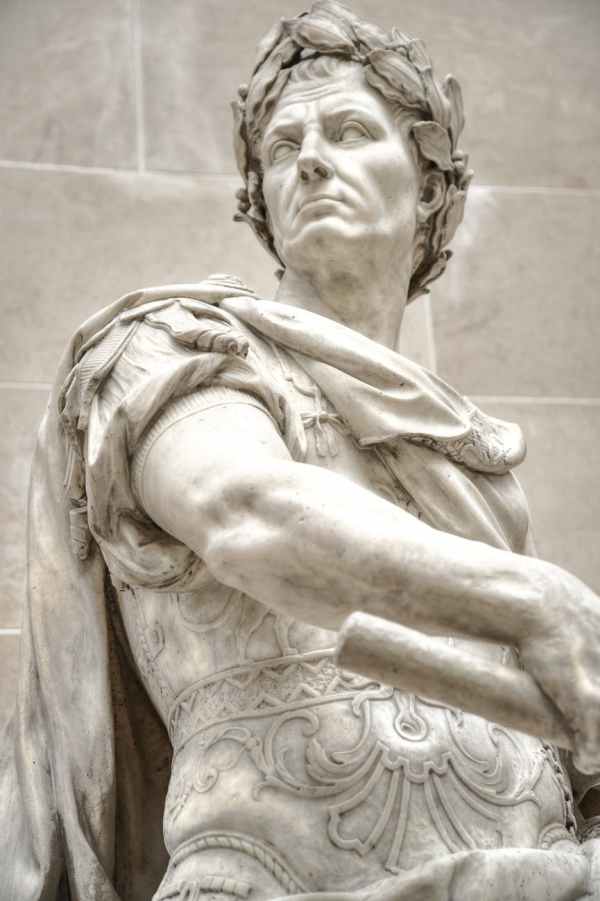
Even Jesus had to pay taxes. He was asked about it– even challenged over it. The Pharisees wanted to trap Jesus into taking a stance and offending many of His followers or running afoul of the Roman government. They asked, “Is it right to pay taxes to Caesar, or not?” (Matthew 22:17)(https://biblia.com/bible/esv/matthew/22/15-22) Of course, if Jesus said it was right to pay taxes, He would anger those who were fighting to be free of Roman oppression. Paying taxes to Caesar, in effect, legitimized Roman occupation and subjugation of the Jews. Much of the tax money was used to extend Rome’s control over the Jews, and to pay the soldiers and officials who made life miserable for Jesus’ followers on a daily basis. And it was common knowledge that many tax collectors were corrupt and cheated the people to line their own pockets, as well. The Romans worshiped countless gods and goddesses, but had no respect for the God of Israel. It was humiliating, and burdensome, and unjust to pay taxes. And yet, if Jesus said it was NOT right to pay taxes, He would be inciting open rebellion against the Roman occupation. He and His followers were be arrested and killed.

But Jesus did not fall into the Pharisees’ trap. He asked to see a common coin. He asked whose face and likeness were on the coin. “Caesar’s.” And then Jesus said, “Give to Caesar what is Caesar’s and to God what is God’s.”

I was reminded as I opened bills and wrote checks this past week, that I do NOT receive a bill from God. I owe God everything– my life, my next breath, my health, my hope of eternal life. Yet He never sends me a bill, or an overdue statement. He charges no interest, or late fees, even when I let distractions keep me from giving Him the praise and honor that is due to Him. Even when I choose to go through my day without sharing my heart’s longings with Him.

I may not like paying bills, but I do it. I “render unto Caesar,” even as I complain about taxes and interest fees. But do I “render unto God what is God’s?” And when I do, is my attitude the same as it is when paying bills? God forbid!

God never cheats; He never asks for something He doesn’t deserve. And He has given me far more than I could ever ask or imagine, through the power that is at work IN ME! God doesn’t give loans– He gives gifts of eternal value.

What can I render unto God today? Surely I can give Him praise, and share His grace and goodness with others…it isn’t impossible. It isn’t beyond my duty. It isn’t isn’t even “taxing!”

Too Much of a Good Thing

My late uncle came to know Christ– really know Christ– later in his life.  He and my aunt spent their final years doing advanced Bible studies by correspondence course– hour after hour studying Hebrew and Greek, filling out paperwork, sending it in, and waiting for the next lesson (this was before the explosion of online classes and internet shortcuts).

When Uncle Fred was diagnosed with ALS (Lou Gehrig’s disease), and he knew his time on earth was drawing to a close, he planned his funeral service, and it was incredible– uplifting, encouraging, hopeful!  This from a man who, earlier in life, had had anger issues, numerous issues with money, and serious doubts about God.  One of his favorite scripture passages came from Proverbs, and it surprised me a bit.  It wasn’t about promise or hope or power or expectation.  Instead, it was about discipline and correction and balance.

Proverbs 30:7-9 New International Version (NIV)

“Two things I ask of you, Lord;
    do not refuse me before I die:
Keep falsehood and lies far from me;
    give me neither poverty nor riches,
    but give me only my daily bread.
Otherwise, I may have too much and disown you
    and say, ‘Who is the Lord?’
Or I may become poor and steal,
    and so dishonor the name of my God.

The first request is one we might expect– keep me from lies and falsehood. Not just the lies of others, but keep ME from lying. After all, this is in keeping with the ninth commandment. And we need God’s help to keep away from all sins, including self-deception!

walk human trafficking

The second phrase is a little harder to swallow– “Give me neither poverty nor riches”– OK, I don’t want to be poor, and it’s probably not good for me to be super wealthy.  I’ll just be a comfortable middle-class sort of person. 

It’s the last phrase that catches us– “But give me ONLY my daily bread.”  Excuse me?  I don’t know about some of you who may be reading this, but I don’t want ONLY my daily bread.  What about all those verses that say we can ask for ANYTHING in Jesus’ name and he will do it!?  What about being prepared in and out of season–what about savings accounts and retirement plans and having extra to give to those in need?  What about a cozy lake cottage or a really nice vacation?  Don’t I deserve to treat myself?  Haven’t I earned a few creature comforts?  I give to charity, and I volunteer at church. I don’t need to be rich, but “only my daily bread” sounds a bit like poverty…

The next verse gives the reason, and also the test.  “Otherwise, I may have too much and disown you and say, ‘Who is the Lord?’ Or I may become poor and steal, and so dishonor the name of my God.”  It’s tempting at this point to brush off the warning.  After all, I haven’t disowned God, have I?  I still go to church and write about prayer.  What more does God want of me…Who is God to ask more of me?  Who is the Lord to tell me what I can’t have…We don’t start out denying or disowning God, but we begin to question his ways, and our own obedience.  Similarly, we don’t think we are stealing or dishonoring God’s name, but how many of us have tried to “beat the system” to get ahead instead of turning to God or the church for help?  Tax breaks that are questionable, lying (see verse 8a again…) about our income to qualify for federal programs or grants, “borrowing” from family or friends with little or no plan for how to repay them…  I wish I could say I didn’t know anyone who had ever bragged to me about they had “cheated” just a little, or that I had a perfect track record in this area.

view of tourist resort

This passage is filled with wisdom, but it is not wisdom we teach in many of our churches today.  Yet it is exactly what God teaches by example and what he expects of us.  Did not Jesus pray for God to “Give us this day our Daily Bread?”  He didn’t ask God to pour out the storehouses of Heaven so we could add a pool in the back yard, or afford a new car, or get that extra pair of shoes or the latest new gadget.  Yet he prayed with the complete confidence that God would not withhold any of his needs or cause him to live in shame or starvation.

man holding sheep statuette

It’s not as though God has commanded us to live as paupers and beggars– look at the way he provided for the Israelites in the wilderness.  He provided, quite literally, their daily bread/manna.  Just enough for each day, with a double portion for the Sabbath.  Just enough– just a sufficient amount.  No one had to worry about losing their food supply to theft, packing it up to travel, using it up before the expiration date, or comparing one brand to another to check for gluten or preservatives or recall notices.

No one had to worry about whether their shoes were the right color to match their favorite outfit, or if they had enough gas in the tank for their next move.  God provided all their needs when they absolutely COULD NOT.  And he provided more than just their basic needs– they had herds and flocks; he provided water and grazing for them, too.  He had caused the Egyptians to give them gold and jewels as they left Egypt, so they would have enough (and far more than enough) to make all the tools and objects for the tabernacle, and still have a medium of exchange when they reached their new homes in the Promised Land.

But God did not encourage His people to seek after riches–even for His sake. When David wanted to build an elaborate temple, God sent word that, while David’s intention was good, He (God) did not need a Temple; nor did He want David to build one. And David listened and humbly thanked God for the blessings he already had, and the opportunities God had provided for him. Solomon DID build the temple, but he allowed the riches flooding into his kingdom (among other things) to turn his heart away from God.   He built an elaborate Temple, but then he spent even more time and money to build his own palace and throne! He collected horses from Egypt and many foreign wives (expressly forbidden for the kings of Israel– see Deuteronomy 17:14-17). And he fell into cynicism and idol worship.

Our current culture (at least in the U.S. and in much of the rest of the world) tends to be consumed by…consumption.  Having the newest and latest and best of everything.  Seeing to our own comfort and self-esteem and satisfaction– often at the expense of our devotion to Christ and our service to others.

adult beautiful elegant eyewear

There’s nothing wrong with nice things– helpful tools, comforts, pleasures– God doesn’t want us to be miserable or full of a false humility that throws away opportunities and rewards.  But he needs us to see that not every “good” thing is the “best” thing for us.  We CAN be too rich, too thin, too smart, too proud…you get the idea.  Too much of a good thing can blind us to the BEST thing!

Why Confess?

One of the prayer models I like to use often is based on the acronym ACTS. ACTS stands for Adoration, Confession, Thanksgiving, and Supplication. I like this model because it is well-rounded. It works like this:


ADORATION–I love to begin prayer by remembering and acknowledging God’s worth, His supremacy, His Holiness, and His majesty. It sharpens my focus on the WHO of prayer, rather than the WHAT of my worries or doubts. And it puts everything in the proper perspective. Sometimes, I come to God by praying a Hymn, or praying a Psalm, or remembering the many names of God.

CONFESSION–Confession is important in prayer, and since I want to concentrate on it, I’ll come back to this element below.

THANKSGIVING– Thanksgiving returns me to remembering what God has already done– for me, for others, throughout history, and just yesterday in my life. Instead of prayer being all about my needs, wants, or concerns, prayer should be an honest conversation with God. And that must include gratitude, because God is truly GOOD! If you ever doubt that, think about the first five minutes of your morning. If you awoke, you are alive (thank you, God!). If you heard your alarm, opened your eyes and saw anything, if you were lying on a bed, in a shelter with a roof, if you were able to sleep through the night without the terrors of war, slavery, starvation, torture, or chronic agonizing pain, you have much for which to be grateful. If you were able to get out of bed on your own, able to eat breakfast, get dressed, and you have a job to go to or a purpose to fulfill in this day, you are among the blessed. To withhold praise and thanksgiving is to miss one of the privileges of life.

Photo by Tima Miroshnichenko on Pexels.com

SUPPLICATION–Yes, we bring requests to God. And He already knows what we need, what we desire, and what He has planned for us. So supplication is not about making God aware of our needs. But it is another act of acknowledging that God hears and responds to us. Because that’s the kind of God He IS! And because we have spent time Adoring, Confessing (to), and Thanking God, we know that we can present our requests without fear or doubt.

Most of us are fine with Adoring, Thanking, and Saying our requests, but Confession can be tricky– especially in our culture. What are the elements of Confession that trip us up? Mostly, I think, it’s a misunderstanding of what confession is (within the element of prayer) and what it is NOT.

Confession is defined as admitting to guilt, or to a crime or sin or wrongful act. But, even more basically, confession is an admission that we are not the ultimate authority over our lives or the lives of others. As such, we must confess before we can accept God’s atonement for our Sin. If we do not confess our need for God, we cannot accept, understand, or appreciate the depth and nature of His sacrificial Love for us. So when we pray, we must confess, not only God’s Glory in the heavens and the Earth, but His Sovereignty in our lives; His authority over our emotions, our thoughts, and our actions. King David gave us many great examples of confession in his Psalms– and they can be terrific models to use in our own prayers. (See Psalm 6, Psalm 32, Psalm 38, Psalm 51, and others.)

Confession in prayer is not primarily a list of our petty missteps– though we should be willing and able to name them, rather than denying what we’ve said and done–but a daily admission of God’s right to determine how we conduct our thoughts, our habits, our priorities, and our relationships, and acknowledging that God is Merciful, Gracious and Loving– beyond all our failures, mistakes, and even past rebellion. Confession shouldn’t focus so much on what we’ve done, as on how God is able to free us from guilt and shame, and how we intend to move on away from the past. We confess that our ways are not Holy, and in doing so, we underscore that God’s ways ARE Holy, perfect, wise, and good. God already knows our thoughts and actions, but WE need to be reminded of our goal– to run the good race (see Hebrews 12:1, and 1 Timothy 6:12) to follow Christ; to become more like God each day!

Confession is primary to the Christian Life– we confess that ONLY by the work of Jesus (the cross and resurrection) can we be reconciled to God. We cannot pray openly to God if we don’t believe–and confess– that this is true. God is not fooled by sweet talk or glib arguments. We cannot believe that Jesus’ atoning death and resurrection saved us if we don’t believe that it was necessary and good for Him to do so. And besides, confession is good for the soul!

“If we confess our sins, he is faithful and just to forgive us our sins and to cleanse us from all unrighteousness.”

1 John 1:9 (KJV)

Confession has a negative reputation in many Christian circles, and it is misunderstood in others. Just listing our sins or admitting we did something wrong doesn’t have any value without the positive confession that Jesus is “the way, the truth, and the life.” (see John 14:6) In fact, a better definition of Christian confession is this– agreeing with God about who I am (a sinner/imperfect/unable to attain Holiness on my own), and who HE is (perfect/Holy/Sovereign/the One who Loves me absolutely)

When we pray today, I hope we will confess– positively, profoundly, willingly, and whole-heartedly. I hope we will humbly and honestly confess any actions or habits that are interfering with our Christian walk. And I hope we will joyfully confess that Jesus is LORD; that we are trusting in Him to guide us, intercede for us, and give us the power to live more abundantly in this life, and throughout eternity. What a great way to pray!

Passing Gas

There once was a distinguished scholar and lecturer who was invited to be part of a symposium at a prestigious university. But during his time on stage, the professor realized that he was having a gas attack. Not wanting to embarrass himself by passing gas in front of the rest of the panel (and indeed the entire auditorium full of students) he politely asked to be excused to take a short break as the rest of the panel discussed a minor issue. He proudly excused himself, making it seem as though he was merely bored and wanted to stretch his legs a bit. Exiting the auditorium, he raced to the nearest bathroom and “let it rip,” not realizing that his portable microphone was still “hot.” The entire audience could hear, not only the gas he passed, but the other noises he made– of pain as the gas was passing, and of relief at the end of the attack. As he returned to his seat on stage, he was stunned to see people grinning and pointing, and hear stifled giggles as he rejoined the panel. Even his colleagues were finding it difficult to meet him with a straight face. Finally, the moderator asked, somewhat sarcastically, if the professor felt better after his break, and could be please be sure that his microphone was “turned back on…” As he finally realized what had happened, the professor was mortified, and barely spoke during the rest of the symposium. He left in a hurry, and it was many years before he agreed to visit that university again.

We may laugh at the downfall of the proud professor, but how often do we try to “pass gas” discreetly, pretending that we are “above” petty embarrassments and minor setbacks. As Christians, it is especially tempting to pretend that we “have it all together;” that because we follow Christ, we never struggle with pain, or niggling doubts, or unanswered questions. We sit in judgment on our neighbors because we do not stumble over the same sins that we see in them.

The world is watching. They pay close attention, not only to the sins we avoid, but to the sins we push aside or try to explain away. Sins like pride and gossip; sins like “bending the rules” and “fibbing.” It’s not that they don’t know about their own sins. In many cases, they are trapped in a cycle of guilt about their own sins, and their inability to escape the cycle on their own. Or they live in a web of lies about their lifestyles and habits– “I’m no worse than Him!” “God understands my weakness. He can’t condemn me for being the way He made me!” “God and I have a bargain. I don’t do X, and he’s ok that I do Y instead…”

But are we any “better?” “I don’t gossip. I ‘share’ prayer concerns.” “I’m a work in progress. God isn’t finished with me yet!” “King David told lies, and he was a ‘man after God’s own heart’!” “I’m not cheating on my taxes. You should hear my neighbor talk about what he’s done!” “I know I need to lose weight, but, well, there’s just more of me to love!” We are just as ready to find excuses for doing things we know to be wrong, unhealthy, unloving, and sinful, as our neighbor or our “enemy.”

Even more, we are tempted to pretend that we “have all the answers.” After all, if we trust God, how can we still have questions about pain or suffering or grief? We feel that admitting our weaknesses will expose us to ridicule, and that it may hurt our testimony.

That doesn’t mean that we should condone the sins of others, or that we should carry a load of shame over our own lapses. The point is that Jesus calls us to walk humbly and bring ALL our burdens to Him in prayer. Do I still struggle with my tongue–am I still spouting sarcastic retorts make me look smart, while putting others down? I need to submit that habit to the Lord. Does it bother me that my brother smokes or looks at porn? I should not condone such behavior, but it’s not my place to “make him” change his behavior. I should pray about it, and let him know I care about what these habits may be doing to his health and relationships. God doesn’t “hate” my neighbor who can’t seem to hold down a job, nags her husband and kids, and uses foul language– and neither should I! I shouldn’t encourage her bad behavior, but I should be willing to listen to her, show her compassion as someone Christ died to save, and offer her the same friendly helping hand I would be willing to give my other neighbors.

And I should be honest about my own limitations. God has saved me. I am His. But he didn’t save me because I had “cleaned up my act.” And he doesn’t reject me because I still don’t know all the answers or do all the “right” things. Instead, He guides me to be more like Him as I faithfully follow His ways, including confessing when I mess up. God is big enough to save me and re-shape my future in ways I can’t even imagine. I didn’t “win” my salvation. It is a gift– one that keeps on giving!

Being a Christian isn’t about acting “better” than those around us– though we should be walking in Jesus’ footsteps and living more like Him each day. It can be difficult, as the rest of the world may hold us to a higher standard. We will be judged more harshly than our neighbors who do not attempt to follow Christ. We will be accused of holding judgmental attitudes, even when we don’t display them. And we will find our standards and morals being maligned as “old-fashioned” or “snobbish” or even “hateful.” Not because they are any of those things, but because God’s standards (and anyone who agrees with them) offend those who rebel against them. And we still live in a fallen world, just like everyone else. We still wrestle with temptations, we still experience the consequences of sin– our own and others’–that make us sick, or weak, or poor, or otherwise look like “failure” to those around us. And it does no good to pretend that life isn’t sometimes difficult and painful–we’re not fooling anybody!

Instead, being a Christian is about “becoming” better than we can be without God’s Spirit living, moving, and acting THROUGH us. And a big part of that process involves “passing gas.” We need to let go of the sin and the “bad gas” that still builds up inside of us– pride, shame, stubbornness, laziness, envy, criticism, apathy, anger, bitterness, hatred, and so much more. And we need to acknowledge that our Salvation– now and through eternity– only comes through the finished work of Jesus Christ, not our own efforts. This process is called “Sanctification.” We are “saved” by Grace through Faith (see Ephesians 2:8-9). We cannot boast about having been saved. But we testify about our salvation by a changed nature, led by God’s spirit– a “new” compassion for those around us; a new delight in following God’s standards; a new humility about our own limitations, and a new joy for the way God can work through even our weaknesses to give us victory!

Ironically, passing gas is a necessary part of our bodily processes. If we don’t get rid of the “bad” gas, it will lead to bloating and actually poison us! Similarly, if we don’t acknowledge areas where we need to confess, continue in obedience, and submit our will to the Holy Spirit’s promptings, we will become bloated with our own self-importance, and poisoned by our self-deceptions.

So today, as I pass gas– as I surely will at some point– I hope that I will be convicted, and even amused, at how God uses the lowly things of this world for our benefit, and His Glory!

Building Blocks of Healthy Prayer

When I was in elementary school, we learned about nutrition. Back then, we were taught that there were four basic food groups (nutrition education has gone through several “cycles” since then– food pyramid, healthy plate, “eating the rainbow”, etc.). Eating a healthy balance of foods is essential to good health. If I only eat meat, or only sweets, I will not be healthy. If I just eat whatever or whenever I feel like it, my body won’t get all the necessary nutrients to grow, fight off diseases, and stay strong.

Pursuing a healthy prayer life includes essential “building blocks” or nutrients, as well. Over the course of many years, I have seen various guidelines and acronyms to help include different building blocks in prayer. I want to share a couple of them again today. These guidelines are just that– guidelines. But they can help balance our prayer life, and help it grow.

The first acronym I learned, and the one I have used for decades, is ACTS. Here’s how it works:

  • Adoration/Acknowledgement– begin each prayer by acknowledging God’s Sovereignty, His Holiness, His Goodness, and other qualities worth worshipping. This helps put you in the right frame of mind when talking to God. I am not just talking to a neighbor or a “good buddy”– I am speaking with the One who holds all of Creation in His hands! And He WANTS a relationship with me! He is all-powerful: there is nothing I can ask that He cannot do! His is all-loving: there is nothing I can ask that He won’t filter through His loving wisdom and will. Even if I don’t know what to ask for; even if I ask for the “wrong” thing– God will only allow those things that He can use for good. God is beyond space and time: He knows all that has happened– all the triumphs and tragedies of my life so far, and all that is to come. He is LORD: He is in control– now and forevermore. Whatever seemingly impossible circumstances I face, they are nothing compared to the eternal, almighty plans of God.
  • Confession–This doesn’t mean an endless repetition of all my failures and sins from six months ago, or raking myself over the coals for not being “holy enough.” This is an honest assessment of who I am in relation to God. God is Holy and perfect. I am not. If I acknowledge God’s goodness, I must also acknowledge that I fall short. I don’t know everything. I don’t always act with the right motives. I NEED the Holy Spirit’s guidance, and I DEPEND on Christ’s finished work on Calvary for my Salvation. This should naturally lead to
  • Thanksgiving/Trust– I can trust God to save me, NOT because of who I am, but because of what He has done. I can see God’s hand working in and around and through me as I yield to His Spirit in me. I can recall, and acknowledge so many of the ways that God has blessed me and others around me. Once I have these building blocks in place, I can bring burdens to God through
  • Supplication– this is just a fancy term for asking God to work His will in specific areas– healing, guidance, encouragement, strength, understanding, submitting to His will, and following Him. I can ask for personal help, or lift up family members, neighbors, friends, and yes, even enemies! I can pray about situations great and small–from wars and famines to lost keys and short tempers.

I learned about ACTS when I was in college, and I have found it to be a great guideline. While I don’t use it for every prayer– sometimes an issue calls for immediate and direct supplication, for instance– I find that using this in daily prayer helps me grow in faith, patience, endurance, and hope. When I come to God in panic or stress, and I haven’t built up a healthy, consistent practice of prayer, my words can be anemic– lacking in faith and based on my fear or anger. I pray with my focus on problems, rather than on God’s power to overcome any circumstance. Using ACTS helps me remember that it is GOD who “acts,” and always for the best!

The second acronym I have used is PRAY. It is very similar to ACTS, but the end focus is slightly different:

  • Praise/Adoration– once again, it begins with praising the God who is worthy; the God who hears me, sees me, loves me, and knows what is best. I cannot live victoriously without remembering the source of hope and victory, and putting my heart in HIS hands.
  • Repentance– as with Confession above, this is not an act of groveling and rehearsing past shame. It is acknowledging anything that I might be holding on to that gets in the way of my worship of and submission to God’. E.M. Blaiklock, the Christian apologist from New Zealand once said: “God alone knows how to humble us without humiliating us and how to exalt us without flattering us.”  Repentance is not about humiliation or holding on to guilt, but rather about staying humble and honest about our need for God’s Grace and Power. And turning from anything that might get in the way of following Jesus Christ.
  • Ask– once we have a right view of who God is, and who we are, we are free to ask Him whatever is on our mind, and share our questions, fears, burdens, etc., with the One who has all the answers!
  • Yield/ “Yes, LORD!”– The final step is making sure we are ready to listen and respond to God as we expect His answer. No matter what God’s answer may be, we should trust and obey His wisdom above our own.

I have come to value PRAY as a wonderful tool to help in my pursuit of prayer, and in my broader pursuit of Christlikeness. Both ACTS and PRAY help me pray “better.” It’s not that God grades my prayers or listens more or responds differently: but it helps me to better appreciate the power of prayer, and the power behind prayer. Individual prayers can change circumstances, but the pursuit of prayer is meant to change US as well. Prayer that shapes us, helps us grow– if that isn’t at least part of our pursuit of prayer, we are missing out on what God wants to do through us, and not just for us.

It is important, just as with nutrition, that we have a healthy balance in our prayer life. That balance consists of worship, repentance, sharing our burdens, showing gratitude, and offering ourselves in humble service. Prayer is too important to just “wing it.” We need to pursue it with the same (or better!) dedication that we give to our physical health.

Do Justice

Sometimes, we pray for God to “show us the way,” to help us know how best to please Him. We are faced with choices that seem right or good, but other choices seem equally good. In fact, sometimes, “God’s ways–” His laws and commands– seem awkward, outdated, harsh, even “wrong” in light of circumstances.

Photo by JJ Jordan on Pexels.com

But the prophet Micah points out the God has shown us how to please Him. He even spells out three things God requires of us: to do justice, love mercy, and walk humbly with our God. (Micah 6:8) Later, Jesus confirmed that the two greatest commandments are to “Love the Lord your God with all your heart and with all your soul and with all your mind” and “Love your neighbor as yourself.” (Matthew 22:36-40) I want to explore this in greater detail, beginning with Micah’s first requirement– Do Justice.

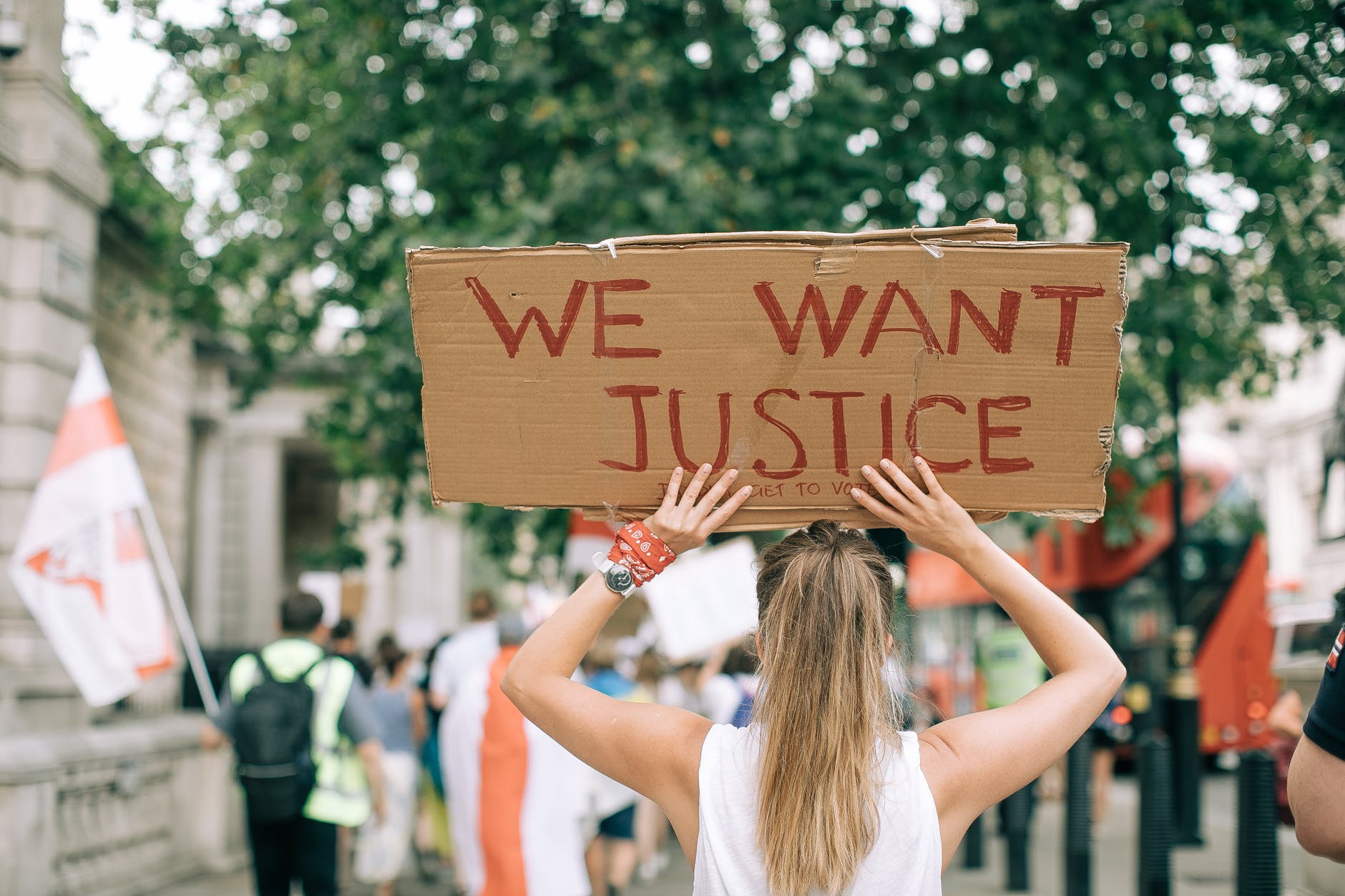
On its surface, this seems sensible and self-evident– Justice is good; injustice is bad, and a good God would always want us to be on the side of justice. But this is not a statement of thought or sentiment. God’s requirement is not that we prefer justice, or agree that justice is a good thing, or even denounce injustice. Instead, it is an action statement– DO justice (some versions use the phrase “act justly”). Those of us nodding our heads, or pointing our fingers, or arguing about past injustices miss the requirement entirely. We are to love mercy (more about this in another post), but to do justice– act justly–behave in accordance with justice.

DO. JUSTICE. Tell the truth; honor commitments; pay debts; actively share with the needy around us; actively defend our neighbors against threats; actively confront and seek punishment for those who are doing harm; honor and respect those in authority over us; accept the limits and limitations of our circumstances; obey the law, even when others don’t. There is nothing easy or self-evident about doing justice in a fallen and unjust world.

This is not a “social justice” or social media activity; not a matter of “being on the right side of history” about a specific political agenda, or a moral crusade. It is a personal matter– personal choices to take action toward individuals for the sake of justice. It may involve personal sacrifice of time or money. It may involve confronting family members or close friends who are lying, cheating, or breaking the law, rather than turning a blind eye or excusing their actions. It may mean saying “no” to an opportunity that involves sketchy practices.

We like to think of JUSTICE–in big letters, stretching across decades–as an ideal to which we aspire. We don’t like to see it as a discipline that imposes on us a set of actions and reactions. We want to see others “do justice.” We want to force them to see things “our” way, and to act as we would choose. But if the shoe is on the other foot, we would rather receive mercy than justice. We do not rush to make amends; we do not volunteer to take punishment that we have earned. We are quick to judge and condemn– slow to confess and repent.

Photo by Rosemary Ketchum on Pexels.com

Our current political situation in America is a great example of this. As a Christian– someone who wants to follow Christ’s example and please God in every area of my life– I’ve had to confess to being very unjust in my words and attitudes toward political candidates, media personalities, even neighbors and family members. I am constantly bombarded with photos, news stories, FB posts, memes, and more expressing criticism, sarcasm, innuendo, half-truths, exaggerations, and out-right lies. When I pass them on, comment on them, rejoice in (or disdainfully dismiss) their messages, am I acting justly? Am I doing justice to the people involved when I pass instant judgment or give instant approval? When I impute motives before I even know the full extent of actions taken? When I ignore uncomfortable truths, or insist on “my” truth? Can I do justice if I refuse to seek the truth, refuse to get involved or be inconvenienced? Refuse to change direction to align with God’s truth?

It is easy to point out hypocrisy in others, but if I want to please God– to do justice– I have to begin with me. I have to begin with the small acts I do every day. Am I doing justice to my spouse if I complain about her/his habits? Am I doing justice to my boss if I “call in sick” to go shopping or go to the beach? Am I doing justice when I keep the extra change because the cashier made a mistake at the store? Am I doing justice when I pretend that my stances on abortion or marriage or the minimum wage give me the right to silence, or harass, or destroy my neighbor?

I have to stop just talking about justice, or demanding justice for past wrongs, or making an idol of “Justice”– I need to pray for the wisdom and strength to act justly.

Lord, help me to seek justice. But even more, give me the wisdom to discern what is just, and the power to do it whenever and wherever I have the opportunity. For the glory of Your Name. Amen.

God is Not On “Our Side”

Tomorrow is Election Day in the United States. It is a “mid-term” election. We will not be electing a national president, but we will be electing (or re-electing) all 435 federal Representatives to our national legislature, several Senators, some state Governors, and many state legislators. Some towns and cities will be electing mayors and council members; many school districts will be electing board members. There will also be many proposals on the ballots– in my own state, we will be voting on whether or not to change our constitution to legalize abortion, whether to change our voting laws, and whether to amend our statute on term limits for state officials.

Photo by Element5 Digital on Pexels.com

Pundits and worried voters will tell you that there is a lot at stake tomorrow. They will make it sound as though the world will end if “their” side doesn’t win–if their proposals don’t pass or their party’s candidates lose the vote count. While there IS a lot at stake in the vote, there is also a lot of hope, regardless of the outcome. No matter who “wins” or what proposals get passed, God is still on His Throne. It is God who forms nations, raises up rulers, or puts them down, and who sees the hearts and minds of all people.

Photo by Porapak Apichodilok on Pexels.com

God is not an American. He is not a Democrat or Republican. God is Sovereign over all the Earth. He does not “take sides,” in any way that we would understand. God, who promised to be the God of Abraham, Isaac, and Jacob– who promised to lead them to a land He would show them, and to establish their nation–is the same God who raised up Nebuchadnezzar to rule the Israelites during their exile. He is the same God who raised up Pharaoh, who enslaved the people of Israel, and used Pharaoh’s own stubbornness to reveal His power during the plagues and the parting of the Red Sea. God uses unlikely people to accomplish His purposes, NOT our agenda.

Photo by antonio filigno on Pexels.com

I believe that Christians have a clear duty to vote and to participate in civic matters. And I believe that Christians should be informed and critical voters, not rubber-stamping a candidate or agenda just because s/he/it “looks good.” But I also believe that Christians are to be honest people of integrity and honor, regardless of the outcome of a particular election cycle. That doesn’t mean that we can’t speak out against injustice, corruption, or deceptive campaign ads; nor does it mean that we can’t be conflicted about imperfect laws and candidates. In the final analysis, our ultimate allegiance and our ultimate trust must be found in God and in His Word. We are citizens of God’s Kingdom first, and our nation after that.

Groups, whether political or social groups, must be very careful about claiming that “God is on our side.” We must be far more concerned with whether or not WE are on GOD’S side! As individuals, are WE humble, honest, obedient, and committed to the truth? Are we working to build up our neighborhoods? Are we caring for the poor, the widows, and the fatherless among us? Are we turning a blind eye to evil in our midst, or worse, winking at corruption or excusing those in power when they abuse it in “our” favor?

Photo by Andrea Piacquadio on Pexels.com

God promises never to leave us nor forsake us (Hebrews 13:5). He promises to be by our side, all the way, all the time. But He never promised to be ON our side. It may be His will to bring judgment to our nation, our state, or our city, in the form of corruption and even failure. It may be His will to lead us through a time of hardship, chaos, and persecution. It may be His will to bring swift correction and justice where we have felt comfort and let our own moral standards grow lax. God’s will is always for us to grow, to improve, to become more disciplined in our own lives and more compassionate toward others around us. And His will is more important than our own comfort or being proved “right” over our political rivals.

Whatever God’s will is; whatever the outcome of tomorrow’s election, I pray that I will be a good citizen of His Kingdom, and a good citizen of my country. Of course, I hope that good measures and Godly candidates will prevail, but I know I can trust my Savior more than I can trust a ballot box. And His reign has no term limits!

Photo by Juhasz Imre on Pexels.com

A Legacy of Faith

Psalm 112 English Standard Version (ESV)

The Righteous Will Never Be Moved

112  Praise the Lord!
Blessed is the man who fears the Lord,
    who greatly delights in his commandments!
His offspring will be mighty in the land;
    the generation of the upright will be blessed.
Wealth and riches are in his house,
    and his righteousness endures forever.
Light dawns in the darkness for the upright;
    he is gracious, merciful, and righteous.
It is well with the man who deals generously and lends;
    who conducts his affairs with justice.
For the righteous will never be moved;
    he will be remembered forever.
He is not afraid of bad news;
    his heart is firm, trusting in the Lord.
His heart is steady; he will not be afraid,
    until he looks in triumph on his adversaries.
He has distributed freely; he has given to the poor;
    his righteousness endures forever;
    his horn is exalted in honor.
10 The wicked man sees it and is angry;
    he gnashes his teeth and melts away;
    the desire of the wicked will perish!

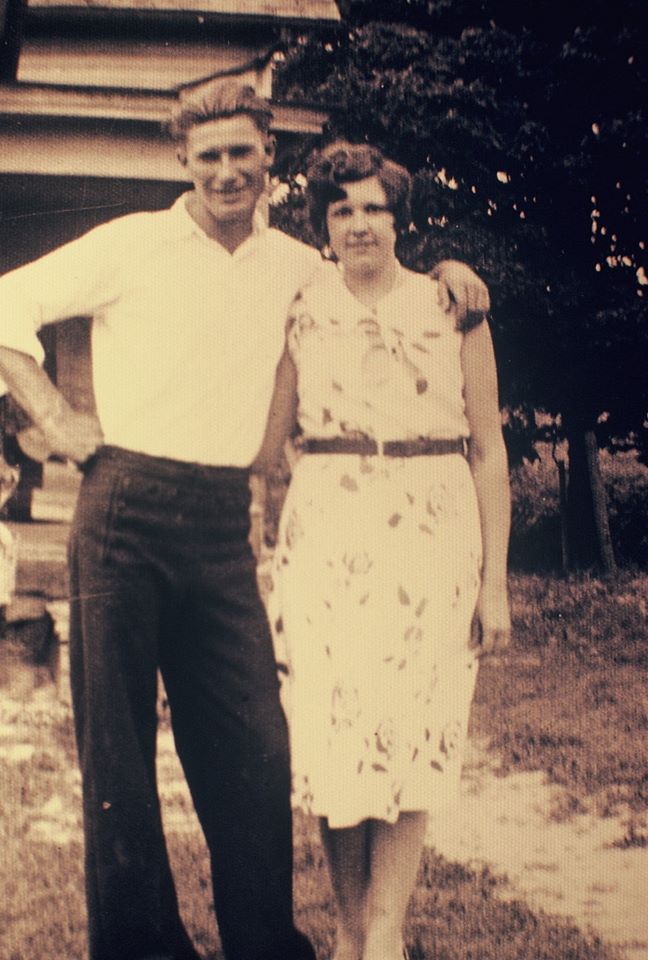
My grandmother would have celebrated her 108th birthday today. I’m confident that she IS celebrating today– but she no longer has to count birthdays, or worry that this one might be her “last.” She passed into eternity more than 25 years ago. But she and my grandfather left a legacy of faith, hope, integrity, and prayer that lives on. It is a quiet legacy– my grandparents were not “important” people–they worked hard, lived a simple lifestyle, and never made a showy practice of their faith. But they lived it in such a way as to leave others with a glimpse of what steadfast faith looks like.

Grandma was born just a few short weeks after the sinking of the Titanic. She lived through two World Wars (one of which kept her separated from her husband, working in a factory, and raising two young girls). She lived through times of war, times of riots and uncertainty, and times of disease and pain. She knew what it was to struggle and lose. She was born before women could vote. She and my grandfather lived through the “Great Depression,” picking up whatever odd jobs they could, and sometimes not having enough for rent or food. But she also knew incredible joy and satisfaction. She knew what it was to be loved and to give love. She knew the joy of seeing a job to completion, and of using her talents and skills to help others. Most of all, she and grandad shared an incredible faith– one that had been tested many times– in God’s goodness, His provision, and His faithful protection. They lived in circumstances that would cause many to fear. But I never remember Gram being frightened–she wasn’t oblivious to bad news and difficult circumstances–but she faced them with confidence and resolve, the kind that gave hope and courage to everyone around.

My grandparents moved a lot. I mean, A LOT! They probably moved 50 times (at least) during their 62 years of marriage. Sometimes, they moved because Grandad had “itchy feet.” He liked change; he liked to have new projects to tackle; he liked to feel “free.” He loved moving into a “fixer-upper,” or renting a place with a run-down yard. But sometimes, they moved because they had to. They moved a lot– but they were never “moved” from each other, from their family, or their faith. They didn’t lose hope; they didn’t shift opinions based on their circumstances; they didn’t break promises or end friendships.

Photo by Ketut Subiyanto on Pexels.com

Psalm 112 gives a wonderful description of a “righteous” person. Not a self-righteous person, and not a perfect person (as none of us are perfect). But it is a great picture of the kind of legacy my grandparents left behind. They were generous– not just with money, but with gifts, work, time, hospitality, and words of encouragement and hope. They were rock-solid in their integrity– they went above and beyond not to cheat or lie or complain or shirk duties. In all their struggles (and in their good times) they never lost sight of God’s Goodness and Sovereignty.

My prayer today is that I would pass along such a legacy; such a witness. God is faithful, He is good, loving, and kind. He is never far from those who call on His Name, and He is able to deliver us from all our struggles. I am so grateful that, in addition to all the other blessings I take for granted, God gave me amazing grandparents. I hope He brings such people into your life today, and equips you to be such a legacy-builder, as well!

Broken Prayers

In “Pursuing Prayer”, I want to explore ways to develop my prayers; to become “better” at praying– more confident, more Christlike.  But along the way, I have found that “better” doesn’t always mean what I think it ought to mean.  Sometimes, becoming “better” requires becoming broken.

food healthy yellow broken
Photo by Pixabay on Pexels.com

I don’t like being broken.  I don’t want to be shattered, ruined, like a broken vase.  I don’t want to pray like a broken record– sending up the same failures, the same weaknesses, the same painful memories.  I don’t want to be pinched, and cracked, and mangled.  I don’t want to be stretched and molded and squeezed.  I want to have comforting chats with God, not drawn-out confessions, or rebukes, or unanswered questions.

broken clay close up crack
Photo by Martins Krastins on Pexels.com

It is tempting to avoid brokenness–cover it up, pretend, deny, ignore its existence.  I don’t want to bring God my questions, my fears, my hurts.  I don’t want to open up the dark places of my soul.  I want to wear a smile and make small talk with God–“How are you today?”  “Just lovely, Father, and how are you?”  “Fine weather we’re having.”  “Yes, thank you for the breezes yesterday.  And could I just put in a plug for my neighbor’s gall bladder surgery?  I told her I would pray for her, so could you just give her a speedy healing?  That’d be great.  Well, gotta run. Talk to you soon…Oh, and I’m sorry for the way I blew up at the kids the other day.  I don’t know WHAT got into me.  You know I’m just not that way, right?  So I’m just asking for grace to kinda cover that up and make it ok again.  Thanks.”

blur broken ceramic clay
Photo by Fancycrave.com on Pexels.com

God is not fooled.  God is not impressed or amused at our shallow righteousness.  He’s not impressed or overcome by our brokenness, either.  But He wants it, anyway.  He wants all of it.  Because He wants to build honesty, intimacy, and most of all, restoration.  God doesn’t want us to wallow in our failures, any more than He wants us to gloat in our false perfection.  He wants to break the bondage they have over us.  He doesn’t get tired of hearing our voices, even in guilt or shame, rage or despair…if they are raised to Him.  He doesn’t want us to stay shattered and ruined.  But He needs us to be redirected, refreshed, rebuilt, rekindled, and renewed.

farm against sky
Photo by Sebastian Voortman on Pexels.com

There are many things that need to be “broken” to become better– we “break” in shoes, we “break” ground to create a new field or prepare for a new building.  We “break bread” to eat it and share it with others.  We “break” horses in order to prepare them to run or work more effectively.  We “break” bad habits.  We even “break” the ice in a new friendship.  The point is not to stay broken, but to “break through” whatever is keeping us oppressed and held down.

petaled flower drawing on white egg shell
Photo by Netaly Reshef on Pexels.com

When I am feeling broken, and I cry out to God, He doesn’t deny my brokenness; He doesn’t turn away in disgust; He doesn’t stick a hasty bandage on my wounds.  God acknowledges my pain, He listens to my questions.  He loves me enough to come and stay with me through the worst moments–even when others have gone; even when I deny His presence and turn my face to the wall–and He begins the process of turning even those scars and cracks and tears into treasures.

Brokenness is inevitable in our fallen and broken world– God is not out to break us; people and time, circumstances, and even our own good intentions will cause us to fall and fail–am I willing to uncover my brokenness and need, and allow God to reshape my shattered dreams?

yellow and pink flowers view behind broken glass
Photo by Pixabay on Pexels.com


Blog at WordPress.com.

Up ↑