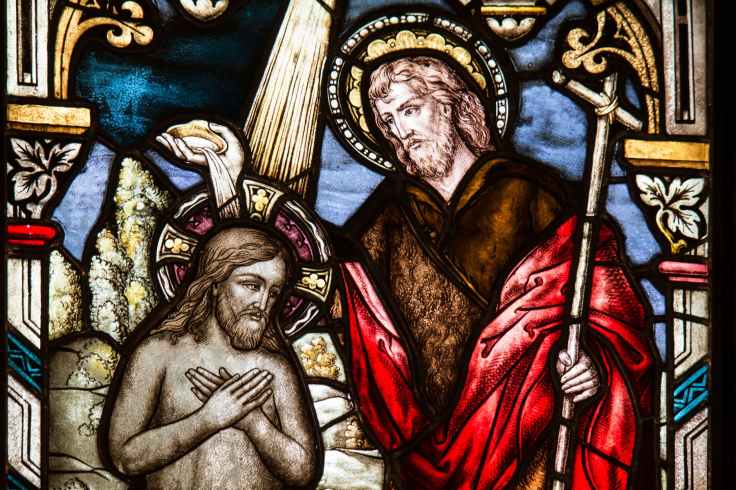
What Would Jesus Pray?

Several years ago, it became incredibly fashionable (literally) to wear t-shirts, necklaces, and especially bracelets with the four letters, WWJD– which stood for “What Would Jesus Do?”  This was supposed to serve as a reminder that the wearer was an ambassador of the Kingdom of God, and was supposed to be a follower of Jesus, and thus should act in accordance with what Jesus would do in any given situation.  Stuck in traffic–What would Jesus do?  Presumably, we would not lose his temper, honk and scream obscenities, or rudely try to cut or push others off the road.  Tempted by the scantily clad actors and actresses in a new R-rated movie– What would Jesus do?  Presumably, he would not attend R-rated movies filled with sexual situations in the first place, or, finding himself tempted, he would leave the movie.

I think the intention was good in the beginning– even scriptural in a sense.  The Children of Israel were commanded, in Deuteronomy 6: 8 to “tie them (God’s commandments, laws, and decrees) as symbols on your hands and bind them on your foreheads.  Write them on the door frames of your houses and on your gates.”  Throughout the Bible, the patriarchs, prophets, Jesus, and the apostles, often spoke of keeping God’s Word in our hearts and on our minds as we go through our daily routines.  This short reminder should help us do just that– redirect our thoughts to the One we are to follow.  As far as it achieved that goal, it was a good thing.

The problem is that it didn’t work that way for most people.  The jewelry or the t-shirt didn’t serve as a reminder to the wearer, but as a symbol to everyone else.  “Hey, look at me!  I’m wearing a fashionable accessory with a cryptic message that lets you know that my thoughts and actions represent Jesus here on earth!”  Ironically, Jesus would have been the last person to wear such an item– not only because he wouldn’t have to ask the question (BEING Jesus, and all), but because his focus was on others–Jesus didn’t wear his heart on his sleeve, or his wrist, and he didn’t call attention to his own righteousness.  Instead, he spoke to outcasts, and touched lepers.  He acted in accordance with God’s wishes, not because he had decided what he thought God would want him to do, but because he knew who God wanted him to become.

One of the worst casualties of the WWJD craze is that many people substituted their own wisdom for a study of God’s word– in other words, they imagined what Jesus would (or might) have done, instead of learning and following what he DID.  Of course, Jesus was never stuck in a traffic jam.  But he did face demands on his time, and stressful situations.  He was never tempted by movies or internet porn, but he was surrounded by a culture that had “religious”  “temple” prostitutes, along with sexual immorality not that different from what we see today.  The Bible doesn’t give us a picture of Jesus planning and executing a strategy for specific temptations– it DOES give us specific examples of people over a long period of time who failed or triumphed over temptations, big and small, and of people who turned to God for strength to overcome temptation and grace when they had fallen.  It also gives us a picture of Jesus living a life that was perfectly pleasing to God– including a life of prayer.

What would Jesus pray?  Look at John 17.  Look at Luke 11:1-4 or Luke 22: 39-48.  Look at Mark 14: 32-42.  There are many examples of Jesus’ prayers– prayers that pour out his heart to his Father– in faith, in pain, in grief, and in hope.  In fact, it would be appropriate to say in answer to the question, “What would Jesus do?”– Jesus would take it to God in Prayer! Look at the way He taught His disciples to pray:

“And when you pray, do not be like the hypocrites, for they love to pray standing in the synagogues and on the street corners to be seen by others. Truly I tell you, they have received their reward in full. But when you pray, go into your room, close the door and pray to your Father, who is unseen. Then your Father, who sees what is done in secret, will reward you. And when you pray, do not keep on babbling like pagans, for they think they will be heard because of their many words. Do not be like them, for your Father knows what you need before you ask him.
“This, then, is how you should pray:

“‘Our Father in heaven,
hallowed be your name,
your kingdom come,
your will be done,
    on earth as it is in heaven.
Give us today our daily bread.
And forgive us our debts,
    as we also have forgiven our debtors.
And lead us not into temptation,
    but deliver us from the evil one.
For if you forgive other people when they sin against you, your heavenly Father will also forgive you. But if you do not forgive others their sins, your Father will not forgive your sins. (Matthew 6:5-15 NIV)

Jesus did not ask the Father to give His disciples a blueprint of “Holy” activities or attitudes. He asked for fundamentals– that God’s Kingdom would come; that God would meet our daily needs; that God would forgive us as we forgive others; and that God would steer us away from temptations and evil. For everything else, Jesus directed His disciples to DO what He did, not ask what He would do. Reach out to those who are needy and hurting with love and practical help. Forgive. Tell the Truth. Worship God above all else, and go to Him in prayer.

Jesus didn’t come to earth and live his life to make us great, or successful, powerful or popular by the world’s standards.  He came to seek and to save those who were lost.  He asks us to do the same– not in our own strength or success, but in the overflow of the grace and power he has poured into us.  T-shirts and jewelry are nice, but Jesus used his life–his time, his love, his talents, his words and his actions in accordance with God’s will and God’s wise commands to bring people to himself.  Then he did what none of us could do– he fulfilled God’s law, becoming the perfect sacrifice for our sins, and conquering Sin and death.  What would Jesus do?  He DID IT!  It is FINISHED!  Our part is not to do what only God can do, but to what he has asked of us and trust him to do the rest.

bow down

This is also true in our pursuit of prayer.  I often get side-tracked in wondering if my prayers match up to what Jesus might have prayed in the same situation– and that shouldn’t be my immediate focus.  Prayer is, as I have to keep reminding myself, a pursuit.  It is a process and a journey, and an ongoing, deepening conversation with the one who loves me best.  And it is not a one-sided conversation– God answers my prayers, not just by meeting immediate needs or changing circumstances.  He speaks through his law, through the Psalms and prophets, through the Gospels and the Epistles, and through the godly wisdom of friends and counselors and ministers of his Grace.  And in doing so, he teaches me to pray.

May I stop worrying so much about the length or the style or the “worthiness” of my prayers.  May I instead listen, and learn, and continue the pursuit.

Christians, Christ-followers, and Jesus Freaks

I see a lot of articles, posts, and religious sites as I wander around the internet. And there has been a lot written and shared lately about the word Christian getting a “bad rap.” Many writers and church goers are no longer comfortable calling themselves Christians. They don’t want to be identified with “bad” Christians– hypocrites, political extremists, etc., who loudly and proudly use the label while treating others with contempt, and generally acting like bullies and/or clowns. The growing trend is to use the term “Christ-follower” to describe a lifestyle that seeks to mirror that of Jesus Christ during His life on earth.

Photo by Pixabay on Pexels.com

Proponents of this practice point out that Jesus never called His followers “Christians.” Instead, He consistently invited people to “Follow me.” The term “Christian” is associated with the earliest Gentile churches and with the scattering of the persecuted church across Judea, Samaria, and Asia Minor. The term originated in Antioch a few years after Jesus’ resurrection:

19 Now those who were scattered after the persecution that arose over Stephen traveled as far as Phoenicia, Cyprus, and Antioch, preaching the word to no one but the Jews only. 20 But some of them were men from Cyprus and Cyrene, who, when they had come to Antioch, spoke to the Hellenists, preaching the Lord Jesus. 21 And the hand of the Lord was with them, and a great number believed and turned to the Lord. 22 Then news of these things came to the ears of the church in Jerusalem, and they sent out Barnabas to go as far as Antioch. 23 When he came and had seen the grace of God, he was glad, and encouraged them all that with purpose of heart they should continue with the Lord. 24 For he was a good man, full of the Holy Spirit and of faith. And a great many people were added to the Lord. 25 Then Barnabas departed for Tarsus to seek Saul. 26 And when he had found him, he brought him to Antioch. So it was that for a whole year they assembled with the church and taught a great many people. And the disciples were first called Christians in Antioch. (emphasis added)

Acts 11:19-26 (NKJV via biblegateway.com)

For a more detailed look, check out this link: http://www.bible.ca/ef/expository-acts-11-19-26.htm

Photo by Paul Theodor Oja on Pexels.com

Christian was not a positive or honorable label for the early followers of Jesus Christ. There are still many places in the world where the label “Christian” invites arrests, beatings, and death threats. There are places where the name “Christian” invites scorn and derision. What has changed (or seems to have changed) in the intervening years is that we see and hear of more and more places in the world where the label “Christian” brings up images of sneering protesters condemning gays or smug white faces spouting self-righteous phrases to justify greed, racism, and/or injustice. “Christians” are not just unwanted or misunderstood by others–Christians are unwanted by their own; misunderstood and misrepresented, at odds and at war with one another.

So what can be gained by followers of Jesus Christ in re-branding themselves as “Christ-followers?” After all, it’s just a name. In the 1960s, many Christians were condescendingly labeled “Jesus Freaks.” Jesus Freaks were viewed much like Hippies. They spoke of Peace and Love and Acceptance. They taught about kindness and unity. They were often young, and generally disillusioned with the older generation and its way of life. They acted a lot like Hippies; they just didn’t do as much experimenting with drugs and free sex. Much like the early Christians, they were labeled by those who dismissed their message and their way of life. They rejected traditional or mainstream Christianity, and were dismissed by many who called themselves Christians. Some were openly critical of previous generations of Christians. Many of those who wish to be called “Christ-followers” now are the descendants (or remnants) of the Jesus Freaks of the 60s. The mind set is very similar– disillusionment with others who have misused or abused the name of Christ, and a desire to “rescue” the reputation of the church.

Photo by Matthew T Rader on Pexels.com

There have been other groups across the centuries who have tried to re-brand and re-label their devotion to Jesus– God-fearers, Disciples, Reformers, Witnesses, Saints, Fellowships, etc.. And there is no command in Scripture that we must all call ourselves by a particular label.

But is seems odd to me that the very label, “Christian,” that came about because of persecution, that came about as a derisive, sneering, condescending term, was embraced by those it sought to shame and intimidate. Why didn’t the original “Christians” re-brand themselves to make their cause less offensive? Why has this term, “Christian,” endured over the centuries?

Photo by Francesco Paggiaro on Pexels.com

I think there are a few very good reasons:

  1. “Christians” bear the name of Christ, whatever other name they give themselves. When I say I am a Christian, I know that there are people who will compare me to others who make this claim. But I am not just a member of a group that likes the idea of Christ; I’m not just a Facebook follower of Christ, or a fan of Christ, or a student of Christ. Christ is my Lord; my life; my identity. Christ– Jesus the Christ, the Messiah. Not Joe Smith down the road who also attends my church, or a famous evangelist or Bible teacher, or even one of the Apostles, or Saints. Jesus– son of Mary and Joseph; Son of God and Son of Man. This same Christ was arrested, given a sham trial, condemned to be crucified like a common criminal, and hung, naked and tortured before a mocking crowd. He was humiliated, misunderstood, and abandoned by those who claimed to care the most. THAT is the name I willingly bear.
  2. “Christian” is a label. I can label myself in any number of different ways– “Woman,” “American,” “Caucasian,” “College graduate.” But there are many others who can use those same labels. They may define what I am, but they don’t define who I am. I may be appalled (and I am, sometimes) at things other women do, at things other Americans say, at the history of Caucasians and their interactions with indigenous peoples in other parts of the world, at the snobbery of other college graduates…But I don’t say, “I’m no longer going be an American; I want to be known as a resident of the United States, but I have my own system of government and culture and language independent of those living in Missouri or Idaho or Chicago– they don’t represent who I am.” Of course they don’t represent who I am–they never did. We all, collectively, are Americans AND residents of the United States. I can’t decline to be a woman because I don’t like the way other women behave or speak. And I can’t choose to be “other than” a Christian…all I can do is give it another label.
  3. Finally, who I am is not found in a name or title or label. It is the sum total of my character and the way I live my life. Jesus didn’t tell His disciples that they would be known by any particular name, but He did say they would be known and identified by their love: 34 A new commandment I give to you, that you love one another; as I have loved you, that you also love one another. 35 By this all will know that you are My disciples, if you have love for one another.” (John 13:34-35 NKJV). That doesn’t mean I have to approve of everything other “Christians” do– in fact, if they use the name Christian and do not have love for others, they prove they are liars– but it means that I must do everything in the name of Christ.
    I am a Christian first, before I am a woman or an American or any other label. That means that I am the co-heir and sister to a young man in India who has been rejected by his family and expelled from his school for being a Christian. I am an ambassador of Christ to the woman I meet in the grocery store whose children are taxing her patience and whose cart is blocking the aisle I want to enter. I am an example of Christ’s love to the young couple who have been victimized by other “Christians” because they are “different.” And I am a Christian in a world of “fake” Christians, and confused Christians, and faulty and very human Christians just like me, who need correction, mercy, justice, and wisdom to follow Christ, to die to self, and to bear the honor of His name. Ultimately, I can call myself a Christian, a Christ-follower, a Jesus Freak–any other label I want. Whether I AM a Christian or not will be determined by how I live, not what I call myself.
Photo by Pixabay on Pexels.com

If you are a Christian reading this– how are you bearing His name today?

Blog at WordPress.com.

Up ↑