Today is a reminder of violence. “Good Friday” is filled with reminders of torture, injustice, and brutal death on a cross. There is almost nothing about this day that suggests “Peace.” And yet, it is because of this day, and this cruel and violent death, that WE can have peace with God. Jesus made peace for us by suffering at the hands of corrupt and brutal men. He could have fought back. He could have called down legions of angels to avenge each cut and bruise He suffered. With a breath or a single word, He could have slain the entire Roman Empire, freed the nation of Israel, and claimed victory and “peace.” He could have avoided the violence of beatings and death. He could have appealed to Pilate, who already was inclined to release Him. He could have argued with the Sanhedrin, or said whatever they required to secure His pardon and avoid the cross. He could have run away in the Garden, and stayed hidden and given up His ministry for safety and “peace.” But He didn’t. He didn’t fight back, He didn’t argue, He didn’t plead. He healed the ear of one of His arresting officers. He welcomed one of the thieves crucified next to Him into the Kingdom of God. He made provision for His mother’s well-being. He forgave those who accused Him and crucified Him–even from the Cross!
Jesus said that those who make peace will be called the children of God. Not those who seek peace– those who make peace. There is a difference. We tend to seek peace through avoidance. We isolate, insulate, hibernate and alienate, all in attempting to find peace. We avoid conflict. We avoid attachments that might cause us heartbreak or betrayal. Even in our prayers (and I’m speaking from personal experience), we ask for peace without pain or involvement. We want God to shower us with peace and protection, but we don’t ask for the courage or the strength to “make” peace.
Making peace involves reaching out, taking risks, being willing to suffer misunderstanding, conflict, and injustice. It means that we will “take up our cross” and be willing to die to our own comfort and safety for the sake of Christ. That does not mean that we are to be combative, aggressive, abusive, or contemptuous. But, like Jesus, we are to stand firm, even as we offer open arms to those who disagree with us, mock us, even persecute us. True peace is a gift–first from God, and passed on to others who do not deserve it. It is a gift of Grace and Love. The Children of God should be makers of peace, not avoiders of conflict. We need to meet violence and aggression with strength of purpose and positive action. And that should be reflected in our prayer life as well.
One of the classic comedy routines of the 20th century was a skit by Abbott and Costello, called “Who’s on First?” It’s all about mistaken identities and confusion, when the roster of players on a baseball team contains unusual names and nicknames that sound “question-able”.
I love baseball, and comedy, but the routine should make us do more than laugh. One of the big problems we face is that we often don’t know “who” is on first (or second, or in left field) in the game of life. We tend to become spectators, and fans, but we don’t always know the names of the players, or what position they play. We watch as players–celebrities, government power brokers, athletes, etc.–come and go on the “roster.”
And it can filter into our prayers. While we look at the line-up of human “players” around us, we can forget that God is in charge of the outcome of the “game.” God knows exactly “who’s on first,” and who will be there at the bottom of the fourth. He knows who will strike out in the third, who will hit a grand slam in the fifth, and who will drop the ball in the sixth. While we watch the players and bite our nails when the bases are loaded and there is a full count, God already knows the next pitch.
We may not understand why “Who” is on first, instead of someone else. Sometimes, we see people rise to a position only to abuse their power and oppress others. We may question “Why?” as well as “Who?” Sometimes, we may ask, “How?” “How could God put them in the line-up?” And the only answer I can offer is, “I don’t know.” God’s ways may not make sense to us in the moment. We may never understand the How or Why of our lives or circumstances. But God sees the whole picture, and His ways are not our ways. His understanding is far greater than ours.
Finally, we need to make sure that we are more than just spectators. Watching from the sidelines may seem safer, but we won’t really learn how to pray if we never learn how to “play.” God loves prayer warriors, but He commands us to be “doers of (His) Word.” (James 1:22-25) If we are just listening from the sidelines, we will continue to be confused and frustrated– in our praying and in our living!
We may not always know “Who’s on First.” But we should take comfort in knowing “Who IS First.” No matter who takes their position as shortstop or who is throwing the pitches, God is always sovereign. No matter who seems to be “winning” the game, God has already determined the outcome of the ultimate “World Series.” We can pray with confidence, knowing that, with God as our manager, Christ as the umpire, and the Holy Spirit as coach, we have the winning team!
Do you ever feel invisible? One of the common complaints among depressed people is that they feel as if no one sees them. “No one would notice if I just disappeared..” “No one really notices me…I just fade into the background.” “I always get passed over; pushed aside; ignored…” “Everyone just seems to look right through me. It’s like I don’t even exist.”
Hundreds of years ago, Hagar, the slave girl of Abraham’s wife, Sarah, believed herself to be abandoned and alone. She had been used by her mistress as a pawn in a scheme to give Abraham a son. Hagar was able to do what Sarah could not (get pregnant by Abraham), and she let it go to her head. But she was still a slave. When Sarah complained to her husband, Abraham reminded her that she still had power over Hagar. Sarah used that power to mistreat Hagar, causing her to run away into the wilderness. But God was watching. The “angel of the Lord” not only saw Hagar– he found her beside a spring and called out to her by name. He asked why she was in the wilderness, and then gave her a promise– that her descendants would become too numerous to count! In response, she gave God a name– El-Roi– “the god who sees me.”
The Bible is filled with stories of people–sometimes warriors and kings, but often ordinary, even lowly, people: slaves, younger siblings, nameless servants–who are seen and chosen by God for His Glory, to play a special role in history. God sees them all; He knows them all by name (even if their names are not recorded in the Bible!) He knows each person’s strengths and weaknesses; He knows everyone who will cross their path, how their story began, and how their story will end.
We can take great comfort in knowing that God sees us. There is nothing hidden from Him– when we are slighted or mistreated; when we are the ones wronging others…He knows our thoughts and emotions. He knows our strengths and weaknesses (better than we know ourselves!) He understands– even when we don’t–what’s happening in and around us. God sees us exactly as we are– and He already knows all that we can become! Hagar could see that she was a pawn. She could see herself giving Abraham a child when Sarah had not. But God didn’t see her as “just” a slave girl or “just” a pregnant woman. He saw her her as a young woman in distress; as a woman with unique hopes and dreams, aches and disappointments; and as the ancestress of millions upon millions of people– unique people, each one loved and seen and known intimately by their creator. He saw her as someone worthy of being found and called and reassured. And even though God sent her back into a difficult situation, He kept His eyes on her, and came to her rescue again years later.
On days when you feel invisible, or forgotten– when it seems that no one would notice your absence– remember Hagar’s experience with El-Roi– “The God who Sees.”
It’s depressing to watch the news, lately–the reports include the COVID-19 pandemic, rioting and violence, injustice, crime, natural disasters…there is very little to celebrate. And yet, my nation just recognized the 244th anniversary of our declaration of independence from Great Britain. In that declaration are the immortal words, “We hold these truths to be self-evident, that all men are created equal, that they are endowed by their Creator with certain unalienable Rights, that among these are Life, Liberty and the pursuit of Happiness.–That to secure these rights, Governments are instituted among Men, deriving their just powers from the consent of the governed, –That whenever any Form of Government becomes destructive of these ends, it is the Right of the People to alter or to abolish it, and to institute new Government, laying its foundation on such principles and organizing its powers in such form, as to them shall seem most likely to effect their Safety and Happiness..” America has never realized perfection of these truths. No nation can claim perfection, just as no individual person can claim perfection. “All have sinned and fall short of the glory of God.” (Romans 3:23). But the truth still stands. All men (and women, children…human beings) are created equal, and are endowed by their Creator with certain inalienable rights. God does not favor the rich or the poor, men or women; He doesn’t favor one skin tone over another; He doesn’t love Baptists more than Catholics, or agnostics! He is not partial to citizens of one nation over another; He doesn’t favor Republicans over Democrats. Governments and individuals may deny or withhold these rights; they may pervert the truth or twist and shape circumstances to their favor at the expense of others. But the truth still stands.
Long ago, there was an empire called Assyria– powerful, ruthless, domineering. They were not governed by principles of fairness, equality, or justice. They conquered and slaughtered other people at will. Their capital city was Nineveh. The prophet Jonah, a man thoroughly familiar with their cruelty and lack of justice, was dispatched by God to warn the people of their coming judgment. Instead of obeying, Jonah fled. It would seem understandable that Jonah might fear the people of Nineveh. Delivering such a warning could put him in danger. But that wasn’t why Jonah fled.
The story of Jonah is well-known. After fleeing toward Tarshish on the first available ship, God sent a storm. Fearing that the ship would sink, the sailors cast lots to choose a human sacrifice to appease the sea gods. Jonah volunteered, saying it was his sin that “caused” the storm. Reluctantly, the sailors threw him overboard, and the storm ceased immediately. Jonah was “saved” when a giant fish swallowed him. From the belly of the fish, Jonah prayed, and God rescued him again, causing the fish to spit him out onto dry land. Jonah took advantage of his second chance, and went to Nineveh, preaching the message of destruction.
But when Jonah’s message results in mass repentance and a “second chance” for the Ninevites, Jonah is disgusted. THIS was why he didn’t want to go to Nineveh– because he did not want them to receive a warning and a potential reprieve! He knew that God was sending him, not with a message of doom, but with a message of hope! There was a chance to repent– to try again–to seek justice and avoid destruction. They didn’t deserve it. Certainly, they had never given mercy to any of the peoples they had already conquered. God had every right to destroy them without any warning– and Jonah had counted on it.
I almost always focus on the character of Jonah when I read through this story. https://www.biblegateway.com/passage/?search=Jonah+1&version=NIV (follow this link to see chapter 1 and use the site to read the other three chapters). But what about the people in the city of Nineveh? Imagine a stranger walking around one of America’s major cities– Washington, New York, Seattle (in light of recent events there)… His face and skin are unnaturally white and blotchy; bleached by stomach acid from an enormous fish. He looks like a zombie, and his message is delivered in utterly horrible assurance–“yet forty days, and this city will be destroyed.” Not by a spike in COVID-19 cases; not by looters or protesters tearing down a couple of buildings here or there–total destruction by the hand of God.
What might we do differently if we had forty days to convince God to stay His hand and give our nation a chance to repent. We claim we are not like the Assyrians– we were founded on truthful principles and ideals. We “hold” these truths, but we do not live them out as a nation.
The Ninevites did not have time to amend or rewrite a Constitution. They did not have forty weeks or forty years to “reconstruct” their empire or implement social justice legislation.
But they had time to pray. They had time to fast, and repent, and seek the mercy of God. From the least to the greatest, they fasted and prayed. Even their animals fasted! They stopped frantically trying to grab power, and turned their eyes toward their Maker and Judge. And God listened! God forgave! God showed mercy!
May we pray– in every nation, region, city, village, or settlement– for God’s mercy in these times, and at all times. God is not waiting for us to “get it right.” He is waiting for us to come to Him. May we be humble and hopeful and turn to Him today. And may we learn from their example.*
*Spoiler alert– while the Assyrians in Nineveh repented after the message of Jonah, they quickly forgot God’s mercy and returned to their wickedness. Just a few decades later, God DID bring destruction on the entire empire– this time without warning!
I was re-reading a familiar passage in the gospel of John recently, and I was struck by a truth I had missed before. In the first part of John 8, there is a story about a woman caught in adultery https://www.biblegateway.com/passage/?search=John+8%3A1-11&version=NIV I have read this story many times, and even heard sermons preached on this passage. What struck me this time wasn’t exactly new material, or a new reading, but a new understanding of a detail that was there all along.
The story begins with Jesus teaching a crowd of people in the temple courts in Jerusalem. His teaching is interrupted by a group of Pharisees and teachers of the law. They have a woman caught in the act of adultery, and they come to Jesus asking his opinion about stoning her. They obviously know the laws of Moses, because they cite them. But they cite only a certain portion of the law, and they want Jesus to weigh in (so they can use his own words to trap him).
Jesus turns the tables, and passively bends down to write letters in the sand. He says only, “If any one of you is without sin, let him be the first to throw a stone at her.” One by one, the accusers and the crowd– everyone except Jesus–melts away. Finally, Jesus asks who is left to condemn the woman. There is no one. Jesus refuses to condemn her, and sends her on her way, telling her to “Go, and sin no more.”
There was already a crowd around Jesus before the Pharisees and teachers arrived. They did not bring this woman to Jesus to get an honest answer to a question, or to bring about justice (for that, they should have brought both her AND the man involved!); they brought her to a very public spot to humiliate her and trap Jesus. She was a pawn in a political and religious game, and she was guilty of a crime that was punishable by death. She was accused and forced to stand before a crowd to be condemned without a trial. So often, I read this passage, and my focus is on Jesus and the woman and the Pharisees– I forget that there is a crowd of ordinary people being “played” by the Pharisees for their own purposes.
Jesus never answers the question at hand. According to the laws of Moses, the woman should be stoned. That is the point the Pharisees want Jesus to address. They have set him up. If he agrees with their interpretation of the laws of Moses, he should insist that the woman be stoned. But this will be in violation of the Roman laws, and will lead to Jesus being arrested by the Romans. But if Jesus upholds the Roman law, he will be turning his back on centuries of Jewish tradition dating back to Moses. The problem is that the Pharisees have resorted to some half-truths. The laws of Moses DO speak of stoning; they speak of adultery being punishable by death– for both the man and the woman involved. However, the Priests and leaders of Israel have not followed this practice. King David committed adultery with Uriah’s wife. Neither one was stoned or condemned to death. There are no records of other adulterous couples being stoned throughout Israel’s history. So it is rather disingenuous for the Pharisees to bring this case to Jesus and ask him to speak judgment where they will not. Jesus knows this is not about actual justice; it isn’t really about the law of Moses– because they are not following it themselves! By turning the tables back on them, Jesus exposes their hypocrisy and failure in front of the very crowds they are trying to impress with their clever plans.
One by one, the woman’s accusers melt away. But it’s not just them, it’s the crowd of ordinary people– the ones who were likely riled up by the Pharisees and teachers. Think about the mob mentality–a guilty woman, caught in the act and brought before a teacher with moral authority–there is nothing like scandal to get a crowd of anonymous bystanders worked up and ready for blood. Yet, Jesus’ gentle reminder that any of us could be found “guilty” of something and condemned to shame and punishment puts out the flame of anger and resentment, and causes the mob to evaporate. No one is left to accuse, to curse, to insult, to humiliate, or condemn.
Finally, it’s down to Jesus and the sinful woman. There IS one person there who is without sin– one person who has the right to throw stones, to judge, to punish. Yet he reaches out with compassion and mercy. He is still righteous– he doesn’t shrug off the woman’s sin. He doesn’t say, “Well, that’s no big deal. Let’s just pretend that never happened.” or “I think you’ve learned a valuable lesson here today, young lady.” He simply says, “Neither do I condemn you. Go now and leave your life of sin.”
Next time, I want to address each of these details from a practical standpoint in light of modern circumstances, and what lessons I am taking from Jesus’ actions.
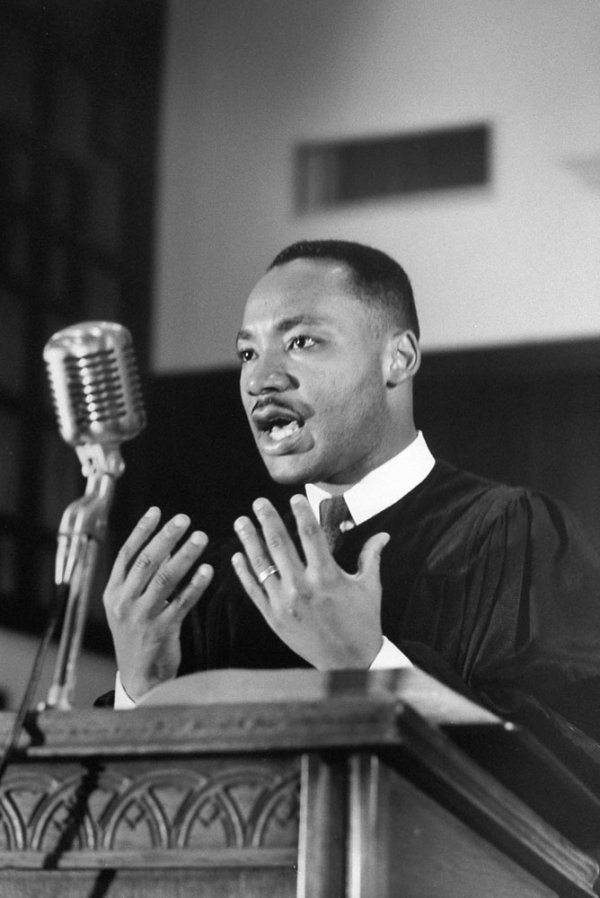
Last week in America, we marked two important dates. We celebrated the birth of a great hero, patriot, and statesman, Martin Luther King, Jr. And we marked the 47th anniversary of the Supreme Court decision, Roe v. Wade, which effectively legalized abortion across the land.
The life of Dr. King was marked by hardship, oppression, violence, and assassination at the age of 39. Dr. King was a brilliant student and gifted speaker. He led peaceful protests and civil rights marches calling for justice and equality under the law for all people. More than 50 years after his death, there are still issues of racial discrimination and racial tensions in this country. The disproportionate loss of life and liberty among blacks in urban areas has led to a new round of protests, some of which go under the name of “Black Lives Matter.” There is a feeling that, especially with the police and government officials, black lives don’t matter– that black lives are devalued and dismissed as less deserving of respect and protection.
In light of this, there has been “push back” from those who argue that “ALL Lives Matter”, or that “Blue Lives Matter” (blue for police who have become victims of mob violence and angry crowds who feel that the police are responsible for racism and corruption). The argument is that groups like “Black Lives Matter” are not so much about bringing awareness or promoting justice, but are meant to divide us as a nation and exact revenge for past offenses, slights, and perceived slights.
There is speculation about what might have happened if Dr. King had not died when he did. Would he have continued leading non-violent protests? Would the Civil Rights movement of the sixties gained more momentum under Dr. King’s leadership? Would our nation have achieved a new dawn of equality, freedom, and unity, greater and stronger than what we have seen in the last five decades? Would Dr. King be pleased with the progress we have made, or ashamed? Did his life make a difference? Yes. But was it “enough” of a difference? Does it matter to a young person of color growing up in Baltimore or Chicago that Dr. King spoke out, marched, and died for a dream that seems frozen in time and unfulfilled?
Just two days after our nation wrestled with that uncomfortable memory, we marked one even more controversial. In 1973, our Supreme Court ruled that no state could prohibit abortion. The decision also limited the ability of states to restrict abortion. Since that decision, an estimated 60 million Americans http://www.numberofabortions.com/ (not to mention infants around the world) have been denied the right by legal practice to be born. This is roughly equal to the number of people killed in World War II, though estimates of both numbers vary by source (https://www.nationalww2museum.org/students-teachers/student-resources/research-starters/research-starters-worldwide-deaths-world-war)
In looking at abortion, we see millions of lives who were determined NOT to matter. They didn’t deserve respect, protection, liberty, education, dreams, food, shelter…not even breath and a heartbeat!
Oh God– let us see life as YOU see it. Every life matters infinitely to You. You have created all life–unique, precious, priceless, glorious, fragile, and yet eternal. You walked among people, healed the sick and broken, reached out to the outcast and isolated, welcomed children, and brought the dead back to life. In Christ, you took on human life– breathed the air, knew joy and pain, weariness, hunger, and strife.
One life– every life– matters. It matters, not because we are important to the world, but because we are precious in the eyes of our creator. We celebrate the life of Dr. King, because we was considered important in the history of our nation. But God celebrated Dr. King’s life from the moment of his conception. God knit him together in his mother’s womb, just as He does for each of us. God knew the moment of Dr. King’s birth. He saw every tear, heard every laugh, felt every bruise that Dr. King experienced. And God knew the moment of Dr. King’s assassination. He knew the shock and horror it would be for his family. He knew that years later, we would quote Dr. King’s words and even argue about his relevance and impact. But Dr. King’s life mattered to God even if it had been a life of obscurity or failure.
Similarly, and incredibly, every one of those 60 million lives that have been lost to abortion “mattered” to God. He knew and loved them from the moment of conception. And He knew– He KNEW– that they would be aborted; thrown away and discarded by those who should have loved and protected them. And He LOVES those who killed them– their lives “matter” to God as well. Dr. King’s dream was that his children would be judged by the content of their character. God will judge us one day on that basis; but He offers to judge us by the content of HIS character, if we will trust Him to forgive us for the past, and transform us as we live for Him.
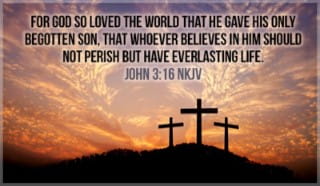
Your life matters to God. It has worth and meaning. You are infinitely precious– so much so that God sent His only son to live and to die for your sake. What an incredible love He has for you! What an incredible love He has for every person you will encounter today!
One of the reasons I began a blog about prayer over eighteen months ago was in reaction to a scathing op-ed article about prayer written in the wake of a mass shooting. Well, here we are again. Two highly publicized (and several “smaller”) mass shootings occurred over the last week in the U.S., and the outrage and anguish is overwhelming and completely understandable. The senseless violence and subsequent loss of life stops us in our tracks. Why? Why would anyone do this? How? How could this happen? In the wake of such evil, millions of people rush to distance themselves from such evil; many of them resort to angry protests and calls for action. Many point their fingers at this leader, that group of people, that philosophy, that industry–any entity (other than oneself) that can be held responsible and made to “pay.” Many offer earnest condolences for the families of the victims– often with the phrase “thoughts and prayers.”
But what good are any of these responses? Nothing we say or do can turn back time and undo the events of the past week. No amount of protesting, legislating, avenging, or moralizing will guarantee that everyone lives in peace and safety as long as evil lurks in human hearts– whether by vigilante gun violence, war, terror attacks, economic and political unrest, rioting, looting, domestic violence, brutality, assault, murder, or suicide. “Banning” guns (or “assault weapons”, “military-style” weapons, etc.) sounds like a sensible action to take, but it is not practical in the face of evil people who will not follow the law, and corrupt governments who will not enforce the law, or worse, who use their power to oppress their own citizens.
Finding, and even punishing a scapegoat may make us feel morally superior and bring a false sense of closure, but it will not break the cycle of anger, hatred, injustice, or lack of respect that is at the root of violence.
But there is something equally repugnant about hearing the phrase “thoughts and prayers”, no matter how earnestly it may be expressed, in the wake of inhuman tragedy. The “thoughts and prayers” of strangers have no warmth, no solidity, no promise, and no strength. They are wisps and vapors of selfish and graceless bystanders, who want to ward off the evil that has befallen someone else. They are nothing more than a pseudo-spiritual appeasement offered to the nameless, faceless fates.
And the greater tragedy is that such empty phrases, expressed as reactions to great evil, cheapen the very real power that should be found in the pursuits of thinking/meditating and praying.
Prayer is not a knee-jerk reaction to bad news. It is not a gesture meant to signal to others that you are beyond the touch of whatever forces have just hurt someone else, or that by your thirty second of piety you can alter the consequences of a catastrophe or change the course of the future.
Where were the “thoughts and prayers” of others two weeks ago? Where will they be tomorrow or next week? What quality of “thoughts and prayers” go out to the families of victims whose names we have not even bothered to learn? Such superficial public expressions, sent with seven teary-eyed and five or six high five/praying hands emojis, mean very little to anyone except the sender. They change nothing from the past, and offer nothing going forward.
I am as guilty of this kind of meaningless virtue-signaling as anyone. I want to feel as though I can, by such empathetic expressions, encourage and strengthen those who have been touched by horror, tragedy, survivor’s guilt, trauma, grief, etc. But I can’t. Nor can my anger, frantic attempts to “fix the world”, or brilliant analyses of all the root causes of violence prevent the next bombing, drive-by shooting, hijacking, arson, political uprising, or disappointing election result. I cannot change the hearts or minds of those with whom I disagree. I cannot “make” a better world.
But that is why I write this blog. It is through a lifestyle of prayer– real prayer, difficult and sometimes agonizing prayer, joyful and grateful prayer, pleading and gut-wrenching prayer, consistent and obedient prayer–that I engage with the only One who CAN bring hope, justice, change, renewal, and salvation to this world. And it is through a lifestyle pursuit of prayer–daily seeking God’s face, asking for His wisdom, accepting His mercy when I fail, reflecting on His character, acting in obedience–that He can change me. That power, that hope, and that renewal is available to ANYONE who will ask. It sustains us when tragedy strikes, and it empowers us to offer far more than empty “thoughts and prayers”– it causes us to pray, not just after a tragedy, but unceasingly– not just for our own comfort and safety going forward, but for the well-being of our enemies, not just for those who look like us or think like us, but for those who scream at us and tell us to stop already with the “thoughts and prayers!” That power causes us to seek peace where there is hatred, justice where we find corruption, and humility when we are surrounded by narcissism.
And if we are not doing those things– if we are not tapping into that power– we should be taking a closer look at those “thoughts and prayers” we are hiding behind.
The prophet Jeremiah lived in violent times. His city was besieged by the Babylonians, and his king was a prisoner in his own palace. God had sent messages of judgment and punishment for the entire nation. Jeremiah prayed diligently, and spoke out against the injustice, pride, and idolatry all around him. In response, he was arrested, beaten, thrown into a pit, and abandoned. God even told him to stop praying for his countrymen, because they were unwilling to accept the truth about their condition, or prepare for the punishment to come. But in the middle of the violence and bad news, God offered hope and promises of restoration, justice, renewal, and peace. He also gave this warning to Jeremiah, that he should stand firm– he should, by his example of consistent obedience and hope– influence others, NOT let himself be influenced by the anger and arrogance of those around him.
Lord, I need to stop offering cheap thoughts and empty prayers that do nothing to honor You and little to help others. Give me the strength and grace to stop reacting to tragedy by reflecting the anger and self-righteousness around me. YOU are my hope, and the best hope I can offer to anyone else. Help me to serve others in truth and love, not judge them, dismiss them, or honor them above You. Help me to seek and stand for justice that is consistent with Your character and Your word, even if I stand alone.
The Biblical patriarch, Jacob, is known for many things– He was the son of Isaac and Rebekah, and grandson of Abraham. He was the brother of Esau. He cheated and/or schemed his way into taking both the blessing and birthright that belonged to his older brother. For this, he was sent away to live with his Uncle Laban, and told to choose a wife from among his extended family.
Jacob’s life took a dramatic turn when he left his small (but slightly dysfunctional) family behind to begin this new chapter. Growing up, Jacob had been the quiet one, the one who stayed around the house. This was no longer an option. Jacob faced a long journey, and years of work to establish his own family and career. On the way to Paddan Aram and the house of Laban, Jacob had his first encounter with God– the vision of “Jacob’s Ladder” at the place he would call “Bethel.” There, God confirmed his promise to establish Jacob, increase his family, and bless all people through him. No longer was Jacob a second son with only his wits to help him succeed (or cause trouble)– God had promised to be with him and watch over him wherever he may go! https://www.biblegateway.com/passage/?search=Genesis+28%3A10-22&version=NKJV
With that promise and the hope of finding a welcome, Jacob arrived at the well where his uncles flocks were watered. Jacob would take over the work of herding and watering the many flocks of Laban. He worked for the first month without wages–setting a dangerous pattern. After the first month, Laban “generously” offered to pay Jacob, and even let Jacob set the terms! Jacob demanded no monetary wages; he wanted only to marry his beautiful cousin, Rachel, with whom he was deeply in love.
Seven years pass– Jacob has worked for almost nothing but the food he has eaten, and the promise of marriage with the daughter of Laban. And in a scene that seems strangely familiar, Jacob is presented with a feast, and his promised blessing– his wife. But Laban tricks him, substituting one daughter for another. Instead of Rachel, Jacob is bound to her sister, Leah.
When Jacob confronts his new father-in-law, he is given an excuse– tradition says the older daughter must be married first. Laban had seven years to explain this to Jacob, seven years to “break the bad news”, seven years to offer Jacob an alternative. Yet Laban chose to deceive his nephew and use his love for Rachel to get seven years of cheap labor. Worse, he chose to string Jacob (and Rachel) along for another seven years. The Bible gives us a clue as to one ulterior motive of Laban– Leah had “weak” or “delicate” eyes. It is possible that she had been rejected by other men or deemed ineligible for marriage. Without a prospective husband, Leah will be dependent on her father for life. But married to Jacob, Leah becomes one less responsibility for Laban. https://www.biblegateway.com/passage/?search=Genesis+29%3A14-30&version=NIV
Laban gambles his daughters’ fate on Jacob’s character. Jacob could have cast Leah aside easily and forced her to return to her father’s house a ruined woman. He could have treated her as a servant, rather than a wife– he could have beaten her or “given” her to someone else. And Jacob could have decided Rachel was not worth another seven years of labor, or that he could not trust Laban to keep his word. He could have walked away. He could have taken his anger and frustration out on Leah or on the flocks. He could have returned to his father and started another family quarrel.
But this Jacob is not the same as the one who left Canaan. He serves another seven years, marries Rachel, and then works yet another six years for flocks to call his own. All the time working for a man who is greedy, deceitful, capricious, unjust, selfish, and oppressive. He doesn’t complain, doesn’t rebel, and doesn’t cheat, lie, sabotage or steal from this horrible boss and indifferent father-in-law. Instead, he shows that he has been transformed from the young Jacob who caused so much trouble for his brother and father back home.
May we choose to submit today to the God of Jacob, and remember that His promise to Jacob extends to all who trust Him– He will not leave us; He will see us and be with us wherever we go!
We hold these truths to be self-evident, that all men are created equal, that they are endowed by their Creator with certain unalienable Rights, that among these are Life, Liberty and the pursuit of Happiness–Declaration of Independence, Thomas Jefferson (July 4, 1776)
We’re getting ready to celebrate our Independence Day in America. There will be parades, cookouts, parties, fireworks, and a host of other celebrations. There will be a lot of flag-waving and patriotic displays. At some gatherings, there may be readings of our Declaration of Independence. This document was drafted to outline, not just a list of reasons why they should rebel, but what they hoped to build as a result of their struggle for freedom.
Over 240 years later, this document, and what it stands for, is still relevant and calls us to a high standard– one our nation has not fully achieved. In spite of the great strides we have made and the example we have been to the rest of the world, in recent decades, we have left behind many of the very truths we aspired to hold.
First, there is a dangerous belief that “truth” is no longer self-evident, nor is it timeless. We don’t hold beliefs and truths anymore. We shift with the tide of public opinion and the shadowy promise of “being on the right side of history”– which just means being on the winning side of the current debate within our lifetime and hopefully into the next set of history books.
Second, we have spent countless hours, shedding blood, sweat, and tears over the phrase “ALL MEN”– struggling to reach the promise of equality for all humankind. We have fallen short of this vision, and twisted it into a grotesque parody of itself. Instead of working together in unity and inclusiveness, we have devolved into factions each fighting to be “more equal” than others. Instead of looking at the equal value and humanity of all our people, we point fingers at all the people who are “less worthy”, “more privileged”, “entitled”, “marginalized”, “intolerant”, “judgmental”, who “need to be silenced”, or “need to be kept in their place”…how can neighbors and fellow citizens be so vicious? One answer may be found in the very next phrase…
ARE CREATED equal, and are endowed BY THEIR CREATOR…Usually, this phrase is emphasized in the exact opposite places– the emphasis is on EQUAL and ENDOWED. We have lost the “truth” of being “UNDER GOD”. We have lost the truth of being created. We have lost the truth that our worth, our rights, our values, are not a product of our own opinions and observations.
It is easy to point to others and say, “They are ruining our country– They are not living out these truths.”
The harder lesson is to look at my own assumptions, actions, and beliefs. Do I TRULY believe that all the people around me– of every creed, gender, race, political party, nationality, educational achievement, or economic level are created equal and endowed BY THEIR CREATOR with value, and inalienable rights? If, at any point, I make assumptions about the worthiness of “those people”, assuming that God loves me more, or will have more mercy or grace toward me because of who I am or how I behave; because of the color of my skin, or where I live, or who I voted for; because of the things I know or the good deeds I have done–I am part of the problem. Christians, if we bear the name of Christ who created all mankind, and we hate those whom Christ created, the love of Christ IS NOT in us.
That doesn’t mean that we ignore sin and compromise our character, and pervert justice in the name of a comfortable facsimile of equality. But it also means that we must stop whitewashing hatred and injustice in the name of morality. Morality without love cannot heal our nation. Nor can rewriting our history. Nor can declaring our Independence.
The Declaration of Independence is not a stand-alone document. It had no authority on its own. If our founders had lost the Revolutionary War; if they had abandoned their vision of a government “of the people, by the people, for the people”; if their descendants had failed to bring a divided nation back into unity; if our parents and grandparents had not struggled and fought to make our nation live up to its principles; and if our generations fail to come together and work toward that same vision– Independence will not be something to celebrate, but something to detest.
While it is called the Declaration of Independence, it is a spirit of dependence– on God, on His truth, and on the goodwill of our fellow Americans, that keeps this document alive and full of promise.































 Pursuing Prayer