Why Confess?

One of the prayer models I like to use often is based on the acronym ACTS. ACTS stands for Adoration, Confession, Thanksgiving, and Supplication. I like this model because it is well-rounded. It works like this:


ADORATION–I love to begin prayer by remembering and acknowledging God’s worth, His supremacy, His Holiness, and His majesty. It sharpens my focus on the WHO of prayer, rather than the WHAT of my worries or doubts. And it puts everything in the proper perspective. Sometimes, I come to God by praying a Hymn, or praying a Psalm, or remembering the many names of God.

CONFESSION–Confession is important in prayer, and since I want to concentrate on it, I’ll come back to this element below.

THANKSGIVING– Thanksgiving returns me to remembering what God has already done– for me, for others, throughout history, and just yesterday in my life. Instead of prayer being all about my needs, wants, or concerns, prayer should be an honest conversation with God. And that must include gratitude, because God is truly GOOD! If you ever doubt that, think about the first five minutes of your morning. If you awoke, you are alive (thank you, God!). If you heard your alarm, opened your eyes and saw anything, if you were lying on a bed, in a shelter with a roof, if you were able to sleep through the night without the terrors of war, slavery, starvation, torture, or chronic agonizing pain, you have much for which to be grateful. If you were able to get out of bed on your own, able to eat breakfast, get dressed, and you have a job to go to or a purpose to fulfill in this day, you are among the blessed. To withhold praise and thanksgiving is to miss one of the privileges of life.

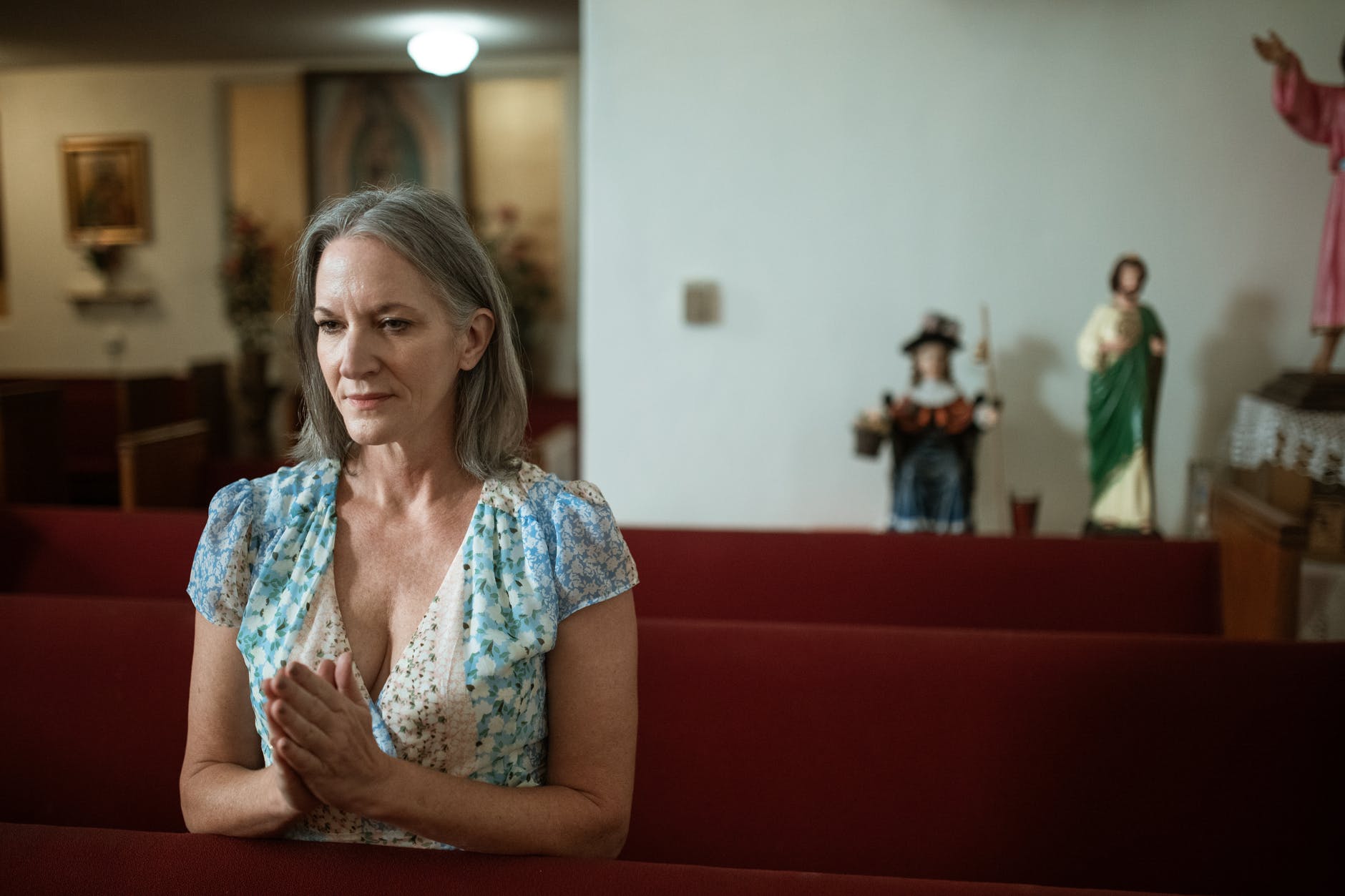
Photo by Tima Miroshnichenko on Pexels.com

SUPPLICATION–Yes, we bring requests to God. And He already knows what we need, what we desire, and what He has planned for us. So supplication is not about making God aware of our needs. But it is another act of acknowledging that God hears and responds to us. Because that’s the kind of God He IS! And because we have spent time Adoring, Confessing (to), and Thanking God, we know that we can present our requests without fear or doubt.

Most of us are fine with Adoring, Thanking, and Saying our requests, but Confession can be tricky– especially in our culture. What are the elements of Confession that trip us up? Mostly, I think, it’s a misunderstanding of what confession is (within the element of prayer) and what it is NOT.

Confession is defined as admitting to guilt, or to a crime or sin or wrongful act. But, even more basically, confession is an admission that we are not the ultimate authority over our lives or the lives of others. As such, we must confess before we can accept God’s atonement for our Sin. If we do not confess our need for God, we cannot accept, understand, or appreciate the depth and nature of His sacrificial Love for us. So when we pray, we must confess, not only God’s Glory in the heavens and the Earth, but His Sovereignty in our lives; His authority over our emotions, our thoughts, and our actions. King David gave us many great examples of confession in his Psalms– and they can be terrific models to use in our own prayers. (See Psalm 6, Psalm 32, Psalm 38, Psalm 51, and others.)

Confession in prayer is not primarily a list of our petty missteps– though we should be willing and able to name them, rather than denying what we’ve said and done–but a daily admission of God’s right to determine how we conduct our thoughts, our habits, our priorities, and our relationships, and acknowledging that God is Merciful, Gracious and Loving– beyond all our failures, mistakes, and even past rebellion. Confession shouldn’t focus so much on what we’ve done, as on how God is able to free us from guilt and shame, and how we intend to move on away from the past. We confess that our ways are not Holy, and in doing so, we underscore that God’s ways ARE Holy, perfect, wise, and good. God already knows our thoughts and actions, but WE need to be reminded of our goal– to run the good race (see Hebrews 12:1, and 1 Timothy 6:12) to follow Christ; to become more like God each day!

Confession is primary to the Christian Life– we confess that ONLY by the work of Jesus (the cross and resurrection) can we be reconciled to God. We cannot pray openly to God if we don’t believe–and confess– that this is true. God is not fooled by sweet talk or glib arguments. We cannot believe that Jesus’ atoning death and resurrection saved us if we don’t believe that it was necessary and good for Him to do so. And besides, confession is good for the soul!

“If we confess our sins, he is faithful and just to forgive us our sins and to cleanse us from all unrighteousness.”

1 John 1:9 (KJV)

Confession has a negative reputation in many Christian circles, and it is misunderstood in others. Just listing our sins or admitting we did something wrong doesn’t have any value without the positive confession that Jesus is “the way, the truth, and the life.” (see John 14:6) In fact, a better definition of Christian confession is this– agreeing with God about who I am (a sinner/imperfect/unable to attain Holiness on my own), and who HE is (perfect/Holy/Sovereign/the One who Loves me absolutely)

When we pray today, I hope we will confess– positively, profoundly, willingly, and whole-heartedly. I hope we will humbly and honestly confess any actions or habits that are interfering with our Christian walk. And I hope we will joyfully confess that Jesus is LORD; that we are trusting in Him to guide us, intercede for us, and give us the power to live more abundantly in this life, and throughout eternity. What a great way to pray!

“I Have Seen the Lord!”

18 Mary Magdalene went to the disciples with the news: “I have seen the Lord!” And she told them that he had said these things to her.

John 20:18 (NIV) via biblegateway.com

Over the past few weeks, there have been images of Jesus Christ all over– Jesus looking very gentle and passive as He rides a donkey into Jerusalem; Jesus teaching vast crowds and looking wise and unflappable. Thousands of images of Jesus the Suffering Servant– bruised, bloodied, yet meek and forgiving–carrying a Cross through the streets, or hanging between the two thieves. And the images of a risen Christ–glowing and serene and unearthly.

These are not false images, by any means. Jesus is all of these things: the Lamb of God, the Suffering Servant, the Son of Man…He came to experience full humanity, and to live as an example, die as our atonement, and ascend to Heaven as our intercessor and Savior. But there is more to the story. Our images of Jesus are often passive, and belong in the past tense. We have baby Jesus, parable-telling Jesus, humble Jesus nailed to the cross. The Bible also gives us images of Christ the Conqueror; Jesus as Warrior; Jesus as the King of Kings, and final authority.

When Jesus makes His return to Earth, He will come as LORD– victorious ruler of His creation–judge and final authority. We make a grave error if we only see Jesus as the Lamb of God, and not also the Lion of Judah. Jesus was meek and humble as a man, but He was always fully GOD as well. When Mary Magdalene finally recognized the Risen Jesus, she recognized Him as “the Lord.” All those who saw the Risen Christ recognized Him, not just as their friend or even as their teacher, but as their Lord. No earthly authority dared approach Him, question Him, try to re-capture Him, or hold Him. He appeared at will to those who were waiting for Him. He stopped telling parables, and started commissioning His disciples to spread the Gospel. Even those who knew Him had trouble at first recognizing this “Risen” Christ.

Do we? Does our focus on Holy Week end with Easter as the “Happy Ending?” Or do we see in the Risen Lord the beginning of the next chapter in God’s Story? Yes, “It is Finished.” But the final act is yet to come.

Beloved, we are God’s children now, and what we will be has not yet appeared; but we know that when he appears we shall be like him, because we shall see him as he isAnd everyone who thus hopes in him purifies himself as he is pure.

1 John 3:2-3 (ESV-emphasis added)

When we look at images of Jesus Christ, — when we pray “in Jesus’ name”–do we see a kind teacher? A humble servant? A “Good” example to follow? Someone willing to lay down His life for us? Those are all accurate descriptions– but do we recognize Him as The Lord? He is the King of Kings and the Ruler of All Creation. Do we speak to Him as we would to an earthly King or Ruler? Do we give Him the Honor we would give an earthly celebrity or hero? Do we seek to know everything about Him? Do we seek to please Him? Obey Him? Magnify Him?

It is easy to get caught up in a “Jesus and Me” theology that celebrates the intimate and close relationship that Jesus offers to us; but do we lose some of the awe and majesty of who we are really following? Was this, at least in part, what happened to Mary and the others after Jesus’ death on Good Friday? Had they gotten so comfortable with seeing Jesus as a man, that they couldn’t really see Him as the Messiah? Or did they only see in Him what they wanted to see– a prophet sent from God who would fulfill their longing for freedom from the Romans, or the miracle worker who would feed them bread and fish and take away their pain? When they went to the tomb on Easter morning, they expected to see the dead body of their friend, not the glorified body of their Creator!

When we seek Jesus today, are we looking for a friend and counselor? Are we looking for someone to meet our needs or fulfill our longings? Or are we looking for our Lord in all of HIS Glory? Do we come away feeling better about ourselves, or are we “bowled over” by spending time with the Alpha and Omega? What a different testimony we might have if we could say, every day, “I have seen The Lord!”

Elementary!

I love solving things–puzzles, mysteries, codes–I love finding the answer. It’s very satisfying. And I love reading mystery stories–Agatha Christie, Georges Simenon, Dorothy Sayers… But I have very mixed feelings about Sherlock Holmes. Always have had. I loved the intricacy of the mysteries themselves. They seemed impossible; unsolvable. Yet somehow, Holmes always knew the answer. And then, as he calmly explained how “elementary” it was, he would throw out details that no one else could possibly know without three doctorate degrees and a photographic memory.

I recently watched a series of TV episodes about Sherlock Holmes, and it struck me again. However, in our modern age, it is not so very impossible to become an expert on esoteric topics in almost no time. We have the internet, where vast amounts of information is available at the tip of our fingers. We can find facts about nearly everything, everywhere, at any point in history. We can virtually track people, visit places, experience adventures, and yes, even solve mysteries– all without leaving our couch. And while there are numerous dangers of relying on information found in cyberspace, there is no denying the easy availability of it.

One of the things I like about most mysteries is that they show the triumph of good over evil. Mysteries tend to show us, not only the impact of evil in the loss of life or property, the suffering of victims, and the need for vigilance, but the longing for order and knowledge and safety that we hope someone can “solve.” A good mystery story ties up all the “loose ends” and answers all the burning questions– “Who did it?” “How?” “Why?” By the end of the story, we feel victorious and safe and satisfied.

But reading mysteries or solving puzzles can give us a false sense of safety and knowledge. In real life, there are many unsolved puzzles, unanwered questions, and “cold” case crimes with no resolution. We are left asking “Why?” and “How?” about many of the things that have happened in our lives. And the answers are not “elementary”– even for the most intelligent among us.

As an adult, I read (and watch) the Sherlock Holmes mysteries with a different mindset. I know, from past experience, that Sherlock Holmes will always outwit the criminal. And I will probably learn some little-known fact– likely one that I never needed to know–that may be astonishing. But I am more interested in the character of Sherlock Holmes himself, now. Likewise with many of the other detectives I enjoy reading about. Because mysteries involve the triumph of good over evil, they attract writers who study the ongoing fight between the two. Mysteries often involve complex machinations, intricate plots, many-layered characters, and misleading information.

And the detectives are often equally complex and many-layered. Their startling intellect and deductive skills leave us in awe. Yet, they also have human frailties that lead them to overlook key clues or lead them to take risks beyond what we would consider wise. And many of them wrestle with the concept of good and evil–they are often tempted to take the law into their own hands, or to do something illegal in order to bring a criminal to justice. Thus, the reader is left with another mysterious question– just what is “Good” or “Evil?” Are there times when, in order to do “right” we may need to do something that others consider “wrong?” Can two “wrongs” make a “right?”

Some of the best detective characters are almost god-like in their ability to ferret out evil. But they are constrained in their ability to defeat evil. They are, in the end, human. Even Sherlock Holmes, with his arrogant assumptions and dizzying deductions, cannot wipe out evil; cannot keep it from touching and even ruining lives. In fact, as Sherlock Holmes (and others) discovers, intelligence is often a key ingredient of evil. “Stupid” criminals are easy to catch. The great detectives are needed to find the brilliant masterminds of evil; the ones who would otherwise go undetected and unstopped.

The man who created Sherlock Holmes, Sir Arthur Conan Doyle, was an agnostic and, in later life, became a spiritualist. He wrestled with the concepts of good and evil and particularly with the concept of how a “good” God could allow evil to exist. He was skeptical of the existence of the Biblical God, but instead believed in the continuing existence of the human spirit after death. He believed that the battle between good and evil was left to mankind to solve. He, like his famous character’s sidekick, Watson, was a medical doctor. He was a man who worshipped science– a man who valued facts above all. In fact, the stories of Sherlock Holmes offer us what seems to be a triumph, not just of good over evil, but of facts over faith.

Today, we celebrate the triumph of faith and facts over skepticism and arrogance. Jesus, unlike Sherlock Holmes, did not come to the earth to “solve the puzzle of evil” by bringing individual human criminals to justice. He did not brag about His great intellect, though He dazzled the Jewish Priests of His day with His knowledge and understanding of Scripture. Jesus had no fixed address. He did not write treatises or analyze dust samples– He created nature; He had no need for further study! His disciples did not write about Jesus merely because He did miracles. They did not write about Him in order to become rich or famous. Instead, they were martyred and exiled. Jesus did not put an end to the corruption of the priesthood under the Pharisees and Sadducees. He did not break the yoke of the powerful Roman Empire. He died on a wooden cross, hung between two criminals, after being convicted in an illegal trial, and a farce of an appeal to Pilate. He was flogged, taunted, pierced, and buried in a borrowed tomb. He was, by all appearances, defeated by evil and death. He lost– by human standards and appearances.

But faith tells us that God is Good; that Jesus is God; that Good triumphs over evil. And the facts bear out our faith. Yes, Jesus died. It was recorded, affirmed, and witnessed. But that wasn’t the end of the story. He rose again. There is no body in the tomb. There are witnesses to His post-crucifixion appearances. There were witnesses of his ascent into Heaven. His disciples died for their testimony and continued faith in the face of persecution, torture, and threats. And believers over the past two millennia have lived and died in the faith. We are witnesses of His power to redeem, to restore, and renew lives.

The events of Good Friday and Easter present the ultimate mystery. Jesus, Son of God, Messiah– eternal, all-powerful, all-Good– became a sacrifice for us. He allowed Himself to be an innocent victim of Evil for our Good. And in doing so, He didn’t just “solve” a puzzle– He defeated the power of Evil once for all! We don’t have to know more than the enemy. We don’t have to chase down and outwit death. We don’t have to be terrorized by the threat of evil, the weight of our guilt, or the power of the grave. All we have to do to defeat the evil in our lives is to trust in the work of the Risen Savior and follow Him.

And that is Elementary!

Close to the Broken Hearted

As I write this, I am keenly aware that one year ago, I was at a graveside, saying farewell to my mother. Grieving comes in waves. I rejoice that she is in heaven, and I rejoice that she had a good, long life, and that she didn’t suffer very long at the end. But there is still an ache– wanting to share a memory or a laugh and knowing she isn’t here; questions I didn’t know I had, but now she can’t answer them; just missing her voice and her smile. My father has been gone for 25 years, and the same ache still hits at odd moments.

Sometimes, grieving brings us closer to God. At other times, we can let our grief drive us away from God. But God doesn’t move. He is ever-present. And He reminds us that He is “close to the broken hearted” (Psalm 34:18). When we are grieving, that is a blessed reminder. Grief tends to isolate us. “No one understands…” “Laugh, and the whole world laughs with you; cry, and you cry alone.” We see the “rest of the world” enjoying life, seemingly untouched by sorrow, and we feel abandoned twice over.

As Christians, we are called to follow Jesus’ example, and be close to the broken hearted. We should be the ones ready with a hug, a listening ear, and a shoulder to cry on. We should be the ones who, like the friends of Job (before they offered ill-advised ‘counsel’) are willing to sit with our suffering friends for days at a time, offering the comfort of solidarity and ‘presence.’

My family was blessed with a host of Christian friends and family who comforted us in the days and weeks after Mom’s passing. They still ask. They still share memories. They still pray for us. And in return, we do the same. God does not want any of us to suffer alone.

And this is also true for those who suffer a broken heart for other reasons– divorce, the loss of a home to fire or flood, the loss of a job, a wayward son or daughter– it is important for us to draw strength from others, and offer strength in our turn. But the source of our strength is Jesus, who suffered on our behalf, and rose victorious over death and separation. When “no one” understands, He DOES. When the world leaves us grieving alone, He is THERE. And when we see someone else grieving and suffering, and we don’t know what to do– He gives us the strength and the compassion to reach beyond our own resources and offer comfort.

On our own, we can be like Job’s friends– after awhile, we try to offer solutions, explanations, even judgment about another’s grief. “It’s time to move on.” “Just get over it.” “Well, if only you had…” None of these are helpful. Jesus never said any of those things to the people He came to comfort. Instead, He encouraged them to look to Him as the “resurrection and the life.” (see John 11:25).

Today, let us do the same. There are hurting people all around us. Let’s be an encouragement to others to embrace life– even when we are broken hearted.

Passing Gas

There once was a distinguished scholar and lecturer who was invited to be part of a symposium at a prestigious university. But during his time on stage, the professor realized that he was having a gas attack. Not wanting to embarrass himself by passing gas in front of the rest of the panel (and indeed the entire auditorium full of students) he politely asked to be excused to take a short break as the rest of the panel discussed a minor issue. He proudly excused himself, making it seem as though he was merely bored and wanted to stretch his legs a bit. Exiting the auditorium, he raced to the nearest bathroom and “let it rip,” not realizing that his portable microphone was still “hot.” The entire audience could hear, not only the gas he passed, but the other noises he made– of pain as the gas was passing, and of relief at the end of the attack. As he returned to his seat on stage, he was stunned to see people grinning and pointing, and hear stifled giggles as he rejoined the panel. Even his colleagues were finding it difficult to meet him with a straight face. Finally, the moderator asked, somewhat sarcastically, if the professor felt better after his break, and could be please be sure that his microphone was “turned back on…” As he finally realized what had happened, the professor was mortified, and barely spoke during the rest of the symposium. He left in a hurry, and it was many years before he agreed to visit that university again.

We may laugh at the downfall of the proud professor, but how often do we try to “pass gas” discreetly, pretending that we are “above” petty embarrassments and minor setbacks. As Christians, it is especially tempting to pretend that we “have it all together;” that because we follow Christ, we never struggle with pain, or niggling doubts, or unanswered questions. We sit in judgment on our neighbors because we do not stumble over the same sins that we see in them.

The world is watching. They pay close attention, not only to the sins we avoid, but to the sins we push aside or try to explain away. Sins like pride and gossip; sins like “bending the rules” and “fibbing.” It’s not that they don’t know about their own sins. In many cases, they are trapped in a cycle of guilt about their own sins, and their inability to escape the cycle on their own. Or they live in a web of lies about their lifestyles and habits– “I’m no worse than Him!” “God understands my weakness. He can’t condemn me for being the way He made me!” “God and I have a bargain. I don’t do X, and he’s ok that I do Y instead…”

But are we any “better?” “I don’t gossip. I ‘share’ prayer concerns.” “I’m a work in progress. God isn’t finished with me yet!” “King David told lies, and he was a ‘man after God’s own heart’!” “I’m not cheating on my taxes. You should hear my neighbor talk about what he’s done!” “I know I need to lose weight, but, well, there’s just more of me to love!” We are just as ready to find excuses for doing things we know to be wrong, unhealthy, unloving, and sinful, as our neighbor or our “enemy.”

Even more, we are tempted to pretend that we “have all the answers.” After all, if we trust God, how can we still have questions about pain or suffering or grief? We feel that admitting our weaknesses will expose us to ridicule, and that it may hurt our testimony.

That doesn’t mean that we should condone the sins of others, or that we should carry a load of shame over our own lapses. The point is that Jesus calls us to walk humbly and bring ALL our burdens to Him in prayer. Do I still struggle with my tongue–am I still spouting sarcastic retorts make me look smart, while putting others down? I need to submit that habit to the Lord. Does it bother me that my brother smokes or looks at porn? I should not condone such behavior, but it’s not my place to “make him” change his behavior. I should pray about it, and let him know I care about what these habits may be doing to his health and relationships. God doesn’t “hate” my neighbor who can’t seem to hold down a job, nags her husband and kids, and uses foul language– and neither should I! I shouldn’t encourage her bad behavior, but I should be willing to listen to her, show her compassion as someone Christ died to save, and offer her the same friendly helping hand I would be willing to give my other neighbors.

And I should be honest about my own limitations. God has saved me. I am His. But he didn’t save me because I had “cleaned up my act.” And he doesn’t reject me because I still don’t know all the answers or do all the “right” things. Instead, He guides me to be more like Him as I faithfully follow His ways, including confessing when I mess up. God is big enough to save me and re-shape my future in ways I can’t even imagine. I didn’t “win” my salvation. It is a gift– one that keeps on giving!

Being a Christian isn’t about acting “better” than those around us– though we should be walking in Jesus’ footsteps and living more like Him each day. It can be difficult, as the rest of the world may hold us to a higher standard. We will be judged more harshly than our neighbors who do not attempt to follow Christ. We will be accused of holding judgmental attitudes, even when we don’t display them. And we will find our standards and morals being maligned as “old-fashioned” or “snobbish” or even “hateful.” Not because they are any of those things, but because God’s standards (and anyone who agrees with them) offend those who rebel against them. And we still live in a fallen world, just like everyone else. We still wrestle with temptations, we still experience the consequences of sin– our own and others’–that make us sick, or weak, or poor, or otherwise look like “failure” to those around us. And it does no good to pretend that life isn’t sometimes difficult and painful–we’re not fooling anybody!

Instead, being a Christian is about “becoming” better than we can be without God’s Spirit living, moving, and acting THROUGH us. And a big part of that process involves “passing gas.” We need to let go of the sin and the “bad gas” that still builds up inside of us– pride, shame, stubbornness, laziness, envy, criticism, apathy, anger, bitterness, hatred, and so much more. And we need to acknowledge that our Salvation– now and through eternity– only comes through the finished work of Jesus Christ, not our own efforts. This process is called “Sanctification.” We are “saved” by Grace through Faith (see Ephesians 2:8-9). We cannot boast about having been saved. But we testify about our salvation by a changed nature, led by God’s spirit– a “new” compassion for those around us; a new delight in following God’s standards; a new humility about our own limitations, and a new joy for the way God can work through even our weaknesses to give us victory!

Ironically, passing gas is a necessary part of our bodily processes. If we don’t get rid of the “bad” gas, it will lead to bloating and actually poison us! Similarly, if we don’t acknowledge areas where we need to confess, continue in obedience, and submit our will to the Holy Spirit’s promptings, we will become bloated with our own self-importance, and poisoned by our self-deceptions.

So today, as I pass gas– as I surely will at some point– I hope that I will be convicted, and even amused, at how God uses the lowly things of this world for our benefit, and His Glory!

Do You Love Me?

15 When they had finished eating, Jesus said to Simon Peter, “Simon son of John, do you love me more than these?”
“Yes, Lord,” he said, “you know that I love you.”
Jesus said, “Feed my lambs.”
16 Again Jesus said, “Simon son of John, do you love me?”
He answered, “Yes, Lord, you know that I love you.”
Jesus said, “Take care of my sheep.”
17 The third time he said to him, “Simon son of John, do you love me?”
Peter was hurt because Jesus asked him the third time, “Do you love me?” 
He said, “Lord, you know all things; you know that I love you.”
Jesus said, “Feed my sheep. 18 Very truly I tell you, when you were younger you dressed yourself and went where you wanted; but when you are old you will stretch out your hands, and someone else will dress you and lead you where you do not want to go.” 19 Jesus said this to indicate the kind of death by which Peter would glorify God. Then he said to him, “Follow me!”

John 21:15-19 (NIV)
Photo by Anna Shvets on Pexels.com

Today is Valentine’s Day, and many people will be saying, “I love you,” or asking, “Do you love me?” And many others will reply, “Yes, I love you,” or “I love you, too!” Cards and gifts may be exchanged; some couples will dine out or have romantic candlelit dinners at home. It is a day to celebrate love. There are thousands of poems and songs about love– ooey, gooey, gushy love; unrequited love; first love; true and lasting love; even “puppy” love.

But Valentine’s Day can also be a painful reminder– of lost love, betrayal, and loneliness. The story of Peter’s betrayal and reinstatement is not a “Valentine” story of romantic love, but it carries some lessons for today about love in general, and the Love of Christ in particular.

  • Love is a choice– freely given and freely accepted (apologies to Elvis Presley and others who have sung about not being able to help falling in love…) When Jesus first called Peter (and in the above passage as well) He simply asked Peter to “Follow me.” He made no demands, offered no bribes, used no intimidation. There is no long list of requirements or expectations; no bargaining; no “quid pro quo.” That said, Love is not a light-hearted or whimsical thing. Peter’s choice to love Christ, and to follow him cost him his life. Christ’s choice to love us led Him to humble Himself to death, even death on the cross (Philippians 2:8). Jesus could have escaped this fate several times over– He CHOSE to die for each of us!
Photo by Criativithy on Pexels.com
  • Love is more than just a feeling. “Follow me” demands an action and a commitment. There are many today who “love” the idea of Jesus; they love the parables, or the gospel story; they are in love with “love.” But the idea that “Love” is all you need (apologies to the Beatles) misses the mark. Feelings change; feelings are transitory and often dependent on circumstances. Love chooses to follow– even when the going gets rough; even when it is not convenient, even when it involves sacrifice.
  • Loving someone involves taking the risk of being hurt, denied, or betrayed. There is no Biblical passage describing the amount of hurt Jesus must have felt when Peter denied Him three times, or when Judas betrayed Him. The Biblical account tells us that Jesus already knew and predicted these two events, but how agonizing–every bit as painful as the nails in His hands and feet! Jesus loved those who spit at Him, abandoned Him, condemned Him, and persecuted Him. And we also see Peter in this passage being hurt at Jesus’ questioning him a third time; Peter was shocked and hurt when Jesus predicted his denial, and when Jesus said to him, “Get behind me, Satan.”(Matthew 16:23) Love is never free from risk– especially the imperfect love we have as humans.
Photo by Design Killer on Pexels.com
  • Love leads to restoration and forgiveness. Peter’s denial of Christ could have haunted him for the rest of his life. Had Jesus said nothing; done nothing to address this hurt, it would not have changed the fact that Peter was forgiven. But in publicly restoring Peter, Jesus made it clear that it was “all good” between them– Peter wasn’t just conditionally forgiven, he was completely restored!
  • Love is stronger than death! It is stronger than sin, or betrayal, denial, or hurt. Love is eternal and limitless, everlasting, and enduring. God IS Love and to know God is to know love. To speak to God and to hear His voice and read His Word is to converse with Love. Whether in the presence of saints on a mountaintop, in the midst of a raging storm, or on a quiet beach– Love is closer than our next breath, and more powerful than our deepest fear. Love never fails (1 Corinthians 13: 8)

And that’s a love worth endless celebration!

Salt of the Earth

The other day, as I was doing a Bible study on the Women of the Bible (Spangler and Syswerda, Zondervan Press, 2007), I was reading about Lot’s wife. The story is found in Genesis 19. Lot and his family were living in the wicked city of Sodom, which the Lord was getting ready to destroy. Abraham, knowing his nephew and family could face destruction, had pleaded with the Lord. God had promised that if He found even 10 righteous people in the city, He would not destroy it. But the men of the city came in a mob and tried to rape the angels of God. Only Lot tried to prevent this crime, and even offered his daughters as a substitute for the angels! No other righteous people were found. The doom of Sodom was at hand.

The Angels led Lot, his wife, and his two daughters out of the city toward the small town of Zoar. In fact, they had to take them by the hands and physically drag them away from the coming disaster. They warned the entire family to flee– take nothing with them, and don’t look back! But Lot’s wife did look back, and she was turned into a pillar of salt. In one split-second of weakness, she lost her life and her future, and left her family to unravel (see later chapters in Genesis).

I remember hearing this story as a child, and one question has always nagged at me. Why a pillar of salt?

Have you ever wondered about it? What is it about the destruction of Sodom and Gomorrah that would cause anyone to become a pillar of salt? God never does anything without a reason or a lesson to learn. So what can we learn from this?

Interestingly, the authors of the Bible study spent an entire lesson on “Salt.” They told of its importance in the Ancient World, its abundance in the Middle East, and how Jesus spoke of His disciples being the “Salt of the Earth.” (see Matthew 5:13). We are commanded to have qualities similar to salt– to cleanse, purify, and season the world around us. 

And then, yesterday, we experienced some freakish winter weather. It rained. And it sleeted. And it rained some more. And the temperature hovered just at the freezing point, causing a layer of ice to form over the roads, sidewalks, trees, power lines, cars, etc. Ice was everywhere, and I was out spreading –you guessed it– salt. Salt melts the ice that covers walkways and roads, making it safer to walk or drive.

But here’s the thing about salt. It only works when it is spread around and used. It does no good to put a pillar of salt in the middle of a highway, or on the kitchen table. A pillar of salt can make an interesting decoration, but it’s real worth is in its usefulness, and in its interaction with other elements. We don’t eat salt by itself. We use it to flavor other foods– we sprinkle it, we rub it in, we dissolve it– we don’t appreciate salt unless it works WITH something else. We use it WITH ice, to melt it off of the sidewalk. We use it ON raw meat to cure it and preserve it. We use it IN water to clean or soften items.

Lot’s wife was a pillar of salt. She had worth and value; she had a family that was being preserved to be a witness of God’s Grace and Redemption. But she turned away from God’s protection and His provision. Her value was trapped by her moment of rebellion, or curiosity– whatever caused her to look back.

How are we being salt in the world today? Are we being used to season the world around us? To help spread health, and purity, and life? Are we helping to melt icy hearts and soften hard hearts we meet? Are we willing to be spilled and spread and rubbed in to situations not of our choosing? Or are we standing as pillars of useless potential?

I pray that I will learn from the story of Lot’s wife. A new lesson. A new sense of purpose today. I hope you will be encouraged, as well. Let’s go out and “shake” things up in our world today!

The Value of a Life

Today in America, we celebrate the life of Dr. Martin Luther King, Jr. Dr. King was a minister, a brilliant writer and student of theology, a leader in the Civil Rights movement of the late 1950s and early 1960s, a noted speaker, and man who arguably made a difference in the world. Dr. King was murdered in 1968, at the age of only 39, leaving a family and a nation devastated by his loss.

Next Monday, we will observe the 51st anniversary of the Supreme Court decision Roe v Wade, in which nine judges effectively legalized abortion in the U.S. for over half a century. Even though this decision has been overturned, many states, using the precedent of Roe v Wade, have changed their state laws to allow for abortion. In many states, it is now legal to abort a child right up to the moment of birth!

What is the value of a single life? Who gets to decide that they have the right to take another person’s life– whether by assassination, capital punishment, abortion, murder, or euthanasia?

It is a question that our society has struggled with for centuries. Who can give life? Who can take life? Who can determine the conditions of another person’s existence? And, for those who live, what is the “value” of their life–to their family, to their neighborhood, to their nation, or to history? Who gets to set the standard of what constitutes a “worthwhile” life or the “quality” of life for someone else? For themselves?

I’ve been reading through the book of Genesis this month, and, according to the Bible, this subject is as old as human life on earth. Cain decided that Abel’s life was expendable, so he killed him– the first murder. The people of Sodom and Gomorrah felt they had the right to enslave and rape anyone they wanted to. Joseph’s brothers plotted to kill him, before selling him into slavery, instead.

The Bible doesn’t hide this history, nor does it sugar-coat the actions of those featured in its pages. But, the Bible offers us a clear picture of WHO gives life, and WHO has the authority to decide what life is worth. God alone has this authority. It is God alone who can create and sustain life. Mankind has the choice– to protect life or destroy it; to treat life with respect or with disdain; to honor the Giver of Life, or to rebel against Him.

All the atrocities of the Old Testament lead to the ultimate decision on the value of a single life. Jesus lived a simple, ordinary human life. He lived with compassion, with purpose, and with humility. And He was willing to GIVE His life to atone for all the murders, all the abortions, all the slavery, all the injustices in history, so that WE could enjoy abundant, eternal life with Him. By looking to this singular life, and trusting in the power of His death and resurrection, we can choose to honor all life. We can make a difference. We can live with purpose and joy.

Dr. King’s legacy is one of honoring life, and pointing out the evils of those who seek to devalue the lives of others based on the color of their skin. Abortion’s legacy is one of destroying life, and promoting those who devalue the rights of the helpless.

The choice is still before us. How will we determine the value of a single life in the coming week? How will be add value to life on earth? How will we live for more than just the moment?

How Much Is That Doggie In the Window?

How much is that doggie in the window?
The one with the “waggly” tail…
How much is that doggie in the window?
I do hope that doggie’s for sale!

Two songs about puppies–how could that possibly relate to a life of pursuing prayer? Well, I’m going out on a limb, but let me try to connect the dots.

“If anyone comes to me and does not hate his own father and mother and wife and children and brothers and sisters, yes, and even his own life, he cannot be my disciple. Whoever does not bear his own cross and come after me cannot be my disciple. For which of you, desiring to build a tower, does not first sit down and count the cost, whether he has enough to complete it? Otherwise, when he has laid a foundation and is not able to finish, all who see it begin to mock him, saying, ‘This man began to build and was not able to finish.’ Or what king, going out to encounter another king in war, will not sit down first and deliberate whether he is able with ten thousand to meet him who comes against him with twenty thousand? And if not, while the other is yet a great way off, he sends a delegation and asks for terms of peace. So therefore, any one of you who does not renounce all that he has cannot be my disciple”

Luke 14:26-33

33 But seek first his kingdom and his righteousness, and all these things will be given to you as well. 34 Therefore do not worry about tomorrow, for tomorrow will worry about itself. Each day has enough trouble of its own.

Matthew 6:33-34 (NIV)

22 But be doers of the word, and not hearers only, deceiving yourselves. 23 For if anyone is a hearer of the word and not a doer, he is like a man observing his natural face in a mirror; 24 for he observes himself, goes away, and immediately forgets what kind of man he was. 25 But he who looks into the perfect law of liberty and continues in it, and is not a forgetful hearer but a doer of the work, this one will be blessed in what he does.

James 1:22-25 (NKJV)

Children love puppies. Most children have expressed desires similar to the ones in both of the songs above. They wish and dream and beg for a pet to love; a furry “best buddy” to play with and befriend. There is a longing deep in our hearts for someone to understand; someone who is always ready to greet us with unconditional love and companionship. And sometimes, we have a tendency to take this desire–this wish– and see in our relationship with Christ its fulfillment. Christ is the our “forever” friend; someone we can talk to; someone who will share our burdens, and walk along with us “most everywhere.” This is not “wrong.” But Jesus warned His listeners that becoming a disciple would involve more than just dreams, wishes, and good feelings.

Following Christ comes with a cost– we cannot just wish for God’s presence when it is convenient and jolly, and escape or turn our backs when our Christian Walk involves sacrifice or hardship. Jesus is not just our Friend; He is our Lord! We need to be ready to let go of anything that would hinder our relationship with Him; we need to be willing to risk and even lose things we love in the pursuit of the One we Love Best. After all, Jesus gave up everything– including His Life– to make our relationship and reconciliation possible.

Jesus challenged His followers to “count the cost” of their discipleship. It’s more than just wanting a “fuzzy feeling” of belonging and listening to the Wisdom of God. It’s committing to a life of growth, work, and submission to His Will and His Purposes. A child may want a puppy, but may not be mature or responsible enough to care for it. We may want a relationship with Christ, but we need to measure our willingness to do His Will and make changes and sacrifices. And when we count the cost, we also need to assess the value of what we are gaining! We may “lose” the life we dream about, filled with warm puppies and cloudless days. But we will gain eternal life in the Presence of the one who created the clouds and puppies, as well as the one who fashioned our very soul. Christ gave up His life so that we could experience a more abundant life. Not an easier or dreamier life, but a life with purpose and victory.

The Christian Walk is far more than just “dreams and wishes.” It is more than just asking about the initial price– because that is far beyond what we could ever pay! Redemption and Eternal Life are beyond any price. But they are also free! The cost of our Salvation has already been paid. The cost of our sanctification– our growth and maturity– is what we need to consider as we walk forward.

And the joy we will experience on this journey is greater than the joy of having a puppy–greater than the fulfillment of all our dreams and wishes–it is nothing less than the Glory of Eternity in the Presence of the One who truly loves us perfectly and unconditionally! That is worth the pursuit. That is worth EVERYTHING.

Let Heaven And Nature Sing!

Christmas is so much bigger than just us. That struck me afresh as I was listening to Christmas Carols earlier this week. It is more than just preparing our individual hearts, as crucial as that is, to accept the wonder and miracle that the God of the Universe would empty Himself of all His Royal Prerogative; all His Glory, to become, not just a human being, but a baby! To grow up among His flawed and rebellious creation; to know hunger and exhaustion; to wait in lines, to obey His “elders.”

His coming was not just a quiet birth in the night– though it was that, too. Such a paradox. His birth split the heavens, and divided all time into “before” and “after.” And yet, it went unnoticed by so many people crowded into Bethlehem that night. People living outside of Judea had no idea (other than some wise men from the East) that their King and Savior; their Creator and Redeemer, had just burst into history and humanity with a tiny mewling cry and covered in placenta.

But the Heavens knew! Angels marveled and shouted His Praise! Rocks and hills thrummed with the joy of it. The oceans may have danced, mountains skipped, trees cheered, frosty air molecules jumped up and down, and the stars– the suns of millions of galaxies– laughed in delight! For this was Their Savior, too! Jesus came to redeem all of creation–to fulfill God’s perfect plan!

Photo by Felix Mittermeier on Pexels.com

How can this be? After all, we still have earthquakes and tidal waves; we still have forest fires and smog. Nature is still unpredictable and untamed. And yet, Christ’s coming was the sign that the “groaning” of all creation would certainly come to an end. The promise was true! The Hope of Heaven, the Light of the World, the Word of God, was HERE. Living ON the earth. Able to climb a tree, step into (or walk on top of) the water, breathe the scent of flowers, and look up at all the stars He Himself had placed in the reaches of space. Able to enjoy– as He meant for US to enjoy– all the bounty of the Earth. 

And this same Savior has prepared another place– one that is already perfect and needs no redemption, no taming or saving or reclaiming–for those who put their Trust in Him. This tiny Babe, held in the arms of an ordinary girl in a grubby little stable in a tiny corner of the world He holds in His own arms. He is Lord of ALL Nature– that we can see on the Earth, and that which awaits us in a New Heaven and a New Earth!

Christmas is bigger than you and I. It is bigger than our lights and traditions. It is bigger than all of history. Bigger than the night sky; bigger than all we can imagine or dream. Because Christmas is the Advent of Christ– the one who encompasses everything. Let ALL Heaven and Nature Sing! Let the Angels announce His Glory! And let us Repeat the sounding JOY!

Father, I marvel at your Creation. I marvel at your desire to enter into it; to teach us how to have Joy in our journey through it. And I bow in Awe that You would include me in the bigger picture of eternity. Help me to carry this marvel into each moment, as I seek to Honor You and Enjoy the Wonder of Your Nature– both Your Creation, and Your Character! Amen!

Blog at WordPress.com.

Up ↑