We don’t like to talk about (or write about!) prayers of confession and repentance. And yet, the Bible is full of such prayers. In fact, even the Lord’s Prayer contains the phrase “forgive us..” Even if we pray eloquent prayers of praise and petition, our prayers will be lacking without first evaluating our relationship with Christ and seeking His forgiveness and continued cleansing.
I know there are those who will challenge this statement– after all, once we have “accepted Christ,” aren’t we considered to have His righteousness? Haven’t we BEEN forgiven? If we must keep asking for forgiveness, does that mean that Christ’s death and resurrection are not sufficient to “save” us?
I do not mean to suggest anything of the sort. We ARE forgiven– past, present, and future– our names entered in the Lamb’s Book of Life. God isn’t holding on to a grudge over every future fib, flub, or fall. And nor should we. Confession in the prayer of a Christian shouldn’t be wallowing in guilt and shame, or confessing the same sins over and over, doubting that Christ’s finished work isn’t actually finished. But just as in all close friendships, we sometimes ask, “Are we ok?”, to clear the air and maintain closeness, it is appropriate to “fess up” with God– to clear the air– precisely so that shame and guilt DO NOT build up or slowly seep into our relationship.
God will not withhold His promised salvation from us if we are trusting in Him. We are justified, and our advocate, Jesus Christ, mediates for us constantly, just as the Holy Spirit indwells us to be able to overcome temptation and do what we cannot do on our own. But WE are still living in our fallen world and fallen bodies. We will find it difficult to trust; we will find it tempting to judge others; we will doubt our own decisions– did we really do “right”? And while God is eternally faithful– we are not; nor have we reached perfection in all our daily actions and thoughts. We are “okay” with God– but confession reminds us of that!
In the story of the prodigal son (Luke 15:11-32), the son rehearses a speech of confession. And even as he begins saying his rehearsed words, His father interrupts with complete reassurance of his love. How much more does God delight in reassuring us of His eternal, unfailing love!?
Two thoughts I’d like to add here:
One– It can be very easy for us to fall into confession as a works-based ritual. Confession adds nothing to Christ’s finished work on the Cross. We are saved by God’s Grace– period. Ten thousand prayers of confession will not make us “more” saved.
Two– It can be just as easy to avoid self-evaluation and discipline as we grow “comfortable” with our Christian Walk. Confession is not about “right” and “wrong” as much as it is about humility. The Apostle Paul says, “And I am sure that God who began the good work within you will keep right on helping you grow in his grace until his task within you is finally finished on that day when Jesus Christ returns.” (Philippians 1:6 The Living Bible)
We don’t need to be hampered by guilt, fear, or shame– but we should want to keep our relationship with God pure above all other relationships. And that means being willing to submit to God’s will and God’s discipline on a daily basis. Confession is not an admission of God’s failure to save us; nor of our commitment to follow Him. Rather, it is an admission of how important that relationship is, and how much we need to keep our commitment fresh, pure, and vibrant. God HAS forgiven us; He will continue to forgive– freely, and fully!– as we follow Him.
My husband and I recently sat in the comfort of our apartment, and watched the movie trilogy of The Lord of the Rings. I’ve read the books several times, and enjoyed the movie several times, as well. The story is a classic tale of good v. evil, where it looks almost impossible for good to triumph. But, through the courageous acts of a few unlikely heroes (with the help of many others), evil is destroyed at last, and peace–eventually– returns to Middle Earth. It is one of my favorite stories, but it is not always “comfortable.”
The books and movies can be almost torture to watch, sometimes. There are battles, and betrayals, tragedies, and frustrations galore. From the midges that attack the party near the beginning of their journey, to the Ring Wraiths who relentlessly haunt Frodo as he carries the ring of power to its final end; from the unnatural armies of the Uruk-Hai, created by the betrayer Saruman, to the betrayal of Boromir from within their own fellowship; from the fall of Gandalf in the mines of Moria to the madness of Denethor in Gondor–there are plenty of times that the reader/viewer is tempted to turn away from such agony and despair. How could there be a “happy” ending? How could Frodo and Sam possibly survive long enough to finish the task, let alone return from it?
And yet, Sam himself provides an answer:
Yes, that’s so,’ said Sam. ‘And we shouldn’t be here at all, if we’d known more about it before we started. But I suppose it’s often that way. The brave things in the oldtales and songs, Mr. Frodo: adventures, as I used to call them. I used to think that they were things the wonderful folk of the stories went out and looked for, because they wanted them, because they were exciting and life was a bit dull, a kind of a sport, as you might say. But that’s not the way of it with the tales that really mattered, or the ones that stay in the mind. Folk seem to have been just landed in them, usually – their paths were laid that way, as you put it. But I expect they had lots of chances, like us, of turning back, only they didn’t. And if they had, we shouldn’t know, because they’d have been forgotten. We hear about those as just went on – and not all to a good end, mind you; at least not to what folk inside a story and not outside it call a good end. You know, coming home, and finding things all right, though not quite the same – like old Mr Bilbo. But those aren’t always the best tales to hear, though they may be the best tales to get landed in! I wonder what sort of a tale we’ve fallen into?’ ‘I wonder,’ said Frodo. ‘But I don’t know. And that’s the way of a real tale. Take any one that you’re fond of. You may know, or guess, what kind of a tale it is, happy-ending or sad-ending, but the people in it don’t know. And you don’t want them to.’ https://thetolkien.forum/wiki/Sams-Speech
Movie version:
Often, when I am facing “an adventure,” I am praying for God to take away the circumstances; to change the world around me, so I can be comfortable. I love to read stories, but I don’t want to live through what it might take to make a great one! And yet, God calls us to “be strong and courageous” (Joshua 1:9). Jesus calls us to be courageous as well, “In the world you have tribulation, but take courage; I have overcome the world” (John 16:33b). And Paul reminds his protege, Timothy, that “God has not given us a spirit of timidity, but of power and love and discipline.” (2 Timothy 1:7)
In the movie version of Lord of the Rings, the four courageous hobbits return to the Shire after all the fighting to find things almost exactly as they had left them– hobbits comfortably going about their business, oblivious to the grand and terrible adventures of their neighbors and the rest of the world. Hobbits, we are told early on, do not concern themselves with the “adventures” of the wider world. They like comfort. And the Shire, in some ways, represents a haven from the evils of the world of men and orcs and other creatures. In the books, however, evil spills over into the Shire, and the hobbits must face battles even when they expect to return to comfort.
Comfort is a wonderful feeling– ease and peace, no reason to worry or fret. Everything is familiar and good, expected, and desired. But comfort doesn’t build character. Courage does. Frodo and Sam, Merry and Pippin, all return to the Shire changed by their adventures. They are no longer “comfortable” living in ignorance of the wider world, no longer afraid of what might happen if they step beyond the borders of the Shire.
The same is true for us as Christ followers. Jesus commands us to Go into all the world. He does not promise comfort, in fact, He promises that we WILL have trouble. But He also promises that we will not face danger alone; and that we will see victory– His final victory. We DO know the end of the story! We do not know what tomorrow may bring, but we DO know that it won’t end in futility. Even our disasters will be redeemed! Even if tomorrow brings tragedy, grief, pain, or torture, we know it is not the way our story ends. But we must face tomorrow with courage. We must continue on THROUGH the story, even when it looks like we can’t go on. Courage, not comfort, will lead us to the victory.
Today, I pray that God will forgive me for the times I have asked for comfort and not for courage. For the times I have stayed in the Shire, instead of going forth to face the battles beyond. For the times I have been too afraid, or just too lazy, to obey His call to GO and be a light in this dark world.
21 “Not everyone who says to me, ‘Lord, Lord,’ will enter the kingdom of heaven, but the one who does the will of my Father who is in heaven. 22 On that day many will say to me, ‘Lord, Lord, did we not prophesy in your name, and cast out demons in your name, and do many mighty works in your name?’ 23 And then will I declare to them, ‘I never knew you; depart from me, you workers of lawlessness.’ –Matthew 7:21-23 (ESV)
As someone who spends her time “in pursuit” of prayer, I pay close attention when I hear others praying. People use many different phrases to address God when they pray– “Our Father in Heaven,” “Father God,” “Heavenly Father,” “Daddy,” “Papa God,” “Lord Jesus,” and many others. And there is no “right” phrase or “wrong” phrase to use. But there definitely IS a right and wrong mindset and heart attitude!
Jesus himself, shortly after teaching His disciples what is known as “The Lord’s Prayer,” talks about those who go around calling Him “Lord, Lord.” But they do not obey God, and they will not enter the Kingdom of Heaven. This suggests that that have “prayed” in some form or other, but it is merely a formality or a ritual, and not something that comes from a humble heart. Jesus goes on to tell of their insistence that they “deserve” to enter Heaven based on the incredible things they have done “in (your) name.” Most people, looking at their outward success and good works, would surely assume that they are sincere followers of Christ– after all, how else could they perform such miracles? They have called on the Name of Jesus and they have called Him, “Lord.” Yet, Jesus says of them, “I never knew you.”
What terror those words strike in the heart of those who desire to follow Christ! Is it possible that God will reject those who have called on His Name and believed on Him?
Well, Yes and No… Later in Matthew, Jesus is teaching His disciples about the final judgment, and He tells a similar story, but with more “context:” In the following parable, both the sheep and the goats claim to have done good works and both groups believe they will enter into the Kingdom of Heaven. It can be assumed that both groups have prayed at various times and believe themselves to be “known” to the Father…
31 “When the Son of Man comes in his glory, and all the angels with him, then he will sit on his glorious throne. 32 Before him will be gathered all the nations, and he will separate people one from another as a shepherd separates the sheep from the goats. 33 And he will place the sheep on his right, but the goats on the left. 34 Then the King will say to those on his right, ‘Come, you who are blessed by my Father, inherit the kingdom prepared for you from the foundation of the world. 35 For I was hungry and you gave me food, I was thirsty and you gave me drink, I was a stranger and you welcomed me, 36 I was naked and you clothed me, I was sick and you visited me, I was in prison and you came to me.’ 37 Then the righteous will answer him, saying, ‘Lord, when did we see you hungry and feed you, or thirsty and give you drink? 38 And when did we see you a stranger and welcome you, or naked and clothe you? 39 And when did we see you sick or in prison and visit you?’ 40 And the King will answer them, ‘Truly, I say to you, as you did it to one of the least of these my brothers, you did it to me.’ 41 “Then he will say to those on his left, ‘Depart from me, you cursed, into the eternal fire prepared for the devil and his angels. 42 For I was hungry and you gave me no food, I was thirsty and you gave me no drink, 43 I was a stranger and you did not welcome me, naked and you did not clothe me, sick and in prison and you did not visit me.’ 44 Then they also will answer, saying, ‘Lord, when did we see you hungry or thirsty or a stranger or naked or sick or in prison, and did not minister to you?’ 45 Then he will answer them, saying, ‘Truly, I say to you, as you did not do it to one of the least of these, you did not do it to me.’ 46 And these will go away into eternal punishment, but the righteous into eternal life.” –Matthew 25:31-46 (ESV)
We can call Christ “Lord” without actually making Him our LORD. We can pray to God without seeing Him for who He really IS. And we can follow “Christianity” without actually following CHRIST.
I think the phrase that Jesus uses in the first quote is very telling. The people call Him “Lord, Lord.” And then, they go into a litany of things “WE have (done) in your name” (emphasis added). They do NOT call Him “Father” or even “LORD” (In the Bible, the term, “LORD” is “Adonai”, which is the substitute for Yahweh– the actual NAME of God, sacred to the Hebrew authors. It is not like “lord” as we might use for any nobleman or someone in authority, but is reserved only for the One with ultimate authority and majesty. In other words, not “Lord, Lord” but “LORD– the ONLY LORD”). Instead, they call Him, “Lord, Lord”. And they boast of the spectacular and even superhuman things THEY have done. But one of the things they fail to mention is prayer. They have used His name, but they have not necessarily called on His name– except as a formality. They have not spent time in communion with Jesus. They have not asked for His will to be done. They have not come to Him in humility or praise for HIS mighty works, only in arrogance of how they have done miracles similar to His. Nowhere do they mention following in service, as Jesus taught His disciples, nor do they mention suffering in His Name! In the later parable, both groups (the “sheep” and the “goats”) were startled by the examples Jesus gave of what they HAD or HAD NOT done. These were simple acts– humble acts rendered to outcasts, rather than showy acts of power. They were acts that materialized (or didn’t!) out of humility and compassion, rather than power or favor.
True followers of Christ will take up His yoke. They will listen for His voice, and they will be eager to obey. They will serve like Him– they will stay yoked to Him in humility and in submission. If you wonder whether or not you are truly following Christ– this is a good test. Satan will always try to make us feel as though WE must carry the load, proving ourselves worthy. He may tempt us to compare ourselves with others who seem to be “winning” at Christian service by getting noticed or listing multiple achievements. But our eyes should not be on others or even on ourselves or our accomplishments. Our eyes should be focused on God– what He has done for us on the Cross; what He is doing in our lives as we obey Him; and what He chooses to do through us as we continue to follow Him–even when it seems that we are doing very little things. We may never know in this life how important our small acts of service really are. In God’s economy, they are huge. Heaven rejoices over such small things as giving a cup of water to a thirsty child, or smiling at a lonely person on the bus, or visiting someone in the hospital or in a jail cell. The world needs more humble servants and fewer TV evangelists. (Note: I am not saying that TV evangelists cannot be doing the work of God– but I am saying that I see very few humble celebrity pastors…just an observation.) And, as the Apostle Paul reminds us, God’s strength is shown best in our weakness. (see 2 Corinthians 12:9) As we come to Him in prayer, in dependence and in humility, God’s power is perfected. As we respond in obedience, our life is brought into conformity with His.
Today, as I pray, “Lord Jesus” or “Heavenly Father,” I pray that I will do it with the right spirit. I pray that I will be quick to praise, quick to obey, and eager to seek my Father’s face, instead of my own validation. After all– Jesus is LORD!
I spent last week helping out at Vacation Bible School. But most of the kids didn’t see me “working.” I was behind a curtain, helping with the puppet show. My puppet was a little boy named “JJ.” He was a hand puppet. Hand puppets are pretty simple to operate– you stick your hand inside the puppet, and move its mouth as you talk. There are also “hands” you can operate with your fingers to make the puppet clap or wave, etc. During the course of the week, “JJ” also had one “costume change”– he wore a simple plastic bag poncho, but he put it on backwards. “JJ” was the comic relief of the puppetry team! But his purpose was to expand on the Biblical principles we were teaching throughout the week. “JJ” learned about sin and its effects– often by example– and about God’s forgiveness. And he helped the younger kids review their daily Bible verse.
I have worked with puppets off and on over the years, especially during my time as a youth services librarian. Puppets help tell stories in an entertaining and engaging way. But puppets are merely tools. The same stories can be told using flannel cut-outs, or videos, or illustrated comic books. In fact, everything that “JJ” did was scripted. If he nodded, it was because the script said to nod. If he sang, the song was in the script. And when the puppet show was done for the day, “JJ” rode around in a canvas bag, lifeless and unused.
We use puppets at VBS to teach about Christian principles– but pursuing a Christian life is NOT about being a puppet. Many people reject Christ, because they believe that God is asking them to become puppets. They learn about concepts like the indwelling of the Holy Spirit, and it sounds to them as though God will “possess” them, and take away their free will and their ability to live life on “their” terms. But that is not what Jesus taught. Jesus was perfect in Righteousness– yet he clearly CHOSE to follow His Father’s instructions, and he did it using His own unique personality and style. Jesus did not parrot the words of God when He taught. He told stories– parables– that brought God’s laws and commands to life, and helped people understand them better. Jesus was no puppet. And He doesn’t ask us to be puppets, either. Instead, we are witnesses– telling our own stories, living our own lives–SHOWing others how Christ lives THROUGH us. God doesn’t want “tools” or mindless puppets. He wants a relationship with us that gives our unique experiences an eternal and sacred purpose.
Yes, in Christ, we become a “new creation.” (see 2 Corinthians 5:17) We see the world through a different lens; our minds are renewed (see Romans 12:2); we follow Christ’s example and walk in obedience to God. But we do so out of our desire to be closer to God– our desire to pursue the relationship that only God can offer us. The Holy Spirit indwells us; He doesn’t coerce us or take over our mind– rather, He helps us continue in our newness and progress toward greater Godliness!
It was fun to spend a week using “JJ” to help teach the daily lessons. But we had dozens of amazing volunteers who also made VBS memorable, fun, and, hopefully a life-changing week for the kids who came. There were the actors who did a daily skit; the singers who taught the kids vibrant songs and dance moves; the Bible teachers who explained deep issues with wonderful skill; the volunteers who taught science lessons and crafts that tied in with our daily themes; the food staff, who created treats that told a story; the sports team that provided games (and plenty of water on hot days!) and the group leaders, greeters, and security staff that ensured that the kids were welcomed, introduced to others, and kept safe. Each of us lived out the message of the Gospel– God’s love for each of His children!– in our unique ways.
One of the ways we served last week was in prayer. We prayed together as a team. We prayed in our small groups and areas, and we prayed with the kids. And each person’s prayer was unique. Some people get nervous about praying aloud in a group– others are eloquent speakers. But each person’s prayer shows their heart for God and others. In our puppet skit, JJ talked about wanting to pray with his “granny” after the skit. But the puppets never prayed. And I think that is appropriate. Prayer is not about a “script.” Prayer is not about someone else putting words in your mouth. Prayer doesn’t come from a hand or a finger moving us to speak. Prayer comes from the heart. And I hope the kids (and adults) last week were moved more by our prayers than by our puppets!
I’ve been exploring the Apostle Paul’s first letter to the Corinthians; specifically chapter 13, verse 13. Paul states that there are three virtues that remain, after all else has passed away or been lost: Faith, Hope, and Love. And, while the other two are great and necessary, the greatest is Love.
So much has been written about Love– poets and prophets, songwriters and storytellers. most would agree that Love is the greatest virtue. But they wouldn’t all agree on what “Love” is. The Greeks have three different words for love– in fact most languages have more than one word– English has dozens of synonyms: Love, adore, desire, passion, enamored, infatuated, devoted…you get the idea. Except there are several ideas, so how do we know which kind of love remains? What kind of love endures beyond life and time and against every obstacle?
Human love is fallible; it is temporal (and sometimes even temporary). It doesn’t last forever– in spite of poetic promises and sacred vows. People “fall in love” and they fall out of love. Human love grows deeper; but it can also grow cold. It can be conditional, and manipulative; selfish, and shallow. Human love is often based on feelings that change with the seasons. We “love the whole world” when we are feeling good–we love mankind, but can’t stand our next door neighbor!
God’s love is eternal and unconditional. It never depends on His “mood.” It never depends on who we are or what we have done. God loves because it is His nature. He IS Love. He is the definition of enduring, everlasting, boundless, endless LOVE. This is the Love that endures. It is the Love that changes us from the inside out, and changes the world around us. It is this Love that infuses our Faith, that inspires our Hope, and allows us to approach a Holy God and share His Mercy and Grace with those we might otherwise deem “unlovable.”
We are living through chaotic times, filled with raw and dangerous emotions– anger, hatred, pride, despair, resentment, greed, grief, and fear. God’s love is more than just another emotion. I cannot love my enemy with human emotion– nor does God ask me to. God loves through us– it is His Love that we need to access and carry with us into the darkness. I want to bring Love into the world– and I want to be seen as a Loving person. But God asks me to Love even when it is rejected; even when I am seen as the enemy; even when I get hurt in the process. That doesn’t mean that I invite or tolerate abuse because I think it makes me more virtuous or because I think I somehow deserve it. But it does mean that I continue to pray, I continue to have Faith and Hope that God will turn even the smallest acts of Love into seeds that will return a harvest in His time and in His way.
When I look at the life of Jesus Christ, that is just what He did. He had the power to destroy the corrupt Temple system– He demonstrated just a particle of His passion when He drove the money changers out of the Temple courtyard (Matthew 21:12-13). He could have led a rebellion against the oppressive Roman Empire. (In fact, that is one reason He was rejected as the Messiah. He chose not to use His power for political or economic gain– even for the benefit of His own people.) He had the power to wipe out leprosy, or blindness, or demon possession– He could have been the most powerful man on Earth, and single-handedly put an end to poverty, injustice, and so much more. If solving those issues for His people in His lifetime would have been the most loving thing– He would have done it. But He spent His time listening to and helping individuals in need– those who had lost hope, those who needed healing, those who were carrying guilt and doubt and grief. He spent His time, not just talking about Love, but demonstrating Love– personal, unconditional, life-giving Love. Jesus spoke to crowds, yes, but most of His time was spent in small groups or one-on-one– teaching, eating, listening, caring–Loving.
Loving this way takes time– it takes effort, and it comes with risk. Jesus, loving in just this way, was misunderstood, rejected, hated, even killed. But His Love conquered death, and brought life and victory. I may not be asked to become a martyr– but will I seek to Love like Jesus? Will I pray for people I don’t know; or people who have opposed me, or rejected me? Will I continue to love those who have hurt me in the past, or rejected my help? Will I reach out in Love to people who are in rebellion against God? People who mock Him, cry out against Christians, persecute us–even kill us? Will I pray for and support those who are in danger because they are showing God’s Love in this way? Because whether I do or not– Love Remains. Will I be Faithful? Will I reach out in Hope? Will I risk Loving as Christ Loves?
We live with the same brokenness that Jesus faced during His ministry. People around us are hurting– we are hurting! But our Faith tells us that God hears our prayers. Our Hope tells us that God has a plan for the future. And our Love compels us to share the burdens of others as we wait for Christ’s return.
Jesus WILL someday “fix” the brokenness of this world. He WILL Reign and Rule for Eternity. But He asks us to live with the three virtues that ensure that we will overcome the darkness of our own world– that will cause us to shine a light in the darkness–Faith, Hope, and Love!
I have to start this by saying I don’t always feel particularly hopeful as I look around and hear all that is happening. There are a lot of reasons to be discouraged, even depressed. Upheaval, suffering, injustice, disasters, anger, death, and evil surround us at nearly every turn. I can say that my Faith sustains me, and it does, but I still feel beaten down and exhausted by all the chaos and hurt and anger and misunderstanding.
Faith sustains us in times of trouble, but our hearts can still feel heavy. Faith tells us that God is in control, but we can feel powerless in the midst of suffering. What keeps us motivated to look for the best on even the worst of days? What allows us to have joy even as we grieve and strain and suffer? Faith is our anchor, but what renews our strength, and keeps us looking beyond the storm?
In 1 Corinthians 13, the Apostle Paul talks about things that are temporary– possessions, knowledge, gifts, prophecies– and three things that remain: Faith, Hope, and Love. Last time, I wrote about Faith. But Hope is a more difficult and more nebulous concept. The writer of Hebrews defines Faith for us– “the substance of things hoped for; the evidence of things not seen” (Hebrews 11:1). But there is no substance or evidence for Hope. Hope is not a physical anchor; it is not a realization. Neither is it a mere wish, or dream; at best, it is an expectation. Yet Paul says it “remains,” even when other things pass away.
How is this possible– that a Christian should Hope after all else has been lost, abandoned, or destroyed? Isn’t Faith more solid, more important, than Hope? Aren’t knowledge, obedience, and perseverance more important and more tangible? Isn’t hope wispy, fleeting, and conditional? Lately, it sure seems so. I say that I hope we all get through these tough times; that we will come through all this stronger, wiser, more compassionate, more just, more prepared, etc., but what am I really hanging on to? Where is my Hope?
My Hope DOES have substance and a sure foundation–in the life, death, and resurrection of Jesus Christ, and in the sure promises of my Heavenly Father! I may have wispy dreams and half-formed wishes of what I would like to see in my life or in the world around me tomorrow, or next year. I may have dreams and visions of what Peace and Justice and Health look like– and I may never see them materialize in my lifetime. I may have to adjust my vision within the temporary world of possessions, and gifts, prophecies and human systems of government and society. But I can remember the life of Christ; in spite of His circumstances, He remained true to His purpose. In His death, He remained compassionate, humble, and loving toward those who hated Him. In His resurrection, He brought eternal Hope to all who choose to trust Him. I can Hope because He fulfilled God’s promises. He WAS Hope. He gave Hope, and He demonstrated Hope. And He pointed to the Hope of His return and our eternal destiny!
I can be inspired by the dreams and hopes of other Christians throughout the years, even if their dreams have not been realized. I can be inspired by the prophecies of others, even if they don’t match my visions. And I CAN see beyond the darkness of the moment (or the year) to see that people (even I) can change; situations can change; circumstances can change; rhetoric and tone can change for the better. Painful valleys and unexpected upheaval may not be what I would want, but sometimes, it serves to clear out the “sinking sand” where dream houses would otherwise be built.
And Hope is necessary to Prayer– Faith tells us that God hears, even when we can’t see Him or hear His answer. Hope tells us that God cares. He is not aloof in hearing our prayers. He doesn’t answer us out of some worn sense of duty or obligation. He doesn’t just give us His law or even His forgiveness– He gives us restoration and Hope and abundant life! Hope for change in our own lives; hope for progress and healing in our world; hope for victory over sin and evil. Most of all, hope for eternity. God is just and merciful, but He is also gracious and loving beyond all measure. I can cry out when all other hope is gone– His Hope Remains! His Hope is a Solid Rock. His Hope comes with an eternal guarantee.
We had a storm blow through the area the other night. We were under a tornado warning, and a couple of tornadoes did touch down several miles northeast of here. Long before the tornado warning was issued, the weather forecast predicted strong storms with the possibility of hail and/or tornadoes. But even without them, it was easy to sense that “something was in the air.” There was a quality of heaviness in the very air outside. And the sky was an unnatural greenish-gray color, even where it wasn’t dark with storm clouds.
In life, we often get warning signs of impending “storms”–physical symptoms that tell us there may be a problem like infection or disease that needs to be diagnosed; a tense atmosphere at work that suggests big changes may be coming; withdrawal of a family member that alerts us they may be struggling with emotional or mental issues. These “atmospheric disturbances” may be subtle at first. We may choose to ignore them, or dismiss their importance, until we find ourselves in the middle of the storm!
God calls on us to trust Him in any weather or circumstance. We can pray about even the slightest change in our “atmosphere,” whether at home, work, or even internally. And part of God’s wisdom is to send us warnings so that we can not only pray, but take proactive measures. We can reach out to family members, make an appointment with our doctor, be cautious about spending in the weeks and months ahead, seek out help and counseling, etc.
But sensing “atmospheric disturbances” is not all about seeking a remedy or avoiding struggles. Even with advanced warnings, some people last night were unable to avoid damage to their properties or loss of electricity from the storms. Several people were trapped in a shipping warehouse that was hit by one of the tornadoes. Thankfully, no one lost their life; still, it took hours to rescue them all, and some of them went home to no power. But what if– just what if– someone looking up at the sky, or feeling the heaviness in the air, prayed in that moment? What if they prayed for safety– not just for themselves, but for others who would be in the path of the storm? What if someone in that shipping warehouse made plans weeks ago for tornado drills and emergency plans to protect the workers, and made the call for everyone to shelter together?
There are hundreds of stories of dramatic rescues and miraculously saved lives after almost any weather emergency. But how many untold stories are lost in the simple prayers and small corrections that take place when God’s people respond to “atmospheric disturbances” with prayer and wisdom?
And when God chooses to allow storms to come into our lives, how many stories could be told of the presence of God to calm, not the storm, but our own fear of it? God knows, as we cannot, how big the storm will be, how long it will last, and what “damages” we will face. And His Grace is sufficient to give us everything we need to face them all. That doesn’t mean we won’t suffer– damage, loss, grief, frustration– these are part of our life in a fallen world. God won’t always remove these things from our life. But he will NEVER abandon us to face them alone.
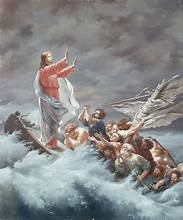
Jesus Christ faced storms in His life. One of them came on the Sea of Gallilee, as Jesus was sleeping in the boat. (See Mark 4: 35-41) A storm came up, and the disciples were terrified. They woke Jesus up, and Jesus calmly rebuked the wind and the waves, and the storm stopped. We often focus on the fact of Jesus being able to control the wind and the waves. But one of the amazing things about this story is that Jesus was IN THE BOAT! His own life was in danger from the storm. The disciples were not alone. Jesus did not let them put out to sea and face the waves, while He was safe on shore.
And so, too, Jesus is WITH US in our storms. We don’t have to wake Him up, and He may not choose to give us a miracle, but He’s right there! He can be trusted, no matter what our circumstances, no matter what dangers or damages we have to face. He knows how the storm ends; He knows how our story ends; He knows when the sun will come out again, just like it did earlier this week, announcing that all will be well.
It is Morel season in my home state of Michigan. Morels are mushrooms that only grow in mid-Spring. They are usually found in or near wooded areas, and they are delicious! Thousands of eager hunters search woods, roadsides, forests, orchards, and glades looking for the elusive spores each year. While morels can be “grown,” they are not easy to cultivate. Finding them is like a treasure hunt in all the freshness of spring’s new growth!
Morel mushroom
But there are several look-alike mushrooms– some of which are dangerous and even poisonous– growing now, too. It takes a good eye and some knowledge to tell the difference. False morels may have a similar shape, but they usually are slightly different in color and texture. Some false morels will appear brown, reddish, or even slightly purple, while true morels range from yellow, yellow-gray, or gray-black. False morels may be “puffier” or “spongier” than true morels. And while true morel “caps” attach to their stems, false ones may be detached or flared. It is important to know the difference and to be cautious when collecting the elusive morel.
false morel–gyromitra esculenta
The same is true of morals–there are plenty of people masquerading as men and women of integrity. They are polite, clean, charming; many are even respected members of the community. They may volunteer, give to charities, attend a local church, run for public office, hold a job requiring responsibility and trust. They look and act like honest, kind people. But they may be dangerous– even poisonous. They may even rise to positions in the church, destroying faith and trust among members of their flock, or spreading distrust and confusion among neighbors and even families.
So how do we “spot” the difference? Just as importantly, how do know which type we are!?
There are a few principles in the Bible that we can use to identify “false prophets” and those with “look-alike morals.”
First, we need to study what a true “Christ-follower” should look like. It is vital that we take the time to study for ourselves what the Bible says. Asking “what would Jesus do?” does us no good if we don’t know what He actually did and said! Putting all our trust in a role model or a dynamic leader is like choosing a mushroom because it “looks tasty–it could be a morel…”
Second, we need to look for people who try to “color” or “shade” the truth to look “tastier.” All the way back in the Garden of Eden, Satan used this trick with Eve– twisting God’s words, adding supposedly “hidden” knowledge, and dismissing the severity of God’s warning:
The woman said to the serpent, “We may eat fruit from the trees in the garden, but God did say, ‘You must not eat fruit from the tree that is in the middle of the garden, and you must not touch it, or you will die.’”“You will not certainly die,” the serpent said to the woman. “For God knows that when you eat from it your eyes will be opened, and you will be like God, knowing good and evil.”
Genesis 3:2-5 (NIV)
Closely related to this, we need to look for people who use words to spread division or discontent–including constant critics and complainers. It is tempting to get caught up in arguments about certain traditions, worship styles, external standards, new practices, personal revelation, etc.. But we must avoid such poison, and avoid spreading it! One poisonous mushroom can poison the whole “batch!”
Beware of those who arrogantly claim to have “new knowledge” or “new interpretations”– God does NOT change; nor does His Word. New insights and deeper or personal understanding should stand up under testing. Someone who is not willing to be questioned or asked to explain themselves may have a bad reason for their unwillingness. Just because something is traditional, or “old” doesn’t mean it must change.
Also beware those who are dismissive toward others in the church, whether they are critical of the teaching, the music, certain ministry programs, or individuals who serve. We are commanded to build one another up, not pass judgment based on personal prefrerences.
Look (and listen) closely to make sure we are still “attached” to our stem– the Living Word of God. Many Christians will quote “moral” sayings that are found nowhere in the Bible:
“God helps those who help themselves.”
“The devil made me do it.”
“There are many paths to God.”
“All you need is love.”
“God just wants us to be happy.”
“God will never give you more than you can handle..”
Finally, we need to look at the person’s “fruit.” Someone can have an impressive outward show of morals, yet miss out on “bearing fruit.” Such people may display all the trappings of earthly success, yet they seen to have no peace, or their lives seem joyless or filled with discontent or intemperence. In my own life, am I demonstrating Love, Joy, Peace, Patience, Kindness, Goodness, Faithfulness, Gentleness, and Self-Control? (see Galatians 5:22-23) Am I humble? Or am I impatient, unkind, judgmental, fickle, reckless, complaining, bitter, envious, angry, dissatisfied, greedy, worried, and prone to mock others– especially those in the church?
Beware of false prophets, who come to you in sheep’s clothing but inwardly are ravenous wolves. You will recognize them by their fruits. Are grapes gathered from thorn bushes, or figs from thistles? So, every healthy tree bears good fruit, but the diseased tree bears bad fruit. A healthy tree cannot bear bad fruit, nor can a diseased tree bear good fruit. Every tree that does not bear good fruit is cut down and thrown into the fire. Thus you will recognize them by their fruits.
Matthew 7:15-20 (ESV)
When we find true followers of Christ, we should be able to recognize the treasure of a life redeemed and transformed. While none of us is perfect while we remain in our present bodies, we should be producing a harvest of good fruit that sets us apart from “look-alikes” who are merely outwardly moral.
In the Gospel of John, there is the curious story of Lazarus. Lazarus and his two sisters, Martha and Mary, were good friends of Jesus. There are other stories throughout the gospels of Jesus interacting with this family. But this story appears only in John’s gospel, and it contains some details that raise several questions.
The story begins with an urgent message. Lazarus is gravely ill, and the sisters send word to Jesus to come quickly. Yet Jesus seems to dismiss the message, saying that it is not a sickness that will end in death, and he lingers two days before he decides to begin the journey toward Bethany. There is no sense of panic or urgency in Jesus’s response. And, though it says he loved Mary, Martha, and Lazarus, he seems unmoved by their obvious distress.
When Jesus finally arrives, Lazarus has been dead for four days. The two sisters both mention, with some bitterness, that if Jesus had come sooner, their brother need not have died. Jesus never gets defensive, but he challenges the sisters about their faith. In his exchange with Martha, he says that her brother will rise again. She agrees that he will rise again in the resurrection at the end of time. But Jesus redirects her faith–“I am the resurrection, and the life: he that believeth on me, though he were dead, yet shall he live: And whosoever liveth and believeth in me shall never die. Believest thou this?” (v. 25b-26). Her statement of faith, in spite or her grief and bitterness, prompts her to act. She goes to find her sister and bring her to the Savior, that she might be comforted.
Martha’s faith is small comfort in the circumstances. Her brother is still dead. His body lies rotting in a nearby cave. Her faith is fixed in the distant future, even as the author of Life and Eternity stands next to her. Her belief is wispy– more of a wish or a dream than the solid God-in Flesh standing before her.
Yet Jesus chose to use this seeming defeat as a showcase for His power to give life and resurrection. Many people who saw this were transformed and put their trust in Him. Others saw Jesus’ growing ministry as a threat to their own power and authority. They reacted with fear and even anger, that Jesus would bring the miraculous into their well-ordered normality. The Pharisees, including the chief priest, Caiaphas, determined that Jesus must die in order to “save” them from the Romans. Instead of seeing Him as the agent of their eternal salvation, they saw Him as an obstacle to their limited “freedom” to operate under the Roman oppression.
What is my faith like as I pray today? Do I believe that God “could’ve” or “should’ve” solved a problem in my past? Do I believe that God is not acting fast enough or decisively enough? Do I have a wispy faith that God will make all things right in Heaven, but is uninterested in the “here and now?” Do I believe that God’s answers might upset my life or cause me to “lose” control?
God, as you challenge my faith, help me to declare even my weak and imperfect belief; help me to act on it, and bring others to you for comfort. For in doing, so, I may be preparing the way for an incredible miracle– for revival and renewal; for the glory of Your great Name! And help me to see your answers through eyes of faith, and not fear of the unknown. Help me to trust you for the future I cannot see– a future that is in your capable and loving hands.
The other day, God answered a prayer I had been praying for about a month. I had lost a letter. Such a small thing, and yet it was priceless to me. It was old, yellowed, and crumbling. I was a letter from a law office, sent in 1933, informing my great-grandmother that her long-lost great-granduncle had died in California. He had not made a will, so his fortune was to be divided between any of his surviving relatives. The law office had found 36 such relatives, one of whom was Lila Green, for whom I am named. The “fortune” had been greatly reduced by the Great Depression– his stocks were worthless, and his properties greatly reduced in value. Still, the share that came to my great-grandparents allowed them to pay off debts, keep their farm, and even invest at a time when others were destitute.
I had intended to scan the letter and include it in a book I am writing about the lives, times, and families of my great-grandparents. But I had put it aside and misplaced it.
Such a dingy, yellowed, fragile letter– just a single sheet in an equally yellowed and fragile envelope with a three-cent stamp still clinging to one corner. I could not remember where I had placed it for “later.” I looked everywhere, or so I thought. And I had prayed that God would show me where it was. It seemed as though God might be telling me to “just let go” of the letter. That it wasn’t necessary for the book, and I was wasting my time looking for it. Still, it hurt to think that my great-grandmother, grandmother, and mother had preserved the letter, just to have me lose it when it could be useful again.
And then, my husband asked me to look for some paperwork to finish our taxes. Oh NO! Surely I could find important papers from the past year– I was pretty certain I knew where they would be. Still, I prayed that God would help me find them quickly. And I did! But as I was putting the financial papers away in the aftermath, I found a book bag behind the box of receipts and tax papers. It looked empty– no books inside– but it wasn’t. There, waiting patiently, was the letter, along with some other old papers I wanted to keep in my family history files!
I was so thrilled! I danced around, thanking God for His answer to my prayer. I was far more thrilled, in fact, over finding that letter, than I was about finding the tax papers!
But what about the “lost” people I encounter each day? When was the last time I put aside my other tasks and spent time “searching” for ways to share the gospel? How much time have I spent reaching out to “find” the hurting, the needy, the hopeless? Have I done more than just say a quick prayer, or shed a couple of tears? Have I even prayed consistently for weeks or even years?
Of course I pray for family members I know and love; for old friends and classmates who are struggling; even for people groups or nations where Christians are being persecuted, and the Gospel is being hindered. But that’s not the same.
This letter reminds me that there are people– many of whom “look” rather worn or worthless– people for whom Christ gave His life to save. People who need someone to listen, and offer hope. They need to be “found.” Even so, not all of them will accept the Gospel message. I can’t force them to see God for who He really is; I can’t make them choose to follow Christ. But I can do a better job of letting them know how very much God loves them, and wants a relationship with them. Yes, even those who feel yellowed and used; even those who have been sitting, forgotten, lost in the shuffle.
15 1-3 By this time a lot of men and women of questionable reputation were hanging around Jesus, listening intently. The Pharisees and religion scholars were not pleased, not at all pleased. They growled, “He takes in sinners and eats meals with them, treating them like old friends.” Their grumbling triggered this story. 4-7 “Suppose one of you had a hundred sheep and lost one. Wouldn’t you leave the ninety-nine in the wilderness and go after the lost one until you found it? When found, you can be sure you would put it across your shoulders, rejoicing, and when you got home call in your friends and neighbors, saying, ‘Celebrate with me! I’ve found my lost sheep!’ Count on it—there’s more joy in heaven over one sinner’s rescued life than over ninety-nine good people in no need of rescue. 8-10 “Or imagine a woman who has ten coins and loses one. Won’t she light a lamp and scour the house, looking in every nook and cranny until she finds it? And when she finds it you can be sure she’ll call her friends and neighbors: ‘Celebrate with me! I found my lost coin!’ Count on it—that’s the kind of party God’s angels throw every time one lost soul turns to God.”
Luke 15:1-10 (The Message)
I thank God that He helped me find the old letter. But I am eternally grateful that He seeks out and saves people like me, and like you. I pray that today, I will have eyes that see, and a heart that reaches out to the “lost.”