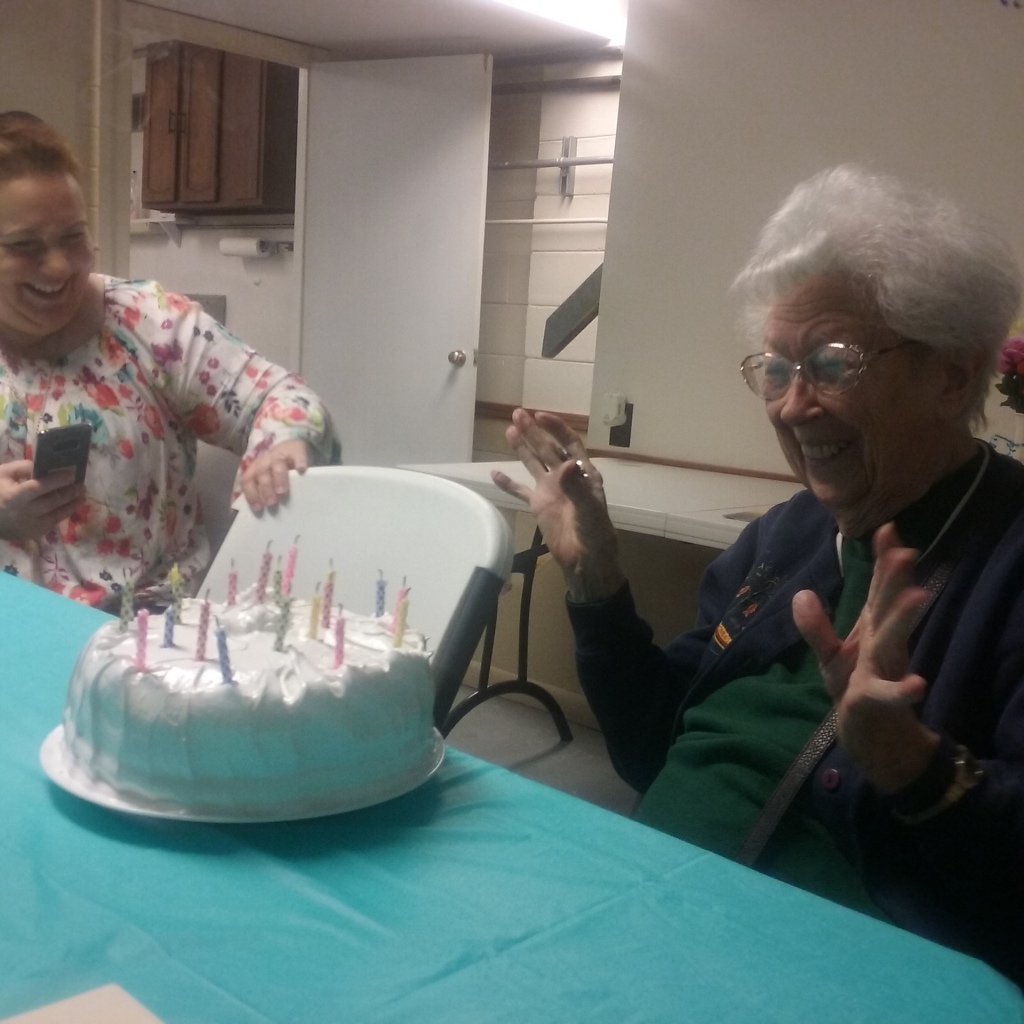
I missed posting here last Friday– we were busy planning my mom’s funeral. Mom died last week at the age of 89. We spent most of last week planning how to say our last goodbyes.
Goodbyes are never easy. And those that come with death are painful. We will miss our Mom, Grandma, Great-grandma, friend, cousin, neighbor, aunt, surrogate mom, and all the other roles she filled during her earthly life. We will miss her smile, her warm friendship, her faithfulness, her drive and passion, her energy, and her zest for life and adventure. I used to call or visit her every day. I will never again hear her voice in this life. I will never again hold her hand or share a laugh with her on this side of heaven.
But saying goodbye, for Christians, is NEVER permanent. I have said my very last goodbye to Mom, because someday, I will say “Hello!” to her again. And along with her, I will be welcomed into eternity by the One who created me and loves me even more than Mom did! No more painful partings; no more wondering when I will see her or speak to her again.
She is with so many loved ones to whom she had to say, “goodbye” over the years. And all of them are joyful and secure in the knowledge that there will be no more “goodbyes” in Heaven.
Mom was a prayer warrior, as I have said before. She prayed daily, multiple times a day, lifting up friends, relatives, and even strangers. And I will miss knowing that she is praying for me. But there is Someone Else who is praying for me daily– even constantly! Jesus sits at the right hand of the Father, making intercession for us every moment!
His disciples were in anguish at the thought of having to say “goodbye.” But Jesus told them to be glad, because He would send a comforter, the Holy Spirit, to them after He went away. They said their last “goodbye” to their beloved Teacher, but He didn’t leave them alone to grieve. He left them with a mission to achieve. He also left them with a promise that He was coming back! And this time, He would bring them to their eternal home in Glory!
And Mom has done something similar. She left a legacy of caring and praying and sharing the Gospel. She left hundreds with hope and peace for their future. And now it’s important to carry the baton; to finish our leg of the race, and continue the mission that Jesus passed on to His disciples long ago; the legacy that was passed to Mom, and that she has passed on to us. Someday, all the “last goodbyes” will have been said; all the last bitter tears shed, and we will all celebrate the arrival of God’s Glory. The only thing left to bid “goodbye” will be Sin and Death, grief and mourning.
I thank God for “Last Goodbyes.” Because I know that Goodbye is never the end for those of us who know Christ. We will be sad for awhile, but our grief will be swallowed up in joy and victory! Goodbye, Dear Mom– for now. You are safe and secure. Your prayers have been answered, and ours continue in hope and confidence. Amen!
As I write this, my mom is dying. We don’t know how much longer she has, but we’ve asked for prayers as she takes this journey toward death and resurrection. These are sometimes difficult prayers to make. We don’t like to see Mom suffering, but we don’t like the thought of separation through death, either. Our initial prayer would be for complete healing. But that’s not realistic, given that Mom has heart failure and is almost 90 years old. That doesn’t mean that God cannot or would not grant total healing. But we aren’t expecting that kind of miracle when we pray today.
For some people, our prayers seem meaningless. One of my classmates from school reacted to my request for prayer by saying, “I just wish that prayer DID something…” I take this to mean that if we don’t get a miraculous outcome, she believes our prayers are wasted. I hope I’m misinterpreting here, but I know that this is a common criticism of prayer in tough times. It seems that every time there is a natural disaster, or a mass shooting, people who offer “thoughts and prayers” are roundly criticized for praying “instead” of “doing.” As though the two are mutually exclusive. As though prayer is an empty gesture in the face of disaster and distress. As though there is no hope, no comfort, and no help in praying.
There are others who will assert with complete confidence their belief that God will answer any prayer for a miracle, simply because they ask it “in Jesus’ Name” or because many people are praying for the same outcome. I call these kinds of prayers, and attitudes about prayer, “Vending Machine Prayers.” It is the belief that prayer must produce an immediate and positive outcome, or it is “broken” or invalid. If you don’t get what you were expecting, you must have prayed “wrong,” or didn’t have “enough” faith. Or your prayer just didn’t “work.” When someone puts money into a vending machine, and presses a button or punches in a code or pulls a knob, and they don’t get the expected item, some of them will kick the machine, or curse. Or they will try again, carefully trying to get the “right” result. Vending machines are inanimate objects designed to give a satisfactory consumer experience. If the coins or bills “jam,” if the knobs or buttons malfunction, if the product gets “stuck,” or isn’t available, the consumer feels cheated. Sometimes, they can get their money returned, but most often, they go away angry and unfulfilled.
God is not a vending machine. He is not “designed” to serve us or give us satisfaction. There is nothing we can “insert” in our relationship with God –even sincere prayer–that obligates Him to give us what we desire. God chooses to answer prayers in whatever way He knows is best for our eternal and overall well-being. God still gives miracles. I’ve seen it and experienced it. In fact, we could have lost Mom several years ago, when her heart failure put her in a similar state. God provided a miracle in the form of heart valve replacement surgery–and a cancellation that moved her surgery schedule forward before her condition was too far gone. I’ve seen people healed of cancer– and people whose prayers for healing ended in their rapid decline and death. But none of those prayers were wasted. Not one. God was working– sometimes on the sidelines, strengthening family members to deal with grief; sometimes providing testimonies to those with doubts and questions; sometimes planting seeds that would bear fruit years later in the lives of those left behind–sometimes God was working “sideways,” as He did with Mom years ago to give her several more years of life, even though she wasn’t completely healed, to grow and prepare for this next step and testify to God’s sustaining power.
God is not apathetic, and He certainly isn’t “happy” about Mom’s decline and her impending death. He shares our sufferings and our sorrows. But God knows and sees the “rest of the story!” Jesus wept over the death of His friend Lazarus, even though He knew that Lazarus would be raised back to life. Jesus was sharing the deep grief over the loss and sorrow felt by all of His friends, just as He rejoiced with them as Lazarus walked home from the tomb! (See John 11 for the whole story.) God doesn’t delight in death. He is the author of LIFE. But He is very present through every stage of life– even that last bitter taste of death we all must experience. And just as we pray for God’s miraculous presence, we pray for His guiding, comforting, and hopeful presence in ALL situations.
Prayer DOES something! Even if we don’t see immediate changes in situations; prayer changes US. It changes OTHERS. It changes our priorities and perspectives. It draws us close– to each other and to the One whose Love is Eternal and unchanging.
116 I love the Lord, because he hath heard my voice and my supplications.
2Â Because he hath inclined his ear unto me, therefore will I call upon him as long as I live.
3 The sorrows of death compassed me, and the pains of hell gat hold upon me: I found trouble and sorrow.
4 Then called I upon the name of the Lord; O Lord, I beseech thee, deliver my soul.
5 Gracious is the Lord, and righteous; yea, our God is merciful.
6 The Lord preserveth the simple: I was brought low, and he helped me.
7 Return unto thy rest, O my soul; for the Lord hath dealt bountifully with thee.
8 For thou hast delivered my soul from death, mine eyes from tears, and my feet from falling.
9 I will walk before the Lord in the land of the living.
10 I believed, therefore have I spoken: I was greatly afflicted:
11 I said in my haste, All men are liars.
12 What shall I render unto the Lord for all his benefits toward me?
13 I will take the cup of salvation, and call upon the name of the Lord.
14 I will pay my vows unto the Lord now in the presence of all his people.
15 Precious in the sight of the Lord is the death of his saints.
16 O Lord, truly I am thy servant; I am thy servant, and the son of thine handmaid: thou hast loosed my bonds.
17 I will offer to thee the sacrifice of thanksgiving, and will call upon the name of the Lord.
18 I will pay my vows unto the Lord now in the presence of all his people.
19 In the courts of the Lord’s house, in the midst of thee, O Jerusalem. Praise ye the Lord.
There are dozens, if not hundreds, of people praying for my Mom (and all of us who love her so very much). And probably, there are some “vending machine” prayers among them. That’s ok. God hears them all. And I am so very blessed by them all. Because prayers DO SOMETHING AMAZING. They rise to a God who sees, who hears, and who LOVES unconditionally, eternally, and perfectly! We’re actively trying to do what we can do to make Mom comfortable and seeking treatment that will ease her last days, but we depend on God’s touch, His healing, His timing, and His good will to see us all through and keep us in perfect peace.
When I was growing up, I knew three important things about my father: I knew he loved me–and the rest of our family–faithfully and truly. I knew he loved God–He was a man of faith, prayer, integrity, and obedience to the Word. I knew he would do anything to protect and provide for our family.
But I also knew that my Daddy wasn’t perfect. He was not the strongest man in the neighborhood; or the fastest, or richest, or most respected. He wasn’t the tallest, or most athletic. He wasn’t a leader in local politics or a chamber group or fraternal organization. He didn’t have a string of degrees, or a fleet of fancy cars. He didn’t even have a lot of hair, or perfect teeth. But he had a gentle laugh, a deep wisdom, and a hug that made me feel safe and precious. He had a enormous heart– one that was easily touched, but firmly committed. He was humble and kind; he was loyal and brave and joyful.
I was blessed to have such a Dad. I know people whose earthly fathers were distant, disapproving, absent, or even abusive. Earthly dads, even one like mine, are still human. They make mistakes and bad choices; they carry baggage from their own childhoods; they carry fears and failures; they fall short of our expectations, and their own hopes and dreams. And yet, we long to have a father we can trust; a father who won’t fail us, even in the little things; a father who will perfectly understand us, provide for our needs, and protect us. No matter how old we are, or how successful we may be, our need for a father’s love and approval never end.
Our mental and emotional picture of God is often shaped by our relationship with our earthly fathers. Especially if our father was abusive, it can be difficult to believe that God really loves us. After all, if God loves me, why did He give me an abusive Dad? If God can protect me, why did He allow me to go through a journey with Cancer? Or poverty? Our fallen world leads us into circumstances that cause us to doubt God’s goodness and His ability to redeem our broken past. But, while God sees our painful circumstances, He also sees things that we can’t. He sees the pain that our fathers feel in their own brokenness and inability to “fix” their own past. He sees the kind of growth and compassion that we can learn in our difficulties– lessons that we would not learn in ease and apathy.
God is a different kind of Father. He is eternally sovereign; the King of Kings, and the Creator of the Universe. There is no comparing Him with anyone else’s father– because He is the Ruler and Father of all! Yet, He wants a close loving relationship with each one of us– with me! With you! He is not just committed to doing His best to provide and protect some of us– He is fully capable of providing ALL our needs and protecting us against ALL enemies, including sin and death! For those who have grown up with a distant or abusive father, it can be difficult to hear of God as our “Father” and feel the kind of comfort and trust that we are meant to have. Yet God invites us into His very presence– ALL the time; ANYTIME. He is everything that the word “Father” was meant to be!
Someone once used the analogy of President John F. Kennedy to describe how we can relate to God as “Father.”. As President, JFK was arguably the most powerful man in the world– the leader of the most powerful nation on earth. At his command, soldiers, sailors, pilots, and even nuclear missiles, could be deployed. The stroke of his pen could sign bills into law, grant pardons, and appoint powerful positions. To enter the Oval Office and have an audience with the President was an honor reserved for rulers and generals and authorities– and his children.
There is a picture of JFK, Jr. as a small boy, peeking out of the Resolute Desk, as his father sits behind the desk conducting the business of the nation. The son had complete access to his father’s presence– access to the most powerful man on earth–his Daddy. He may not have fully understood what his father was doing, or even how important his father was– but he knew that he could spend time with his Dad.
Of course, President Kennedy was not God. He was fallible, and terribly mortal, as the nation learned to its grief. But the idea that God is distant and uncaring, or even vindictive and petty, is belied by the many Psalms and hymns and prayers throughout the ages. And the idea that God is just another “pal”, or “the man upstairs”–someone who loves us, but has no real power to command our obedience or rescue us from our enemies–is also belied by the many miracles and examples of His power in nature and in history. And unlike the exclusive nature of the relationship between JFK and his biological children, God invites ANYONE who calls on Him through His Son to be adopted as a son/daughter with the same intimate privilege of total access. https://www.biblegateway.com/passage/?search=John%201:11-13&version=HCSB (John 1:12)
So when I pray today, I’m not praying to my “Daddy” in any earthly sense. As much as my earthly Dad loved me, I am praying to someone who loves me more, and better, and perfectly. I am praying to the King of Kings, who also invites me to call him, “Abba”– “Dad.”
Being a Christian is less about cautiously avoiding sin than about courageously and actively doing God’s will.
Dietrich Bonhoeffer
Dietrich Bonhoeffer was a German pastor and writer who ended up sacrificing his life as he protested the Nazi regime in his homeland. Many of the things he wrote are uncomfortable for modern Christians to read. Sometimes, we want to coast along, joyfully celebrating our own Salvation, and ignoring the evil around us. After all, the ultimate victory is already won in Christ, isn’t it?
I write a lot about the power of prayer. And I stand behind what I write. But a life of prayer and Bible Study that doesn’t result in actively living out and spreading the Gospel is a life of lukewarm and selective obedience. This is not to say that we should skitter around trying to earn our Salvation with random acts and self-righteous crusades. But we must have the courage to “come out of the closet” as Christians in a dark and unfriendly world.
What does this look like? Does it mean wearing a badge or getting in people’s faces with “the Truth.” Perhaps. But mostly, it means every day living out the kind of love and truth that Jesus demonstrated. Jesus didn’t march in protests, hand out pamphlets with convicting messages, or start arguments to humiliate atheists in front of crowds. But He didn’t back down in the face of arguments and tough questions asked by His opponents. He ate with sinners– but He didn’t wink at their sin, or send them away reassured that they were “good enough” to please God. He went where God sent, spoke God’s Truth, and DID God’s work.
Jesus wasn’t a writer; He wasn’t a professor of Theology, or an elected official. The Pharisees were constantly frustrated with His lack of “credentials.” But their frustration came because Jesus spoke with the kind of authority they could never achieve– Jesus was authentic. He spoke, not from cold and lofty intelligence, but from wisdom and love. And Jesus didn’t just speak. He served. He listened. He lived out all that He spoke. He “courageously and actively” DID the will of the Father.
Jesus prayed and studied scripture. Jesus spent time alone communing with the Father. He spent time in rest. He spent time being social with His family and friends. But in every activity, He wove in the Truth of God’s word. And crowds followed Him. They wanted to listen, even as He spoke uncomfortable truths. And some of them came to love Him. Others came to hate Him, and even kill him.
We can’t be true followers of Christ and not risk being mocked, and hated. We WILL be misunderstood, laughed at, persecuted, ignored, and inconvenienced. We should not invite this with obnoxious or arrogant behavior. But we must not shrink away from it when it comes at us, or try to avoid it by being silent in the face of evil and injustice.
One of the recent charges leveled against Christians is that we meet evil with “thoughts and prayers” but little action. We must be wise and careful with such charges. Often, the taunt is thrown at us in an effort to get us to take a specific, ungodly “action” INSTEAD of praying. But we must honestly examine ourselves and ask what Godly actions SHOULD I be taking to make a difference? What actions should I be denouncing as ungodly, even if they are popular and seem to be “right?” And what must I do to defend the power of prayer in the face of ridicule?
One of the other charges leveled against Christians is that we are “intolerant.” Again, we need to be wise and careful in answering this charge. Are we quick to judge others, while giving ourselves a “pat on the back” for merely avoiding a particular sin or sinful lifestyle? What is if about our life and work that makes others see us as “intolerant?” Are we exclusive and prejudiced in our interactions? Or are we humble in presenting the truth of God’s word? Do we speak from a need to defend our own actions or from a desire to help others? Are others offended by our words and actions, or by the truth of God as it convicts them?
I got a scam phone call the other day. The lady on the other end started the conversation by saying something like, “Hello. My name is Jane, and I’m calling from the Business Lending Department. How are you today?” Her voice was pleasant, and her question innocuous, yet my “radar” went off, and I hung up the phone, rather than answering her question.
I answered the phone by saying, “Hello” and the name of my little shop. It’s a business phone number, and I get many calls from customers, and from salespeople as well. Usually, as soon as I say my greeting, they jump right in with their request, or their name and request, i.e. “This is Sharon. I was in the other day, and I was wondering about…” or “This is Matt from (Name of my insurance agency), and I need to speak with you about a change in your coverage.” A business person may occasionally say something like, “I hope you’re doing well today.” or “Is this a good time to talk?” A friendly customer or a friend will often ask, “How are you?” or “How are things going?” But this was different. There was a long pause, which seemed odd, as though the call might be from far away. The phone number that came up on caller ID was not from a local area code and didn’t include a state listing or a company name (Pennsylvania or Wyoming, State Farm, or Citibank, etc.) This can happen with cell phone calls, but it can also be an indication that the call is coming from a hidden number. “Jane,” while she sounded pleasant, also sounded like she was reading from a script. “My name is Jane” indicated that she was not someone I would have met before, and “How are you today?” sounds like the opening line from a stranger’s sales pitch.
I have read articles about scam calls. One of the first things they do is ask an innocuous question like, “Can you hear me, ok?” It seems like a simple, silly, harmless question, but if they ask you a Yes/No question, and you say “Yes,” they can record your answer and use it to “prove” that you agreed to a product or program by phone– even if you didn’t. “How are you today?” isn’t a Yes/No question, but it is the kind of question most people will answer without thinking, and it naturally leads to other seemingly innocuous questions, like “Can you hear me?” Call me hyper-cynical or super-suspicious, but these questions seem– from a complete stranger– like “set ups” to me after reading about how they are sometimes used.
“Jane” is such a common and unassuming name. I have friends named Jane. One of my favorite novels is “Jane Eyre.” I love reading books about Miss Jane Marple, the unassuming, crime solving spinster of the equally unassuming village of St. Mary Mead. She was just “Jane.” Not Jane Torquist, or Jane Sullivan, or Jane Suzuki. And “just Jane” was calling from “the Business Lending Department.” Not the business lending department of a particular bank or business group. Not Wells Fargo, or Chase, or even a local banking chain. Not Visa or American Express. Just “the Business Lending Department.” Again, call me paranoid, but that set all my alarm bells ringing.
After I hung up, I felt bad. Hanging up–even when I suspected the call was far from innocent–seems very rude. “Jane” had been very pleasant. It felt churlish and even cowardly to hang up on her. I started stewing. I don’t like to think of myself as rude, churlish, or cowardly. After all, what would Jesus do, right? So I prayed for forgiveness, even though I wasn’t sure precisely what I had done wrong.
And God answered my prayer immediately. “Jane.” The woman had given her name as “Jane.” I have a friend named Jane who is going through a tough time right now. I have been praying for her for weeks. Had I prayed for her today? Not yet! God had sent me a reminder of my friend Jane via a scam call! Aren’t God’s ways mysterious and magnificent?! He also gave me a great idea to help me be at peace about the phone call. I thought, “if “Jane” ever calls back, I’m not going to answer her question, and play a passive role in the conversation. I will simply ask her what company she works for, and how SHE is today!”
And guess what! About an hour later, “Jane” called back. The call started exactly like the earlier call. The script was exactly the same– the same pause, the same wording. So when she asked, “How are you today?” I simply asked her, “which company do you work for? You said you are calling from the Business Lending Department, but which one?” And this time, SHE hung up! I had been right to be suspicious– right to stand my ground and not get involved in a scam– on any level.
Such a simple encounter, but so many lessons to be learned:
God answers “little” prayers; “awkward” prayers; He answers earnest and simple prayers when we just don’t even know what to pray or why. Things that seem silly (like whether or not I seemed rude or cowardly to a scam artist!) are never too silly or unimportant to take to the very Throne of Grace.
God uses simple things to call our attention to bigger things. This woman could have chosen any name, but she said her name was Jane, and I believe that was God-ordained, to remind me to lift up my dear friend– to move my mind from something silly, like a phone scam, to something infinitely more important, like thanking God for Jane’s friendship over the years, and sharing in her immediate concerns.
God teaches us to recognize authenticity– and insincerity–as we follow Him. My “alarm bells” went off almost immediately when I answered this phone call. Why? Even though “Jane” was pleasant, she didn’t seem authentic. She used words and phrases that seemed friendly and harmless on the surface, but the delivery just seemed “off.” The same thing can happen when I read an on-line article, or listen to an advertisement, or even get involved in conversations. God sends us a spirit of Discernment that is sharper than just “being savvy.” But it comes from Him– not our own intelligence or listening to “smart people.” I know this because I know people who are acknowledged as “intelligent” who fall for amazingly stupid schemes and make appallingly bad life choices, while others who are called “simple” avoid such things without even being able to explain how. It reminds me of a story about a famous pianist practicing a complicated piece. She was playing along and suddenly stopped, saying she had missed a single note. “How can you tell?,” asked her friend who was standing nearby. “Your fingers are flying over the keys. How can you tell that you missed anything. The piece sounded fine to me.” “But I practice hours each day. I’ve heard myself play this piece hundreds of times correctly. I know what it SHOULD sound like. And this time, I missed a note.” When we practice listening to God’s voice– whether in the Bible, or in our conscience, or in the advice of others, we learn to hear “what it SHOULD sound like!”
God teaches us wisdom, and gives us “second chances” to put it into practice. Jesus faced malicious Pharisees who tried to trick Him with seemingly innocuous questions. They came to Him with polite but false flattery, and tried to catch Him “off guard.” Jesus generally responded by asking them simple questions in return– questions that often exposed their real motives. He didn’t lose His temper; He didn’t passively fall into their traps. He didn’t walk away without an answer, either.
God can use “bad” experiences to teach us good things. He is teaching me to recognize a “scam” when I start to hear it. But (hopefully) He is also teaching me to speak and act more authentically myself! How often do I ask someone “How are you today?” not because I actually want to hear the answer, but because it is the “polite” thing to do? How often do I ask seemingly harmless questions without thinking? My words can bring healing– or suspicion, harm, or confusion. Jesus asked some probing questions, but always with the intent of helping others see the truth.
Lord, I am so thankful for the lessons you give us– even in the simplest situations in the midst of our busy lives. Help me to listen for your voice– even when “Jane” is on the line. What an amazing and wise God you are!
Because of the Lord’s great love we are not consumed, for His compassions never fail. They are new every morning; Great is Your faithfulness. I say to myself, “The Lord is my portion; Therefore I will wait for Him.”
We live in a world of seemingly finite resources. We work hard to save money, save time, protect our joints, take care of our teeth, maintain our house or yard, repair our vehicle, conserve water, protect our air quality, etc.. And we work hard to ensure that we get our “fair share”–vacation time, wages, tax breaks, sale prices, the best return on our investments, the lot with the best view, the window seat on the plane or bus, credit for our hard work, and more.
God’s resources are unlimited and bountiful. Through Christ, we are joint heirs to all the riches of God. God is our “portion.” And no one who trusts in Him will be left with less than a cup filled to overflowing (Psalm 23:5). We may not fully comprehend or receive our great good fortune in this life, but we will enjoy it the next for eternity! And there is no need to scramble and scrimp, worry, or wrangle trying to get it– it’s our promised “portion” and our inheritance.
What a world of worry, stress, desperation, and trouble we might avoid if we carried this promise in our memory and LIVED it out. The prophet Jeremiah wrote these words– Jeremiah, the weeping prophet; Jeremiah, whose life was in constant danger as he watched his homeland being invaded, conquered, and exiled. Jeremiah, in the midst of his anguish, took time to write some of the most hopeful and joyful words of prophecy. Jeremiah knew that, even if the nation of Judah was conquered and destroyed, the LION of Judah would still bring ultimate victory. And to the victor belong the “spoils!” Jesus is our victor and our victory. His are the spoils of war to lavish upon those He chooses.
Jesus (called the Lion of Judah, an image found in both Genesis and Revelation) has already given us victory over Sin and Death. And the “Lion’s Share” of the spoils– abundant life, restoration, redemption, and the Righteousness of God– are for all those who call on His name and worship Him in Spirit and in Truth! He’s reserved a “Lion’s Share” for each of us.
“The Lord is my portion; Therefore, I will wait for Him.” ” I will trust and not be afraid.” (Isaiah 12:2) “You too be patient; strengthen your hearts, for the coming of the Lord is near.” (James 5:8) https://bible.knowing-jesus.com/topics/Waiting-On-The-Lord (See also Psalm 37)
Instead of scrambling for a “lion’s share” today, let’s call on the Lion, and allow Him to give us our “daily bread,” knowing that His portion is more than sufficient today and forever!
I love visiting old churches and cathedrals, with their vaulted ceilings and solid stone walls infused with centuries of incense and the echoed prayers. And I love being outdoors surrounded by the glorious beauty of creation. These spaces seem infused with a special sense of the sacred. It is easy to feel close to God is such spaces.
But God is omnipresent. A crowded bus is no farther from God’s presence than a majestic mesa. The hush of a hospital ward is just as close to His heart as the swelling choir in a cathedral. In fact, when Jesus lived among us on earth, He spent much of His time walking dusty roads, talking and working miracles among the noisy “rabble” of ordinary people. He did not seek out “sacred spaces;” instead, He took the “sacred” into the dark and dirty streets where it was often ignored or dismissed.
Sometimes, Jesus would go off by Himself into the wilderness or into the hills to pray, as well. It is important to make a time or space to do this. But there is nothing especially sacred about particular spaces– even ones designed to be places of worship. It may not be easy to find a physical space for prayer and worship, but we can make a mental “space”– close off distractions, move or turn away from others for a few precious minutes–focus on God’s presence. Remember, His presence is always with us; we just need to acknowledge it!
Prayer connects us to God– wherever and whenever we pray. That doesn’t mean that we should not seek out special times and places to be alone with God. But we needn’t wait for a certain moment or location or position in which to meet with God. He is eternally, immediately available to listen. Are we?
Today is Boxing Day. Some people will leave their Christmas decorations up for awhile longer; maybe even until after the New Year. Others will box up all the holiday trappings for next year. But the boxes and bags that held gifts yesterday are likely put away– some put aside; others in the trash. We laugh about toddlers and pets being more fascinated with the boxes than with the gifts inside, but most of us tear off the paper and rip open the boxes to get to the “good stuff” hidden inside. The ribbons and bows, the gift card holders and glittery greeting cards, while they delight us in the moment, pale in comparison to the gifts and the thoughts behind them.
What a shame it would be if all the wonderful gifts under the tree remained unopened– boxed away for another year, just to be placed back under a Christmas tree in 2023. What a useless tradition it would be to give gifts that were never opened or used, or even seen!
And yet…the Greatest gift of all–the very reason for the Christmas season– often remains boxed up and carefully preserved for another year. “Jesus is the reason for the Season,” as some people say. But have we RECEIVED Him? Have we opened up the gift of His coming; of His offer of salvation and reconciliation– or do we just enjoy the idea of the Baby in the Manger and the Wise Men coming from afar and offering gifts; the angels singing in the night sky, and the gentle animals in the stall?
The Gospel writer and Apostle John wrote that Jesus “came unto His own, and His own received Him not.” (John 1:11) God so Loved the world that He gave His son (John 3:16), but the gift remained unopened and ignored by those who should have welcomed Him. He grew up and lived among them– healed their diseases, spoke comfort and truth, laughed and shared sorrows with them– and they cried out, “Crucify Him!” God’s “one-size-fits-all” perfect gift– the “gift that keeps on giving” eternally!–was despised and rejected. And the Gift is still rejected, ignored, scorned, and unopened today.
All the splendor and glitter of the Christmas season will fade away– the decorations will go back in their boxes; the wrappings and trimmings will be forgotten. But the Gift! Let’s bring it out and use it– revel in it; wonder at it. God with Us. God reaching down and out and beyond to bring us Home–forever! And God giving us the privilege and the power to BE His hands and feet and eyes and lips as we minister to those around us! God holding us close as sons and daughters. “But as many as received Him, to them He gave the right to become children of God, to those who believe in His name..”(John 1:12) When we open this gift, we are not just recipients, not merely believers or followers– we are Children of God.
Lord, help me not make the grave mistake of taking your incredible gift and leaving it in a box, or worse, opening it up and putting it back in a box for later. Help me to live in the “present”– in every way– and to enjoy the privilege of being Your child forever. Amen!
When I was a child, we used to write letters to “Santa” with a list of what we wanted to find under the Christmas Tree that year. Sometimes this was a school project– practice in letter-writing etiquette, etc.– and sometimes, it was done spontaneously after poring through the Sears “Wish Book” Christmas catalog, or after watching Saturday morning cartoons with their endless ads for toys, dolls, bikes, and sugary cereals.
As adults, we often do something similar, drafting a Christmas “wish list” in our prayers and Advent dreams. Our adult lists may be as shallow as those of childhood–a new dishwasher, or a shiny piece of jewelry; a new “toy” boat for Dad, etc. Sometimes, they sound more virtuous– world peace, a healthy economy, a cure for cancer…
It isn’t “wrong” to have wishes at any time of year. And we should hope for better things in the world around us. But we can get caught up in the idea of Christmas being all about wishes and desires at the expense of the real GIFT of Christmas– Christ Himself! In fact, we can become numb to the fact that Jesus wasn’t just “another” Christmas gift among our “wish list” items.
9 The true light that gives light to everyone was coming into the world. 10 He was in the world, and though the world was made through him, the world did not recognize him. 11 He came to that which was his own, but his own did not receive him. 12 Yet to all who did receive him, to those who believed in his name, he gave the right to become children of God— 13 children born not of natural descent, nor of human decision or a husband’s will, but born of God.14 The Word became flesh and made his dwelling among us. We have seen his glory, the glory of the one and only Son, who came from the Father, full of grace and truth.
John 1: 9-14 (NIV)
Christ didn’t come that first Christmas in response to any person’s wish list. In fact, the Bible says that when Jesus came into the very world He created, He was rejected, ignored, even despised by those who should have recognized and welcomed Him. He didn’t come wrapped in shiny paper and waiting for us to enjoy Him. He came wrapped in rags, forced to go into exile under threat of death, and honored only by humble shepherds and strangers from foreign lands. No one sought Him out on their own. Even the shepherds and wise men were led by angels and a guiding star.
This year, instead of concentrating on wish lists and our desires (even noble ones!), let’s reflect on God’s wish list– that we would turn from sin and rebellion, and be reconciled to Him; that we would make His gift our greatest desire!
During this season of the year, we hear a lot of “Christmas” music. Much of it is secular music–Santa Claus and magical snowmen, gifts and parties, and the Holiday “blues.” But much of it is related to the real reason for Christmas: the birth of Our Lord. And the number of songs, hymns, cantatas and symphonies related to Christ’s birth is staggering! Popular secular singers record “their” versions of favorite hymns; choirs and orchestras present new songs and ancient melodies. Many of the songs fall into two distinct categories, however. There are quiet lullabies–peaceful and meditative, focused on the infant in the manger; and there are Hallelujahs– joyful and majestic, focused on the wonder of God coming to earth.
I don’t know if there were actually lullabies OR Hallelujahs on that first Christmas. The Bible mentions the visit of the angels, but they were “praising God and SAYING, ‘Glory to God in the Highest..'” We often assume that their praise included singing, but the Bible isn’t specific. But it is interesting to look at the contrast of the quietness of the manger and the Glory of the angel hosts, and hear the contrast in the hymns we raise at this time of year.
Lullabies, and quiet songs, like “Silent Night,” or “Away in a Manger” call our minds and hearts to the humility of the Christ child. Babies are cute and engaging. And they are not “silent.” But they do not command authority and majesty. Babies cry out for help. They are needy in a way that God is NOT. And yet…God came in the form of a helpless baby. The God who created the galaxies needed someone to feed and change Him; to carry Him from place to place and rock Him to sleep. “O, Little Town of Bethlehem” reminds us that He came to a cattle shed in a small town, rather than to a palace in the seat of power.
Hallelujahs, like “Joy to the World” and “Hark, the Herald Angels Sing,” remind us that this was no ordinary child. And yet…the angels did not appear IN the manger or even in the little Town of Bethlehem. The Angels were compelled to sing their praises, not to the learned priests, or the courts of power, but to dumb-founded shepherds on a cold hillside. What an explosive visitation! Their praises (whether shouted or sung) shattered the quiet and the darkness. Like a sudden fireworks display, the Glory of God’s servants split the night.
God enters our hearts– sometimes quietly, like the cooing of an infant; sometimes dramatically, like a chorus of angels. God is at work– sometimes in humble moments and ordinary gestures; sometimes in glorious flashes of insight and inexplicable miracles. And this season, our prayers will rise up– sometimes like the humble cries of a newborn baby; sometimes like the soaring songs of angel hosts– prayers of need; prayers of thanksgiving; prayers of awe-struck worship; prayers of simple confession of our own unworthiness, and of God’s sufficiency and everlasting Love. Peace and Glory; lullabies and Hallelujahs; simplicity and majesty– all wrapped up on a manger of hay on one Holy Night.