Prepare Him Room

“Let every heart prepare Him room,
And Heaven and Nature sing!”

from “Joy to the World”, by Isaac Watts

I cleared a space in my living room for a tree.
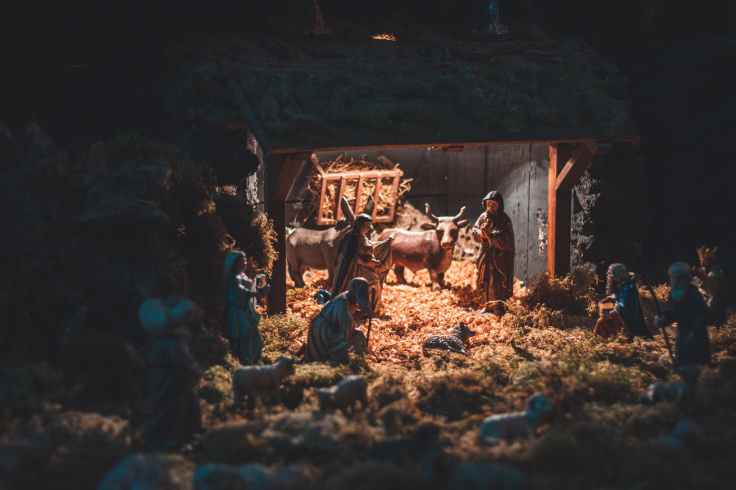
I placed a Nativity set on our newly-cleaned mantle place.

I found a cozy nook to wrap all the Christmas gifts,
And I used candles and decorations to fill all the empty space.

I cashed in my Christmas club money to buy the gifts
For friends and family.

I set aside money to buy stamps for Christmas cards
And to give to charity.

I cleared my schedule and made time for
All the extra running this Holiday season.

For parties and shopping with friends;
For Church and family–all excellent reasons!

But it wasn’t until I made time and space for the Babe–
God come to Earth as a baby Boy–

It wasn’t until I let go of all of “it” for “HIM,”
That my heart was transformed with Unspeakable Joy!

Christmas has room for bells and lights,
For carols, and cookies, and festive nights.

Christmas has room for laughter and presents.
But it isn’t really Christmas without HIS PRESENCE.

“Let every heart prepare Him room” this year.
Let every heart be filled with true cheer.

Let us Adore Him–far and wide–
This Savior who was born; who died

And rose victorious over the tomb!
Who entered our world in a Virgin’s womb,

The one who came to save the human race;
The one who is filled with “redeeming Grace!”

May Christmas Day, and ALL our days
Be filled with Wonder, Joy, and Praise!

Today, as we celebrate the coming of Jesus Christ into the world, let us remember that He came into a world that wasn’t prepared. There was no room in the inn. There was no baby shower, anticipating the arrival of a long-expected birth. In fact, His birth came without all the trappings that we have added to the Holiday. I love all the wonder of the Christmas Season– all the lights and songs; gathering with family, and friends, Advent services and Christmas Eve candlelight vigils, gifts and cookies, Christmas movies and Christmas cards– I could go on for pages!

But the heart of Christmas comes quietly and simply; when we step back from all the glitter and activity and take in the absolute wonder that the God of the Universe stepped into all the limitations of His Creation– a world of time and space, dirt and disease, broken hearts and broken bodies–and He did it for YOU and for ME. He had to be fed and changed–the ruler of Nations!–and placed in a manger to lie in all the helplessness of infancy. He had to walk wherever He wanted to go. He had to eat and sleep and wait in lines and wash away the dirt and sweat of His exertions. He had to listen to the foolish arguments and explain Himself to critics whose very souls He had lovingly created. And He let them condemn Him unfairly and kill Him in the most painful and humiliating way they could dream up.

Christmas is about Joy bursting into a world that was NOT prepared for it. It is about the inextricable link between suffering and celebration; between seeking and being sought out; between salvation and sacrifice.

Our Joy at Christmas cannot be manufactured by songs or gifts or entertainments. It can’t even be found in rituals and traditions. But when Jesus finds room in our meditations, our relationships, and our lives, Joy is the overflow.

May we all find Joy this Christmas– whether or not we prepared in advance; whether or not we checked off all the items on our “to-do” lists; whether we can afford all the trimmings and decorations; even if we are crying out in the darkness– may the Joy of Christmas burst upon us, just as Jesus burst upon a weary world so long ago! 

“Joy to the world! The Lord has Come!”

Of Gingerbread, Christmas Trees, and Frankincense…

As the Christmas season approaches, people are decorating their homes– wreaths, Christmas Trees, lights, gingerbread houses, manger scenes, elves and reindeer, candles and more. And along with the sights and sounds and tastes, the air is redolent with the scents of the season.

Scents evoke memories and emotions deeper than any of our other senses. We can close our eyes or ears to unwanted stimuli, but it’s difficult not to breathe in the spicy air filled with cinnamon or cloves, or ignore the scent of pine or scented candles filling the room.

There was no gingerbread, or evergreen tree, or clove orange in the stable where Jesus was born so long ago– no candles or air fresheners to cover the other scents of animals and afterbirth. But when the wise men arrived to worship the infant King (which may have been a couple of weeks or even months later), they brought gifts, and two of the three were spices– Frankincense and Myrrh. They were precious spices, with medicinal and healing properties, and were also used in embalming– symbolic of Jesus’s future life and death. Oddly enough, their fragrances are reminiscent of citrus and pine, two scents we commonly associate with the Christmas season. https://www.history.com/news/a-wise-mans-cure-frankincense-and-myrrh

Photo by Jonathan Meyer on Pexels.com

God never wastes details. The Bible is full of them– lists of names, detailed instructions for the construction of the Tabernacle and Temple, references to various places, animals, trees, events– seemingly unimportant, sometimes even distracting–but all of them have a purpose. The gifts of the Wise Men (or Kings) were costly, prophetic, and worthy of a newborn king. But they were also physical gifts. The Bible never tells us how the gifts were eventually used– Did Joseph and Mary use the gold to help pay for their flight to Egypt? Did Mary save the frankincense and myrrh to use for Jesus’s burial? We don’t know. But the spices would have kept their scent for a long time, releasing their fragrance whenever the jars or containers were opened. And they reveal something about both the recipient and the givers.

God reveals Himself to us in many ways– and He appeals to all of our senses. Our worship of and fellowship with Him should do the same. We may not have access to frankincense or myrrh (though they have increased in popularity and are readily available from dealers in essential oils), but the Bible tells us that WE are a fragrance– our worship, our obedience, our sharing of the Gospel with others.

14 But thanks be to God, who in Christ always leads us in triumphal procession, and through us spreads the fragrance of the knowledge of him everywhere. 15 For we are the aroma of Christ to God among those who are being saved and among those who are perishing, 16 to one a fragrance from death to death, to the other a fragrance from life to life. Who is sufficient for these things?

2 Corinthians 2:14-16 (ESV) via http://www.biblegateway.com

Above all, our prayers are said to be incense– a pleasing aroma before the throne of heaven:

The Lamb Takes the Scroll (Revelation 5:1-10 CSB)

Then I saw in the right hand of the one seated on the throne a scroll with writing on both sides, sealed with seven seals. I also saw a mighty angel proclaiming with a loud voice, “Who is worthy to open the scroll and break its seals?” But no one in heaven or on earth or under the earth was able to open the scroll or even to look in it. I wept and wept because no one was found worthy to open the scroll or even to look in it. Then one of the elders said to me, “Do not weep. Look, the Lion from the tribe of Judah, the Root of David, has conquered so that he is able to open the scroll and its seven seals.”

Then I saw one like a slaughtered lamb standing in the midst of the throne and the four living creatures and among the elders. He had seven horns and seven eyes, which are the seven spirits of God sent into all the earth. He went and took the scroll out of the right hand of the one seated on the throne.

The Lamb Is Worthy

When he took the scroll, the four living creatures and the twenty-four elders fell down before the Lamb. Each one had a harp and golden bowls filled with incense, which are the prayers of the saints. And they sang a new song:

Photo by Josh Sorenson on Pexels.com

You are worthy to take the scroll
and to open its seals,
because you were slaughtered,
and you purchased people
for God by your blood
from every tribe and language
and people and nation.
10 You made them a kingdom
and priests to our God,
and they will reign on the earth.

Photo by Jeswin Thomas on Pexels.com

This season, as we revel in the scents of the season and remember the gifts given to the infant Emmanuel, let us present Him with the gift of fervent prayer and enthusiastic praise. He is Worthy!

Let Heaven And Nature Sing!

Christmas is so much bigger than just us. That struck me afresh as I was listening to Christmas Carols earlier this week. It is more than just preparing our individual hearts, as crucial as that is, to accept the wonder and miracle that the God of the Universe would empty Himself of all His Royal Prerogative; all His Glory, to become, not just a human being, but a baby! To grow up among His flawed and rebellious creation; to know hunger and exhaustion; to wait in lines, to obey His “elders.”

His coming was not just a quiet birth in the night– though it was that, too. Such a paradox. His birth split the heavens, and divided all time into “before” and “after.” And yet, it went unnoticed by so many people crowded into Bethlehem that night. People living outside of Judea had no idea (other than some wise men from the East) that their King and Savior; their Creator and Redeemer, had just burst into history and humanity with a tiny mewling cry and covered in placenta.

But the Heavens knew! Angels marveled and shouted His Praise! Rocks and hills thrummed with the joy of it. The oceans may have danced, mountains skipped, trees cheered, frosty air molecules jumped up and down, and the stars– the suns of millions of galaxies– laughed in delight! For this was Their Savior, too! Jesus came to redeem all of creation–to fulfill God’s perfect plan!

Photo by Felix Mittermeier on Pexels.com

How can this be? After all, we still have earthquakes and tidal waves; we still have forest fires and smog. Nature is still unpredictable and untamed. And yet, Christ’s coming was the sign that the “groaning” of all creation would certainly come to an end. The promise was true! The Hope of Heaven, the Light of the World, the Word of God, was HERE. Living ON the earth. Able to climb a tree, step into (or walk on top of) the water, breathe the scent of flowers, and look up at all the stars He Himself had placed in the reaches of space. Able to enjoy– as He meant for US to enjoy– all the bounty of the Earth. 

And this same Savior has prepared another place– one that is already perfect and needs no redemption, no taming or saving or reclaiming–for those who put their Trust in Him. This tiny Babe, held in the arms of an ordinary girl in a grubby little stable in a tiny corner of the world He holds in His own arms. He is Lord of ALL Nature– that we can see on the Earth, and that which awaits us in a New Heaven and a New Earth!

Christmas is bigger than you and I. It is bigger than our lights and traditions. It is bigger than all of history. Bigger than the night sky; bigger than all we can imagine or dream. Because Christmas is the Advent of Christ– the one who encompasses everything. Let ALL Heaven and Nature Sing! Let the Angels announce His Glory! And let us Repeat the sounding JOY!

Father, I marvel at your Creation. I marvel at your desire to enter into it; to teach us how to have Joy in our journey through it. And I bow in Awe that You would include me in the bigger picture of eternity. Help me to carry this marvel into each moment, as I seek to Honor You and Enjoy the Wonder of Your Nature– both Your Creation, and Your Character! Amen!

Let All Mortal Flesh Keep Silence

Christmas is a time of joy and light. But the time of Advent is often a time of somber reflection. We remember a time we have never known– a time before the coming of Christ the Messiah– a time before the mysteries of Heaven were revealed and before the victory of Salvation was accomplished. Advent reminds us of the spiritual darkness that existed before God, in human form, in humble obedience, and in sacrificial love, became the Light of the World, and the Hope of All Nations.

Before the bells rang, and the angels sang; before the kings brought gold and the shepherds ran to tell the news; before there were Christmas Carols, Christmas decorations, or Christmas pageants– there was solemn silence, fear, dread, and waiting. God had been silent. The prophets had been silent. The world had grown hard and cold.

Jesus stepped out of the unfathomable glory of the Highest Heaven– surrounded by armies of angels all worshiping Him and ready to do His bidding. In an instant, He became a helpless fetus inside a helpless young woman, a subject of the Roman Empire, and at the mercy of her culture. Her fiance could have repudiated her; her parents could have disowned her; her community could have had her stoned to death, along with her unborn child. No one, even those who were anticipating the arrival of a Christ, was expecting this tiny baby growing inside the womb to change the course of history.

He was born in obscurity, in ignominious squalor. He was the Lord of All Creation, wrapped in rags and laid in a feeding trough in an overcrowded city at tax time. There were no bells or carolers, no glittering trees or festivals of lights, no sounds of joy and celebration– not in that manger in Bethlehem. Instead, there were strangers pushing and shoving, shouting, and snoring in the inns and houses and streets, being watched by soldiers and pickpockets alike, as they made their way through narrow, unfamiliar streets and tried to lock out the worry and danger and dread. There may have been silence in the fields and valleys outside of town, but not near the stable where Jesus was born. No. The “silence” we sing about during Advent is the silence inside our own hearts– a call to “be still,” and know that this baby we celebrate is God Incarnate. He is the One to whom every knee will one day bow, and every tongue confess that He is LORD.

In the stillness and silence of Advent, in the darkness lit only by candles and faint hope, we being to understand the contrast. We re-imagine what came before the joy and hope and eternal clouds of witnesses shouting, “Holy, Holy, Holy!” We remember the days and years before the angels sang, and the star danced across the night sky– before the shocking crucifixion and the glorious resurrection of this still unborn Savior.

Let us spend these days of Advent preparing our hearts for the true wonder of Christmas. It doesn’t come in the wrapped packages under a festive tree, or in the feasting with friends or family. It doesn’t come with sirens and parades, or speakers at the mall blaring out favorite tunes. It doesn’t come in the majesty of a Cathedral ringing with the voices of a choir and organ. It comes when the silence and darkness of our sin and dread are pierced with the overwhelming glory of God With Us– Emmanuel is coming! But for now, for these moments, Let All Mortal Flesh Keep Silence.

When Half-Spent Was the Night

‘Tis the season for Christmas Music– hymns and carols, ancient songs and modern tunes celebrating the Advent and Birth of the Lord Jesus. Joyful, passionate, somber, or even a bit silly, such music can lighten our spirits, and remind us of the incredible gift of God– Emmanuel–His very presence among mankind.

Christmas lyrics often use wonderful imagery to retell this amazing story. The Bible accounts tell of shepherds, angels, wise men, and stars– the songs give us the immediacy of a dark night– “silent”, “still”, “earth as hard as iron; water like a stone”, “a midnight clear”, “half-spent was the night”…

Most of us live in a world that rarely gets so dark. If we live in a town or city, we are surrounded by street lights, security lights, even night-lights in the hallway. Even so, we have a feeling for how the midnight and early morning hours seem darker, colder, quieter, and more dreary than any other time. And there is a significance in remembering that Jesus came to earth in the midst of literal and metaphorical darkness, “when half-spent was the night.”

Photo by Alex Fu on Pexels.com

God is Omnipresent– it is not as though God leaves us when all is merry and bright– but His presence is often most keenly sought, and unexpectedly found, in darkness and distress. When all seems bleak, cold, and hopeless, Jesus comes silently, small and fragile as a baby, bringing light, hope, joy, and peace. He comes when the night is “half-spent”– when the darkness is deepest, the silence weighs heaviest, and the cold is most bitter; when hope and light seem lost.

Jesus’ Advent came after four hundred hears of silence. Prophets, such as Isaiah, Zechariah, and Micah, had spoken of Messiah rescuing Israel from captivity. But the years had passed, and Rome ruled the Jewish people with an iron fist. God had stayed silent, and hope seemed remote. Rome would continue to rule the world for another four hundred years. But when Messiah arrived, He didn’t come to break the power of Rome. He didn’t come at the end of that particular “night”; rather, He came when the night was “half-spent.” He came gently, quietly, and humbly. He came to deliver Israel from something much darker, colder, and deadlier than a foreign occupation. Jesus, through His life and death and resurrection, came to deliver Israel, and the rest of the world, from the power of sin and death.

All the promise of deliverance and salvation that came in the middle of that bleak night so long ago, remains for us to celebrate– even in the middle of our “half-spent” nights.

We may not see the dawn in the middle of our struggles. We may not hear the angels singing or feel the warmth of the new day coming. But because of this “Rose e’er Blooming”, we can rejoice. We can find hope and peace in the present night, knowing that Emmanuel is with us! Like a lamp in the night, He will stay with us as we travel through the present darkness. After all, “Thy WORD is a lamp unto my feet and a light unto my path.” (Psalm 119:105) Jesus is the Living Word of God, and thus, our living light!

With the Poor, and Mean, and Lowly..

During this season, many of us spend time decorating–we add lights, candles, sparkling ornaments, and fragrant trees–we make our houses and yards festive and bright. And it is appropriate to do so, as we are preparing to celebrate the Light of the World, and the joy of Immanuel– God With Us.

But it is also good to remember that God did not enter a world cleaned up, decorated, adorned, and prepared for Him. Jesus was born in a stable. Angels celebrated; prophets dreamed; the faithful waited and watched; but the rest of the world was distracted by a census, crowded streets, rude and grumpy neighbors, taxes, cold nights and endless bad news. There was no Advent preparation for Jesus’ birth– no candles or Christmas carols, no glittering lights or shiny tinsel, no shopping sprees or holiday parties. In fact, Jesus arrived in a world that was much like what we see on the news– chaotic, messy, frustrated, angry, and sad.

This season, some of us will put up elaborate mangers with beautiful figurines–robed Wise Men, earnest Shepherds, and the Holy Family; a few animals, and an angel or two– all clean and shiny and serene. In reality, it was likely crowded, noisy, dirty, smelly, and cold. The Shepherds and Wise Men were not there at the same time, and the angels were not present at the stable.

It seems obvious to say, but it’s important to remind ourselves that Jesus himself never celebrated Christmas. He never sang carols about His own birth; He never counted down the days on an Advent Calendar; He never decorated a Christmas Tree, or enjoyed a plate of Christmas cookies. Instead, He spent His life among the poor, the mean, and the lowly. He entered the lives of beggars and lepers and outcasts–and He brought light into their world. The Lord of all creation, who created galaxies of glittering stars, who commanded armies of angelic hosts–walked on dusty roads and had no home to decorate. He fed the hungry, healed the sick, and showed compassion to those who were possessed by demons.

This Advent season, as we decorate and prepare our homes for a warm and merry Christmas, may we remember to live among the poor, the mean, and the lowly. This year, it may seem difficult, but it is not impossible to share hope and joy with those who need it so desperately. May we prepare our hearts as well as our hearths to accept the Light of the World. And may we reflect it into the world around us– more than ever!

Holy God, you came in humility and compassion. You lived to serve, and you died to save. Show me how to love and serve in this season of darkness and fear, just as You did so long ago, that those living in darkness may experience more than just holiday tinsel and glitter. Amen.

O, Christmas Tree

As I look out my window today, the sun is shining on hundreds of bare branches. The sky is blue-gray, and the branches are brown and mostly lifeless. Occasionally, a breeze will stir the thin upper branches, or the very last of the dead-looking leaves. When the snows come, the branches and twigs will glisten and stand out against the white-covered ground and slate-gray skies above.

But elsewhere in town, and in the forests and woods just outside of town, there are evergreens! Their green needles and sturdy, squat shapes may go unnoticed in spring and fall, when the other trees show off their glorious changing colors and elegant branches. Soon it will be their time to stand out. Their low branches help break the snow drifts, and increase visibility. Their greenery reminds us that life endures and continues.

I hesitated to write about Christmas Trees. There are no Christmas Trees in the Bible story of the Nativity. Decorated trees have a connection with pagan rituals from long ago. It wasn’t until the first half of the 19th century that Christmas Trees really became a tradition throughout most of Europe and spread to America. What connection do they really have with pursuing a Christian Walk? Only the ones we choose to apply…

  • Evergreen trees are a symbol of eternal faithfulness. They stay green year-round. They do not lose “leaves” like other trees (though they drop needles and cones). This can be a reminder to us of God’s faithfulness and His unchanging nature.
  • Evergreen trees are generally the “newest” trees. After a fire, for instance, pine and fir trees will be the first trees to spring up. Hardwoods take longer to recover and regenerate after a disaster. Just as the birth of Jesus represented the coming of new life and hope, an evergreen tree can symbolize new, fresh growth.
  • While there is no “Christmas” Tree in the birth of Christ, there is a tree in His death on a wooden cross. Hidden in the greenery and lushness of a Christmas Tree is the solid trunk that symbolizes the Cross that Jesus bore, and the Cross that bore Him. Even the needles on the tree call to mind the crown of thorns– sharp, painful, prickly. Jesus came to serve; He came to bear the shame and humiliation, the pain and suffering that WE deserve.
  • Christmas Trees “point” upwards. Unlike many other trees, they get narrower as you look up, and are broad near the bottom. This is a reminder that here on earth, we are to spread out–spread the Gospel, spread the Love of Christ to as many as we can. And our focus should be drawn up to God in Heaven. That is why we traditionally “crown” our trees with stars or angels– to remind us that Heaven should be our “top” focus.

This year, if you are putting up a Christmas Tree, I pray that your focus would not be on the tree itself. It may be real or artificial; green or white or some other metallic color. It may be decorated with glass bulbs, funky home-made crafts, expensive, individualized ornaments, chains of cranberries or popcorn, bright ribbons or twinkle-lights, paper chains, or even photos of loved ones. But all that can be distracting from the true meaning of a Christmas Tree and WHO it represents. And I pray that your focus would not be on the gifts placed in or around the tree, but that those gifts would truly remind us of the greatest Gift of all– Jesus! I pray that the tree would be another wonderful reminder of the one who created trees, knowing He would one day die on one! I pray that you would be encouraged to share new and enduring life and growth to others. I pray that you would be encouraged that God’s plans are eternal, and His Promises faithful and sure.

The Power of Pictures

When my Mom died back in February, she left a house full of memories, and also a house full of papers and empty containers, old clothes and books, and worn furniture and broken appliances. Mom was a hoarder, and it has taken months to begin sorting through all that Mom treasured. Yesterday, I was sorting through a tub of old photos. Mom took thousands of photos over the years, and we gathered up over 25 tubs of them. They are in random order, so one group of photos may be from the late sixties, while the next might have been taken just a few years ago.

It’s been both frustrating and entertaining to go through batches of photos. Seeing my face at age 6 with missing front teeth; seeing my nephew holding his newborn daughter; seeing my Dad in his work uniform; seeing long-lost relatives when they were both alive and younger than I am now! It can be jarring. I found a photo of my favorite pair of sneakers from childhood– they were bright yellow with black stripes and white treads. I loved those sneakers and I finally wore them out. But there they were, staring up at me from an old photo– brand new– and I felt the same sense of excitement I had when I was 10 years old. I also found an old photo of a cousin who recently passed away. There she was, fifty years younger at a family reunion, a young mother with two sons (another son and daughter were yet to be born!) It was a sharp stab to know how much her family is grieving right now. And yet, it was a beautiful reminder that she is NOT gone; she is raised to life, and grief will be turned to joy as we have an eternal “Family Reunion” in heaven!


Mom took a lot of wonderful pictures that mean so much to us now. But Mom also took a lot of “dud” pictures– pictures that were out of focus; pictures of old clothes, or faded flowers. Several pictures of the same thing from different angles. Pictures of people eating–their mouths wide open and gaping angrily. There are no labels telling why such pictures were taken, or what they might mean. Years later, they leave us confused and frustrated– and ready to throw them out!

They say a picture is worth a thousand words. And I have been living that lately, as I sort through old memories. But the pictures are reminding me of other memories– other “pictures” that are even more powerful.

God reveals Himself to us in so many ways– and in so many “pictures.” The Bible is full of parables, metaphors, proverbs, and histories that provide us with word pictures of His character. In Genesis, we read the story of Abraham and Isaac, which illustrates the great sacrifice God would make for our Salvation. Abraham was willing to give his son– the son God had promised– believing that God could raise him from the dead. Isaac didn’t die. He didn’t even know what was coming. But Jesus DID. God’s promises never fail. Unlike Isaac, Jesus KNEW what awaited Him at Calvary. He knew there would be no last-minute, substitute ram. HE was the lamb who would be slain. And He would rise victorious!

In Exodus, God provides another parallel; another word picture to show what He would do. He sent ten plagues on Egypt to prove His power, both to the Egyptians AND to the nation of Israel. But the tenth plague was much more than just a display of power. It was a metaphor for the Cross. In order to escape the Angel of Death, the Israelites were to use hyssop and the blood of the Passover lamb to “paint” the top and sides of their doorframes. Using the hyssop, they “whipped” blood onto the wooden doorframe, causing it to “bleed”– at the top, and on each side. The blood would drip down, creating a similar pattern to the blood on the cross–blood from the wounds on Jesus’ head and outstretched hands. There would even be a pool of blood on the ground, suggesting where His feet would be nailed to a wooden cross. It is a stark picture– a gruesome picture of pain and suffering. But it is a powerful picture that shows us how Jesus’ pain and suffering led to our Salvation. Death holds no power over the Cross! We can rest, knowing that God’s plan is for our rescue, not our destruction.

In the New Testament, Jesus used metaphors and explained how ancient stories foretold His arrival, as well as His death and resurrection. He used the story of Jonah to explain that He would be in the grave for three days. He used the prophets to remind His listeners of God’s many promises. His disciples recorded the stories. The Apostles continued to use the ancient scriptures to “show” that Jesus was the Messiah and that His life and death fulfilled the promises and prophecies.

Time after time, Jesus told parables– stories that were meant to “show” the character of His Father. And WE are also meant to reflect Our Father to the world! WE are to be pictures of God’s Love, His Grace and Mercy, His Faithfulness, and His Holiness. Whatever we do, wherever we go today, we WILL be like a photograph, showing others who we are inside– what we value, what we believe, who we trust, how we love and how we live. We can be powerful witnesses to God’s Love by the way we go about our daily activities. But we can also be “duds”– pictures of people pursuing worthless activities, or looking at the world from a dozen skewed perspectives.

I pray that my “photo” today will reflect God’s character, challenge assumptions, encourage others, and stir powerful reactions for HIS Glory!

Jesus Wept

It is the shortest verse in the entire Bible– St. John 11:35:  “Jesus wept.”  Only two words.  They are easily memorized; they are also easily overlooked or misrepresented.  Jesus wept over the death of his good friend Lazarus.

Read the story of Lazarus here.

Jesus wept–Emmanuel felt deep emotion and showed it.  God shed tears over the pain and sadness of a death; Messiah cried for the loss of his good friend.  Jesus was no stranger to sadness and loss– God understands the sharp sting of death.  God is compassionate, not heartless or cruel.  If we are in emotional turmoil, it is not because God doesn’t know our pain or doesn’t care.  He hurts WITH us in our times of deepest need.

girl in pink jacket on wooden bridge in the forest

Jesus wept–People often ask the rhetorical question, “What would Jesus do?” when faced with a situation.  Here is an example of what Jesus did– he wept.  Sometimes, the “thing to do” is to acknowledge the reality of our situation–death hurts.  It brings out feelings of anger and even fear.  Death is scary.  It’s ugly, and it fills us with a sense of injustice, and a desire to wake up and find that death is just a very bad dream.  Aching loss, wracking sobs, feeling punched in the gut by circumstances– these are valid feelings and reactions.  To pretend otherwise or to deny ourselves or others the right to express those feelings does great harm, just as wallowing in sadness and remaining isolated in our grief can drag us into hopeless depression.

Jesus wept– period.  He didn’t punch a wall or point fingers at Mary and Martha for “letting” their brother die.  He didn’t try to justify his extra-long stay that kept him from arriving before his friend died.  Neither did he justify returning to a region where he was not “safe” from the authorities in order to comfort the sisters (and ultimately raise Lazarus back to life).  People often criticize Christians for “not doing enough” to erase hunger, cure diseases, or end poverty in the world.  Some even point out that Jesus, being God incarnate, had the power to do all of this during his earthly ministry.  But he didn’t.  As he was dying, he said, “It is finished.”  He wasn’t referring to some social revolution or economic program, or political movement that would abolish the oppression of the Roman Empire, or the corruption of the Pharisees, or end the slave trade.  That doesn’t mean that God approves of evil, corruption, and injustice.

But it means that Jesus’s mission was accomplished through what he did in life and through his sacrificial death.  He loved freely, healed those who were willing, and taught about the true character of his Heavenly Father.  He ate, and laughed, and slept; he burped and sweat, and cried.  He prayed and worshiped and worked and gave.  Jesus didn’t weep because he had no power to keep Lazarus from dying.  He proved that just minutes later.

person holding hand

Jesus wept because he was showing us the very heart of God.  God’s heart is not to flex his sovereign muscles and demand our instant and abject obedience– though he has the perfect authority and right to do so.  His heart is to walk intimately with us, even when that walk goes through the very valley of the shadow of death!  God’s love isn’t flinty and cold.  It isn’t pushy and arrogant and selfish.  It is extravagant and gracious beyond all imagination.  It is raw agony and pure joy. It doesn’t immediately “fix” our hurts or answer all our questions, but it wraps around us even IN our pain, and it give us hope to endure and carry on.

man hugging a woman wearing black tank top

What in your life causes you to weep?  What burdens and aches and frustrations and questions drive you to tears?  Jesus may not take away what hurts us, but he will never turn us away because we are scarred or scared or broken.  He will share our burdens, wipe our eyes, and hold us as we pour out our tears.

Sometimes It Causes Me to Tremble.

Have you trembled, lately?

I have to admit, this is not a reaction I enjoy. I want to meet with God in prayer, feeling loved, confident, and joyful. And I know that God is sovereign, awesome, and powerful…but I want to revel in the goodness of redemption and the hope of glory, not tremble in fear or awe.

Yet, we are told to do both throughout scripture. I can’t really have one without the other. I cannot accept God’s love without acknowledging His awesome Holiness and the horror of His suffering and death. Without Jesus’ willingness to go to the cross, and His triumph over death, I would have no hope beyond this life, and no reason to expect Goodness in this life.

Today, I need to tremble– to see and acknowledge the awful wrath of God, fully and horrifically borne by Jesus on the cross. God did not send His Son to tidy up an uncomfortable or embarrassing “slip” on the part of one man. Jesus bore the weight of the Holocaust and the nightmares of genocide, terrorism, abortion, plague, war, and famine throughout the ages. Jesus paid the price of slavery, and sex trafficking, and human sacrifice committed over centuries and millennia of hatred and abuse. Jesus faced the punishment justly deserved by billions of acts of rebellion and rejection by people He had lovingly created. And He did it so that you (and I) could be held guiltless and allowed to enter the courts of praise.

Someday, we will see Him face-to-face. Yes, it will be joyful, and glorious. But it will also be cause for trembling. To see perfection, righteousness, Holiness, and Love, and yet see the One who was “pierced for our transgressions, and crushed for our iniquities…”

Isaiah 53 (NIV) via Biblegateway.com

There is little glory in momentary happiness or small victories. But when we stop and tremble at His Majesty, we arise with joy unspeakable, and true worship!

Blog at WordPress.com.

Up ↑