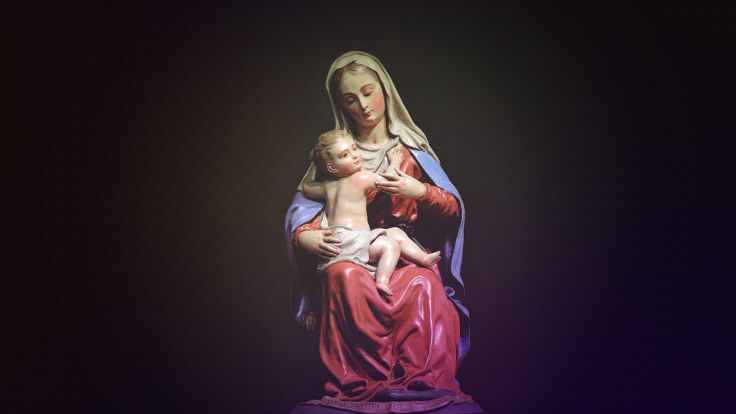
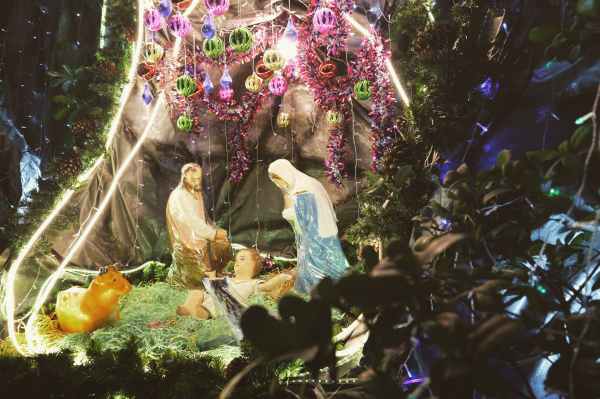
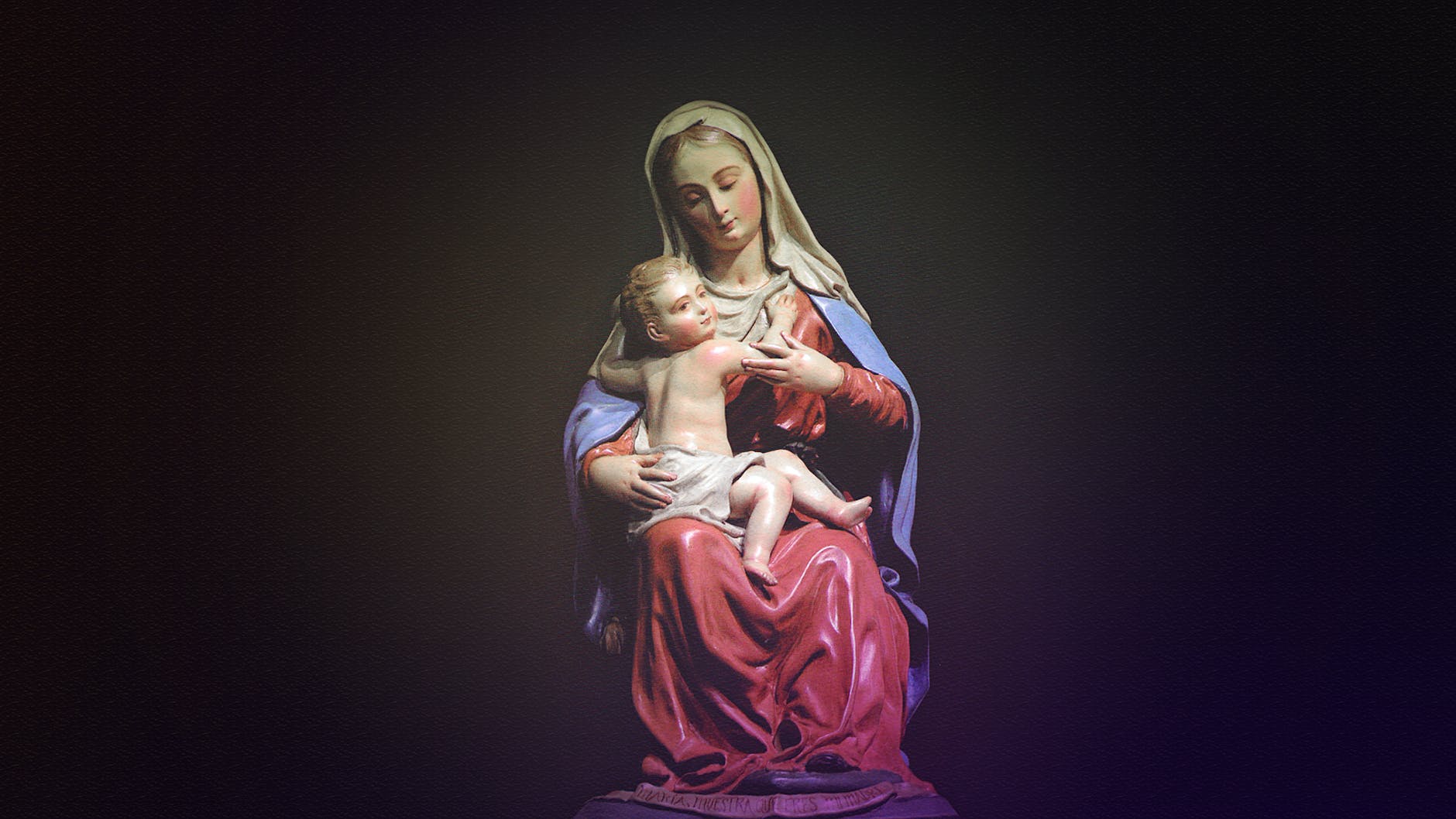
What Child is this who, laid to rest On Mary’s lap is sleeping? Whom angels greet with anthems sweet, While shepherds watch are keeping? This, this is Christ the King, Whom shepherds guard and angels sing; Haste, haste, to bring Him laud, The Babe, the Son of Mary. Why lies He in such mean estate, Where ox and ass are feeding? Good Christians, fear, for sinners here The silent Word is pleading. Nails, spear shall pierce Him through, The cross be borne for me, for you; Hail, hail the Word made flesh, The Babe, the Son of Mary. So bring Him incense, gold, and myrrh, Come peasant, king to own Him; The King of kings salvation brings, Let loving hearts enthrone Him. Raise, raise a song on high, The virgin sings her lullaby; Joy, joy for Christ is born, The Babe, the Son of Mary.
Words by William C. Dix
No other name in all history elicits such differing and intense responses. Jesus, the son of Mary Jesus, the Son of God Jesus, the Son of Man Jesus, the Son of David Jesus, the Christ Jesus, the Messiah
Who is this child– ruler of the universe, Laid in a feeding stall, In a simple stable, In a small town, In a captive land? Son of a carpenter (illegitimate, by some accounts), In the royal line of David (but so far removed as to be of no account).
Yet angel hosts sing “Gloria!” Kings and philosophers travel from distant lands for just a glimpse, Bringing priceless treasures and humbled hearts, While the beleaguered puppet king of a conquered people Prepares to destroy him.
Will he rise to take his place in Herod’s palace? Will he lead a revolt to free his people from Rome? Will he bring together rival factions among the priesthood? Will he … Die in agony, betrayed and scorned?
This, this is Christ the King; The Lamb of God. Savior and Sacrifice. “The Silent Word”, Pleading, Healing, Bleeding, Ascending. Even in his humble life and Ignominious death He rose to change the world– Stopping time and dividing it into All that came before and All that has happened since.
This is Christ the King Bruised for our sins, Betrayed by our selfishness Cheapened by our compromise and corruption.
Bring him incense, gold, and myrrh; He is more than our tinsel, jingle bells, and platinum charge cards. He is the King– He is the babe– the son of Mary. He is the King who will return in all of His Glory! He is the Christ!
I’ve been exploring the Apostle Paul’s first letter to the Corinthians; specifically chapter 13, verse 13. Paul states that there are three virtues that remain, after all else has passed away or been lost: Faith, Hope, and Love. And, while the other two are great and necessary, the greatest is Love.
So much has been written about Love– poets and prophets, songwriters and storytellers. most would agree that Love is the greatest virtue. But they wouldn’t all agree on what “Love” is. The Greeks have three different words for love– in fact most languages have more than one word– English has dozens of synonyms: Love, adore, desire, passion, enamored, infatuated, devoted…you get the idea. Except there are several ideas, so how do we know which kind of love remains? What kind of love endures beyond life and time and against every obstacle?
Human love is fallible; it is temporal (and sometimes even temporary). It doesn’t last forever– in spite of poetic promises and sacred vows. People “fall in love” and they fall out of love. Human love grows deeper; but it can also grow cold. It can be conditional, and manipulative; selfish, and shallow. Human love is often based on feelings that change with the seasons. We “love the whole world” when we are feeling good–we love mankind, but can’t stand our next door neighbor!
God’s love is eternal and unconditional. It never depends on His “mood.” It never depends on who we are or what we have done. God loves because it is His nature. He IS Love. He is the definition of enduring, everlasting, boundless, endless LOVE. This is the Love that endures. It is the Love that changes us from the inside out, and changes the world around us. It is this Love that infuses our Faith, that inspires our Hope, and allows us to approach a Holy God and share His Mercy and Grace with those we might otherwise deem “unlovable.”
We are living through chaotic times, filled with raw and dangerous emotions– anger, hatred, pride, despair, resentment, greed, grief, and fear. God’s love is more than just another emotion. I cannot love my enemy with human emotion– nor does God ask me to. God loves through us– it is His Love that we need to access and carry with us into the darkness. I want to bring Love into the world– and I want to be seen as a Loving person. But God asks me to Love even when it is rejected; even when I am seen as the enemy; even when I get hurt in the process. That doesn’t mean that I invite or tolerate abuse because I think it makes me more virtuous or because I think I somehow deserve it. But it does mean that I continue to pray, I continue to have Faith and Hope that God will turn even the smallest acts of Love into seeds that will return a harvest in His time and in His way.
When I look at the life of Jesus Christ, that is just what He did. He had the power to destroy the corrupt Temple system– He demonstrated just a particle of His passion when He drove the money changers out of the Temple courtyard (Matthew 21:12-13). He could have led a rebellion against the oppressive Roman Empire. (In fact, that is one reason He was rejected as the Messiah. He chose not to use His power for political or economic gain– even for the benefit of His own people.) He had the power to wipe out leprosy, or blindness, or demon possession– He could have been the most powerful man on Earth, and single-handedly put an end to poverty, injustice, and so much more. If solving those issues for His people in His lifetime would have been the most loving thing– He would have done it. But He spent His time listening to and helping individuals in need– those who had lost hope, those who needed healing, those who were carrying guilt and doubt and grief. He spent His time, not just talking about Love, but demonstrating Love– personal, unconditional, life-giving Love. Jesus spoke to crowds, yes, but most of His time was spent in small groups or one-on-one– teaching, eating, listening, caring–Loving.
Loving this way takes time– it takes effort, and it comes with risk. Jesus, loving in just this way, was misunderstood, rejected, hated, even killed. But His Love conquered death, and brought life and victory. I may not be asked to become a martyr– but will I seek to Love like Jesus? Will I pray for people I don’t know; or people who have opposed me, or rejected me? Will I continue to love those who have hurt me in the past, or rejected my help? Will I reach out in Love to people who are in rebellion against God? People who mock Him, cry out against Christians, persecute us–even kill us? Will I pray for and support those who are in danger because they are showing God’s Love in this way? Because whether I do or not– Love Remains. Will I be Faithful? Will I reach out in Hope? Will I risk Loving as Christ Loves?
We live with the same brokenness that Jesus faced during His ministry. People around us are hurting– we are hurting! But our Faith tells us that God hears our prayers. Our Hope tells us that God has a plan for the future. And our Love compels us to share the burdens of others as we wait for Christ’s return.
Jesus WILL someday “fix” the brokenness of this world. He WILL Reign and Rule for Eternity. But He asks us to live with the three virtues that ensure that we will overcome the darkness of our own world– that will cause us to shine a light in the darkness–Faith, Hope, and Love!
One of my favorite Christmas movies has always been “It’s a Wonderful Life.” The movie tells the story of a man who finds himself desperate, sad, frustrated, angry, and suicidal on Christmas Eve –sounds like a real winner, huh? But before he gets to that point, Heaven is preparing an angel to come to his rescue. Through the eyes of the angel, the viewer “gets to know” George Bailey– his family, his friends, his struggles and his joys–and gets to see his life in perspective. The angel, Clarence, decides to give George an unusual gift– the chance to see what the world would be like, not just if he were to commit suicide, but what it would be like if he, George Bailey, had never existed. George is astounded and horrified to see the effects of his absence, and he learns to value his life, his family, and his friends as never before.
The dramatic effect of one person’s life cannot be overstated, but this is especially true of the life of Christ! Can we dare to imagine what life would be like today if Jesus had never been born?
Of course, the most obvious and tragic consequence is that there would be no Salvation by Grace. For a more complete discussion on this, there are several other essays and even books, including “What if Jesus Had Never Been Born” by D. James Kennedy and Jerry Newcombe. (Full disclosure: I have not read this book– I just found out about it as I was writing this, but I trust it is a good resource.) And all speculation on this subject is just that– the Bible is clear that it was always God’s plan for Jesus to come, to live, to die, and to defeat death, just as He did, just when He did. Any alternative vision is not from God, but from our own imaginations. But what other “ripples” do we take for granted in our world, that would not have happened (or would have happened very differently) if Jesus had never been born, or had not completed the work of His life, death, and resurrection?
There would be no Christmas. Not just the Christian celebration of Christmas, but much of what we call “secular” Christmas. While some cultures might have a local festival for winter solstice, there would be no worldwide celebration such as we know.
There would be no “Santa Claus,” no “St. Nick,” no “Father Christmas,” no “Papa Noel”, etc. The model for our modern Santa Claus, St. Nicholas, wouldn’t have been a Christian Bishop in Asia Minor, because there would have been no Christians there, or anywhere else.
No Christmas Cartoons– no story about Rudoph the Red-Nosed Reindeer; no singing elves and jolly Mrs. Santa Claus; no Heat Miser and Snow Miser (if you know some of the other Rankin-Bass productions..) Hours of childhood memories erased.
No other Christmas stories and movies– no Scrooge and Marley; no MIracle on 34th Street; no “Yes, Virginia, There is a Santa Claus”; no “Santa Clause” (and its successors) no “Christmas Story” or “Christmas Vacation”; not even Hans Gruber falling from the Nakatomi Tower. Millions of DVDs, books, VHS tapes, local theater productions– never existed.
We can kiss Frosty the Snowman goodbye, as well. Without the magical snowfall of Christmas, the story never takes shape– literally.
No Christmas Carols or Christmas music. I know of at least three local radio stations that are playing Christmas music exclusively right now. They started the day after Thanksgiving, and they will continue through the end of the month. Thousands of Christmas songs– from favorites like “O, Come All Ye Faithful,” and “O, Holy Night,” to annual disasters, like “Last Christmas,” and “Santa, Baby”– all wiped out.
No Christmas cards. Millions of cards are sent out each year, connecting family and friends around the world. Except there wouldn’t be any if Christ had never been born.
No Christmas Lights.
No Christmas shopping. (And while that may seem like a good thing for my personal budget, have you ever looked at what the Christmas season means for most Western economies?) No Christmas wrapping; no Christmas ornaments; no Christmas sweaters or socks; no Christmas candy or cookies…
No Salvation Army bell ringers at the stores– no Salvation Army; no reason to ring bells…
No Christian charities– not just the Salvation Army, but every other charity that was founded on Christian principles, or for Christian outreach…no downtown rescue missions, no soup kitchens, no international Christian efforts to rescue hurting children or provide relief for families. I by no means want to suggest that ONLY Christians are charitable, or that NO charities would exist without Christ. Charities are a mainstay of most religions, and always have been. The distinction I would make is that more Christian charities have been developed and have thrived in the last 2,000 years, than charities started by other religious and secular organizations, and there is evidence that they do more efficient and more broad-based work than their counterparts. https://www.christianpost.com/news/christian-charities-more-reliable-than-others-according-to-forbes.html
No Christian colleges or universities– Are you a fan of Notre Dame Football? Sorry. Notre Dame doesn’t exist. Neither do Harvard, Yale, Princeton, Cambridge, Oxford, Saint Andrews, Georgetown, and several other colleges and universities throughout Europe, North America, and elsewhere. Even universities that are completely secular today were once founded on the idea that education was a Christian virtue. This doesn’t mean that there would be no places of higher learning– there would just be far fewer than we know today.
No “Christian” books– and this includes books that introduce Christian concepts, allegories, and allusions. No “Pilgrim’s Progress,” no “Jane Eyre.” no “Lord of the Rings…”
No Churches– no cathedrals, no picturesque country chapels, no strip mall fellowships, no megachurches…
None of the Christian Memes; Promises; favorite verses… no Beatitudes; no Fruit of the Spirit; no “Golden Rule,” no Romans 8:28 or John 3:16 or Philippians 4:13…
No Twenty-First Century! Our calendar is literally based in part on the assumed birth of Christ. And while there are other calendars– Chinese, Aztec, Hebrew, etc., that are numbered differently, most of the world uses the Roman/Julian/Gregorian Calendar, which splits time into B. C. or B.C.E. — literally “Before Christ” or “Before the Christian Era”, and A.D. (Anno Domini– year of our Lord!) or C.E. “Christian Era.”
It paints a pretty bleak picture. Our world, as we know it, would be vastly different if Christ had never been born. That is not to say that the innovations, inventions, or achievements of the past centuries might NOT have happened at all– but they would have happened without the same purpose and effect. Many of the events of the past two millennia were inspired by, undertaken by, and driven by the message of the Christ– His birth, death, resurrection, and promised return! We hear about some of the negative things of the Church– wars and excesses, scandals and failures. But what about the successes– the transformation of violent cultures and conflicts into peaceful resolution, the drive to end slavery, cure illnesses, eradicate hunger–so many of the blessings we enjoy here on earth are the result of work done by those who long to love their neighbors as themselves and to see God’s will done “on earth as it is in Heaven!” The Joy and Generosity of the Christmas season cannot be separated from its central cause. The Wonder, the sense of the Miraculous and Holy, the sense that there is something “More” beyond a crisp winter morning or a day off work or a genial meal with friends–it all MEANS something. It doesn’t just come from nowhere, or a human desire to be kinder this one day each year. The character of George Bailey exemplifies an ordinary life that has meaning and purpose. His sense of purpose has gotten lost in the crush of bills, obligations, disappointments, and injustices. His prayer is one of quiet desperation; he is completely unaware that it is part of a vast chorus of prayers. But God hears it– and God sends Clarence!
There is a reason that George is visited by an Angel on Christmas Eve. Clarence may not be suave and sophisticated; he may not have intellectual arguments that can help George comprehend all of life’s wonder and purpose. But just like the angels at the first Christmas, Clarence comes from Heaven. He is God’s chosen messenger. He brings Heaven’s perspective and truth into a dark world, showing George what IS and HAS BEEN and what CAN BE– all because George was born– because CHRIST was born! It IS a WONDERFUL Life– not because of our circumstances, but because God’s Greatest Gift redefines our circumstances and transforms our perspective!
4-7 But when the time arrived that was set by God the Father, God sent his Son, born among us of a woman, born under the conditions of the law so that he might redeem those of us who have been kidnapped by the law. Thus we have been set free to experience our rightful heritage. You can tell for sure that you are now fully adopted as his own children because God sent the Spirit of his Son into our lives crying out, “Papa! Father!” Doesn’t that privilege of intimate conversation with God make it plain that you are not a slave, but a child? And if you are a child, you’re also an heir, with complete access to the inheritance.
Galatians 4:4-7 (The Message)
George emerges from his nightmare experience to find he is, in fact, “the richest man in town.” Oh, that we would wake up this Christmas morning fully aware of the rich heritage that is ours– because WE were born. Because HE was born! Because we can be BORN AGAIN!
What Would Jesus Do? This question, shortened to the acronym WWJD, appeared as a fad on bracelets, t-shirts, billboards, etc., a few years ago. The idea was to ask oneself how Jesus Christ would act or react in various situations.
While I don’t disagree with the premise, I have never been a fan of this trend– mostly because it calls for people to speculate or imagine what Jesus would or might have done in their place. There is nothing wrong with wanting to act like Jesus– that’s what we’re supposed to do–to be disciples of Christ, and be His ambassadors. But our minds and hearts are not perfect; in fact they can be deceitful and arrogant, self-righteous and self-justifying. It is more common for us to justify how Jesus would act like us, than for us to adjust our thoughts and actions to those we know Jesus took during His time on earth. Would Jesus be angry about injustice– of course! Would He want us to have empathy for others– undoubtedly! But what would He actually DO? There are some pretty clear examples in the Bible– both examples of what Jesus DID, and what He DID NOT do:
Jesus drank wine; He visited and ate with known sinners; healed on the Sabbath (in direct violation of the church leaders of His day); interacted with the Romans (soldiers and leaders, etc.)who were oppressing the Jews– without protesting their rule or joining rebel groups; healed and performed miracles for some, but not for others; forgave sins for some, but not for others; paid His taxes without complaint; challenged religious leaders and spoke harshly against their practices; refused to get drawn into condemning and stoning a guilty adultress….
Jesus prayed. He want to temple regularly; read and studied God’s word; He rested, meditated, and spent time alone; He listened to strangers and treated those He met with compassion and respect; He honored His mother, but did not put her above His work; He loved his friends, even those who did not understand Him and the one who betrayed Him; He did not flatter those in power or disdain those in lowly positions; He cared deeply, wept unashamedly, and laughed heartily…
Jesus did not own a home. He didn’t have a “regular” job; He had no savings account or retirement fund; He had no donkey or horse for transportation; He wasn’t a member of a particular congregation or church council, like the Pharisees. Jesus didn’t have a university education; He didn’t run for public office; He never got “employee of the month;” He never married or had kids; We have no evidence that He ever gave to a particular charity, or joined any activist group. Jesus never hosted a barbecue, or led an evangelistic gathering, like His cousin, John the Baptist…
Jesus never addressed many of the issues we deal with today– civil rights, gay rights, abortion, health care, income inequality, democracy/socialism, smoking, drug use, pornography, violence in the media, global climate change, speed limits on highways, income tax structure, campaign finance reform, gender dysphoria, unisex bathrooms, vegans vs. meat eaters…
But the point of Jesus’ ministry on earth was to preach the coming of the “Kingdom of God,” and to fulfill His promise to go to the cross, die for our sins, and to rise again on the third day. He spent time teaching and discipling twelve very different individuals, who saw and did things very differently from each other, and differently from Jesus himself. Peter was fiery, John was a quiet observer, James was stern and concerned about actions, Matthew was concerned with history and prophecy. And all of them were loved by and commissioned by Jesus to spread the Gospel.
In these days of COVID-19, faced with fear and panic, many Christians (myself included) are struggling with the “right” response–we all want to show the love of God, and honor Him above all. In doing so, however, I find myself spending a lot of time justifying my own actions, and condemning the words and actions of others. And I find myself getting hurt and angry when someone I know and love reacts differently, uses different words or tones, or gets caught up in arguments about what “we must do.”
We MUST seek God’s wisdom in these times. And we MUST listen to and obey His word. But beyond that, I believe that God wants us to be very different “parts of the body” (see 1 Corinthians 12) https://www.biblegateway.com/passage/?search=1+Corinthians+12&version=ESV And I believe that God wants us to work together, honoring the various gifts and personalities that we have been given. Some of us are going to be fiery in our defense of health care workers, and advocating for the best and fastest medical care and treatments available. Some of us are going to be spreading small words and acts of encouragement wherever we see the opportunity. Some of us are going to be standing up against threats of corruption and injustice lurking among the actions of those in power. Some of us are going to speak boldly about our Hope in Christ, evangelizing and calling people to repentance. Some are going to be “standing in the gap” in prayer and counseling. Some are going to be providing money, food, PPE (personal protective equipment), and other services. And we must honor the other members of the body– in whatever role they take on– and seek unity, rather than division.
Instead of blasting each other on Facebook or angry e-mails, we need to bring our initial reactions– anger, disappointment, hurt, confusion– to God. HE is the one who will judge our actions and motives in the end. Unless we see Christians who are flagrantly violating God’s laws– looting, cheating, spreading malicious lies and causing division, cursing God and/or misrepresenting Him in heretical fashion–we should ask, not just what Jesus would/might do in my situation, but what DID Jesus do in my place.
Because He died for me when I was still a sinner. He sacrificed His life. Not because I had done anything “right,” or “good enough.” He didn’t keep a list of all the things I got “wrong.” He did not bring condemnation– He brought forgiveness, mercy, and hope! And His mercies are new every morning. If I “get it wrong,” if I do something, or don’t do something–because I am still human and I don’t know everything about COVID-19 or the global economy or what tomorrow will bring–God will still love me. God will forgive me.
My prayer is that I will do the same for others– that I will extend Grace, and true encouragement (rather than flattery or mutual congratulation), and Love, because I know without a shadow of doubt or speculation, that this is What Jesus Would Do.


















 Pursuing Prayer