
In reply Jesus said to the disciples, “If you only have faith in God—this is the absolute truth—you can say to this Mount of Olives, ‘Rise up and fall into the Mediterranean,’ and your command will be obeyed. All that’s required is that you really believe and have no doubt! (Mark 11:22-23– The Living Bible)

Have you ever said to a mountain– “Rise up and fall into the Mediterranean?” I doubt any of us have done so. But is that what Jesus really meant when He gave this instruction to His disciples? What was He really trying to say?
The Bible is crammed full of literary devices– metaphors, parables, hyperbole, personification–and yet people get criticized for reading it too “literally” or too “literarily.” In this passage, Jesus uses hyperbole to show that we can boldly pray about ANYTHING– there is nothing too big or too impossible for God to accomplish. But Jesus is not suggesting that we foolishly ask God for ridiculous things just to demonstrate His power. In fact, Satan tempted Jesus in this very way in the desert (see Matthew 4:1-11 and Luke 4:1-13). He asked Jesus to throw Himself off the highest point of the Temple, to prove that angels would come to His rescue and He wouldn’t be hurt. But Jesus rebuked him, saying, “it is also written, ‘Do not put the LORD your God to the test.'” So, it seems that Jesus is not “literally” asking His disciples to move physical mountains just to prove it can be done.
To put this scene in context, Jesus had passed by the same road just a day before, and looking for a snack, He had passed a fig tree, but the tree had no fruit. Jesus casually made a pronouncement– “You shall never bear fruit again!” When He and the disciples pass that way again just a day later, the tree has withered, and the disciples are astonished. But the lesson here is not about trees and mountains– it is about Faith and about the power of our Words.
We may never have cause to move an actual mountain, but there are many metaphorical “mountains” that we must climb or go around in life. And many people will sneer at Jesus’s assurance that if we have faith, such mountains can be told to “Rise up and fall into the Mediterranean.” That cancer diagnosis; the horrible boss at work; those medical bills that seem impossible to pay off; the pain of abandonment when your spouse demands a divorce– we can pray fervently, tearfully, desperately, only to see the mountain seem just as immovable as ever.
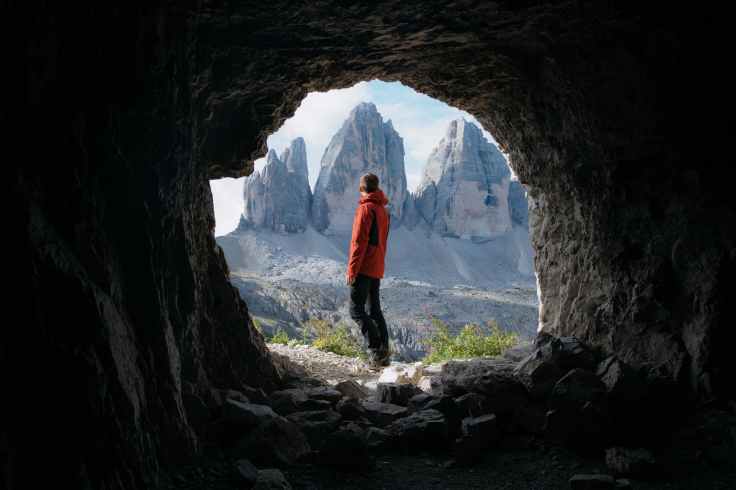
So, what DOES Jesus really mean? Is He lying about the power of faith? Is He setting us up to pray for disappointment? What can we learn from the mountain analogy? What can we learn from the fig tree?
I don’t have a complete or definitive answer. But I can share a couple of insights. As I said above, I don’t believe the lesson here is about the tree or the mountain. It’s about Faith, the power of words, and ultimately, about perspective.
Let’s start with the tree. Jesus is hungry. He goes to a tree, where he hopes to find a fig. But the tree offers nothing. Jesus could walk away, grumbling about the tree. “Stupid tree! I wanted a fig, but NOOOO!” What a childish outburst that would have been. And I have been guilty of this very kind of silly complaining and grumbling over a car that doesn’t start, or a weed that pops up in my garden, or a co-worker who said something that hurt my feelings. Notice what Jesus DID– He addressed the tree. He did not complain to the gardener or punch the tree trunk or rant in the street or spend the rest of the day nursing His disappointment. By the next day He had completely forgotten the incident– it was His disciples who were still interested in the tree. Jesus had moved on.
How often do I wallow in hurt, frustration, or guilt? How often do I replay conversations in my head, or waste time trying to assign blame for my circumstances? How often do I go behind someone’s back to complain, instead of asking for clarification or confronting a misunderstanding? How long do I chase down an apology or an explanation from someone else for my own hurt feelings and bruised ego? Jesus asks us to be proactive–to speak up in prayer, in conversation, and yes, sometimes even in confrontation.
A final thought about the withered fig tree. The same Jesus who used His words to heal lepers and forgive sins, used His words to wither the fig tree that had not served Him. He did not scorch the fig tree or take and ax to it and chop it down, but in judgment, He caused the tree to wither. Jesus had the power to judge the Pharisees, the demons who tormented people, the tax collectors with whom He dined, and the prostitutes He forgave. With a single breath, He could have destroyed the Roman oppressors, wiped out the corrupt priests, and cleaned up the masses of beggars and thieves of Jerusalem. But instead, He told stories. He fed the hungry. He gave sight to the blind. And He warned the hypocrites of the judgment to come if they did not repent. Words are so very powerful. What we say, (and what we listen to) we will come to believe. The Bible tells us that “Nothing is impossible with God.” (Luke 1:37; Matthew 19:26)
The disciples were focused on the fig tree when Jesus dropped a bombshell pronouncement. “Say to this mountain…” But it wasn’t about the mountain. It was about the “impossible” power of God. It was about looking beyond the mountain and addressing the real obstacle– lack of faith and perspective.
The Apostle Paul spoke of a “thorn in the flesh” (see 2 Corinthians 12:7-10). Three times he prayed that God would remove it, and God said, “No.” But God also gave Paul a different perspective– it wasn’t about the “thorn,” it was about pride. Paul’s continuing struggle with his “thorn” meant that he had to rely on God’s power to overcome his physical weakness. Paul’s “mountain” of pain could have stopped him from doing God’s work. But God moved the real “mountain”– Paul’s reliance on his own passion and drive– and threw it into the sea, so that Paul could move on in his real purpose.
In a very small way, I had a “mountain moving” lesson years ago at work. I clashed with my “new” boss. I found her verbally harsh toward my fellow co-workers, and I disagreed with her vision for the future of our workplace. I campaigned and complained, and I prayed that God would expose her corruption and remove her from our workplace. But it wasn’t about the “mountain” I saw in my boss. God moved me (and later her) out of that job and into new opportunities. And He showed me how my own attitude had contributed to the problem and not the solution. I had to track her down and apologize for MY actions and forgive her. And suddenly, the “mountain” I had made of the situation was gone! But I had to come to the point of believing that God would remove the actual “mountain” and not the one I had created.

In larger ways, I have seen cancer patients who have thrived in spite of their condition; I have seen others pronounced cancer-free. I have seen lost family members restored to Faith and relationships healed. I have seen God’s provision and protection in seemingly impossible situations. God CAN move mountains! And God WILL make a way, where there seems to be no way! But I have to ask, and believe, instead of complaining and isolating, or hiding in the shadow of my own “mountains.”
Will I believe that today, even when I can’t see how He will do it? Will I ASK Him to move my mountains– both large and small? Will I ask God to show me all that is possible through His power? In His way and in His time? Will I ask Him, not just for what I think I want or need, but for ANYTHING that HE wants for me? Because when I do, when I turn my focus from the mountain to the Mover of Mountains– Amazing things WILL happen!

