I have a very bad habit (one among many). I tend to be competitive, and a bit of a perfectionist when I work at something. I’m never satisfied with “good enough” when I think I can do a little better. This includes shopping for bargains. I will go to great lengths to stretch a dollar; to save a few cents–outlet and discount stores, sale shelves, bargain basements–I’ve haunted them all.
But prayer shouldn’t be a “bargain basement” encounter. God is not in the business of selling. He’s in the business of redeeming. God is lavish in his Grace, and sufficient– even abundant– in his blessings.
It’s not that I should sit back and expect God to lavish me with abundant resources and comforts. But why do I hunt for the “bargains” in my prayer life? Why do I ask God for the bare minimum when I pray– “Lord, just help me get through this next hour.” “Father, help me pass this test.” “God, I need 10 dollars to get through the week.”
I’m eager to hunt for resources that I “find” at a bargain. Why am I not eager to see how God provides for my needs every day? Why is it more satisfying to work hard for what I need, than to see God come to my rescue when my efforts are not enough?
It’s not that I am asking for bad things or wrong things, or that I should be asking for so much more. But what does my attitude say about God? I say that God is Love, I say that he is Good. I say that he can do anything, and that he is gracious and merciful. But my prayer life says otherwise.
It’s time that I ask God for “my daily bread”, without expecting day-old leftovers. And, when he chooses to give me Manna, it’s time for me to see that provision for the miracle and the blessing that it is.
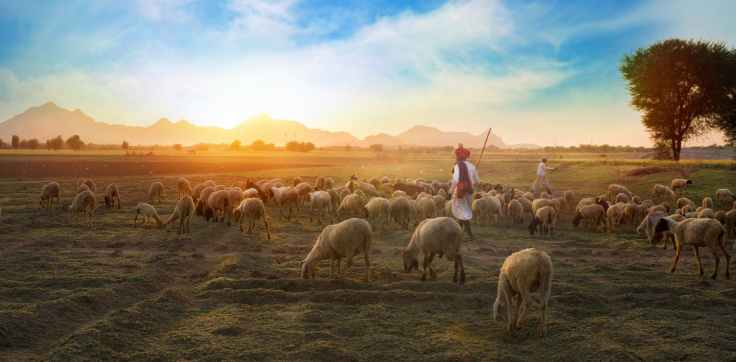
How often do I recite this favorite Psalm without really thinking about it? In the words of this Psalm, I am loved, cherished, sustained, and led by Him. But am I in reality? Do I submit to His leadership and guidance? When I pray, am I really coming to meet with my Shepherd, or am I trying to meet with God on some other level or in some other relationship?
I’ve been reading through the first few books of the Bible. I’m in Numbers right now, and Moses is leading the Israelites through the wilderness. The spies have just returned from Canaan, and the people have rebelled against God, weeping and accusing God of leading them to the Promised Land only to have them die in battle with the giants of the land.
I read through this and shake my head, but haven’t I done similar things in my walk with God? I want to avoid the wilderness. I want to walk in the green pastures, but I don’t want to travel through the valley of the shadow of death to get there! I look at obstacles and setbacks as though God were sitting far away, arms akimbo, laughing at my struggles; in reality, He is right beside me all the way, waiting to help me overcome each obstacle and gain victory together with Him. I’m looking at the giants, when He wants me to trust Him for the milk and honey He has promised. I still have to face the giants, and the battles ahead– but I don’t have to face them alone. I don’t have to face them in my own strength, my own limited wisdom, or my limited vision.
But here’s what I am learning as I read through this section of the Bible right now:
God IS with me. He doesn’t leave me or give me anything HE can’t handle. But I have to walk through the wilderness. I have to fight battles. I have to face giants. I have to learn to trust for my daily bread– whether it is manna or money to buy bread–daily. I have to listen to His voice; not impose my plans and ask for Him to bless them.
God doesn’t want me wrapped up or caged: He will not take away my freedom to follow (or NOT follow) Him. And when I wander, He may allow me to wander in circles for a while (hopefully not forty years!), but He will still be right there, ready to lead me when He sees that I am ready to move forward.
He will supply all that I really need– water from the rock, bread from Heaven– not because I have the money or resources, I think I’ve earned, but because He IS my provider. He can part the Red Sea; He can destroy Pharaoh’s armies. He can make the earth swallow up those who threaten me and defy Him. I am safe, even in the wilderness, when I stay close to the Shepherd!
He will counsel and correct me. He will offer forgiveness again and again. He will not leave me lost or unable to return to His side. He will be a “Presence” in my life, wherever I go– day or night.
He sees me and He hears me– which is both comforting and fear-inducing. But it is a healthy fear; an awesome and reverent fear; one that keeps me humble. After all, I am a sheep, NOT the Shepherd! I can call out to Him, and He knows where I am (because He is right there, too), and He knows what I need. God saw the Israelites worshipping the Golden Calf even as He was speaking to Moses up on the mountain. God heard Moses as he pleaded for mercy, even in His anger and wrath.
He calls me by name. The Bible, especially the Old Testament, is full of individual names. Not just the ones we study in Sunday School; not just the ones in the children’s stories; but names of the leaders of the various tribes of Israel, and names of the spies, names of craftsmen God had selected to build the Ark and all the items needed for the Tabernacle, and names of those who rebelled. I am not lost in the crowd; I am not forgotten among the many. God knows me intimately– just as He knows you!
Even when my prayers seem like whining, bleating, plaintive “baa-ing”, I know my Shepherd hears. And He delights to hear from me. He delights in leading me through the wilderness and providing for my every need. And His promises sustain me when I don’t know what’s coming next, or I fear what I see on the horizon.
So I will pray today, and tomorrow, and every day, knowing that even my– especially my– “sheepish” prayers are not in vain.
I’ve been reading in the book of Numbers this week. Numbers is not the most exciting book of the Bible. Many of the chapters are about the census, or about further rules and regulations concerning sacrificial offerings, etc.. But the chapters from 11-15 detail a series of rebellions– grumblings against Moses and efforts to return to Egypt. These rebellions happen after over two years after God had led the people out of Egypt. For two years, they have been protected, fed, sustained, and instructed by God himself. His spirit has appeared as a pillar of cloud by day and a pillar of fire by night throughout their journey. They have had manna and quail to eat, water from the rock to drink, and they have seen the vast army of Egypt drowned in a matter of minutes, while they were led through the sea on dry land!
And now, they are so close to the “finish line.” They are on the very doorstep of the land of Canaan; the land God had promised to GIVE them. All that is left is for Moses to send out some scouts to bring back a report about the land– its cities and farmland, its people and its produce. Those two years must have seemed like a lifetime, but now it would be coming to an end. God would provide a homeland; a place to build houses, raise crops, rear their children, and settle into lives of peace and prosperity.
So what happened? The scouts brought back a factual report. The land had fortified cities, and lush farmland. It was already planted with plenty of fruit trees and vineyards. And there were ancient people groups with mighty warriors. Israel had just taken a census. They also had mighty warriors, and a lot of them! Moreover, they had God’s promise that the land would be GIVEN to them as their inheritance.
They were so close! Victory, rest, and prosperity were so close they should have been able to taste them. Instead, their warriors moaned and wailed like infants. The same people who had vowed to follow the Lord at Mount Sinai, now planned to walk away from His promised prize. They decided to turn around and go back to slavery in Egypt–the same Egypt that God had decimated two years earlier by sending plagues and destroying its army.
Two years of camping and living “on the road,” lost in two hours of grumbling and fear-mongering. And the punishment? Forty years of needless wandering–time to realize what had been thrown away in petty worrying and imagining the worst. Time to regret their reaction and their failure to trust God. Time for God to show them, once again, His ability to keep them safe and sound in the desert places.
And the learning curve would be a steep one. Almost immediately, a group decided that they would “prove” to God that they were ready to conquer Canaan– on their own. But it didn’t work. Then a group decided that Moses was to blame for their misfortune. But they were “swallowed up.” In the forty extra years of wandering, group after group would challenge Moses (and God) and be destroyed from within. Moses, who had already lived forty years in the wilderness tending sheep, would have to repeat the task, shepherding the entire nation of Israel for forty long and difficult years. And even he would fall victim to his own frustrations, calling water from another rock, but doing it “his” way. Even Moses would fall in the wilderness, never getting to enter the promised land.
How many times have you noticed that the closer we get to a goal, the more likely we are to fall short. We sabotage our own efforts, or we rebel against good instruction. Sometimes we just give up a few yards short of the finish. We are just over half-way through the month of February. What goals or resolutions did you make for this year? How many of them have you stuck with?
Here are three things I take away from the lessons of Numbers 11-15:
Look Beyond. Don’t take your eyes off the prize! The scouts’ report was not all bad. Yes, the cities were walled and the warriors were big and fierce. But the walls of Jericho were eventually brought down without a single battering ram, siege ramp, or arrow! Don’t ignore the trials ahead, but don’t let them blind you to the blessings beyond them!
Look ahead, not behind. Don’t waste time living in past comforts or running from past mistakes. God has something better than whatever we’re going through now. But God isn’t waiting on the other side. He is beside us, around us, WITH us right now. He is patient with us. It may take us two years (or forty-two!) to reach a goal, but if we learn to follow God, we will never be forsaken.
Look UP! God’s spirit didn’t appear on the ground around the Israelite camp. He appeared as a pillar. God called Moses UP on Mount Sinai. We need to stop looking back at our past, or around, comparing ourselves to others, and look at God’s promises. In relation to our goals and dreams, we need to LIFT them up in prayer! Daily!
We are so close! Let’s keep going in the right direction towards God’s promises.
In Exodus, chapter 16, the people of God are wandering in the wilderness of Sin (literally and figuratively!). They begin to grumble and complain about food, contrasting their current situation with their life in Egypt. Whenever I have read this passage in the past, I have assumed that the Israelites lacked food– that they were starving in the desert–and that their grumbling had some merit. After all, they are in a desert. Their complaints about water make sense. Surely, their complaints about food have the same ring of desperation.
But a few chapters earlier, and a few chapters later, we get a better picture of the true situation of these wandering bands of Israelites. As they left Egypt, they demanded from Pharaoh that they be allowed to take their flocks and herds! This would suggest that they had sheep, cows, and goats with them–meat and milk in some quantity. They may have had other animals as well– chickens, pet dogs or cats, oxen or horses. The need for water was greater– not only water for the people, but for their animals– but the complaint about meat seems to have had nothing to do with actual need. If anything, their complaint might have been about grazing land for their animals– but they never bring this complaint before the Lord. Either there was enough grass, even in the wilderness, or they had brought grain to feed their flocks. And there was grain for bread–just a few short chapters later, God gives directions for the sacrifices– sacrifices that are to involve rams, bulls, and three different types of bread, cakes, and wafers made with wheat flour!
The Israelites have provisions. They have taken enough food for the journey up to that point, and more. They complain, not that they ARE starving, but that they believe they will starve. God answers their complaint by sending quail– enough that they got sick of it– and bread from heaven (manna). The manna continues to fall without fail every day (except the sabbaths) for 40 years, throughout all their moving; in every location and season, on rocky mountainsides and dusty plains.
God’s amazing and miraculous provision should have produced thanksgiving and worship. Instead, the people got sick of the quail, and continued with their complaining and grumbling for an entire generation as they wandered around the wilderness.
How many times do we complain about “needs” that are not needs at all? I find myself worrying about bills getting paid, or the car making “odd” noises, or an aching shoulder. I find myself thinking back to days when I had more money or free time, and far fewer aches and pains. It is tempting to ask God for a return of “the good old days.” But God’s plan for the Israelites didn’t involve pots of meat that came with chains attached. God’s plan for my life doesn’t involve my immediate comfort, but my eternal character. And even in times when I feel like I’m wandering in the wilderness, God never leaves me. I have been poor, but I have not starved. I have been sick, but not left to die alone. I have been lost, but never abandoned.
There is wealth in the wilderness–the riches of God are available to those who will trust Him. Like manna, God will provide what only He can, and enough to see us through each day. He doesn’t promise that we will have “pots of meat” or easy circumstances. Instead, if we open our eyes, we will see miracles of grace, showing us how much God loves us and cares for us.
God’s people complained a lot, but rarely did they celebrate God’s provision or offer thanks. May we learn from their story, and praise the God who sends quail and manna to the very ones who doubt His mercy and love!
As I type this, I am eating leftovers. I made a big pot of beef stew the other night, and we’re making another meal out of what was left. Some things, like beef stew, often taste just as good (or even better) warmed up again. And it’s very convenient not to have to make a new meal from scratch. We like leftovers, and I am very thankful that we are able to have an abundance of good food. But today’s leftovers started me thinking…
Did you know the Bible has something to say about leftovers? I’ve been reading in Exodus and Leviticus lately, and as God was giving instructions for the Passover Seder, the gathering of Manna in the desert, and the priestly sacrifices, He spoke about leftovers. During the Passover, all the meat was to be eaten on the night of the Passover Seder. Any meat left over was to be thrown away. Several families could share a Passover meal, in order to avoid waste, but the meat was to be eaten in one meal. Similarly, Manna was to be gathered and eaten for a single day (except over the Sabbath). No leftovers! The priests were allowed to eat leftover meat for a single day after the sacrifice, but no more than that.
So often, the “rules” of the Old Testament seem strange to us– arbitrary and even harsh. But in context, they paint a picture of God that we would do well to study. So what do the rules about “leftovers” teach us about God and our relationship to Him?
First, God knows what we need. We may often plan too much or too little, or use more or fewer of our resources, but God knows exactly what is necessary. And if we are listening to and trusting God, we can be sure that His plans and resources are sufficient!
Secondly, God PROVIDES what we need. Our tendency to store extra food and other resources “just in case” may be motivated by a sincere desire to help our neighbors in times of trouble– there’s nothing wrong with that– but often we are motivated by fear or pride, instead. We fear not having enough, instead of trusting God to provide. Or we pride ourselves on our ability to provide, rather than acknowledging that our resources and abilities all come from God.
God’s ways are NOT our ways. God sent the entire nation of Israel into the wilderness. They had all their animals with them– but no place to plant, grow, or harvest wheat or other grain. God could have ordered them to slaughter their animals for meat, or sent them with huge stores of harvested grain, or led them through areas with gardens and orchards. But instead, He sent Manna and quail for them to eat. He provided in ways that they could NOT.
God’s mercies (and provisions) are “new every morning.” (Lamentations 3:22-23) God doesn’t give us the “leftovers” of His abundance. He lavishes us with Love and Grace. Every day!
God isn’t impressed with my “leftovers.” My leftover offering; my leftover time spent in prayer or Bible Study; my leftover interactions with others, my leftover discipline.
And that brings me around to prayer and giving. Do I give God my “leftover” praise and thanks? My “leftover” confession (after I’ve pouted and argued and justified by actions to myself)? Do I lift up “leftover” requests–those things I think I’m “supposed to” pray about, but not those I judge unworthy of MY time or attention? After all, would I want God’s “leftover,” absent-minded help? Would I want His half-hearted blessing? Do I give “leftovers” to my family, friends, and neighbors? Or mere scraps to those in need?
The other day, I was on Facebook, and one of my friends requested prayer. It was something I felt was a trifling situation, and I scrolled past her post. But then I realized that I was scrolling past an opportunity to join God in what He would do for my friend. It might not have felt like a big deal for me, and certainly it wasn’t beyond God’s ability to work in that situation. Why did I hesitate? Did I feel I had the right to judge either my friend’s motives or her situation? Did I think I could lift up a “leftover” prayer– “God, help _________. Amen.” I stopped, scrolled back and took a moment to lovingly lift her up, and pray that God would intervene in her situation and forgive me for presuming to judge.
Leftovers are not “bad” or “wrong” in and of themselves. They are blessings. But we should not live on “leftovers”– especially when it comes to our relationships with God and others! Like God, let our mercies be “new every morning,” and let us share gladly from the abundance God has given, not grudgingly or half-heartedly.
I’ve already posted recently about Ash Wednesday (see the post from Feb. 15), so it may seem strange on a day of fasting and ashes to be writing about food. And manna doesn’t seem to have much of a connection to prayer– bear with me…
Manna was, quite literally, “daily bread.” God sent manna each day for the children of Israel as they wandered and camped in the wilderness on their journey to the Promised Land. It appeared overnight, much like dew, and evaporated in the heat of the day. Yet the small “grains” could be gathered and made into nourishment for the thousands of Israelites who had no other source of bread. Manna and the bread made from it were only good for a day (except on Friday, when twice as much would fall so no work needed to be done on the Sabbath). God provides for our needs daily– we don’t have to worry and fret. Jesus returned to this theme often, including the Sermon on the Mount and The Lord’s Prayer.
Manna was uniquely suited for the Israelites in their situation. Manna did not require time to grow, harvest, or prepare. It did not require storage space, as it was collected and used up daily. It did not require yeast, salt, or sugar to be added to it–God designed it to be simple, sufficient, sustaining, and even sweet!
Manna was provided even after the Israelites complained and accused Moses (and God!) of leading them into the wilderness to die. God will not withhold punishment (see what happened in Numbers 11 when the Israelites complained about the manna!), but He will provide for our needs out of His love for us, not as a condition of our righteous behavior. All the people had access to manna, even those who complained or were defiant. If someone went hungry, it was not because God refused to provide– but because they chose not to avail themselves of His gift, or because they refused to accept the nature of the gift.
Manna was consistent. God didn’t send manna one week and raisins the next; God is faithful and unchanging–the manna wasn’t just a nutritional provision, it was a reflection of God’s nature! God gives good gifts; it is our selfish nature that often takes His goodness for granted, and asks for what we do not need.
Once the Israelites reached the Promised Land, the manna stopped. God’s gifts meet our needs– in His way, and in His time. God does not give gifts blindly or absent-mindedly. God knew exactly how much manna to send each day, and exactly when the manna would no longer be needed. He was watching closely the whole time– every step of the journey.
So today, whether or not you are fasting, you can rejoice in the knowledge that God has seen every step of YOUR journey. He will provide for our every need, including the need for forgiveness, courage, physical nourishment, and spiritual growth. All we need to do is look for it, gather it, and use it!




















 Pursuing Prayer