
(Today, I am revising a post from a couple of years ago.)
Matthew 5:1-12 (NIV via biblegateway.com):
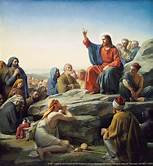
5 Now when Jesus saw the crowds, he went up on a mountainside and sat down. His disciples came to him, 2 and he began to teach them.
The Beatitudes
He said:
3 “Blessed are the poor in spirit,
for theirs is the kingdom of heaven.
4 Blessed are those who mourn,
for they will be comforted.
5 Blessed are the meek,
for they will inherit the earth.
6 Blessed are those who hunger and thirst for righteousness,
for they will be filled.
7 Blessed are the merciful,
for they will be shown mercy.
8 Blessed are the pure in heart,
for they will see God.
9 Blessed are the peacemakers,
for they will be called children of God.
10 Blessed are those who are persecuted because of righteousness,
for theirs is the kingdom of heaven.
11 “Blessed are you when people insult you, persecute you and falsely say all kinds of evil against you because of me. 12 Rejoice and be glad, because great is your reward in heaven, for in the same way they persecuted the prophets who were before you.

No one likes to feel “left out.” We have a deep desire to be accepted, liked, loved, respected, and needed. We want to “fit in.” But sometimes, acceptance and inclusion are not possible. Sometimes, they are offered, but at a price too steep. Sometimes, we make unhealthy compromises in our efforts to avoid conflict or to win respect.

In His Sermon on the Mount, Jesus gave us at least seven principles/actions that will bring us blessing. But they are in opposition to human nature– NOT designed to help us “fit in” with most of society. Elsewhere in scripture, we are told to stand apart from what others are doing or saying. God wants people who will follow HIM, not the world.

- People who are poor in spirit— this can be taken at least two ways: those who consider themselves poor in a material sense, and hold their money and possessions lightly; or those who are aware of their spiritual poverty, knowing that they need guidance and wisdom from above. Such people are humble–not pushy, not arrogant, not greedy, not spending time proving how clever or wealthy they are. Such people will “possess” the kingdom of heaven– not by fighting and straining and striving and grasping for sole ownership–it is God’s gracious gift to be shared by all who are poor in spirit.
- People who mourn–not people who are eternally gloomy and depressed, but those who mourn the loss of innocence, the injustices of the world, the suffering and grief of others. Such people also rejoice at the sight of a glorious sunrise, or laugh to see children playing– but they do not deny or circumvent the realities of a fallen world. They face facts–even when those facts are convicting, grievous, and painful. And they do not react with denial or distraction, with outrage or disinterest. They mourn. Such people will be comforted, even in the midst of mourning, by God’s sovereignty and righteousness.

- People who are meek –there is a difference between being meek and lacking confidence or being a stooge or a fool. Meek people still have boundaries– and they respect the boundaries of others. They stand up for what is right, but they don’t insist on always being “right.” Such people will not stake a claim on the earth or try to grab their “fair share.” Instead, they will inherit all that God has in store for them! Notice the parallel with those who are “poor in spirit.” Meekness and humility are despised by the proud and the loud. But they are respected and honored by God, and sought out by people of discernment. Some of the greatest leaders are not bombastic and dictatorial, but humble and wise in creating success for everyone around them– not just themselves!
- People who hunger and thirst for righteousness–hunger and thirst are natural and ongoing processes. There are people who want “justice” or “righteousness.” They want it NOW. They want it to be retroactive. They want it to be a foregone conclusion. And they want it to be eternal. But they don’t long for personal righteousness, and they don’t want to feel hunger or thirst for it. They don’t want to seek after true righteousness; they just want the results. They just want the world to spin righteously all around them. But for those who hunger and thirst– Jesus is both the Living Water and the Bread of Life. He brings a daily portion of all-sufficient Grace, wisdom, and forgiveness to keep us filled.

- People who are merciful–I was struck as I read this again by the term merciful. We spend a lot of time and energy talking about God’s Grace– the fact that God gives us untold blessings that we don’t deserve. But here, Jesus is talking about the merciful– not giving others the condemnation or punishment they deserve. I find it much easier to be Graceful than to be Merciful. It is easy to bless others; to be charitable, or charming, encouraging, or bountiful. It is much more difficult to bite back an insulting or critical retort, to forgive a debt, to let go of a grudge, or keep from passing on a juicy morsel of gossip. It is easier to focus on the Golden Rule of doing unto others as you would like them to do unto you, than to Love your enemies. Jesus asked us to do both– but the blessing here is for those who show Mercy!
- People who are pure in heart–not just shiny on the surface. I can say all manner of spiritual-sounding things; I can do all kinds of good deeds; I can even write blog entries on scriptural truths– but God looks on my heart, to see if it is pure. And if I haven’t covered my heart in posturing and false rituals, justifications and excuses, denials and rebellion, I should be able to “see” God– to have a clearer picture of who He is, what He is doing in the world around me, what He wants me to do and say and become…And other will be able to see God reflected in my words and actions, as well!

- People who are peacemakers–not just people who “go along to get along,” but people who are willing to help bring about peace, and who will create an atmosphere of unity and respect–at home, in the workplace, and in their neighborhoods. When we bring peace to a chaotic relationship, or create a peaceful atmosphere, we are doing the work of reconciliation, and we are showing others the nature of our Father.

- When we cultivate (or allow God’s Spirit to cultivate) these characteristics in our lives, we will not “fit in” with the world around us. We will stand out and stand apart. And that will make us targets for persecution, abuse, misunderstanding, insults, and false accusations. But we can be encouraged, not only because of the blessings Jesus promises in the Beatitudes, but in the reminder that we stand in very good company. We may not fit in at the office; we may be ostracized by our family; we may be targeted in our community– but we fit in with a host of prophets, apostles, saints, and with Christ Himself!







 Pursuing Prayer