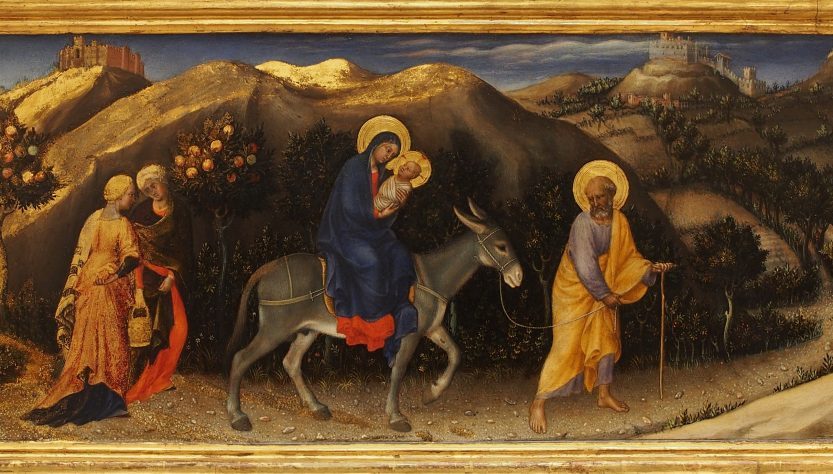
Joseph and Mary traveled dark and dangerous roads to reach Bethlehem before the birth of the Baby Jesus. The wise men made a long journey to see the newborn king. The entire nation of Israel spent more than 40 years wandering in the wilderness. Abraham, Jacob, Jonah, the Apostle Paul…there are many tales in the Bible of long journeys to unknown destinations and unknown outcomes.
Traveling can be exciting and adventurous, but it can also be filled with detours, setbacks, and hardships. Traveling means being away from our comfort zone, our “safe” place– even if our “safe” place isn’t really safe. Travel often means going into the unknown, especially if we travel alone or travel against our own will. Where does this road lead? Who will I meet along the way? Where will I stay at night? Will I get lost? Will I get delayed? What if I get sick or hurt or attacked? Will I find my way back home? Can I feel safe in a new home, among unknown people and circumstances?
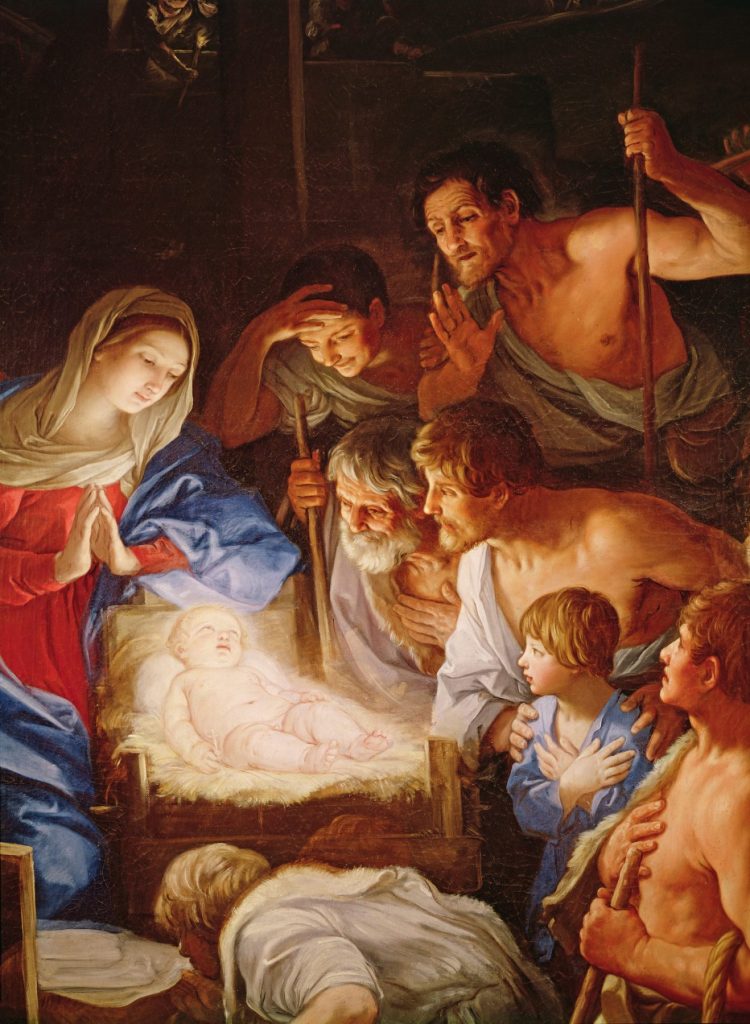
Jesus was born “away from home.” The first people to greet him were not grandparents or giddy relatives or neighbors, but shepherds– unnamed in scripture, unknown to his parents. In fact, the Bible doesn’t say much about Jesus being close to an extended family– his own small family always seemed to be on the move! Later, Joseph was told to take Mary and the child to Egypt; another long and unexpected journey, another long and winding road.
As an adult, Jesus was also “on the road” for much of his ministry. Long dusty roads leading to Galilee, or Jerusalem, Jericho, or Bethany.
At times, it can seem like our “roads” in life are long, winding, dusty paths leading to strange new places– lonely, rambling trails or busy superhighways taking us where we don’t always want to go. But we don’t need to fear traveling– even if we have to walk through the “valley of the shadow of death,” God is always with us. Just as He was with Mary and Joseph on the long road to Bethlehem, where there was no room for them in the inn. Just as He was with Jesus on the lonely path in the Garden of Gethsemane. Just as He was with Jonah in the belly of the big fish!
As we await the Advent of the Christ Child this year, it is likely that most of us have been on a long and winding road. Though many of us have been prevented from physical travel to foreign lands, we’ve traveled on an emotionally and even spiritually exhausting road in 2020. Chaos, corruption, COVID, elections, “executive orders”, economic collapse, lock-downs, lawlessness, and loneliness–we seem to have traveled a lot of miles, and most of them have been perilous and unfamiliar. But God has a plan, and a destination. The journey may not make sense right now; it is not the journey we would have planned; not the journey we would have chosen. But let us follow it to Bethlehem– to the Manger– to the Cross– and finally, HOME!
There is a saying–“If life gives you lemons, make lemonade!” In other words, if your life circumstances are “sour,” you should look for ways to make your circumstances into something sweeter.
Often, it seems like God gives us lemons–even when we pray and do what we know is “right,” it seems like our circumstances get no better. In fact, sometimes, they get annoyingly, frustratingly worse. But God does not abandon us; He doesn’t sit back and laugh at our frustration, or leave us to flounder in chaos with no hope. Sometimes, our circumstances are opportunities for God to make lemonade.
When God rescued Israel from slavery in Egypt, He did not lead them directly to the Promised Land. Instead, He led them through the wilderness and to the shores of the Red Sea. There, they were trapped by the Egyptian army, complete with horses and chariots and trained warriors. But God’s plans were bigger than the armies of Egypt, and bigger than the sea. God made a path of escape through the sea, and used the very same sea to drown the enemy!
What a miracle! But it wasn’t long before the people began complaining about “lemons” from God–the complained about the food, the journey, the scenery, and their leader, Moses. Even when God did many more miracles– bread from Heaven, meat from the sky, water from the rock, divine intervention in battles– the Israelites were still complaining about all the “lemons” in their life, and longing to go back to Egypt and slavery!
There are seasons in life when it seems like God is giving us lemons–a job loss, an unexpected illness, a wayward daughter, a house fire, civil unrest… Struggles and pain will come into our lives; we should not pretend otherwise, or seek to deny them when they come. And God does not expect us to “make lemonade” all on our own. But He may allow us to be squeezed a bit; He may send the lemons today, and sugar next Monday. He may not give us a fancy carafe and cute little teacups. But He will give us all we need to make lemonade if we are prepared for the task. And usually, He will give us more than enough to set up a lemonade stand and serve others!
Several years ago (2005), I had the opportunity to visit a settlement of Haitian refugees in the Dominican Republic. Multiple mission groups had banded together to provide basic needs– shelter, basic medical services, toilets and showers, etc. Service teams from Canada and the U.S. had come in to build two-room houses and set up a small clinic and school. Donations had come in– clothing, bedding, toothbrushes… Thousands of Haitians had been displaced after a bad hurricane season and massive flooding, and this refugee camp was home to nearly 150 families. Even with the donations, there were shortages– there was running water, but it wasn’t potable. There was rice, but few vegetables and very little meat. Aspirin and antibiotics were rationed, and most of the children were thin, and sad, half-clothed in rags and bare-foot.
In the midst of all this, there was a miraculous donation– of flip-flops! Literally thousands of pairs of flip-flops–brand new overruns: different sizes, but all the same colors and style–more than enough for every person to have a pair. God had given the people of this settlement a LOT of lemons. Shoes were well and good, but the people needed water… The shoes were distributed– there were even a few left over. But about a week later, it was observed that most of the people were still walking around bare-footed. What had happened to the donated flip-flops? Were the people ungrateful? Were they too proud to use the new shoes? Too fearful?
Not at all! These amazing people trusted that God could help them turn lemons into lemonade. They loaded the flip-flops into large bags, carried them (bare-footed) on their backs into town (the nearest town was nearly 10 miles away, but it was on the coast and attracted many tourists), pooled what little money they had to rent a booth at the beach, and SOLD the flip-flops. The money they made from the sale of the flip-flops purchased five-gallon jugs of drinking water. The jugs were carried back from town and shared among the members of this growing community. As they continued to sell the donated flip-flops, they purchased other small items– packets of laundry detergent, fly swatters, plastic dishes and cups–and established a small colmado (local store) within their own community. When I was able to visit again a couple of years later, the refugee camp was a thriving community– many of the houses had been painted, and had gardens and picket fences, on which clothes were drying in the sun. And while some children were still running in bare feet, many others had shoes. Some of the shoes were ragged and some were mismatched, but the children were happy and healthy. In the middle of the community, there was a beautiful church. Inside, there was a woman sweeping and singing songs of praise.
I share this story because it both encourages me and shames me. In this season of “lemons”– COVID-19 and violent unrest in my country– I have a choice. I can complain like the children of Israel. I can pray for God to take away the lemons; I can beg for Him to send me lemonade. Or I can look around for opportunities to use what He has provided– graciously provided– and sing His praises as I make lemonade.
God, grant me the eyes to see your provision amid whatever challenges I face today. THANK YOU for the lemons you have given me today, and, when I am squeezed, help me to become a sweet and refreshing reminder to others of YOUR Grace and Joy.
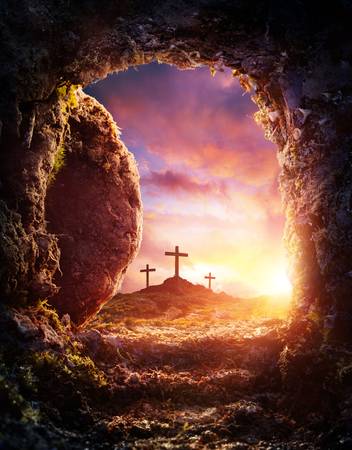
We are living in dark days– days of death counts, and dire predictions; of fear and grief and chaos. Masks, social distancing, angry outbursts, collapsing economies, job loss, political unrest, disease, plague–we are in the grip of a global pandemic. “Bring out your dead.” It’s a phrase from hundreds of years ago, and the horrors of other plagues and other disasters. Tombs, graveyards, skulls and visions of death abound. And yet, as Christians, we celebrate an empty tomb…
It’s been over a month since many Christians celebrated Easter (and almost a month for Orthodox Christians). How soon many of us forget the power of the resurrection. Our world is gripped with fear and anger. But we should be gripped with hope and healing. We celebrate an empty tomb– a testament to the victory of life over death, and hope over chaos!
Even when we use the symbol of the cross, it is not about Christ’s death, but his ultimate victory that we celebrate. Jesus himself even referred to the cross in these terms in John 3:
“Just as Moses lifted up the snake in the wilderness, so the Son of Man must be lifted up, that everyone who believes may have eternal life in him.”
Jesus is speaking with Nicodemus, a Pharisee and religious teacher. He is referring to an historic incident in the wilderness, when the Israelites had rebelled (once again), and the Lord sent venomous snakes among them. Nicodemus would have known about this incident, but Jesus presented it as more than just history– it was a foreshadowing of God’s perfect plan of salvation! https://www.biblegateway.com/passage/?search=Numbers+21%3A4-9&version=NIV God had Moses make a bronze snake to be lifted up on a pole. When the people looked up and saw the bronze snake, they could live. In just such a way, when Jesus was “lifted up” on the cross, he didn’t just die. He battled death to bring life to anyone who “looks up” and believes.
That ancient symbol of a snake on a pole is used by physicians to represent healing. The ancient symbol of Christ on the cross is used to represent redemption and eternal life. Combined with the reality of an empty tomb, we can celebrate life in the midst of any circumstances.
These are difficult days–even with the hope of eternal life, we still have to face the sadness and grief of death, the confusion and hardship of economic chaos, and the uncertainty of what tomorrow will look like– socially, politically, economically, and physically. But we need only “look up” and beyond our circumstances to be reminded that this is not the whole story. There is an empty tomb– ours! There is victory–ours! Won for us by the perfect plan of God, and the perfect obedience of Jesus Christ.
God’s ways are not our ways. God often turns our expectations on their heads– choosing Abraham and Sarah to become parents at an advanced age; choosing Moses, reluctant, disgraced, and hot-tempered, to shepherd close to a million refugees across the wilderness; choosing David, young and poorly armed to defeat the mighty giant, Goliath; choosing to send His Messiah as an infant, the son of a teenage girl stranded miles from home in a cattle shed…
Not only that, but God chooses to include cryptic and seemingly random details in many of the stories we read in the Bible. When Abraham and Sarah received news that they would become parents, Sarah laughed. Such a small detail, but God called attention to it, even giving the name Isaac (Laughter) to this promised son. When God called Moses, He didn’t just include the details of the burning bush and the miraculous signs, He chose to include Moses’s excuses and objections, and a curious command to Moses to remove his shoes.
Recently, I found a short discussion about the “five smooth stones” David used to defeat Goliath. https://www.biblegateway.com/passage/?search=1+Samuel+17%3A26-50&version=MSG Some teachers spend time talking about the number of stones– why five? Did David doubt God’s power and provision? Can we attach significance or apply principles to each stone? But someone commented (I’m sorry, I lost the reference, or I would attach a link) on the fact that the stones were smooth–I’d never really noticed that detail before. David chose five smooth stones from the brook, not five heavy rocks, not sharp-edged stones of flint, not round balls made of iron– five smooth stones. The smooth stones in the brook may seem like a strange choice to us if we are not used to using a sling, but to David, such stones meant greater accuracy and speed. Five such stones would have been about a handful– easy to carry, load, and fire in rapid succession, if necessary.
I would like to suggest that there are some principles here that apply to both prayer and Christian living, especially involving how we can pray for and interact with the “giants” and “enemies” in our lives:
First, understand the reality of the “Giant”—Goliath was huge; bigger than any single warrior in Israel. But he wasn’t bigger than God. Goliath was also hampered by his heavy armor, his size, and his arrogance. David was offered armor and weapons similar to Goliath’s, but David’s greatest weapon was his understanding that Goliath was no match for the God of Angel Armies! We often make the mistake of magnifying our enemies. We see their size, their shining armor, and heavy weaponry. We forget that God is the maker of smooth stones!
Second, actions really do speak louder than words. Goliath inspired fear; he taunted the army of Israel. Yet he never landed a blow against David. Goliath scoffed, bullied, and talked a good game, but David paired his words with action. Goliath demanded that David (or any other warrior) “Come down to me..” He had a javelin and a spear, but he never used either one. I find it interesting that many “enemies” of the Church behave the same way. They want to challenge the followers of Christ in debates; they publish books and articles filled with arrogant words, accusations, and complex arguments. It is tempting to respond in kind– to get into a war of words; to match their arrogance with our self-righteous assertions. What if we fought their words with action, instead of spending so much of our time answering and defending ourselves against empty arguments and accusations. We will not “win” any culture wars; we will not “win” the hearts and minds of the next generation; we will not “defend” morality by using bigger, better, or more persuasive words, or by having better armor and sharper weapons than our enemies. We need smooth stones from the brook–small acts of kindness and humility and grace that defy all the logic and brute force of those who trust in their own understanding.
Third, accuracy is better than power. Goliath had one spear–and it was impressive–” His spear shaft was like a weaver’s rod, and its iron point weighed six hundred shekels.” (verse 7). Still, Goliath had a javelin, a sword, and several pounds of armor. David had no armor, one shepherd’s staff, and his sling and five smooth stones. But he only used one stone! It was accurate and true; it was sufficient, and it won the battle! Sin likes to flaunt it’s power–shiny armor, impressive weapons.. But if we are “true”–if we hold fast to the truth and follow the words and example of Jesus Christ–if we are faithful in our everyday walk with Christ, it is sufficient. There is an amazing climax in the movie, Star Wars (episode 4, A New Hope), where the young Luke Skywalker is sent with a group of fighters on a seemingly impossible task– destroy the “indestructible” Death Star! There is only one weakness–one small target. Luke’s small fighter plane is old and outdated; he and his fellow soldiers are under attack, and the pressure is on. But Luke’s accurate shot leads to victory. It is a modern retelling of the story of David and Goliath (with several space-age gadgets and extra plot twists). How many of our interactions with others get “sidetracked” by anger, envy, bitterness, and pride, to the point that we no longer reflect Christ accurately? How often do we consistently pray to stay “true” to God’s word, rather than praying for more powerful opportunities or platforms?
Fourth, know your strengths and weaknesses (and those of your enemy). David knew that his strength was, first and foremost, in God. And David’s passion for God’s honor gave him focus and commitment beyond all that was found among the skilled soldiers of either side. He knew that fancy weapons and armor could not improve his skill with the sling, and that his skill had been tested in battle before. But David also knew better than to aim the stone at Goliaths’s breastplate, shield, or greaves. Goliath’s weakness was in his head! His first weakness was in thinking that his power was enough to defy the God of Israel’s army. But he also left his head unprotected from attack. Some scholars have even suggested that Goliath may have had very poor eyesight– that he was a fierce warrior in hand-to-hand combat, but literally could not see the stone coming at his forehead. Perhaps all his blustering and taunting was, in part, to distract from his very real vulnerability. I am reminded that this is also true of many of the “giants” we face. Their weakness is in their head and in their vision–they trust in their own understanding and in human arguments, or in their “vision” of who God is, or “isn’t”, or “should be”. They rely on what they can comprehend and control. They wave their swords and rattle their shields; they have gleaming armor and they “talk a good game”. They have locked away their hearts and bodies, often hiding painful scars and deep hurts. Goliath was a giant–but he wasn’t a god. He was once a little boy (or maybe never a “little” boy, but a young boy..). David was a young man (probably in his mid-to-late teens), who was a simple shepherd. How do we see ourselves? How do we see others around us? Do we know our weaknesses? Do we see the vulnerability in those who would threaten us?
Last, God’s “weapons” are not like those of the world. Five smooth stones do not look like weapons. In fact, five smooth stones from the brook may have looked charming and harmless and even comforting in David’s hand. Four of those stones may have gone back into the brook, to be polished some more by the current, or carried out to the sea. Christ’s followers have armor and weapons, but they are spiritual in nature. We are to put on the “whole armor of God” (https://www.biblegateway.com/passage/?search=Ephesians+6%3A11-18&version=ESV, including the “sword of the Spirit”, which is the word of God. Truth, Righteousness, Peace, Good News, Faith, Salvation– This is how we prepare for battle! And we are to pray at all times! Imagine dropping the weapons of sarcasm and self-righteous posturing, and picking up a smooth stone of grace! God calls us to use unconventional “weapons”– not to kill or destroy those around us, but to demolish lies, tear down walls of hatred, and defend the helpless. Has God placed you in a situation where you need to pick up “five smooth stones” today?
I’m really sick of hearing about shoes in the news lately. But, surprisingly, I think it’s time for a brief word about shoes— from a Biblical perspective.
The Bible has a lot more to say about shoes than most of us realize. Way back in Exodus, when God called Moses from the burning bush, He commanded Moses to take off his shoes. Later, in Deuteronomy, the Israelites are reminded that during their years of wandering, their shoes did not wear out– God took care of even the smallest and lowliest of details in providing for their needs in the wilderness.
Boaz secured the right to marry Ruth through an old ritual involving an exchange of sandals. The prophets used shoes to indicate the coming exile, and the need for people to be prepared to leave their homeland.
In the New Testament, John the Baptist declares Jesus’ superiority by saying that he (John) is not worthy to latch Jesus’ shoes! And the Apostle Paul includes shoes (or sandals or boots) in his list of spiritual armor, asking us to wear on our feet the readiness of the gospel of peace (Ephesians 6:15). A Christian’s shoes are to be used to bring good news and peace– not anger, protests, and divisiveness.
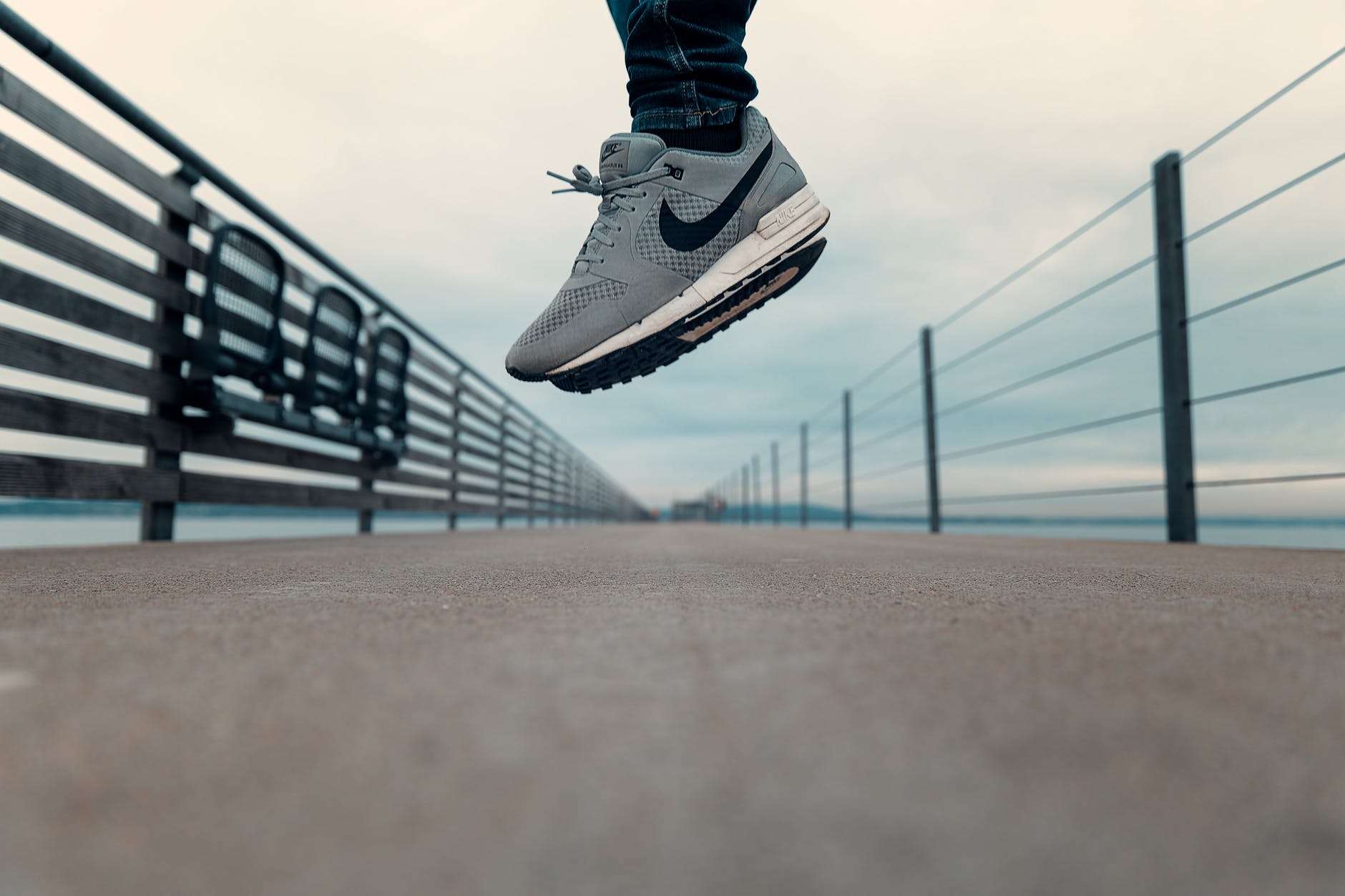
Shoes are meant to serve a useful purpose. They protect our feet from surfaces that are hot, cold, wet, dusty, or rough. They provide traction, allowing us to start and stop moving on pavement, gravel, rocks, and flooring. Some shoes even provide arch support so we may stand and walk for hours with minimum damage to our bones and nerves. Shoes allow us to walk farther, run faster and with more confidence, and stand firm.
The most ridiculous thing about all the fighting over a shoe’s ad campaign is that it’s not about the SHOE–and no one is entirely clear on what it IS about– is it about race, police, injustice, patriotism, lack of patriotism, residual guilt over slavery, respect (or lack of respect) for military and/or rescue personnel, the NFL, Black Pride, White Privilege, income inequality, all of the above, something entirely different? Mostly, it seems to be about anger, hurt feelings, hatred, and generic outrage.
Lord, from my head to my toes, I want to bring peace, hope, and love to this world in YOUR NAME. Help me not to be blinded or distracted by all the world’s empty substitutes. Let me wear the shoes that make my feet ready to bring your gospel of peace and reconciliation to others. May I walk and run and climb and stand in Christ’s name and for His sake. Amen.
The phrase comes from Tennyson in Idylls of the King, but it is reminiscent of phrases given to Joshua as he prepared to lead the Israelites across the Jordan and into the promised land.
Joshua 1:2-3 (NKJV) 2 “Moses My servant is dead. Now therefore, arise, go over this Jordan, you and all this people, to the land which I am giving to them—the children of Israel. 3 Every place that the sole of your foot will tread upon I have given you, as I said to Moses.
God tells him several times to “Be strong and courageous..” (Joshua 1:6), “Be strong and very courageous.” (Joshua 1:7), “…be strong and courageous. Do not be terrified; do not be discouraged, for the Lord your God will be with you wherever you go.” (Joshua 1:9)
When I think of being strong and courageous, I don’t usually think of ducklings! I think of hero bodybuilders or armored knights of old…people who are prepared to crush and conquer and face an army. Yet God repeats the phrase to Joshua, including at last the command to “not be terrified; do not be discouraged..”, which indicates that Joshua was close to terror and despair, rather than filled with hope and adrenaline.
And little wonder. Joshua had to be experiencing a slight sense of Déjà vu. About forty years earlier, he had been part of the group of spies sent to scout out the promised land…spies who had come back terrified and discouraged. The entire nation was ready to rebel against Moses and even God. Now, forty years later, Joshua was to try again– this time as Moses’ replacement, a new leader for a new generation already prone to complain and rebel.
Some days I feel a little like Joshua– facing walled cities, giants, and feeling totally inadequate to the task. Some days it even feels like a struggle to “arise”, let alone going forth to conquer.
And then God reminds me…”Every place that the sole of your foot will tread upon I have given you, as I said to Moses.” It’s not that God is literally leading me into the promised land as I go to the grocery store or face a difficult customer at work or walk around the neighborhood. But, figuratively, He is helping me win battles against temptation, discouragement, anger, and bitterness. He IS with me wherever I go, and He wants me to trust HIS strength and wisdom to triumph. I become “more than a conquerer” (Romans 8:37) when I stop trying to fight in my own strenth and rely on His. My strength may be minimal, my motivation questionable, and my wisdom lacking, but I can waddle confidently into battle, knowing that the victory is certain!
This is also true for my pursuit of prayer– My prayers are often flighty, inadequate, sporadic, and even grudging. I keep a prayer journal, and that can help with motivation, discipline, and even praise, but it doesn’t guarantee that I will draw perfectly near to God or follow Him with total faithfulness. The more I rely on MY efforts, the more I am fighting to replace God’s strength and wisdom with my own. God doesn’t want me on the sidelines, or sleeping in– He wants me in the game. But the outcome doesn’t depend on my ability or my performance (or my lack of feathers!)




























 Pursuing Prayer