One of my favorite old hymns is the ancient Irish tune, “Be Thou My Vision.” I have heard it jokingly referred to as “the optometrist’s hymn.” But there’s a lot more to unpack in the title than just a plug for good eye care.
God’s word is full of references to sight, seeing, blindness, light, lamps, darkness, night, day, visions and dreams, foresight and prophecy, images and reflections, and much more. God is both the source of our sight, and of our insight. God sheds light on our deepest secrets of the past, and provides a lamp allowing us to see the obstacles ahead more clearly. Jesus came to be the Light of the World, and bring sight to the blind, both physically blind and spiritually blind.
Many times, we pray for answers– we want a quick solution to our circumstances, or a definitive direction for our next step. But God sometimes wants to show us a bigger picture. Sometimes, he wants to show us more intricate details. Instead of asking for what we want God to give us, we need to ask for God to give us the vision HE has for our future. He may not reveal every detail– or he may only reveal the next detailed step. But God’s vision is clearer and bigger, and more glorious than we will ever know if we aren’t willing to look with His eyes to see.
We also need to ask God to BE our vision– that we would see him more clearly for Who He Is! Whatever is in our focus will appear bigger and clearer than things in the periphery. When we allow Him to be our vision, we start to see things from His perspective, which makes all the difference. What we see on our own is often an optical illusion– problems look bigger than they really are, hurts and grievances grow larger, and people become distorted by the lenses or mirrors we use to view them. And we lose sight of God’s glory, wisdom, majesty, power, and everlasting love. But God restores our focus and our perspective, so that we see problems in the light of His power to overcome; we see people who are made in His likeness and image– people who are loved by God, even if they are in rebellion against Him. We see the glory of God’s creation as it was meant to be, even as we see the wreckage of pollution, corruption, disease and disaster. We see God’s mercy as lives are transformed and families are mended and justice is finally achieved. And we see the rays of hope in God’s promises fulfilled and those yet to be fulfilled.
Several years ago, Eric Clapton recorded a song written by Tommy Sims, Gordon Kennedy, and Wayne Kirkpatrick. It was called, “(If I Could) Change the World”, and it ended up winning three Grammy awards. The chorus keeps repeating, “(if) I could change the world– I would be the sunlight in your universe. You would think my love was really something good. Baby, if I could change the world.”
The song speaks to a great longing we have to, if not change the entire world, at least change the circumstances around us. If only we could! Especially in a situation like that of the singer, who is in love with someone who doesn’t return his feelings. Oh the things he would do– He would bring down the stars, he would be king for a day, he would shine as bright as the sun! All in the hope of changing the heart of the woman he loves…Ahh, romance.
But there is a reality in this song that grieves the heart of God. Our world NEEDS to change. It is fallen, and it is on a collision course with death and destruction due to Sin. It is natural that we should want to change the world around us– it is full of danger, disappointment, death, and deception. But the only one who can truly change it (for the better) is the one who created it in the first place. We want to change the world by taking the place of God. WE want to be the sun in the center of our solar system. WE want to place the stars and planets. WE want to be the kings and queens of our days and lives.
And there are certain things over which we DO have that kind of control. WE can change our attitudes. WE can change our behaviors. WE can change some elements of our environment and our social circle. We can change jobs, hairstyles, addresses, sleep schedules, gym memberships, diets, and more.
But there are other things that we simply cannot change. We can’t change the weather– even when we talk of “climate change” we don’t speak of individuals being able to single-handedly improve (or destroy) the environment. We can’t change another person’s heart (as this song laments), or their mind. And, as Jesus reminds us, we can’t add a single hour to our lives (see Matthew 6:27)! We cannot change our genetic code to add inches to our height or subtract inches around our middle! And, while surgeons suggest that we can change our gender, it is not possible for a man or woman to change their basic DNA and assigned organs to completely “become” someone else. We cannot change the rotation of the Earth (and thank goodness! Even the slightest changes would wipe out life as we know it!) We cannot even rid the world of mosquitoes!
But our “groaning” echoes that of all nature (see Romans 8:22-23)– we long to see the world as it SHOULD BE. Something in our souls longs to see the world renewed, transformed, and perfected. And it WILL BE! God has promised to make a “new heaven and earth” (see Isaiah 65:17; 2 Peter 3:13; Revelation 21:1) And when that happens, HE will be the sunshine in our universe. We will KNOW that His Love is REALLY something Good! And while we wait, Jesus has promised to change our current situation, as well. HE can change our world! And that’s something worth singing about!
Welcome to a New Year! And everything that lies before us is shrouded in mystery. But is that a cause for fear or excitement?
That is the question that weighed heavily on the mind of Ebenezer Scrooge in “A Christmas Carol.” Scrooge carried resentment and bitterness from his past, and isolation, anger, and disdain about the present. And he greatly feared a future he could not manage or define.
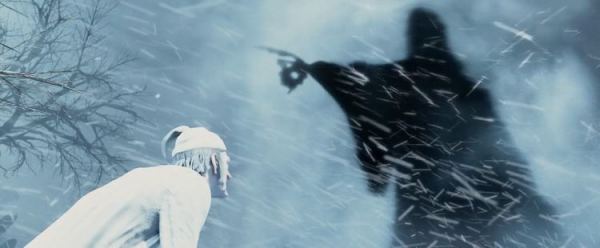
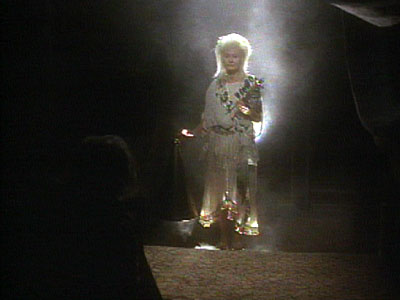
After visits from the Ghost of Christmas Past and the Ghost of Christmas Present, Scrooge was left emotionally off-balance and fearing the worst. Finally, he was visited by the third mysterious spirit, the Ghost of Christmas Yet to Come. He already knew the sad fate of his friend, Jacob Marley. Would this spiritual visitor show Scrooge a dire future already fated, or merely shadows of what might be? And the Ghost delivers strange sights– predators gleefully trading in the belongings of the recently deceased, heartless business acquaintances discussing the funeral arrangements of one of their fellows, and grieving family members in the household of Bob Cratchit. But what was his own fate? Where was Ebenezer Scrooge in the Christmases yet to come?
The answer comes in a cemetery, where Scrooge sees a newly-dug grave and a stone bearing his own name!
Death always seems to come as a surprise, even when we know that we will all die someday. Our own death may haunt us, but usually from a safe distance. It will come someday. Once we are old. Once we are weak, and sick, and ready to rest. Once we have achieved our goals and fulfilled our purposes. But that’s not how death works. It comes in its own time, not ours. It comes, not as an expected closure, but as a rude interruption of our hopes and dreams.
Ebenezer Scrooge, forced to deal with his mortality, and the legacy of his past and present, realizes that life is not what we forge out of our own plans and our strength of will or our hard work. Life is a gift. But life is not a given. Life has a purpose, regardless of the purposes and goals we bring to it. And that purpose has to do with giving and receiving other gifts– generosity, hope, forgiveness, encouragement, time, fellowship, and Love.
This Ghost never speaks to Scrooge with words. Instead, he shows Scrooge a world in which Scrooge has no more chances to give or receive gifts. He has chosen to hoard his wealth, his time, and his heart– and the result is that he will die alone, unmourned, a useless shell of rotting flesh. His fear and bitterness have brought no comfort to anyone, and have left the world a colder, icier, more horrible place.
But there is hope, even in this haunting experience. Scrooge wakes from this night and realizes that he is ALIVE! The Ghost has given him a great gift– the chance to live– the chance to experience connection and hope, joy and creativity, excitement and generosity.
What will this new year bring to US? Can we face an uncertain future with hope? Can we accept the gift of Life– even with its pain and struggle– as a priceless opportunity? Can we reach out to others, even knowing that we will sometimes be rejected, betrayed, and used? Can we strive to make things a little better– in our homes, our communities, our place of work, and in the wider world?
Scrooge did, and so can we! “A Christmas Carol” does not finish with a cold gravestone– even though we must know that Scrooge has to die one day. The story ends with music and light and gaiety, as Scrooge embraces the mystery of his own future and learns to live in hope and charity with those around him.
As we step into the future, may we also embrace the Life that God has given us, the joy of sharing time with others, and the expectation of good gifts that God will continue to give us in the future. As Tiny Tim says, “God bless us, everyone!”
My prayer is that you will experience excitement as we all take the next steps– God’s spirit will light the way; God’s word will be a lamp unto our feet (Psalm 119:105). God’s glorious gift of Christmas– the coming of Christ to be our Emmanuel, our example, and our Savior–will be the carol that we sing as we travel into the unknown!
If you missed my last blog post, I’m looking at the story of A Christmas Carol, by Charles Dickens. It may not seem like a “jolly” Christmas story, or even a “religious” story, but it is “spiritual.” Ebenezer Scrooge is literally haunted by three spirits over the course of Christmas Eve. Last time, I spoke of the Ghost of Christmas Past. Today, I’d like to look at the Ghost of Christmas Present.
I know, Christmas was a few days ago– we’re currently at the cusp of New Year’s Eve, but these few days between Christmas and New Year’s Day can often feel jumbled up and run together. And, traditionally, the Christmas season is not just one day, but twelve days, stretching from December 25 to January 6. So today is still technically part of “Christmas.”
In “A Christmas Carol”, Scrooge is actually visited by four spirits. The first is the ghost of his old friend, Jacob Marley, who offers Scrooge both a dire warning, and a chance of redemption. Scrooge has already been visited by Marley, and by the ghost of Christmas past– a look at the moments and people who have shaped Scrooge’s life up to the present. Scrooge has seen both happiness and tragedy in his life, but the “light of truth” carried by the first ghost has shown how Scrooge has rejected happiness, instead embracing a life of fear, loneliness, and greed.
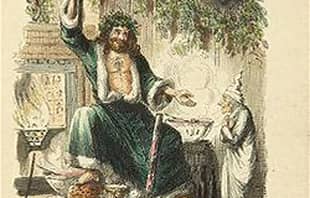
The next spirit, the Ghost of Christmas Present, focuses less of Scrooge himself, and more on the people he has ignored or rejected. This spirit shows Scrooge what he is missing by hoarding his wealth and isolating himself from the rest of the world. It is a picture that many of us would do well to study!
One of the first stops is the home of Bob Cratchit, Scrooge’s underpaid, put-upon clerk. Scrooge makes use of Bob’s time and skills, without ever showing any interest in him as a person. Scrooge is oblivious to Bob’s existence outside of the counting house. He assumes that Bob has a family, but he has no idea who makes up that family. The Ghost of Christmas Present forces Scrooge to see that Bob and his wife have several children, including a sickly and crippled son named Tiny Tim. Though they have very little money (thanks in part to Bob’s meager wages!), they have plenty of love and happiness. Scrooge fears many things that may happen, while his clerk faces very real fears that “haunt” him every day. Yet Bob does not complain, does not exhibit bitterness, and does not hide away from the world.
Next, the ghost takes Scrooge to see his nephew. Scrooge keeps his nephew at a distance because of his bitterness and fear. But in doing so, he is missing out on his nephew’s kindness, wit, and warm circle of friends. Scrooge has treated his nephew with disdain, fearing that the younger man is jealous of all his riches. But the ghost shows Scrooge that his nephew actually feels sorry for his uncle. Again, Scrooge has great wealth, but his nephew is content, and even very happy with his lower station in life. He loves his wife and enjoys friendships that make him wealthier in many ways than his uncle!
Finally, the ghost of Christmas Present shows Scrooge a sight he would never willingly see– the suffering and neediness of the poor, whom Scrooge has sneeringly consigned to death. Rather than seeing humanity, Scrooge sees only people who might drain him of his wealth– the undeserving poor who “cost more than they are worth.” The ghost reminds Scrooge of an earlier off-handed remark about helping those who would rather die than go to workhouses: “If they’d rather die, then let them do it–and decrease the surplus population!” The ghost warns Scrooge that he should be very careful in declaring who is among the ‘surplus population’. In heaven’s eyes, Ebenezer Scrooge himself might have less worth than ‘the least of these.’
And the King will answer them, ‘Truly, I say to you, as you did it to one of the least of these my brothers, and sisters you did it to me.’“Then he will say to those on his left, ‘Depart from me, you cursed, into the eternal fire prepared for the devil and his angels. For I was hungry and you gave me no food, I was thirsty and you gave me no drink, I was a stranger, and you did not welcome me, naked and you did not clothe me, sick and in prison and you did not visit me.’ Then they also will answer, saying, ‘Lord, when did we see you hungry or thirsty or a stranger or naked or sick or in prison, and did not minister to you?’Then he will answer them, saying, ‘Truly, I say to you, as you did not do it to one of the least of these, you did not do it to me.’ (Matthew 25:40-45 ESV)
Scrooge’s feelings and senses are overwhelmed by what he experiences. The present surrounds him– the sights, the smells, the laughter, the cold of a dark winter’s night, and the heat from a roaring fireplace; the stench of the docks and homeless camps, and the aromas of Christmas dinner; the colors and lights of decorations, toys, and costumes; the ringing of bells, and the singing of Christmas Carols. Once again, Scrooge can hear music and laughter, he can sense the love and compassion, but he can only participate on the periphery. The music haunts him, but it comes from others, not from his own frozen heart.
So, what happens to us in this Christmas present? Do we feel connected to the joy and gratitude, the love and hope of the season? Or are we isolated by worry, frozen in fear, enslaved by anger or greed? Christmas is often a time of great sadness and loneliness. And sometimes, the laughter and the lights seem hollow and fake. Especially in the days just after Christmas, we can feel let down, abandoned by the promise of merriment and fulfillment brought by parties and gifts and feasting and entertainment. Outside, the winter is still cold, the bills keep coming in the mail, and fears and worries cloud our days. Some of our fears are very real– disease, grief, loss, sudden changes in circumstances and relationships–Christmas lights and music alone cannot cut through the fog.
My prayer for today, and for the New Year at our doorstep, is that we would open our ears and eyes and hearts to what is around us– acknowledge that we live in a fallen and often worrisome world, but recognize that there are opportunities all around us, as well. We don’t have to isolate. We don’t have to live in constant fear. Christmas isn’t just a day; it isn’t just a season– Christmas is about Christ coming to dwell with us!
Open your ears! Listen to the music of the season– “Peace on Earth! Good Will to Mankind!” “JOY to the World! The LORD has come!” “Let Heaven and Nature Sing!” “Glory to the Newborn King!” Keep listening to the promises of God’s Word– “Never will I leave you nor forsake you!” “Lo, I am with you always!”
Open your eyes– see the wonderful opportunities to share both joy and sadness with others. Seek out the great opportunities to give and receive help and love and fellowship! See the good things that the LORD has done– the friendships and family in your life; the beauty of nature, the ‘wonder of His Love!’.
Open your heart– Receive the greatest Gift! Redemption; new birth; eternal and abundant Life! Choose life and gratitude and humility. Practice childlike faith, hope, and JOY!
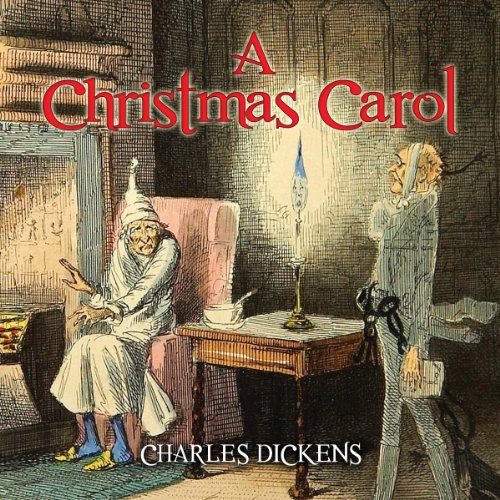
Charles Dickens wrote “A Christmas Carol”– a (literally) haunting tale of greed, bitterness, and, in the end, redemption. Set in Victorian England, the story involves a miser named Scrooge, his business partner, Marley, who has been dead for seven years, and three mysterious spirits: The Ghost of Christmas Past, the Ghost of Christmas Present, and the Ghost of Christmas Yet to Come…
Scrooge and Marley
Scrooge doesn’t really hate Christmas. He considers it a Humbug– an annoying and worthless distraction from the “reality” of making money. What bothers Scrooge– what eats at him and rules his actions– is the fear of poverty and powerlessness. He avoids relationships so that he cannot be hurt or abandoned. He avoids spending money– even for common comforts like coal to heat his office–for fear that he will fall into poverty. He does not like people because he will not trust anyone enough to risk getting hurt or used.
Scrooge’s only “friend,” his former partner Marley, lived by similar principles during his lifetime. He “visits” Scrooge on Christmas Eve to warn him of the fate that awaits those who fail to realize that there is more to life than making and keeping money. “Mankind was my business. The common welfare was my business; charity, mercy, forbearance, benevolence, were all my business. The dealings of my trade were but a drop of water in the comprehensive ocean of my business!” Marley has managed to arrange for Scrooge to be haunted by memories of the past, visions of the present, and shadows of what may be in the future.
The first of these “spirits” reminds Scrooge of Christmases from his childhood and early adulthood. Some of the memories are sad– Scrooge is left to spend the holiday alone at school, as his cold and distant father refuses to show him love, mercy, or guidance. Later, Scrooge is reminded of how his decision to pursue wealth alienated the woman he could have married. But there are happier memories, too. His first boss, Mr. Fezziwig, brought happiness and a sense of camaraderie and purpose to Scrooge’s early employment. He celebrated both hard work and the joy of fellowship with his employees. Scrooge sees visions of his beloved sister and is reminded that he has a family (his sister’s son) with whom he could make and share happy memories– if only he would choose to do so.
I will write about the other visitations later, but I want to camp out here for a little bit.
What memories would the Ghost of Christmas Past bring to me? To you? Are there sad or painful memories of Christmases without loved ones? Christmases that included anger or rejection? Christmases spent with poverty, uncertainty, or sickness? Would you feel bitterness? Fear? Guilt? Regret? Or would there be nostalgia for days gone by? Longing for family members who have passed? Questions about what might have been?
It is tempting sometimes to shove our memories of Christmas past in a closet or an old trunk and try to forget them. In Dickens’ story, Scrooge ends up desperately trying to snuff out the light of Truth that the spirit is holding. He doesn’t want to remember; doesn’t want to know or deal with the pain and loss of his past.
But before we can truly live in the present, we must confront the past. We do not have to live there. Our memories– good and bad– are but shadows of the things that have been. But they can cast long and devastating shadows if we let them. Denying past pain or trauma can give us a false sense of control. Burying ourselves in work or pleasure or entertainment may feel like a solution. Being cautious and angry and cynical may seem like wisdom. We can blame others, blame ourselves, even blame God for our feelings of hurt and fear of being hurt again and again. OR we can, with the light of truth, revisit our past. We can discover the healing power of redemption and forgiveness. We can– we must– still acknowledge the pain, the injustice, the grief that lies on our past. But we also must see that the shadows of the past only fall behind us. However the past may have shaped us, damaged us, challenged us, or forged us, the present and the future can be turned in a new direction.
And that is possible because of Christmas– because of Christ!
When Scrooge first visits his past with the Ghost of Christmas Past, the first image he experiences is of his classmates from school riding in sleighs and wagons singing Christmas carols. Singing! He could not join in. As an adult he has chosen not to join others as they sing of the wonder of Christ’s birth. But the carols echo– their message endures! Christ is Born! Glory to the Newborn King!
My prayer today is that Christmas past holds some happy memories for you. But the very Good News of Christmas is that it isn’t just about the past. And our past Christmases don’t have to haunt us. Because the Light of Truth– The True Light of the World (John 1:9) –that came on that first Christmas so long ago leads the way forward!
It’s been nearly 45 years since I first heard this phrase, but it has resonated with me ever since. Samuel Taylor Coleridge wrote of it over 200 years ago, speaking of how readers interact with literature, especially when it contains fantastical or supernatural elements. Our high school English teacher and drama coach, Mrs. Barr spoke of it not only in the context of literature but in the context of the theater. In fact, in all art, the artist depends on at least some willing suspension of disbelief on the part of his/her audience.
In visual art, we must believe that a few strategic blobs of color, or carefully shaped pieces of marble or wood have captured something timeless and true about a single moment in time– that movement and emotion and life can be held immortal on a canvas or a statue or a tapestry. We must suspend our disbelief that paint, or wood, marble or stone exists only as itself– in the artist’s capable hands, mere matter transcends its ordinary form to touch our very soul. In music, we can hear, in the well-played notes of an instrument, the sounds of birds, the falling rain, the crashing of thunder, the marching of armies, or the buzzing of bees. Music doesn’t just touch our ears, it can touch our souls. Shakespeare also alluded to this in a comical way: “Is it not strange that sheep’s guts should hale souls out of men’s bodies” (Much Ado About Nothing– Act II, Scene 3) We can listen to a symphony without being moved, but in the willing suspension of disbelief, we can be transformed and inspired by notes on a page and breath being blown into wood or brass or fingers or bows being drawn over “sheep’s guts”.
In literature or in the movies, we must suspend our disbelief that mythical creatures, aliens, monsters, and talking animals live among us as a normal occurrence– for the duration of the story…Dragons must be vanquished, Fairy Godmothers must be allowed to help poor Cinderella to the ball, and The Raven must repeat his ominous line, “Nevermore.” Frodo must hide from orcs and Nazgul in order to reach the Fires of Doom and destroy the One Ring. Charlotte must spin her wordy webs and Papa Bear must exclaim, “someone has been sitting in my chair.” As children, we shed our disbelief readily and enter into the story, falling in love (or having nightmares about) imaginary characters. As adults we become cynical, and lose some of our ability to enter into imagination and other-wordly realms.
I was recently reminded of this concept of the willing suspension of disbelief in two different contexts– loss of Faith, and the deception of the internet– including “fact checking” and AI. Very different experiences, but I think they both tie in.
First, in the loss of Faith. I know so many people, family, friends, even strangers, who write passionately about their loss of Faith. Oh, they don’t call it that. They have other terms, other catchphrases– they talk about their “Deconversion” or their “Awakening”. They are too smart, too savvy, too enlightened to give credence to Faith in Jesus, or in any “god” or divine being. After all, they cannot see “Him” or “it”; they cannot prove His existence (they can’t prove His non-existence either, but that’s another story). Believing in God, they claim, is the same as believing in fairy tales.
And yet…Keats once posited, “Beauty is truth, truth beauty– That is all ye know on earth, and all ye need to know” (Ode on a Grecian Urn). Earlier in his poem, he also says, “Heard melodies are sweet, but those unheard are sweeter; therefore, ye soft pipes, play on; not to the sensual ear, but, more endear’d, pipe to the spirit ditties of no tone…” There is an acknowledgement that we do not just exist in a physical plane, but in a world of metaphysical marvels– memory, hope, and yes, even “fairy tales”.
Of course, we know that there is no Cinderella– no “happily ever after” in this world. Life is not a fairy tale story. But our lives ARE stories– we have a beginning and an end. We want to find a purpose, a reason for being who we are, where we are, and even when we are. We search for our “true” identities. We dream dreams and harbor hopes. We battle evil forces– the demanding boss, the annoying neighbors, blizzards and tornadoes, cancer…And we believe very strongly in concepts of justice and injustice, fairness and unfairness, goodness and evil–metaphysical concepts. We long to be understood, accepted, “seen,” and loved (ever after!). And we must suspend our disbelief in the face of evil to search for the good. We must suspend our disbelief in our own worth to make choices that preserve our health and develop our latent talents. Indeed, we must believe and cherish what we do NOT see or have never experienced, or we will be crushed by our (often temporary) realities. When cynicism and disbelief BECOME our belief system, we become the living dead. Oh, we can continue doing “good” things without believing in God; we can espouse a code of “good living”, we can take care of our bodies and emotions within a framework of humanism and self-esteem. But we will not experience the fullness of Truth, or Beauty, or majesty, that lives in Faith.
Loss of Faith represents, what I would call an “unwillingness” to suspend disbelief, or a tendency to cling to only that which can be experienced on a physical plane. But there is another danger– that of an “unwilling” suspension of disbelief–believing things that are deceptive, because they are presented as “truth.” This includes such things as “fake news” on the internet, “fact checkers” who tilt the truth and “throw shade” on inconvenient or uncomfortable truths, and AI-generated stories meant to “create” truth where none exists.
I would like to say that I am immune to such things; that my knowledge and dependence on truth cannot be subjected to manipulation. But that is not always true. I see a touching story on Facebook about a young person who is missing– please spread the word– only to find out that the post is several months out of date. I see a meme that accuses one political big-shot or a celebrity or even a corporation or business of being corrupt, unfair, evil, etc., and I am outraged– until I realize that the original post was generated by a person or group that is completely unknown to me. I don’t know their true experience, or their motivation in spreading this information (or false information). It MAY be true, it MAY be completely false, but it is most likely somewhere in between– not nearly as bad as portrayed, or as every bit as bad as other politicians, celebrities, or companies who aren’t mentioned in the meme or article.
Outrage— especially outrage that is deliberately and manipulatively generated– is the suspension of not just disbelief, but of discernment. We immediately judge. We immediately feel our blood pressure rise, our cheeks flame, and our breathing accelerate. Webecome passionately angry, but we also become instantly indignant and self-righteous. I would never…I cannot tolerate… But what have we done on a smaller scale? Are we SO innocent? Do we have the authority to judge based on a single article or photo?
But it is not just outrage that can be deliberately and manipulatively generated. AI and bad actors on the internet and other media sources can also manipulate our hopes, our disappointments, and our beliefs in what has happened and what is happening around us. Stories appear online that sound authentic, narrated by well-modulated voices (many of which seem familiar), telling us that this event took place and changed someone’s life, or that this celebrity has finally “spilled the dirt” about beloved co-stars who died a couple of decades ago. Others purport to give “wise words” from aging actors or writers or recently dead corporate gurus. We suspend our disbelief, or our suspicions, because we trust the voice or the photoshopped picture. We choose to believe the worst of people we already dislike. We choose to believe only the best of people we like. If a stranger came up to me on the street with a story like this, I would be suspicious. Who are they? Why are they telling me this? Why should I trust them? But we suspend our disbelief if we see it in print with what looks like credible photos and when narrated by what we assume to be a credible voice. If we bother to look at the source, even that seems credible– I may not have heard of this news service, but it has the word “news” in its heading…
We put our Faith in things seen– even if they are false, while we hold truth and beauty to be suspicious, because we have lost the ability to hope and trust in something beyond our own wisdom and personal perceptions.
We need dreamers and artists and writers who see truth and beauty in the universal and metaphysical realities of faith and hope and majesty. And we need people with the discernment to disbelieve what strangers claim to “show” and “tell” us with their clever manipulations.
Both Faith and “the willing suspension of disbelief” depend on the Will. We have to make choices in what we are willing to believe and how far we are willing to search for the truth– both in what we can see, and in what we cannot.
I have a song that Jesus gave me, It was sent from Heaven above; There never was a sweeter melody, ‘Tis a melody of love.
I love the Christ who died on Calvary, For He washed my sins away; He put within my heart a melody, And I know it’s there to stay.
‘Twill be my endless theme in Glory; With the angels I will sing; ‘Twill be a song with glorious harmony, When the courts of Heaven ring!
In my heart there rings a melody, There rings a melody with Heaven’s harmony; In my heart there rings a melody; There rings a melody of Love.
Hymn by Elton M. Roth (1891-1951)
My grandfather had perfect pitch–he could hear a musical note and tell you what the note was or whether it was “in tune”. He loved music and taught himself to play several musical instruments, including trombone, ukulele, auto harp, thumb harp, saxophone, violin, flute, banjo, dulcimer, trumpet, penny whistle, ocarina, and harmonica. My grandmother played piano, organ, and a host of percussion instruments.
My grandfather could hear perfect pitch, but he rarely sang. He could make wonderful music with instruments, but not with his own voice. He might have done so, but he never bothered to practice. In fact, while he could play a multitude of instruments, he never became proficient on any of them.
Prayer is accessible to anyone, as is music, but tuning and practice are required if we want to pursue prayer as a discipline and a means to develop a more harmonious relationship with God. Prayers that are out of tune can be sharp– nagging, complaining attempts to bargain with God; or they can be flat– lifeless and empty of trust and affection. Prayers that lead to growth, healing, and change are those that are “attuned” to the heart of God. What a sweet song of praise when we live in harmony with God and others– working, growing, sharing, and singing together.
I don’t have perfect pitch– I can usually hear if my voice or my flute seems out of tune with another instrument or other voices, but sometimes I need help. The same is true of my pursuit of prayer. I need help to keep in tune– a prayer journal is one tool I use. But it also helps to have a prayer group or prayer partner, a prayer list, or a book of prayer. For more ideas, see: Proactive Prayer Points and Prayer Journal.
I heard a riddle a few years ago, that went something like this: ”What kind of car would Jesus drive? A Honda–it says in the Bible that Jesus and his disciples were all in one Accord!”
While that pun may raise some groans, it also hints at a valid principle. Those who follow Christ should be “in one accord.” Whether we are riding together in a car, or sitting together in a service, or serving together on the mission field, we should be of one mind. But what does that actually mean in a practical sense? How does it relate to a pursuit of prayer?
To be “in accord” is to be unified, in agreement, in consensus, in harmony, with all the others of a group. It is the act of blending together for a single purpose– to match up with others in a single focus–to unite in one glorious expression. Think of a harmonic musical chord– three or more single notes being played together to make a fuller, richer, more complete burst of sound. The notes must act together– they must be in harmony within the scale, and they must be played at the same time. There is even such a concept in music of “resolving” a chord– first playing a chord in a minor key, then changing one or more of the notes to form a similar chord in a major key. The human ear is drawn to chords that “resolve”– music that ends on a “positive note.”
In human relationships, we also like resolution and harmony. As Christians, we are strongly encouraged to live in harmony and unity, living for others, so that we may “glorify the God and Father of our Lord Jesus Christ with one mind and one voice.” (Romans 15:6 CSB) We are not to insist on having things “our way,” to resist those who offer Godly correction, or to be part of creating divisions. Instead, we are to refrain from selfish ambition, to remain faithful to Christ’s teachings, and to “resolve” conflict whenever possible.
Likewise in prayer. We should echo the prayers of others, as we seek God’s will to triumph over situations and circumstances. That doesn’t mean that we all have to intone the same rote words whenever we are together. But it does mean that we should support each other in prayer, just as we would in speaking to each other and about each other.
And that involves seriously evaluating how we speak and act and think about our fellow Christians. If we gossip or spread complaints about our Brothers and Sisters in Christ, we are NOT in accord, and our prayers cannot be in harmony with theirs. If we are waiting for others to see things “our way,” we should be very careful about how we pray– it may be that WE are the ones who need to reconsider, or it may be that we need to listen before we presume to judge. Being “in one accord” involves humility, kindness, gentleness, and a willingness to accept (and sometimes to give) difficult Godly correction. The goal is not for others to see things “my way,” but for all of us to see things God’s way!
And when that happens, our prayers will be like a symphony, built of gloriously harmonious chords. Just imagine how delightful it is to pray “in one accord,” knowing that our prayers not only reach heaven, but fill it with music!
“Praise Him, Praise Him, Jesus our Blessed Redeemer…” “Here I am to Worship. Here I am to bow down. Here I am to say that You’re my God…”
Have you prayed a hymn lately? Or maybe meditated on a single phrase from a recent worship chorus at Church? Music is often a language unto itself, and can be a great tool for prayer. Recently, I spoke of praying scripture. This is very similar, and in fact, many of the Psalms are both prayer AND scripture. There is something about music that can transcend words alone to communicate our thoughts, emotions, and even memory as we pray.
Just like praying scripture, there is also a temptation to use music to substitute for prayer, and we should seek to avoid that. But in general, music can be a great inspiration and addition to our pursuit of prayer. I find that hymns reach back through my memory to pull out great truths of faith that I can pray back to God, while newer worship choruses often capture emotions, including both praise and confession. At times, I have even used secular music, including love songs and the blues, to tap into emotions that I want to share with the One who loves me eternally and cheers me when no other can.
King David is the quintessential “singer/prayer” in the Bible, and his Psalms are wonderful to use. Many of them are still being put to new music and can be sung, as well as read or recited. But there are thousands of hymns, songs, choruses, cantatas, operatic masses, chants, raps, and more that can be presented as prayer. How?
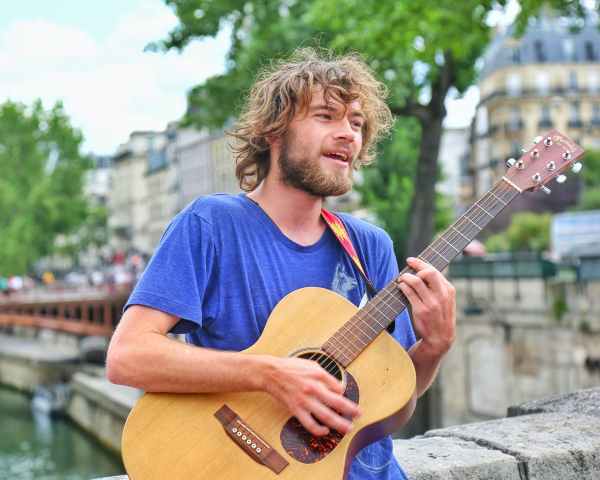
Use whatever method fits you best– use the radio, an MP3, streaming service, CD, etc., to play a song, or sing it a capella; if you are a musician, you can play the song on your instrument and sing along or think of the lyrics as you play.
Go through one verse of the song over and over– or one line or phrase that has a particular meaning. Meditate on it before the one who inspired it. “A Mighty Fortress is our God…A Mighty Fortress are you, God… A bulwark never failing… NEVER failing…”
Do a “mash up” as you are singing one song another one may come to mind. Create a medley of personal worship. Some songs might even run into each other!
Don’t be afraid to add dance or movement. Clap along. Lift your hands. Sway.
If you are having trouble getting started, find a book of hymns or songs, or tune the radio to a station that plays good music.
Make up a song from your heart! Reach back into your memory for a children’s chorus (if you grew up in church). Change the lyrics to “redeem” a classic rock song (it sounds strange, but it is not impossible for most tunes!)
Make a joyful noise!– Don’t worry if you are not a great singer. God listens to your heart!
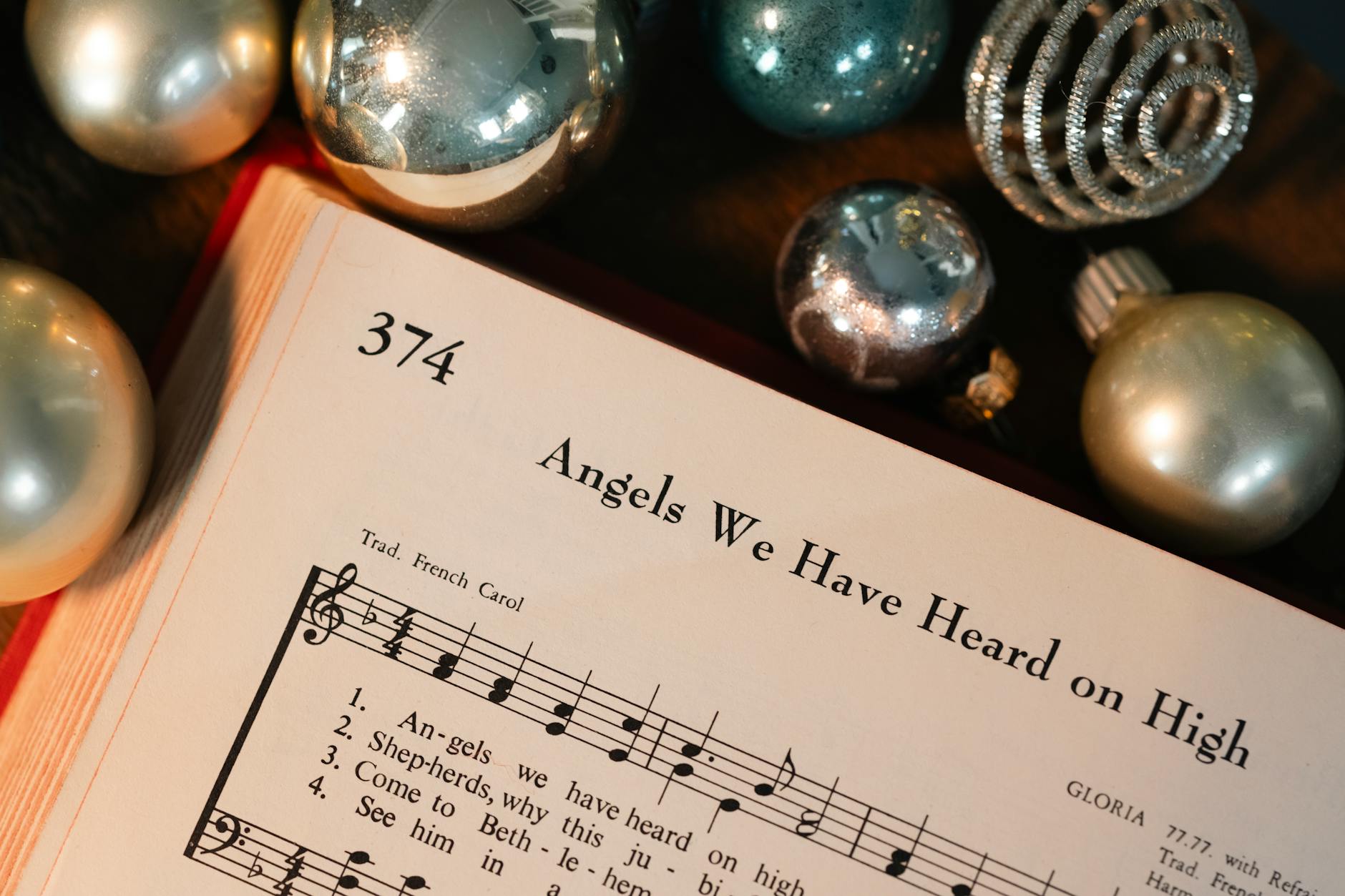
During this season of the year, we hear a lot of “Christmas” music. Much of it is secular music–Santa Claus and magical snowmen, gifts and parties, and the Holiday “blues.” But much of it is related to the real reason for Christmas: the birth of Our Lord. And the number of songs, hymns, cantatas and symphonies related to Christ’s birth is staggering! Popular secular singers record “their” versions of favorite hymns; choirs and orchestras present new songs and ancient melodies. Many of the songs fall into two distinct categories, however. There are quiet lullabies–peaceful and meditative, focused on the infant in the manger; and there are Hallelujahs– joyful and majestic, focused on the wonder of God coming to earth.
I don’t know if there were actually lullabies OR Hallelujahs on that first Christmas. The Bible mentions the visit of the angels, but they were “praising God and SAYING, ‘Glory to God in the Highest..'” We often assume that their praise included singing, but the Bible isn’t specific. But it is interesting to look at the contrast of the quietness of the manger and the Glory of the angel hosts, and hear the contrast in the hymns we raise at this time of year.
Lullabies, and quiet songs, like “Silent Night,” or “Away in a Manger” call our minds and hearts to the humility of the Christ child. Babies are cute and engaging. And they are not “silent.” But they do not command authority and majesty. Babies cry out for help. They are needy in a way that God is NOT. And yet…God came in the form of a helpless baby. The God who created the galaxies needed someone to feed and change Him; to carry Him from place to place and rock Him to sleep. “O, Little Town of Bethlehem” reminds us that He came to a cattle shed in a small town, rather than to a palace in the seat of power.
Hallelujahs, like “Joy to the World” and “Hark, the Herald Angels Sing,” remind us that this was no ordinary child. And yet…the angels did not appear IN the manger or even in the little Town of Bethlehem. The Angels were compelled to sing their praises, not to the learned priests, or the courts of power, but to dumb-founded shepherds on a cold hillside. What an explosive visitation! Their praises (whether shouted or sung) shattered the quiet and the darkness. Like a sudden fireworks display, the Glory of God’s servants split the night.
God enters our hearts– sometimes quietly, like the cooing of an infant; sometimes dramatically, like a chorus of angels. God is at work– sometimes in humble moments and ordinary gestures; sometimes in glorious flashes of insight and inexplicable miracles. And this season, our prayers will rise up– sometimes like the humble cries of a newborn baby; sometimes like the soaring songs of angel hosts– prayers of need; prayers of thanksgiving; prayers of awe-struck worship; prayers of simple confession of our own unworthiness, and of God’s sufficiency and everlasting Love. Peace and Glory; lullabies and Hallelujahs; simplicity and majesty– all wrapped up on a manger of hay on one Holy Night.

































 Pursuing Prayer