Elementary!

I love solving things–puzzles, mysteries, codes–I love finding the answer. It’s very satisfying. And I love reading mystery stories–Agatha Christie, Georges Simenon, Dorothy Sayers… But I have very mixed feelings about Sherlock Holmes. Always have had. I loved the intricacy of the mysteries themselves. They seemed impossible; unsolvable. Yet somehow, Holmes always knew the answer. And then, as he calmly explained how “elementary” it was, he would throw out details that no one else could possibly know without three doctorate degrees and a photographic memory.

I recently watched a series of TV episodes about Sherlock Holmes, and it struck me again. However, in our modern age, it is not so very impossible to become an expert on esoteric topics in almost no time. We have the internet, where vast amounts of information is available at the tip of our fingers. We can find facts about nearly everything, everywhere, at any point in history. We can virtually track people, visit places, experience adventures, and yes, even solve mysteries– all without leaving our couch. And while there are numerous dangers of relying on information found in cyberspace, there is no denying the easy availability of it.

One of the things I like about most mysteries is that they show the triumph of good over evil. Mysteries tend to show us, not only the impact of evil in the loss of life or property, the suffering of victims, and the need for vigilance, but the longing for order and knowledge and safety that we hope someone can “solve.” A good mystery story ties up all the “loose ends” and answers all the burning questions– “Who did it?” “How?” “Why?” By the end of the story, we feel victorious and safe and satisfied.

But reading mysteries or solving puzzles can give us a false sense of safety and knowledge. In real life, there are many unsolved puzzles, unanwered questions, and “cold” case crimes with no resolution. We are left asking “Why?” and “How?” about many of the things that have happened in our lives. And the answers are not “elementary”– even for the most intelligent among us.

As an adult, I read (and watch) the Sherlock Holmes mysteries with a different mindset. I know, from past experience, that Sherlock Holmes will always outwit the criminal. And I will probably learn some little-known fact– likely one that I never needed to know–that may be astonishing. But I am more interested in the character of Sherlock Holmes himself, now. Likewise with many of the other detectives I enjoy reading about. Because mysteries involve the triumph of good over evil, they attract writers who study the ongoing fight between the two. Mysteries often involve complex machinations, intricate plots, many-layered characters, and misleading information.

And the detectives are often equally complex and many-layered. Their startling intellect and deductive skills leave us in awe. Yet, they also have human frailties that lead them to overlook key clues or lead them to take risks beyond what we would consider wise. And many of them wrestle with the concept of good and evil–they are often tempted to take the law into their own hands, or to do something illegal in order to bring a criminal to justice. Thus, the reader is left with another mysterious question– just what is “Good” or “Evil?” Are there times when, in order to do “right” we may need to do something that others consider “wrong?” Can two “wrongs” make a “right?”

Some of the best detective characters are almost god-like in their ability to ferret out evil. But they are constrained in their ability to defeat evil. They are, in the end, human. Even Sherlock Holmes, with his arrogant assumptions and dizzying deductions, cannot wipe out evil; cannot keep it from touching and even ruining lives. In fact, as Sherlock Holmes (and others) discovers, intelligence is often a key ingredient of evil. “Stupid” criminals are easy to catch. The great detectives are needed to find the brilliant masterminds of evil; the ones who would otherwise go undetected and unstopped.

The man who created Sherlock Holmes, Sir Arthur Conan Doyle, was an agnostic and, in later life, became a spiritualist. He wrestled with the concepts of good and evil and particularly with the concept of how a “good” God could allow evil to exist. He was skeptical of the existence of the Biblical God, but instead believed in the continuing existence of the human spirit after death. He believed that the battle between good and evil was left to mankind to solve. He, like his famous character’s sidekick, Watson, was a medical doctor. He was a man who worshipped science– a man who valued facts above all. In fact, the stories of Sherlock Holmes offer us what seems to be a triumph, not just of good over evil, but of facts over faith.
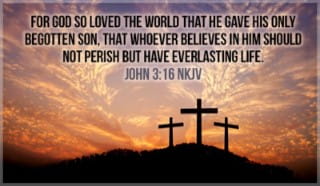
Today, we celebrate the triumph of faith and facts over skepticism and arrogance. Jesus, unlike Sherlock Holmes, did not come to the earth to “solve the puzzle of evil” by bringing individual human criminals to justice. He did not brag about His great intellect, though He dazzled the Jewish Priests of His day with His knowledge and understanding of Scripture. Jesus had no fixed address. He did not write treatises or analyze dust samples– He created nature; He had no need for further study! His disciples did not write about Jesus merely because He did miracles. They did not write about Him in order to become rich or famous. Instead, they were martyred and exiled. Jesus did not put an end to the corruption of the priesthood under the Pharisees and Sadducees. He did not break the yoke of the powerful Roman Empire. He died on a wooden cross, hung between two criminals, after being convicted in an illegal trial, and a farce of an appeal to Pilate. He was flogged, taunted, pierced, and buried in a borrowed tomb. He was, by all appearances, defeated by evil and death. He lost– by human standards and appearances.

But faith tells us that God is Good; that Jesus is God; that Good triumphs over evil. And the facts bear out our faith. Yes, Jesus died. It was recorded, affirmed, and witnessed. But that wasn’t the end of the story. He rose again. There is no body in the tomb. There are witnesses to His post-crucifixion appearances. There were witnesses of his ascent into Heaven. His disciples died for their testimony and continued faith in the face of persecution, torture, and threats. And believers over the past two millennia have lived and died in the faith. We are witnesses of His power to redeem, to restore, and renew lives.

The events of Good Friday and Easter present the ultimate mystery. Jesus, Son of God, Messiah– eternal, all-powerful, all-Good– became a sacrifice for us. He allowed Himself to be an innocent victim of Evil for our Good. And in doing so, He didn’t just “solve” a puzzle– He defeated the power of Evil once for all! We don’t have to know more than the enemy. We don’t have to chase down and outwit death. We don’t have to be terrorized by the threat of evil, the weight of our guilt, or the power of the grave. All we have to do to defeat the evil in our lives is to trust in the work of the Risen Savior and follow Him.

And that is Elementary!

Let All Mortal Flesh Keep Silence

Christmas is a time of joy and light. But the time of Advent is often a time of somber reflection. We remember a time we have never known– a time before the coming of Christ the Messiah– a time before the mysteries of Heaven were revealed and before the victory of Salvation was accomplished. Advent reminds us of the spiritual darkness that existed before God, in human form, in humble obedience, and in sacrificial love, became the Light of the World, and the Hope of All Nations.

Before the bells rang, and the angels sang; before the kings brought gold and the shepherds ran to tell the news; before there were Christmas Carols, Christmas decorations, or Christmas pageants– there was solemn silence, fear, dread, and waiting. God had been silent. The prophets had been silent. The world had grown hard and cold.

Jesus stepped out of the unfathomable glory of the Highest Heaven– surrounded by armies of angels all worshiping Him and ready to do His bidding. In an instant, He became a helpless fetus inside a helpless young woman, a subject of the Roman Empire, and at the mercy of her culture. Her fiance could have repudiated her; her parents could have disowned her; her community could have had her stoned to death, along with her unborn child. No one, even those who were anticipating the arrival of a Christ, was expecting this tiny baby growing inside the womb to change the course of history.

He was born in obscurity, in ignominious squalor. He was the Lord of All Creation, wrapped in rags and laid in a feeding trough in an overcrowded city at tax time. There were no bells or carolers, no glittering trees or festivals of lights, no sounds of joy and celebration– not in that manger in Bethlehem. Instead, there were strangers pushing and shoving, shouting, and snoring in the inns and houses and streets, being watched by soldiers and pickpockets alike, as they made their way through narrow, unfamiliar streets and tried to lock out the worry and danger and dread. There may have been silence in the fields and valleys outside of town, but not near the stable where Jesus was born. No. The “silence” we sing about during Advent is the silence inside our own hearts– a call to “be still,” and know that this baby we celebrate is God Incarnate. He is the One to whom every knee will one day bow, and every tongue confess that He is LORD.

In the stillness and silence of Advent, in the darkness lit only by candles and faint hope, we being to understand the contrast. We re-imagine what came before the joy and hope and eternal clouds of witnesses shouting, “Holy, Holy, Holy!” We remember the days and years before the angels sang, and the star danced across the night sky– before the shocking crucifixion and the glorious resurrection of this still unborn Savior.

Let us spend these days of Advent preparing our hearts for the true wonder of Christmas. It doesn’t come in the wrapped packages under a festive tree, or in the feasting with friends or family. It doesn’t come with sirens and parades, or speakers at the mall blaring out favorite tunes. It doesn’t come in the majesty of a Cathedral ringing with the voices of a choir and organ. It comes when the silence and darkness of our sin and dread are pierced with the overwhelming glory of God With Us– Emmanuel is coming! But for now, for these moments, Let All Mortal Flesh Keep Silence.

I Don’t Know Why…

I don’t know why…
God didn’t stop the bullet that took the life of a seven-year-old girl in Chicago last weekend;
God allowed for miraculous births in the same weekend in multiple hospitals around the world.

Photo by Pixabay on Pexels.com

I don’t know why…
Hundreds of people flocked to my hometown to defy social distancing measures and put others at risk of COVID-19 so they could drink and splash around in the shallows of a small lake. I don’t know why they left garbage and excrement in the lake and in people’s yards and in the high school parking lot.
Thousands of men and women risked their lives to maintain order and serve the public–donning their uniforms and braving the heat and the chaos to serve people who despise them, spit on them, defame them, and vilify them.

Photo by Harrison Haines on Pexels.com

I don’t know why…
God made snakes. And mosquitoes. And moles. And giraffes.

Photo by Pixabay on Pexels.com

I don’t know why…
On some days God feels so distant and silent; and other times He seems to be surrounding me and permeating me and holding me tight. I don’t know how His word can sometimes feel stale and sometimes cut right through me. I can’t fathom how God can be everywhere—every-when! That He knew me before all the history books and ancient empires and cities and shipwrecks and wars and all the stories I take for granted were even imagined…that He knows me now– every thought; every cell; every hair, every breath…that He knows me a million years from now. I don’t know why He chose to make me, and preserve my life, and bless me with days and hours, with friends and family, and teachers and tasks, challenges and changes.

Photo by Quang Nguyen Vinh on Pexels.com

I don’t know why.
I don’t know how.

But praise God, I know WHO.
I know who made me. I know who holds me. I know who has the power to make good come from even the worst circumstances. I know who wins the ultimate victory over death and sin and disease and destruction.

And He walks with me and He talks with me—And He tells me I am His own!

But I Don’t Understand…

I’m getting a double whammy this week–two Bible study groups; one studying Daniel and the other Job.  Some of you will groan just reading the first sentence.  Along with the book of Revelations, these are two of the most difficult and misunderstood books in the Bible.  And for good reason.  The book of Daniel doesn’t just contain the favorite stories of Daniel in the Lions’ Den and Shadrach, Meshach, and Abednego, it also contains prophetic visions that seem to foreshadow two distinct sets of events– one set that happened in the time between Daniel’s life and the birth of Christ, and another set of events yet to come.

lion sleeping beside rock
Photo by Aldo Picaso on Pexels.com

The book of Job is puzzling– there are no good clues as to when it took place, or exactly where, or even if it is real or a parable.  There is a curious interchange between God and Satan that is unlike any other passage in scripture.  Finally, it is filled with difficult dialogues from Job and his friends, as they try to make sense of his suffering as God stays silent.  When God finally speaks, He doesn’t directly answer Job’s questions or his friends’ misleading statements.

grayscale photography of man praying on sidewalk with food in front
Photo by sergio omassi on Pexels.com

What happens when I don’t understand what God is doing (or seemingly NOT doing) in my life or the lives of others?  What happens when the world doesn’t make sense, and the Bible doesn’t seem to shed any light?  What happens when I pray, but God seems silent?

I think the answer has a lot to do with where I am in my relationship with Christ:

  • I can panic, lose faith, or become angry and insolent.  If I don’t know God or don’t trust him; if I doubt his goodness or wisdom or power, I may run from his word and his presence.
  • I can lean on my own understanding.  I can substitute my own limited wisdom for God’s, and try to “explain away” all the things I don’t quite understand.  I may ignore the Bible passages I don’t understand, in favor of doubling down on the ones I think I know.  I can insist on my own interpretations of difficult or disturbing passages, even if someone points out inconsistencies in my logic, or context clues that disagree with my view.

arrogant

  • I can lean on someone else’s understanding, listening to their views without question or without reading and praying through it myself.  If someone else has an answer, shouldn’t that be enough?  Even if I still don’t fully understand, at least I have an answer…
  • I can ignore the question–after all, do I really need to know about God?  Isn’t it enough that He exists and He is good?  If I say it loud enough and often enough, won’t that make the questions go away?

adult beautiful casual cute
Photo by Pixabay on Pexels.com

It seems that there is a better way– God never promises us easy answers or complete answers to all the questions in this life.  We can be angry or grateful for that truth, but most of all we must accept it.  God will answer many of our questions–maybe not in the time and manner we expect.  And some of them we won’t understand this side of heaven.  But the Bible is clear in calling us to pursue answers, and be honest when we don’t understand.  God may not give us a simple answer, but He promises to give us wisdom– wisdom to seek, and wisdom to wait; wisdom to trust, and wisdom to keep knocking.
Ask, Seek, Knock, Wrestle, Search, Pray, Plead, Study, and Learn.

pexels-photo-935944.jpeg

Blog at WordPress.com.

Up ↑