Solitary Prayer?

So often when I pray, I do so in isolation, and I think of it as a solitary activity.  I am communicating with God– often silently–it is a private conversation.  Or is it?

At any given moment on any given day, millions of prayers are ascending to Heaven.  Consider the arithmetic of prayer– millions of prayers, millions of pray-ers, and God is part of each one–twice the number of participants.  But God is triune– so now there are four participants in every “personal” prayer, and four participants for every one in a group prayer!  It’s mind-blowing to think of all the spiritual investment that is happening through prayer at this very instant around the world.  And in heaven?  Our prayers ascend; God likens our prayers to incense– a pleasing aroma.  If I light a scented candle, or burn incense, the aroma is not personal– it permeates the air, penetrates my clothing, clings to my hair, lingers and touches on all who are nearby.  This doesn’t diminish the intimacy of prayer, but transcends it, and transforms it.  God is relational– from the intimacy of private prayer to the glory of his kingdom– he wants us to belong, to share, and to love.  Love doesn’t happen in a vacuum.  It is not a solitary activity, nor one in which anyone is “just a number.”

I think we are often deceived and intimidated by numbers and statistics.  We sometimes feel very small and powerless and alone.  We measure our prayers by their duration or the number of our words, or how small our perceived influence.  We pray alone or in a tiny group, or seem to get swallowed in a crowd, and we think our prayers travel a linear path to God’s ears and they are ended.  May our eyes be opened to the reality that we are never alone, never helpless, and never unimportant to God–that our prayers, like incense, linger, radiate, and echo as they ascend.

fog-dawn-landscape-morgenstimmung-163323.jpeg

God uses the small and humble things in life to confound those who think they are wise and powerful and important.  He is the God who changes our suffering into sufficiency, and our abiding into abundance.  He multiplies our faith, and increases our joy; he divides our sorrows and cancels out our sin.  He hears our every sigh.  He dries our every tear.  He knows our every thought.  He inhabits the praises of his people– let that sink in as we pray today.


I Was There!

apps blur button close up

Disneyland!  Niagara Falls!  Tokyo!  Paris!  Dallas!  Machu Piccu! Sydney! Kilmanjaro! Stonehenge! NYC!  Souvenirs remind us, and declare to others, where we’ve been.  T-shirts, knickknacks, photos, post cards, and more call us to remember places we’ve visited, or even lived.  There are apps that allow you to tag, city by city, all the places you’ve ever been (if you can remember them all).  Metropolises to tiny hamlets, all can be recorded and seen by anyone else with the app.

Most of the time, when we think of souvenirs, we think of pleasant memories and planned visits.  But there is another kind of souvenir–scars, traumas, sickness, crime– that can taint our memory of a place.  It’s one thing for my husband and I to visit battlefields from the American Revolution or the American Civil War– it is quite another for a veteran to visit a battlefield where he took a shell to the stomach and had to be carried out still under enemy fire, or for someone to return to a war-torn village they once called home.

As humans, we can only be in one geographic location at any one time.  We can watch live footage of events around the world, but we cannot participate in or experience them in the same way.  But God can. He is beyond space and time. He has no limitations. And there is one way we join with Him to “be there” from miles away, any time.  We can pray.  I can pray for people I’ve never met; I can pray for many people at once.  And I can feel the power of others’ prayers even when I am otherwise alone. It’s one of the mysterious and glorious ways that God allows us to join with Him in His Work and in His Nature. We are never alone. Others may be far away physically, but through their prayers, and through God’s power, they are with us wherever we go!

close up photography of brown and yellow toy figure

More importantly, we can be reassured that God is ALWAYS there–He has promised never to leave us or forsake us. He needs no jet or GPS, no visa or key, to reach us wherever we are.  And he needs no souvenirs to remind Him of His visits with us, or of the beauty (or disaster) in which we live. God didn’t just promise us He would think about us (see Psalm 139:16-17https://www.biblegateway.com/passage/?search=psalm%20139&version=ESV), but that He would be with us always and everywhere (see Psalm 139:7-12https://www.biblegateway.com/passage/?search=romans%208%3A%2038-39&version=ESV) and that nothing can separate us from Him (Romans 8:38-39).

bryce canyon canyon clouds dawn

I love looking at souvenirs, but far more, I love the memories that can’t be captured by a keyring, or a T-shirt, or a small statuette.  I love the memories of smiles, and warm hugs, meals shared, and tears spilled.  And I love the stories that remind me that even if I’ve never set foot in a particular village or city, through prayer, I was There!

Where will you go today?


Just a Second…

A few years ago, I published a blog entry called Just a Minute… , which spoke of an effort to get everyone to spend one minute each day praying for their country.  I think this is a good idea, and I hope many people are doing it. The world needs more prayer, and more people coming together to pray!

four men seated on rocks facing mountain

While corporate prayer is a valuable exercise, and setting aside a particular time to pray with others (whether in person or in spirit) is also a great idea, the thought of a short, minute-long prayer seems inadequate, sometimes.  I suppose (indeed I hope) that most people spend more than a minute in prayer if they take this challenge.  It’s easy to do– there are a LOT of things to pray for!

sign open

But it struck me as I reviewed this earlier post that God is above, and beyond, time.  A single minute can be as rich and telling of our relationship with him as an entire hour.  And scheduling a particular time to pray is beneficial to us, but it is immaterial to our Father.  He doesn’t keep “office hours.”  There is no need for an “open” sign at the throne of grace– it never closes.  God is never unavailable, or “more” available.  It only takes a split second for us to recognize his omnipresence, and connect to it.

There is no need for us to wait for Sunday, or a High Holy Day, or a certain hour to pray.  And our prayers may only last a few seconds or a minute– “God, I need help!”  “Thank you, Jesus!”  “God, please help my neighbor today.”  There is no need to wait until a crisis or miracle, either.  We can pray about things that may seem insignificant to others, but God is honored when we share our thoughts with him first, and throughout the day.

It is wonderful to spend long hours alone with God– when we have the opportunity, and when we have made time to honor him above all.  But he is always present.  Even in chaos and crisis, we can take a split second to remember the one who calms the storms.

time lapse photography of road during golden hour

Every Wall Has Two Sides

A mighty fortress is our God;
A bulwark never failing…


bulwark:

noun
    1. a wall of earth or other material built for defense; rampart.
    2. any protection against external danger, injury, or annoyance:The new dam was a bulwark against future floods.
    3. any person or thing giving strong support or encouragement in time of need, danger, or doubt:Religion was his bulwark.
  1. Usually bulwarks. Nauticala solid wall enclosing the perimeter of a weather or main deck for the protection of persons or objects on deck.

see Dicionary.com for further synonyms, etc.

black cannon in front of the brick wall building

Walls, fences, borders, barriers– there are many reasons to build them, and many ways to view them, but they have only two sides, and we can be only on one side or the other.  I enjoy visiting castles and forts, monasteries, and mansions.  Nearly all have impressive walls.  From the outside, they look imposing, intimidating, and often unfriendly (especially those with armed guards and cannons!).  But inside, the walls provide protection, insulation from any outside threats, and often peace.

Most walls provide protection– from nature, from floods or winds, from predators, and from enemies.  But there are a few walls that are built, not to keep danger out, but to keep people trapped within.  Such walls are used to isolate, punish, and imprison.

God is described in the Psalms (and elsewhere) as a fortress, a rock, a safe place, a hiding place, and a sure defense.  But those attributes and qualities are for those who chose to come inside the fortress; to ask for protection and defense.

Sometimes, we approach God as an adversary, rather than a defender and protector.  We find ourselves on the outside, facing dangers unprotected and alone.  The very walls that can shield us and give us peace rise up as barriers,   We feel locked out and vulnerable.  The only difference between peace and peril is where we are in relation to the wall.  We are no stronger, our enemy is no weaker on one side or the other– only the wall makes the difference.  And the level of peace and confidence is related, not to our own ability, but to the stability and strength of the wall between us and disaster.  The higher and stronger the wall, the safer we feel.

selective focis photo of blue betta fish

Other times, we approach God as a jail-keeper.  We have lived inside the walls, and resent His protection.  We have forgotten, or we deny, that there is danger outside the walls.  Or we assume the walls are too close or too restrictive to offer us peace.  But God hasn’t built a wall to keep us near Him or to control us– He IS the wall, the fortress, the bulwark.  To approach Him is to be protected.  To resent His protection is to resent His very presence.

Earthly walls will eventually crumble and return to dust.  Even walls that have stood the test of centuries, like the Great Wall in China, or the Tower of London, or the Wailing Wall in Jerusalem– they are not perfect, nor will they last forever.  But our Bulwark, our Sure Defense, will never fail.  Not only will He never fail to stand, nor fail to protect us, He will never fail to let us in when we seek His salvation.

man wearing gray and red armour standing on the streets

Things That Make You Wonder…(Daniel, Chapter 3)

The Biblical book of Daniel can be difficult to read. It contains stories, but they don’t seem to tie together. And sprinkled among the stories are visions, dreams, and prophecies. In chapter two, King Nebuchadnezzar threatens all the wise men of Babylon in his fear over a disturbing dream. (https://pursuingprayer.blog/2019/07/17/daniel-prayer-under-pressure/ and https://pursuingprayer.blog/2019/07/19/daniel-prayer-under-pressure-part-2/) At the end of the chapter, Nebuchadnezzar falls prostrate in awe of the God of Daniel, and rewards Daniel with a high position. He even rewards Daniel’s friends who prayed for him.

None of this context seems to carry over into the next chapter. If Nebuchadnezzar listened to Daniel’s interpretation; if he was in awe of the God of Daniel (the God of Israel– the God of Jacob), he forgot it all. The events of chapter three may have happened months or even years after the earlier episode; they may even have happened before(!)– we don’t know. But chapter three feels almost like a wholly disconnected story. Another thing that makes this story perplexing is the absence of the central character of Daniel. His name never appears in the story, and his friends are only given by their Babylonian names (unlike in chapter 2, where both the Hebrew and Babylonian names are given).

The story in Daniel chapter 3 is a familiar one to many children. (https://www.biblegateway.com/passage/?search=Daniel+3&version=MSG) Nebuchadnezzar orders an enormous statue to be built in Babylon. When it is complete, he orders all the administrators of his kingdom– minor rulers, judges, treasurers, advisers–to come to the dedication, where they are to fall prostrate and pay homage to the statue as soon as they hear the music that has been commissioned for the event. This is not a suggestion, it is an order, and anyone who fails to do this will be thrown into a fiery furnace.

Suddenly, there is a group of troublemakers (some translations call them astrologers or fortune tellers, others list them as Chaldeans–a people whose empire predated the Babylonian dynasties and whose culture and religion had produced great scholars and sorcerers). These men come forward with a single purpose– to denounce the Jews. Oddly, they only mention three names– Shadrach, Meshach, and Abednego. They don’t mention Daniel, nor do they mention any of the other Jewish captives who were in service to the king as administrators. Not only are Shadrach, Meshach, and Abednego accused of disobeying the king’s order, they are described as being disrespectful and contemptuous of the king (and the ancient gods of Babylon and Chaldea).

Much is made about the amazing things that happen next–Shadrach, Meshach, and Abednego are called before the king, who gives them a chance to answer the charges and he offers to give them another chance to bow down before the great image. When the three men refuse, Nebuchadnezzar is furious and orders the fire to be made seven times hotter. Men are killed in the process of stoking the flames, but Shadrach, Meshach, and Abednego are thrown in, and begin walking around unfazed. Not only so, but Nebuchadnezzar is astounded to see a fourth figure walking with them, and looking like “a son of the gods.” He calls the three men out, and everyone is astonished to note that they are completely unharmed. Their clothes and hair are not singed or scorched, they are not hot, and they don’t smell of fire.

Just as in the previous story, Nebuchadnezzar’s reaction is emotional and immediate. He gives praise to the God of Shadrach, Meshach, and Abednego, and makes orders that will protect them from future harassment. But there are some interesting undertones in this story that I think we ought to consider, and things we can learn about prayer in the process.

  • We called Daniel’s dilemma in Chapter two “Prayer under Pressure”. The pressure was not just on Daniel, though he stepped up to face the king. When Shadrach, Meshach, and Abednego prayed with Daniel–when they stood apart with him during their training– when they took a stand to follow the God of Israel in a land of ancient and powerful ‘gods’, they did so knowing that there would be pressure, powerful enemies, and potential persecution. God asks us to be faithful to him, regardless of our circumstances. Nebuchadnezzar had promoted Daniel and his friends to positions of power and privilege. They were grateful to the king, and loyal and devoted to serving him– except when that service called them to dishonor God. Many of us today face the pressure of honoring rulers or leaders who do not acknowledge or serve God; leaders who are corrupt or seem unworthy of our honor. We are to serve faithfully and show respect for their authority unless we are asked to disobey God’s laws or to disown or dishonor God. HE makes rulers to rise and fall. As we will see, Nebuchadnezzar’s power is far more precarious than it looks.
  • Following God will always bring confrontation and bring false accusations. Jealousy, guilt, envy, greed, anger, and malice will come to those who prosper under any circumstances. How much more to those who prosper at the hand of God? Those who have not schemed, stolen, or crushed others, and yet have been elevated to power, wealth, or honor– such people baffle and frustrate those who are grasping and clawing their way “to the top.” Those who deal in lies and stealth cannot accept truth and integrity. They will seek to twist others’ words, deeds, and reputations– sully names, destroy legacies, start rumors, invent grievances. We can let these little “fires” distract us from the “fiery furnace.” We can spend so much time defending ourselves, retaliating with our own rumors and grievances, or seeking revenge, that we become no better than our enemies. I know this from shameful personal experience. We can destroy ourselves in the struggle to justify ourselves. God doesn’t listen to rumors! God ignores false accusations, because He KNOWS the heart of every person. No matter how hot the “fire” gets, God is with us. He may not put the fire out. He may allow it to get seven times hotter, but He will be with us. If we are trusting Him, we will still have to walk around in the flames, but He will see to it that (ultimately) we are not singed or scorched!
  • Frequently that attacks we face (see above) are not about us at all. They are about people in rebellion against the God we serve. The men who spoke against Shadrach, Meshach, and Abednego may have had a personal grudge, but the Bible story points out a bigger plot. Daniel’s friends may have “felt the heat”, but the fire was not burning just for them. Daniel, Shadrach, Meshach, and Abednego were recent captives from a conquered nation who rose very quickly to power by openly serving their “foreign” God. The Babylonians (and the Chaldeans before them) had risen to power through violence, intrigue, and reliance on sorcery, sacrifice, and ancient rituals that were abhorrent to the God of Israel. He had allowed them to do so to be the agents of punishment against His own rebellious people. But the power of the Babylonian empire was not of their own making, nor was it greater than God’s power to deliver the remnant of His faithful servants. Many times, we are oppressed by others whose anger and viciousness hide their rebellion against God. They fear those who serve Him, because they fear His justice and His wrath. They hate those who serve Him, because they hate Him. When we pray for deliverance from their schemes and violence, we need to know that God hates injustice; He hurts with us as we suffer; but He wants two things for our tormentors and bullies– 1) to see God’s example of faithfulness in our lives, so they have no excuse for their rejection; and 2) to give them an opportunity to repent and receive mercy. He also wants to do two things for us–1) to refine us and show us how faithful He is; and 2) to use our struggle to encourage and embolden others. Very few people would have noticed that three men out of several thousand disobeyed the king’s command. But because of the opposition they faced, and their total commitment to follow God in the face of it, crowds witnessed their vindication and God’s salvation.
  • Notice that Nebuchadnezzar, while he acknowledges that God has saved Shadrach, Meshach, and Abednego, does not tear down the statue, humble himself to serve their God, or abandon his arrogance. Twice, God has shown His awesome power to this proud and powerful ruler; twice Nebuchadnezzar has been impressed, even awed– but he hasn’t been changed. Yet!

  • Where is Daniel? We don’t know. He may have been sent to one of the distant provinces and wasn’t in attendance for the dedication ceremony. He may have had a moment of weakness and joined the others in bowing down to the statue! All we know is that he is absent from one of the great miracles of his day. (He’ll have his own scary confrontation with a different king later in life.) This baffles me, but it also gives me hope. If Daniel DID bow down and worship the statue while his friends were faithful, God obviously forgave him and used him in a mighty way for the rest of his life. If he missed this fiery trial, perhaps God’s mercy was in it. God does not ask all of us to suffer the same trials, or have the same triumphs. God’s plan for each of us is unique. He doesn’t ask all of us to be “spiritual superstars.” He DOES ask each of us to be faithful for the fiery trials that come our way– whether fiery furnaces of persecution, or wildfires of hectic distractions and temptations, or the sudden flames of disaster or tragedy.

Today, as we pray, let us remember to thank God that, even when trials and fires come into our lives, He knows why. He knows how hot they will get. He knows how long we will be in the flames. And He is right there with us, so that we, too, may walk around, unbound and unharmed by the fires meant to destroy us.

Daniel– A Life of Dangerous Prayer

When we hear about the Biblical story of Daniel, we usually hear only the small story of Daniel and the den of lions. Daniel was thrown into a den of lions for refusing to obey the king. God shut the mouths of the lions and Daniel was saved. It is an amazing, miraculous, even incredible story. But what makes Daniel’s story truly amazing is to see it in perspective. I’d like to spend a couple of days looking at the larger picture of Daniel’s life.

Daniel, like most prophets of the Old Testament, was an ordinary person– yet he was different, too. Daniel was from the line of kings and the royal household of Israel. He was strong and intelligent, among the elite young men of the land. According to the Bible, he was also gifted with the ability to interpret dreams and visions– a gift of extraordinary importance that set him apart from others.

But Daniel was also a slave– a captive who was ripped from his homeland and taken by force to serve in the court of the Babylonian king. He was a stranger in a strange land; he walked a very dangerous line of trying to keep the favor of the king while dealing with very powerful and resentful enemies among the king’s other courtiers. Daniel stood apart–there is little mention of a family in Daniel’s story– Daniel faced many of his trials alone (except for God). And, while Daniel survived many extraordinary trials, he never received the kind of promise or fulfillment that we see in lives like Abraham or David. Daniel spent most of his life as a captive. He never returned to his homeland. He never saw the fulfillment of his great vision– in fact, he asked for clarification, and was simply told to go his way–he would understand at the end of time.

But Daniel has a lot to teach us about prayer– its power, its peril, and its promise.

In the first chapter of the Book of Daniel, we are told a very little about Daniel’s background and how he ends up in the service of the king. https://biblia.com/bible/esv/Dan%201 One little detail that stands out is that Daniel is given a new name– not by God, but by the Babylonian official who is his new “boss”. Daniel is to be known as Belteshazzar– “Protect the life of the King”. Daniel is used by God to protect, and even warn, the foreign kings who have taken him captive. Daniel faithfully serves his oppressors– he does not seek to betray them or plot revenge against them. But the new name doesn’t stick. We still know Daniel by his original name–“God is my Judge.”

Daniel’s first trial comes when he and his friends are selected for potential service to Nebuchadnezzar. They are to be trained and fed at the king’s own palace. They are to be assimilated into Babylonian culture, history, laws, etc. But Daniel refuses to be “defiled” by the royal food and wine. Instead, he and his companions ask for a diet of plain vegetables and water. Much has been made of this– entire diets and healthy living books have been based on just this simple request. I think such plans miss the bigger picture. Daniel’s request wasn’t about veggies or “strength training.” It wasn’t about eating smarter or being stronger and healthier than the other captives. It was about obedience to God AND to the very authorities who were offering the food from the king’s table.

There was nothing nutritionally “wrong” with the king’s food or wine, nor any particular virtue in the vegetables Daniel requested. But there were at least three good, Biblical reasons why Daniel may have refused to eat the king’s food. First, the Babylonian customs called for sacrifice to their gods–even human sacrifice in some cases! But much of the meat, fruit, and grain offered at the king’s table may have come from the temples. Food that had been ritually “offered” to the gods would be fit for the table of the king. But Daniel would not want to eat the food offered to these other, false gods– it would suggest that Daniel agreed that these gods were worthy of the sacrifices that had been offered– including infants. Better to eat plain food of any type than food that had religious implications. Second, the food was likely to be non-Kosher. God’s people were to be distinct, including in their diet. There were several types of foods forbidden to the Jews that would likely be on the daily menu of the palace–not just the foods themselves, but the way they were prepared. It’s not that these foods were not edible or nutritious, but God wanted his people to demonstrate discipline and obedience. Daniel did not want to compromise or cause trouble on a daily basis rejecting first this dish, then questioning that one…easier by far to simply request what he knew was in line with God’s ways. Finally, Daniel was being offered rich and decadent food while many of his fellow Israelites were starving in their captivity. To stuff himself full of the best food in the land would not change their circumstances– but it would change Daniel’s heart. This was more important than any particular diet. Daniel did not claim that his requested diet of vegetables would make him stronger or wiser or healthier than the others– he trusted that God would sustain him to be at least as strong and healthy as anyone else. And God did more!

It is important, also, to note that Daniel did not defy the king or demand special treatment. He won the respect of the official in whose charge he was being kept. He even helped the official overcome his fear of the king. Why is this important? Daniel was in a difficult and dangerous position. He was a captive– a slave in a strange land– with a golden opportunity. He was chosen to be in the elite group of young people who could serve with power and influence in the land of their oppressors. Daniel, in fear or seeking his own advancement, could have trusted to his own wits and the favor of the Babylonians. He could have abandoned his commitment to serve God in favor of serving the immediate whims of those around him. He could have determined that in his new situation, he should adapt to the new rules, even those that contradicted God’s word. Or, he could have been defiant and arrogant–demanding that the Babylonians recognize all the customs of his native land, including his Kosher diet. He could have encouraged his friends to lead a rebellion; he could have gone on a hunger strike to protest the king’s food. But the king had never commanded that the young people eat his food– he had merely offered it as an incentive. Daniel used wisdom and tact. He won the trust of the official by suggesting a trial period of ten days to see if the “alternative” food plan would prove acceptable. He didn’t place his trust in his own actions– he placed his trust in the true Judge and offered faithful service– both to God and to Nebuchadnezzar.

No matter our circumstances today– whether we are in a palace or a prison; whether we are free or enslaved– God sees us. He will judge, not only the actions of our oppressors, but our response to oppression and hardship, and mistreatment (or our oppression and mistreatment of others). May we, like Daniel, turn to the true Judge, and walk worthy of His Name today.

Where is God When…?

A priest, a Baptist minister and a rabbit go to a pub for lunch. The hostess meets them at the door with a message. “Today, we are helping a local blood bank. Your lunch is free if you donate a pint of blood.” All three agree to donate blood in exchange for a free lunch. The hostess asks each one in turn for his blood type. The priest says, “I believe my blood type is A negative. The minister says, “It’s been a long time, but I seem to remember that I am AB positive.” Finally, she turns to the rabbit. “I was supposed to be a Rabbi, so I must be a Type O!”

I love puns, and like many puns, the humor in this one comes from a grammatical or spelling error. Something in the story is almost, but not quite, as it should be. It is a good thing to be able to laugh at small mistakes. But what happens when things are terribly wrong? It’s not funny at all. It’s devastating, confusing, and frightening. We want answers. We want the situation “fixed.” We want to find out what went wrong, why it went wrong, and who is responsible.

California is burning as I write this. Thousands of acres destroyed; hundreds of homes and businesses reduced to ashes; thousands of people left homeless. Where is God in these fires? When an innocent child is abducted, raped, mutilated and left for dead, where is God? Where is God amid the unrest in Mozambique, where typhoons and political unrest have caused so much havoc? Where was God when the hurricane and storm surge displaced tens of thousands of people in North Carolina, Tennessee, and Georgia less than six months ago? Where is God in the war-torn regions of the world, where innocent families are being terrorized by bombing raids and invading armies? Where was God when millions were dying of COVID just a few short years ago?

I’d love to say that I have an answer. One that is comfortable, unassailable, logical and easy to understand. But I don’t. The “glib” answer is that God is on His Throne, omnipotent and all-wise. And He is. He is not to “blame” for personal tragedies or for sweeping disasters. Sometimes, God intervenes in miraculous ways to “save” us from certain death, “accidents,” or even attacks. But often, He chooses not to do so. And I have no explanation, no all-encompassing, deeply soothing answer for those who are left suffering.

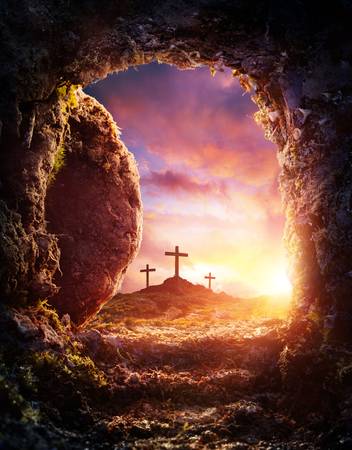
What I do know is this: God is a redeeming God. He is a God who can and often will turn tragedy into triumph. And even if, in such cases, the triumph is often bitter-sweet. This is a God who created mankind, knowing we would reject His goodness and go our own way. This is a God who took a single faithful man (Abraham) and made him the father of many nations– some of whom are still at war to this very day. This is a God who did not spare His Only Begotten Son, but allowed Him to go through a sham trial, be falsely convicted, and die a painful, publicly humiliating death. And then, Christ arose!

What does that mean for someone whose son or daughter is still dead after five (or 25) years of grieving? For someone who lives every day with the trauma of having been raped or abused as a child. It does not give immediate comfort. It does not take away the sting of injustice, pain, and questioning. But it is the promise of redemption– that just as Christ rose victorious, He will cause the pain and grief of the past to disappear in the Joy and Wonder of Eternity with Him. He WILL bring ultimate and complete justice, and it will be perfectly overwhelmed with mercy, grace, and freedom from the past.

It may seem slow and painful, but it WILL happen. Those who have suffered; they will laugh again. Those who are drowning in the senselessness of their own sorrow will experience healing and have answers to their questions. Those areas of the world where suffering is so great in the present– they will recover. Trees and gardens will grow again. Houses will be rebuilt. And yes, there will still be disasters and devastation in our lifetime, and in the years to come– UNTIL THAT DAY. That day when Christ returns to make all things new. Whatever hurts and griefs we carry now, they will be overtaken by joy and healing. No more fires, no more floods, no more war, no more disease, no more “mistakes.”

I don’t know why God allows us to suffer now. I’ve heard some philosophers try to explain, and they have many “good” reasons:

Suffering often leads to growth and necessary change.
Suffering produces resilience and develops character.
Suffering teaches us that there are consequences to our selfish and sinful actions.
Suffering often brings people closer together and brings out the best in us as we offer help and hope and encouragement.
Suffering teaches us to be compassionate toward others in their suffering and grief.
Suffering contrasts with joy, helping us to appreciate what is truly good in our lives.

These are not bad answers. But they are not complete. They are not “enough.” And I think that’s part of God’s plan. God doesn’t want us to live life on autopilot. He doesn’t give us “easy” answers– just like He doesn’t give us a life without any purpose or challenge. He doesn’t want us to focus on having all the answers. He wants us to learn from each other, depend on one another, and ultimately to trust that He knows best. It’s not an easy lesson to learn. But if we stay in pursuit of Prayer, and closeness to God, it’s a lesson well worth struggling through.

And sometimes, we can learn to laugh at life’s “typos” and other little mistakes as we travel this life.

I Just Called to Say…

Near the end of 2020, my mother took a bad fall and broke her hip. Because of COVID, we were not allowed to visit her while she was recuperating. Thankfully, she had her cell phone and was able to make and receive phone calls. My mom was a very independent sort, but she loved to be “in the know” about all that was happening in the neighborhood and among our family members– births, deaths, hospitalizations, relocations, etc.. But, for all her interest in “what’s new,” Mom was completely computer-illiterate. She didn’t text, she didn’t have e-mail, and she knew nothing of social media. She relied on her phone and her desk calendar and notepad. Being trapped in a nursing home for six weeks was torture for her, even though she needed to recover and do physical therapy there. I tried to call her every day, and each time, she would ask, “Do you have any news?”

Sometimes, I had “news” for her; someone had tested positive for COVID, or a new baby had been born. But most days, I had to tell her– “I just called to say I love you, and I’m thinking of you.” And I could “hear” her smile on the other end of the line as she replied, “well, that means a lot. I just love to hear your voice.”

I don’t know why, but it struck me the other day how often we pray about circumstances– we “call” on God because we have “news”– situations that we want to bring to His attention– as if He didn’t already know! We pray because we want to lift up someone who is ill or suffering; we pray because we need to make a confession and ask forgiveness; we pray because we are facing an unknown future, and we desire God’s guidance and wisdom. Other times, we pray because we have a specific praise or thanks to offer. These are all legitimate reasons to reach out to God in prayer, and we certainly SHOULD pray in all circumstances, but how often do we call on God just to say, “I love you and I am thinking of you!” In fact, how often do we take the time to disconnect from social media and all the other distractions of our day to really focus on spending time with God?

Mom went back in a nursing home a couple of years after her first fall…she fell again and broke her other leg! So, I called her nearly every day– with or without “news.”

I marvel that God is every bit as eager to hear from me– even me– every day, “just because.” I’m so glad that I had the ability to talk to Mom; to hear her voice–and yes, even to share the “news.” She has been gone almost two years now, but what precious memories of our time together on the phone! How much greater my joy that I can talk to my creator; that I don’t have to worry about a busy signal or dropped call; that I can read His words to me any time of day; that His presence–even though I can’t see Him or hear His voice–follows me everywhere. And that He sends special people to call me, or text, or e-mail– “just because.” And no matter how I feel about my circumstances, God is so very glad to hear from me. And you!

This isn’t a hymn, but the music was running through my head as I wrote this. How often to we hear a ballad or a love song, and suddenly realize that God sings love songs over us?! (See Zephaniah 3:17!)

Out of Time

We are saying goodbye to another year–It hardly seems like we’ve already reached the end of 2024. Time seems to travel faster each year, even though I know I have the same amount of time each day. But it feels like I keep running out of time! At some point, 2025 will “run out” of its designated time. We live in a world limited by time and space.

But God lives outside of earthly time and space– He rules them, bends them, and contains them in His sovereignty. I often write about the omnipresence of God– that He is everywhere. In fact, the only place He is NOT is Hell; and He’s even visited there, once… But God is also omnipresent in time. He IS the God of Abraham, Isaac, and Jacob– always, and all at once, along with being the God of everyone who has ever called and will ever call upon His name to put their trust in Him. God IS in the past; He is ever present, and He is ALREADY in the future, acting and overseeing His plans and purposes.

With the birth of Jesus Christ, God did not step out of time– instead, He inserted Himself into time and space and obeyed the limits He Himself had placed. He came exactly when He had determined, exactly where, and exactly how He had planned. And the same is true of His death and resurrection. His death on the cross was not a moment too soon, and not a single second overdue. Yet, Jesus was at the mercy of the very time and space He had created. Just like us, He was limited to being in one place at a time, and limited to the circumstances around Him.

Nothing shows this better than the story of Lazarus (John 11). A close friend of Jesus, Lazarus became mortally ill. Word was sent to Jesus so He could come immediately and heal Lazarus, but He delayed in coming. He delayed for two days, continuing to work where He was before going to help friend. He knew that Lazarus would not survive. By the time He arrived in Bethany, Lazarus had not only died, but had been buried. Both of Lazarus’s sisters greeted Jesus with the same rebuke–” If you had been here, my brother would not have died…” The God who is everywhere, always, was limited by His physical form, and had to walk to Bethany. He could not continue to work in one area, and be in Bethany at the same time. Nor could He stop time and space so the Lazarus’s sickness could “wait” for Jesus’s arrival days later. But the Sovereign, Omnipresent God had not “run out of time” to save His friend. Even in His human form, in His “inability” to get to Bethany “in time,” Jesus was acting according to His Sovereign plan. He brought Lazarus out of the grave! He was “there” in all of His power and mercy. And He was precisely where and when He needed to be!

As we enter a new year, it comes with limitations–12 months, 52 weeks, 365 days, and so on–we can’t see what will happen, or where we will be in March or September. It may seem that God is “late,” or “absent” in our circumstances. We may be tempted to stop praying when we don’t see immediate answers. We may, like Mary and Martha, be tempted to scold the very author of Life when we don’t get the answer we want when we want it.

This year, let us remember that God is beyond time and space. This allows us to trust that He can and will do what is best, when it is best. It also allows us to trust that God can make the most of OUR time as we trust it to Him. We may be limited to 24 hours a day, but we serve a God who can stretch and bend time, and supplement even our smallest efforts and resources with the endless riches of His Grace!

Of Spiders, Skeletons, and Saints

(NOTE: this post has been revised from three years ago.)

Just before writing this, I found a spider crawling on my shoulder. I’m not a big fan of spiders. This one wasn’t huge or furry or anything, but it startled me. I didn’t scream, but I did jump, and frantically brushed at my shoulder, and then stomped on the spider a couple of times for good measure as it tried to crawl away.

Spiders are not uncommon. They eat other annoying insects, and many are not harmful to humans. But they are “creepy.” They have all those legs and eyes and they hide in corners and drop down from ceilings. Some of them jump and some bite. There are a lot of “creepy” creatures in this world– spiders and snakes, rats and lizards, worms, and bats, and scorpions, roaches and fleas, and more. “Creepy” critters startle us; they scare us in the ways that they move, in the noises they make, and in the threat of danger– diseases, poisons, filth…

This time of year it is not unusual to see “creepy” creatures in movies and decorations and costumes for Halloween. Another type of “creepy” sighting involves things associated with death or near-death– ghosts, zombies, skeletons, ghouls, vampires…Their creepiness comes from the idea that Death has power over the living. The idea that Death stalks among us causes fear. Death is an enemy we cannot conquer. Everyone has to taste death and the unknown that follows. Everyone has a skeleton in life, but a skeleton walking without muscle or skin is terrifying to us. Everyone has a soul, but a soul without a body (or a body without a soul) makes us fearful–will that be our fate? What kind of existence would that be?

I am not a big fan of “creepy” stories and horror flicks. I don’t like being frightened for entertainment, and I have never understood why such things appeal to others. Recently, though, I heard from someone an explanation that made me think. They said, “I enjoy watching horror films and reading scary books because I know, no matter how scary it gets, that Good will always win out in the end.” Well, all right. I still don’t want to watch spooky stuff, but I can agree with the sentiment of the speaker.

Not all frightening things in this world are “creepy.” Cancer, blindness, aging, loss of a loved one, job loss, homelessness, loss of reputation, betrayal, false arrest, slavery to addiction, abuse, starvation–all are scary realities that can leave us overwhelmed, afraid, and even feeling hopeless. Nothing we can do will eradicate the threat of hardship, suffering, and death that await us all. We can make plans to “cheat” death, or build walls against getting hurt or suffering loss. But we cannot banish the threat or the fear of “what if..”, nor can we slay Death.

The Good News is that Death doesn’t win in the end. Death seems like the final word, but we can endure even this, knowing that “Good will always win out in the end.” God has not destined us to be skeletons, ghosts, or zombies, but to be saints–awakened to new life, cleansed of all sin and disease, and eternally Alive in Him! I can be startled by the spider, “creeped-out” by a skeleton, and knocked down by a debilitating disease. But I can turn the page, open my eyes, look up, and keep going, knowing that God is on His Throne.

And there’s more good news–Life, Hope, and Love are always with us. No spider, skeleton, sickness, or other threat will ever find us alone; none will ever take God by surprise; nothing can separate us from God’s Loving Care.


18 And Jesus came and said to them, “All authority in heaven and on earth has been given to me. 19 Go therefore and make disciples of all nations, baptizing them in the name of the Father and of the Son and of the Holy Spirit, 20 teaching them to observe all that I have commanded you. And behold, I am with you always, to the end of the age.”

Matthew 28:18-20 (ESV)

Cast all your anxiety on him because he cares for you.Be alert and of sober mind. Your enemy the devil prowls around like a roaring lion looking for someone to devour. Resist him, standing firm in the faith, because you know that the family of believers throughout the world is undergoing the same kind of sufferings.10 And the God of all grace, who called you to his eternal glory in Christ, after you have suffered a little while, will himself restore you and make you strong, firm and steadfast. 11 To him be the power for ever and ever. Amen.

1 Peter 5:7-11 (NIV)

6 Be strong and courageous. Do not be afraid or terrified because of them, for the LORD your God goes with you; he will never leave you nor forsake you.”

Deuteronomy 31:6

6 So we say with confidence, “The Lord is my helper; I will not be afraid. What can mere mortals do to me?”

Hebrews 13:6

38 For I am convinced that neither death nor life, neither angels nor demons, neither the present nor the future, nor any powers, 39 neither height nor depth, nor anything else in all creation, will be able to separate us from the love of God that is in Christ Jesus our Lord.

Romans 8:38-39 (NIV)

Blog at WordPress.com.

Up ↑