Have you ever seen a photo collage–a large picture made up of hundreds or thousands of tiny photos? If you stand back, you can see a large picture– a face, or a landscape, perhaps–but when you get closer, you can see the many smaller photos that make up the details.
Prayer is like that. Each of us is a tiny details in the grander scope of the world’s population. Millions of people are praying at any given time on any given day. And we don’t see all of the others– sometimes we don’t see or hear or think of anyone else as we pray. But God sees and hears them all–moreover, God weaves and blends our prayers into something amazingly more than meets our awareness. Prayers of thanksgiving add a dash of bright color; prayers of anguish sound a minor tone; prayers of confession rise like incense, and prayers of worship wrap around all the colors and sounds and scents.
Yesterday, I was feeling very depressed and small. It was difficult to pray. My perspective was off, and I could only see my own problems and emotions. Prayer helped change my perspective. As I spoke to God; as I thought about His power and omniscience, I began to see that I WAS small–but my God is enormous! And while He sees the entire picture– all places and times and peoples–He also looks on every tiny detail. He knows my name; He knows my every thought. He knows my needs and my desires; He knows my weaknesses and my unique gifts– gifts He has given! Even if no one else noticed, God would be able to pick out the smallest detail in His amazing creation, and bring it into perfect focus.
We live in a wonderfully diverse world, filled with unique individuals. One thing that defines us to our families, neighbors, and friends, is our name. Names can be tricky–some are difficult to pronounce, or spell. Some names are shortened or changed to form “nicknames.” Others are changed by circumstances, like adoption or marriage. Some names are common to several people, or shared as “namesakes” of others, or shared between generations, calling for additions, like “Jr.,” or “the elder” or “the fourth.” Some people reject the name they were given at birth, preferring to use an alias, or going through a legal process to change it. Some names have become symbolic, or stereotyped, famous, or infamous, or iconic.
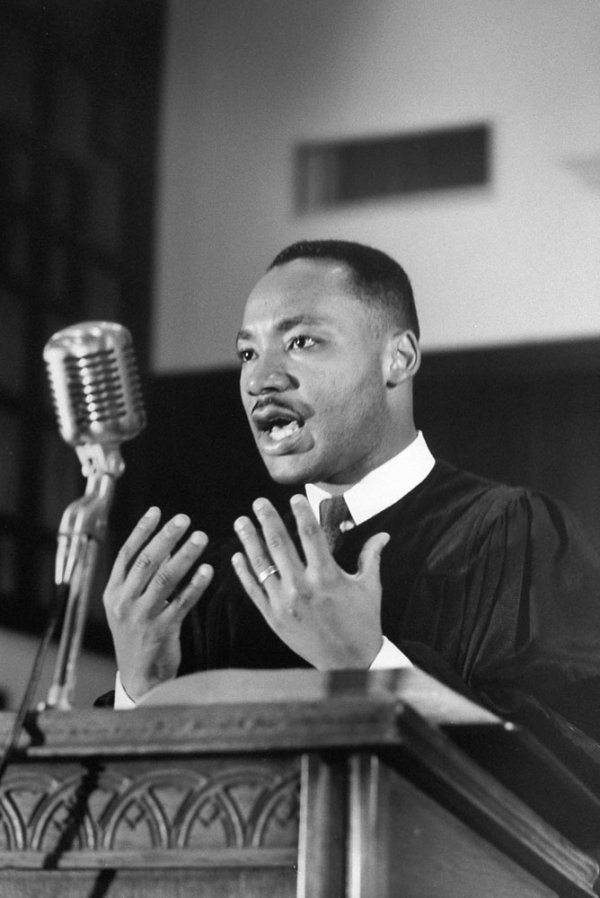
Civil Rights activist Rev. Dr. Martin Luther King Jr. gesturing during sermon at Ebenezer Baptist Church. (Photo by Donald Uhrbrock//Time Life Pictures/Getty Images)
Even though many of us may share a common first name, or surname, (or even both), our name still represents who we are–it becomes a symbolic representation of all that makes us unique– our personality, our history, and our character. And it’s not just people who carry names. We name rivers and mountains, cities, houses, farms, cars, products, pets, works of art…the list goes on. It is deep in the human soul to name things. This is a God-given desire. All the way back in the second chapter of Genesis, God brought all the beasts of the air and land to Adam, to see what name he would give them. Adam and Eve chose the names for their sons– names with very personal meanings. Names are important and carry power; they should never be taken lightly.
God recognizes each one of us by name. The prophets Isaiah and Jeremiah both refer to God calling them before they were even born! Before the great judge Samuel even knew how to recognize God’s voice, God called him by name. God often changes names– Abram to Abraham, Jacob to Israel, Saul of Tarsus to Paul, the disciple Simon to Peter (or Cephas). One reason God changes names is to show His power to transform people and give them, not just a new name, but a renewed nature and spirit.
And when we talk to God, whose very name is sacred, He allows us to call on Him through the Name He gave to Himself/His Son– Jesus. There are many boys and men who carry this name, but when we pray in the name of Jesus, we are referring to the one and only Begotten Son of God the Father; the Jesus of the Trinity; Jesus the Virgin-born Messiah. HIS name is above all other names. There is power in every ordinary name, but THIS name carries eternal, sovereign, immeasurable power. It encompasses His holiness, His compassion, His wisdom, His goodness, His faithfulness, and His Love. There is no other name by which we are saved; no other name by which we can be made new. It is not a name to be taken lightly or in vain. It is a name to be honored, cherished, and exalted. JESUS. The name above all names!
Yesterday was a roller-coaster ride–pain, annoying interruptions, difficult encounters, successful ventures, bad moods, beautiful skies. And I almost forgot to write this post. It was just one of “those” days.
I am comforted by three things, though:
God’s love is never a roller-coaster. It is steady, eternal, and extravagant. Even on days when I can’t feel it or turn my back on it, God’s love surrounds me. No matter what the circumstances; no matter what I’ve done or what’s been done to me, God’s love never changes– it never falters, it never diminishes. He loves me just as much as he would on a perfect day; just as much as He has on my “better” days. God’s love is not based on what kind of day I might be having. It is based on WHO HE IS!
Jesus had days like this, too– he KNOWS what I’m going through. He knew pain, frustration, misunderstandings, betrayal, loneliness, grief, joy, struggle, success, and even “failure” (at least in the eyes of those around him). Some days, it feels like no one understands; that no one wants to listen. Jesus was a great listener during his time here; better than any of his friends or family. And when no one wanted to listen to Jesus, he simply found time to get away and talk with the Father. What a great example for us to follow. Better yet, Jesus is always on call to listen and advocate FOR us to the Father. And the Holy Spirit gets involved, too, helping us find words and expressions when we pray. God made us. He understands our weaknesses. He doesn’t condemn– He stands ready to help!
God is Alpha and Omega. He is eternal, and He is God of the Past, Present, and Future. Today may be an awful day– or a wonderful day. Tomorrow is a mystery to us. Yesterday tends to haunt us. But God is present in all three times at once. Nothing takes Him by surprise or causes Him to wallow in worry or regret. And that should give us courage to live in the present (even if it seems chaotic or frustrating), knowing that God’s plans and timing are for our Good. Even if we “mess up” in the present, God has the power to redeem and renew our future– if we let Him.
My wise Mama told me there would be days like this–she knows from experience. And she also knows all the ways God is ever-present and ever-ready to give wisdom, courage, and comfort. Today, I want to pass along a little of that wisdom– just like she passed it on to me. I hope your day is not the kind of roller-coaster I had yesterday. But even if it is: God Loves you, He knows what you’re going through, and He is eternally present and powerful to give you all that you need to get through.
12 We ask you, brothers, to respect those who labor among you and are over you in the Lord and admonish you, 13 and to esteem them very highly in love because of their work. Be at peace among yourselves. 14 And we urge you, brothers, admonish the idle,[a] encourage the fainthearted, help the weak, be patient with them all. 15 See that no one repays anyone evil for evil, but always seek to do good to one another and to everyone. 16Rejoice always, 17 pray without ceasing, 18 give thanks in all circumstances; for this is the will of God in Christ Jesus for you.19 Do not quench the Spirit. 20 Do not despise prophecies, 21 but test everything; hold fast what is good. 22 Abstain from every form of evil.23 Now may the God of peace himself sanctify you completely, and may your whole spirit and soul and body be kept blameless at the coming of our Lord Jesus Christ. 24 He who calls you is faithful; he will surely do it.
The Apostle Paul, writing nearly two thousand years ago, left some final instructions to believers in Thessalonica. One of the instructions was to “pray without ceasing.” I have visited this phrase before, and I came back to it recently, because it still has much to teach us.
As with any verse or passage in the Bible, it helps to have context. To say “pray without ceasing,” without acknowledging the other instructions may leave a false impression. Paul is not saying that we should all stop living and working, eating or sleeping, and do nothing else but pray. But he means that we should pray consistently and frequently– prayer should be a natural part of our daily routine, and a natural reaction to events and circumstances as they occur. Prayer should not only be a personal practice, either. It should be part of “admonishing,” “encouraging,” and “helping” those around us. In fact, everything we do can be infused with prayer, and can actually be part of our ongoing prayer life. Also, prayer is part of being joyful always and giving thanks in all circumstances–“for this is the will of God in Christ Jesus for you.” Not just joy or thanksgiving or prayer, but all of them together!
What struck me about this passage today was the idea that if we are practicing consistent prayer (and rejoicing and being thankful in prayer), and teaching and encouraging others to do the same, there will be prayer “without ceasing.” As the world spins, people all over the globe who are faithful will lift up prayers that never cease. My prayers rise with those of millions of others who pray at the same moment. But someone else just finished praying before I started; someone else will begin praying as I say my “Amen.” People with very different circumstances, praying in different languages, from different parts of the world– but we have so much in common! And each prayer–each pray-er–is like a note in a symphony rising to the throne of Grace.
Our prayers are so much more than we know. They have so much more value than we imagine. Not just because we say them; not just because of the thoughts and emotions that go into them. But because, when we lift them to the God of all Creation, He weaves them into what only He can.
“Social Distancing” is the latest buzz-phrase in the media. With the spread of COVID-19, governments and health officials are asking people to avoid meeting in groups, avoid physical contact, and keep our distance from those outside our immediate family. Those who are most susceptible to the disease are being asked to self-quarantine; those who contract the disease are put in isolation. This is causing many people additional suffering, because they feel alone and even abandoned.
But God assures us that He will never leave nor forsake us. No matter how “distant” we may be from others, God is always with us– ALWAYS. Prayer does not summon God to our side, or capture His focus and attention from someone or something else. Our God is omnipresent and omniscient– He know our every thought; He is with us through every moment and every breath.
So why do we feel so alone and frightened at times like these?
Disaster, disease, hardship– especially when they come unexpectedly or develop rapidly– remind us that we live in a fallen world. We KNOW our world isn’t perfect. We know that life is fragile. We know that health and comfort are not guaranteed. But sudden tragedy leaves us unable to deny that our world is broken and we cannot, by our own efforts, fix it. We expect that God’s presence means God’s perfection will surround us, protect us, and shield us from the reality of Sin and its consequences– including the reality of Sin in the natural world around us. Hurricanes, earthquakes, infections, climate change– God allows them to happen. They will continue to impact our fallen world until God chooses to step in and put a permanent end to them. But He is still here WITH us through the storms and sicknesses and trials of life.
God’s voice is often gentle and comforting. Panic and fear are loud and insistent. We will hear the voice we focus on most. God whispers in our ear if we are listening to Him– if we concentrate on spending time with Him. How much of my time today was spent in Scripture and prayer? How much of it spent listening to the news or reading FB posts full of anger and confusion?
Sometimes, in the good times, we pay God lip service; taking for granted that He is there, but not acknowledging His presence. Sure, we say that He walks with us (or we walk with Him); but we don’t take a moment to look up and see where He is leading us. Instead of being close to God by following our Shepherd, we are close to Him because He is chasing us down to bring us back to the right path. He is right there, but in our panic, we don’t see Him, because He is no longer leading us.
Fear and panic draw our attention inward. It’s one of the reasons “social distancing” causes emotional distress. We are social creatures, but our focus is easily drawn inward, and more so when there seem to be no other people around. Our own thoughts, fears, and questions grow bigger– enough to consume us if we are not careful.
Pray. Pray some more. Pray without ceasing! (2 Thessalonians 5:17)
Let God speak– meditate on God’s word. Meditate on His names and His character.(Psalm 19) Seek out websites that magnify God. Call or e-mail friends who can pray or praise with you.
Sing! Worship the God who is bigger than any crisis we may face. Sing at the top of your lungs– if you are alone, there is no one else to hear you, but the one who adores your “joyful noise” (Psalm 100)
Encourage others– Be the reminder that someone else needs today. (1 John 4)
These are fearful days. As I write this, the world is reeling from the Coronavirus/COVID-19 pandemic. There are travel bans and business closures; people are hoarding hand sanitizer, soap, and toilet tissue, bread and bottled water.
But what do we really fear? The Coronavirus is dangerous– even potentially deadly–but so is the “regular” flu (to a lesser extent). Many people will suffer from the Coronavirus for a few days, only to recover and return to “normal”life. The economic reverses and closures, while temporarily devastating, will come to an end, as well.
In many ways, the real fear is, as Franklin Roosevelt once said, “fear, itself.” Panicked people hoarding basic supplies leave us wondering if we will face food shortages, or be left without any way to protect ourselves from the spread of this disease. We fear the rumors, the exaggerated stories, the dire possibilities and predictions. We fear over-reacting and inviting unnecessary dangers, and we fear under-reacting and taking unnecessary risks. We even begin to fear those close to us– are they telling us the truth? Are they giving us helpful advice? Do we trust their sources of information?
In the midst of this atmosphere, there are three mistakes I think we need to avoid as Christians:
Panic– the world around us reacts with fear. We are told, again and again in scripture, not to be afraid, not to worry, and not to fret. “Yea, though I walk through the valley of the shadow of death, I will fear no evil.” (Psalm 23:4) Why can we keep calm when the rest of the world succumbs to fear? “For Thou art with me..” (v. 5a) No set of circumstances– even a worldwide pandemic– are a match for God’s omniscience, His power, or His mercy. We may not know the future, but God does. He knows how this chapter of the story ends. He knows what we need, and how to supply it; He knows every cell of our bodies, and every virus in the atmosphere. And, while He may not supernaturally stop this disease in its tracks, He will give us wisdom to respond in ways that may limit the spread and severity of COVID-19– and even teach us lessons to face the next crisis.
Over-confidence–the Psalmist says, “I will fear no evil.” That doesn’t mean that I will take no caution, make no plan to protect my loved ones and myself, or feel no concern over adverse conditions. It is very tempting to put on a show of bravado in the face of worldly panic; to project confidence in ourselves and disdain for danger. Our confidence doesn’t lie in ignoring the very real dangers and struggles ahead– our confidence lies in knowing that God is ALWAYS in control. We should have a healthy concern in the weeks ahead. We should not berate those who express worries–we should direct them toward our source of comfort and strength, not waste time bragging or sneering.
Isolation– times of crisis bring out the best or worst in us. Panic and over-confidence can make us step back and close ourselves off to those in need. We need to be wise to ways that we can offer practical help and spiritual guidance to those around us. How can we offer to share burdens? Ease financial difficulties? Help deliver food or medicine to those in quarantine? Offer shelter or hospitality to those displaced by quarantine or travel bans? Help those who are grieving or stressed?
Finally, notice that the Psalmist singles out the fear of evil. Panic will bring evil in its wake. Evil will need to be confronted and checked by those willing to fight it. We need to confront those who try to take advantage of others; we need to hold thieves and liars and fear-mongers accountable, as we combat their message of greed and panic. Not because we are here to judge; but because we are here to spread Grace and Peace, Blessing and Kindness. May we be more contagious than Coronavirus in bringing God’s power and Love to those who need it so desperately at this time.
As we approach the arrival of a new year, there is a lot of talk about vision–20/20 vision, that is. For the past few years, I’ve heard of companies, community groups, even churches using the year 2020 as a target date for planning, and using the phrase “2020 Vision” in their mission statements, fund-raising drives, and talking points.
The phrase comes from 20/20 vision, considered clear or “good” vision. Someone with 20/20 vision has no need of corrective lenses or surgery to improve their reading, or correct their sight. Figuratively, 20/20 vision suggests good planning or foresight. So it is desirable to plan with clear “vision” and forethought, rather than jumping into a project, or from one unmet goal to another.
But, while it’s clever to borrow the idea of 20/20 vision and tie it to the coming year, it doesn’t guarantee that our future plans will be wise or successful just because the calendar says 2020. In the same way, just because we have 20/20 vision, it doesn’t mean that we can see everything around us perfectly. We will see clearly those things on which we focus– those things that are right in front of us and not obstructed. Even with “good” vision, we cannot see things that are hidden from sight or things that are outside our scope of vision.
Even the old phrase, “Hindsight is 20/20 vision,” doesn’t mean that we will always gain clarity with time. Sometimes we understand past experiences in a different light after time has passed. But sometimes, we are still left wondering and asking about events from our past; no wiser or less damaged by setbacks or failures, and no better prepared for future trials and pains.
If vision, even good vision and planning, is no guarantee of future success, perhaps it would be better to trust to “blind faith.” After all, doesn’t the Bible say, “walk by faith, not by sight?” Except the Bible doesn’t exactly say that. Instead it says:
6 So we are always confident, knowing that while we are at home in the body we are absent from the Lord. 7 For we walk by faith, not by sight. 8 We are confident, yes, well pleased rather to be absent from the body and to be present with the Lord.
This verse often gets taken out of context and twisted to suggest that “faith” is opposed to “sight,” and therefore faith must be “blind” to reason, experience, or reality. Many good articles and sermons have been written to clarify the concept (see one example here: https://www.biblestudytools.com/blogs/theologically-driven/walk-by-faith-a-misused-verse.html). Faith is not blind–or should not be blind. Rather, it utilizes the ability and practice of seeing what is hidden or indistinct in the present. If our faith is based on empty myth, rumor, conjecture, or cloud dreams, it is not faith at all–it is nothing more than a mirage. Faith is seeing beyond the obvious, the blatantly visible, and trusting more than just what we can immediately see. We don’t walk through life ignoring reality, or dancing across a superhighway full of speeding cars. But we see our circumstances as having hidden elements; our lives have unseen depths, and are lived on both physical and metaphysical spheres. There is more to life than meets the eye– and while faith may not always show us a clear picture of what lies beyond our sight, it causes us to know that something beyond our “20/20 vision” exists and matters.
The great old hymn, “It Is Well With My Soul,” speaks to this as well. No matter what our circumstances look like, we can have confidence that “It is well, it is well, with my soul!” “And Lord, haste the day when my faith shall be sight..” We look forward, even as we look around, and look back to the finished work of Jesus our Savior. We see the present, but we walk in the knowledge that there is more than what our eyes behold.
Faith doesn’t negate the need to use our senses and common sense to navigate life. And using planning and vision for the future doesn’t negate the need for faith. Rather, they work together. And they work together best in prayer.
When we pray, we are exercising our faith– speaking to the One we do not see, though we know Him and trust Him. And we bring to Him our plans and visions and hopes and dreams. We lay them in His Hands, trusting that where our vision is “good,” He will empower and bless us; where our own vision is lacking, His Spirit will help us to refocus and see enough of what lies beyond to keep walking forward.
Amazing grace! How sweet the sound That saved a wretch like me! I once was lost, but now am found; Was blind, but now I see. ’Twas grace that taught my heart to fear, And grace my fears relieved; How precious did that grace appear The hour I first believed. Through many dangers, toils, and snares, I have already come; ’Tis grace hath brought me safe thus far, And grace will lead me home. The Lord has promised good to me, His Word my hope secures; He will my Shield and Portion be, As long as life endures. Yea, when this flesh and heart shall fail, And mortal life shall cease, I shall possess, within the veil, A life of joy and peace. The earth shall soon dissolve like snow, The sun forbear to shine; But God, who called me here below, Will be forever mine. When we’ve been there ten thousand years, Bright shining as the sun, We’ve no less days to sing God’s praise Than when we’d first begun.
timelesstruths.org Amazing Grace, lyrics by John Newton
As I write this, a massive hurricane looms in the Atlantic Ocean, devastating the Bahamas, and threatening several major cities along the southeastern coast of the United States. There is much fear, danger, and distress for people living in these areas, for their families, and for compassionate people watching helplessly from a distance. What can anyone DO in the face of such raw power and destruction? What hope or comfort can we offer?
There are many questions we cannot answer in times like this– we can offer no definitive explanation why hurricanes form, how they behave, why they change courses, grow, shrink, or when or where they will make landfall. There are many actions we cannot take– we can’t stop a hurricane, or shift its course, weaken it or make it go away (though scientists and others have been trying for decades). We cannot provide immediate “fixes” for the damage that hurricanes (or other weather emergencies) leave behind.. roads and houses take time to rebuild; fields and forests must be replanted; families must heal and grieve.
What we can offer seems, on the surface, to be insufficient and condescending– we offer prayers, reassurance that God sees and knows and cares, we say, “trust in God and His promises.” And many sneer at such “gifts. God doesn’t promise to steer the hurricanes away from our loved ones, or our own villages or cities or islands. God doesn’t promise that we won’t experience disaster, fear, pain, or grief. God doesn’t promise us days of sunshine with never a cloud, or storm or loss.
What God DOES promise is Grace– not comfort, not ease, not happiness– something mysterious, undeserved, and unexpected. God’s grace is sufficient– it is enough– through ANY and EVERY circumstance when we ask for it. ENOUGH–never lacking, never too much for us to use, but just right for His good purpose and our best interest in learning to know Him.
Grace doesn’t take away the storms of life; it allows us to experience victory in, through, and in spite of the storms. Grace makes us strong enough, brave enough, wise enough, healthy enough, kind enough, rich enough, and “good enough” to get to the next step in our journey. It may fall short of what we expect, or envy, or dream of for ourselves, but it is never too little to be useful. God’s economy is not about bigger and better, grander or “more.” Because “More” is never “enough”– there is never enough money to buy a longer life; there is never enough strength to defeat heartache and loneliness; never enough goodness to eradicate the injustices of a hundred wicked generations. Bad things will happen. Loved ones will be wounded or killed. Homes and roads and villages will be destroyed. But God is faithful to comfort us, strengthen us, sustain us, and give us a new vision, a new hope, and a new life. Only God is big enough, rich enough, strong enough, and wise enough to do “exceedingly abundantly above all that we ask or think” https://www.biblegateway.com/passage/?search=Ephesians+3%3A20-21&version=NKJV. The amazing part is that He sends us the Grace we need to be part of the unfolding story–just what we need, just when we need it most– not because of anything we have done, but because of His great compassion.
Grace doesn’t take away the storms of life– this may seem unfair and cruel. God, even a loving God– allows us to weather storms, even to be broken and crushed by them. But God also brings blessing, renewal, healing, comfort, hope, and a renewed sense of purpose, compassion, and vision. These things often come only after the storm. Storms can bring us to a point of fear and despair, or to faith and dependence. Grace is a gift–God won’t force us to acknowledge or accept His Grace. We can choose to tremble at the storm’s approach, or rage, or try to run away. But God’s offer means we never have to face the storm alone.
Grace won’t take away the storms in our lives– and it won’t make us foolishly fearless in the face of hurricanes. But it can relieve our fears and give us the courage and wisdom to face even the fiercest trials in life; even the fiercest storms that rage. And isn’t that an Amazing hope?! Our prayers may seem small; our hope may seem insignificant– because we are not “enough” . But we serve a God and pray to a God who holds the future in His hand. Our prayers are held in the same hands– our faith is in the one who is more than “enough” to face the storm and relieve our fears.
The Bible is full of names. Some we know well– Adam, Eve, Abraham and Sarah, Joseph, David, Moses, Mary and Joseph, Jesus, John, Peter, Paul, Mary Magdalene. Others are less familiar–Nimrod, Eli, Darius, Deborah, Ezekiel, Jezebel. Some are just unbelievable– Keren-Happuch, Maher-shalal-hash-baz, Basemath, Abishag, Shammuah, Pallu…you get the idea.
But sometimes, the Bible seems to get carried away with names. Take the lists of genealogies and “begats” found in Genesis, Matthew, and Luke. Endless names of fathers and sons, tribes, and descents. They can be boring to read; even mind-numbing. But there is also important information included in these lists, if you just take the time to look closely. https://christinprophecy.org/articles/those-boring-begats/
Similarly, in places like Exodus and Leviticus, 1 Samuel, 1 Chronicles, Ezra, and Nehemiah, and elsewhere, there are extensive lists of those who were leaders of clans and families, workers who helped build (or rebuild) the temple and walls of Jerusalem, those who served in the tabernacle, and those who were among the heroes of King David’s army. In the New Testament, there are lists of people in Paul’s letters– greetings, rebukes, side-notes and requests meant for various people who are never mentioned again. Why include what amounts to a post-script in Holy Scripture?
It turns out that many of these names give us valuable clues about development of the nation of Israel– how the tribes settled and spread out; how they interacted with each other and with the surrounding nations. The names in Ezra and Nehemiah help us connect the returning exiles with their ancestors (and confirm the extent of the destruction of entire clans and families in the fall of Jerusalem). The names in the New Testament show a picture of the early Church– how it spread, who joined the early believers, and where they came from.
What does all this mean to us hundreds of years later? It show us:
God’s plans are detailed and inclusive–The Biblical writers did not have to include so many names– they could simply have condensed the story to say that Abraham had hundreds of descendants; that the tabernacle was built; that many people returned to Jerusalem to rebuild the temple and walls, and that the early Church grew rapidly. But God wanted names included (even the strange ones) so generations of readers would see the scope and detail of God’s unfolding plan. These were real people– individuals–cherished by God and worth including in the Biblical narrative.
The Bible is more than a series of mythical adventures or allegories. Many of the names (of people and places) in the Bible have been confirmed in historical and archaeological records– even those that were thought to be “wrong.”
God’s plans are universal. The Bible lists include names from various nations and cultures– Jewish names, Egyptian, Ethiopian, and Babylonian, Roman and Greek names, the names of tribes and clans that spread throughout the Earth. God knew them all. God watches over us all.
Each of us has an important role to play in the ongoing story of God’s grace. Our names may not all end up in the pages of Scripture, but our names can be in the Lamb’s Book of Life. God knows the name of every person who has ever existed! He doesn’t call us by the name of our younger sister, or get confused by our nickname or birth/adopted name– He knows us intimately like no one else ever will!
Names are important. None is more important than the Name that is above all Names– Jesus. Messiah, Christ, Savior, Immanuel. His is the Name that saves. Let’s call on Him today!
Have you ever been to a conference for work, or a large meeting or convention, where you were required to wear a temporary name badge? It might be a simple sticker with a space to write your name, or it might be a pre-printed card set inside a clear plastic pouch attached to a lanyard or a safety pin. It may have a stripe or box in a bright color, and/or an introductory word or phrase, such as “Hello..” or “My name is…” Perhaps you’ve had to wear a name tag for work on a daily basis, or you have to carry an ID tag pinned to your shirt, lapel, or around your neck or waist.
Such tags serve a purpose; they are functional, if boring, and even if they are also annoying, they are temporary. Some of them give a little more information, such as where you are from or what company, or plant, or building you represent. Name tags make it easy to identify someone and put a name to a face. But a name tag cannot reveal much beyond a person’s name. Sometimes, a name tag doesn’t even meet that simple criterion. I have a simple name, Lila, that is commonly misspelled and misspoken. I have had people look right at my name tag and call me, “Lisa,” “Lily,” or “Leah.” Wearing my name on my shirt or hanging from my neck may (or may not) make me identifiable. It does not make me knowable or known.
When we come before the Throne of God, we need no name tag. God not only knows our name, He knows us intimately– our thoughts, our attitude, our fears, our hopes, our weaknesses and strengths. He has numbered the hairs on our heads, and knows the words we will say before they reach our tongues.
This knowledge might cause us apprehension– there can be no hiding from God–even if we can lie to ourselves about our actions, motivations, and feelings, we can’t lie to Him. But this intimate knowledge should also ease our every fear– God knows all about us, and loves us unconditionally.
Prayer can be many things– joyful, contrite, needy– but it never needs to be small talk!

































 Pursuing Prayer