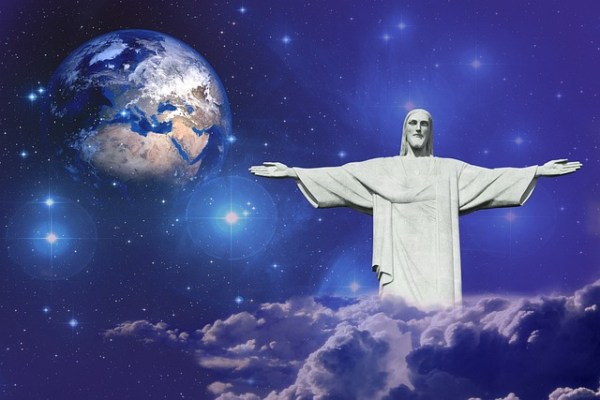
What does it mean when I pray to “the Alpha and the Omega?”
“I am the Alpha and the Omega,” says the Lord God, “who is, and who was, and who is to come, the Almighty.” Revelation 1:8 (NIV)

God exists. He is not bound by space or time. He was, and is, and will always be. And He is LORD of all that is, or was, or is to come. He is the source of all things, and they do not exist before or after or beyond Him.

As that relates to prayer– there is NOTHING that can take God by surprise; nothing that can exhaust His energy or His resources; nothing He has begun that won’t be completed; nothing lost that cannot be recovered or renewed. I can pray to Him about the most hopeless situation, knowing that God has already seen it from beginning to end.
He is Alpha– “The Beginning”–Except that God has no beginning or end. We do, and we understand time as a linear function. Everything else that we experience has a beginning, a middle, and an end in time. Dawn signals the beginning of the day; sunset marks the end of the day. Weeks, months, and years all have a beginning and an end. Our life cycle has a beginning and an end– we are conceived and born; we live; and we die. But we have a God-given curiosity to know “beyond” our own beginning. We study to see what came before us– history, genealogy, archaeology, paleontology– we want to know where we came from. And this is distinctly human. Cats don’t wonder about their lineage; dolphins don’t scour the seabed looking for bones and shells that may tell them about their ancestors. Humans, created in the image of God, want to understand and experience eternity past. And that is what God is– He was before the beginning. He is the source of our beginning. The Apostle John sums it up:
In the beginning was the Word, and the Word was with God, and the Word was God. 2 He was in the beginning with God. 3 All things were created through Him, and without Him nothing was created that was created. 4 In Him was life, and the life was the light of mankind. 5 The light shines in darkness, but the darkness has not overcome it. John 1:1-5 (Modern English Version)
He is Omega–“The Ending”–God has no end. But we do (at least our earthly life does). We do not want to think of death as the “end.” Scientists are constantly trying to explain what happens “after” death. And in spite of those who claim that there is “nothing,” most people have a hope (or dread) of what comes next. Even those who do not “know” God have a sense of immortality and eternity. We obsess about our “impact” our “legacy” on earth. How will we be remembered by those who come after? How long will our name still be part of someone’s memory or history? What is our ultimate destiny? Our ultimate “end” is to be with God. It is our purpose. It is how our earthly lives will be judged to have had real meaning. Was God our beginning and our end? Was He our first and last priority? Our best and highest thought? Heaven awaits us. There will be an “end” to life as we know it. But for those who trust in Jesus, there will be no endless darkness or soulless existence:
No longer will there be any curse. The throne of God and of the Lamb will be in the city, and his servants will serve him. 4 They will see his face, and his name will be on their foreheads. 5 There will be no more night. They will not need the light of a lamp or the light of the sun, for the Lord God will give them light. And they will reign for ever and ever. Revelation 22:3-5 (NIV)
When I pray to God, I’m not praying to the God of the Old Testament, the God of Ages Past, or the God of my parents– well, I AM– but more than that, I am praying to the God who always was, who surrounds me every second of NOW, and who will always be exactly as He always has been– Almighty, All-Knowing, Holy, Abundant, Gracious, Loving, Trustworthy, and All-Sufficient.




 Pursuing Prayer