Words have weight– I’m not talking about thousand-page novels or multi-syllable legalese terms– some words simply weigh heavier on the mind and heart than others. Some everyday words spill out like dust motes carried on a light breeze. They hang suspended in midair, without any set purpose or destination, and finally settle, forgotten, until someone sweeps them away. Other words explode, sending shards and pellets at unwary targets. Some words thunder like falling rocks in an avalanche of guilt or anger or hatred. And some rare and precious words have the weight of a quilt or a hug, or an arm lifting you up when you are falling.
One of the amazing things about prayer is that as we pour out our words before the Savior, the weight of our words is lifted off our hearts and minds and given to him to carry– the weight of the guilt, the weight of worry, the weight of grief, the weight of anger, the weight of hurt. Not only does God take on the weight of our words (and our pain and guilt), but he makes sense of it all– maybe not instantly, or in the way we imagine– but he brings order and goodness out of our chaos and burden.
And those everyday words swirling around like dust fall into the light, where they shine like gold dust in His presence. When we bring everything to God, he transforms it; he transforms us.
Our words have weight in prayer. And our words to others have weight, as well. Today, I want to weigh my words carefully. Are my words burdening others, or helping them lift a load of care? If I had to carry the weight of my words– my criticisms and clever put-downs, my accusations and angry tantrums, my bragging and comparisons– would I be dragging them behind me with joy and pride? What if, instead, my words were filled with the weight of shared laughter, encouragement, hope, and compassion? What if my words held the weight of truth and kindness and peace?
“Times are tough!” I hear many people complaining about the economy lately. And they have good reason– gas prices, food prices, housing prices, taxes– everything is getting more expensive, and wages or other sources of income just aren’t keeping up.
While we may worry about the current economic conditions, we need to step back and look at a different economy– God’s economy.
This weekend, I wrote out checks and paid bills. I even put some money in the offering at church. But God doesn’t look at the amount of money I paid or gave away, how much I spent or saved, earned or invested. He’s aware, of course, of such things, but God looks at a different “bottom line.” God cares how I spend or save money, whether it’s pennies or thousands of dollars. But He also cares how I spend my time and energy. And my life is “richer” than just the money in my bank account or the things in my house.
God doesn’t give us everything we want– He loves us too much for that. Life isn’t about having the most “toys;” it isn’t about having the easiest or most entertaining experiences. It isn’t about “winning” and having “more.”
I have noticed that the happiest people are often those who have had to struggle the hardest. In God’s economy, it is His pleasure to give more than we can ask or imagine– but often in ways we would never expect. (see Ephesians 3:20-21) In God’s economy, I am rich. Not because of anything that I have done, or earned, or because I was born to a wealthy family or because I won the lottery. I am rich because of what God has done. And if I am tempted to doubt that, I can begin listing all the blessings of God– and I will run out of space and time!
God has given me life. I didn’t choose to be born. I did not have the power to create myself. But God made me unique among all the people who have ever lived. He gave me a body, a mind, a soul, and a spirit. He gave me thoughts and dreams and opportunities to grow and enjoy life.
God gives me hope and purpose and a reason to live. Life can be difficult. It can be painful. It can be tempting to see only the darkness, the grief, the regrets. But it can be beautiful. It can be almost painfully beautiful, sometimes. What a gift. And what a gift God offers in each new day. A new chance to hope. A new chance to strive. A new chance to make a difference.
God has given me family and friends. And sometimes, that can be a struggle! We aren’t perfect, and we don’t always see eye to eye. We step on the toes or we step on the feelings of others. But we also make each other laugh. We make each other stronger. We help each other grow. We enrich the lives of others, and others enrich our lives in return.
God has given me His word– His promises; His love-letter; His wisdom; His counsel; His power to shape my story. And yours! The Bible is not just a collection of stories or words. It is Truth. It is Grace. It is how we can KNOW the riches God has for each of us.
God has given me His Salvation. No matter what today brings; no matter what has happened in my past– whether things I have done, or things that have been done to me–God sees me as His child. And if I believe in Him; if I trust Him to be who He says He is– my Father, my Savior, my Lord–He will throw my past and my guilt “as far as the east is from the west”(see Psalm 103:12). I am debt-free! And I will inherit all that God will share with His children throughout eternity!
And God has given my His Presence. I am never alone. I am never forsaken or forgotten. NEVER. (Hebrews 13:5) If I am sitting in despair on an ash heap, seeing no hope and no future, God is sitting there with me, waiting for me to see Him, and accept that He is more than “enough” to get me through.
And with such riches, I can follow God’s lead and be generous in return. I don’t have the power to give life, but I can celebrate it, advocate for it, protect it, and remind others of its beauty and promise.
I can encourage others– with acts of service, with a smile, by faithfully lifting them up in prayer. What if we thought about hugs as endowments? What if, in God’s economy, every hug you give is worth $2,000? What if every prayer is like investing in a bank account? What if your smile is worth a fortune to someone today? I can be a friend to someone who feels unseen or unheard. I can share a conversation with someone who feels lonely. I can share a burden for someone who just needs a helping hand.
I can share God’s promises. I can share His wisdom. I can share His compassion. I can share His Mercy and Grace with those who least expect or “deserve” it. I can share my hope and my joy. I can help someone look up and look beyond a bad day. And where there is suffering and pain– I can share that, too, knowing it is part of God’s good economy. And maybe, as I offer my presence, I can help someone else see the presence of God sitting there with us both!
You may not feel very rich today. And in this world’s economy, you may be in great need. God may not shower you with cash or assets in the present moment. But God has promised to give you everything you truly need for life and Godliness (2 Peter 1:3-4)
Last week, I saw numerous posts with New Year’s resolutions, promises, and goals. One that I saw repeated often was the phrase, “This year, I need more of Jesus and Less of Me.” And, while I can see the appeal of such a phrase, I’d like to take a closer look at what that really means in a practical sense.
It’s easy enough to say a phrase like this and then proceed to live exactly the same as last year– struggling to be a “better” person, a more Christ-like person–and wondering why it isn’t working. But what if we’re missing the real transformation we need this year by misunderstanding what this phrase really means?
“More Jesus.” Actually, there is no “more” Jesus to be had than there already is. We can’t “get” more Jesus. We already have access to all the Grace, Power, and Peace that Jesus can offer. We have His Spirit to guide us, His example to follow, His indescribable sacrifice to motivate us, His promises to sustain us…what “more” are we looking for?
What we really mean by this phrase isn’t more of Jesus, but more TO Jesus and more FOR Jesus– more of our devotion, more of our obedience, more of our submission, more of our learning to lean on Him. We need to make more room for Him, more time for Him, more energy.
“Less Me.” In today’s world that revolves around identity and self-expression, this is where we lose non-believers, and many Christians, as well. The language of the New Testament– Jesus’ own words in fact! — call for us to die to ourselves and be raised to new life in Him. To many people, this seems like a very bad bargain. Matthew 16:25 puts it this way: “For anyone who keeps his life for himself shall lose it; and anyone who loses his life for me shall find it again.” (The Living Bible) But look closely at this statement. Jesus is not promising death, but LIFE. (See also John 10:10) Jesus isn’t proposing to take away our life, but to help us find our best life. The word “life” in this passage can be translated as “life” or “soul.” When we think of “dying” to ourselves, or “losing” our life, we see only the negative. And death IS the ultimate negative. We don’t want to “die.” We don’t want to let go of this precious gift of life that we have been given. And it seems as though Jesus asks us to make a ridiculous trade– our life for His; our will for His; our self-control and determination for His mastery and domination.
Except that is Satan’s oldest and greatest lie! When Jesus says, “anyone who loses his life for me shall find it again,” He’s not promising a shadow life of slavery or degradation. God doesn’t want Holy zombies or robots, mindlessly and grudgingly following orders. He wants to bring us into the BEST and most abundant LIFE we can experience! But in order to experience any of it, we have to “get out of the way!” We have been given the ability to choose between right and wrong, between following God’s way or rebelling against it. It is when we believe the lie that God doesn’t love us, that He doesn’t have our best interests at heart, that He is withholding “something” from us– power, “fun,” happiness, achievement, etc.–that we lose our true life. We lose perspective, we lose joy, we lose peace, we lose our true purpose, we lost trust, and we lose hope. We get so worried that God will “cheat” us out of what we want in life, that we become enslaved to our own limitations and fears. I have hopes and dreams, but on my own, I will scheme, connive, compromise, and fall short of what I could become. I will let circumstances and bitterness determine my limits. I will betray all the promises of God for all the lies of the world. i may “win” the game of life, but in the end, I will still die. And I will die never knowing what I might have achieved WITH God, instead of in my own strength and wisdom.
So when we say, “Less Me,” what we really mean is less of my grasping, less of my whining, less of my demanding my own way, less of me shutting out others, less of me standing in opposition to God’s best for my life. ”More Jesus”– more trust in Him, more humbly walking WITH Him, instead of shaking my fists AT Him, actually results in “More Me”– not the ME that wants the world to revolve around only myself, but the Me that God created me to be! The Me that can only be shaped by a Master’s Hand. The created me bringing glory to and through the Creator!
So this year, instead of saying “More Jesus, Less Me,” maybe we should say, “Me Less, Jesus More!” Me less and less in the driver’s seat. Me less prideful and isolated. Me less prone to anger and bitterness. Me less in the center of my thoughts and plans for today. Jesus more in my daily talk. Jesus more in control of my emotions and reactions. Jesus more of my focus. Jesus more of my best and most trusted friend! And in the end, Me, More like Jesus made me!
10 If one falls, the other pulls him up; but if a man falls when he is alone, he’s in trouble.11 Also, on a cold night, two under the same blanket gain warmth from each other, but how can one be warm alone? 12 And one standing alone can be attacked and defeated, but two can stand back-to-back and conquer; three is even better, for a triple-braided cord is not easily broken.
Ecclesiastes 4:10-12
At least once each month this year, I want to write about practical ways to develop our Pursuit of Prayer. Today, I want to focus on seeking out a partner or prayer group.
There are many benefits of adding corporate or communal prayer to our lives. Most of our prayers will take place between just ourselves and God. We may pray during our quiet time, early in the morning, or just before bedtime. Our prayers may be short or long; full of joy or sorrow; silent or even mumbled. But when we pray with at least one other person, the following should happen:
We should be more focused. It may sound shallow or presumptuous, but praying aloud in front of a “human” audience has a tendency to keep us focused on the words we use and the thoughts we are sharing. And, while we can fall victim to the temptation to show off our eloquence, or say what we think others want to hear, we can also be sharpened by the reality that God AND others are listening! Have you ever “caught” yourself praying without really “hearing” your own thoughts? Sometimes, prayers can become rote or stale. We can pray on “automatic pilot”– repeating requests or phrases without really meaning them. Praying aloud in front of others won’t necessarily stop that from happening, but it should make us more focused.
We should learn from the prayers of others. Listening to others pray gives us insight into THEIR thoughts and hearts. It can also give us insight into how others communicate with the Father. Sometimes others have knowledge of issues and requests of which I am unaware or unburdened. Sometimes, they have a different way of relating to the Father– not “better,” but different in perspective or experience. I have been startled, convicted, encouraged, and emboldened by listening to the prayers of my brothers and sisters in Christ. And there is a “flip-side” to this, namely
We should allow others to learn from our prayers. I know many people who feel their prayers are somehow “inferior.” They use simple words, or their words don’t flow smoothly. They are ashamed to pray in public. And yet, thousands have been inspired and humbled by so-called “simple” prayers. They teach faith and humility; trust and caring; and even courage and strength. If everyone’s prayers were the same, or if everyone’s prayers were about their own abilities or eloquence, they would lose much of their power– because prayer is not about US; it is about God working THROUGH us.
We can agree in prayer. As one of us prays aloud, the other(s) can pray along silently in agreement. This may seem like a simple truth, or a trivial point, but it is not. Prayer, like the rest of our life, is meant to be done in communion with others–we are not meant to be solitary and self-sufficient. There is exponential power in communal prayer, as we come together in agreement on various issues. It is one of the reasons that so many revival experiences begin with a small group of people who pray fervently. This isn’t just a metaphysical phenomenon. Hearing others pray about the things weighing on my heart encourages me to keep praying when I am alone again. Hearing others pray with the same heart encourages my faith and resolve. Hearing others agree in prayer may even plant a seed that wasn’t there before. Conversely, hearing others pray may cause me to reevaluate my own thinking, or help us better hear faulty thinking and disagreement over certain issues, causing us to seek resolution and truth over long-held but unquestioned beliefs. Praying aloud can help bring us closer toward unity!
Our prayers become more powerful. “Where two or three are gathered…” Matthew 18:20 says that where two or three are gathered together in my (Jesus’) name, he will there in the midst of them. This verse is often taken out of context. It does NOT mean that Jesus will ONLY be with groups of two or more. Jesus promises never to leave or forsake ANYONE who puts their trust in Him. Others have taken this promise (along with its preceding verse) to mean that where two or three people pray together, Jesus is obligated to give them whatever they ask for. This is also misleading. Jesus is with us, not to give us a particular outcome or answer, but to guide us into truth and faith. It means that Jesus is with each person, AND with everyone who gathers together in HIS name. His presence is magnified; His power is magnified (if such a thing is possible…) Just as in the passage in Ecclesiastes, the power of a united group– even a small group of two or three PLUS JESUS– cannot be over-emphasized. Remember the story of Shadrach, Meshach, and Abednego? Satan does not worry when Christians gather together to protest or complain. It warms his heart to see a small group of Christians come together to gossip, boast, or argue. But he shudders when Christians meet together in Faith to pray! It is much more difficult for him to distract, distort, and discourage us when we pray together–for each other, with each other, beside each other!
We become more accountable. This happens best when we meet regularly for prayer with another/others. It doesn’t have to be daily or even weekly, but when we meet consistently, we challenge one another to be faithful, active, and accountable in our prayers and in our living. I pray more often alone when I pray more often with a friend or group! I pray with more focus and purpose. I pray more intentionally.
If you don’t have a regular prayer partner or prayer group, I encourage you to seek out a friend or a group of people who will meet regularly. Even if it is not a “Prayer” group– it may be a Bible Study group, a group of friends meeting for lunch once a month, or a neighbor who carpools or commutes with you. Make prayer part of your friendship or group on a regular basis.
“O Lord My God! When I in awesome wonder consider all the worlds Thy hands have made…Then sings my soul…” (emphasis added) When was the last time you spontaneously broke into the kind of wonder and praise that we find in this old familiar hymn? If it has been awhile, let today be the day that you joyously and loudly sing praise to our Awesome and Great God.
So often, I come to prayer focused on myself– my needs, my unworthiness, my circumstances. But prayer is the act of communicating with the One who is all-sufficient, all-worthy, all-powerful, and all-loving. As we pray, it will often happen that all the cares and concerns melt away in the wonder and insight that we are actually talking to GOD!
But there are times when we miss the great opportunity to fully open ourselves to the Glory and Majesty of Our Father. Yes, we communicate; Yes, He still hears us. But we fail to come away with the full blessing of having spoken WITH God. We speak TO Him; we even speak OF Him. But when we speak WITH God, we are in the presence of such majesty, that we are left beyond words! Our Soul Sings! Our Heart is overflowing! Our mind is overwhelmed with the concept!
Prayer is so much more than what we say; so much more than what we think. God is so much bigger, so much greater, so much MORE than anything we can describe, anything we can imagine! And THIS is who we approach when we pray.
If you have the opportunity, spend some time in nature today. Look up at the sky– clouds, stars, and the endless canopy of space– and let the Majesty of God fill your senses as you make time for prayer. If you cannot get outdoors, find a picture or film or website to remind you of the grandeur of God’s wonderful creation. And then, sing out, shout out, pray and praise the Maker of the Universe, and the Lover you Your Soul! This same God of the beginning is the God who was, who IS and who is to come! The same miracles He has done in the past, He will do NOW and through all time.
There is NOTHING too big or too difficult for God. There is nothing too small or unimportant for Him to do, either. And what He does, He does with Joy and in Love! He rejoices over every one who comes to salvation. He rejoices over every one who comes to Him empty and tired and discouraged– and He rejoices to give them rest, and hope, and strength for the journey ahead. He offers Grace and Beauty from ashes. He offers Eternal Life and Everlasting Peace!
And if that doesn’t make your soul sing, I don’t know of anything else that can!
My prayers will not change the world. Read that again, because it is important to come to grips with certain realities, and with certain half-truths. My. Prayers. Will. Not. Change. The. World. BUT…
We have a great tendency to think in extremes. And the subject of prayer is no exception. Either our prayers seem powerful or they seem empty. But we live in a world of limitations, a world of boundaries. I can do small things– things that make a small difference. I can help a neighbor. I can give out of my abundance. I can exert whatever power or influence I might have. I can write or speak in an effort to persuade.
But I can’t move mountains. I can’t fix a broken soul. I can’t end wars or stop famines or control the wind and waves. And my prayers cannot FORCE God to bend to MY will; to act as I see fit, or in My timing. It is not my actions or my wishes or my words– even in prayer– that will ever change the world.
Sometimes, others will see this as failure. They will say that prayer is ineffective, or weak, or no more than wishful thinking. They see it as an abdication of power– asking God to do something instead of taking action. And that kind of faulty thinking can take root and cause me to stop praying as fervently or as faithfully as I once did. It might make me doubt God’s goodness or His willingness to hear me, or to bless others. Worse, I may see His blessing of others as a slight to my own prayers and pains. I may see my prayers as a waste of time, and I may place more value on striving and struggling and fighting over the power of Faith and Obedience.
Keep Praying!
The truth is that God is the only one who has both the power and the wisdom to save the world– and us– from all the problems we see around us. And the other truth is that HE is the one who invites us to pray as an act of communion with Him IN all his power, wisdom, mercy and love. Our “small” prayers are tied to a Great and Mighty God!
My prayer will not CAUSE God to change circumstances, but it WILL involve me in the process of change– it will allow me to confirm and acknowledge God’s work as it unfolds.
My prayer may not result in immediate change of my circumstances or in the face of great disasters. But it will result in a change in ME. And it will result in changes I can’t even begin to imagine– changes that may unfold over generations; changes that may multiply ten-thousand-fold! Prayer will put me in a place where God can more easily mold me and shape my character to endure and thrive and even ACT in ways that make a positive and lasting difference.
Even prayers of worship and thanksgiving, that may seem to go in only one direction– we have no idea how God uses such prayers to pour out His greatness and worthiness on those of us who are unworthy. God’s ways are mysterious and unpredictable– but they lead to unexpected miracles and unmerited blessings.
Keep praying in the face of doubt. Keep praying in the face of exhaustion and pain. Keep praying in the face of persecution and misunderstanding. God is listening. God is at work. And others are watching and listening, too. Your prayers may be the inspiration to someone else who is struggling. Your prayers may be the seed that is being planted in the very person who is persecuting you. Your praise may be the fuel that will start a fire elsewhere in the world!
10-14 I’m glad in God, far happier than you would ever guess—happy that you’re again showing such strong concern for me. Not that you ever quit praying and thinking about me. You just had no chance to show it. Actually, I don’t have a sense of needing anything personally. I’ve learned by now to be quite content whatever my circumstances. I’m just as happy with little as with much, with much as with little. I’ve found the recipe for being happy whether full or hungry, hands full or hands empty. Whatever I have, wherever I am, I can make it through anything in the One who makes me who I am. I don’t mean that your help didn’t mean a lot to me—it did. It was a beautiful thing that you came alongside me in my troubles.
Philippians 4:10-14 (The Message)
I know many Christians who quote Philippians 4:13–generally in the King James or New King James versions: “I can do all things through Christ, who strengthens (strengtheneth) me.” It is a powerful verse, but taken out of context, it can become twisted and lead to unrealistic expectations. In context, Paul is not talking about achievement, but about endurance. “I can endure all things…” or “I can cope with all circumstances…” is a better understanding, which is why I chose to quote from The Message, instead of another translation. Many times, however, we co-opt this familiar verse to fill our calendar with busy plans for our own achievements, trusting in God to give us the strength to multi-task our way past exhaustion. We end up frustrated, disappointed, and even questioning our faith.
God never meant for any of us to do “all things..” In fact, He wants us to trust Him to direct our paths– even when He directs us away from achievement and into rest or even need. Paul was a doer. He loved to be on the road, preaching and teaching, building up churches, and making new converts. But the letter to the Philippian believers was written from a jail cell. Paul could not be there to minister to them, but they had ministered to him, instead! Paul was thanking his friends for the help they gave him, not because he was abandoned or starving, but because their gifts reminded him of their care for him, and of God’s care for all of us. God had given Paul a season of rest from the road– imposed rest, but rest that gave him time to reflect on God’s goodness in solitude.
When we set ourselves up to “do all things,” it usually means “all the things I think I can or ought to do,” or “all the things I am asked or expected to do as a volunteer or a friend or neighbor or parent…” God is more concerned with our “being” than our “doing.” He wants us to be seeking after righteousness, not self-righteousness. He wants us to be growing in our love for others– even if we can’t “do it all.” He wants us to follow Him, not impress Him!
I’m in a season of “can’t” right now. It’s not that I can’t do anything, but I can’t do “all things.” That’s not a result of my lacking faith or having a wrong view of God– God CAN do anything and “everything.” But I can’t. And God’s plan isn’t to empower me to be autonomous, self-sustaining, or self-righteous. I NEED others! And I NEED Him! What I CAN do, is trust in His timing and His resources to be sufficient for my daily needs. I can get “enough” done today, with God’s wisdom and strength. I can do “enough” to overcome anxiety or depression– with the help that God provides. That may mean allowing someone else to do simple tasks that I can’t do today. It may mean accepting medical help. It may mean changing my schedule or my expectations for today. But I can endure all the setbacks, and the moments of grief or weakness that keep me from “doing” what I had planned. I can weather it all in the power of Christ. And so can you! If you are finding yourself in a season of “can’t,” don’t skim over Philippians 4– study it. Claim it! Christ’s power isn’t for those who “can.” It’s for those who ask!
It’s a great thing to have a “can-do” attitude. But sometimes, we need a season of “can’t do” in order to step back and see what we “can BE” in the power of Christ!
When I was growing up, I knew three important things about my father: I knew he loved me–and the rest of our family–faithfully and truly. I knew he loved God–He was a man of faith, prayer, integrity, and obedience to the Word. I knew he would do anything to protect and provide for our family.
But I also knew that my Daddy wasn’t perfect. He was not the strongest man in the neighborhood; or the fastest, or richest, or most respected. He wasn’t the tallest, or most athletic. He wasn’t a leader in local politics or a chamber group or fraternal organization. He didn’t have a string of degrees, or a fleet of fancy cars. He didn’t even have a lot of hair, or perfect teeth. But he had a gentle laugh, a deep wisdom, and a hug that made me feel safe and precious. He had a enormous heart– one that was easily touched, but firmly committed. He was humble and kind; he was loyal and brave and joyful.
I was blessed to have such a Dad. I know people whose earthly fathers were distant, disapproving, absent, or even abusive. Earthly dads, even one like mine, are still human. They make mistakes and bad choices; they carry baggage from their own childhoods; they carry fears and failures; they fall short of our expectations, and their own hopes and dreams. And yet, we long to have a father we can trust; a father who won’t fail us, even in the little things; a father who will perfectly understand us, provide for our needs, and protect us. No matter how old we are, or how successful we may be, our need for a father’s love and approval never end.
Our mental and emotional picture of God is often shaped by our relationship with our earthly fathers. Especially if our father was abusive, it can be difficult to believe that God really loves us. After all, if God loves me, why did He give me an abusive Dad? If God can protect me, why did He allow me to go through a journey with Cancer? Or poverty? Our fallen world leads us into circumstances that cause us to doubt God’s goodness and His ability to redeem our broken past. But, while God sees our painful circumstances, He also sees things that we can’t. He sees the pain that our fathers feel in their own brokenness and inability to “fix” their own past. He sees the kind of growth and compassion that we can learn in our difficulties– lessons that we would not learn in ease and apathy.
God is a different kind of Father. He is eternally sovereign; the King of Kings, and the Creator of the Universe. There is no comparing Him with anyone else’s father– because He is the Ruler and Father of all! Yet, He wants a close loving relationship with each one of us– with me! With you! He is not just committed to doing His best to provide and protect some of us– He is fully capable of providing ALL our needs and protecting us against ALL enemies, including sin and death! For those who have grown up with a distant or abusive father, it can be difficult to hear of God as our “Father” and feel the kind of comfort and trust that we are meant to have. Yet God invites us into His very presence– ALL the time; ANYTIME. He is everything that the word “Father” was meant to be!
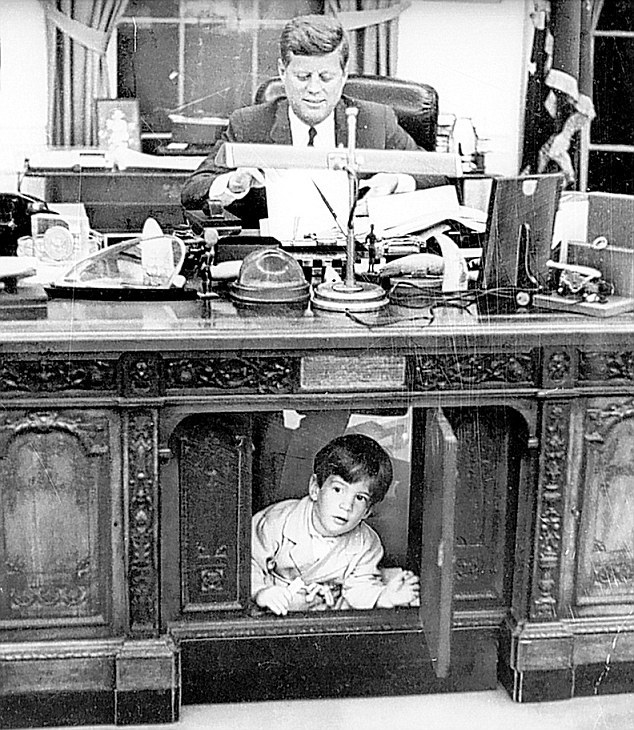
Someone once used the analogy of President John F. Kennedy to describe how we can relate to God as “Father.”. As President, JFK was arguably the most powerful man in the world– the leader of the most powerful nation on earth. At his command, soldiers, sailors, pilots, and even nuclear missiles, could be deployed. The stroke of his pen could sign bills into law, grant pardons, and appoint powerful positions. To enter the Oval Office and have an audience with the President was an honor reserved for rulers and generals and authorities– and his children.
There is a picture of JFK, Jr. as a small boy, peeking out of the Resolute Desk, as his father sits behind the desk conducting the business of the nation. The son had complete access to his father’s presence– access to the most powerful man on earth–his Daddy. He may not have fully understood what his father was doing, or even how important his father was– but he knew that he could spend time with his Dad.
Of course, President Kennedy was not God. He was fallible, and terribly mortal, as the nation learned to its grief. But the idea that God is distant and uncaring, or even vindictive and petty, is belied by the many Psalms and hymns and prayers throughout the ages. And the idea that God is just another “pal”, or “the man upstairs”–someone who loves us, but has no real power to command our obedience or rescue us from our enemies–is also belied by the many miracles and examples of His power in nature and in history. And unlike the exclusive nature of the relationship between JFK and his biological children, God invites ANYONE who calls on Him through His Son to be adopted as a son/daughter with the same intimate privilege of total access. https://www.biblegateway.com/passage/?search=John%201:11-13&version=HCSB (John 1:12)
So when I pray today, I’m not praying to my “Daddy” in any earthly sense. As much as my earthly Dad loved me, I am praying to someone who loves me more, and better, and perfectly. I am praying to the King of Kings, who also invites me to call him, “Abba”– “Dad.”
I’m really not sure at all how this post relates to prayer, but it is a subject that’s been stewing in my brain for awhile, so I thought I would “write out” my thoughts.
I have long been disgusted with a certain argument used by those who discount Creation (by a supreme God with intelligent design and purpose as put forth in Scripture). Their claim of a universe that is the result of a series of random accidents is compared to a chimpanzee with a typewriter. Supposedly, given enough time, there is a possibility that the chimp could “randomly” type a masterpiece– a Shakespearean play or the text of the New Testament.. It is a very tiny probability, but, the argument goes, enough of a probability to suggest that the universe came about in a similarly unexpectedly random way. The proponents of this argument always seem to leave their chimp typing away, convinced that their argument is unassailable– that they can drop the mic, walk off stage to the thunderous applause of their peers, and sit smugly back while creationists pick up their jaw from the floor and stammer in defeat. (To further explore how this analogy works, see https://www.npr.org/sections/13.7/2013/12/10/249726951/the-infinite-monkey-theorem-comes-to-life)
I’m flabbergasted that this argument still gets any credence. It is laughable in its illogical assumptions and disregard for the complexity and wonder of Creation. AND it refutes its own basic assumption– that of randomness. Let me break it down:
First their example is NOT random at all. And, once true randomness is introduced, the idiocy of the argument is obvious. What if we replace the chimpanzee with any other random animal? A hedgehog. A butterfly. A hippopotamus. A fish. What is the probability of any of THEM typing a masterpiece? None. The theory hangs on the mathematical principle of probability theory, but probability rests, not on random unknowns, but on specific factors and specified outcomes, i.e. an agent (such as a chimpanzee) with the ability to use a specific type of tool (such as a keyboard) to produce a certain outcome (such as a specific phrase or work of literature).
The same thing applies if we replace the typewriter. Oh, modern arguments have replaced the typewriter with a computer keyboard– in fact computer models have even been tasked with trying to figure up the most likely probability percentage of this “random” event. But what if we take away the keyboard filled with letters, and give the chimp a crayon of a ball point pen. What chance then of the simian “creating” a work of fiction or a sacred book? As soon as it becomes apparent that the “probability” of such random factors producing a specific outcome is not just tiny, but non-existent, the analogy becomes ludicrous.
Finally, we don’t have random literature. Generally, we have “Hamlet.” But barring that, we have “random” works by Shakespeare, or Milton, or the King James Bible. The chimpanzee doesn’t have an Arabic keyboard. It never seems to type out classic works in Chinese literature (though it “could” in theory, I suppose). What we have is a very specific example of a single creative act that “might” statistically be “produced” (see the discussion on this below) given an infinite amount of time. And it is a visual image that our brains are tricked into thinking of as a “possible” outcome of random chance.
But it is not just the absence of true randomness, but the absence of reality that distresses me. The proponents of this argument not only want us to assume that the chimpanzee CAN type out a masterpiece, but that it WILL type out a masterpiece. On what theoretical plane is it logical to assume that the average (or even above-average) chimpanzee will spend any length of time pounding away at a keyboard to produce literature? To what purpose? Why should it? Or that the typewriter will never “jam” or run out of ribbon; or that a word processor will never experience a “glitch” or lose power, or have enough memory to store all the “failed” attempts. Will “auto correct” kick in? At what point does reality suggest that this “random” event is not only not probable, but not logical? As one wit suggested, “A million chimps at a million typewriters will never write Hamlet, but they will break the typewriters and fling their poop.”(I found this on the internet– I have no attribution for the “quote” as it was simply included with an image of a chimp at the typewriter.)
And how long will this take? You can’t realistically have a single, immortal chimpanzee in this scenario. You need infinite generations of chimps (supplied with typewriters) with nothing better to do than prove an illogical “random” theory. How many humans will it take to “witness” this process? How do they determine that the outcome has been reached successfully? And they all–chimps, machinery, witnesses– have to work toward this single goal; NOT of their own free will (and not “randomly”), but enslaved to a very human need to suggest what can only be theorized.
This brings me to another failing of the argument. One of the reasons we still use the word “theory” when speaking of Evolution or the “Big Bang” is that they can be theorized, but never demonstrated. No one can demonstrate how a universe can be formed out of nothing, because the universe and all its materials are already here. The most one could ever do is “re-create” or “simulate” what happened “In the beginning.” Similarly, the theoretical chimpanzee (or aardvark, or whatever) will never “create” Hamlet or the book of Matthew, or Paradise Lost. At most, it might create a reproduction–by “accident” rather than earnest intent–of an already existing masterpiece. This is not Creation. It is not even imitation, in the way that “West Side Story” re-creates “Romeo and Juliet” or a new translation of St. Matthew “modernizes” the King James Version of the same gospel. If a chimpanzee successfully photocopies a page of Shakespeare, we would never suggest that it was a literary “creation.”
And this brings me to my last baffling observation– that the Creation of the Universe would be compared to the creation of a single artistic product, and that Art and Literature would be dismissed as mere random “occurrences,” the likes of which any monkey could produce.
The Apostle Paul warned of this kind of futile thinking in his letter to the Romans:
18 The wrath of God is being revealed from heaven against all the godlessness and wickedness of people, who suppress the truth by their wickedness, 19 since what may be known about God is plain to them, because God has made it plain to them. 20 For since the creation of the world God’s invisible qualities—his eternal power and divine nature—have been clearly seen, being understood from what has been made, so that people are without excuse.21 For although they knew God, they neither glorified him as God nor gave thanks to him, but their thinking became futile and their foolish hearts were darkened. 22 Although they claimed to be wise, they became fools 23 and exchanged the glory of the immortal God for images made to look like a mortal human being and birds and animals and reptiles.24 Therefore God gave them over in the sinful desires of their hearts to sexual impurity for the degrading of their bodies with one another. 25 They exchanged the truth about God for a lie, and worshiped and served created things rather than the Creator—who is forever praised. Amen.
Romans 1:18-25 (NIV)
The world is filled with awesome and majestic reminders of God’s Power, His Character, His Faithfulness, His Wonder, and His Glory. God created the chimpanzee– and the kangaroo, the pineapple, the ostrich, the Milky Way, and YOU! And He created individuals with the creative capacity to invent typewriters, write sonnets, paint murals, and compose sonatas. He is a God of infinite variety, and amazing consistency. Many of those who study the origins of life on Earth– really study it, rather than trying to “figure it out,” have concluded that the factors necessary to “create” and sustain life– and more amazingly, to sustain the life we see around us in its beauty, power, and complexity–require such exquisite precision and timing that the “probability” of life on Earth (and the probability of “Earth” itself) without a supreme and purposeful Creator is beyond human calculation– and even beyond computer calculation!
So I guess this does bring me back to prayer– We don’t pray to a theoretical “god,” but the God of Creation, and Wonder, and Majesty! Let’s remember to Praise Him today!
In the beginning was the Word, and the Word was with God, and the Word was God. 2 He was with God in the beginning. 3 Through him all things were made; without him nothing was made that has been made. 4 In him was life, and that life was the light of all mankind. 5 The light shines in the darkness, and the darkness has not overcome it…14 The Word became flesh and made his dwelling among us. We have seen his glory, the glory of the one and only Son, who came from the Father, full of grace and truth.
John 1:1-5; 14
Emmanuel– God WITH us. The Baby Jesus in the manger is the same Jesus on the Cross; the same Jesus who was involved in the Creation of the universe.
We love seeing the Baby Jesus in the manger. We like the idea of Jesus, the good teacher and friend. We even bow our heads to honor the Jesus of the cross. We pray to Jesus, acknowledging that He is the God-Man who came to save us from Sin. But sometimes, we get so comfortable seeing Jesus lying peacefully in the manger or serenely enduring the pain of the Cross, that we ignore His absolute Holiness and Power.
Jesus was fully human– he ate, slept, cried, felt cold, and felt pain. But He is also God– fully Divine; fully Sovereign. He doesn’t force us to worship Him– not now, anyway. Someday, though, every knee will bow, and every tongue compelled to confess that Jesus is the Ultimate Authority in Heaven and on Earth (Philippians 2:10-11). Larger than life; more permanent than history; eternally Sovereign.
We pray to a God who is so awesome and glorious that no person can see His face and live. And yet, we pray to a God who so loved mankind that He came and walked among us, lived among us, and died among us. We look at Baby Jesus in the manger– we see the face of God. And when we look at our neighbors and friends, we look at those made in the image of God– we see those beloved of God; those Jesus came to save.
This is not new theology. This is basic Christianity. But sometimes, in the bustle of the “Season, ” we forget the wonder and the miracle that is the very reason for it all. God is NOT distant. He is not looking for reasons to reject or condemn us. He reaches out to us EXACTLY like a baby reaches out– seeking to be held close. He is as close as the person sitting next to you at the dinner table, or sharing a seat on the bus. GOD! Not a theology; not a list of do’s and don’t’s. Not an esoteric idea. A Presence; a living Christmas Present! An eternal Gift of Love! One with arms and legs; a twinkling eye and infectious smile.
In this season of Advent and Christmas, may we let the Glory of God fill us with awe and wonder. And may we let the Love of God fill us with hope and joy. May our prayers be like the sweet singing of the Angels on that Holy Night so long ago. “Glory to God in the Highest! And, on earth, Peace among those with whom He is pleased.” (Luke 2:14).
































 Pursuing Prayer