Casting Shadows

Today is “Groundhog Day.” Tradition says that on this day, if a large rodent called a groundhog peeks out of its hibernation burrow to see its shadow, there will be six more weeks of winter. For more history about this observation, see https://www.yahoo.com/lifestyle/groundhog-day-five-things-didn-095407401.html?fr=sycsrp_catchall .

Candlemas, the celebration on which Groundhog Day is founded, is actually the day of the Baby Jesus’ presentation in the Temple (see Luke 2:22-40). Forty days after his birth, every first-born male child in Israel was to be presented at the temple, and a sacrifice was to be made for his redemption. This traces back to the Passover tradition, when the angel of death passed over the houses of the Jewish families who had painted their door frames with blood. Meanwhile, the first born sons (and animals) throughout Egypt were slaughtered. In this way, God showed His Power and His Mercy, leading Israel out of Egypt in triumph, while showing judgment on the Egyptians. (See Exodus 12).
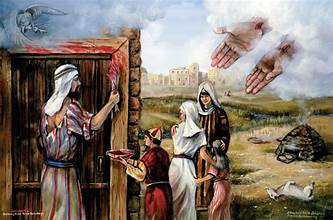
History and tradition cast long shadows. The Jews had been slaves in Egypt for nearly 400 years. A new tradition helped them remember where they had come from and celebrate the promise that God would lead them to their own land. The Jewish people had kept this sacrificial tradition for centuries, reminding them of God’s mercy in saving their sons, and in redeeming them as a people from slavery in Egypt. Christians, realizing that this tradition “foreshadowed” the coming of Christ, adapted it into a new celebration. Christians celebrated Candlemas for centuries, remembering that Jesus was presented as OUR sacrifice, OUR redemption from Death into eternal Life Jesus came to be our Sacrifice, and also our Light. 

But somewhere along the way, pagan beliefs and rituals were woven into the story of this day, until it has become “Groundhog Day.” Instead of the Lamb of God, we celebrate a common rodent. Somewhere in Pennsylvania (Punxsutawney), a small crowd gathers as someone lifts up a frightened groundhog and pronounces a weather prediction (one that is less than 50% accurate!) And everyone is looking for a shadow, instead of celebrating the Light.

The thing about shadows is that you cannot see them when you are looking INTO the light. You have to look away, turn around, look back, to see a shadow. Shadows are cast when something gets between the source of light and a flat surface. History casts shadows. Memories cast shadows. Sin casts a huge shadow. But Jesus is pure light. The Word of Life came to be a “lamp unto (our) feet and a light unto (our) path” (Psalm 119:105 KJV). We are meant to learn from the shadows of the past, but not to walk in them. We are to walk in the light, looking forward to the fulfillment of God’s promises, even as we celebrate the faithfulness of His past actions in the lives of others.

Light casts no shadow. But it banishes the darkness where shadows live. Our choices have consequences. We can turn away from the light, or step in opposition to the light, and cast shadows that may follow for generations–cycles of abuse, isolation, hatred, anger, or regrets. Or we can choose to follow the light, and banish the shadows of the past– bringing peace, repentance, reconciliation, and hope.

Heavenly Father, today, I pray that I will be a reflection of Your light in the world; that my actions would help banish shadows of doubt and despair, and shine with Your truth and hope for others to see. Where there are shadows in my life from the past, may I learn from them and leave them behind as I follow you more closely. Where I have cast shadows in the lives of others, help me to bring light and healing in Your name. Amen.

In One Accord

I heard a riddle a few years ago, that went something like this: ”What kind of car would Jesus drive? A Honda–it says in the Bible that Jesus and his disciples were all in one Accord!”

While that pun may raise some groans, it also hints at a valid principle. Those who follow Christ should be “in one accord.” Whether we are riding together in a car, or sitting together in a service, or serving together on the mission field, we should be of one mind. But what does that actually mean in a practical sense? How does it relate to a pursuit of prayer?

To be “in accord” is to be unified, in agreement, in consensus, in harmony, with all the others of a group. It is the act of blending together for a single purpose– to match up with others in a single focus–to unite in one glorious expression. Think of a harmonic musical chord– three or more single notes being played together to make a fuller, richer, more complete burst of sound. The notes must act together– they must be in harmony within the scale, and they must be played at the same time. There is even such a concept in music of “resolving” a chord– first playing a chord in a minor key, then changing one or more of the notes to form a similar chord in a major key. The human ear is drawn to chords that “resolve”– music that ends on a “positive note.”

In human relationships, we also like resolution and harmony. As Christians, we are strongly encouraged to live in harmony and unity, living for others, so that we may “glorify the God and Father of our Lord Jesus Christ with one mind and one voice.” (Romans 15:6 CSB) We are not to insist on having things “our way,” to resist those who offer Godly correction, or to be part of creating divisions. Instead, we are to refrain from selfish ambition, to remain faithful to Christ’s teachings, and to “resolve” conflict whenever possible.

Likewise in prayer. We should echo the prayers of others, as we seek God’s will to triumph over situations and circumstances. That doesn’t mean that we all have to intone the same rote words whenever we are together. But it does mean that we should support each other in prayer, just as we would in speaking to each other and about each other.

And that involves seriously evaluating how we speak and act and think about our fellow Christians. If we gossip or spread complaints about our Brothers and Sisters in Christ, we are NOT in accord, and our prayers cannot be in harmony with theirs. If we are waiting for others to see things “our way,” we should be very careful about how we pray– it may be that WE are the ones who need to reconsider, or it may be that we need to listen before we presume to judge. Being “in one accord” involves humility, kindness, gentleness, and a willingness to accept (and sometimes to give) difficult Godly correction. The goal is not for others to see things “my way,” but for all of us to see things God’s way!

And when that happens, our prayers will be like a symphony, built of gloriously harmonious chords. Just imagine how delightful it is to pray “in one accord,” knowing that our prayers not only reach heaven, but fill it with music!

For more information on this concept, check out https://www.gotquestions.org/in-one-accord.html .

A Walk Around the Block

I keep a prayer journal. I’ve written about it several times on this blog. I keep track of people and places to pray about every day of the year. But I also have a tool I call “Prayer Points.” Each day of the week, I like to focus on a different aspect of life around me. One day a week, I focus on family matters. Another day, I focus on finances. Yet another day is all about cultural influences. And one day is for community. When the weather allows, I love to take walks around my neighborhood. And as I walk, I think about how I can pray for my community. I pray for the local churches (including, but not limited to my home church). I pray for the local schools, our local community college, and our local day care facilities, and their influence over our children and grandchildren. I pray for our local businesses– the grocery stores, the insurance reps, the chiropractor’s office down the street, the local bakery, the museum across the tracks (the train station, while I’m at it). I pray for houses, parks, families and pets, trees and roads, too! I am amazed at how much I notice on my walks as I am thinking of ways to pray.

It’s winter in our area right now, so I can’t physically take a walk around the block without bundling up. But I can walk the perimeter of my small shop and mentally take a walk around the neighborhood, praying as I pace back and forth. I did this the other day, and couldn’t believe how quickly the time had passed! And next week, I can take another “walk” as I pray for gas stations, fast-food restaurants (as well as the local diners and bistros), the library, the post office, the hospital….

I post this, not as a model for everyone who reads this. Some people live in remote areas– where I grew up, there were only about seven houses and four fields on “my block”! And it may not be possible, or even safe to walk around your neighborhood praying for specific buildings. But mentally, we can each consider how to pray for “our” neighborhood. It may be your neighborhood at work, or on your commute, or at school. It may be the neighborhood of your closest village or your apartment complex or cul-de-sac. You may wish to draw a map to remind you to pray for those around you. You may be able to drive around periodically. You may wish to list your closest neighbors in a journal or planner.

It’s important for our prayers to be inclusive–to reach out and carry burdens for those around us. That doesn’t mean ignoring our own needs or concerns. But it can help put those needs in perspective. We are not meant to “do life” alone. We are part of our communities, whether we acknowledge it or not; whether we participate in community life or not. And that should find reflection in our pursuit of prayer.

Have you taken a walk around the block lately? Have you noticed situations around you that call for praise or petition? What are some of the ways you see God working in your neighborhood? How would you like to see more of God’s hand at work there? In what ways might God be calling you to become more involved in community activities or one-on-one with your neighbors?

Unspoken

What does it mean when someone says they have an “unspoken” prayer request? If you are new to Christianity or to prayer, this can seem confusing. Aren’t we supposed to present our requests to the Father? Aren’t we supposed to pray for one another? How can we ask someone to pray for us, and then hold back on giving a reason? Is that “cheating” somehow?

There are several reasons why someone may ask for “unspoken” prayer, and there is no reason why we should not pray just as fervently for an unspoken request. So why would someone be reluctant or even unable to speak their request?

  • Sometimes, they are passing along a request from another. Someone has shared a burden, and it seems too large for just one or two people. But the original request was not shared publicly, nor did the sharer give permission to share details in a group. It is important to honor the other person’s attempt to avoid gossip and oversharing.
  • Sometimes, the request involves a delicate personal situation– an unsaved spouse, an aging parent facing financial difficulties, etc.– and the details of a request might cause unnecessary pain or shame to another, or strain an already tenuous relationship.
  • Sometimes, the person asking for prayer cannot put their request into words. They know there is a problem, but they may not fully understand what they need or even want. Sometimes, a sudden change throws them into turmoil. Other times, an unrecognized problem has been looming, and they are taken by surprise. Sometimes, there are multiple issues and layers of issues that can’t be explained easily.
  • Sometimes, the person is ashamed of asking. They may feel like a failure for even asking. It may be an issue they thought they had overcome, and they are reluctant to admit that it isn’t resolved. They may not be ready to confess a secret sin, but they know they need help.

Whatever the reason, we should always be willing to pray, especially when asked to do so. But how can I pray for someone who won’t or can’t tell me what they need? 

In many ways it is the same– If I know that “Sue” is battling cancer, I am still praying to the same God as I am for “Janet” who can’t tell me about her recent diagnosis or her ongoing battle with a wayward teenage daughter. Yes, I can be more specific in my prayer for Sue, but I can still lift up Janet as someone who needs God’s care, protection, and encouragement. I can acknowledge that God loves both women, and that God is the only one who can meet their needs. I can praise God that HE knows all; that He is sovereign over all, and that He cares about Sue and Janet (and Me) far more than I can understand. 

What are some practical guidelines when praying for “unspoken” requests?

  • Honor the other person’s privacy. Don’t try to drag a confession or sordid details from someone who is already struggling to share their need for prayer. Your “need to know” all the details is less than another person’s need for earnest encouragement, compassion, and support.
  • Concentrate on the basics— don’t try to “guess” at specifics. Pray for their general health, well-being, growth, encouragement, and strength to persevere. If you know of an ongoing situation, don’t get bogged down on praying for just that issue. Use this opportunity to uphold your friend or neighbor, brother or sister in loving prayer, not intense scrutiny.

  • Do not cast judgment. It is NOT your place to decide whether or not the other person “should” be more open or share more details. It is NOT your place to decide whether or not the other person “really” needs your prayer. We all know people who “overshare,” and we all know people who seem addicted to drama. We all know other people who never open up or seem independent and self-contained. Their “unspoken” requests are still “real” requests– even if they are making the third one this week. Lift up your sister or brother with love, not exasperation or comparison with anyone else. Remember, you would not want someone else dissecting your life trying to decide if your prayer requests are “worth” their time.
  • Thank God for the opportunity to join God in loving others! If someone is asking for your prayer, it generally means that they respect and trust you to respond. God is giving you a unique and wonderful opportunity to join in His work! Prayer of this type is not a burden or an obligation. It should be a joyful experience.

  • Follow up. Let the other person know that you are praying for them. If possible, pray with them, remembering that this is not an opportunity to pry, poke, or condescend, but to uplift, encourage, and invite God to act! If you get the opportunity to do so, check in with the other person in a few days or a week, to let them know you are still praying.
  • Use this opportunity to build your relationship. ”In what other ways can I be praying for you?” ”Is there anything I can do for you?” Don’t make a fuss. They may (even probably will) say no. Don’t pry about details, but offer practical assistance, as well as prayer, whenever possible.

I try to use this model whenever I get an “unspoken” request– whether in person, as part of a prayer chain, or scrolling through social media. EVERY request is an opportunity. EVERY request deserves my eager and faithful response.

He Already Knows..

Prayer is a wonderful thing; sometimes it’s also a curious thing. Why do we pray to a God who is omniscient? If He already knows our needs, why do we bother to ask? If He already knows everything we’ve done, why do we need to confess? If He already knows about my neighbor’s cancer, why do I start a prayer chain?

Prayer is much more than sharing information with God. It is sharing my heart with God. What I pray, who I pray for, how and when and even where I pray– all come from my heart. God knows the information. He knows my heart, too. But He longs for me to take the time and effort to share it with Him (and to listen to His response!). God doesn’t want to be the one I turn to when I’ve tried all the other options. He is my Father, and He wants me to come to Him at every opportunity.

Moreover, when I pray, God is not surprised by anything I say, but sometimes I am! I find that one confession often leads to another– God already knew all that I had done and all about my attitude, but I lied to myself about my motive or about a small act or comment. Only in prayer does God have my full attention, and His Spirit uses that opportunity to help me see myself better, and clean the slate. Sometimes, I ask God for something I want, and God’s Spirit causes me to see what I really need, instead. Often, when I pray for someone I know, the Spirit will remind me of other ways I can pray for them, or bring another person to my thoughts. I may not know the other person’s need– but God already knows!

Finally, I find it a great comfort to pray to the one who holds everything together– the one who knows the end from the beginning, and everything in between. I don’t pray to a God who is kind, but ineffective. I don’t pray to a God who knows, but doesn’t care. God is the maker and sustainer of the universe; He is the lover of my soul, and the Almighty and Eternal One.

Today may be full of surprises– some good, some disappointing, some even overwhelming. God already knows. He knows our anguish, our hopes, our faults, and our triumphs (even the tiny ones). Many things about my life are difficult to understand or anticipate. I don’t have to know all the answers. I don’t even have to know all the “right” questions. God already knows!

Praying for Time

When I was a late teen, and into my early twenties, I loved English pop music, including the duo, Wham! Their music was bubbly, upbeat (mostly), and easy to sing along to. I listened along, sang along, watched their videos, and danced along. When the duo broke up, I was eager to follow the rise of singer/songwriter George Michael, whose first two solo albums I bought and listened to, as well. But the tone of his solo music was different. There were danceable, singable tunes, but they were darker and more cynical. And many of the songs were less about enjoying life and more about social commentary, confusion, and even despair. The songs were well-crafted, but they were haunting, rather than enjoyable or uplifting. They spoke of sadness, depression, and world-weariness.

One of the songs that has haunted me for years was from his second album, “Listen Without Prejudice.” In it, he talks about greed, poverty, apathy, and a loss of innocence. It’s called “Praying for Time,” but the tone of the song suggests that time has all but run out.

And yet…

One of the ideas that still shines through the words of the song is that prayer–specifically praying for time–may be the only hope that we can still cling to. And in a time of darkness and hopelessness, prayer can reach beyond “wounded skies” to a God whose Grace extends even to His children who have “slipped out the back door.”

There is something about the idea of time as a gift from God that stays in the soul, long after most hope is gone. I think it is why we are so driven by the concept of time and time “running out” as we hustle through our busy lives. I think it is why we spend time avoiding “down time” and “alone time” and the quiet time we should take to reflect, meditate, and yes, even time to pray. And I think, too, that it is why we recognize that wasted time is a sin– that there is a purpose in our time on Earth that transcends having “fun” or living for our own selfish aims. George Michael often used “spiritual” words and phrases for his songs– often with a cynical twist, pointing out some of the hypocrisy he saw around him (and occasionally, within himself).

These are the days of the open hand
They will not be the last
Look around now
These are the days of the beggars and the choosers

This is the year of the hungry man
Whose place is in the past
Hand in hand with ignorance
And legitimate excuses

The rich declare themselves poor
And most of us are not sure
If we have too much
But we’ll take our chances
‘Cause God’s stopped keeping score

I guess somewhere along the way
He must have let us all out to play
Turned his back and all God’s children
Crept out the back door

And it’s hard to love, there’s so much to hate
Hanging on to hope
When there is no hope to speak of
And the wounded skies above say it’s much, much too late
Well, maybe we should all be praying for time

These are the days of the empty hand
Oh, you hold on to what you can
And charity is a coat you wear twice a year

This is the year of the guilty man
Your television takes a stand
And you find that what was over there is over here

So you scream from behind your door
Say, “What’s mine is mine and not yours”
I may have too much but I’ll take my chances
‘Cause God’s stopped keeping score

And you cling to the things they sold you
Did you cover your eyes when they told you
That he can’t come back
‘Cause he has no children to come back for

It’s hard to love, there’s so much to hate
Hanging on to hope when there is no hope to speak of
And the wounded skies above say it’s much too late
So maybe we should all be praying for time

“Praying for Time” George Michael, Listen Without Prejudice, 1990 (lyrics taken from Lyrics.com)

In an interview, George Michael analyzes his own lyrics:

While he mentions “He” and “God,” it is clearly humanity he blames for the apathy and selfishness, greed and scandal, the “empty hand” and “wounded skies” mentioned in the song. And his repetition of “all God’s Children” and its counterpart, “no children to come back for,” is aimed at US– people who “slipped out the back door,” moving away from God and embracing our own wickedness. WE have entered this time of hopelessness and despair. WE have crafted it in our own ignorance, and then in our own pride and stubbornness. But we can still pray for time– time to repent, time to return, time to reach out to others with compassion and hope. What the song just barely misses is that prayer can open so much more than just time. Prayer can bring renewal, justice, redemption, and eternal hope! God hasn’t stopped “keeping score,” by any means. But He is holding back the wrath and judgment we all deserve, giving us time to seek Him! Most of all, we can pray, not with desperation, but with confidence– even in times of confusion and distress, because we have an Advocate, Jesus Christ, who hears all our prayers– desperate, confused, ashamed, angry, hopeful, offered with no more than a mustard seed’s faith.

George Michael, like all of us, lived in a fallen world. He was looking at the world, and seeing injustice, greed, apathy, corruption, violence, and the ravages of Sin. His own life was plagued with sorrow, tragedy, pain, injustice, drug addiction, betrayal, and the effects of Sin– both his own and others’. I don’t know if he ever found peace and hope in this life. I hope so. His gifted life ended early and tragically. But his song lives on with a warning, and a hint of promise, too.

We SHOULD all be praying for time– time to change. Time to repent, and seek God’s wisdom. Time to reach out to a darkened world with more than despair and dark analysis. To reach out with the Hope of Christ, who brings Redemption, Justice, and MERCY! We should be praying for time to meditate on the Goodness of God, as well as time to see the needs of others. We should be praying for wisdom to share our resources, and to multiply the good we can do– things that only God’s power can really accomplish. We should be praying for connection– restored relationships, and renewed fellowship with the Father. We should be praying for time to pray! Not just a desperate kind of prayer that this song suggests, but a lifelong pursuit of prayer that connects us to the Source of Hope, Joy, Peace, Power, and Love.

This year, while I don’t often listen to George Michael’s music anymore, I will be “praying for time.” And I will be investing more time in prayer! I hope you will join me in the time God has gifted us with this year!

For more analysis of the song and its relation to prayer see the following:

All Things New

Every year, I try to read the Bible from cover to cover…a little each day, beginning with Genesis on January 1, and ending with the last of Revelation on December 31. So yesterday, I finished the last verse of Revelation 22– AMEN! And today’s reading begins with “In the beginning…”

Once again, I will read the Bible as a cycle– “beginning” to “AMEN.” But the Bible, like most other books doesn’t really have a beginning and an end. Things happen “before” the beginning, and things happen after “the end.” The Bible tells us of the beginning and the end of our created earth. But where Genesis begins with darkness and void, Revelation ends with light and joy and victory! ”They all lived happily ever after…”

And I am reminded that God’s character shines through every page of His Word. He makes all things new! He creates! He redeems! He Blesses!

Photo by Munmun Singh on Pexels.com

As we go into a new year, we can take great encouragement from the message of the Bible. Every year– every day, and even every moment–is filled with God’s presence and His promise of eventual renewal and redemption. We face an uncertain year in terms of human achievement and “progress.” War, famine, economic collapse, natural disasters, disease, heartbreak, and death– all are possibilities and even probabilities in our fallen world. But the Bible teaches that our problems, as enormous as they seem to us, are not outside of God’s power to redeem and redress. 

His plan is to recreate, rejuvenate, and replenish. All our relationships; all our ambitions; all the landscapes of all our dreams– will one day be reshaped. All the terrors and tribulations of Sin and Death will be vanquished. There will be no more need for fear or distrust or even cautious optimism. It will be NEW– not just “new and improved”, but new and perfected! Whatever we pray for in the coming year, we can know that God will bring situations full circle from tragedy to eventual triumph. It may not happen today; it may not happen this year or even in this lifetime. But God keeps His promises from “the beginning” to the Final “AMEN!”

And on this first day of a New Year–let’s rejoice that God is the God of all New Things; the Maker of All Good and Perfect Gifts; the God who is able to do exceedingly abundantly above all that we ask or imagine (see Ephesians 3:20-21)!

O Come, O Come, Emmanuel

During this season of Advent, we often sing this ancient hymn.  It dates back nearly 900 years, and continues to be sung and/chanted in Latin.  https://hymnary.org/text/o_come_o_come_emmanuel_and_ransom

The hymn is a contrast of weary longing and hopeful prophecy.  The promised Messiah has not yet arrived, but his coming is sure, and cause for great rejoicing.

The hymn is also a prayer– pleading for the coming of Messiah, even as it comforts with the reminder that he WILL come.  And it reminds us of the power of prayer– not just the power of approaching Almighty God, but the power of acknowledging our longings, our needs, and our dependence on God.  Even in our darkest hours, even in captivity and oppression, we can have hope in God’s timing and wisdom.  He DOES see our struggle; he DOES care, and he WILL send hope and rescue.

But the song also points out a pitfall–in the first verse, the prayer is for Emmanuel to rescue Israel from Roman Occupation; to end its immediate plight of being politically and economically oppressed.  There were many people who saw Messiah, heard him speak, even felt his touch, who rejected him because he did not do what they were expecting.  There are many today who cannot believe in Jesus Christ because he doesn’t take away their current circumstances of pain and suffering.

In their narrow focus, people miss the greater miracle of what Messiah is all about.  Jesus did not come to free us from temporary troubles and trials; to make us comfortably apathetic or arrogantly victorious over personal poverty or sickness.  He came to free us to be able to endure and/or overcome our circumstances; to offer hope where there seems to be no hope.  He came to show us that our circumstances don’t define us or cut us off from God’s love; that our past is not more powerful than His forgiveness and power to heal; that even suffering and oppression can be endured with joy, even as we work together to overcome them.

This year, as I ponder this hymn, I am both discouraged, and emboldened. I am discouraged, because I hear voices calling out for many things, but few of them are calling for a Messiah. We live in a world that desperately wants what Christ offers– peace, unity, forgiveness, eternal life– but without a Savior. We want to save ourselves, and we want to do it casually, heroically, and without acknowledging our helplessness. We read books, seek out gurus and life coaches, haunt the internet, all searching for answers that only God can provide. We long to see an end to injustice and oppression– or whatever seem unfair or difficult to us or those we champion– but we don’t want to submit to the example of a humble Christ who serves others.
But I am emboldened to pray that more of us would desire more than the “quick fix” or the “feel good” solutions of the world. I pray that we would earnestly desire that this Advent Season would be a time of yearning for MORE of Christ; more of His Joy; more of His Love for others; more of His Hope to spread around us. I want us to Rejoice– not in the bright lights and decorations, or even the beautiful melodies of Christmas carols– but in the real gift of Christmas! Emmanuel!

This season, as we sing this hymn, I pray that we would see the continuation of its message.  Emmanuel HAS come– Jesus not only came and won the victory over sin and death on Calvary; he has commissioned US to be the bearers of the Good News.  There are dark places in the world praying for hope and rescue to COME.  Will we share the love of Christ in our own neighborhoods?  When we bear the name of Christ, we should be on mission to rescue those who are captives, not of Rome, but of Sin and the tyranny of Death.  So that we all can  know the reason to Rejoice! Rejoice!

Give Thanks!

At least once each month, I want to share some practical thoughts about pursuing a life of prayer. Since we are in the Thanksgiving season, I thought I would share some ideas about giving thanks.

It’s easy enough to say, “Thank You!” when we receive a gift or someone does something special for us. After all, it’s just two small words, and they are (usually) welcome words at that. But what are some practical ways to grow in our expression of thankfulness and gratitude this season?

  • Of course, we can make a list– “Count Your Blessings”– of all the things we have to be grateful for. But what do we do with the list AFTER we write or type it out? What are some ways to keep a running list of blessings? In what ways can you keep a list visible and interactive? Keep a special journal. Challenge yourself to fill it with all the things you have (tangible and intangible). Keep a whiteboard where the family can add things each week. Can your family fill the white board? Can you fill an entire notebook?
  • Make thankfulness shareable each day. Thank the cashier at the grocery store. Thank your children when they go above and beyond (and see if it doesn’t happen more often!) with their chores. Thank your parents. Thank your spouse. Thank your pastor. Point out to others when there are things that make you grateful– a beautiful day, a favorite sweater, a good meal at a restaurant (or at home!) It will naturally grow thankfulness in your prayer life if you are growing thankfulness in your other relationships– and vise versa!
  • Demonstrate thankfulness– practice random acts of kindness. Be an encourager. Give compliments freely. Donate. Volunteer. Take positive action. You might give OTHERS a reason to be thankful, as well.
  • Seek out gratitude. On days when it seems hard to give thanks, look for it. Look backward– remember better days, and God’s faithfulness in other hard times. Look forward– look at the promises of God for the future. Look sideways– rejoice with those who rejoice. Instead of comparing your lot with others, join in their happiness. Look for ways to be glad for others, just as you would want them to join in your happiness. This is easier to write than to put into practice, but practice will make it easier to do.
  • Practice starting prayer with praise and thanksgiving. It is so tempting, especially when we are facing trials and an unknown future, to start our prayers ASKING, instead of ADORING. It won’t change your situation, but it will change your attitude when you begin with THANKS!
  • Break down your big “thank yous” into little ones. “Thank you for my house..” can become “Thank you for the floors and the roof and the bedroom and the kitchen and the dishes in my kitchen and the tub in the bathroom and for running water…” You get the idea. It will amaze you how detailed God is in meeting ALL our needs!
  • Practice the art of “letting go” of what you do NOT need, and keeping what you will actually use. How much of your clutter can help others? How much stress comes from hanging on to things we no longer need or use? There are many websites and books on this topic; some from a Buddhist perspective, but the idea is valid for all faiths. Jesus said, “Where your treasure is, there will your heart be also.” Matthew 6:21 “Seek first the kingdom of God and His righteousness, and all these things will be added to you.” Matthew 6:33 It is possible to have TOO MUCH to be thankful for! And it is possible to be more thankful for less!
  • Break the complaining habit! Whenever you find yourself complaining, try to stop and replace your complaint with a thank you for something else in your life. Having a bad hair day? Thank God for comfy shoes! Having a difficult day with a teenage child? Thank God that you survived your own teenage years!

Thanksgiving is so much more than just a holiday. It is a way of life– a pursuit that relates very directly to the pursuit of Prayer!

Prayer and Fasting

I had to fast overnight for some bloodwork I had done this morning. No food for 12 hours; no water for 8 hours before the blood draw. It shouldn’t seem like such a difficult thing, but at 9 or 10 p.m., I imagined I smelled food. My mouth watered– and then it felt dry. I felt woozy and weak. Surely I could have just a cracker or some orange juice, right? But no, I finished the fast and rejoiced to eat breakfast after the blood draw was complete. And simple scrambled eggs tasted sooo good! Oddly, I have often gone several hours without food and without all the imagined side effects I felt last night. The actions were the same, but the focus was on what I was doing, not what I was missing.

Fasting has become popular in recent years. I know several people who practice intermittent fasting for weight loss and other health benefits. Others fast for religious reasons (other than prayer); some people give up certain foods ritually, for Lent or other festivals. Some even fast in dangerous ways (anorexia, etc.) Fasting is usually about our relationship (sometimes an unhealthy relationship) with food.

Prayer, on the other hand, is all about our relationship with God. And when the Bible speaks of Prayer and Fasting, it is also about our relationship with God. The Bible gives many examples of fasting– even “extreme” fasting. Moses, King David, Jesus, and the Apostles all practiced it. Sometimes entire groups (churches), cities (Nineveh–see Jonah, chapter 3), and nations (Israel/Judah) fasted. The Bible also gives us many reasons to do fasting, including repentance of personal or national sin, deep personal struggles, and focusing on a single issue, such as the unsaved, the persecution of fellow Christians, seasons of famine, or ongoing injustices. But the Bible isn’t specific with guidelines and rules about fasting, because, like prayer, it is primarily a pursuit. It’s not about the extremes or the number of days, or the amount of food we “give up.” It is about the pure pursuit of God’s sufficiency. God is not impressed by whether we fast for one day or forty; He does not count the number of calories we might have consumed or the amount of weight we lost. He doesn’t measure the strength of our will power or our “success.” He isn’t impressed by posturing and virtue signaling. What He does ask is that we pray with complete focus and integrity, without the distractions that food, entertainment, and even sleep can sometimes become.

We can fast for hours or days– miss one meal or fifteen–and still “miss” the blessing of prayer, because we are focused on what we are doing (or not doing) instead of focusing on what God is doing. We can also “fast” in ways that have nothing to do with food– turn off the TV or phone, retreat from crowds and busyness, even “fast” from sleep! The point is not that WE are “better” for fasting, but that fasting is “better” for US!

Today, consider a small “fast”– replace a coffee break, snack, meal, hour of social media, or that extra 15 minutes of sleep with some time alone and wholly abandoned to God. Not only will we come away refreshed and not “missing” whatever we traded, but we will more fully enjoy those same activities or foods when they take their rightful priorities. Remember, prayer and fasting is not a contest or a ritual, it is a pursuit and an adventure! Enjoy it!

Some thoughts:

  • 1) Fasting is as individualized as praying. There is no perfect “formula.” But there are several helpful suggestions. You can set a time limit (one day; 12 hours, etc. without food or a certain activity) or a food/activity limit (only one meal a day for seven days, only one television program per night for a week). You can plan days or weeks ahead to fast for a definite period, or you can decide spontaneously to start fasting until you feel led to stop. One caveat– Fasting is not a game. It IS a commitment, and shouldn’t be done without a real desire to get closer to God.
  • 2) Having said that, fasting isn’t about your will power, or success/failure. Sometimes, circumstances will prevent you from completing a planned fast. Certain health issues or family situations may prevent you from fasting for a day or more. Sometimes you will fall short of the goal you set. Don’t let that stop you from trying again, or trying differently. God isn’t about perfection on your part– He IS about helping you grow stronger and more complete as you continue to walk with Him.
  • 3) Fasting is personal. It isn’t about looking virtuous, posting about your struggles, or comparing yourself to others. (See Matthew 6:16-18) That doesn’t mean it can’t be done as a group. But group fasting should be about a single focus or topic, not about making everyone in the group conform to a preconceived expectation. There is great encouragement to be found in praying as a group, and some encouragement in fasting as a group, but remember, fasting is between you and God, not you and the group, or you and all your Facebook friends.

  • NOTE: At least once a month this year, I want to offer some practical suggestions on how we can better pursue a life of Prayer and living the Christian Life. I hope this post gives each reader something to consider.

Blog at WordPress.com.

Up ↑