
Baseball season is off to a great start! I love baseball, and I love word-play, so it’s probably no surprise that I really love the Abbot and Costello routine, “Who’s on First?” (watch here)
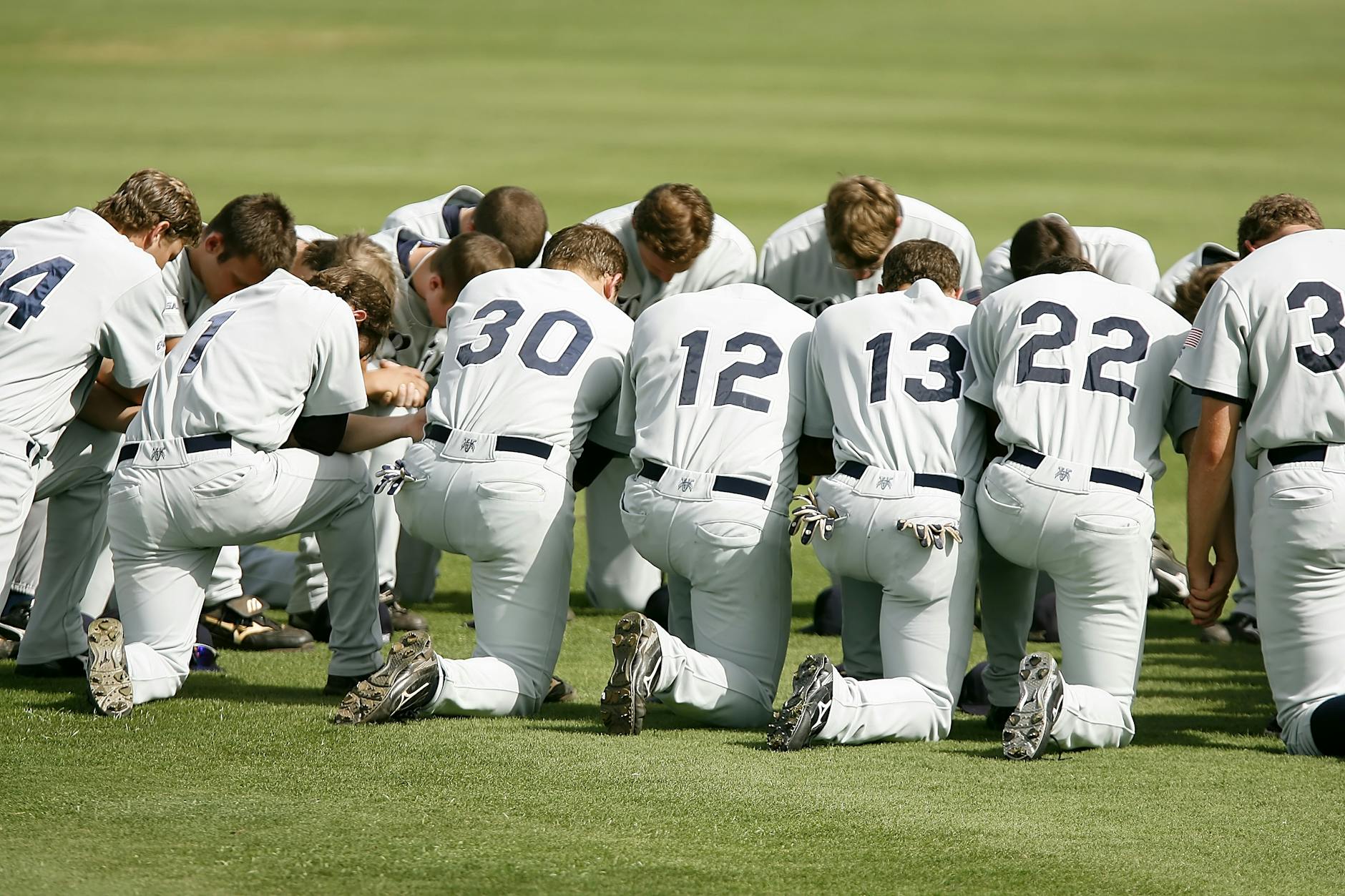
The idea behind the famous routine is that Abbot is trying to explain the positions on the baseball team, but the players’ names lead to all sorts of needless confusion. You don’t really have to know a lot about baseball to be entertained by the comedy routine, but the more you do know, the funnier it gets. Baseball depends on coordinated team effort– knowing who is playing where can make the difference between spectacular plays and disasters– both offensively and defensively. But as much as I would love to talk about both baseball and comedy today, I really want to use baseball as a metaphor for prayer.
Prayer is very personal, especially confessional prayer, but often it is also communal and a coordinated team effort. Every player (pray-er) wants to play our best, and we are gifted for certain positions on the “team.” Some of us are great at pop-ups– catching people “in the moment” and praying with them, sharing their burdens and joys with concise sentence prayers. Some are sluggers– prayer warriors who “knock it out of the park.” Some are outfielders, patiently persistent in praying for the lost, and ready to chase down a line drive or jump up to make the save. Some are basemen– praying to keep the enemy from gaining ground, or catchers, defending home base from all attempts to score. Some are good at bunting–providing the necessary support and sacrifice so that someone else can advance. And some are master pitchers–crafting prayers that strike out or even shut-out the enemy. Our coach, our mascot, our general manager and MVP? The Almighty, Triune God! He knows our strengths, weaknesses, and how we can improve our performance and standing. He also wants to help our team become closer and stronger. After all, baseball is wonderful, but Christian living is even better– it has eternal consequences!
When we ask, in relation to prayer, “Who’s on First,” we need to remember a few things:
Always listen to the coach!
Remember you are not alone.
PRAY to win!
Look out for and support your teammates.
Each inning is a new beginning– don’t live in the last inning.
Don’t let the current score determine your play.
Don’t let the other team’s players or their fans take you “off your game.”
(Spoiler alert)– We are the champions!
Let’s get suited up and ready to take the field for today’s game…after all, you or I may be on first!
Pursuing a lifestyle of prayer means more than just coming to God with a list of requests and a couple of scattered “Thank You’s” every now and again. Prayer is a discipline– that means being a disciple of prayer! How can I learn to pray for effectively? Commune with God in a richer and more satisfying way? There are many tools and methods that can help with this. One of them is called the ACTS method.
ACTS is an acronym for Adoration, Confession, Thanksgiving, Supplication. And praying in this order can radically transform the way we enter into prayer and the way we respond to God’s answers. On a busy day, I often start prayer with my supplications– my requests, my needs, my hopes and desires. I may be approaching God, but my thoughts and heart are all about “what’s in this relationship for me!” “I want healing for ______, and protection for my family, and a resolution to this problem at work, and…”
But the ACTS method flips this order–it starts with Adoration. It begins by coming to God and acknowledging who HE IS. Worship will outweigh worry. Adoration accentuates God’s Ability and His Authority over whatever is on our mind. It also leads naturally into
Confession. Not the kind that masks false humility– “Woe is me, I’m so unworthy. I am a worm, and I don’t deserve to be happy or free or victorious in Christ.” Rather, confession comes as we recognize who we are in relation to God. We are not worthy of God’s blessings in our own righteousness, but IN CHRIST, we are able to come boldly before God in dependence and joyful acceptance of HIS righteousness. And we can’t accept it if we are still hanging on to old habits and sinful ways of thinking. We must agree with God, let go of whatever is holding us back, and gladly prepare to move forward!
Now we are in Thanksgiving mode. We are reminded of God’s mercy, and His faithful care of us. He has been faithful to answer prayers in the past, and to be with us, even in times of trouble and seeming silence. He IS there. He DOES listen. His mercies are new every morning! (Lamentations 2:22-23)
NOW, we are ready to present our Supplications. In fact, we are ready to follow the direction of the Apostle Paul, when he told the Philippian believers: “Do not be anxious about anything, but in every situation, by prayer and petition, with thanksgiving, present your requests to God. And the peace of God, which transcends all understanding, will guard your hearts and your minds in Christ Jesus.” Philippians 4:6-7 (NIV).
There are many times when we pray in desperation or in a hurry about a specific need, when this approach can be modified. But for deep prayers during a quiet time, or in a small group, the ACTS method can really boost our connection with the Holy Spirit. We begin by thinking we are praying about “something,” and are amazed to re-discover that prayer is really about “someone!”
I have found that such prayers also cause me to more readily ACT in the matters I bring up for request. I’m not just turning them over to God because I am helpless and He is my last resort. Even when I “know” that is not the case, when I focus on the problem and not the Provider and Protector, I forget that He can give me the power to “do all things” (see Philippians 4:13) in Christ’s strength and for His Glory!
Note: This is a re-post from seven years ago, but I thought it was worth revisiting…
Have you ever had one of those days where things just don’t seem to make sense? It doesn’t have to be a “bad” day, necessarily–just a day when things don’t seem to “fit.” I had one of those days yesterday.
I journal my prayer life– I have notebooks with names and places for each day of the year. Yesterday, my notebook included the city where my daughter lives and the names of three people celebrating birthdays, among other needs. One of the names was a complete mystery to me. I couldn’t remember who this person was, or how I knew either her or her name…I was drawing a blank and didn’t know how I should pray for her. Was she a former classmate? Was she a daughter or mother or sister of someone I knew better? I ended up praying a very general prayer– for her health, her family, etc., but it bothered me.
Hours later, speaking with someone on the phone, another name came up, along with a prayer request– a man suffering with an illness who happened to have the same surname. Coincidence? Possibly, but the name stood out, and I prayed again– for both. Now I was really curious. I did some digging. The first person WAS the sister of someone I knew, and their father is the one suffering from an illness.
God is amazing, and one way is how he gives us the opportunity for “a-ha!” moments like the one I had yesterday. I have spoken to several Christians who are sometimes separated by several time zones from those they normally call on for help or advice. In crisis moments, they have cried out to God. Thousands of miles away, someone will be awakened from a sound sleep with a sudden urge to pray for their distant friend, or another will be stopped in their tracks and send up a random prayer as their mind wanders. Often, this will be in the exact moment of the crisis, and God will intervene with a miraculous healing or rescue or provision. Days later, the two parties will connect and be astonished at the timing.
What used to puzzle me about such prayers was this– if God already knows the need, and plans to act, why involve the second (or third) party? Because stories like this, while impressive and inspiring for those who believe, rarely cause a skeptic to come to faith, and aren’t necessary for those who already believe.
I think God has many answers, and I know I don’t have all of them, but here are three things I believe God is doing through such puzzling circumstances and outcomes:
While it doesn’t turn a skeptic into a believer, it DOES give the skeptic something to explain away– one such instance might be ignored as coincidence, but five? two hundred? And we have a Biblical precedent in the book of Acts, chapter 12, when Peter is rescued from prison and shows up at the very house where believers are praying for his release! Even they didn’t believe at first, and left Peter out in the cold!
It IS an inspiration and an encouragement as a follower of Christ to know that he not only hears our prayers, but he recruits others to think about us, bear our burdens, and share in our trials.
Last (on my short list; I’m sure God has many other wonderful answers I haven’t imagined yet), I believe that God’s purpose for us involves communion– eternally living, sharing, and loving together with Him and with each other. It is one of the highest honors and greatest privileges to be involved in God’s work through prayer…it is something we all can do, anywhere, anytime, but it requires being humble and willing to stop what we’re doing, commit our moments and our hearts in prayer for others (sometimes without knowing why!), and trust God to do all that we cannot.
Prayer sometimes seems puzzling, but that’s because we don’t see all the answers– yet. Someday, what a marvelous and miraculous picture will unfold– and we have the opportunity to fill in the gap; to be the answer to 34-down; to be the missing piece of the pine tree in the upper right corner– to answer the call and finish the puzzle!
Are any of you suffering hardships? You should pray. Are any of you happy? You should sing praises. Are any of you sick? You should call for the elders of the church to come and pray over you, anointing you with oil in the name of the Lord.Such a prayer offered in faith will heal the sick, and the Lord will make you well. And if you have committed any sins, you will be forgiven. Confess your sins to each other and pray for each other so that you may be healed. The earnest prayer of a righteous person has great power and produces wonderful results. Elijah was as human as we are, and yet when he prayed earnestly that no rain would fall, none fell for three and a half years! Then, when he prayed again, the sky sent down rain and the earth began to yield its crops. James 5:13-18 (NLT)
I heard someone the other day claim that a friend of ours “has a direct line to God.” The implication was that our friend’s prayers are more powerful and more effective, because she has an “in” with God that others just don’t have. The friend in question was quick to point out that God does not have “favorites.” He loves us all the same, and He listens to all our prayers with the same loving care and goodness.
There are, however, some prayers that are more “powerful” than others. There is an oft-quoted verse from James, chapter five that says, “The earnest prayer of a righteous person has great power and produces wonderful results.” James goes on to present the example of the great prophet, Elijah, whose prayers caused God to stop the rain for three and a half years and then caused the rain to fall again. Unfortunately, the lesson we often take from this passage is that Elijah was a powerful pray-er. If we were a great prophet like him, maybe we would pray powerful prayers as well. But James is clear– “Elijah was as human as we are”–in fact, this same Elijah, after his “powerful” prayer that brought the rain back, ran and hid in a cave and begged God to let him die!
There are two things that make prayer powerful, and neither of them have to do with WHO is speaking! The first is that prayer has to be earnest. Prayers that are sincere, heartfelt, and consistent with God’s will are powerful– regardless of the words used, the length of time the speaker has been following Jesus, or the “importance” of the subject. God looks at the heart; He sees (and hears) right through the words! He sees the motives. And if our motives are impure or selfish, our prayers will still be heard and answered, but perhaps not with the miraculous flourish that we expected.
Secondly, powerful prayers are lifted up by “a righteous person.” And this is where many people miss the blessing of this verse. Who, exactly, is “a righteous person”? NO ONE! At least, not on our own. If we think that our prayers will be powerful because of who we are, what we have (or haven’t) done in the past, or how religious we claim to be, our prayers will actually be LESS effective. Like so many things in the Christian Life, this concept is counter-intuitive and counter-cultural. Powerful prayers are not the ones delivered by those who think they are powerful. Powerful prayers come from those who accept that all power, and all righteousness as well, comes from Christ alone. Such people know they are not innately “righteous.” Their righteousness comes from Christ– through His death and resurrection– alone. And such prayers reflect a wholehearted trust that God knows best and will answer in His own loving and wise way.
Truly powerful prayers come from anyone who is fully trusting in God– not because of who they are, but because of who GOD is. My friend does have a “direct line to God”– but so does anyone who trusts Him completely! You don’t have to be an Elijah to have a powerful prayer life. And that’s a great comfort, because even Elijah wasn’t always a mighty prophet. Sometimes, he was frightened, defeated, and depressed. Sometimes, he was hurt and sullen. Sometimes, he was just plain worn to a frazzle! But God still heard him and used him to inspire a nation.
Do you ever wonder if your prayers are “too little?” Are you bothering God, pestering him with requests to help you find your misplaced keys, or help you make the green light on your way through a busy part of town? After all, God is the ruler of galaxies– there are over six billion people, let alone the cattle on thousands of hills, sparrows, and lilies of the field for him to consider just on our planet.
I know many people who find it awkward, or even impossible, to offer up “little” prayers. They believe that God is too busy, too important, and “too Holy” to be concerned with their petty wishes. I know others who pray about almost everything– what flavor of ice cream to choose; what color nail polish to wear; whether to join their friends for a game of Monopoly or a trip to McDonald’s… Is there a happy medium; a guideline on what constitutes an “appropriate” subject for prayer? Is there such a thing as a prayer that is “too” little to bring to our Father?
I don’t think so. I think there are prayers that exasperate God because they are selfish and prideful. I think there are prayers that come to God with disrespect and disbelief, and a lack of consideration for who he is. But I think those who come to God asking for his help, his wisdom, his grace, and his protection– no matter how small their request may seem–bless the heart of God and receive his full attention.
God constantly uses the small and seemingly unimportant things of this world to make huge statements of great value. Consider sand. Sand is almost everywhere– it is under our feet, blowing in the wind, all along the beach; it gets in our shoes, between our toes, even in our hair! Sand seems unimportant, even annoying sometimes. We use it for all kinds of things, most of which we consider unimportant– sandbags for weight, sand to play in, or build a temporary sand castle. We use sand to make glass, or to polish stones, or to keep time. A single grain of sand has no value to us, except in the rarest of circumstances, when it becomes the nucleus of a pearl. But God sees each grain of sand. He knows the value of sand. In explaining to Abram about his promise, God said that he would make Abram’s descendants like the grains of sand– beyond counting!
God uses tiny seeds to produce and reproduce big harvests. God uses bugs and insects to create amazing (and sometimes terrifying) structures–giant anthills, enormous beehives and hornet nests, spider webs and more. He uses the simple and even foolish things of this world to confound the wise.
Moreover, God delights in the little things– the details and minutiae. King David, and later Jesus, would be moved to compare our day-to-day living to that of grass, and common birds, and flowers– not because we are not important to God, but because THEY ARE– if the things we take for grated are under God’s constant care, how much more are we!?
Lastly, God ASKS us to be faithful in the little things–to care for the grass and sand and flowers in our midst– to offer up the little prayers and share our “small” concerns with him. I like to remember childhood, and the shared delight of my parents when we made “little” discoveries on nature walks, or learned to make cookies, or grew another inch. It was much easier for them to tie our shoes, but they loved watching us learn to do it. God doesn’t want us to hide in a corner and try to figure out all of life before we come to him. He wants to teach us, help us, and celebrate the small victories with us– as well as the great triumphs.
I think our society has lost its appreciation for the “small” moments and the “stuff” of life. We try to cram our lives full of importance and purpose, only to find it slipping through our fingers like sand.
“Father, thank you for being a God of galaxies and grains of sand. Thank you that no detail is too small for you to notice; that you care about each one. Help me to see the blessings in the “little things” and to seek you first– with my praise and with my ponderings, life’s triumphs and its trials.”
They have healed the wound of my people lightly, saying, ‘Peace, peace,’ when there is no peace. Jeremiah 8:11(ESV)
While people are saying, “There is peace and security,” then sudden destruction will come upon them as labor pains come upon a pregnant woman, and they will not escape. 1 Thessalonians 5:3 (ESV)
Peace I leave with you; my peace I give to you. Not as the world gives do I give to you. Let not your hearts be troubled, neither let them be afraid. John 14:27 (ESV)
I have said these things to you, that in me you may have peace. In the world you will have tribulation. But take heart; I have overcome the world.” John 16:33 (ESV)
4 Jesus answered: “Watch out that no one deceives you. 5 For many will come in my name, claiming, ‘I am the Messiah,’ and will deceive many. 6 You will hear of wars and rumors of wars, but see to it that you are not alarmed. Such things must happen, but the end is still to come. 7 Nation will rise against nation, and kingdom against kingdom. There will be famines and earthquakes in various places. 8 All these are the beginning of birth pains…21 For then there will be great distress, unequaled from the beginning of the world until now—and never to be equaled again. Matthew 24:4-8; 21 (NIV)
One of the prophetic names given to Jesus in the book of Isaiah is “Prince of Peace” (Isaiah 9:6). And yet, Jesus did not bring an end to the Roman occupation of Judea while He walked the earth. He did not end slavery or war or oppression. He did not bring the kind of “peace” that most of us look for even today. We live in a world of war, dissention, upheaval, and chaos. There is hatred, injustice, slavery, abuse, and oppression, and none of the efforts to bring peace in our world have succeeded in wiping out any of these evils. In the nearly 2000 years since His crucifixion and the rise of the Christian Church, these evils have remained. Great strides have been made over the years– slavery is officially outlawed in many areas of the world; human rights have been codified. Humanitarian efforts have greatly decreased the number of people who die of starvation and disease, homelessness and exposure to the elements. But there are thousands, and indeed hundreds of thousands of people around the world who are refugees from their home countries, who are denied human rights, who live in fear of bombing raids and terrorist attacks.
Where is the Peace?
Jesus spoke freely of the tribulations His followers through the generations would face. He never promised us a world without any trouble. He promised that, in this life, we WILL have trouble. And it will increase over time. People will grow suspicious, hateful, and cold. Nations will rise up against other nations; families will be divided in such a way that one’s greatest enemies will be their closest relatives! Wars and natural disasters will intensify. And ONLY Christ’s return will stop any of it. Human efforts may make a difference for a short while, or make a small difference for a long while, but nothing we can do, single-handedly or as a human race, will deliver us from the evil that lives in the human heart. In fact, we often delude ourselves into thinking that we can change the world on our own; we seek to force our plans on others “for their own good,” little knowing that we may be sowing the seeds of bitterness, backlash, and revenge.
Jesus Christ is the Prince of Peace. He will administer perfect peace and justice when He returns. And in the meantime, He offers us an inner peace that passes all understanding. We can experience peace as bullets whip around us; as we are being misunderstood, mistreated, and abused; as we face injustice and oppression. We can do this because Jesus gave us the example. He did not fight back or even complain as He was arrested, falsely accused, sentenced, and executed. He did not seek to force everyone to accept His rightful claims. He did not even protest the unjust treatment of His people by the Romans.
What He did instead was to focus on God’s mission– He interacted with those who were suffering; He healed the sick; He brought comfort to those who were grieving. He brought sinners to repentance and sought to make peace between individuals and God. Jesus is the Prince of real and lasting Peace– not just peace in “our time” or peace for a generation, but eternal and everlastingly joyous Peace. This is the kind of peace that sees trouble and tribulation for what it is– temporary and transformational. Suffering can make us bitter or better, and Jesus shows us how to experience the latter. When we protest instead of pray, we forfeit that peace. When we pray, we gain wisdom in how to stand firm against injustice without losing our own peace and perspective.
These are not peaceful times, but we can still experience peace, hope, trust, endurance, joy, and light in the days ahead, thanks to our Prince of Peace.
God knows our innermost thoughts, wishes, and needs. So why do we pray? We’re not telling God something he doesn’t already know. He asks us to seek him, though he is omnipresent. He tells us to knock, and the door will be opened, yet he also says he stands and the door and knocks. Is this another Bible mystery? An oxymoronic enigma?
I don’t think so– I think it is a case of God laying out some ground rules of relationships– his with us, us with him, and even us with each other. God is spirit, but he ask us to build dwelling places where he can meet with us– temples, tabernacles, churches. He wants to abide, to live in relationship and companionship. Ultimately, he offers to dwell in each of us. But he has created each of us as a unique being. And just like a unique building, we have walls and windows and doors. When we reach our eternal dwelling place, this will still be so. We will be changed, purified, sanctified, and glorified, but our souls will not be subsumed or merged into a single temple or a single “soul.” Heaven is not like Nirvana. God is eternally God and we are eternally his creation. Living in communion is not the same as merging or evolving into something not ourselves. We remain uniquely individual, and as such, we need to learn to take initiative to open our doors and windows– to interact, to serve, and to honor each other.
Have you ever been blindsided by someone who expected you to read their mind? You know they are hurt and angry, but you find out later (sometimes much later!) that they wanted you to comment on their new hairstyle, or they expected you to ask them out for coffee. Maybe you know the pain of being on the other end– wishing someone would notice your weight loss or ask about your day. God wants us to learn to reach out, to ask, seek, and knock, instead of isolating ourselves behind locked doors. We are to be active, not passive, about noticing others, sharing with and including others, and serving others. But we are to do it in love and humility– with grace and mercy and love, not with bullhorns, fists, or combat boots.
God is the Almighty one– yet he stands at the door and knocks. He could barge through our stubbornness and rebellion, and drag us kicking and screaming to the altar. He could tear down the walls of isolation and storm crush our pretentious justifications and excuses. But he stands, waiting for us to open the door, and seek his face. The one who spoke the universe into being waits for us to begin the conversation!
At the age of 14 months, just after I had learned to walk well, and had learned to say “Mama” and “Da-da”, I became very ill. Our doctor was baffled– I was tired and weak, I was losing weight, but I wasn’t carrying a fever. It wasn’t any of the “usual” culprits– we did find out I was allergic to penicillin, but other antibiotics had no effect. We tried a different doctor– he was also stumped, and all the while, I got weaker. My desperate parents prayed for healing as the weeks went on. I was too little to even describe any symptoms– I whimpered and slept; I ate very little, and became too weak to walk.
God was listening to my parents’ prayers, even though the situation seemed impossible and tragic, and God seemed silent and distant. My mother, in the years since this incident, has shared with me the “breakthrough” moment for her– that moment when her prayers changed from “heal my little girl”, to “thy will be done.” Not immediately, but shortly after that, the new doctor was inspired to look for another cause. After some blood tests, he determined that my body wasn’t absorbing and processing protein. As soon as I began a regimen of protein booster shots, my health began to improve. I was still sickly as a child; I had immunity issues, and I was small for my age, but I was out of grave danger. I had to relearn how to walk, and my return to solid foods (especially meat) was a gradual one. I have no actual memory of these events, but I learned a valuable lesson about prayer.
When we pray “Thy will be done,” we sometimes think it is “our” will vs. “God’s” will… that God’s will is always opposed to ours; that it will lead to us losing whatever it is we are holding on to. That may be the case, sometimes. We grapple with God’s will, struggling and wrestling, like Jacob, until we are forced to give in. Some of us limp our way to the altar of prayer. But God’s will is not set in relation to ours– His will is His own. It is higher than ours. It is perfect and complete. That doesn’t always make it pleasant, comfortable, or easy. In my family’s case, it meant months of trips to get shots– every day for the first few weeks; every week for months afterwards, and every month after that until the time I started Kindergarten (a year later than I might have if I had been healthier). For many, “Thy will be done,” means saying goodbye to a loved one. Sometimes it means losing a limb, or letting go of a cherished dream. But what we see; what we experience; these are mere moments in God’s plan for our eternity. Like the booster shots I had to have as a child, they bring a momentary sting, and the fear of them may loom large, but in God’s plan, they bring us the opportunity for life and health and ultimately, triumph.
Sometimes God’s will means walking through the fire, or walking through the valley of the shadow of death. Long before my birth and health scare, my mother had lost twins, and been a divorced mother of a young son. She had already faced death and heartbreak and hardship. After this incident, she would be hurt by my brother’s teenage rebellion, face depression, and go through health issues with my father before his death; but she would also gain another daughter and live to see grandchildren and great-grandchildren who brought her joy. In my own life, I have faced the shattered dream of wanting children of my own. I struggled for years with singleness, when I wanted to be married and have a family. But God’s will was for me to learn patience, compassion, and empathy for others who hurt in these areas. And he has blessed me with a family I would never have imagined–not only the husband, step-children, and grandkids, but all the students and children I met through my careers in education and public libraries.
It is natural and easy to pray for what our will, our feelings, or our intuition tells us is best– healing for the sick (immediate healing is even better), success for our ventures and those of our families and friends, safety in travels and daily routines, prosperity, and happiness. It is not wrong to want these things. But it is better by far to remember that God is sovereign and good. Giving him complete control over our situations is not weakness; it is not “giving up”. Instead, it is investing our future– putting it in the hands of the one who holds tomorrow, and all of eternity! It is trusting the one who is most trustworthy to make the most of our hours and days, our treasures and our dreams.
Even Jesus taught His disciples to pray “thy will be done on earth as it is in heaven” (Matthew 6:10b). But He didn’t just teach that phrase to His disciples– He prayed it Himself in the Garden of Gethsemane. “Father, if you are willing, take this cup from me; yet not my will, but yours be done” (Luke 22:42). Jesus knew he would face humiliation, torture, and death. He knew that He would take on the punishment for all the sins of the world– punishment He did not deserve– and that He would be subject to the full wrath of God. In His humanness, He was anguished to the point of sweating drops of blood. Yet He chose to pray, “Thy will be done.”
I have never been in that kind of anguish– even when I was so very sick or depressed about seemingly broken dreams. But I still find it difficult to fully surrender to God’s sovereign will when the future is in doubt, and when the present looks overwhelming. But growth and victory come when I let God take the reins and guide me through the valleys and wilderness walkways of life. His will is mysterious and sometimes scary, but He is always faithful. And I know that from experience.
Yahweh is my shepherd; I shall lack nothing. He makes me lie down in green pastures. He leads me beside still waters. He restores my soul. He guides me in the paths of righteousness for his name’s sake. Even though I walk through the valley of the shadow of death, I will fear no evil, for you are with me. Your rod and your staff, they comfort me. You prepare a table before me in the presence of my enemies. You anoint my head with oil. My cup runs over. Surely goodness and loving kindness shall follow me all the days of my life, and I will dwell in Yahweh’s house forever. Psalm 23 (World English Bible)
“I am the good shepherd; I know my sheep and my sheep know me— just as the Father knows me and I know the Father—and I lay down my life for the sheep. I have other sheep that are not of this sheep pen. I must bring them also. They too will listen to my voice, and there shall be one flock and one shepherd. The reason my Father loves me is that I lay down my life—only to take it up again. No one takes it from me, but I lay it down of my own accord. I have authority to lay it down and authority to take it up again. This command I received from my Father.” John 10:14-18 (NIV)
Yahweh is my shepherd…The LORD Almighty is my caretaker and protector. I don’t need to fear danger, lack of resources, darkness– even the shadow of Death!
God is Mighty and has all Authority. Yet He chooses to guide me, guard me, and provide for me. Not because of who I am– I am a wayward lamb– but because of His Loving Character. It’s literally who He IS and what He Does!
God is not distant. I may not see Him, but He surrounds me. I may not audibly hear His voice, but He speaks to me. I may not see a hand reaching down from Heaven, but He is at work all around me, and His Spirit lives inside of me! God is my Shepherd, not my “boss” or my jailor. He sees both dangers and delights which are along the path of my life, and He knows how to navigate the road ahead. And He is not a hired “master” or overseer. He is my Creator and Sustainer. He is the one who knows me, and when I follow Him, I know His voice. I know both the Authority of His voice, and the Love He has for me.
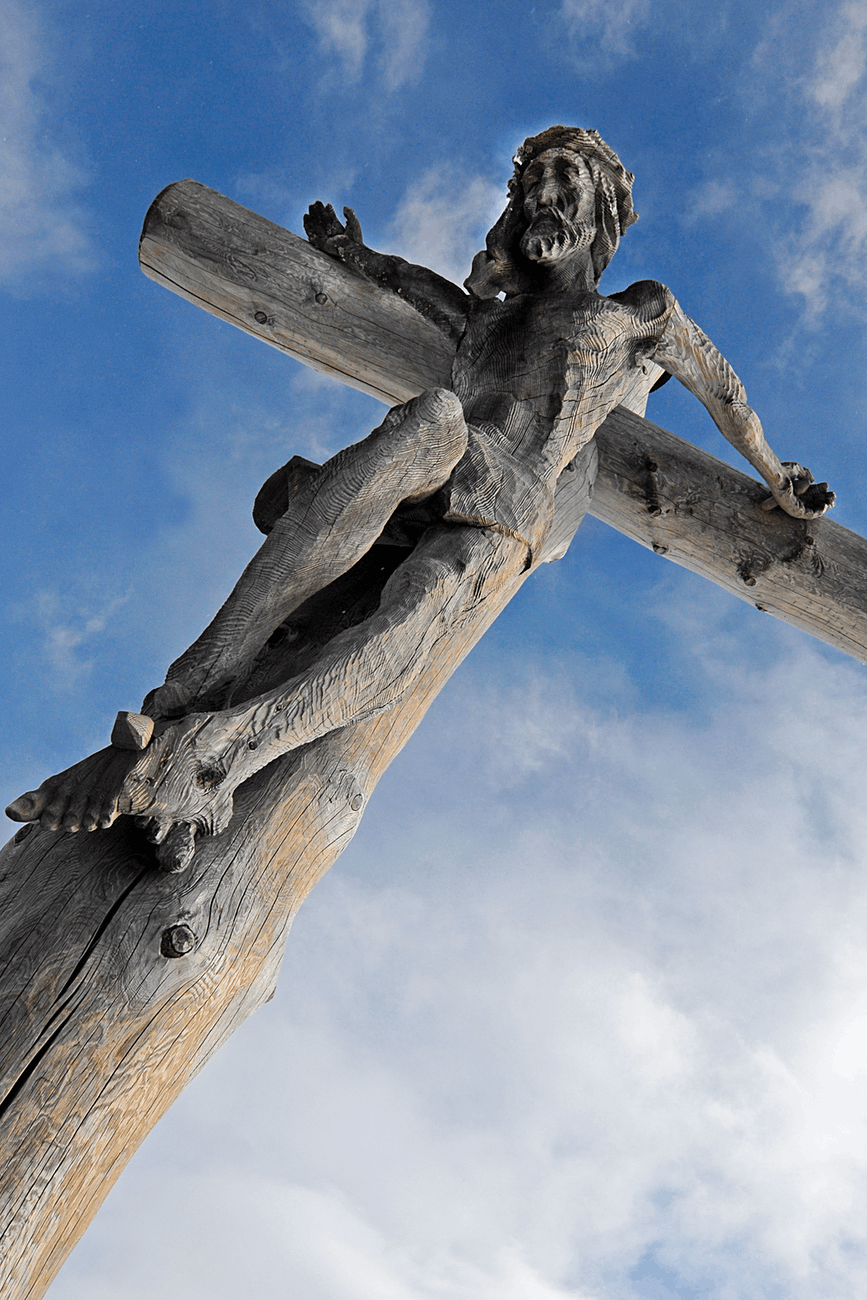
As we go through Holy Week, it is worth remembering that He is also the Shepherd who lays down His LIFE for His sheep. Willingly, lovingly sacrifices what we cannot, so that we may have the LIFE that He gives us. He is our guardian, our guide, our benefactor, and the Lover of our Souls.
When I pray to the Good Shepherd, I am praying to someone who knows all about me; my past and future, my strengths and weaknesses, every challenge I will face, and every blessing He is waiting for me to receive from Him. My prayers cannot surprise Him or baffle Him or stretch Him beyond His capacity to answer. And His answers will be wise and perfect in their scope, their timing, and their resources.