What’s That Smell?!

Years ago, when I worked in a public library, one of my jobs was to help empty the book drop. Most libraries have a large receptacle outside the building where people can drop off their books after hours. We had a “drive up” drop box, and the large bins would get full– especially over a holiday weekend! It was important to empty them out and get the books checked back in– and to check for damage.

I was always amazed at the state of some of our returned books. We were located near several beaches along Lake Michigan, and many of our books would return with sand trapped in the plastic covering (and between the pages) of many books. Some books came back with torn or dog-eared pages. Some had been marked with pens, crayons, or markers. Some books came back with unusual “bookmarks,” including utility bills, photos, letters, and even credit cards and drivers’ licenses!

But the worst one I can remember happened on a Tuesday morning after Labor Day weekend. There was a plastic shopping bag, tightly knotted at the top, containing two books. And it smelled HORRIBLE. It smelled like swamp water and mildew and dead animal! Inside, the two books were not just mildewed– they had mold growing in them. The books were almost a month overdue, but they were damaged beyond all repair, and I needed to call the borrower to let them know we would be charging a book replacement fee.

The story came out– I talked to the mother. Her daughter had taken library books to Summer Camp, and they had gotten wet after a rainstorm. Not wanting her clothes or other items to get wet, the girl had placed the books in the plastic bag. Summer Camp ended, and she packed everything–including the still-damp books inside the shopping bag– and brought them home. Somehow, the bag with the books ended up under her daughter’s bed, where they stayed for three more weeks! In the meantime, the mother had received an overdue notice from the library and couldn’t find the books. Certain that they had been returned, she had called the library to complain about “our” mistake. Several staff members had combed the shelves, trying to find the missing books, but hadn’t seen them.

Summer was coming to an end, and the girl in question was cleaning her room, which had begun to smell. She found the bag with her two missing library books– the source of the smell. Totally embarrassed, the mother brought the bag to the library book drop and threw it in, so she wouldn’t have to face us in person. She apologized profusely over the phone, and happily agreed to pay the replacement fee the next time she came in.

What does all of this have to do with prayer and worship?

Well, it’s a long and winding story, but here is my thought process today: It’s getting ready to rain. We have a small leak, and a bucket that catches the rainwater in our hallway. Water that drips into the bucket and stands for a few days will get fetid. That got me thinking about living water. Living water is described throughout the Bible– and it is always moving– flowing, rolling, gushing, pouring, etc., which reminded me of a verse in the book of Amos–“But let justice roll on like a river, righteousness like a never-failing stream” Amos 5:24 (NIV). But as I was looking at this verse in context, I was arrested by the verses just above–Amos 5:21-25 “I hate, I despise your religious festivals; your assemblies are a stench to me. Even though you bring me burnt offerings and grain offerings, I will not accept them. Though you bring choice fellowship offerings, I will have no regard for them. Away with the noise of your songs! I will not listen to the music of your harps. But let justice roll on like a river, righteousness like a never-failing stream!” (emphasis added).

God isn’t just mildly offended when we neglect justice, obedience, compassion, and truth. He calls the empty festivals of the wayward Israelites a “stench”– a nose-twisting, swoon-inducing, stinking, reeking, sweltering offense that causes the eyes to water and the whole body to convulse with repugnance!

And what had caused the festivals and religious assemblies of the Israelites to become a stench? They were following the rules for burnt offerings. They were singing songs and fellowshipping together. But it was all about THEM. They were not elevating and worshipping God, but worshipping idols dedicated to the stars and the sun and the moon. And they would leave the assembly unmoved, unchanged, and continuing in their wicked ways. They oppressed the poor and innocent and ignored the very God they claimed to serve.

Suddenly, my memory of the stench of those books attached itself to the condition of complacent, and even false worship as it was described by Amos. Those moldy books had been thrown into a convenient bag and then forgotten. They were ignored, shoved under a bed and returned late, shamefully treated, and falsely claimed as returned. Just like God’s people had treated His word, His commands, and His promises.

Water– rain water, river water, spring water–if it is allowed or even forced to sit still, can lose its freshness and stop giving life. Justice, righteousness, mercy– are all supposed to roll like water– they are meant to be shared, pursued, and spread. When we withhold justice, hoard mercy, compromise on obedience, make worship about spectacle and feelings instead of honor and true praise, we stagnate. Our testimony begins to stink. Our lives spill over with selfishness, bitterness, and apathy. When our praise becomes automatic, OR it becomes more about the spectacle than the Spirit– it will also stagnate and smell “off.”

As the rains arrive, I want to remember that God sends Living Water, not just to fill my cup, but to spill over and bring life to others, and glory to Himself.

Nothing smells like the freshness after a spring rain! And THAT’S the aroma I want to give back to God in my prayer time, my worship, and in my life!

When God “Remembers”

“He remembers His covenant forever, the promise He made, for a thousand generations.” – Psalm 105:8

“God remembered Noah and all the wild animals and the livestock that were with him in the ark”– Genesis 8:1

“God heard their groaning and he remembered his covenant”–Exodus 2:24

Throughout the Bible, God “remembers” His people and His Promises. But that doesn’t mean that He ever “forgot” either one.

God is omniscient– He “knows” everything– He “forgets” nothing. When God says He remembers, He is not suddenly conscious of something that slipped His mind. He doesn’t suddenly recall a person or promise that He hasn’t thought about in a while. Sometimes, it may seem that we are forgotten. God may seem distant, or silent, or preoccupied when we call out to Him. The descendants of Jacob lived for four hundred years in Egypt, and many of them must have felt as though God had abandoned them and forgotten His promises. But when it says, “God heard their groaning and He remembered His covenant (Exodus 2:24), it doesn’t mean that God suddenly heard their groaning, or that He had not noticed their suffering and slavery in the years leading up to that time. When “God remembered Noah and all the wild animals and the livestock that were with him in the ark” (Genesis 8:1), it doesn’t mean that God was letting them drift along in the ark aimlessly while He went off and played golf or took a nap!

God is always watching– always aware– always in control. NOTHING can take Him by surprise or sneak in or out of His conscious awareness. When God says He remembers–that is for OUR benefit. God is reminding us that He will never– can never– forget His promises. It is a reminder that He will NEVER leave us or forsake us– even when we can’t see Him, or understand what He is doing. It is a call for US to remember just how faithful, powerful, and omnipotent God really is!

I love this reminder, because there are many days when I feel alone, ignored, unheard, or “passed by.” There are days when I question whether God really hears my prayers. But I don’t have to wonder or worry. God will never forget me. His love is eternal and unshakable. God’s thoughts toward me are a constant cosmic embrace– even if I don’t feel them in the pain of the moment.

When God “remembers,” it is a powerful testament to His eternal plans for us. He shows up, not when we expect, or not when we have earned His comfort or His grace; He shows up in His perfect timing and for His Glory. Our job is to “remember” who has us in His thoughts, and in His Hands. What a great thing to remember today!

A Drop in the Bucket

We had a leaky faucet the other day–drops of water dripping into the sink, “plink…plink…plink.” It was an annoyance. I put a container under the faucet to catch the water as it came out. It wasn’t a large container, but it filled up and had to be emptied, before it could overflow. It seemed such a waste; each drop just dribbling away to no good purpose.

Sometimes, I feel like my prayers must be like those drips from the faucet; that they are just drops in a huge ocean of prayers and requests being poured out by people all over the planet. But that is not true. According to the Bible, God experiences our prayers as an aroma, like incense, rising up to Heaven, where He breathes them in. (See Psalm 141:2 and Revelation 5:8, among others.)

My prayers may feel small and insignificant, but they blend with the prayers of others into an intoxicating aroma of praise, worship, dependence, submission, obedience, sacrifice, awe, reverence, reflection, repentance, joy, and even grieving tears. My prayers are part of something magnificent and mysterious. So are yours!

To pray is to offer ourselves to God– our thoughts and emotions, our time, our gratitude, our honesty, our humility, and our joy.

Just think of the power of a majestic waterfall, or the might of the ocean waves– all made up of tiny individuals drops of water. Water can turn turbines to produce electricity; water can carve canyons our of rock; and water can change landscapes or reshape landforms. And there is power in the volume of water, or of prayer. But there is also the mighty power of the Holy Spirit inhabiting our individual prayers. Each single “drop in the bucket” holds amazing worth and power in God’s hands.

So don’t turn off the spigot of prayer today. Let each drip and drabble do a mighty work!

Nacho Prayers

Have you ever ordered nachos at a restaurant? I’m not talking about just tortilla chips with sauce– I mean the loaded, deluxe, supreme nachos that some with everything but the kitchen sink. There are several layers of goodness: crispy tortilla chips, smothered in rich, gooey nacho cheese sauce, and piled with spiced meat, tomatoes, green onion, black olives, salsa, chilies, beans, more cheese (shredded), maybe even some mango or avocado, and sour cream. Each flavor is distinct– different textures, different temperatures–yet they come together as they land on your taste buds. And each bite is just a little different– a different ratio of cheese to meat to veggies to chips in each taste.

And that means that my nacho is “not ‘cho” nacho. Even with all the same ingredients, my nacho experience will never be exactly the same as yours.

In a strange way, prayers are kind of like nachos. Prayers have many distinct “ingredients”– confession, praise, anguish, supplication, thankfulness, even questions. And many people can pray with the same ingredients and still offer up unique prayers. My prayer is “nacho” prayer– and your prayer is not mine; even when we are praying together about the same thing.

God loves the variety and uniqueness of our individual prayers. He never tires of “nacho” prayers. And He never compares my “nacho” prayers with yours, or your prayers with mine. Indeed, He loves tasting the individual ingredients in their unique ratio of flavors and elements. He loves hearing our gooey, cheesy emotions, as well as our crisp list of needs; He appreciates the savory outpouring of our praise, as well as the spicy and even bitter tang of our grief.

Can you imagine the tantalizing aroma of our prayers as they rise to Heaven? What satisfaction it brings to God as we pour out our thoughts and concerns to the One who loves us best? God isn’t looking for gourmet prayers. Our prayers may be neatly arranged or completely sloppy. They may contain lumps of worry, or be soggy with emotion; they may be spiced with urgency, or smothered in majestic outpourings of praise. God is still hungry to hear from us!

Putting It All On the Table

In 2 Kings, chapters 18 and 19, we can read about the reign of King Hezekiah of Judah. During his reign, a mighty king, Sennacherib of Assyria, came to lay siege to Jerusalem. Sennacherib taunted King Hezekiah, sending him a letter boasting about the might of the Assyrian army, and all its conquests. In the letter, he also taunts King Hezekiah about trusting in God to save Jerusalem, suggesting that God was unable to rescue the Jews, while simultaneously suggesting that God had given the Assyrians His blessing.

Hezekiah had already made some provision for the coming siege. He had his workers divert the water supply that flowed out of the city, creating a system of tunnels that kept the water inside the city walls and filled pools and wells for the people to withstand the siege while depriving the invaders of a crucial resource. (Evidence of these tunnels has been discovered by archaeologists, including carvings by two work crews who were “competing” to see who could complete their part of the tunnel fastest!)

Entrance to Hezekiah’s Tunnel in Jerusalem

But Hezekiah did not trust in his preparations. He did not trust in diplomacy or alliances. He took the offending letter from King Sennacherib into the Lord’s temple and spread it out before the Lord (2 Kings 19:14). He prayed earnestly, never mentioning his own efforts and preparations, but reminding himself of God’s power and glory. He even acknowledged that the Assyrians had been victorious in their other conquests! But then he asks for God to rescue the nation– “then all the kingdoms of the earth will know that you alone, O Lord, are God. “(v. 19).

I was struck as I read this recently. Hezekiah was a king. He had done a great deal to bring reform and renewal to the kingdom of Judah. He could have appealed to God on the basis of his own efforts. He could have asked for God’s help for his own sake, and for the sake of his people. He could have spoken about how Sennacherib taunted the army, or the king. He could have cried out in panic and outrage that God would allow Judah to be invaded. But he put it all on the table, literally, asking God to judge Sennacherib’s words and respond for the sake of His Sovereign Glory.

God DID respond, and the Assyrian troops were routed by the Angel of the Lord. Sennacherib returned to his home, and was assassinated in the temple of his false god by his own sons. Hezekiah’s troops didn’t even have to lift a finger!

What situations am I facing today, that need to be brought to God in prayer? What threats seem to hover over me? Do I respond as Hezekiah did? Or do I try to bring only the part that seems “too much” for me to handle? Do I bring my own agenda, or my own efforts to cloud the issue? Do I worry more about my own reputation than I do about God’s honor?

Lord, may I be more like Hezekiah–may I lay everything on the table before You, knowing that Your power is more than sufficient, and that Your honor and glory are greater than any force at work against me. Protect and defend those who humble themselves before You. Destroy those forces that would seek to exalt themselves and taunt Your Holy Name. Rise up, that “all the kingdoms of the earth will know that You alone, O Lord, are God!”

Onward!

Today is Memorial Day in the U.S.– a day when we honor those who have fallen in battle and given their lives for our country. It is also a day on which we often decorate the gravestones of ancestors and relatives who have passed on. There may seem to be little connection between soldiers of war and civilian great-grannies or uncles, but Memorial Day can stretch to both– especially to Christians. Here’s how I see it:

  • Soldiers who gave their lives never lived to see the fruits of their sacrifice. They died, never knowing if their sacrifice was in vain. Our ancestors, similarly, poured their efforts into rearing children and living lives of integrity, little knowing how their efforts would be carried on by the next generation. There is a risk in battle– whether a war-time conflict, or just daily survival–a risk that all our hard work and all the perils we face will end in failure. We memorialize those whose efforts did NOT fail. We honor those whose sacrifices made a difference in our lives and in the lives of others. They lived (and died) for a purpose– and we honor that purpose, as well as the individual lives.
  • All of us are fighting a battle– a spiritual battle– in which our very lives are on the line. Some of us will lose our lives, literally, through imprisonment, persecution, torture, or disastrous choices we make to surrender to the enemy. Others will lose our lives figuratively, giving up our time and our own dreams to a greater cause. We honor those who went before us in this fight. We honor the good examples and the fallen heroes.
  • Soldiers go where they are sent. They often die and are buried far from their homes, on the battlefield. They may or may not have graves with the rest of their families. Many in our family were immigrants and pioneers, moving far from “home” to start a new life. Some of them moved as the result of war coming to their ancestral home and pushing them to relocate.

Memorials– whether gravestones, statues, monuments, or stories passed down to the next generation– serve as reminders of our priorities– freedom, family, and Faith. God’s people throughout the years have raised memorials to commemorate God’s faithfulness, as well as the high cost of fighting against Sin and its effects.

Dr. Martin Luther King, Jr. Memorial

I pray that on this Memorial Day, we will take time to remember, and give thanks for those who have fought the “good fight” in the name of freedom, and in the name of Faith. But more than that, I pray that we will be inspired to carry on the fight– knowing the risks and weighing the costs–to preserve those things that are most important. Let’s pause to remember– and then let’s move Onward!

The God Who Whispers

19 1-2 Ahab reported to Jezebel everything that Elijah had done, including the massacre of the prophets. Jezebel immediately sent a messenger to Elijah with her threat: “The gods will get you for this and I’ll get even with you! By this time tomorrow you’ll be as dead as any one of those prophets.” 3-5 When Elijah saw how things were, he ran for dear life to Beersheba, far in the south of Judah. He left his young servant there and then went on into the desert another day’s journey. He came to a lone broom bush and collapsed in its shade, wanting in the worst way to be done with it all—to just die: “Enough of this, God! Take my life—I’m ready to join my ancestors in the grave!” Exhausted, he fell asleep under the lone broom bush. Suddenly an angel shook him awake and said, “Get up and eat!”
He looked around and, to his surprise, right by his head were a loaf of bread baked on some coals and a jug of water. He ate the meal and went back to sleep. The angel of God came back, shook him awake again, and said, “Get up and eat some more—you’ve got a long journey ahead of you.” 8-9 He got up, ate and drank his fill, and set out. Nourished by that meal, he walked forty days and nights, all the way to the mountain of God, to Horeb. When he got there, he crawled into a cave and went to sleep. Then the word of God came to him: “So Elijah, what are you doing here?” 10 “I’ve been working my heart out for the God-of-the-Angel-Armies,” said Elijah. “The people of Israel have abandoned your covenant, destroyed the places of worship, and murdered your prophets. I’m the only one left, and now they’re trying to kill me.”
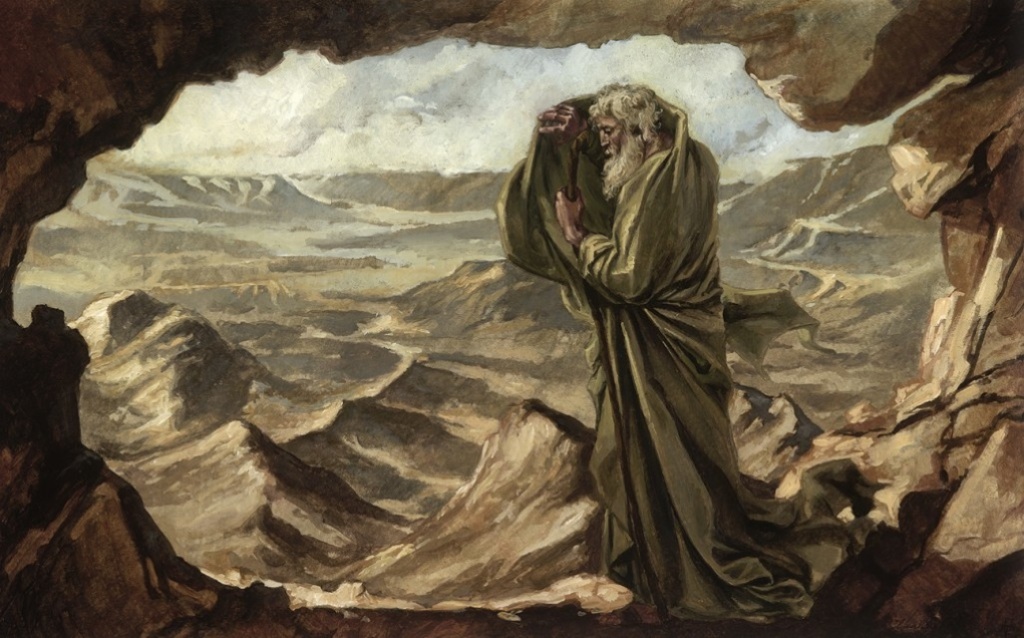
11-12 Then he was told, “Go, stand on the mountain at attention before God. God will pass by.” A hurricane wind ripped through the mountains and shattered the rocks before God, but God wasn’t to be found in the wind; after the wind an earthquake, but God wasn’t in the earthquake; and after the earthquake fire, but God wasn’t in the fire; and after the fire a gentle and quiet whisper.


13-14 When Elijah heard the quiet voice, he muffled his face with his great cloak, went to the mouth of the cave, and stood there. A quiet voice asked, “So Elijah, now tell me, what are you doing here?” Elijah said it again, “I’ve been working my heart out for God, the God-of-the-Angel-Armies, because the people of Israel have abandoned your covenant, destroyed your places of worship, and murdered your prophets. I’m the only one left, and now they’re trying to kill me.” 15-18 God said, “Go back the way you came through the desert to Damascus. When you get there anoint Hazael; make him king over Aram. Then anoint Jehu son of Nimshi; make him king over Israel. Finally, anoint Elisha son of Shaphat from Abel Meholah to succeed you as prophet. Anyone who escapes death by Hazael will be killed by Jehu; and anyone who escapes death by Jehu will be killed by Elisha. Meanwhile, I’m preserving for myself seven thousand souls: the knees that haven’t bowed to the god Baal, the mouths that haven’t kissed his image.” 19 Elijah went straight out and found Elisha son of Shaphat in a field where there were twelve pairs of yoked oxen at work plowing; Elisha was in charge of the twelfth pair. Elijah went up to him and threw his cloak over him. 20 Elisha deserted the oxen, ran after Elijah, and said, “Please! Let me kiss my father and mother good-bye—then I’ll follow you.” “Go ahead,” said Elijah, “but, mind you, don’t forget what I’ve just done to you.” 21 So Elisha left; he took his yoke of oxen and butchered them. He made a fire with the plow and tackle and then boiled the meat—a true farewell meal for the family. Then he left and followed Elijah, becoming his right-hand man.
1 Kings 19 (The Message)

As a child, I was confused by this story from the life of Elijah the prophet. Just before this, Elijah had challenged the prophets of Baal and Asherah. He was outnumbered 850 to one, yet he stood defiantly, and asked the people of Israel to choose between their false gods and the one true God. God had produced fire on the mountain and shown His mighty power, while the false prophets were humiliated and later slain. It was a stupendous victory! And yet, Elijah, when told of Queen Jezebel’s anger, fled in terror, hid in the wilderness, and asked for death! Surely, Elijah remembered what God had just accomplished. Surely he knew that the same God who sent fire and ended the drought could protect Elijah from harm. Didn’t he? And I expected that God would react with consternation at this display by Elijah–how ungrateful to throw such a pity party after God had done such a miracle!

But God did the most curious thing. He could have sent a powerful reassurance. He could have ordered Elijah to return to the palace to deal with the wicked king and queen–finish the job and bring divine justice to Israel’s ruling family. He could have called Elijah out over his bad behavior and lack of faith. But God let Elijah whine and run away. And after Elijah threw a temper tantrum, God sent an angel to bring him food and water. Finally, God allowed Elijah to see His power in the forms of a mighty wind, an earthquake, and a fire. And it was THEN, and only then, that God spoke to Elijah in a still, small voice– a whisper– something so intimate and comforting that Elijah could not fail to recognize that it was the voice of God.

God CAN and will do mighty miracles. But so often, He prefers to work in a whisper. He is Glorious, and Powerful, and Omnipotent– yes. But He is also intimate and gentle and nurturing– especially with those who have ears to listen; those who have been broken down; those who need a quiet voice of reassurance and peace.

As I have grown older, I see so much in this passage that I couldn’t see as a child. I see how often I “lose it” just after I think I’ve won a great victory. I see how many times God has come to me in whispers and little gestures– just when I need a gentle hug and a simple reminder of His care. God is not the one who points out my temper tantrums and lack of faith. God doesn’t yell recriminations at me– even when I know I deserve them! I see how often I throw a tantrum, and expect God’s wrath, only to be met with His arms around me, calming me, lifting my head so I can look into His eyes of compassion and mercy. God is my Father– and a gentle, wise, and loving Father. And when He draws me close– He whispers of His Love.

Yes, God sent fire from the mountain. He caused justice to be done upon the false prophets. It was mighty; it was fierce; it was devastating. God IS a God of wrath– and even prophets can get wounded in the fight. There is evil in the world, and when we stand up to it, it is exhausting– even when we know God is with us. But God knows our limits. He will often give us more than we can handle– in our own power– and He will pull us through the kind of trials that test and stretch those limits. But He is also preparing a time and place of rest and His quiet whispers of encouragement and hope when we are tempted to give up.

God didn’t just whisper empty promises or nice-sounding platitudes when He finally spoke to Elijah. He brought a new message– someone else would be God’s instrument of justice for Ahab and Jezebel. Someone else would come alongside Elijah in his ministry. And someone else (7,000 someone else-s in fact!) WERE being faithful. Not only had God been with Elijah in the past, God had been preparing the future for Elijah to receive rest, and for others to rise up and carry on. He could have shouted this message from the mountaintop. But He wanted to whisper His message of hope to a faithful prophet who needed quiet reassurance after a difficult battle.

I don’t know what God wants to whisper to me (or to you) today. But I pray that we will have ears to hear, and hearts to respond. And God will whisper to us, whether we just defeated an army of enemies, or just woke up from a much needed nap! He will gently remind us that He loves us in our tantrums just as He loves us in our victories. And He will whisper, because that’s how close He really is in our every moment!

Why Say Grace?

When I was growing up, we always said grace before our meals. It wasn’t an afterthought; it wasn’t an affectation. It was just part of the meal. We sat down, said grace, and started eating. Sometimes, Dad did the honors; sometimes, it was Mom. And sometimes, my sister or I were asked to say it. It was usually something simple, though it wasn’t always the same. We would say grace at home, around our own table, and we would say grace at restaurants– wherever and whenever our family was together for a meal.

Today, my husband and I have the same tradition. We don’t have children in the house, but he and I take turns saying grace, and if one of the grandkids happens to visit, they know they may be asked to take a turn, as well. If David and I are eating out, we still take a quiet moment to hold hands, close our eyes, and say grace. Some times, other diners or wait staff will stare (or glare) or comment, but most of the time, they don’t even notice.

So why do we do it? Is it no more than force of habit? Are we just “holier” than other diners? Do we really think it impresses God if we say grace, or that God will be angry if we don’t say it?

No. But we believe saying grace is important. Here are some reasons why:

  • Grace is about gratitude. In our busy lives, it can be tempting to take things for granted– even things like food and family. We are BLESSED to have food to eat, and family with whom to share it. We are blessed when we go out to eat to have others cook and clean up for us. We are blessed whenever our family or neighbors can share a meal with us. God is a loving and gracious God, and grace is a time to remember our blessings.
  • Grace slows us down for just a minute to REMEMBER who we are, and who God is! All our blessings– including food and family and time to share them– come from God. Grace reminds us to be humble as well as thankful. It reminds us to see God’s hand at work in even the smallest and most mundane happenings in our lives. And it reminds us that God is faithful in all things, big and small.

  • Grace also helps us to remember to thank the people involved in our meals– the ability to buy groceries; the work it takes to prepare our food; friends and family who share our meals; neighbors who have given or traded with us for food; the cooks and wait staff that serve us at restaurants. Saying grace helps us SEE how we are interconnected; how we depend on God and on others in every area of our lives.
  • Grace gives us the opportunity to lift up our immediate worries and give them to God, instead of holding on to them. Grace is more than just a quick word about food. It is a time for us as a couple (or a family) to pray together about worries that are on our minds. Then, instead of being stressed as we eat, we can stay “in the moment” with each other, and enjoy mealtime together! It’s also a great way to share our thoughts, feelings, and concerns in a safe and informal environment. How much better mealtime is when stress and frustration are diminished, and joy and peace are given a seat at the table, instead!

Saying grace is much more than just a quaint habit from a bygone era. It is a vital part of our growth as individual Christians, and as a Christian couple. I believe it is a simple and quiet witness to others. I believe it has benefits for our digestion, our attitudes, and our emotions, as well.

Grace– not just the mealtime prayer, but the concept of Grace– is not loud or showy. It is, however, consistent, lovely, and powerful. May we say grace; may we show grace; may we live in the power of Grace today!

Saint Patrick’s Breastplate

In honor of St. Patrick’s Day yesterday, I am reprinting one of his prayers, called St. Patrick’s Breastplate. For more on this and other prayers attributed to St. Patrick, see https://slife.org/saint-patricks-prayers/.


St. Patrick (also known as Padraig or Padrig) lived in the fifth century during the last of the Roman era in Britain. Held as a slave in Ireland as a young man, he escaped and returned to his home. However, he felt called to return to the land of his captivity as a missionary. Today, he is celebrated for his efforts to bring the Good News of Christianity to the very people who had enslaved him. The following prayer is attributed to St. Patrick. It is as relevant today as it was over 1500 years ago:

I arise today
Through the strength of heaven;
Light of the sun,
Splendor of fire,
Speed of lightning,
Swiftness of the wind,
Depth of the sea,
Stability of the earth,
Firmness of the rock.

I arise today
Through God’s strength to pilot me;
God’s might to uphold me,
God’s wisdom to guide me,
God’s eye to look before me,
God’s ear to hear me,
God’s word to speak for me,
God’s hand to guard me,
God’s way to lie before me,
God’s shield to protect me,
God’s hosts to save me
Afar and anear,
Alone or in a multitude.

Christ shield me today
Against wounding
Christ with me, Christ before me, Christ behind me,
Christ in me, Christ beneath me, Christ above me,
Christ on my right, Christ on my left,
Christ when I lie down, Christ when I sit down,
Christ in the heart of everyone who thinks of me,
Christ in the mouth of everyone who speaks of me,
Christ in the eye that sees me,
Christ in the ear that hears me.

I arise today
Through the mighty strength
Of the Lord of creation.

Now I Lay Me Down to Sleep..

Now I lay me down to sleep;
I pray the Lord my soul to keep.
If I should die before I wake,
I pray the Lord my soul to take.

I learned this prayer as a child. It seemed very grim, and pessimistic. As a child, I spent very little time (as little as possible) thinking of my own mortality, or the state of my soul after a day of playing with dolls or running around outside. I was blessed with a safe and easy childhood. Of course, I had days of sickness, a bout of chicken pox, the loss of a pet, news of neighbors who had died in war, fallen to cancer, or been killed in accidents–moments that caused me to reflect a bit more. But I didn’t want to think about serious things. I wanted peace and happiness.

As a younger adult, I came to the conclusion that prayers like this were old-fashioned, and designed to scare vulnerable children into a false faith based on fear and gloom. Shouldn’t children learn about the Love of Jesus and the Mercy of the Father, instead of worrying about death and eternal doom of their soul? Prayers like this would be “bad” for young children; traumatic and disturbing. Better to teach them prayers that were sweet and light, and full of only the goodness of God.

Lately, however, I remember things a bit differently. Yes, there is gloom and doom in this old children’s prayer, but there is also comfort, Love, and Mercy. As a child, I could “lay me down” to sleep in peace, knowing that God would, indeed, keep my soul from harm. I didn’t expect to die, but when I woke up dreaming of monsters, or suddenly became aware of mortality, I didn’t have to stay fearful. God is bigger than any monster; bigger then Death. I could not trust anyone better, mightier, or more capable than the Lord to keep my soul, or to “take” it safely to its final destination. I learned about the Goodness of God, but I also learned about stark realities– the persecuted Church, war, famine, injustice–things that God wants me to confront, and endure, and lift to Him in prayer. And for every “gloomy” reality, there are stories of victory and joy, faith and resilience, love and grace– because God is standing by, ready to rescue and reassure and redeem.

Bedtime prayers are a great comfort to me now. And they are also important prayers in my Christian Walk. It is at bedtime that I can reflect on God’s goodness throughout the day. I can be thankful for all the blessings God has given me, and for all the ways He has guided me and protected me– often without my knowledge and in spite of myself! Instead of worrying, tossing and turning, trying to “figure out” tomorrow, I can lift my burdens to God, knowing that I won’t face anything tomorrow alone! I can reflect on all the times I thought I couldn’t make it, but God made a way! And I can confidently rest in the hope that nothing can separate me from God’s loving care. Not yesterday’s guilt, nor today’s failures, nor tomorrow’s unknown (or imagined) trials– not even death!

I am old enough now that mortality plays a bigger role in my thoughts. I have lost my parents, my grandparents, aunts and uncles, classmates, co-workers, neighbors, and friends. I’ve experienced both great joy and great sorrow. But I need not be afraid of disease, dilemmas, or death. I need not worry about the state of my soul. I may have griefs, aches and pains, and worries about tomorrow. But I can “lay me down” in peace and patience, knowing I have a Good, Good Father whose love has surrounded me for over half a century. I can “Hush” all my fears, and sleep like a baby, knowing my God is always standing right by my side.

Blog at WordPress.com.

Up ↑