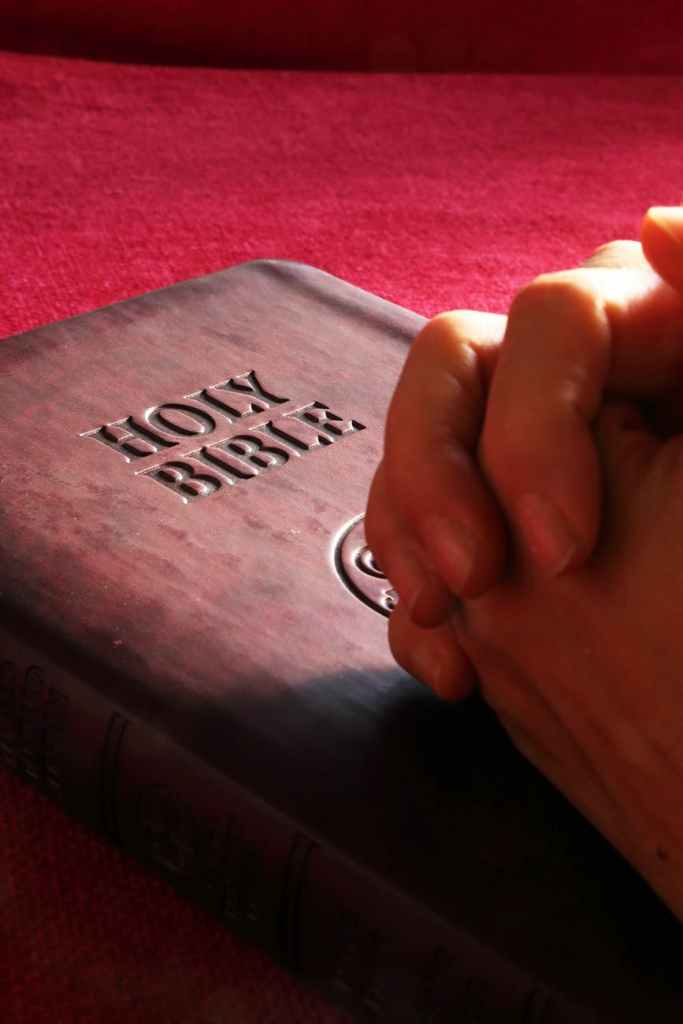
Attitudes of Prayer

One day, a minister arrived later than usual for the mid-week meeting at the church where he served. He heard raised voices, and found that several of his parishioners were arguing about congregational prayer.

Stan said the congregation ought to stand.

Neil thought they should all kneel.

Ima Bower insisted that everyone should bow their heads.

Mr. Folger thought everyone should fold their hands as well.

Ray Sands declared that his hands would be raised toward Heaven during the prayer.

Iris didn’t believe in closing her eyes,

Lydia Schutter disagreed.

Selma wanted to pray scripture.

Rhys thought it would be best to recite The Lord’s Prayer at each service.

Cy Lentz just wanted everyone to pray silently in his/her seat.

Gabby Orson wanted to pray in tongues.

Andy Holder wanted everyone to hold hands when they prayed.

Wanda Singh liked the idea of praying hymn lyrics.

Mary Lee liked that idea, as long as the hymns were upbeat choruses, and not somber old hymns.

Harry and Rush both championed short prayers.

Ruth Lesley insisted that all prayers be formal, written, and submitted to the pastor for approval.

Pastor Ora Freer was dismayed by all the bickering. When the room quieted a bit, he made a suggestion.

“I think we should cancel our midweek service tonight. While I have heard about many “Attitudes” of Prayer here this evening, I don’t think we have the right “Attitude” for prayer together at this time. Perhaps next week, we can talk about which of your methods would please God the most. In the meantime, you may pray at home in any “attitude” you choose.

The next week, only five people showed up for the midweek meeting. But they had one of the most refreshing and productive prayer meetings ever held at that church.

What matters most in prayer is not the attitude of our body, the volume or nature of our words, or the nature of our expression– what matters most is the attitude of our hearts. This is especially true when we gather together. Insisting on one “right” way to pray whenever we meet with others can get in the way of our real purpose, which is to meet with GOD. God wants to hear from us–and He wants to hear us providing support and encouragement to others, even in our pursuit of prayer.

Tips for Praying Scripture

At least once each month, I want to give some practical tips I have learned that have improved my pursuit of prayer over the years. Today, I want to talk about praying scripture.

On its surface, praying scripture just means reading or saying Bible verses back to God. Of course, some Bible verses or passages lend themselves to this practice, while others do not. (Lists of genealogies in the Chronicles come to mind…) Sometimes, it requires that we change a pronoun or verb tense, or otherwise personalize the scripture, but we are echoing God’s “Word” back to Him in an act of worship. We may be echoing God’s literal words, or repeating words of worship spoken centuries earlier. Some examples:

“Lord, in the beginning YOU created the heavens and the earth”…(from Genesis 1:1)
“Give praise to the Lord, proclaim his name;
    make known among the nations what he has done.
Sing to him, sing praise to him;
    tell of all his wonderful acts.
Glory in his holy name;
    let the hearts of those who seek the Lord rejoice.
Look to the Lord and his strength;
    seek his face always.” 1 Chronicles 16:8-11

Create in me a pure heart, O God,
    and renew a steadfast spirit within me.
Do not cast me from your presence
    or take your Holy Spirit from me.
Restore to me the joy of your salvation
    and grant me a willing spirit, to sustain me.
(Psalm 51:10-12)

“On my bed I remember you; I think of you through the watches of the night” (Psalm 63:6)

“Search me, God, and know my heart; test me and know my anxious thoughts. See if there is any offensive way in me and lead me in the way everlasting” (Psalm 139: 23-24)

Now to YOU who are able to do immeasurably more than all we ask or imagine, according to Your power that is at work within us, to You be glory in the church and in Christ Jesus throughout all generations, for ever and ever! Amen. (taken from Ephesians 3:20-21)

There are some benefits of doing this, but also some pitfalls. First the benefits:

  • Praying scripture can help us when we just don’t know what to say. Sometimes, we are so burdened or so exasperated, or so overwhelmed with emotion, that our words are swallowed up. But a remembered passage of scripture may allow us to speak our emotions in a way that our own words cannot. Sometimes, scripture will give us a focus that we lack, allowing us to put aside distracting thoughts, as well.
  • Praying scripture can help us memorize or review scripture. It can be helpful to read scripture aloud as a prayer, or even repeat key verses as prayer. Sometimes, we will be studying scripture and it speaks to us in a way that causes us to stop and pray it back.
  • Praying scripture can keep our prayers grounded. When we are tempted to pray selfish, momentary requests, scripture reminds us of God’s majesty, sovereignty, and timeless nature. Scripture magnified God and puts our petty worries and desires in their proper perspective.
  • In a group setting, praying scripture can help others focus better, or inspire them to remember another scripture passage that relates to what you have just prayed!

There are many other benefits of praying scripture, but there are also a few pitfalls:

  • Beware of using scripture as a substitute for your own thoughts and concerns. It is powerful to pray the Bible as it relates to your own worship and emotions, but God doesn’t want to hear only the echo of His words– He wants to hear them coming from your heart, as well as your lips. The ancient prophets warned against those who used a form of worship that lacked conviction and submission to His will.
  • Don’t feel bad when you say a prayer that does not contain a direct scriptural quotation– praying scripture is a tool and a guide, not a ritual or requirement. Don’t feel arrogant or superior when you DO pray scripture– it is a tool and a guide, but it does not make your prayer more effective or more Godly than an earnest prayer without a scripture reference.
  • Don’t “cherry-pick” scripture to pray in a way that is out of context or goes against the overall flow of scripture. Two of the most overused and misused scripture passages are Romans 8:28 and Jeremiah 29:11. They are both verses of promise and encouragement, and certainly can be used in prayer. But in context, they are meant to encourage those who are in the midst of anguish and despair, NOT promises to make life carefree or answer a selfish desire for an immediate good outcome.

If you have never (or rarely) tried praying scripture, I hope you will incorporate this tool into your pursuit of prayer. Whether you use a print Bible, scroll through a list of verses on line, or draw upon memory, you will find God’s words to be uplifting, convicting, encouraging, and wholly sufficient as you pour out your heart to your Maker. And if you already use this practice, I hope these tips will help you remember to use scripture wisely and appropriately as you pursue and practice a closer walk with God.

Praying Scripture

At least once a month throughout this year, I want to write about some practical ways to freshen the pursuit of a life of prayer. Today I want to discuss several ways of praying scripture.

Photo by Pixabay on Pexels.com
Photo by Tima Miroshnichenko on Pexels.com
  • Probably the most common way people think of praying scripture is to actually pray the words of a Psalm or Biblical prayer. Many of the psalms ARE prayers in poetic form, so this makes sense. Some excellent “prayer psalms” include Psalm 3, 8, 15, 16, 18, 25, 30, 51, 54, 57, 63, 66, 71, 84, 98, 101, 103, 108, 123, 130, 138, 139, 142, 143, 145, 146, and 150 (among several other passages throughout the others). There are also wonderful “prayer” passages throughout the rest of the Bible. In the New Testament, there are the prayers of Jesus, as well as prayers throughout the Epistles. Choose a familiar one. Choose one that is new to you. Choose an entire passage, or just a few verses…
  • A second way to “pray scripture” is to read a passage and “pray it back” in your own words. Echo the praises (or the confessions or requests) of the original speaker. Add your own personal words and thoughts to those of others through the ages.
  • Another method is to read a passage of scripture, or a story from scripture, study it, meditate on it–then use what you have just learned about God’s character to inform your prayer. Did God show Himself to be powerful, merciful, faithful, Holy, patient? Reflect that back to Him in prayer.
  • Related to this method is praying back to God His attributes and names as found in Scripture. “The God who sees.” “The God who hears.” “The Almighty.” “The God of Abraham, Isaac, and Jacob.” The God of Israel.” “Wonderful Counselor.” “The Son of Man.” “The Lamb of God.” etc.
Photo by Pixabay on Pexels.com
  • Yet another way to use scripture in prayer is to reflect on a person in the Bible and how God used that person, blessed that person, or dealt with that person. David, Daniel, Ruth, Hannah, Jonah, Samson, Gideon, Esther, Paul, Peter, Mary Magdelene– there are several examples of real, fallible, often ordinary people who encountered God. How did God find them? What did He do for them (or in spite of them!)? What could He be planning to do in YOUR life if you follow Him?
  • Finally, there are scriptures that leave us with questions. Why not use these questions as a opportunity to pray!? Take a passage of scripture that you find confusing or even contradictory, and pray about it. Ask God for wisdom and understanding. Come to Him believing that there is a purpose to each word and passage of the Bible, and that He can reveal Himself through even those words that seem to make no sense!
Photo by Tima Miroshnichenko on Pexels.com

Of course, not all of our prayers will be “scripture-based” in this way. But what might happen if we try praying this way once this week? Prayer is so mysterious and multi-faceted–we should engage and explore as we pray. After all– it’s more than just prayer– it’s a pursuit!

Praying Scripture

This is not a great secret or a new discovery, but a reminder that we can “pray” the Scriptures. Sometimes, we do this in corporate prayer, as in a congregation reciting “The Lord’s Prayer” together. But often, it is when we are reading God’s word, or a particular verse haunts our memory that we echo the words in our prayer life. There are so many benefits from this:

Photo by Luis Quintero on Pexels.com
  • We are joining in a great tradition– much of Scripture records the prayers of the patriarchs and of Jesus Himself. When we echo those words, we affirm them–both to God and to ourselves.
  • We are praying in the light of the truth–God’s own words on our lips can keep us from trying to put our words in God’s voice!
  • We are deepening our understanding and experience of Scripture– making it personal, rather than just a learning exercise or a daily duty.
  • We are deepening our experience of Prayer– it is more than just me talking to God. It is me agreeing with God’s Word, and God’s Word literally speaking through me.
  • We are reminded of what prayer can do– many of the prayers of Scripture are followed by answers, from prophecies to miracles to movements of the Holy Spirit.
  • We are reminded that God answers prayer that is consistent with His will– not all Biblical prayers were answered in the ways that their petitioners hoped or expected!

The Bible is full of wonderful examples of prayers. Here are just a few to get started:

  • Abraham’s prayer for God to spare Sodom in Genesis 18 (v. 23-32).
  • Moses praying for God to forgive Israel’s sin and disbelief in Exodus 32 (v. 31-32)
  • Moses praying for a successor to lead Israel into the Promised Land (Numbers 27:16-17)
  • Gideon’s prayer for guidance in Judges 6
  • Manoah’s prayer for help in raising his son Samson in Judges 13
  • David’s prayer in 2 Samuel 7 (v.18-29)
  • Elijah’s prayer for God to send fire from Heaven in 1 Kings 18 (v.36-37)
  • Several of the Psalms, including 3, 51, 90, 102, 103, 105, and many others.
  • Hezekiah’s prayer for God to save Israel from their enemies in Isaiah 37 ( v.16-20)
  • The prayer of Jebez in 1 Chronicles 4:10
  • Habakkuk’s prayer for revival in Habakkuk 3: 2-19
  • Jesus’ prayer in Matthew 11:25
  • Jesus’ prayer for His disciples (John 17)
  • Jesus’ prayer in the Garden of Gethsemane (Matthew 26:39-44)
  • Jesus’ prayer from the cross in Luke 23:34
  • Stephen’s prayer in Acts 7:59-60
  • Prayer of worship in Heaven in Revelation 5:13

https://christian.net/resources/the-top-most-powerful-prayers-in-the-bible/

In addition, Bible passages that describe the Character and Majesty of God the Father, the Son, and the Holy Spirit can be used as prayers of worship and adoration. Bible stories and events can be lifted up in worship of God’s power and faithfulness through the ages. Jesus’ teachings (such as the Beatitudes) can be lifted up as the desire of our hearts, and as requests for the strength and wisdom to follow Him.

Photo by cottonbro on Pexels.com

Now unto him that is able to keep you from falling, and to present you faultless before the presence of his glory with exceeding joy, To the only wise God our Saviour, be glory and majesty, dominion and power, both now and ever. Amen.

Jude 1:24-25

Blog at WordPress.com.

Up ↑