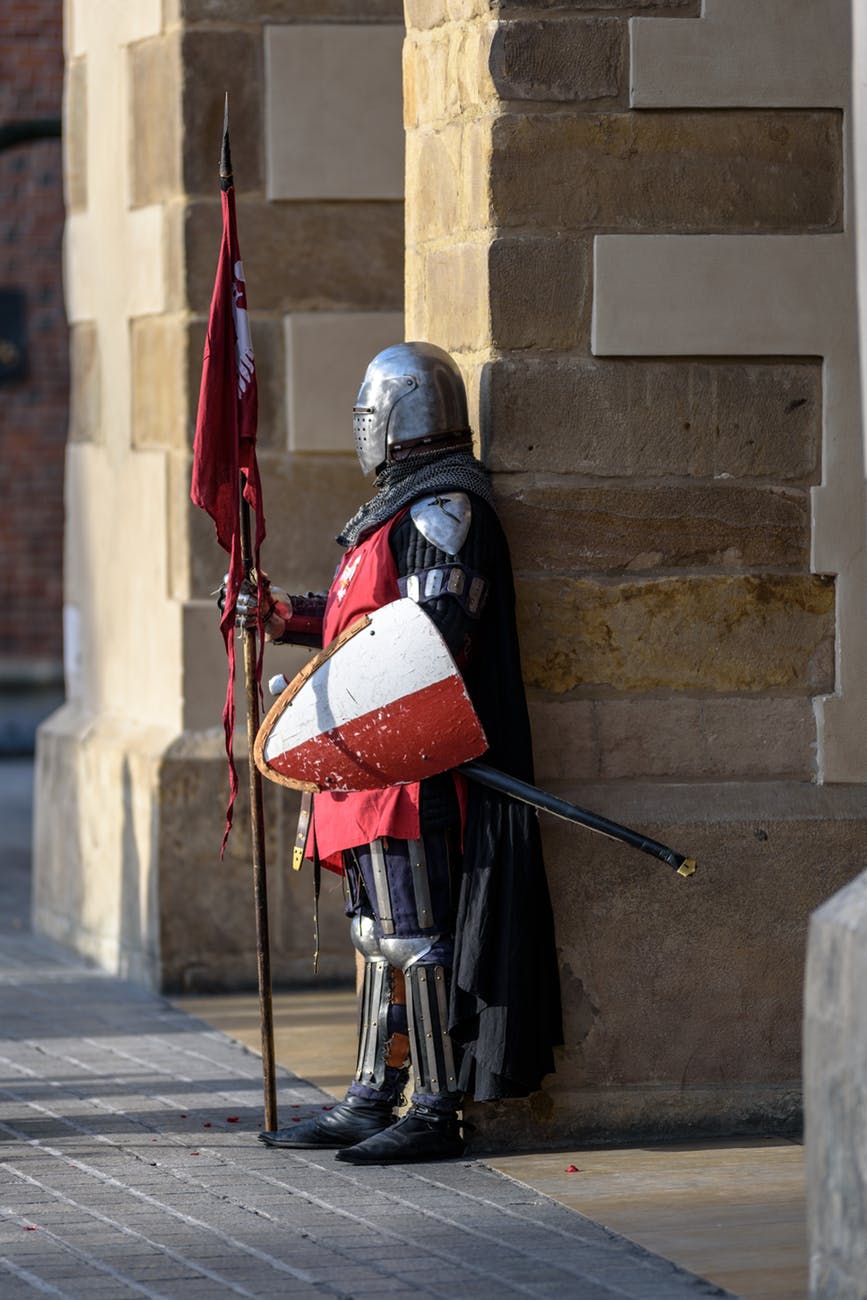
Walls, fences, borders, barriers– there are many reasons to build them, and many ways to view them, but they have only two sides, and we can be only on one side or the other. I enjoy visiting castles and forts, monasteries, and mansions. Nearly all have impressive walls. From the outside, they look imposing, intimidating, and often unfriendly (especially those with armed guards and cannons!). But inside, the walls provide protection, insulation from any outside threats, and often peace.
Most walls provide protection– from nature, from floods or winds, from predators, and from enemies. But there are a few walls that are built, not to keep danger out, but to keep people trapped within. Such walls are used to isolate, punish, and imprison.
God is described in the Psalms (and elsewhere) as a fortress, a rock, a safe place, a hiding place, and a sure defense. But those attributes and qualities are for those who chose to come inside the fortress; to ask for protection and defense.
Sometimes, we approach God as an adversary, rather than a defender and protector. We find ourselves on the outside, facing dangers unprotected and alone. The very walls that can shield us and give us peace rise up as barriers, We feel locked out and vulnerable. The only difference between peace and peril is where we are in relation to the wall. We are no stronger, our enemy is no weaker on one side or the other– only the wall makes the difference. And the level of peace and confidence is related, not to our own ability, but to the stability and strength of the wall between us and disaster. The higher and stronger the wall, the safer we feel.
Other times, we approach God as a jail-keeper. We have lived inside the walls, and resent His protection. We have forgotten, or we deny, that there is danger outside the walls. Or we assume the walls are too close or too restrictive to offer us peace. But God hasn’t built a wall to keep us near Him or to control us– He IS the wall, the fortress, the bulwark. To approach Him is to be protected. To resent His protection is to resent His very presence.
Earthly walls will eventually crumble and return to dust. Even walls that have stood the test of centuries, like the Great Wall in China, or the Tower of London, or the Wailing Wall in Jerusalem– they are not perfect, nor will they last forever. But our Bulwark, our Sure Defense, will never fail. Not only will He never fail to stand, nor fail to protect us, He will never fail to let us in when we seek His salvation.
“Forgive us our trespasses as we forgive those who trespass against us.” (Matthew 6:12)
Imagine being a prisoner and being told that you were free to leave! Now imagine someone refusing to leave their prison cell, and choosing to stay locked up! Why would anyone do such a thing? And yet, there are stories of prisoners who have been freed– some of them found innocent of the crimes for which they were being held–who cannot seem to adjust to freedom.
For some, the issue is legal. Even though they have been exonerated, or have served out their sentence, they still face legal consequences–even if their conviction was overturned, or their sentence fulfilled, they still wear the tag of “convicted felon.” Their record, even if legally overturned, still hangs over their head when they apply for jobs, try to register to vote, or attempt to establish credit. For most, however, the issue is psychological. They still wear the imaginary label, “guilty.” “Not fit for freedom.” “Incorrigible.” And often, society does nothing to remove those labels, but rather reinforces the idea that once found guilty, a person can never redeem their life or legacy.
As Christians, we have been given a full pardon for our sins– regardless of whether we have spent time in a physical prison or not. We are free! But we can continue to live as though we are in prison– and worse, we can continue to put ourselves in a prison of unforgiveness toward others.
“If we confess our sins, He is faithful and just to forgive us our sins, and to cleanse us from all unrighteousness.” (1 John 1:9) God does not keep us in a prison of guilt and shame. He is faithful to forgive us, redeem us, and renew our mind and spirit. But part of that cleansing involves letting go of our “right” to hold grudges and cling to old hurts and bitterness toward others. God is faithful to forgive US; He is also faithful to act with justice on our behalf. In forgiving others, we are not denying the justice we deserve. And in forgiving us, God does not deny justice to those whom we have hurt!
God wants to give us true freedom– freedom from guilt and freedom from the burden of injustice. HIS shoulders are big enough to offer both– perfect freedom, and perfect justice. We are allowed to be free of both burdens when we trust God to take care of it all. And we are allowed to walk out of the prison of guilt, shame, bitterness, anger, vengeance, pride, self-righteousness, and self-loathing.
Let’s face it– we have all sinned. All of us have said or done things that have hurt others. We may not know the extent of the damage our words and actions have done, just as others may not be aware of how they have hurt us. And “hurting” people often hurt others in reaction. Jesus paid the price for our sins when He offered Himself on Calvary. His sacrifice stops the cycle of “unavenged” hurt.
Sin still continues to hurt us. Forgiveness doesn’t seek to pretend that what happened never happened, or that it didn’t matter, or that our hurt isn’t real and tragic. But forgiveness allows us to walk out of the prison of living with the label “victim” or “convict” that Sin slaps on our forehead or in our heart. It allows us to breathe the free air of God’s grace and the hope of a joyful, productive, courageous future!
I grew up in a rambling, pre-1860s farmhouse in rural southwestern Michigan. We had a “Michigan basement”,” “– unfinished dirt floors, walls made of fieldstone and rocks, crudely cemented together, exposed floorboards and joists from the ground floor providing a ceiling. A rickety wooden stairway ended in a small cemented landing. It was a haven for dust and cobwebs, and everything in the basement had a grimy film of dust mixed with the residue of an old oil-burning furnace. It was littered with “dead” things– a rusted-out bicycle frame from the 1940s; a long-forgotten set of rattan patio furniture with mildewed pads and broken wicker bits sticking out underneath; a broken rake; and, in one corner, what looked like the skeleton of a small rodent. There was an old cabinet, formerly with two doors, now standing with one door hanging askew, and the other one missing all but half a hinge piece. Inside were old Mason jars, rimmed with lime deposits, holding nails, screws, nuts and bolts, and other odds and ends, and more Mason jars holding home-canned tomatoes from a garden of unknown vintage. There was a single 40-watt incandescent light bulb screwed into an ancient ceramic socket and mounted on one of the overhead floorboards, which did little to diminish the general sense of gloom and decay. There were four small windows–but they had long ago succumbed to grime and dirt from inside and out. It was the stuff of childhood nightmares.
Last week, we had a tornado warning, and one of my friends from church spoke of taking her children to the basement to wait out the weather. It reminded me of my own mother, gathering my sister and I– sometimes pulling us from our beds– and taking us to shelter in the basement until a storm had passed. My father often worked the night shift, and so the job was left to Mom to herd us into the southwest corner of the basement, being sure to bring a blanket and a flashlight, and make sure we were wearing slippers or shoes. She also had an old portable AM/FM radio, so we could listen to the weather bulletins amidst the gloom and dust and damp of the basement.
And yet–
My memories of going to the basement during a storm are not memories that inspire terror or disgust. I never wanted to visit the basement any other time, but during a storm, it was our “safe” place. The winds and rain and hail might rage outside, but we were warm and snug (sometimes too warm!) in our little corner. And no matter how frightened my mom may have been, she always reassured us that we would be safe together in that place. And then, she would lead us in prayer. We prayed that Dad would be safe at work. We prayed for anyone who was in the path of the storm. We prayed that God would protect our house. We prayed for those who were on the road, and for those who would have to go out after the storm to fix electric lines or rescue others. And we thanked God for our basement!
Sometimes, God uses grubby basements to be our “safe” place. What otherwise may seem like a scary situation can become a cause for praise and celebration when we remember that God is with us!
I think of the prophet Jeremiah, who was arrested and thrown into a cistern–a place far worse than our basement– but God caused him to be rescued (https://www.biblegateway.com/passage/?search=Jeremiah%2038&version=NIV). He went from the mud-filled cistern to the palace of the King! And even though Jeremiah faced many other trials and griefs, Jeremiah was able to write: “
I remember my affliction and my wandering, the bitterness and the gall. 20 I well remember them, and my soul is downcast within me. 21 Yet this I call to mind and therefore I have hope:
22 Because of the Lord’s great love we are not consumed, for his compassions never fail. 23 They are new every morning; great is your faithfulness. 24 I say to myself, “The Lord is my portion; therefore I will wait for him.” (Lamentations 3:19-24 NIV)
And I think of Paul and Silas in prison in Philippi (https://www.biblegateway.com/passage/?search=Acts%2016:16-34&version=ESV ). They sang and prayed after having been beaten and unfairly arrested. And they were trapped in the prison when an earthquake hit! But the end result was not only their vindication and freedom, but salvation for the Philippian jailor and his family!
There are seasons when we are forced to go to the basement–literally and figuratively. There are times when we must sit and wait in the dark and damp, uncertain of where the storm will hit or how long it will last. But often, in those basement moments, we find ourselves closer to God than when we climb mountains! God sits with us in the gloom. God has the power to turn our fear and uncertainty into praise and worship. And God will bring those memories of His comfort and strength back to us in other times of trouble.
When I was in seventh grade, I had a teacher named Miss Whitcomb. She was notorious throughout the school system as the “toughest” teacher we would ever have. She was ruthless. She demanded absolute quiet, she did not grade “on a curve,” and she never smiled. She had an ongoing war with grape-flavored chewing gum and students who were three seconds late for class. She gave impossible assignments and offered little in the way of help, comfort, or guidance. She had a point system for behavior, and most students ended up earning detentions. Everyone dreaded her class. Many normally confident and competent students failed her class. They worried themselves into sleepless nights and second-guessing their own abilities.
I suffered through two years of Miss Whitcomb’s classes. I had her for American History, English, and introductory drafting class. She was exacting and frustrating. But I learned a lot. Her assignments often seemed impossible, but some of them were creative as well as challenging. I never learned to love Miss Whitcomb’s class, but I learned to survive it– and, while I can’t say I learned to like her, I learned to respect her.
Years later, I returned to my home town as a teacher. And Miss Whitcomb was my colleague. A new generation of students were suffering under Miss Whitcomb’s impossible demands, and many were sure they could petition the school administration to get her fired. They came to me seeking support. I wouldn’t give it. I told them I remembered how difficult her classes were, but that I felt that it was important that they experience tough teachers, like Miss Whitcomb, because they would often experience tough bosses or professors, and tough situations as adults; learning to survive Miss Whitcomb’s class would give them practice for tough times in the future. And I suggested that they look at her classes as a challenge to be faced, rather than a punishment to be feared.
I had a difficult time understanding why Miss Whitcomb was so “tough.” But I got an insight from an unexpected event. A group of high school students were going on a field trip to see the hit musical, “Les Miserables” at a local university theater. They needed chaperones, and I agreed to come, as it was a wonderful chance to see a national touring company perform a terrific play. Surprisingly, Miss Whitcomb also came as a chaperone. I never thought of musicals as “her thing,” but she had decided to give it a try. Of course, the students were terrified of her, and she ended up sitting on the far side of the group (but it was a much quieter ride up to the campus!)
The play was magnificent, but Miss Whitcomb was very disturbed by it. The next day, she tackled the teacher who had organized the trip to complain. Her complaint was not with the students or the performers. It was about the story itself! She was somewhat familiar with the novel’s plot, but seeing it “live,” she was bothered by the character of Javert, and his pursuit of the main character, Jean Valjean. In the story, Javert has spent the better part of 25 years tracking Valjean, an escaped convict. When he finally finds him, Valjean ends up saving his life. Javert cannot reconcile that the “criminal” he has been looking for– his enemy– has saved him. Miss Whitcomb so identified with Javert, that she found the story untenable.
Why was she so upset? Because Javert was “righteous.” He represented the law. His quest was legal–his foe, Valjean, HAD escaped from prison. He had every “right” to pursue him and force him to complete his extra sentence (Valjean had completed his original term). But Javert was the one, in the end, who needed to be saved. And Valjean, who had every reason to let Javert die, risked his life to save his arch-enemy. This was not how Miss Whitcomb viewed life. The righteous should be the saviors; the guilty should be punished, not celebrated. Miss Whitcomb understood right and wrong– but she had no room for grace or forgiveness.
There is a Bible verse that has always caused me to be curious. Romans 5:8 is well known– “But God demonstrates His own love for us in this: while we were still sinners, Christ died for us.” But Romans 5:7 says, “Very rarely will anyone die for a righteous person, though for a good person someone might possibly dare to die.” (emphasis added) Paul is making a distinction that Jesus also often made–not everyone who is “righteous” is “good.” In Mark 10, Jesus is asked by a rich young ruler what he must do to inherit eternal life. The young man calls Jesus, “good teacher.” But before Jesus answers the question, he turns it back on the young man. “‘Why do you call me good,’ Jesus asked. ‘Only God is truly good” (v. 18). The rich young ruler does not want to know how to become “good.” He does not want to learn from Jesus. He merely wants to be judged as “good enough” to inherit eternal life. And he believes that he is “righteous” enough to have earned it.
Miss Whitcomb was a dedicated teacher. She was a “righteous” educator. But she never learned (or was able to teach) compassion, humility, or mercy. And that was a lesson her students missed. It is a lesson far greater than knowing U.S. History, or Government, or English grammar. I have heard from some of her adult education students that she was far less harsh with them. I hope this is true. She had a lot to give, and she suffered greatly from her own high standards and lack of compassion in relation to her younger students. I believe she had “good” intentions– that she believed her high standards were “right” and that any show of mercy was a weakness. But she missed out on so much– so many students who might have liked her better, and learned more from her–by putting righteousness ahead of mercy.
We serve a God who is BOTH– completely HOLY and Good, and Righteous, as well as merciful, gracious and compassionate. God forgives us without lowering His standards. He sent His Son to save us– While we were yet sinners! Romans 5 continues, “Since we have now been justified by his blood, how much more shall we be saved from God’s wrath through him! For if, while we were God’s enemies, we were reconciled to him through the death of his Son, how much more, having been reconciled, shall we be saved through his life!” (Romans 5:9-10) We don’t have to be terrified of God. We don’t have to be constantly reminded of our past guilt and shame. We don’t have to fear that we will “fail” to please God if we choose to follow Him.














 Pursuing Prayer