The Right Time

But when the right time finally came, God sent his own Son. He came as the son of a human mother and lived under the Jewish Law, to redeem those who were under the Law, so that we might become God’s children

Galatians 4:4-5 (Good News Translation– emphasis added)

At just the right time Christ died for ungodly people. He died for us when we had no power of our own.

Romans 5:6 (New International Reader’s Version–emphasis added)

Do you ever wonder at God’s timing throughout the Bible? Why did He take the Israelites up to the edge of the Red Sea and THEN send the entire Egyptian army after them? Why did He allow Haman to trick the king into signing an edict that would wipe out the Jews and THEN send Esther to try to save them? Why did Jesus wait until Lazarus was dead to visit His sick friend? Or God’s timing in our own lives? Why didn’t He make it possible to get the job I wanted when I first applied, instead of nearly a year later? Why is life so stressful all at once? Why does God seem to give me wisdom AFTER I’ve messed up? And yet, God’s timing is perfect. Not that it seems that way–in fact, it often seems like God is not paying attention to timing at all.

Even in Christ’s birth, it seems like the timing couldn’t have been worse–Joseph and Mary forced to travel far from home, only to find that there was no room anywhere for them to rest. And then– THEN–the labor pains began! It was cold, dark, filthy, lonely, and frightening. And not just that evening: the Romans ruled a significant portion of the world with an iron fist. Jews were not forbidden from worshipping God, but they were heavily taxed, regulated, and watched over by their invaders. This newest census was just another part of the bureaucracy and endless government red tape. It seems like it would be the worst timing ever for Emmanuel to appear.

And yet, Scripture says it was “just the right time” for Christ to come. So what can we discover about this “right time?”

  • God had been silent for 400 years before this– almost exactly the same amount of time the Israelites had been in captivity in Egypt before God sent Moses to lead them out. Coincidence? I’m not so sure…God uses patterns to illustrate concepts. Just as the Israelites had been slaves to the Egyptians, so all of us were slaves to Sin and Death. “And just as Moses lifted up the serpent in the wilderness, so must the Son of Man be lifted up” John 3:14 (New American Standard Bible)
  • The prophets made hundreds of statements about where and how Emmanuel would be born– some seemed completely contradictory; yet they were all fulfilled exactly. Again, this wasn’t a coincidence– God orchestrated events over centuries until it was “the right time” for them to all come to pass. Only God could have coordinated it all–the census, the genealogy of Jesus, Joseph’s hometown, Mary’s contractions coming THAT night in THAT cattle shed, instead of on the road somewhere, or in a private room where the shepherds couldn’t visit…
  • The Jewish people had been in exile off and on throughout the centuries; under Rome, even though they were conquered, most of the Jews who had returned to their homeland were still living there, much as they had centuries before. That wasn’t the case four or five hundred years before– it isn’t even the case today– more Jewish people live outside of Israel than in it!
  • Rome had established its rule over most of the Western World– and with it, they had established a system of roads, common currency, and a complex legal system. All of this played vital roles in the advent of the Savior– from His birth, through His ministry, and even in His trial, death, and the spreading of the Gospel. Before them, the Greeks had established cities and trading centers that would form the basis of the first missionary trips of the Apostle Paul. And they had created a “common” language in which this Good News was first written and spread. Just a few hundred years earlier, the spread of Christianity through letters and traveling ministers would have been much slower, less efficient, and more dangerous. Just a few hundred years later, the Roman Empire would be in shambles; travel would require going through regions separated by differing languages and governments.
  • To me, one of the most fascinating things to imagine is what it might be like if Christ had not come until our own time. First, there would be no Christianity, and none of the work of Christians over the centuries would have been done. But even if we imagine that all of history had unfolded and the present was much as it is, Christ’s birth would not have happened in the same way. Bethlehem would not be under the rule of Rome. In fact, Israel might not even exist; as it is, it exists in hot contention between the Jews, the Palestinians, and their close neighbors in the Middle East. There would be no census, and no need for Joseph and Mary to travel– and certainly not by donkey! There might be “no room at the inn,” but Joseph and Mary would be sent to a homeless shelter, filled with other hapless travelers. The shepherds, seeing angels, might still be filled with fright– mistaking them for missiles! Even so, it would only take minutes for a team of journalists to arrive with cameras, microphones, and commentary! The message of the angels would be dubbed “false” information or “fake news”, as would most of the prophecies about His arrival. “Fact checkers” would “kill” the story, and Mary, Joseph, and all the shepherds and wise men would be “cancelled” or receive threats.

Or not–I can only speculate. But I can say with confidence that God’s timing, even when it seems odd or “wrong” by our limited perspective, is perfect and worthy of our praise. All that seems “odd” or “wrong” about Christ’s coming when, where, or how He did, is just our limited perspective, and our tendency to doubt whatever we don’t understand.

Emmanuel came! He came at “just the right time” to fulfill all the promises and complete His ministry on Earth. Everything happened just as God designed it. And over two thousand years later, we still “Rejoice!” We sing songs, celebrate, and worship. We breathe in Hope, we give gifts, and we cherish the story of Christmas in hundreds of different ways.

This same God has a plan for us today. Throughout our lives, He sends blessings, allows struggles, and patiently stands by, offering help and hope to each of us. There is not a single detail of our lives that escapes His notice or is beyond His capacity or willingness to restore, transform, redeem, or renew.

Emmanuel– God WITH us–at “just the right time!”

Lament

Where are the heroes of old?
Where are the role models?
Where are the men and women of integrity?
Where is Honor?

I look at images of sneering mobs, of angry masses.
They protest in bright colors.
They shout and wave their signs.

Where are those who mourn?
Where are those who warn of danger, crying out a warning;
Crying out for mercy?

Where are Isaiah and Jeremiah?
Where is Ezekiel? Hosea?
Where are the Apostles?
Where are the evangelists?

Everyone is shouting– who is lamenting?
Everyone is angry– who is repentant?
Everyone is righteous in their own eyes.
Yet no one is righteous– no, not one.

We have a generation worshipping comic book “gods”,
And mocking the God of Creation.
People who obsess over someone else’s right to eat an egg,
While screaming for the right to kill their own child without guilt.
Millions praying to their government for more food and better shelter
While ignoring their hungry and homeless neighbors.
While trying to bury Your Words and Your Peace.

And YOUR people, Lord…
People who bear the name of Christ
Are bragging about their blessings from You,
While criticizing others and ignoring the lost.
Those who honor You with their lips
Refuse to cry out in surrender to You;
Refuse to reach out help their neighbors.

Where are the servants?
Where is the remnant of the Faithful?
Where are the prophets? The truth-tellers?
Where are those who mourn?
Where is the Lament?

The God Who Whispers

19 1-2 Ahab reported to Jezebel everything that Elijah had done, including the massacre of the prophets. Jezebel immediately sent a messenger to Elijah with her threat: “The gods will get you for this and I’ll get even with you! By this time tomorrow you’ll be as dead as any one of those prophets.” 3-5 When Elijah saw how things were, he ran for dear life to Beersheba, far in the south of Judah. He left his young servant there and then went on into the desert another day’s journey. He came to a lone broom bush and collapsed in its shade, wanting in the worst way to be done with it all—to just die: “Enough of this, God! Take my life—I’m ready to join my ancestors in the grave!” Exhausted, he fell asleep under the lone broom bush. Suddenly an angel shook him awake and said, “Get up and eat!”
He looked around and, to his surprise, right by his head were a loaf of bread baked on some coals and a jug of water. He ate the meal and went back to sleep. The angel of God came back, shook him awake again, and said, “Get up and eat some more—you’ve got a long journey ahead of you.” 8-9 He got up, ate and drank his fill, and set out. Nourished by that meal, he walked forty days and nights, all the way to the mountain of God, to Horeb. When he got there, he crawled into a cave and went to sleep. Then the word of God came to him: “So Elijah, what are you doing here?” 10 “I’ve been working my heart out for the God-of-the-Angel-Armies,” said Elijah. “The people of Israel have abandoned your covenant, destroyed the places of worship, and murdered your prophets. I’m the only one left, and now they’re trying to kill me.”
11-12 Then he was told, “Go, stand on the mountain at attention before God. God will pass by.” A hurricane wind ripped through the mountains and shattered the rocks before God, but God wasn’t to be found in the wind; after the wind an earthquake, but God wasn’t in the earthquake; and after the earthquake fire, but God wasn’t in the fire; and after the fire a gentle and quiet whisper.


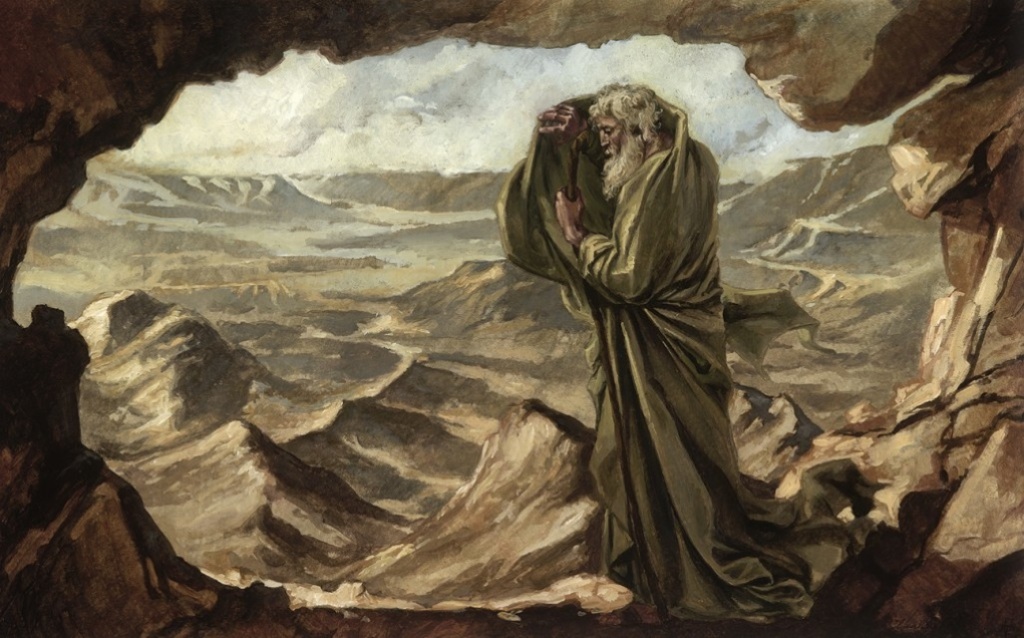
13-14 When Elijah heard the quiet voice, he muffled his face with his great cloak, went to the mouth of the cave, and stood there. A quiet voice asked, “So Elijah, now tell me, what are you doing here?” Elijah said it again, “I’ve been working my heart out for God, the God-of-the-Angel-Armies, because the people of Israel have abandoned your covenant, destroyed your places of worship, and murdered your prophets. I’m the only one left, and now they’re trying to kill me.” 15-18 God said, “Go back the way you came through the desert to Damascus. When you get there anoint Hazael; make him king over Aram. Then anoint Jehu son of Nimshi; make him king over Israel. Finally, anoint Elisha son of Shaphat from Abel Meholah to succeed you as prophet. Anyone who escapes death by Hazael will be killed by Jehu; and anyone who escapes death by Jehu will be killed by Elisha. Meanwhile, I’m preserving for myself seven thousand souls: the knees that haven’t bowed to the god Baal, the mouths that haven’t kissed his image.” 19 Elijah went straight out and found Elisha son of Shaphat in a field where there were twelve pairs of yoked oxen at work plowing; Elisha was in charge of the twelfth pair. Elijah went up to him and threw his cloak over him. 20 Elisha deserted the oxen, ran after Elijah, and said, “Please! Let me kiss my father and mother good-bye—then I’ll follow you.” “Go ahead,” said Elijah, “but, mind you, don’t forget what I’ve just done to you.” 21 So Elisha left; he took his yoke of oxen and butchered them. He made a fire with the plow and tackle and then boiled the meat—a true farewell meal for the family. Then he left and followed Elijah, becoming his right-hand man.
1 Kings 19 (The Message)

As a child, I was confused by this story from the life of Elijah the prophet. Just before this, Elijah had challenged the prophets of Baal and Asherah. He was outnumbered 850 to one, yet he stood defiantly, and asked the people of Israel to choose between their false gods and the one true God. God had produced fire on the mountain and shown His mighty power, while the false prophets were humiliated and later slain. It was a stupendous victory! And yet, Elijah, when told of Queen Jezebel’s anger, fled in terror, hid in the wilderness, and asked for death! Surely, Elijah remembered what God had just accomplished. Surely he knew that the same God who sent fire and ended the drought could protect Elijah from harm. Didn’t he? And I expected that God would react with consternation at this display by Elijah–how ungrateful to throw such a pity party after God had done such a miracle!

But God did the most curious thing. He could have sent a powerful reassurance. He could have ordered Elijah to return to the palace to deal with the wicked king and queen–finish the job and bring divine justice to Israel’s ruling family. He could have called Elijah out over his bad behavior and lack of faith. But God let Elijah whine and run away. And after Elijah threw a temper tantrum, God sent an angel to bring him food and water. Finally, God allowed Elijah to see His power in the forms of a mighty wind, an earthquake, and a fire. And it was THEN, and only then, that God spoke to Elijah in a still, small voice– a whisper– something so intimate and comforting that Elijah could not fail to recognize that it was the voice of God.

God CAN and will do mighty miracles. But so often, He prefers to work in a whisper. He is Glorious, and Powerful, and Omnipotent– yes. But He is also intimate and gentle and nurturing– especially with those who have ears to listen; those who have been broken down; those who need a quiet voice of reassurance and peace.

As I have grown older, I see so much in this passage that I couldn’t see as a child. I see how often I “lose it” just after I think I’ve won a great victory. I see how many times God has come to me in whispers and little gestures– just when I need a gentle hug and a simple reminder of His care. God is not the one who points out my temper tantrums and lack of faith. God doesn’t yell recriminations at me– even when I know I deserve them! I see how often I throw a tantrum, and expect God’s wrath, only to be met with His arms around me, calming me, lifting my head so I can look into His eyes of compassion and mercy. God is my Father– and a gentle, wise, and loving Father. And when He draws me close– He whispers of His Love.

Yes, God sent fire from the mountain. He caused justice to be done upon the false prophets. It was mighty; it was fierce; it was devastating. God IS a God of wrath– and even prophets can get wounded in the fight. There is evil in the world, and when we stand up to it, it is exhausting– even when we know God is with us. But God knows our limits. He will often give us more than we can handle– in our own power– and He will pull us through the kind of trials that test and stretch those limits. But He is also preparing a time and place of rest and His quiet whispers of encouragement and hope when we are tempted to give up.

God didn’t just whisper empty promises or nice-sounding platitudes when He finally spoke to Elijah. He brought a new message– someone else would be God’s instrument of justice for Ahab and Jezebel. Someone else would come alongside Elijah in his ministry. And someone else (7,000 someone else-s in fact!) WERE being faithful. Not only had God been with Elijah in the past, God had been preparing the future for Elijah to receive rest, and for others to rise up and carry on. He could have shouted this message from the mountaintop. But He wanted to whisper His message of hope to a faithful prophet who needed quiet reassurance after a difficult battle.

I don’t know what God wants to whisper to me (or to you) today. But I pray that we will have ears to hear, and hearts to respond. And God will whisper to us, whether we just defeated an army of enemies, or just woke up from a much needed nap! He will gently remind us that He loves us in our tantrums just as He loves us in our victories. And He will whisper, because that’s how close He really is in our every moment!

Let All Mortal Flesh Keep Silence

Christmas is a time of joy and light. But the time of Advent is often a time of somber reflection. We remember a time we have never known– a time before the coming of Christ the Messiah– a time before the mysteries of Heaven were revealed and before the victory of Salvation was accomplished. Advent reminds us of the spiritual darkness that existed before God, in human form, in humble obedience, and in sacrificial love, became the Light of the World, and the Hope of All Nations.

Before the bells rang, and the angels sang; before the kings brought gold and the shepherds ran to tell the news; before there were Christmas Carols, Christmas decorations, or Christmas pageants– there was solemn silence, fear, dread, and waiting. God had been silent. The prophets had been silent. The world had grown hard and cold.

Jesus stepped out of the unfathomable glory of the Highest Heaven– surrounded by armies of angels all worshiping Him and ready to do His bidding. In an instant, He became a helpless fetus inside a helpless young woman, a subject of the Roman Empire, and at the mercy of her culture. Her fiance could have repudiated her; her parents could have disowned her; her community could have had her stoned to death, along with her unborn child. No one, even those who were anticipating the arrival of a Christ, was expecting this tiny baby growing inside the womb to change the course of history.

He was born in obscurity, in ignominious squalor. He was the Lord of All Creation, wrapped in rags and laid in a feeding trough in an overcrowded city at tax time. There were no bells or carolers, no glittering trees or festivals of lights, no sounds of joy and celebration– not in that manger in Bethlehem. Instead, there were strangers pushing and shoving, shouting, and snoring in the inns and houses and streets, being watched by soldiers and pickpockets alike, as they made their way through narrow, unfamiliar streets and tried to lock out the worry and danger and dread. There may have been silence in the fields and valleys outside of town, but not near the stable where Jesus was born. No. The “silence” we sing about during Advent is the silence inside our own hearts– a call to “be still,” and know that this baby we celebrate is God Incarnate. He is the One to whom every knee will one day bow, and every tongue confess that He is LORD.

In the stillness and silence of Advent, in the darkness lit only by candles and faint hope, we being to understand the contrast. We re-imagine what came before the joy and hope and eternal clouds of witnesses shouting, “Holy, Holy, Holy!” We remember the days and years before the angels sang, and the star danced across the night sky– before the shocking crucifixion and the glorious resurrection of this still unborn Savior.

Let us spend these days of Advent preparing our hearts for the true wonder of Christmas. It doesn’t come in the wrapped packages under a festive tree, or in the feasting with friends or family. It doesn’t come with sirens and parades, or speakers at the mall blaring out favorite tunes. It doesn’t come in the majesty of a Cathedral ringing with the voices of a choir and organ. It comes when the silence and darkness of our sin and dread are pierced with the overwhelming glory of God With Us– Emmanuel is coming! But for now, for these moments, Let All Mortal Flesh Keep Silence.

Come To Bethlehem

“O come, all ye faithful, joyful and triumphant,
O come ye, O come ye to Bethlehem!”

“Come to Bethlehem and see
Him whose birth the angels sing;
come, adore on bended knee
Christ the Lord, the new-born King.”

“O little town of Bethlehem,
how still we see thee lie!
Above thy deep and dreamless sleep
the silent stars go by.
Yet in thy dark streets shineth
the everlasting light;
the hopes and fears of all the years
are met in thee tonight.”

“Come!” It echoes in our Christmas Carols; it echoes throughout Jesus’ ministry. It thrums and courses through the prophets and into the Revelations, “Amen, Come Lord Jesus!”(Revelation 22:20)

Christmas is all about coming– the coming of the Christ Child; the coming of the angels to shepherds; the coming of the shepherds to see the newborn King; the coming of the Wise Men. And we are bidden to “come” to Bethlehem and share in the joy and wonder of God coming to be our Emmanuel– God With Us.

But the journey to Bethlehem is not as easy or a joyful as one might imagine. Bethlehem is crowded. It is dark and dreary. It is not “silent” as the hymns make out. It is noisy, dirty, and filled with people who “aren’t from around here.” There is no room here. There is no joyous welcome. There is not enough to eat, what with all the out-of-town travelers; shelves are bare, while garbage is piling up in the streets. Tempers are high, and patience is low.

“Come to Bethlehem.” At this moment, Bethlehem is caught in the chaos and struggle of war. Hospitals are in danger. People live in fear and violence. There is no peace and quiet– no silent streets or glorious angels in the sky– only the light and noise of rockets. We may not be able to physically travel to Bethlehem at the moment, but we can focus our prayers on the Middle East– to the hurting people in Israel and in Gaza– to earnestly pray for truth and peace there. We may not be able to travel back in time to Bethlehem, but we can travel across town to help our neighbors who need encouragement; we can step out of our safe and comfortable lives to share light in the dark regions of today’s world. And we can “Come” to prayer– to lift up those who are hurting, to ask for strength and courage to help, to own our own limitations and emptiness.

“Come to Bethlehem.” At this season, we are tempted to stay where it is cozy and familiar; or to travel somewhere warm and welcoming. We want the joy and peace of the Christmas Season to come to us! But we are bidden to come to Bethlehem, with its crowded streets and suspicious strangers; its unfamiliar alleys and rude Roman officials. We are bidden to come and share this message of peace where there IS no peace. We are asked to come where there is need and darkness and fear– to spread the Good News, not to sit on it.

“Come to Bethlehem.” Are we avoiding our own “Bethlehem?” Are there places we could visit to spread light; places we’re being called to, or places where we should go to “be counted,” but we refuse to come? Are there people we can encourage? Ways we can share hope and help– if we are willing to come away from our own comfort and (manufactured) joy?

Perhaps we long to hear the angels shouting “Glory to God in the Highest!” (Luke 2:14) But if we won’t “come” to Bethlehem, we may miss their song. We may miss seeing the message of Christmas if we insist that it comes to our pleasant palace, instead of seeking the Babe in the Manger of the Little Town of Bethlehem.

“Come to Bethlehem and See.” “Come, Let us Adore Him!” “Come!”

Where Are the Altars?

In the Biblical books of the prophets (Isaiah, Jeremiah, Ezekiel, etc.), there are many references to altars and sacrifices–both the ones built to honor Jehovah God, and those designed for idols.

Israel and Judah were guilty of building thousands of altars and shrines to false gods. Some of them were found even inside the Holy area of God’s own temple! As part of God’s judgment, He repeated that He would no longer accept the empty sacrifices of His people–He would no longer hear their prayers, unless they repented.

I read these words and wondered– Where are our altars today? When I was a child, many of the older churches had what we called an Altar. It was usually a raised platform, with a podium for the minister, and possibly a “host table” for communion. My childhood church also had a small table that held a large Bible. Sometimes, the platform would have a railing around the edge, with a couple of stairs on either side. And, while many churches “passed the plate” for offerings, some had a special plate on the railing of the altar, where people would march up and place their offerings for the week. There it would sit for the rest of the service–random dollar bills of random denominations in random states of being crumpled, folded, and worn, along with checks, and, sometimes even coins. All of them brought forward and placed on the altar.

In many churches, the altar was where congregants would come to receive communion. The most important church events happened “at the altar.” Weddings, baby dedications, Bible readings and sermons, even funerals– all happened at the altar.

And often, we would have an “altar call.” The pastor, or a guest evangelist would urge people from the congregation to meet at the altar– to repent, to receive forgiveness, to be renewed and refreshed as we offered ourselves to God. There we were– random denominations of people, in random stages of obedience or rebellion, all answering the call to follow Christ as Lord. Some stayed there for a few minutes, praying silently. Others might be there for an hour, crying out, trying to find the words to express pain, guilt, or gratitude and awe, that GOD would meet with US there! Sometimes, we would form small groups to pray and give encouragement; sometimes we would disperse, too moved to speak at all. The Altar was the focus of the service– the place where God met with us; where He received our worship and our offerings; where we were challenged and made ready for spiritual battle.

Today, many churches have stages, like any large theater or event center. There is no railing, but there are hundreds of spotlights and fog machines. There is no podium for the pastor–just a headset and maybe a small stand for notes. Sometimes, the pastor reads from a teleprompter. Often, he or she is joined by a full band or orchestra, and dozens of singers, actors, or other assistants. No one from the congregation approaches the stage– why would they get up from their comfortable reclining padded seat? No one even “needs” to bring a Bible– the sermon text is printed out on the giant screens hanging above the stage. Our worship is comfortable, and entertaining. Many of us don’t even go to a church building, anymore. We can livestream worship services, or watch from a satellite location. We don’t even have to change out of our pajamas! And we feel blessed, and filled with excitement to be part of something dynamic and spiritually uplifting.

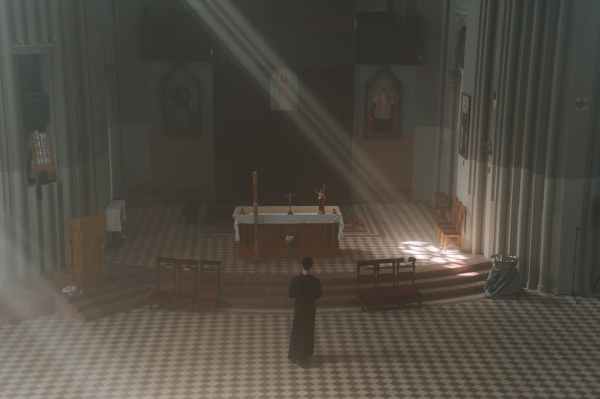
But we have no altars. There is no place for someone to lay their offering before God; no place to meet with Him in repentance or revival. There is no place to remind us of sacrifice and atonement. Oh, to be sure, many churches have a large cross on display somewhere. Some even have the “host table” for communion– somewhere in the wings, just in case–but the concept of an “altar” has all but disappeared from churches in the West. It is an anachronism–something ancient and uncomfortably part of the distant mists of tradition.

I miss the altar. I believe God misses it, too.

How Can You?!

14 But even if you should suffer for righteousness’ sake, you will be blessed. Have no fear of them, nor be troubled, 15 but in your hearts honor Christ the Lord as holy, always being prepared to make a defense to anyone who asks you for a reason for the hope that is in you; yet do it with gentleness and respect, 16 having a good conscience, so that, when you are slandered, those who revile your good behavior in Christ may be put to shame.

1 Peter 3:14-16 (ESV) via biblegateway.com

I was approached years ago by an angry non-believer, who asked me in disdainful tones how I could possibly believe in God, Jesus Christ, heaven and hell, and other Biblical tenets. At the time, I was taken aback by the vehemence and anger. I stammered an answer, heart-felt and, I hoped, theologically “correct”–I think I quoted scripture and gave a short version of my personal testimony. The other person was not impressed or convinced. I felt like I had failed. The other person sneered at my belief–and at God!

I spent weeks going over in my mind what else I might have said. I came up with clever arguments, gripping counter-questions, self-deprecating “homey” zingers, I read books on apologetics, and studied the words of great thinkers…I would be ready next time. I would not be left looking or sounding naive and unprepared. I would have the tools to “win” the argument, and God would be proud of me.

But in the years since, I have done more thinking (and reading, and praying!) And this past month, as I’ve been reading through the Old Testament prophets, I have found a new perspective. Prophets like Isaiah, Habakkuk, Amos, and Malachi spoke the very words of God to people around them. They spoke to ordinary people, and to the religious and political leaders of their day. And almost none of them listened! In fact, the prophets were hated, sneered at, smeared, imprisoned– some of them were even killed.

These prophets were prepared. They were not being ambushed with “gotcha” questions, because they were the ones presenting and challenging people with the truth. The truths they spoke were often harsh and offensive. They were truths about coming judgment and destruction, followed by restoration and revival. There was nothing “welcoming” or attractive about their message. But the people remained stubborn, sinful, and unimpressed.

We live in the post-Resurrection age. Our message contains warnings about judgment and destruction– but unlike the prophets of old, we have a message of immediate and eternal Hope and Salvation. We have centuries of prophecies that have been fulfilled; of testimonies to the power of a risen Christ and the Holy Spirit. Yet even Jesus warned us that “..in the world (you) will have tribulation. But take heart; I have overcome the world.” (John 16:33b ESV)

We often feel that if we cannot “win over” those who challenge us–if we cannot prove to their satisfaction that we are “right” in our beliefs–that we have failed. Yet we have so many examples of faithful witnesses who suffered and died without seeing the results of their faithfulness. God does not ask us to “win” every battle in convincing and decisive fashion. That’s HIS job! What He does ask is that we should be prepared to give an answer– and that we do it with gentleness and respect.

I don’t have to silence the critics. I don’t have to have “mic-drop” moments. I don’t have to “win” every debate. God calls me to be faithful, honest, and humble. My words may not change someone else’s mind. But my changed life and God-honoring attitude may plant a seed that someone else’s words and life, and the power of the Holy Spirit will cause to grow into faith– even if I never live to see it!

In answer to the question, “How can you believe?” The answer often lies, not only in what we say about our belief, but how we live it out!

Fitting In

(Today, I am revising a post from a couple of years ago.)

Matthew 5:1-12 (NIV via biblegateway.com):

Now when Jesus saw the crowds, he went up on a mountainside and sat down. His disciples came to him, and he began to teach them.

The Beatitudes

He said:

“Blessed are the poor in spirit,
    for theirs is the kingdom of heaven.
Blessed are those who mourn,
    for they will be comforted.
Blessed are the meek,
    for they will inherit the earth.
Blessed are those who hunger and thirst for righteousness,
    for they will be filled.
Blessed are the merciful,
    for they will be shown mercy.
Blessed are the pure in heart,
    for they will see God.
Blessed are the peacemakers,
    for they will be called children of God.
10 Blessed are those who are persecuted because of righteousness,
    for theirs is the kingdom of heaven.

11 “Blessed are you when people insult you, persecute you and falsely say all kinds of evil against you because of me. 12 Rejoice and be glad, because great is your reward in heaven, for in the same way they persecuted the prophets who were before you.

No one likes to feel “left out.” We have a deep desire to be accepted, liked, loved, respected, and needed. We want to “fit in.” But sometimes, acceptance and inclusion are not possible. Sometimes, they are offered, but at a price too steep. Sometimes, we make unhealthy compromises in our efforts to avoid conflict or to win respect.

In His Sermon on the Mount, Jesus gave us at least seven principles/actions that will bring us blessing. But they are in opposition to human nature– NOT designed to help us “fit in” with most of society. Elsewhere in scripture, we are told to stand apart from what others are doing or saying. God wants people who will follow HIM, not the world.

  • People who are poor in spirit— this can be taken at least two ways: those who consider themselves poor in a material sense, and hold their money and possessions lightly; or those who are aware of their spiritual poverty, knowing that they need guidance and wisdom from above. Such people are humble–not pushy, not arrogant, not greedy, not spending time proving how clever or wealthy they are. Such people will “possess” the kingdom of heaven– not by fighting and straining and striving and grasping for sole ownership–it is God’s gracious gift to be shared by all who are poor in spirit.
  • People who mourn–not people who are eternally gloomy and depressed, but those who mourn the loss of innocence, the injustices of the world, the suffering and grief of others. Such people also rejoice at the sight of a glorious sunrise, or laugh to see children playing– but they do not deny or circumvent the realities of a fallen world. They face facts–even when those facts are convicting, grievous, and painful. And they do not react with denial or distraction, with outrage or disinterest. They mourn. Such people will be comforted, even in the midst of mourning, by God’s sovereignty and righteousness.

  • People who are meek –there is a difference between being meek and lacking confidence or being a stooge or a fool. Meek people still have boundaries– and they respect the boundaries of others. They stand up for what is right, but they don’t insist on always being “right.” Such people will not stake a claim on the earth or try to grab their “fair share.” Instead, they will inherit all that God has in store for them! Notice the parallel with those who are “poor in spirit.” Meekness and humility are despised by the proud and the loud. But they are respected and honored by God, and sought out by people of discernment. Some of the greatest leaders are not bombastic and dictatorial, but humble and wise in creating success for everyone around them– not just themselves!
  • People who hunger and thirst for righteousness–hunger and thirst are natural and ongoing processes. There are people who want “justice” or “righteousness.” They want it NOW. They want it to be retroactive. They want it to be a foregone conclusion. And they want it to be eternal. But they don’t long for personal righteousness, and they don’t want to feel hunger or thirst for it. They don’t want to seek after true righteousness; they just want the results. They just want the world to spin righteously all around them. But for those who hunger and thirst– Jesus is both the Living Water and the Bread of Life. He brings a daily portion of all-sufficient Grace, wisdom, and forgiveness to keep us filled.

  • People who are merciful–I was struck as I read this again by the term merciful. We spend a lot of time and energy talking about God’s Grace– the fact that God gives us untold blessings that we don’t deserve. But here, Jesus is talking about the merciful– not giving others the condemnation or punishment they deserve. I find it much easier to be Graceful than to be Merciful. It is easy to bless others; to be charitable, or charming, encouraging, or bountiful. It is much more difficult to bite back an insulting or critical retort, to forgive a debt, to let go of a grudge, or keep from passing on a juicy morsel of gossip. It is easier to focus on the Golden Rule of doing unto others as you would like them to do unto you, than to Love your enemies. Jesus asked us to do both– but the blessing here is for those who show Mercy!
  • People who are pure in heart–not just shiny on the surface. I can say all manner of spiritual-sounding things; I can do all kinds of good deeds; I can even write blog entries on scriptural truths– but God looks on my heart, to see if it is pure. And if I haven’t covered my heart in posturing and false rituals, justifications and excuses, denials and rebellion, I should be able to “see” God– to have a clearer picture of who He is, what He is doing in the world around me, what He wants me to do and say and become…And other will be able to see God reflected in my words and actions, as well!
  • People who are peacemakers–not just people who “go along to get along,” but people who are willing to help bring about peace, and who will create an atmosphere of unity and respect–at home, in the workplace, and in their neighborhoods. When we bring peace to a chaotic relationship, or create a peaceful atmosphere, we are doing the work of reconciliation, and we are showing others the nature of our Father.
  • When we cultivate (or allow God’s Spirit to cultivate) these characteristics in our lives, we will not “fit in” with the world around us. We will stand out and stand apart. And that will make us targets for persecution, abuse, misunderstanding, insults, and false accusations. But we can be encouraged, not only because of the blessings Jesus promises in the Beatitudes, but in the reminder that we stand in very good company. We may not fit in at the office; we may be ostracized by our family; we may be targeted in our community– but we fit in with a host of prophets, apostles, saints, and with Christ Himself!

Voice Mail

A couple of weeks ago, I was at a prayer meeting, and I set my phone to vibrate, so it wouldn’t ring and disturb everyone during prayer time. But I forgot to change the settings afterward. For three days, things were pretty quiet as my phone sat vibrating in my purse across the room, or plugged in to the charger overnight! I had several missed calls, and many voice mail messages waiting for me when I finally noticed what had happened. Some of the callers were trying to get in touch with me about my car’s extended warranty, but most were calls about personal or business matters that I should have responded to– if only I had heard the phone ring. This didn’t stop me from sending calls or text messages to other people; it just meant that I didn’t get their messages to me.

I think sometimes, we can do the same thing with other forms of communication, including prayer and Bible study. We send messages to God, but we live with our “ringers” off– unable to receive or respond to God’s messages to us. And, as we become aware of our neglect, we are afraid to check our “voice mail,” lest we find harsh or condemning messages from God. “Where have you been? Why aren’t you answering my calls? I’ve been trying to get in touch!”

Throughout the books of the prophets, God left such messages for His people. They “knew” His law, and His promises; yet they were deaf to His voice, and hard-hearted toward Him. Even as invaders were approaching, ready to destroy the Temple and carry the people away into exile, they ignored God’s call to return to Him and follow His ways. Instead, they prayed to worthless idols and made worthless treaties with neighboring nations– treaties they wouldn’t even keep. They listened to false prophets who only told them what they wanted to hear– that God would come to their rescue and ignore their “bad habits” and idolatry. Again and again, God sent prophets with messages of terror and destruction. And mixed into each was a message of hope and restoration–exile would come, but so would a Savior.

God still speaks through prophecies, though rarely. His greatest word was Jesus Himself, living out His Holy character, and dying to show us both the cost of Sin and the Glory of Grace! God’s “Voice Mail” message to us is Our Savior– not to save us from foreign invaders or earthly trials, but to save us from the power and slavery of Sin. His message is clear and consistent–“Follow Me!”

There are many other messages clogging our voice mail– from car warranties to frivolous memes; from distracting messages to false promises. It is important to check which messages are coming from God’s word, which messages are consistent with His Word, and which ones are contrary to His Word. God will never send a message that contradicts His Character– He will not whisper to us about “cheap grace” or set us up for failure. He WILL warn us of the consequences of Sin and offer us forgiveness whenever we repent.

Photo by Sunshine Caro on Pexels.com

Today, I need to check my “Voice Mail”. God is glad when I speak to Him, but He also wants me to listen and obey; to follow Him. There is a warning in God’s message– something far worse than a temporary exile is headed our way. But there is NO condemnation– only a plea to return to Him, and enjoy the Grace He wants to lavish on us. God’s message is far better than a car warranty– it is a message of Salvation and Eternal life; a continuing message of Hope and Restoration. If only I will listen and respond! Have you checked your voice mail lately?

Anticipation…

Yesterday was the first Sunday of Advent. Four weeks later, we will have Christmas Day. For some, the time will pass in a frenzy of shopping and wrapping– the time will fly by! For some, the time will pass in meditation and reflection– it may seem to crawl. For some, the time will pass with no difference from any other time of year. For most of us, there is a sense of anticipation…we are waiting for something: the “Christmas Spirit,” the festivals and events, the time spent with loved ones far and near…

Photo by Any Lane on Pexels.com

Christmas, more than any other day, brings this sense of expectation. We sing songs, listen to stories, reach out to friends and neighbors– all in anticipation of a single day. And sometimes, the anticipation and expectation exceed the realities of the day. We feel disappointed in the gifts, or the weather, or the circumstances. But our anticipation shouldn’t be about the single day on the calendar. Christmas is so much more than just a day, or even just the “spirit” of the day.

Photo by Any Lane on Pexels.com
Photo by Ivan Samkov on Pexels.com

We don’t know the actual, historical day when Christ entered human history as a baby. As the Gospel of John relates– “In the beginning was the Word, and the Word was with God, and the Word WAS God.” (John 1:1) But this Word, this Only Begotten Son of the Father, this second person of the Trinity, DID enter human history as a member of the human race. He came and dwelt among us, His creation. He walked and talked, ate and slept, worked and wept, lived and died as a man. The Lord of All Creation tasted freshly baked bread and felt the first raindrops of Springtime. The King of the Universe wiggled His toes in the sand, and wiped sweat from His brow. The Lamb of God shared belly-laughs with His friends over a shared joke. The Lion of Judah wept over the death of His friend. The Author of Life knew what it was to die, abandoned and betrayed.

None of this is anticipation for us, as it was for the prophets of old. It is history. Christ has already come. He already lived a life of compassion and grace, wonder and weariness, agony and anticipation, and, most of all, Love. “For God so loved the world that He gave His only begotten Son, that Whosoever believeth in Him should not perish, but have everlasting Life.” John 3:16 Christmas for us is not about anticipating Christ’s arrival. Christmas is the celebration of what that arrival means for us all these years later and forevermore. And we can celebrate all the wonder of Christ on any day of the calendar year. But there IS real anticipation at Christmas– the anticipation of Eternal Life and Christ’s triumphant return. Just like the prophets waited and wondered, we wait in Hope of a glorious reunion.

Christmas, December 25, 2022, may be a disappointing day–it may be dreary, gloomy, lonely, or disappointing in its circumstances. It may bring us bad news, or heartache. But it will also bring us another opportunity to rejoice– to rise above whatever circumstance brings to focus our thoughts forward and upward, where Christ, who once came as a baby, now reigns and rules and waits– anticipating the same reunion that brings us hope and healing.

Photo by Bich Tran on Pexels.com

Blog at WordPress.com.

Up ↑